

Solving the explainable AI conundrum by bridging clinicians’ needs and developers’ goals
Open accessPublished version of a preprint
The DOI matches its Crossref record; 35 of the 35 references it cites were found in a registry or an index.
Abstract
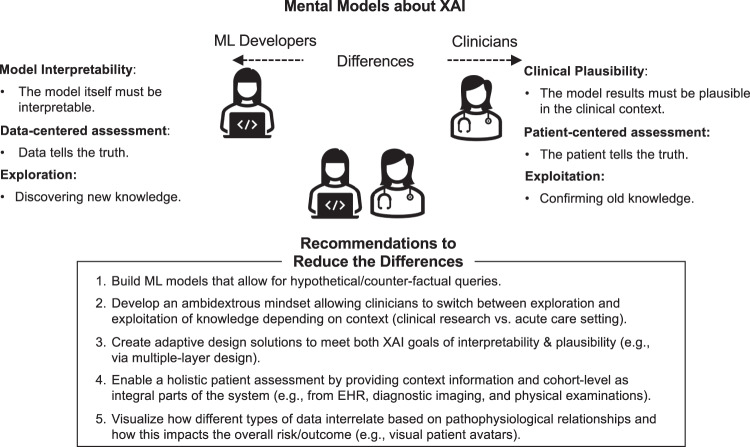
Explainable artificial intelligence (XAI) has emerged as a promising solution for addressing the implementation challenges of AI/ML in healthcare. However, little is known about how developers and clinicians interpret XAI and what conflicting goals and requirements they may have. This paper presents the findings of a longitudinal multi-method study involving 112 developers and clinicians co-designing an XAI solution for a clinical decision support system. Our study identifies three key differences between developer and clinician mental models of XAI, including opposing goals (model interpretability vs. clinical plausibility), different sources of truth (data vs. patient), and the role of exploring new vs. exploiting old knowledge. Based on our findings, we propose design solutions that can help address the XAI conundrum in healthcare, including the use of causal inference models, personalized explanations, and ambidexterity between exploration and exploitation mindsets. Our study highlights the importance of considering the perspectives of both developers and clinicians in the design of XAI systems and provides practical recommendations for improving the effectiveness and usability of XAI in healthcare.
Overview
The claims and statistics of this paper haven’t been checked yet.
Free: it reads the open-access text and checks the first 5 claims that cite a source we can check. Create a free account to check every claim.
Integrity signals
Registry
Cites
Statistics
Figures
Verification
Claims the paper makes
The claims and statistics of this paper haven’t been checked yet.
Free: it reads the open-access text and checks the first 5 claims that cite a source we can check. Create a free account to check every claim.
Claims other papers make about this one
Each is checked against this paper’s own text: does it say what the citing paper says it does?
The source backs part of the claim, not all of it — or backs it for a different population, condition or comparison.
In the citing paper
“Simple, interpretable visualizations, such as bar charts and line graphs, were preferred for understanding predictions at a glance.”
From Explainable AI in hospital clinical decision support systems: A scoping review of healthcare professionals’ perspectives (2026) · cites this paper as [27]
Experimental — accuracy not yet measuredThe source backs part of the claim, not all of it — or backs it for a different population, condition or comparison.
In the citing paper
“Five studies [23,25,27,28,34] specifically described using SHapley Additive exPlanations (SHAP)”
From Explainable AI in hospital clinical decision support systems: A scoping review of healthcare professionals’ perspectives (2026) · cites this paper as [27]
Experimental — accuracy not yet measuredThe cited source says what the claim attributes to it.
In the citing paper
“The XAI orchestrator should be integrated with time-effectiveness in mind since it was found that clinicians sometimes prefer rapid, less detailed information67.”
From Orchestrating explainable artificial intelligence for multimodal and longitudinal data in medical imaging (2024) · cites this paper as [67]
The cited source says what the claim attributes to it.
In the citing paper
“Impact in workflow related to how XAI systems aligned with and influenced work processes, and arose as a theme in 9 papers [23–27,30,31,33,35].”
From Explainable AI in hospital clinical decision support systems: A scoping review of healthcare professionals’ perspectives (2026) · cites this paper as [27]
The cited source says what the claim attributes to it.
In the citing paper
“Considering context and users was also reported, with some health professionals having limited time to interpret model explanations and make a decision [23,25,27,32].”
From Explainable AI in hospital clinical decision support systems: A scoping review of healthcare professionals’ perspectives (2026) · cites this paper as [27]
10 more claims about this paper
Create a free account to see every claim other papers make about this one.
Self-check
Percentages, sums and reported differences re-computed from the paper’s own numbers.
The self-check needs the paper’s full text.
Citations
Cites
User Acceptance of Information Technology: Toward A Unified View1
Venkatesh, V., Morris, M. G., Davis, G. B., & Davis, F. D. (2003) · MIS Quarterly · doi:10.2307/30036540 · Cited by 45,035
The Discovery of Grounded Theory; Strategies for Qualitative Research
Glaser, B. G., Strauss, A. L., & Strutzel, E. (1968) · Nursing Research · doi:10.1097/00006199-196807000-00014 · Cited by 39,449
Seeking Qualitative Rigor in Inductive Research: Notes on the Gioia Methodology
Gioia, D. A., Corley, K. G., & Hamilton, A. L. (2013) · Organizational Research Methods · doi:10.1177/1094428112452151 · Cited by 13,227
Standards for Reporting Qualitative Research: A Synthesis of Recommendations
O’Brien, B. C., Harris, I. B., Beckman, T. J., Reed, D. A., & Cook, D. A. (2014) · Academic Medicine · doi:10.1097/acm.0000000000000388 · Cited by 12,211
High-performance medicine: the convergence of human and artificial intelligence
Topol, E. J. (2019) · Nature Medicine · doi:10.1038/s41591-018-0300-7 · Cited by 10,450
Geurts, P., Ernst, D., & Wehenkel, L. (2006) · Machine Learning · doi:10.1007/s10994-006-6226-1 · Cited by 9,300
Confirmation Bias: A Ubiquitous Phenomenon in Many Guises
Nickerson, R. S. (1998) · Review of General Psychology · doi:10.1037/1089-2680.2.2.175 · Cited by 7,267
Rajpurkar, P., Chen, E., Banerjee, O., & Topol, E. J. (2022) · Nature Medicine · doi:10.1038/s41591-021-01614-0 · Cited by 3,212 · cited 5×
“However, implementation of these systems into clinical practice lags behind due to a lack of trust and system explainability 2,3 .”
InfluentialConfirmation, disconfirmation, and information in hypothesis testing
Klayman, J., & Ha, Y.-W. (1987) · Psychological Review · doi:10.1037/0033-295x.94.2.211 · Cited by 2,094
Causability and explainability of artificial intelligence in medicine
Holzinger, A., Langs, G., Denk, H., Zatloukal, K., & Müller, H. (2019) · WIREs Data Mining and Knowledge Discovery · doi:10.1002/widm.1312 · Cited by 1,885
Research works printed but not linked: 1
- Tabachnick, B. G., Fidell, L. S. & Ullman, J. B. Using multivariate statistics. (Pearson, 2019).
Cited by
Joshi, G., Jain, A., Araveeti, S. R., Adhikari, S., Garg, H., & Bhandari, M. (2024) · Electronics · doi:10.3390/electronics13030498 · Cited by 294
Abbas, Q., Jeong, W., & Lee, S. W. (2025) · Healthcare · doi:10.3390/healthcare13172154 · Cited by 236
“Clinicians have different needs and cognitive styles, and not all explanations are equally meaningful or useful for every user [31,32].”
Should AI models be explainable to clinicians?
Abgrall, G., Holder, A. L., Chelly Dagdia, Z., Zeitouni, K., & Monnet, X. (2024) · Critical Care · doi:10.1186/s13054-024-05005-y · Cited by 175
“Engineers typically focus on the interpretability of the model’s inner workings, such as for debugging purposes, whereas clinicians emphasise the clinical relevance of its outputs [19].”
BackgroundDigital twins as global learning health and disease models for preventive and personalized medicine
Li, X., Loscalzo, J., Mahmud, A. K. M. F., Aly, D. M., Rzhetsky, A., Žitnik, M., & Benson, M. (2025) · Genome Medicine · doi:10.1186/s13073-025-01435-7 · Cited by 152
Chen, M., Wang, Y., Wang, Q., Shi, J., Wang, H., Ye, Z., Xue, P., & Qiao, Y. (2024) · npj Digital Medicine · doi:10.1038/s41746-024-01328-w · Cited by 146
Explainable artificial intelligence for drug discovery and development: a comprehensive survey
Alizadehsani, R., Oyelere, S. S., Hussain, S., Jagatheesaperumal, S. K., Calixto, R. R., Rahouti, M., Roshanzamir, M., & De Albuquerque, V. H. C. (2024) · IEEE Access · doi:10.1109/access.2024.3373195 · Cited by 124
“The insights provided to researchers and clinicians can maintain their interpretability and reliability by using adaptable XAI frameworks that automatically update explanations in response to model updates or changes in data distribution [76].”
BackgroundAdvancing AI in healthcare: A comprehensive review of best practices
Polevikov, S. (2023) · Clinica Chimica Acta · doi:10.1016/j.cca.2023.117519 · Cited by 142
Busch, F., Hoffmann, L., Truhn, D., Ortiz-Prado, E., Makowski, M. R., Bressem, K. K., Adams, L. C., COMFORT Consortium, Abdala, N., Navarro, Á. A., et al. (2024) · BMC Medical Education · doi:10.1186/s12909-024-06035-4 · Cited by 108
Pahud de Mortanges, A., Luo, H., Shu, S. Z., Kamath, A., Suter, Y., Shelan, M., Pöllinger, A., & Reyes, M. (2024) · npj Digital Medicine · doi:10.1038/s41746-024-01190-w · Cited by 93
Bienefeld, N., Keller, E., & Grote, G. (2025) · Journal of Medical Internet Research · doi:10.2196/50852 · Cited by 91
Self-citationPractical AI application in psychiatry: historical review and future directions
Sun, J., Lu, T., Shao, X., Han, Y., Xia, Y., Zheng, Y., Wang, Y., Li, X., Ravindran, A. V., Fan, L., et al. (2025) · Molecular Psychiatry · doi:10.1038/s41380-025-03072-3 · Cited by 100
“Uninterpretable (black-box) methods can lead to unintended, improper use and unfair clinical decisions [49].”
Explainable artificial intelligence in emergency medicine: an overview
Okada, Y., Ning, Y., & Ong, M. E. H. (2023) · Clinical and Experimental Emergency Medicine · doi:10.15441/ceem.23.145 · Cited by 72
“To enhance the implementation of the AI tool, the perception gap between the developers and clinicians was investigated [50].”
MethodBienefeld, N., Keller, E., & Grote, G. (2024) · Journal of Medical Internet Research · doi:10.2196/50130 · Cited by 62
Self-citationLavecchia, A. (2025) · Wiley Interdisciplinary Reviews Computational Molecular Science · doi:10.1002/wcms.70049 · Cited by 87
“Future XAI systems must evolve dynamically by adapting explanations as models are updated to maintain interpretability and relevance in rapidly changing biomedical contexts [130, 131].”
Chen, E., Prakash, S., Reddi, V. J., Kim, D. A., & Rajpurkar, P. (2023) · Nature Biomedical Engineering · doi:10.1038/s41551-023-01115-0 · Cited by 83
“Still , model explainability alone may not be sufficient for clinicians, who expect recommendations to be both interpretable and clinically plausible 25 .”
Achieving large-scale clinician adoption of AI-enabled decision support
Scott, I. A., van der Vegt, A., Lane, P., McPhail, S., & Magrabi, F. (2024) · BMJ Health & Care Informatics · doi:10.1136/bmjhci-2023-100971 · Cited by 65
“29 ⇒ The more complex the model, especially deep learning models, the less explainable it becomes and hence expecting clinicians (and patients) to master the technical and statistical intricacies of most models is unrealistic.”
BackgroundMethodQuantifying the impact of AI recommendations with explanations on prescription decision making
Nagendran, M., Festor, P., Komorowski, M., Gordon, A. C., & Faisal, A. A. (2023) · npj Digital Medicine · doi:10.1038/s41746-023-00955-z · Cited by 82
“Indeed, the variability in modality of XAI can have different impacts on medical decisions depending on the complexity or ambiguity of the context as well as the user ’ s experience of an AI system 25,26 .”
Taylor, R. A., Sangal, R. B., Smith, M. E., Haimovich, A. D., Rodman, A., Iscoe, M. S., Pavuluri, S. K., Rose, C., Janke, A. T., Wright, D. S., et al. (2025) · Academic Emergency Medicine · doi:10.1111/acem.15066 · Cited by 62
McNamara, S. L., Yi, P. H., & Lotter, W. (2024) · npj Digital Medicine · doi:10.1038/s41746-024-01080-1 · Cited by 60
“The clinician-AI interface: intended use and explainability in FDA-cleared AI devices for medical image interpretation”
Li, H., Fu, J., & Python, A. (2025) · Journal of Medical Internet Research · doi:10.2196/71916 · Cited by 69
“To make informed decisions, clinicians usually require a high degree of post hoc interpretability, such as information about the referenced literature and how model outputs translate into clinical metrics [120].”
Graph Artificial Intelligence in Medicine
Johnson, R., Li, M. M., Noori, A., Queen, O., & Žitnik, M. (2024) · Annual Review of Biomedical Data Science · doi:10.1146/annurev-biodatasci-110723-024625 · Cited by 62
“For example, developers use explainable AI tools to debug, probe, and audit models, whereas researchers utilize these tools to discover novel patterns in data (129).”
Explainable AI in medicine: challenges of integrating XAI into the future clinical routine
Räz, T., de Mortanges, A. P., & Reyes, M. (2025) · Frontiers in Radiology · doi:10.3389/fradi.2025.1627169 · Cited by 52
Toumaj, S., Heidari, A., & Navimipour, N. J. (2025) · Artificial Intelligence in Medicine · doi:10.1016/j.artmed.2025.103243 · Cited by 48
Zhang, K., Wang, D., Lin, F., Xie, J., & Zhou, W. (2026) · iScience · doi:10.1016/j.isci.2026.115026 · Cited by 50
“134 The second is the development of disease-specific evaluation standards, such asmandatory pathological confirmationinoncology-related XAIas-sessments.”
InfluentialHuman-AI teaming: leveraging transactive memory and speaking up for enhanced team effectiveness
Bienefeld, N., Kolbe, M., Camen, G., Huser, D., & Buehler, P. K. (2023) · Frontiers in Psychology · doi:10.3389/fpsyg.2023.1208019 · Cited by 39
Self-citationLi, P., Williams, R., Gilbert, S., & Anderson, S. (2023) · Law Technology and Humans · doi:10.5204/lthj.3073 · Cited by 41
Artificial Intelligence Drives Advances in Multi-Omics Analysis and Precision Medicine for Sepsis
Shen, Y., Zhang, P., Luo, J., Chen, S., Gu, S., Lin, Z., & Tang, Z. (2026) · Biomedicines · doi:10.3390/biomedicines14020261 · Cited by 45
“Expectations for interpretability vary across stakeholders: clinicians emphasize actionable insights, whereas developers focus on algorithmic transparency and predictive performance [91].”
Parsons, C. S., Zuiderwijk, A., Orchard, N. A., Oosterhoff, J. H. F., & de Reuver, M. (2025) · BMC Medical Informatics and Decision Making · doi:10.1186/s12911-025-03237-8 · Cited by 41
“This finding is confirmed by a large multi-method co-design study involving 112 clinicians and developers [57], which identified that clinicians prioritise XAI relevant to the clinical context over purely model-focused explainability.”
AI and innovation in clinical trials
Badani, A., de Moraes, F. Y., Vollmuth, P., Chung, C. D., & Mansouri, A. (2025) · npj Digital Medicine · doi:10.1038/s41746-025-02048-5 · Cited by 42
“The resulting adaptabilityleadstomoreef fi cienttrialsbyfocusingresourcesonpromising therapies earlier in the process, enabling the early identi fi cation and discontinuation of less promising options 11 .”
Artificial Intelligence Applications in Cardio-Oncology: A Comprehensive Review
Guha, A., Shah, V., Nahle, T., Singh, S., Kunhiraman, H. H., Shehnaz, F., Nain, P., Makram, O. M., Mahmoudi, M., Al-Kindi, S. G., et al. (2025) · Current Cardiology Reports · doi:10.1007/s11886-025-02215-w · Cited by 39
“XAI approaches include simplifying the model algorithms, providing detailed documentation of modeling methodologies, and integrating it with traditional statistical frameworks to provide clinically relevant insights [90 ].”
A novel XAI framework for explainable AI-ECG using generative counterfactual XAI (GCX)
Jang, J.-H., Jo, Y., Kang, S., Son, J. M., Lee, H. S., Kwon, J., & Lee, M. S. (2025) · Scientific Reports · doi:10.1038/s41598-025-08080-5 · Cited by 33
Literature Review of Explainable Tabular Data Analysis
Quinn, H. O., Sedky, M., Francis, J., & Streeton, M. (2024) · Electronics · doi:10.3390/electronics13193806 · Cited by 31
van Voorst, R. (2024) · Mayo Clinic Proceedings Digital Health · doi:10.1016/j.mcpdig.2024.08.004 · Cited by 31
Staes, C. J., Beck, A. C., Chalkidis, G., Scheese, C. H., Taft, T., Guo, J., Newman, M. G., Kawamoto, K., Sloss, E. A., & McPherson, J. P. (2023) · Journal of the American Medical Informatics Association · doi:10.1093/jamia/ocad201 · Cited by 28
“68”
BackgroundMethodInfluentialHusain, A. N., Knake, L. A., Sullivan, B. A., Barry, J. S., Beam, K., Holmes, E., Hooven, T. A., McAdams, R. M., Moreira, A. G., Shalish, W., et al. (2024) · Pediatric Research · doi:10.1038/s41390-024-03774-4 · Cited by 24
“There are differing opinion as to how explainable a model should be, 86 – 88 however, in clinical settings it is suggested to have some interpretability of the model so that when implemented, the model does not seem like such a black box.”
Paving the Roadmap for XAI and IML in Healthcare: Data-Driven Discoveries and the FIXAIH Framework
Alghamdi, S., Mehmood, R., Alqurashi, F. A., & Alzahrani, A. (2025) · IEEE Access · doi:10.1109/access.2025.3616353 · Cited by 28
“Healthcare professionals require AI explanations that are not only technically robust but also aligned with their decision-making processes [229].”
Bauer, J. M., & Michalowski, M. (2025) · Journal of the American Medical Informatics Association · doi:10.1093/jamia/ocaf110 · Cited by 22
Clinician perspectives on explainability in AI-driven closed-loop neurotechnology
Schopp, L., Starke, G., & Ienca, M. (2025) · Scientific Reports · doi:10.1038/s41598-025-19510-9 · Cited by 22
Adarsh, V., & Gangadharan, G. R. (2024) · Machine Learning · doi:10.1007/s10994-023-06504-9 · Cited by 22
“Bienefeld et al. (2023) explored the differing views of developers and clinicians on XAI in health-care, underscoring the necessity of incorporating both developer and clinician perspectives when designing XAI systems.”
Reimagining healthcare education through nurturing AI-driven innovation
Mendes, J. M. (2025) · BMC Medical Education · doi:10.1186/s12909-025-08254-9 · Cited by 22
Verma, A. A., Trbovich, P., Mamdani, M., & Shojania, K. G. (2023) · BMJ Quality & Safety · doi:10.1136/bmjqs-2022-015713 · Cited by 19
“27 57 58 Trust is central to the adoption of ML technologies and can be influenced by the transparency, fairness and robustness of solutions.”
BackgroundBrown, P. R., & van Voorst, R. (2024) · Health Risk & Society · doi:10.1080/13698575.2024.2412374 · Cited by 26
Lee, M. S., Jang, J.-H., Kang, S., Han, G. I., Yoo, A.-H., Jo, Y., Son, J. M., Kwon, J., Lee, S., Lee, J. S., et al. (2025) · Diagnostics · doi:10.3390/diagnostics15151837 · Cited by 20
“In the clinical domain, significance of explainable AI has escalated, emphasizing two critical aspects: clinical plausibility and exploitation [24].”
Cherry on Top or Real Need? A Review of Explainable Machine Learning in Kidney Transplantation
de Souza, A. A., Stubbs, A., Hesselink, D. A., Baan, C. C., & Boer, K. (2024) · Transplantation · doi:10.1097/tp.0000000000005063 · Cited by 15
Explainable AI: Bridging the Gap between Machine Learning Models and Human Understanding
Avacharmal, R. (2024) · Journal of Informatics Education and Research · doi:10.52783/jier.v4i2.960 · Cited by 32
“Carrying out an experiment which is small but indispensable for a given prediction with the specific confidence level is which is called an anchor [8].”
Park, M. H., Kim, M., Lee, M.-J., Kim, A. J., Cho, K.-J., Jang, J., Jung, J., Chang, M., Yoo, D., & Kim, J. S. (2026) · Diagnostics · doi:10.3390/diagnostics16020335 · Cited by 15
“Although Shapley values form the basis of many explainable AI approaches, recent studies have cautioned against over-reliance on them, noting that clinicians often find such outputs unhelpful for understanding model reasoning [53–55].”
An Efficient Hybrid Model for Healthcare System to Detect Disease Using Machine Learning Techniques
Langeneck, J., Putignano, M., DIMICHELE, D., Giangrande, A., Bilan, M., Toso, A., & Musco, L. (2024) · International Journal of Basic and Applied Sciences · doi:10.12681/mms.35851 · Cited by 14
Machine learning innovations in CPR: a comprehensive survey on enhanced resuscitation techniques
Islam, S., Rjoub, G., Elmekki, H., Bentahar, J., Pedrycz, W., & Cohen, R. (2025) · Artificial Intelligence Review · doi:10.1007/s10462-025-11214-w · Cited by 16
Govindarajan, R., Thirunadanasikamani, K., Kumar, N. K., Sathya, S., Murugan, J. S., & Priya, K. G. C. (2025) · MethodsX · doi:10.1016/j.mex.2025.103491 · Cited by 20
Lee, S., Cho, W. I., Lee, Y., Kim, D. J., Nam, K. H., Lee, S. M., Suh, J., & Ko, T. (2025) · BMC Medical Informatics and Decision Making · doi:10.1186/s12911-025-03239-6 · Cited by 18
“This research suggests that structured prompting offers a viable mechanism for harnessing LLMs to address the well-documented “XAI-to-reality” gap [5, 10, 24].”
Kämmer, J. E., Hautz, W. E., Krummrey, G., Sauter, T. C., Penders, D., Birrenbach, T., & Bienefeld, N. (2024) · BMJ Open · doi:10.1136/bmjopen-2024-087469 · Cited by 13
Self-citationA Comparison of Explainable AI Models on Numeric and Graph-Structured Data
Avinash, A., Harikumar, A., Nair, A., Pai, S. K., Surendran, S., & George, L. (2024) · Procedia Computer Science · doi:10.1016/j.procs.2024.04.088 · Cited by 11
Van Dort, B. A., Engelsma, T., Sneekes, P., Peute, L., & Medlock, S. (2026) · PLOS Digital Health · doi:10.1371/journal.pdig.0001417 · Cited by 9
Curiello, S., Iannuzzi, E., Meissner, D., & Nigro, C. (2025) · European Journal of Innovation Management · doi:10.1108/ejim-01-2024-0078 · Cited by 11
Chrysafi, P., Lam, B. D., Carton, S., & Patell, R. D. (2024) · Hämostaseologie · doi:10.1055/a-2415-8408 · Cited by 9
“110 However, the problem of how to impose explanations on intrinsically nonlinear models and present these explanations to human stakeholders in ways that improve their ability to audit models is an open problem and active research area within ML. 111”
Liu, Y., Zhao, L., Tu, B., Wang, J., He, Y., Jiang, R., Wu, X., Wen, W., & Jian, L. (2025) · Frontiers in Medicine · doi:10.3389/fmed.2025.1587364 · Cited by 10
An, S., Ye, Z., Che, W., Gao, Y., Li, J., & Zheng, J. (2025) · BMC Infectious Diseases · doi:10.1186/s12879-025-11949-5 · Cited by 9
“Similarly, Bienefeld, N. et al. [39] reported that while developers viewed SHAP-based interpretability as useful, clinicians interacting with an AI decision-support prototype found that SHAP explanations did not provide meaningful guidance in practice.”
Islam, S., Bentahar, J., Cohen, R. A., & Rjoub, G. (2025) · Information Sciences · doi:10.1016/j.ins.2025.122114 · Cited by 8
The Explanation Necessity for Healthcare AI
Mamalakis, M., de Vareilles, H., Murray, G. K., Lió, P., & Suckling, J. (2025) · IEEE Symposium on Trustworthy, Explainable and Responsible Computational Intelligence (CITREx) · doi:10.1109/citrexcompanion65208.2025.10981502 · Cited by 9
“Self-explainable applications pertaining to tasks where interpretation of the internal mechanisms of AI are unnecessary due to very low variability in experts’ opinion, a very robust evaluation protocol, a low representation dimensionality of AI application, and the direct understanding of AI…”
MedAI-SciTS: Enhancing Interdisciplinary Collaboration between AI Researchers and Medical Experts
Cao, C., Wu, Y., Fang, X. Z., Liang, Z., Mamykina, L., Sbaffi, L., & Xu, X. (2025) · CHI Conference on Human Factors in Computing Systems · doi:10.1145/3706598.3713926 · Cited by 11
Machine learning to detect melanoma exploiting nuclei morphology and Spatial organization
Veronesi, G., Curti, N., Gardini, A., Querzoli, G., Castellani, G., & Dika, E. (2025) · Scientific Reports · doi:10.1038/s41598-025-02913-z · Cited by 8
“However, this trend towards more complex and high-performance models often conflicts with current demands from the medical-scientific community, which requires complete transparency in decision-making processes 73,74 .”
Artificial intelligence in emergency medicine: a narrative review
Rego, A., Arango-Ibañez, J. P., Taylor, R. A., Smith, M. E., Jones, D. D., Pelletier, J., Colletti, J. E., Gottlieb, M. A., & Long, B. (2026) · The American Journal of Emergency Medicine · doi:10.1016/j.ajem.2026.01.028 · Cited by 9
Aksu, Ö. B., Aydın, R. F., Canpolat, A. G., Demir, Ö., Şahin, M., Emral, R., & Güllü, S. (2025) · Journal of Endocrinological Investigation · doi:10.1007/s40618-025-02715-0 · Cited by 6
“To address this, several strategies warrant consideration: patient-specific prompting that adjusts language complexity, clear executive summaries, and tailored explanations for different user populations [ 38, 39 ].”
Yadgarov, M. Y., Rebrova, O. Y., Бондоевич, Б. Л., Polyakov, P. A., Kadantseva, K., Yakovlev, A., Grechko, A. V., & Likhvantsev, V. V. (2026) · Journal of Clinical Medicine · doi:10.3390/jcm15020777 · Cited by 6
“Seventh, SHAP was used as a post-hoc attribution tool to visualize model behavior; however, SHAP values may be unstable under predictor collinearity, do not imply causality, and should not be interpreted as clinically actionable or definitive explanations of underlying pathophysiology [70,71].”
Explainability in AI-enabled medical neurotechnology: a scoping review
Schopp, L., Starke, G., & Ienca, M. (2026) · Journal of NeuroEngineering and Rehabilitation · doi:10.1186/s12984-026-01892-0 · Cited by 6
Alzuabidi, I. A., Mahmood, H. E., Hussein, R. R. A., Ahmed, A. A., Al-Dmour, N. A., Najim, A. H., & Abdeldayem, M. M. (2026) · Procedia Computer Science · doi:10.1016/j.procs.2026.01.101 · Cited by 7
Noselli, M., van der Vegt, A. H., Cordeil, M., Campbell, V. K., Wang, A. P., Shetty, A., & Scott, I. A. (2025) · IEEE Journal of Biomedical and Health Informatics · doi:10.1109/jbhi.2025.3572494 · Cited by 7
“…deployed AI-CDSS that present AI predictions to clinicians within hospitals; explore the extent of clinician involvement in designing the AI-CDSS given the recognised importance of involving subject matter experts in system design [22]; and investigate how these presentation methods are evaluated.”
Ahangari, G., Norioun, H., Ghaemi, S., & Zali, A. (2025) · Cancer Treatment and Research Communications · doi:10.1016/j.ctarc.2025.101040 · Cited by 8
The Explanation Necessity for Healthcare AIPreprint
Mamalakis, M., de Vareilles, H., Murray, G. K., Lió, P., & Suckling, J. (2024) · arXiv (Cornell University) · doi:10.17863/cam.127814 · Cited by 8
Optimisation-Based Feature Selection for Regression Neural Networks Towards Explainability
Liapis, G. I., Tsoka, S., & Papageorgiou, L. G. (2025) · Machine Learning and Knowledge Extraction · doi:10.3390/make7020033 · Cited by 9
Hughes-Noehrer, L., Channer, L., Strain, G., Yates, G., Body, R. M., & Jay, C. (2025) · JAMIA Open · doi:10.1093/jamiaopen/ooaf071 · Cited by 6
“27,28 A study investigating radiolo-gists’ and computer scientists’ views on AI highlighted significant differences between these groups, with the latter generally predicting faster implementation and a greater impact.”
The Application of Agentic Artificial Intelligence in Orthopaedics
Billi, F., & Bini, S. A. (2026) · Journal of Bone and Joint Surgery · doi:10.2106/jbjs.25.01497 · Cited by 5
Jung, I.-C., Zerlik, M., Schuler, K., Sedlmayr, M., & Sedlmayr, B. (2026) · JMIR Formative Research · doi:10.2196/77481 · Cited by 5
“…to add some variety to the different presented explanation concepts, the typical bar plot visualization for the feature importance explanation concept was extended by a version inspired by the works of Bienefeld et al [45], which created a heat map–style feature importance history in an XUI.”
Artificial Intelligence: How It Changes the Landscape for Work Design Research and Practice
Bienefeld, N., & Grote, G. (2025) · Oxford University Press eBooks · doi:10.1093/oso/9780197692554.003.0019 · Cited by 6
Self-citationGeneralized reinforcement learning control algorithm for fully automated insulin delivery system
Rachim, V. P., Yoo, J., Lee, J., Lee, Y., & Park, S. (2025) · Expert Systems with Applications · doi:10.1016/j.eswa.2025.126909 · Cited by 5
Sumner, J., Ali, J. M., Motani, M., Ang, A. A., Ho, D., & Mukhopadhyay, A. (2025) · BMJ Health & Care Informatics · doi:10.1136/bmjhci-2025-101461 · Cited by 6
Continuous learning as a threat to care
Sparrow, R., Daus, Z., Howard, M., Hatherley, J. J., & Kwan, P. (2025) · Health and Technology · doi:10.1007/s12553-025-01030-1 · Cited by 5
Guo, Y., Meng, X., Yu, E., Zhang, W., Yang, Y., Ma, H., Shao, C., Wang, W., Wang, R., Wang, H., et al. (2026) · npj Digital Medicine · doi:10.1038/s41746-026-02644-z · Cited by 3
“Traditional approaches, such as post hoc feature attributionmethods,mainlyprovidemathematicalinterpretationsofmodel behaviorbutoftenfailtoalignwithphysicians ’ clinicalreasoning 34 .”
KIM, M., Yoo, D., Noh, E., 정용욱Jeong, Y., KIM, M., Cho, K.-J., Kim, M., Sohn, Y. D., & Cho, G. C. (2026) · Diagnostics · doi:10.3390/diagnostics16111682 · Cited by 3
“…post hoc mathematical interpretability methods (e.g., SHAP, LIME) intended to address the “black-box” nature of AI models; such mathematical explanations often fail to translate into tangible clinical actions that improve patient outcomes and are frequently perceived by HCPs as unhelpful [49–51].”
Healthcare professionals show high AI enthusiasm but limited knowledge: A cross-sectional study
Abedin, N., Hahn, P., Zeuzem, S., & Dultz, G. (2026) · PLOS Digital Health · doi:10.1371/journal.pdig.0001433 · Cited by 4
“AI deployment without adequate user understanding can result in automation bias, overre-liance, and failure to detect system-errors [13,18,19], inappropriate clinical decisions, or false confidence in automated systems [18,20,21].”
Leveraging Education Science for AI-Clinician Collaboration in the Patient Care Ecosystem
Tolsgaard, M. G., Feragen, A., & Grierson, L. (2024) · Annals of Surgery Open · doi:10.1097/as9.0000000000000442 · Cited by 3
Wang, H., Aligon, J., May, J., Doumard, E., Labroche, N., Delpierre, C., Soulé-Dupuy, C., Casteilla, L., Planat‐Benard, V., & Monsarrat, P. (2025) · Computational and Structural Biotechnology Journal · doi:10.1016/j.csbj.2025.04.021 · Cited by 4
“There is often a disconnect between developers’ focus on model explainability and clinicians’ preference for context-aware, clinically plausible explanations [45].”
Clinicians' Voice: Fundamental Considerations for XAI in HealthcarePreprint
Röber, T. E., Goedhart, R., & Birbil, Ş. İ. (2024) · UvA-DARE (University of Amsterdam) · doi:10.48550/arxiv.2411.04855 · Cited by 4
“Interviewees were informed of the goal and procedure of the interviews and signed an informed consent form prior to their participation.”
Artificial Intelligence-Driven Image and Data Analytics in Anesthesia
Madadi, F., Kohzadi, Z., Rahmatizadeh, S., Sabouri, A. S., & Dabbagh, A. (2025) · Anesthesiology Clinics · doi:10.1016/j.anclin.2025.07.001 · Cited by 3
Willms, J. F., Schmid, J., Inauen, C., Bögli, S. Y., Bienefeld, N., Beck, T., Boss, J. M., & Keller, E. (2026) · NEJM AI · doi:10.1056/aioa2500749 · Cited by 2
Self-citationFrom symptoms to signatures: a transdiagnostic predictive coding framework for precision psychiatry
Lyndon, S. (2026) · Nature Mental Health · doi:10.1038/s44220-026-00607-7 · Cited by 2
KNIT: Computational Boundary Objects for Real-Time Convergence in Interdisciplinary Teams
Wan, E., Yin, C., Ito, A., Gao, Z., Jia, J., Taoka, Y., Saito, S., Sadek, M., & Mougenot, C. (2026) · CHI Conference on Human Factors in Computing Systems · doi:10.1145/3772318.3791921 · Cited by 5
“Prior work has shown how terms such as "validation" or "user-friendly" carry divergent meanings across disciplines [9, 43, 61].”
Peng, Q., Guo, Y., Tang, H., Liu, S., Huang, W., Chen, X., 氏家, 忠., Zhao, Z., Wang, H. F., Hu, W., et al. (2026) · BMC Medical Informatics and Decision Making · doi:10.1186/s12911-026-03471-8 · Cited by 3
“Consequently, our SHAP analyses should be regarded as exploratory tools for understanding model behavior rather than definitive clinical guidelines or a substitute for mechanistic understanding [66].”
Harzand, A., Ross, E., Weissler, E. H., Zheng, Y., Shah, N. H., Alabi, O., Attia, Z. I., & Beckman, J. A. (2026) · Circulation Population Health and Outcomes · doi:10.1161/hcq.0000000000000146 · Cited by 3
Alqaisi, O., Al‐Ghabeesh, S. H., Dibas, M., Sijarina, L., & Tai, P. (2026) · Nursing in Critical Care · doi:10.1111/nicc.70629 · Cited by 4
“Without a transparent explanation of how predictions are generated, clinicians may be reluctant to act on AI-generated recommendations, potentially nullifying their clinical benefit [34].”
Bajwa, M., LeMoine, J. E., Morris, M., & Bajwa, N. (2025) · Cureus Journal of Computer Science. · doi:10.7759/s44389-025-04125-y · Cited by 2
Research and applications of artificial intelligence in modern radiotherapy procedures
Song, H., Fan, J., Wang, J., Fang, Y., Ren, L., & Hu, W. (2025) · Chinese Science Bulletin (Chinese Version) · doi:10.1360/tb-2024-1304 · Cited by 2
Common pitfalls in using AI in high-risk domains
Randeberg, L. L., & Wesenberg, H. (2024) · Photonics in Dermatology and Plastic Surgery · doi:10.1117/12.3000932 · Cited by 2
“Bienefeld et al. [35] addresses the challenge of getting users to trust algorithms and resulting advice in the context of developing explainable AI (XAI) systems for use in clinical decision support.”
BackgroundProvenzano, D., Haji-Momenian, S., Batheja, V., & Loew, M. H. (2024) · medRxiv · doi:10.1101/2024.10.12.24315347 · Cited by 2
Frey, N., Agha-Mir-Salim, L., Renner, L., Haufe, S., Voge, L., & Balzer, F. (2026) · Research Square · doi:10.21203/rs.3.rs-10892043/v1 · Cited by 2
Multicenter Machine Learning-Based Prediction of Mortality in ICU Patients With Hypocalcemia
Xie, L., Jiang, L., Xiao, M., Sheng, J., Li, X., & Zhang, C. (2025) · Shock · doi:10.1097/shk.0000000000002680 · Cited by 1
Zhang, T., Nan, Z., Guo, S., Yang, S., Li, L., Zhang, Y., Yan, X., Hu, Z., & Zhao, C. (2026) · Scientific Reports · doi:10.1038/s41598-026-52487-7 · Cited by 1
Alili, A., McKane, A. M., Demir, M. F., Emory, C. L., & Gürcan, M. N. (2026) · Journal of Medical Systems · doi:10.1007/s10916-026-02373-6 · Cited by 1
“This distinction is crucial [37], as our goal is not only to accelerate a workflow but also to build clinician trust and facilitate communication for a considered specialist refer-ral—a focus on interpretability that moves beyond what is presented in related literature.”
Artificial intelligence in endoscopy: navigating risk, responsibility and ethical challenges
Olabintan, O., Fearnley, L., Iniesta, R., Mori, Y., Gulati, S., Haji, A., Habli, I., & Hayee, B. (2025) · Frontline Gastroenterology · doi:10.1136/flgastro-2025-103107 · Cited by 2
“24 32 33 The exact nature of effective explanations for medical AI remains an open question.”
Additional file 1 of Should AI models be explainable to clinicians?
Abgrall, G., Holder, A. L., Dagdia, Z. C., Zeitouni, K., & Monnet, X. (2024) · Figshare · doi:10.6084/m9.figshare.27012151 · Cited by 1
Metadata
- Authors
- Bienefeld, N., Boss, J. M., Lüthy, R., Brodbeck, D., Azzati, J., Blaser, M., Willms, J., & Keller, E.
- Affiliations
- ETH Zurich (CH)
- University of Zurich (CH)
- FHNW University of Applied Sciences and Arts Northwestern Switzerland (CH)
- Corresponding author
- Bienefeld, Nadine
- Venue
- npj Digital Medicine
- Published
- 2023-05-22
- Volume
- 6
- Issue
- 1
- Pages
- 94-94
- ISSN
- 2398-6352 (ISSN-L)
- PMC
- PMC10202353
- OpenAlex
- W4377289493
- Semantic Scholar
- f72beb4fbab3a55455ad1403891855103bb470e1
- Cited by
- 159
- References
- 32
- Citations by year
- 2026: 68 · 2025: 52 · 2024: 31 · 2023: 8
- FWCI
- 14.99
- Type
- journal article
- Language
- en
- Open access
- gold
- doi.org
- Licence
- cc-by
- creativecommons.org/licenses/by/4.0 (tdm)
- creativecommons.org/licenses/by/4.0 (vor)
- Locations
- npj Digital Medicine (publishedVersion, cc-by)
- PubMed Central (publishedVersion, cc-by)
- PubMed (publishedVersion)
- Zurich Open Repository and Archive (University of Zurich) (acceptedVersion, cc-by-nc-nd)
- Repository for Publications and Research Data (ETH Zurich) (submittedVersion, cc-by)
- DOAJ (DOAJ: Directory of Open Access Journals) (submittedVersion, cc-by-sa)
- Zurich Open Repository and Archive (University of Zurich) (submittedVersion, cc-by)
- ETH Zürich Research Collection
- Zurich Open Repository and Archive (University of Zurich)
- Funders
- Schweizerischer Nationalfonds zur Förderung der Wissenschaftlichen Forschung (187331, 52441_1)
- Topics
- Physical Sciences › Computer Science › Artificial Intelligence › Explainable Artificial Intelligence (XAI)
- Health Sciences › Medicine › Health Informatics › Artificial Intelligence in Healthcare and Education
- Physical Sciences › Computer Science › Artificial Intelligence › Machine Learning in Healthcare
- Keywords
- explainable AI, clinical decision support systems, co-design, model interpretability, exploration and exploitation, ambidexterity, causal inference, personalized explanations, clinical implementation of AI
About these checks
Registry, retraction, Cites and statistics results are computed, not judged, with one exception: a printed reference that no index lists is read once by a model before it counts as a citation error. Claims are extracted by a model and kept only when their quote appears verbatim in the text; each cited source is then checked, with a model’s help, for whether it says what the claim relies on. Those verdicts can be wrong — read the claim’s quote and the cited source before relying on one.
Statistics and arithmetic are recomputed, not judged.
Confidence bands are shown only for fields calibrated on our annotated test set. None is calibrated yet, so no band is shown.
What counts as a claim ›How we measure confidence ›How we check this ›
Are you an author, or do you see a problem with this page? Request a review
Data sources
Bibliographic data: Semantic Scholar, OpenAlex, Crossref.
Contains information from the Semantic Scholar Academic Graph Datasets, made available under the ODC Attribution License (ODC-BY 1.0).
Semantic Scholar’s data is described in: Kinney, R., et al. (2023). The Semantic Scholar Open Data Platform. arXiv:2301.10140.
