

The DOI matches its Crossref record; 25 of the 25 references it cites were found in a registry or an index.
Systematic review and meta-analysis of the effectiveness of chatbots on lifestyle behaviours
Abstract
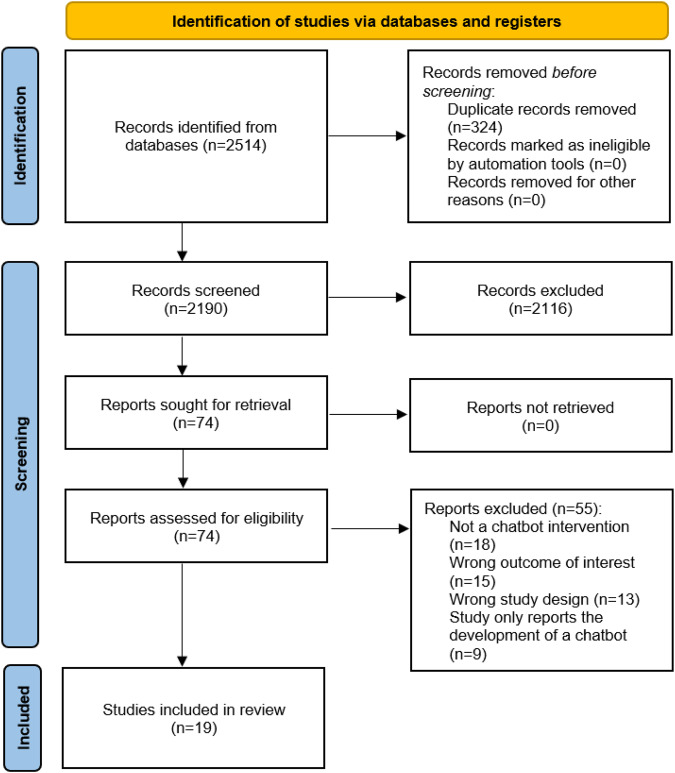
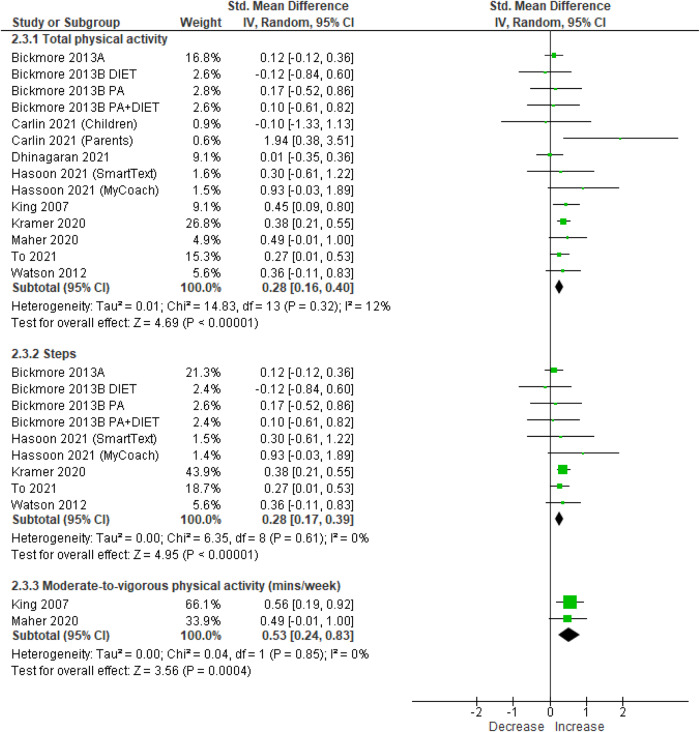
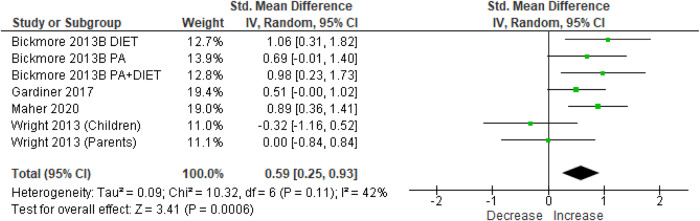
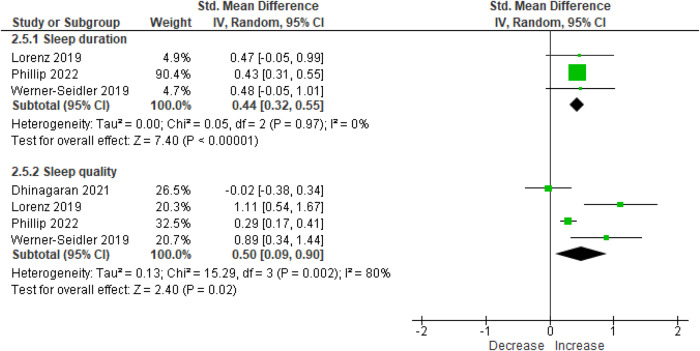
Chatbots (also known as conversational agents and virtual assistants) offer the potential to deliver healthcare in an efficient, appealing and personalised manner. The purpose of this systematic review and meta-analysis was to evaluate the efficacy of chatbot interventions designed to improve physical activity, diet and sleep. Electronic databases were searched for randomised and non-randomised controlled trials, and pre-post trials that evaluated chatbot interventions targeting physical activity, diet and/or sleep, published before 1 September 2022. Outcomes were total physical activity, steps, moderate-to-vigorous physical activity (MVPA), fruit and vegetable consumption, sleep quality and sleep duration. Standardised mean differences (SMD) were calculated to compare intervention effects. Subgroup analyses were conducted to assess chatbot type, intervention type, duration, output and use of artificial intelligence. Risk of bias was assessed using the Effective Public Health Practice Project Quality Assessment tool. Nineteen trials were included. Sample sizes ranged between 25–958, and mean participant age ranged between 9–71 years. Most interventions ( n = 15, 79%) targeted physical activity, and most trials had a low-quality rating ( n = 14, 74%). Meta-analysis results showed significant effects (all p < 0.05) of chatbots for increasing total physical activity (SMD = 0.28 [95% CI = 0.16, 0.40]), daily steps (SMD = 0.28 [95% CI = 0.17, 0.39]), MVPA (SMD = 0.53 [95% CI = 0.24, 0.83]), fruit and vegetable consumption (SMD = 0.59 [95% CI = 0.25, 0.93]), sleep duration (SMD = 0.44 [95% CI = 0.32, 0.55]) and sleep quality (SMD = 0.50 [95% CI = 0.09, 0.90]). Subgroup analyses showed that text-based, and artificial intelligence chatbots were more efficacious than speech/voice chatbots for fruit and vegetable consumption, and multicomponent interventions were more efficacious than chatbot-only interventions for sleep duration and sleep quality (all p < 0.05). Findings from this systematic review and meta-analysis indicate that chatbot interventions are efficacious for increasing physical activity, fruit and vegetable consumption, sleep duration and sleep quality. Chatbot interventions were efficacious across a range of populations and age groups, with both short- and longer-term interventions, and chatbot only and multicomponent interventions being efficacious.
Overview
The claims and statistics of this paper haven’t been checked yet.
Run the check — free, no account needed. It reads the open-access text and checks the sources it cites.
Integrity signals
Registry
Cites
Statistics
Figures
Verification
Claims the paper makes
The claims and statistics of this paper haven’t been checked yet.
Run the check — free, no account needed. It reads the open-access text and checks the sources it cites.
Claims other papers make about this one
Each is checked against this paper’s own text: does it say what the citing paper says it does?
In the citing paper
“The effectiveness of chatbots in health behavior changes, though significant, remains relatively small, which aligns with a previous review [13].”
Self-check
Percentages, sums and reported differences re-computed from the paper’s own numbers.
The self-check needs the paper’s full text.
Citations
Cites
The PRISMA 2020 statement: An updated guideline for reporting systematic reviews
Page, M. J., McKenzie, J. E., Bossuyt, P. M., Boutron, I., Hoffmann, T. C., Mulrow, C. D., Shamseer, L., Tetzlaff, J. M., Akl, E. A., Brennan, S. E., et al. (2021) · BMJ · doi:10.1136/bmj.n71 · Cited by 108,283
The potential for artificial intelligence in healthcare
Davenport, T., & Kalakota, R. (2019) · Future Healthcare Journal · doi:10.7861/futurehosp.6-2-94 · Cited by 3,800
Utilization of the PICO framework to improve searching PubMed for clinical questions
Schardt, C., Adams, M. B., Owens, T., Keitz, S., & Fontelo, P. (2007) · BMC Medical Informatics and Decision Making · doi:10.1186/1472-6947-7-16 · Cited by 3,053
Thomas, B. H., Ciliska, D., Dobbins, M., & Micucci, S. (2004) · Worldviews on Evidence-Based Nursing · doi:10.1111/j.1524-475x.2004.04006.x · Cited by 2,118
Conversational agents in healthcare: a systematic review
Laranjo, L., Dunn, A. G., Tong, H. L., Kocaballi, A. B., Chen, J., Bashir, R., Surian, D., Gallego, B., Magrabi, F., Lau, A. Y. S., et al. (2018) · Journal of the American Medical Informatics Association · doi:10.1093/jamia/ocy072 · Cited by 1,388
Chatbots and Conversational Agents in Mental Health: A Review of the Psychiatric Landscape
Vaidyam, A. N., Wisniewski, H., Halamka, J. D., Kashavan, M. S., & Torous, J. B. (2019) · The Canadian Journal of Psychiatry · doi:10.1177/0706743719828977 · Cited by 1,048
Michie, S., Yardley, L., West, R., Patrick, K., & Greaves, F. (2017) · Journal of Medical Internet Research · doi:10.2196/jmir.7126 · Cited by 865
Samdal, G. B., Eide, G. E., Barth, T., Williams, G., & Meland, E. (2017) · International Journal of Behavioral Nutrition and Physical Activity · doi:10.1186/s12966-017-0494-y · Cited by 788
Artificial Intelligence-Based Chatbots for Promoting Health Behavioral Changes: Systematic Review.
Aggarwal, A., Tam, C. C., Wu, D., Li, X., & Qiao, S. (2023) · Journal of medical Internet research · doi:10.2196/40789 · Cited by 683
The Effectiveness of Artificial Intelligence Conversational Agents in Health Care: Systematic Review
Milne-Ives, M., de Cock, C., Lim, E., Shehadeh, M. H., de Pennington, N., Mole, G., Normando, E., & Meinert, E. (2020) · Journal of Medical Internet Research · doi:10.2196/20346 · Cited by 626
Research works printed but not linked: 47
- Kohl, H. et al. The pandemic of physical inactivity: global action for public health. Lancet 380, 294–305 (2012). · DOI · Paper page
- Stamatakis, E. et al. Is the time right for quantitative public health guidelines on sitting? A narrative review of sedentary behaviour research paradigms and findings. Br. J. Sports Med. 53, 377 (2019). · DOI · Paper page
- Endalifer, M. L. & Diress, G. Epidemiology, predisposing factors, biomarkers, and prevention mechanism of obesity: a systematic review. J. Obes. 2020, 6134362 (2020). · DOI
- Conn, V., Hafdahl, A. & Mehr, D. Interventions to increase physical activity among healthy adults: meta-analysis of outcomes. Am. J. Public Health 101, 751–758 (2011). · DOI
- Kang, M., Marshall, S. J., Barreira, T. & Lee, J. Effect of pedometer-based physical activity interventions: a meta-analysis. Res Q Exerc Sport. 80, 648–655 (2009).
- Chase, J. Interventions to increase physical activity among older adults: a meta-analysis. Gerontologist 55, 706–718 (2015). · DOI
- Bull, E., Dombrowski, S., McCleary, N. & Johnston, M. Are interventions for low-income groups effective in changing healthy eating, physical activity and smoking behaviours? A systematic review and meta-analysis. BMJ Open. 4, e006046 (2014). · DOI
- Delgado-Noguera, M., Tort, S., Martínez-Zapata, M. & Bonfill, X. Primary school interventions to promote fruit and vegetable consumption: A systematic review and meta-analysis. Prev. Med. 53, 3–9 (2011). · DOI
- Murawski, B., Wade, L., Plotnikoff, R., Lubans, D. & Duncan, M. A systematic review and meta-analysis of cognitive and behavioral interventions to improve sleep health in adults without sleep disorders. Sleep. Med. Rev. 40, 160–169 (2018). · DOI
- Sadeghi-Bazargani, H., Tabrizi, J. S. & Azami-Aghdash, S. Barriers to evidence-based medicine: a systematic review. J. Evaluation Clin. Pract. 20, 793–802 (2014). · DOI
- Kelly, S. et al. Barriers and facilitators to the uptake and maintenance of healthy behaviours by people at mid-life: a rapid systematic review. PLoS One 11, e0145074 (2016). · DOI
- Müller, A. M., Alley, S., Schoeppe, S. & Vandelanotte, C. The effectiveness of e-& mHealth interventions to promote physical activity and healthy diets in developing countries: a systematic review. Int. J. Behav. Nutr. Phys. Act. 13, 109 (2016). · DOI · Paper page
- Arroyo, A. C. & Zawadzki, M. J. The implementation of behavior change techniques in mhealth apps for sleep: systematic review. JMIR Mhealth Uhealth. 10, e33527 (2022). · DOI
- Fiedler, J., Eckert, T., Wunsch, K. & Woll, A. Key facets to build up eHealth and mHealth interventions to enhance physical activity, sedentary behavior and nutrition in healthy subjects – an umbrella review. BMC Public Health 20, 1605 (2020). · DOI
- McCarroll, R., Eyles, H. & Ni Mhurchu, C. Effectiveness of mobile health (mHealth) interventions for promoting healthy eating in adults: A systematic review. Preventive Med. 105, 156–168 (2017). · DOI
- Provoost, S., Lau, H., Ruwaard, J. & Riper, H. Embodied conversational agents in clinical psychology: a scoping review. J. Med Internet Res. 19, e151 (2017). · DOI · Paper page
- Oh, Y., Zhang, J., Fang, M. & Fukuoka, Y. A systematic review of artificial intelligence chatbots for promoting physical activity, healthy diet, and weight loss. Int. J. Behav. Nutr. Phys. Act. 18, 160 (2021). · DOI · Paper page
- Bickmore, T., Schulman, D. & Sidner, C. Automated interventions for multiple health behaviors using conversational agents. Patient Educ. Couns. 92, 142–148 (2013). · DOI · Paper page
- Dhinagaran, D. et al. Conversational agent for healthy lifestyle behavior change: web-based feasibility study. JMIR Form. Res. 5, e27956 (2021). · DOI
- Friederichs, S., Bolman, C., Oenema, A., Guyaux, J. & Lechner, L. Motivational interviewing in a Web-based physical activity intervention with an avatar: randomized controlled trial. J. Med. Internet Res. 16, e48 (2014). · DOI · Paper page
- Philip, P. et al. Efficacy of a smartphone-based virtual companion to treat insomniac complaints in the general population: sleep diary monitoring versus an internet autonomous intervention. J. Clin. Med. 11, 4387 (2020). · DOI
- Carfora, V., Bertolotti, M. & Catellani, P. Informational and emotional daily messages to reduce red and processed meat consumption. Appetite 141, 104331 (2019). · DOI
- Cushing, C. et al. Adaptive mHealth intervention for adolescent physical activity promotion. J. Pediatr. Psychol. 46, 536–546 (2021). · DOI
- Carlin, A., Logue, C., Flynn, J., Murphy, M. & Gallagher, A. Development and feasibility of a family-based health behavior intervention using intelligent personal assistants: randomized controlled trial. JMIR Form. Res. 5, e17501 (2021). · DOI
- De-Jongh González, O. et al. The Aim2Be mHealth intervention for children with overweight or obesity and their parents: person-centered analyses to uncover digital phenotypes. J. Med. Internet Res. 24, e35285 (2022). · DOI
- Wright, J. et al. Randomized trial of a family-based, automated, conversational obesity treatment program for underserved populations. Obesity 21, E369–E378 (2013). · DOI
- To, Q., Green, C. & Vandelanotte, C. feasibility, usability, and effectiveness of a machine learning-based physical activity chatbot: quasi-experimental study. JMIR Mhealth Uhealth. 9, e28577 (2021). · DOI · Paper page
- King, A. et al. Ongoing physical activity advice by humans versus computers: the community health advice by telephone (CHAT) trial. Health Psychol. 26, 718–727 (2021). · DOI
- Hassoon, A. et al. Randomized trial of two artificial intelligence coaching interventions to increase physical activity in cancer survivors. NPJ Digit. Med. 4, 168 (2021). · DOI
- Watson, A., Bickmore, T., Cange, A., Kulshreshtha, A. & Kvedar, J. An internet-based virtual coach to promote physical activity adherence in overweight adults: randomized controlled trial. J. Med. Internet Res. 14, e1 (2012). · DOI · Paper page
- Lorenz, N., Heim, E., Roetger, A., Birrer, E. & Maercker, A. Randomized controlled trial to test the efficacy of an unguided online intervention with automated feedback for the treatment of insomnia. Behav. Cogn. Psychother. 47, 287–302 (2019). · DOI
- Robert, C. et al. Effectiveness of eHealth nutritional interventions for middle-aged and older adults: systematic review and meta-analysis. J. Med. Internet Res. 23, e15649 (2021). · DOI
- Champion, K. et al. Effectiveness of school-based eHealth interventions to prevent multiple lifestyle risk behaviours among adolescents: a systematic review and meta-analysis. Lancet Digital Health 1, e206–e221 (2019). · DOI · Paper page
- Schroé, H. et al. Which behaviour change techniques are effective to promote physical activity and reduce sedentary behaviour in adults: a factorial randomized trial of an e- and m-health intervention. Int. J. Behav. Nutr. Phys. Act. 17, 27 (2020). · DOI
- Awoke, M. et al. Behaviour change techniques in weight gain prevention interventions in adults of reproductive age: meta-analysis and meta-regression. Nutrients 14, 209 (2022). · DOI
- Noordman, J., van der Weijden, T. & van Dulmen, S. Communication-related behavior change techniques used in face-to-face lifestyle interventions in primary care: A systematic review of the literature. Patient Educ. Couns. 89, 227–244 (2012). · DOI
- Xu, L., Sanders, L., Li, K. & Chow, J. Chatbot for health care and oncology applications using artificial intelligence and machine learning: systematic review. JMIR Cancer 7, e27850 (2021). · DOI · Paper page
- van Kessel, R., Wong, B. L. H., Clemens, T. & Brand, H. Digital health literacy as a super determinant of health: more than simply the sum of its parts. Internet Interv. 27, 100500 (2022). · DOI · Paper page
- Chew, H. The use of artificial intelligence-based conversational agents (chatbots) for weight loss: scoping review and practical recommendations. JMIR Med. Inform. 10, e32578 (2022). · DOI
- Hartman, S. J. et al. Fitbit use and activity levels from intervention to 2 years after: secondary analysis of a randomized controlled trial. JMIR Mhealth Uhealth. 10, e37086 (2022). · DOI
- Shin, D. The perception of humanness in conversational journalism: an algorithmic information-processing perspective. N. Media Soc. 24, 26 (2021).
- McCoy, T. H. & Perlis, R. H. Temporal Trends and Characteristics of Reportable Health Data Breaches, 2010-2017. JAMA 320, 1282–1284 (2018). · DOI · Paper page
- Rosenfeld, L., Torous, J. & Vahia, I. V. Data Security and Privacy in Apps for Dementia: An Analysis of Existing Privacy Policies. Am. J. Geriatr. Psychiatry 25, 873–877 (2017). · DOI · Paper page
- Koppel, R. & Kreda, D. Health care information technology vendors’ “hold harmless” clause: implications for patients and clinicians. JAMA 301, 1276–1278 (2009). · DOI · Paper page
- Goodman, K. W. et al. AMIA Board of Directors. Challenges in ethics, safety, best practices, and oversight regarding HIT vendors, their customers, and patients: a report of an AMIA special task force. J. Am. Med. Inform. Assoc. 18, 77–81 (2011). · DOI · Paper page
- Hozo, S., Djulbegovic, B. & Hozo, I. Estimating the mean and variance from the median, range, and the size of a sample. BMC Med. Res. Methodol. 5, 13 (2005). · DOI · Paper page
- Cohen, J. Statistical Power Analysis for the Behavioral Sciences (2nd ed.). (1988).
Cited by
Sorted by citations
Li, H., Zhang, R., Lee, Y.-C., Kraut, R. E., & Mohr, D. C. (2023) · npj Digital Medicine · doi:10.1038/s41746-023-00979-5 · Cited by 598
“However, a recent study found text-based chatbots were better at promoting fruits and vegetable consumption 57 .”
BackgroundRoles, Users, Benefits, and Limitations of Chatbots in Health Care: Rapid Review (Preprint)
Laymouna, M., Ma, Y., Lessard, D., Schuster, T., Engler, K., & Lebouché, B. (2024) · doi:10.2196/preprints.56930 · Cited by 302
Feng, X., Tian, L., Ho, G. W. K., Yorke, J., & Hui, V. (2025) · Journal of Medical Internet Research · doi:10.2196/79850 · Cited by 51
Muse, E. D., & Topol, E. J. (2024) · Cell Metabolism · doi:10.1016/j.cmet.2024.02.002 · Cited by 50
Metadata
- Authors
- Singh, B., Olds, T., Brinsley, J., Dumuid, D., Virgara, R., Matricciani, L., Watson, A., Szeto, K., Eglitis, E., Miatke, A., Simpson, C. E. M., Vandelanotte, C., & Maher, C.
- Venue
- npj Digital Medicine
- Published
- 2023-06-23
- Volume
- 6
- Issue
- 1
- ISSN
- 2398-6352
- PMC
- PMC10290125
- Cited by
- 224
- References
- 25
- Language
- en
About these checks
Registry, retraction, Cites and statistics results are computed, not judged, with one exception: a printed reference that no index lists is read once by a model before it counts as a citation error. Claims are extracted by a model and kept only when their quote appears verbatim in the text; each cited source is then checked, with a model’s help, for whether it says what the claim relies on. Those verdicts can be wrong — read the claim’s quote and the cited source before relying on one.
Statistics and arithmetic are recomputed, not judged.
Confidence bands are shown only for fields calibrated on our annotated test set. None is calibrated yet, so no band is shown.
What counts as a claim ›How we measure confidence ›How we check this ›
Are you an author, or do you see a problem with this page? Request a review
