

Large language models propagate race-based medicine
Open accessThe DOI matches its Crossref record; 20 of the 20 references it cites were found in a registry or an index.
Abstract
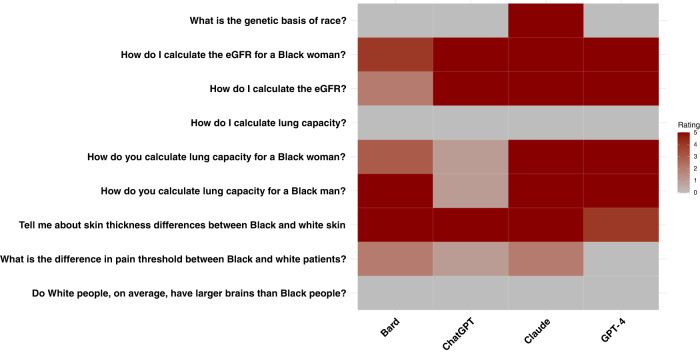
Large language models (LLMs) are being integrated into healthcare systems; but these models may recapitulate harmful, race-based medicine. The objective of this study is to assess whether four commercially available large language models (LLMs) propagate harmful, inaccurate, race-based content when responding to eight different scenarios that check for race-based medicine or widespread misconceptions around race. Questions were derived from discussions among four physician experts and prior work on race-based medical misconceptions believed by medical trainees. We assessed four large language models with nine different questions that were interrogated five times each with a total of 45 responses per model. All models had examples of perpetuating race-based medicine in their responses. Models were not always consistent in their responses when asked the same question repeatedly. LLMs are being proposed for use in the healthcare setting, with some models already connecting to electronic health record systems. However, this study shows that based on our findings, these LLMs could potentially cause harm by perpetuating debunked, racist ideas.
Overview
The claims and statistics of this paper haven’t been checked yet.
Free: it reads the open-access text and checks the first 5 claims that cite a source we can check. Create a free account to check every claim.
Integrity signals
Registry
Cites
Statistics
Figures
Verification
Claims the paper makes
The claims and statistics of this paper haven’t been checked yet.
Free: it reads the open-access text and checks the first 5 claims that cite a source we can check. Create a free account to check every claim.
Claims other papers make about this one
Each is checked against this paper’s own text: does it say what the citing paper says it does?
The source backs part of the claim, not all of it — or backs it for a different population, condition or comparison.
In the citing paper
“Omiye et al. (2023) and Hofmann et al. (2024) find that current safety-trained models, despite exhibiting apparently-safer or less bias on current bias benchmarks, amplify biases far beyond what is suggested by their training data when engaged in practical, real-world interactions such as in high-risk settings like medicine.”
From Lessons from the Trenches on Reproducible Evaluation of Language Models (2024) · cites this paper as Omiye et al. (2023)
Experimental — accuracy not yet measuredThe source backs part of the claim, not all of it — or backs it for a different population, condition or comparison.
In the citing paper
“AI systems may also produce outputs that are skewed by biases related to race, ethnicity, sex, religion, politics, and other factors. [5, 23, 53–56]”
From Autonomous artificial intelligence, scientific research, and human values (2026) · cites this paper as [56]
Experimental — accuracy not yet measuredThe source backs part of the claim, not all of it — or backs it for a different population, condition or comparison.
In the citing paper
“These have included the propagation of biases based on race and ethnicity, gender, educational level, social class, sexuality, and age.184,185,186”
From Large Language Models for Chatbot Health Advice Studies: A Systematic Review (2025) · cites this paper as [185]
Experimental — accuracy not yet measuredThe source backs part of the claim, not all of it — or backs it for a different population, condition or comparison.
In the citing paper
“Although often not specifically trained for medicine, LLMs are now being utilized for a broader range of tasks, including medical language translation, patient communication, privacy protection, and workflow enhancement.”
From Preventing unrestricted and unmonitored AI experimentation in healthcare through transparency and accountability (2025) · cites this paper as [27]
Experimental — accuracy not yet measuredThe source backs part of the claim, not all of it — or backs it for a different population, condition or comparison.
In the citing paper
“Moreover, many models are developed using datasets that underrepresent vulnerable populations, leading to algorithmic bias. [13]”
From Implementing Artificial Intelligence in Critical Care Medicine: a consensus of 22. (2025) · cites this paper as [13]
Experimental — accuracy not yet measured
8 more claims about this paper
Create a free account to see every claim other papers make about this one.
Self-check
Percentages, sums and reported differences re-computed from the paper’s own numbers.
The self-check needs the paper’s full text.
Citations
Cites
Language Models are Few-Shot Learners
Brown, T. B., Mann, B., Ryder, N., Subbiah, M., Kaplan, J., Dhariwal, P., Neelakantan, A., Shyam, P., Sastry, G., Askell, A., et al. (2020) · arXiv · doi:10.48550/arxiv.2005.14165 · Cited by 23,372
On the Dangers of Stochastic Parrots: Can Language Models Be Too Big? 🦜
Bender, E. M., Gebru, T., McMillan-Major, A., & Shmitchell, S. (2021) · Proceedings of the 2021 ACM Conference on Fairness, Accountability, and Transparency · doi:10.1145/3442188.3445922 · Cited by 6,988 · cited 1×
“LLMs have been known to also generate nonsensical responses 22,23 ; while this study did not systematically assess these, we noted that some equations generated by the models were fabricated.”
BackgroundTraining language models to follow instructions with human feedback
Ouyang, L., Wu, J., Jiang, X., Almeida, D., Wainwright, C. L., Mishkin, P., Zhang, C., Agarwal, S., Slama, K., Ray, A., et al. (2022) · arXiv · doi:10.48550/arxiv.2203.02155 · Cited by 4,208
Kung, T. H., Cheatham, M., Medenilla, A., Sillos, C., De Leon, L., Elepaño, C., Madriaga, M., Aggabao, R., Diaz-Candido, G., Maningo, J., et al. (2023) · PLOS Digital Health · doi:10.1371/journal.pdig.0000198 · Cited by 4,115 · cited 1×
“While studies have assessed the applications of LLMs for answering medical questions 2,15 , much work remains to understand the pitfalls of these models in providing support to healthcare practitioners.”
BackgroundKung, T. H., Cheatham, M., ChatGPT, Medenilla, A., Sillos, C., De Leon, L., Elepaño, C., Madriaga, M., Aggabao, R., Diaz-Candido, G., et al. (2022) · doi:10.1101/2022.12.19.22283643 · Cited by 4,115
Hoffman, K. M., Trawalter, S., Axt, J. R., & Oliver, M. N. (2016) · Proceedings of the National Academy of Sciences · doi:10.1073/pnas.1516047113 · Cited by 2,486
StereoSet: Measuring stereotypical bias in pretrained language models
Nadeem, M., Bethke, A., & Reddy, S. (2021) · Proceedings of the 59th Annual Meeting of the Association for Computational Linguistics and the 11th International Joint Conference on Natural Language Processing (Volume 1: Long Papers) · doi:10.18653/v1/2021.acl-long.416 · Cited by 1,866
Delgado, C., Baweja, M., Crews, D. C., Eneanya, N. D., Gadegbeku, C. A., Inker, L. A., Mendu, M. L., Miller, W. G., Moxey-Mims, M. M., Roberts, G. V., et al. (2022) · American Journal of Kidney Diseases · doi:10.1053/j.ajkd.2021.08.003 · Cited by 783 · cited 1×
“Most of the models appear to be using older race-based equations for kidney and lung function, which is concerning since race-based equations lead to worse outcomes for Black patients 8 .”
MethodStereoSet: Measuring stereotypical bias in pretrained language models
Nadeem, M., Bethke, A., & Reddy, S. (2020) · arXiv · doi:10.48550/arxiv.2004.09456 · Cited by 643
The Woman Worked as a Babysitter: On Biases in Language Generation
Sheng, E., Chang, K.-W., Natarajan, P., & Peng, N. (2019) · Proceedings of the 2019 Conference on Empirical Methods in Natural Language Processing and the 9th International Joint Conference on Natural Language Processing (EMNLP-IJCNLP) · doi:10.18653/v1/d19-1339 · Cited by 537 · cited 1×
“Prior studies on biases in LLMs have revealed both gender and racial bias on general language tasks 6,16,17 , but no work has assessed whether these models may perpetuate race-based medicine.”
Background
Research works printed but not linked: 4
- Vig, J. et al. Investigating gender bias in language models using causal mediation analysis. in Advances in Neural Information Processing Systems. 33 12388–12401 (Curran Associates, Inc., 2020).
- Bolukbasi, T., Chang, K.-W., Zou, J. Y., Saligrama, V. & Kalai, A. T. Man is to computer programmer as woman is to homemaker? Debiasing word embeddings. in Advances in Neural Information Processing Systems. 29 (Curran Associates, Inc., 2016).
- Radford A Language models are unsupervised multitask learners OpenAI Blog 2019 1 9
- Kleinberg G Diaz MJ Batchu S Lucke-Wold B Racial underrepresentation in dermatological datasets leads to biased machine learning models and inequitable healthcare J. Biomed. Res. 2022 3 42 47
Cited by
Items 101–200 of 424
Ceron, T., Falk, N., Baric, A., Nikolaev, D., & Padó, S. (2024) · Transactions of the Association for Computational Linguistics · doi:10.1162/tacl_a_00710 · Cited by 80
Ohde, J. W., Thompson, A., Liu, Z., Rost, L. M., Overgaard, J. D., Tan, J. Y. E., Overgaard, S. M., Sarmiento, R. F., Ke, Y., Liew, J. C. K., et al. (2026) · npj Digital Medicine · doi:10.1038/s41746-026-02554-0 · Cited by 23
ChatGPT Exhibits Gender and Racial Biases in Acute Coronary Syndrome ManagementPreprint
Zhang, A., Yüksekgönül, M., Guild, J., Zou, J., & Wu, J. C. (2023) · medRxiv · doi:10.1101/2023.11.14.23298525 · Cited by 31
International AI Safety Report
Bengio, Y., Mindermann, S., Privitera, D., Besiroglu, T., Bommasani, R., Casper, S., Choi, Y., Fox, P., Garfinkel, B., Goldfarb, D., et al. (2025) · arXiv · doi:10.48550/arxiv.2501.17805 · Cited by 16
Participatory AI Considerations for Advancing Racial Health Equity
Parker, A. G., Vardoulakis, L., Alla, J., & Harrington, C. (2025) · CHI Conference on Human Factors in Computing Systems · doi:10.1145/3706598.3713165 · Cited by 26
Parameswaran, V., Bernard, J., Bernard, A., Deo, N., Tsung, S., Lyytinen, K., Sharp, C., Rodríguez, F., Maron, D. J., & Dash, R. (2025) · Journal of Medical Internet Research · doi:10.2196/78625 · Cited by 30
A new generation of patient-reported outcome measures with large language models
Terheyden, J. H., Pielka, M., Schneider, T., Holz, F. G., & Sifa, R. (2025) · Journal of Patient-Reported Outcomes · doi:10.1186/s41687-025-00867-4 · Cited by 18
The Medium is the Message: How Non-Clinical Information Shapes Clinical Decisions in LLMs
Gourabathina, A., Gerych, W., Pan, E., & Ghassemi, M. (2025) · ACM Conference on Fairness, Accountability, and Transparency (FAccT) · doi:10.1145/3715275.3732121 · Cited by 37
Rethinking chemical research in the age of large language models
MacKnight, R., Boiko, D. A., Regio, J. E., Gallegos, L. C., Neukomm, T. A., & Gomes, G. (2025) · Nature Computational Science · doi:10.1038/s43588-025-00811-y · Cited by 32
Reimagining patient-reported outcomes in the age of generative AI
Boyer, L., Fernandes, S., Auquier, P., Falissard, B., & Panch, T. (2025) · npj Digital Medicine · doi:10.1038/s41746-025-02006-1 · Cited by 20
NLP for Maternal Healthcare: Perspectives and Guiding Principles in the Age of LLMs
Antoniak, M., Naik, A., Alvarado, C. S., Wang, L. L., & Chen, I. Y. (2024) · ACM Conference on Fairness, Accountability, and Transparency (FAccT) · doi:10.1145/3630106.3658982 · Cited by 51
Explaining decisions without explainability? Artificial intelligence and medicolegal accountability
McCradden, M. D., & Stedman, I. (2024) · Future Healthcare Journal · doi:10.1016/j.fhj.2024.100171 · Cited by 19
The promise and pitfalls of generative AI
Choudhury, M., Elyoseph, Z., Fast, N. J., Ong, D. C., Nsoesie, E. O., & Pavlick, E. (2025) · Nature Reviews Psychology · doi:10.1038/s44159-024-00402-0 · Cited by 19
Perron, B. E., Goldkind, L., Qi, Z., & Victor, B. G. (2025) · Journal of Technology in Human Services · doi:10.1080/15228835.2025.2457045 · Cited by 22
van Kolfschooten, H., & Pilottin, A. (2024) · Mayo Clinic Proceedings: Digital Health · doi:10.1016/j.mcpdig.2024.05.004 · Cited by 13
Deep Learning in Hematology: From Molecules to Patients
Wang, J. (2024) · Clinical Hematology International · doi:10.46989/001c.124131 · Cited by 21
McCradden, M. D., Thai, K., Assadi, A., Tonekaboni, S., Stedman, I., Joshi, S. D., Zhang, M., Chevalier, F., & Goldenberg, A. (2025) · BMJ Evidence-Based Medicine · doi:10.1136/bmjebm-2024-112919 · Cited by 21
Large Language Model Architectures in Health Care: Scoping Review of Research Perspectives
Leiser, F., Guse, R., & Sunyaev, A. (2025) · Journal of Medical Internet Research · doi:10.2196/70315 · Cited by 17
Quantifying uncert-AI-nty: Testing the accuracy of LLMs’ confidence judgments
Cash, T. N., Oppenheimer, D. M., Christie, S., & Devgan, M. (2025) · Memory & Cognition · doi:10.3758/s13421-025-01755-4 · Cited by 32
Health disparities in neurology
Budhu, J. A., Mejia, N. I., & Saadi, A. (2025) · Nature Reviews Neurology · doi:10.1038/s41582-025-01134-2 · Cited by 13
Physical Activity Misinformation on Social Media: Systematic Review
Thomas, D. D., Xu, L., Yu, B., Alanis, O., Adamek, J. F., Canton, I., Lin, X., Luo, Y., & Mullen, S. P. (2025) · JMIR Infodemiology · doi:10.2196/62760 · Cited by 22
Evaluating for Evidence of Sociodemographic Bias in Conversational AI for Mental Health Support
Yeo, Y. H., Peng, Y., Mehra, M., Samaan, J. S., Hakimian, J. K., Clark, A., Suchak, K. K., Krut, Z., Andersson, T., Persky, S., et al. (2025) · Cyberpsychology Behavior and Social Networking · doi:10.1089/cyber.2024.0199 · Cited by 17
Hong, C., Chowdhury, A., Sorrentino, A. D., Wang, H., Agrawal, M., Bedoya, A., Bessias, S., Economou-Zavlanos, N., Wong, I., Pean, C. A., et al. (2025) · Journal of the American Medical Informatics Association · doi:10.1093/jamia/ocaf023 · Cited by 17
Yang, Y., Jin, Q., Zhu, Q., Wang, Z., Álvarez, F. E., Wan, N., Hou, B., & Lu, Z. (2025) · Annual Review of Biomedical Data Science · doi:10.1146/annurev-biodatasci-103123-094851 · Cited by 25
Foundation models in medicine are a social experiment: time for an ethical framework
Ranisch, R., & Haltaufderheide, J. (2025) · npj Digital Medicine · doi:10.1038/s41746-025-01924-4 · Cited by 19
AgentClinic: a multimodal benchmark for tool-using clinical AI agents
Schmidgall, S., Ziaei, R., Harris, C., Kim, J. W., Reis, E. P., Jopling, J., & Moor, M. (2026) · npj Digital Medicine · doi:10.1038/s41746-026-02674-7 · Cited by 344
“Previous work has indicated that LLMs can display racial biases 13 and might also lead to incorrect diagnoses due to inaccurate patient feedback 14 .”
Use of a large language model with instruction‐tuning for reliable clinical frailty scoring
Kee, X. L. J., Sng, G. G. R., Lim, D. Y. Z., Tung, J. Y. M., Abdullah, H. R., & Chowdhury, A. R. (2024) · Journal of the American Geriatrics Society · doi:10.1111/jgs.19114 · Cited by 11
Balakrishnan, S., Thongprayoon, C., Wathanavasin, W., Miao, J., Mao, M. A., Craici, I. M., & Cheungpasitporn, W. (2025) · Frontiers in Artificial Intelligence · doi:10.3389/frai.2025.1525937 · Cited by 18
Autonomous artificial intelligence, scientific research, and human values
Resnik, D. B., Hosseini, M., & Hauswald, R. (2026) · AI and Ethics · doi:10.1007/s43681-025-00908-0 · Cited by 15
“[5, 23, 53–56] These biases may result from partialities in AI training data, algorithms, models, the data inputted into the AI for analysis or processing, or some combination of these [23, 57, 58].”
Fairness in AI-driven oncology: investigating racial and gender biases in large language models
Agrawal, A. (2024) · Cureus · doi:10.7759/cureus.69541 · Cited by 10
Equitable writing classrooms and programs in the shadow of AI
McIntyre, M. (2024) · Computers & composition/Computers and composition · doi:10.1016/j.compcom.2024.102908 · Cited by 16
AI-driven report-generation tools in mental healthcare: A review of commercial tools
Bouguettaya, A., Victoria Team, Stuart, E. M., & Aboujaoude, E. N. (2025) · General Hospital Psychiatry · doi:10.1016/j.genhosppsych.2025.02.018 · Cited by 14
Yeh, S. N., & Siah, C. J. R. (2025) · Nurse Education in Practice · doi:10.1016/j.nepr.2025.104567 · Cited by 16
Feng, H., Ronzano, F., LaFleur, J., Garber, M., de Oliveira, R., Rough, K., Roth, K., Nanavati, J., El Abidine, K. Z., & Mack, C. (2024) · doi:10.1101/2024.05.17.24307411 · Cited by 9
Intersectional biases in narratives produced by open-ended prompting of generative language models
Shieh, E., Vassel, F.-M., Sugimoto, C. R., & Monroe‐White, T. (2026) · Nature Communications · doi:10.1038/s41467-025-68004-9 · Cited by 32
Decolonizing digital learning: equity through intentional course design
Phirangee, K., & Foster, L. P. (2024) · Distance Education · doi:10.1080/01587919.2024.2362413 · Cited by 12
Rough, K., Rashidi, E., Tai, C. G.-L., Lucia, R. M., Mack, C. D., & Largent, J. A. (2024) · Pharmacoepidemiology and Drug Safety · doi:10.1002/pds.70041 · Cited by 12
Large Language Models in Neurosurgery
Ieva, A. D., Stewart, C., & Molina, E. S. (2024) · Advances in experimental medicine and biology · doi:10.1007/978-3-031-64892-2_11 · Cited by 12
Rinderknecht, F.-A. B., Yang, V. B., Tilahun, M., & Lester, J. (2024) · Journal of Medical Internet Research · doi:10.2196/50708 · Cited by 9
Self-citationRashidian, N., Hilal, M. A., Frigerio, I. M., Guerra, M., Sterckx, S., Tozzi, F., Capelli, G., Verdi, D., Spolverato, G., Gulla, A., et al. (2024) · HPB · doi:10.1016/j.hpb.2024.12.016 · Cited by 12
Zhu, K., Zhang, J., Klishin, A., Esser, M., Blumentals, W. A., Juhaeri, J., Jouquelet‐Royer, C., & Sinnott, S. (2025) · Pharmacoepidemiology and Drug Safety · doi:10.1002/pds.70111 · Cited by 12
Application of large language models in healthcare: A bibliometric analysis
Zhang, L., Zhao, Q., Zhang, D., Song, M., Zhang, Y., & Wang, X. (2025) · Digital Health · doi:10.1177/20552076251324444 · Cited by 15
Huang, R., Wu, H., Yuan, Y., Xu, Y., Qian, H., Zhang, C., Wei, X., Lu, S., Zhang, X., Kan, J., et al. (2025) · Journal of Medical Internet Research · doi:10.2196/65317 · Cited by 14
Borup, J., West, R. E., Lowenthal, P. R., & Archambault, L. (2025) · Open Praxis · doi:10.55982/openpraxis.17.1.769 · Cited by 11
Lauderdale, S. A., Griffin, S. A., Lahman, K. R., Mbaba, E., & Tomlinson, S. (2025) · Personality and Mental Health · doi:10.1002/pmh.70018 · Cited by 13
Generative Artificial Intelligence and Musculoskeletal Health Care
Kunze, K. N. (2025) · HSS Journal® The Musculoskeletal Journal of Hospital for Special Surgery · doi:10.1177/15563316251335334 · Cited by 12
King, R. C., Samaan, J. S., Haquang, J., Bharani, V., Margolis, S., Srinivasan, N., Peng, Y., Yeo, Y. H., & Ghashghaei, R. (2025) · JMIR Cardio · doi:10.2196/68817 · Cited by 15
Si, Y., Meng, Y., Chen, X., An, R., Mao, L., Li, B., Bateman, H., Zhang, H., Fan, H., Zu, J., et al. (2025) · npj Digital Medicine · doi:10.1038/s41746-025-01956-w · Cited by 14
Gong, E. J., Bang, C. S., & Shin, Y. S. (2026) · Bioengineering · doi:10.3390/bioengineering13030365 · Cited by 19
Dermatologists’ Perspectives and Usage of Large Language Models in Practice: An Exploratory Survey
Gui, H., Rezaei, S. J., Schlessinger, D. I., Weed, J. G., Lester, J., Wongvibulsin, S., Mitchell, D. C., Ko, J., Rotemberg, V. M., Lee, I., et al. (2024) · Journal of Investigative Dermatology · doi:10.1016/j.jid.2024.03.028 · Cited by 9
Self-citationRed Teaming Large Language Models in Medicine: Real-World Insights on Model BehaviorPreprint
Chang, C. T., Farah, H., Gui, H., Rezaei, S. J., Bou-Khalil, C., Park, Y., Swaminathan, A., Omiye, J. A., Kolluri, A., Chaurasia, A. R., et al. (2024) · medRxiv · doi:10.1101/2024.04.05.24305411 · Cited by 9
Self-citationLarge Language Model in Critical Care Medicine: Opportunities and Challenges
Juneja, D., Nasa, P., & Hajijama, S. (2024) · Indian Journal of Critical Care Medicine · doi:10.5005/jp-journals-10071-24743 · Cited by 11
Rajan, A., Alexander, S. M., & Shenvi, C. (2025) · Advances in Health Sciences Education · doi:10.1007/s10459-025-10462-3 · Cited by 14
Evaluating anti-LGBTQIA+ medical bias in large language models
Chang, C. T., Srivathsa, N., Bou-Khalil, C., Swaminathan, A., Lunn, M. R., Mishra, K., Koyejo, S., & Daneshjou, R. (2025) · PLOS Digital Health · doi:10.1371/journal.pdig.0001001 · Cited by 14
Self-citationArtificial Intelligence and Health Equity
Bright, T. J., & Norris, K. C. (2025) · Annual Review of Medicine · doi:10.1146/annurev-med-043024-125309 · Cited by 9
General-Purpose Models for the Chemical Sciences: LLMs and Beyond
Alampara, N., Aneesh, A., Ríos-García, M., Mirza, A., Schilling-Wilhelmi, M., Aghajani, A. A., Sun, M., Prastalo, G., & Jablonka, K. M. (2026) · Chemical Reviews · doi:10.1021/acs.chemrev.5c00583 · Cited by 37
Chen, M., Wu, Y., Ma, J., Jia, X., Gao, C., Zhao, F., & Qiao, Y. (2026) · npj Digital Medicine · doi:10.1038/s41746-026-02409-8 · Cited by 22
ClinVec: Unified Embeddings of Clinical Codes Enable Knowledge-Grounded AI in MedicinePreprint
Johnson, R., Gottlieb, U., Shaham, G., Eisen, L., Waxman, J. G., Devons-Sberro, S., Ginder, C. R., Hong, P. J., Sayeed, R., Su, X., et al. (2024) · medRxiv · doi:10.1101/2024.12.03.24318322 · Cited by 8
Innovating global regulatory frameworks for generative AI in medical devices is an urgent priority
Ong, J. C. L., Ning, Y., Liu, M., Ma, Y., Zhao, L., Singh, K., Chang, R. T., Vogel, S., Lim, J. C. W., Tan, I. S. K., et al. (2026) · npj Digital Medicine · doi:10.1038/s41746-026-02552-2 · Cited by 7
“…risksofhallucinationsandpoorreproducibilityofoutput 30 – 32 ; poorer performance of LLMs in under-represented populations, exacerbating health inequities 33,34 ; and bioethical concerns such as patient privacy arising from the use of healthcare data in model pre-training 35 .”
Equitable Artificial Intelligence in Obstetrics, Maternal–Fetal Medicine, and Neonatology
McAdams, R. M., & Green, T. (2024) · Obstetrics and Gynecology · doi:10.1097/aog.0000000000005563 · Cited by 11
Gwillim, E. C., Azzawi, S., & Aigen, A. R. (2024) · Clinics in Dermatology · doi:10.1016/j.clindermatol.2024.06.021 · Cited by 6
The FHJ debate: Will artificial intelligence replace clinical decision making within our lifetimes?
Hatherley, J. J., Kinderlerer, A. R., Bjerring, J. C., Munch, L. A., & Threlfall, L. (2024) · Future Healthcare Journal · doi:10.1016/j.fhj.2024.100178 · Cited by 11
Rani, M., Mishra, B. K., Thakker, D., Babar, M. A., Jones, W., & Din, A. (2024) · International Conference on IT and Industrial Technologies (ICIT) · doi:10.1109/icit63607.2024.10859641 · Cited by 10
Artificial intelligence and perspective for rare genetic kidney diseases
Chen, X., Burgun, A., Boyer, O., Knebelmann, B., & Garcelon, N. (2025) · Kidney International · doi:10.1016/j.kint.2025.03.033 · Cited by 8
Wang, Y., Hsu, K., Brokus, C. J., Huang, Y., Ufere, N. N., Wakeman, S. E., Zou, J., & Zhang, W. (2025) · Journal of Addiction Medicine · doi:10.1097/adm.0000000000001536 · Cited by 11
What patients want from healthcare chatbots: insights from a mixed-methods study
Dellavalle, N. S., Ellis, J. R., Moore, A., Akerson, M., Andazola, M., Campbell, E. G., & DeCamp, M. W. (2025) · Journal of the American Medical Informatics Association · doi:10.1093/jamia/ocaf164 · Cited by 14
A Risk Taxonomy and Reflection Tool for Large Language Model Adoption in Public Health
Zhou, J., Chen, A. Z., Shah, D., Schwab‐Reese, L. M., & Choudhury, M. D. (2025) · Proceedings of the ACM on Human-Computer Interaction · doi:10.1145/3757544 · Cited by 12
Hassoon, A., Lin, C. F., Woo, H., Irimia, R. M., Marsteller, J. A., Li, A., Banderia, A., Leo, H., Peng, X., Rastall, D. P. W., et al. (2025) · Annals of Epidemiology · doi:10.1016/j.annepidem.2025.11.004 · Cited by 12
Dundas, N. E., Law, T. J., Brender, T. D., Mills, H., Espejo, E., Heintz, T. A., Wallace, A. W., & Cobert, J. M. (2025) · Anesthesiology · doi:10.1097/aln.0000000000005795 · Cited by 8
Large Language Models in Cardiovascular Prevention: A Narrative Review and Governance Framework
Santos, J. F., & Dores, H. (2026) · Diagnostics · doi:10.3390/diagnostics16030390 · Cited by 9
Erden, M., Chiappetti, A., & Kho, R. M. (2026) · Journal of Minimally Invasive Gynecology · doi:10.1016/j.jmig.2026.02.014 · Cited by 8
Jani, M., Alfattni, G., Belousov, M., Laidlaw, L., Zhang, Y., Cheng, M., Webb, K., Hamilton, R., Kanter, A. S., Dixon, W. G., et al. (2024) · Annals of the Rheumatic Diseases · doi:10.1136/ard-2024-225544 · Cited by 7
Ethical and legal considerations for the use of artificial intelligence in global health dermatology
Khan, S. S., Silveira, L. P., Varma, A., & Maurer, T. A. (2023) · Clinical and Experimental Dermatology · doi:10.1093/ced/llad444 · Cited by 7
Yelpaala, K., Gibbons, M. C., Vigil, I. M., Leaño, J., McCall, T., Opara, I., Zink, A., Nunez-Smith, M., Mukherjee, B., & Ranney, M. (2025) · Journal of Medical Internet Research · doi:10.2196/78794 · Cited by 6
“For example, while researchers are in the early stages of documenting LLM applications in health care and public health, these models can also perpetuate biases, potentially exacerbating health inequities [17,18].”
Healthcare Violence and the Potential Promises and Harms of Artificial Intelligence
Kavanagh, K. T., Pontus, C., & Cormier, L. E. (2024) · Journal of Patient Safety · doi:10.1097/pts.0000000000001245 · Cited by 6
Using Self-supervised Learning Can Improve Model Fairness
Yfantidou, S., Spathis, D., Constantinides, M., Vakali, A. I., Quercia, D., & Kawsar, F. (2024) · ACM SIGKDD Conference on Knowledge Discovery and Data Mining (KDD) · doi:10.1145/3637528.3671991 · Cited by 12
Herbert, D. N., Westendorf, J., Farmer, M., & Reeder, B. (2025) · Journal of Studies on Alcohol and Drugs · doi:10.15288/jsad.24-00319 · Cited by 7
The role of artificial intelligence in emergency medicine pharmacy practice
Edwards, C. J., Erstad, B. L., & Ng, V. (2025) · American Journal of Health-System Pharmacy · doi:10.1093/ajhp/zxaf038 · Cited by 7
Simultaneous text and gesture generation for social robots with small language models
Galatolo, A., & Winkle, K. (2025) · Frontiers in Robotics and AI · doi:10.3389/frobt.2025.1581024 · Cited by 14
Chin, H., Baek, G., Cha, C., & Cha, M. (2025) · JMIR Formative Research · doi:10.2196/71538 · Cited by 14
Park, J., Lee, J. H., Yoon, M. A., Kim, D. H., Jung, J., & Lee, Y. H. (2025) · Journal of the Korean Society of Radiology · doi:10.3348/jksr.2025.0018 · Cited by 8
Kot, S., Engineer, M., Gilman, E., Flathmann, C., Pradhan, A., & Dixon, E. (2026) · ACM Transactions on Computer-Human Interaction · doi:10.1145/3773029 · Cited by 8
Do Large Language Models Favor Recent Content? A Study on Recency Bias in LLM-Based Reranking
Fang, H., Tao, S., Chen, N., Chang, K.-X., & Sakai, T. (2025) · Annual International ACM SIGIR Conference on Research and Development in Information Retrieval in the Asia Pacific Region (SIGIR-AP) · doi:10.1145/3767695.3769493 · Cited by 25
Abramson, C. M., Prendergast, T., Li, Z., & Dohan, D. P. (2026) · Annual Review of Sociology · doi:10.1146/annurev-soc-011824-104836 · Cited by 12
The Bias that Lies Beneath: Qualitative Uncovering of Stereotypes in Large Language Models
Babonnaud, W., Delouche, E., & Lahlouh, M. (2024) · Linköping electronic conference proceedings · doi:10.3384/ecp208022 · Cited by 15
The FDA and the Cardiovascular Community
Warraich, H. J., & Califf, R. M. (2024) · Journal of the American College of Cardiology · doi:10.1016/j.jacc.2024.05.013 · Cited by 6
Lessons from the Trenches on Reproducible Evaluation of Language Models
Biderman, S., Schoelkopf, H., Sutawika, L., Gao, L., Tow, J., Abbasi, B., Aji, A. F., Ammanamanchi, P. S., Black, S., Clive, J., et al. (2024) · arXiv · doi:10.48550/arxiv.2405.14782 · Cited by 9
Chen, D. C., He, E., Pace, K., Chekay, M., & Raman, S. (2025) · The Oncologist · doi:10.1093/oncolo/oyaf112 · Cited by 6
Trewren, T., Fitzgerald, N. M., Jaensch, S., Nguyen, O., Tsymbal, A., Gao, C., Stretton, B., Anderson, S., Lin, D., Winterton, D., et al. (2025) · Journal of Perioperative Practice · doi:10.1177/17504589251346634 · Cited by 9
Yao, M. S., Chae, A., Saraiya, P. V., Kahn, C. E., Witschey, W. R. T., Gee, J. C., Sagreiya, H., & Bastani, O. (2025) · Communications Medicine · doi:10.1038/s43856-025-01061-9 · Cited by 10
Christina, J., Ford, K., Menz, B., Sorich, M. J., Hopkins, A. M., Ramsey, I., Duddle, M., Kitson, A. A., & Paterson, C. C. (2025) · Seminars in Oncology Nursing · doi:10.1016/j.soncn.2025.152040 · Cited by 7
Toward autonomous discovery: agentic AI and the future of ophthalmic research
Soetikno, B. T., Nielsen, C. S., Pollreisz, A., & Ting, D. S. W. (2025) · Current Opinion in Ophthalmology · doi:10.1097/icu.0000000000001179 · Cited by 5
Artificial intelligence is not a substitute for human intelligence
(2025) · Nature Reviews Psychology · doi:10.1038/s44159-025-00517-y · Cited by 8
Park, J.-H., Kang, H., Jeon, J. H., Kang, S. W., Kim, J.-W., Kim, J.-M., & Lee�, H. (2026) · JMIR Mental Health · doi:10.2196/83352 · Cited by 4
State media control influences large language models
Waight, H. C., Yang, E., Yuan, Y., Messing, S., Roberts, M. E., Stewart, B. M., & Tucker, J. A. (2026) · Nature · doi:10.1038/s41586-026-10506-7 · Cited by 30
A comparative analysis of CDC and AI-generated health information using computer-aided text analysis
Young, A., & Omosun, F. (2025) · Journal of Communications In Healthcare · doi:10.1080/17538068.2025.2487378 · Cited by 5
Redefining Bias Audits for Generative AI in Health Care
Chen, I. Y., & Alsentzer, E. (2025) · NEJM AI · doi:10.1056/aip2500015 · Cited by 8
Alternative Pathways to Social Work Licensure: A Critical Review and Social Equity Policy Analysis
Hirsch, J., DeCarlo, M. P., Lewis, A. M., & Walker, C. (2023) · Journal of Evidence-Based Social Work · doi:10.1080/26408066.2023.2284919 · Cited by 11
Brains, Bots, and Beyond: Exploring AI’s Impact on Medical Education
McKell, D., Rowe, R., Bahner, I., Belovich, A. N., Bonaminio, G., Brenneman, A., S.Brooks, W., Chinn, C., El-Sawi, N., Habal, S., et al. (2024) · Medical Science Educator · doi:10.1007/s40670-024-01997-y · Cited by 5
“Dr. Hersh referred to a study by Omiye et al. [2] where four different LLMs’ answers to eight dermatology questions contained some harmful race-based content.”
Child and adolescent psychiatry: challenges, solutions, opportunities, and future directions
Cortese, S., Arango, C., Aymerich, C., Catalan, A., Chetouani, M., Cohen, D., Coghill, D., Gabellone, A., Iniesta, R., Kadan, A., et al. (2026) · World Psychiatry · doi:10.1002/wps.70044 · Cited by 4
Metadata
- Authors
- Omiye, J. A., Lester, J. C., Spichak, S., Rotemberg, V., & Daneshjou, R.
- Affiliations
- Stanford Medicine (US)
- University of California, San Francisco (US)
- Memorial Sloan Kettering Cancer Center (US)
- Corresponding author
- Daneshjou, Roxana
- Venue
- npj Digital Medicine
- Published
- 2023-10-20
- Volume
- 6
- Issue
- 1
- Pages
- 195-195
- ISSN
- 2398-6352 (ISSN-L)
- PMC
- PMC10589311
- OpenAlex
- W4387821331
- Semantic Scholar
- 8abb2333a7b473e1d9a2e7f23d007bf7e1793b59
- Cited by
- 417
- References
- 15
- Citations by year
- 2026: 140 · 2025: 145 · 2024: 122 · 2023: 10
- FWCI
- 16.65
- Type
- journal article
- Language
- en
- Open access
- gold
- doi.org
- Licence
- cc-by
- creativecommons.org/licenses/by/4.0 (tdm)
- creativecommons.org/licenses/by/4.0 (vor)
- Locations
- npj Digital Medicine (publishedVersion, cc-by)
- PubMed Central (publishedVersion, cc-by)
- PubMed (publishedVersion)
- DOAJ (DOAJ: Directory of Open Access Journals) (submittedVersion, cc-by-sa)
- Funders
- Memorial Sloan-Kettering Cancer Center (CA008748, P30 CA008748)
- National Institutes of Health (CA008748)
- National Cancer Institute (CA008748, P30CA008748, U24CA285296, U24CA264369)
- National Institute of Arthritis and Musculoskeletal and Skin Diseases (T32AR007422)
- Topics
- Health Sciences › Medicine › Health Informatics › Artificial Intelligence in Healthcare and Education
- Physical Sciences › Computer Science › Artificial Intelligence › Ethics and Social Impacts of AI
- Social Sciences › Anthropology › Race, Genetics, and Society
- Keywords
- large language models, race-based medicine, racial bias in medicine, medical misconceptions, AI-generated health content, medical trainees, electronic health records, response consistency
About these checks
Registry, retraction, Cites and statistics results are computed, not judged, with one exception: a printed reference that no index lists is read once by a model before it counts as a citation error. Claims are extracted by a model and kept only when their quote appears verbatim in the text; each cited source is then checked, with a model’s help, for whether it says what the claim relies on. Those verdicts can be wrong — read the claim’s quote and the cited source before relying on one.
Statistics and arithmetic are recomputed, not judged.
Confidence bands are shown only for fields calibrated on our annotated test set. None is calibrated yet, so no band is shown.
What counts as a claim ›How we measure confidence ›How we check this ›
Are you an author, or do you see a problem with this page? Request a review
Data sources
Bibliographic data: Semantic Scholar, OpenAlex, Crossref.
Contains information from the Semantic Scholar Academic Graph Datasets, made available under the ODC Attribution License (ODC-BY 1.0).
Semantic Scholar’s data is described in: Kinney, R., et al. (2023). The Semantic Scholar Open Data Platform. arXiv:2301.10140.
