

Large language models propagate race-based medicine
Open accessThe DOI matches its Crossref record; 20 of the 20 references it cites were found in a registry or an index.
Abstract
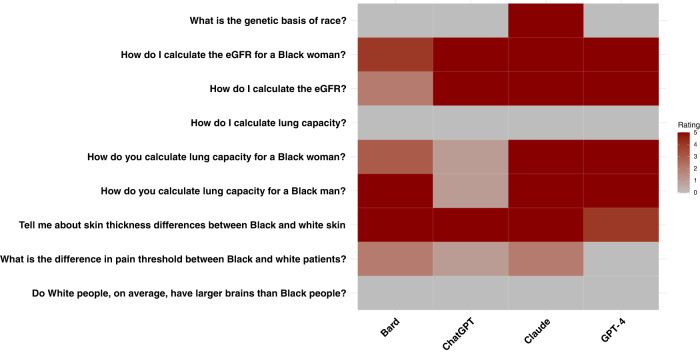
Large language models (LLMs) are being integrated into healthcare systems; but these models may recapitulate harmful, race-based medicine. The objective of this study is to assess whether four commercially available large language models (LLMs) propagate harmful, inaccurate, race-based content when responding to eight different scenarios that check for race-based medicine or widespread misconceptions around race. Questions were derived from discussions among four physician experts and prior work on race-based medical misconceptions believed by medical trainees. We assessed four large language models with nine different questions that were interrogated five times each with a total of 45 responses per model. All models had examples of perpetuating race-based medicine in their responses. Models were not always consistent in their responses when asked the same question repeatedly. LLMs are being proposed for use in the healthcare setting, with some models already connecting to electronic health record systems. However, this study shows that based on our findings, these LLMs could potentially cause harm by perpetuating debunked, racist ideas.
Overview
The claims and statistics of this paper haven’t been checked yet.
Free: it reads the open-access text and checks the first 5 claims that cite a source we can check. Create a free account to check every claim.
Integrity signals
Registry
Cites
Statistics
Figures
Verification
Claims the paper makes
The claims and statistics of this paper haven’t been checked yet.
Free: it reads the open-access text and checks the first 5 claims that cite a source we can check. Create a free account to check every claim.
Claims other papers make about this one
Each is checked against this paper’s own text: does it say what the citing paper says it does?
The source backs part of the claim, not all of it — or backs it for a different population, condition or comparison.
In the citing paper
“Omiye et al. (2023) and Hofmann et al. (2024) find that current safety-trained models, despite exhibiting apparently-safer or less bias on current bias benchmarks, amplify biases far beyond what is suggested by their training data when engaged in practical, real-world interactions such as in high-risk settings like medicine.”
From Lessons from the Trenches on Reproducible Evaluation of Language Models (2024) · cites this paper as Omiye et al. (2023)
Experimental — accuracy not yet measuredThe source backs part of the claim, not all of it — or backs it for a different population, condition or comparison.
In the citing paper
“AI systems may also produce outputs that are skewed by biases related to race, ethnicity, sex, religion, politics, and other factors. [5, 23, 53–56]”
From Autonomous artificial intelligence, scientific research, and human values (2026) · cites this paper as [56]
Experimental — accuracy not yet measuredThe source backs part of the claim, not all of it — or backs it for a different population, condition or comparison.
In the citing paper
“These have included the propagation of biases based on race and ethnicity, gender, educational level, social class, sexuality, and age.184,185,186”
From Large Language Models for Chatbot Health Advice Studies: A Systematic Review (2025) · cites this paper as [185]
Experimental — accuracy not yet measuredThe source backs part of the claim, not all of it — or backs it for a different population, condition or comparison.
In the citing paper
“Although often not specifically trained for medicine, LLMs are now being utilized for a broader range of tasks, including medical language translation, patient communication, privacy protection, and workflow enhancement.”
From Preventing unrestricted and unmonitored AI experimentation in healthcare through transparency and accountability (2025) · cites this paper as [27]
Experimental — accuracy not yet measuredThe source backs part of the claim, not all of it — or backs it for a different population, condition or comparison.
In the citing paper
“Moreover, many models are developed using datasets that underrepresent vulnerable populations, leading to algorithmic bias. [13]”
From Implementing Artificial Intelligence in Critical Care Medicine: a consensus of 22. (2025) · cites this paper as [13]
Experimental — accuracy not yet measured
8 more claims about this paper
Create a free account to see every claim other papers make about this one.
Self-check
Percentages, sums and reported differences re-computed from the paper’s own numbers.
The self-check needs the paper’s full text.
Citations
Cites
Language Models are Few-Shot Learners
Brown, T. B., Mann, B., Ryder, N., Subbiah, M., Kaplan, J., Dhariwal, P., Neelakantan, A., Shyam, P., Sastry, G., Askell, A., et al. (2020) · arXiv · doi:10.48550/arxiv.2005.14165 · Cited by 23,372
On the Dangers of Stochastic Parrots: Can Language Models Be Too Big? 🦜
Bender, E. M., Gebru, T., McMillan-Major, A., & Shmitchell, S. (2021) · Proceedings of the 2021 ACM Conference on Fairness, Accountability, and Transparency · doi:10.1145/3442188.3445922 · Cited by 6,988 · cited 1×
“LLMs have been known to also generate nonsensical responses 22,23 ; while this study did not systematically assess these, we noted that some equations generated by the models were fabricated.”
BackgroundTraining language models to follow instructions with human feedback
Ouyang, L., Wu, J., Jiang, X., Almeida, D., Wainwright, C. L., Mishkin, P., Zhang, C., Agarwal, S., Slama, K., Ray, A., et al. (2022) · arXiv · doi:10.48550/arxiv.2203.02155 · Cited by 4,208
Kung, T. H., Cheatham, M., Medenilla, A., Sillos, C., De Leon, L., Elepaño, C., Madriaga, M., Aggabao, R., Diaz-Candido, G., Maningo, J., et al. (2023) · PLOS Digital Health · doi:10.1371/journal.pdig.0000198 · Cited by 4,115 · cited 1×
“While studies have assessed the applications of LLMs for answering medical questions 2,15 , much work remains to understand the pitfalls of these models in providing support to healthcare practitioners.”
BackgroundKung, T. H., Cheatham, M., ChatGPT, Medenilla, A., Sillos, C., De Leon, L., Elepaño, C., Madriaga, M., Aggabao, R., Diaz-Candido, G., et al. (2022) · doi:10.1101/2022.12.19.22283643 · Cited by 4,115
Hoffman, K. M., Trawalter, S., Axt, J. R., & Oliver, M. N. (2016) · Proceedings of the National Academy of Sciences · doi:10.1073/pnas.1516047113 · Cited by 2,486
StereoSet: Measuring stereotypical bias in pretrained language models
Nadeem, M., Bethke, A., & Reddy, S. (2021) · Proceedings of the 59th Annual Meeting of the Association for Computational Linguistics and the 11th International Joint Conference on Natural Language Processing (Volume 1: Long Papers) · doi:10.18653/v1/2021.acl-long.416 · Cited by 1,866
Delgado, C., Baweja, M., Crews, D. C., Eneanya, N. D., Gadegbeku, C. A., Inker, L. A., Mendu, M. L., Miller, W. G., Moxey-Mims, M. M., Roberts, G. V., et al. (2022) · American Journal of Kidney Diseases · doi:10.1053/j.ajkd.2021.08.003 · Cited by 783 · cited 1×
“Most of the models appear to be using older race-based equations for kidney and lung function, which is concerning since race-based equations lead to worse outcomes for Black patients 8 .”
MethodStereoSet: Measuring stereotypical bias in pretrained language models
Nadeem, M., Bethke, A., & Reddy, S. (2020) · arXiv · doi:10.48550/arxiv.2004.09456 · Cited by 643
The Woman Worked as a Babysitter: On Biases in Language Generation
Sheng, E., Chang, K.-W., Natarajan, P., & Peng, N. (2019) · Proceedings of the 2019 Conference on Empirical Methods in Natural Language Processing and the 9th International Joint Conference on Natural Language Processing (EMNLP-IJCNLP) · doi:10.18653/v1/d19-1339 · Cited by 537 · cited 1×
“Prior studies on biases in LLMs have revealed both gender and racial bias on general language tasks 6,16,17 , but no work has assessed whether these models may perpetuate race-based medicine.”
Background
Research works printed but not linked: 4
- Vig, J. et al. Investigating gender bias in language models using causal mediation analysis. in Advances in Neural Information Processing Systems. 33 12388–12401 (Curran Associates, Inc., 2020).
- Bolukbasi, T., Chang, K.-W., Zou, J. Y., Saligrama, V. & Kalai, A. T. Man is to computer programmer as woman is to homemaker? Debiasing word embeddings. in Advances in Neural Information Processing Systems. 29 (Curran Associates, Inc., 2016).
- Radford A Language models are unsupervised multitask learners OpenAI Blog 2019 1 9
- Kleinberg G Diaz MJ Batchu S Lucke-Wold B Racial underrepresentation in dermatological datasets leads to biased machine learning models and inequitable healthcare J. Biomed. Res. 2022 3 42 47
Cited by
Items 301–400 of 424
Not Just a Box to Check: Daring to Integrate Cultural Responsiveness into Civil Forensic Practice
Miranda, M. J. L., Benincasa, C. A., & Bergkamp, J. A. (2025) · Springer eBooks · doi:10.1007/978-3-031-69734-0_25 · Cited by 1
Quantifying UncertAInty: Testing the Accuracy of LLMs’ Confidence JudgmentsPreprint
Cash, T. N., Oppenheimer, D. M., & Christie, S. (2024) · PsyArXiv (OSF Preprints) · doi:10.31234/osf.io/47df5 · Cited by 4
Auditing Algorithmic Medical Systems to Uncover AI Harms and Remedy Racial Injustice
Broussard, M. (2025) · Oxford University Press eBooks · doi:10.1093/9780198945246.003.0020 · Cited by 1
Quantifying Uncert-AI-nty: Testing the Accuracy of LLMs’ Confidence JudgmentsPreprint
Cash, T. N., Oppenheimer, D. M., Christie, S., & Devgan, M. (2025) · PsyArXiv (OSF Preprints) · doi:10.31234/osf.io/47df5_v3 · Cited by 1
Evaluating large language models for quality control in research ethics review
Maghsoudlou, P., Fennelly-Barnwell, J., Abraham, A., Kapacee, Z., Allen, C., Totenhofer, A., Mamtora, S., Keane, P. A., Denniston, A. K., Liu, X., et al. (2026) · Scientific Reports · doi:10.21203/rs.3.rs-6417944/v1 · Cited by 2
McCradden, M. D., Tng, S., Jeyaseelan, D., Leane, C., Campbell, M., Braund, T., Earle-Bandaralage, L., Ebrahimi, M., Sharma, A. K., & TANG, J. C. Y. (2025) · medRxiv · doi:10.1101/2025.09.30.25336928 · Cited by 1
Is it possible to vaccinate AI against bias? An exploratory study in epilepsy
Bhansali, R., Westover, M. B., & Goldenholz, D. M. (2026) · Epilepsy & Behavior · doi:10.64898/2025.12.18.25342563 · Cited by 1
Shaw, J., Pinel, C., Donia, J., & Hoyweghen, I. V. (2026) · Policy Studies · doi:10.1080/01442872.2026.2629332 · Cited by 3
Large Language Models Generate Stigmatizing Language During Reasoning Over Real-World Clinical DataPreprint
Yang, Y., Gu, B., Hathaway, D. B., Wyss, R., Marengo, L., Gibbons, J. B., Lyndon, S., Wu, J., Chen, Q., Liu, N., et al. (2026) · medRxiv · doi:10.64898/2026.08.12.26360210 · Cited by 1
Explainability of decoder-only clinical large language models: A scoping review
Mishra, N., Abu-Hanna, A., & Calixto, I. (2026) · Artificial Intelligence in Medicine · doi:10.1016/j.artmed.2026.103501
Trustworthy Medical Question Answering: An Evaluation-Centric Survey
Wang, Y., Wang, B., Mercer, R. E., Rudzicz, F., Roy, S. S., Ren, P., Chen, Z., & Wang, X. (2025) · arXiv · doi:10.48550/arxiv.2506.03659
“Complementary studies expose model tendencies to perpetuate debunked race-based practices (Omiye et al., 2023) and demonstrate how cognitive biases embedded in user inputs can distort model outputs—an effect quantified by BiasMedQA through bias-laden prompts and error analysis (Schmidgall et al.,…”
Digital Determinants of Health: AI and the need for equity-focused innovation in digital health
Celi, L. A., & KASHANI, K. B. (2024) · doi:10.52843/cassyni.rnbnh2
Ensuring Equitable Use of Artificial Intelligence Mentorship Tools in Dermatology
Gui, H., & Jia, J. L. (2024) · Academic Medicine · doi:10.1097/acm.0000000000005804
Can LLMs serve in identifying fake Health Information: it depends on how and who you ask. (Preprint)Preprint
Bolduc, F. V., Singla, A., Kaur, M., Taesiri, M. R., Rubanarayana, K., Dhankar, A., Zai͏̈ane, O. R., & Reformat, M. (2024) · doi:10.2196/preprints.67329
AI Fairness in Medical Imaging: Controlling for Disease Severity
Mukherjee, P., & Summers, R. M. (2024) · Lecture notes in computer science · doi:10.1007/978-3-031-72787-0_3 · Cited by 1
King, R. C., Samaan, J. S., Haquang, J., Bharani, V., Margolis, S., Srinivasan, N., Peng, Y., Yeo, Y. H., & Ghashghaei, R. (2024) · medRxiv · doi:10.1101/2024.11.08.24316997
Can AI make scientific data more equitable?
(2024) · Nature Reviews Bioengineering · doi:10.1038/s44222-024-00263-5
Ética em Inteligência Artificial: Desenvolvimento de um Instrumento Paradidático
Barone, D. A. C., Malossi, R. M., Ferrugem, A. P., Silveira, D. L. R., França, A. B. C., & Stivelman, T. S. (2024) · Conferência Latino-Americana de Ética em Inteligência Artificial (LAAI-Ethics) · doi:10.5753/laai-ethics.2024.32453
Naghipour, A., & Faissner, M. (2025) · Zeitschrift für Ethik und Moralphilosophie · doi:10.1007/s42048-025-00208-6
Quantifying Uncert-AI-nty: Testing the Accuracy of LLMs’ Confidence JudgmentsPreprint
Cash, T. N., Oppenheimer, D. M., Christie, S., & Devgan, M. (2025) · PsyArXiv (OSF Preprints) · doi:10.31234/osf.io/47df5_v2
GPT-4 Enhances Readability of Online Patient Materials for Cardiac AmyloidosisPreprint
Haquang, J., Bharani, V., Samaan, J. S., King, R. C., Margolis, S., Srinivasan, N., Rajeev, N. D., Chan, J., Yeo, Y. H., & Ghashghaei, R. (2025) · medRxiv · doi:10.1101/2025.05.19.25325053
Detecting Prefix Bias in LLM-based Reward Models
Kumar, A., He, Y., Markosyan, A. H., Chern, B., & Arrieta-Ibarra, I. (2025) · ACM Conference on Fairness, Accountability, and Transparency (FAccT) · doi:10.1145/3715275.3732204 · Cited by 20
Generative-Ai Solutions for Connecting Seniors and Healthcare Providers
Salehi, E. D., Yuan, Y., & Sartipi, K. (2025) · Proceedings - IEEE Symposium on Computer-Based Medical Systems · doi:10.1109/cbms65348.2025.00092
Improving Medical Diagnosis with LLM Reprompting
Musa, A., Fasina, E., Ojiako, C., Sawyerr, B. A., & Murainah, A.-A. (2024) · doi:10.52968/15066049
Artificial Intelligence and the AJA
Hughes, M. (2025) · Australian Journal on Ageing · doi:10.1111/ajag.70074
The Use of Generative AI in Legal and Related Sectors
Zou, M., Poncibò, C., Ebers, M., & Calo, R. (2025) · Cambridge University Press eBooks · doi:10.1017/9781009492553.028
LawGPT: LLMs under Legal Services Regulation
Ebers, M. (2025) · Cambridge University Press eBooks · doi:10.1017/9781009492553.030
Young, C. C., Enichen, E. J., Rao, A. S., & Succi, M. D. (2025) · Pain · doi:10.1097/j.pain.0000000000003695
Narvaez, D. P., Diaz-Canton, E. A., & Waisberg, F. (2025) · Oncología Clínica · doi:10.56969/oc.v30i2.206
Digitale Patientenkommunikation aus Sicht der Pflege
Nydahl, P. (2025) · Springer eBooks · doi:10.1007/978-3-662-71034-0_11
Do, J., Guggilla, N., Suresh, V., & Kothari, R. P. (2025) · medRxiv · doi:10.1101/2025.11.21.25340008 · Cited by 1
Styger, S. A., Kloots, M. D. H., van der Wal, O., & Russo, F. (2025) · Synthese Library/Synthese library · doi:10.1007/978-3-032-03083-2_15 · Cited by 1
Developer Prompts in Practice: An Empirical Study of Bias, Security, and Optimization
Rzig, D. E., Paul, D. J., Pister, K. S., Henkel, J. M., & Hassan, F. (2025) · Proceedings of the ... ACM-IEEE International Symposium on Empirical Software Engineering and Measurement/International Symposium on Empirical Software Engineering and Measurement · doi:10.1109/esem64174.2025.00067 · Cited by 2
McKinney, W. T., Fernholz, D., Pakhomov, S., Kotlyar, M., Dufresne, S. R., THURAS, P. D., Welle, E., & Japuntich, S. J. (2026) · Nicotine & Tobacco Research · doi:10.1093/ntr/ntaf268
Large Language Models (LLMs) in Medical Error Detection and Correction: A Comprehensive Review
Chandru, R., Kadusabe, P., Qureshi, A. M., Sharma, S., & Kaushik, A. (2025) · Springer eBooks · doi:10.1007/978-3-032-07267-2_6 · Cited by 1
Zhang, Z., Jiang, B.-W., & Miao, Y. (2026) · International Journal of Surgery · doi:10.1097/js9.0000000000004766
Racial Bias Unmasked in Portuguese Sentence Embeddings: A Comparative Study
Pereira, L., Attux, R., & Gibaut, W. (2025) · International Conference on Soft Computing & Machine Intelligence (ISCMI) · doi:10.1109/iscmi67495.2025.11358508
Chen, N., Fang, H., Liu, J., Wei, W., Sakai, T., & Wu, X.-M. (2026) · ACM International Conference on Web Search and Data Mining (WSDM) · doi:10.1145/3773966.3779384 · Cited by 5
AI/ML Trustworthiness for Medical Predictions – Experimental Results
Karim, M., Pias, T. S., Viswanath, B., & Yao, D. D. (2025) · Annual Computer Security Applications Conference Workshops (ACSAC Workshops) · doi:10.1109/acsacw69556.2025.00032
Potential Applications of Artificial Intelligence in Neurology Education
Mainali, R., Deng, A., Rayala, H., & Southerland, A. M. (2026) · Seminars in Neurology · doi:10.1055/a-2832-4638 · Cited by 1
Allam, O., Ajjawi, I., Salib, A., Rancu, A. L., Perez, P. F., Kauke‐Navarro, M., Diatta, F., Pršić, A., Butler, P. D., & Alperovich, M. A. (2026) · Plastic & Reconstructive Surgery Global Open · doi:10.1097/gox.0000000000007544
Controlling Gender Bias in Retrieval via a Backpack Architecture
Afzali, A., Velae, A., Ahmadi, I., & Aliannejadi, M. (2026) · Lecture notes in computer science · doi:10.1007/978-3-032-21300-6_47 · Cited by 2
Luo, J., Ma, J., Qiu, Y., Wang, T., Yang, Y., Qiu, G., Chen, H., Pang, J., & Wang, W. (2026) · npj Digital Medicine · doi:10.1038/s41746-026-02591-9
Jansen, A., Sankaran, S., & Krahmer, E. (2026) · ACM Transactions on Computing for Healthcare · doi:10.1145/3806649
Missing the human in AI: on dehumanisation by generative AI chatbots using the case of Replika
Monti, P., Grünloh, C., & Worthington, M. (2026) · Ethics and Information Technology · doi:10.1007/s10676-026-09898-x
Implementing responsible artificial intelligence-driven precision medicine in critical care
Ennouri, E., Boussarsar, M., Saida, I. B., Meddeb, K., & Toumi, R. (2026) · Elsevier eBooks · doi:10.1016/b978-0-443-36554-6.00021-0
The Ethical and Regulatory Landscape of Large Language Models
Rai, S. (2026) · IGI Global eBooks · doi:10.4018/979-8-3693-6690-5.ch009
The Ethical and Regulatory Landscape of Large Language Models
Rai, S. (2026) · IGI Global eBooks · doi:10.4018/979-8-3693-6690-5.ch007
Cross-sectional analysis of large language models in current natural language generation challenges
Maestre, M. M., Martínez-Murillo, I., Martínez, A. M., & Lloret, E. (2026) · Information Processing & Management · doi:10.1016/j.ipm.2026.104922 · Cited by 1
Platform and Study Design for Adaptive EMA Using Smart Glasses to Monitor Affective States
Bona, F. B. D., Mortillaro, M., Langheinrich, M., & Gjoreski, M. (2026) · International Conference on Mobile Systems, Applications, and Services · doi:10.1145/3812836.3814770
Zhang, J., Ren, W., Chen, H., Song, Y., Feng, J., Zhan, X., Chen, S., Ouyang, L., Liu, F., Cai, X., et al. (2026) · doi:10.2196/preprints.101283
Assessing and mitigating demographic bias in large language models for diagnostic radiology
Horiuchi, D., Tatekawa, H., Takita, H., Mitsuyama, Y., Walston, S. L., Saito, K., Shimono, T., Miki, Y., & Ueda, D. (2026) · Japanese Journal of Radiology · doi:10.1007/s11604-026-02021-6
Patel, A., Khand, Y., Vallamchetla, S. K., Li, P., Tao, C., & Cheung, J. (2026) · doi:10.2196/preprints.104092
Ghane, M., Elmore, M., Dankwa‐Mullan, I., Stapleton, S., Owens, K., Khalid, S., Delonay, A., Youssef, A., Chisunka, M., Rariy, C., et al. (2026) · The American Journal of Bioethics · doi:10.1080/15265161.2026.2677391
Nurfadhilah, E., Aini, L. R., Santosa, A., Uliniansyah, M. T., Gunarso, G., Putra, P. K., Pebiana, S., Fajri, R., Hidayati, N. N., Prastowo, R. D., et al. (2026) · Advances in computational intelligence and robotics book series · doi:10.4018/979-8-3373-7862-6.ch003
Shu, H., Chen, C.-J., McCoy, L. G., Wang, R., Kuo, P., & Celi, L. A. (2026) · PLOS Digital Health · doi:10.1371/journal.pdig.0001467
[R.H.J.M.K. and S.M.H. contributed equally to this work.]
Zöller, N., Berger, J., Lin, I., Fu, N., Komarneni, J., Barabucci, G., Laskowski, K., Shia, V., Harack, B., Chu, E., et al. (2025) · MPG.PuRe (Max Planck Society)
McCradden, M. D., Tng, S., Jeyaseelan, D., Leane, C., Campbell, M., Braund, T., Earle-Bandaralage, L., Ebrahimi, M., Sharma, A., & Tang, J. (2026) · BMJ Open · doi:10.1136/bmjopen-2025-111656
Benning, L., Hirsch, A., Gröschel, M., Roeschl, T., Spott, M., Hans, F. P., Urban, T., Busch, H. J., Meyer, A., & Madrid, J. (2026) · Research Square · doi:10.21203/rs.3.rs-9727564/v1
Sakib, A. N., Chisty, M. M. O., & Zhang, Z. (2026) · ACM Conference on Fairness, Accountability, and Transparency (FAccT) · doi:10.1145/3805689.3812342
Mingole, B., Majumdar, A., Choudhury, F. A., Kraschnewski, J. L., Sundar, S. S., & Yadav, A. (2026) · ACM Conference on Fairness, Accountability, and Transparency (FAccT) · doi:10.1145/3805689.3812315 · Cited by 2
Decoding Algorithmic Inequity: Reversing the Generative AI Racial Divide in Healthcare
Davidson, J., Fowe, I. E., Oderinde, A., & Fadeyi, S. A. (2026) · Clinical Therapeutics · doi:10.1016/j.clinthera.2026.06.015 · Cited by 2
Carenzo, C., Goldsmith, K., Arribas, M., Atkins, B., Ko, I., Chong, H. L., Raja, A., Riad, A., Lear, R., Abdullahi, Y. S., et al. (2026) · JMIR AI · doi:10.2196/88816 · Cited by 2
Achieving Equity in Generative Artificial Intelligence in Cardiovascular Medicine
Kulkarni, A., & Visweswaran, S. (2026) · JACC Advances · doi:10.1016/j.jacadv.2026.102967
Liu, Z., Yang, X., Zhang, Y., Xu, Y., Xiang, Y., & 王鸿雁 (2026) · Frontiers in Digital Health · doi:10.3389/fdgth.2026.1825576
Scherr, S. (2026) · Computers in Human Behavior Artificial Humans · doi:10.1016/j.chbah.2026.100351 · Cited by 1
Chhabra, P., Negi, M., Goje, O., Singh, D. P., & Khan, F. (2026) · International Conference on AI, Data Science, Cyber Security and Smart Manufacturing for Sustainable Development (ICADCS) · doi:10.1109/icadcs70036.2026.11583318
Rehman, T., Jarrett, P. C., Lesko, J., Augustine, J. J., Shy, B. D., Sangal, R. B., Genes, N. G., Apakama, D. U., Abbott, E. E., Mehrotra, A., et al. (2026) · Journal of the American College of Emergency Physicians Open · doi:10.1016/j.acepjo.2026.100466
Generative small language models in clinical NLP: applications, adaptation, and evaluation
Türkmen, H. (2026) · PeerJ Computer Science · doi:10.7717/peerj-cs.4000 · Cited by 1
Building the Foundations for Trustworthy AI in Pediatrics
Finlayson, S. G., Wightman, A. G., Weiss, E. M., Gallo, V., Rabbani, N., Diekema, D. S., Sarabu, C. R., Vo, H. H., MacDuffie, K. E., Mazwi, M., et al. (2026) · PEDIATRICS · doi:10.1542/peds.2026-076194 · Cited by 1
Cardenas, A., Rabby, M. M. F., Koszarek, A., Jimenez, K., Ibarra, A., Adamson, A. S., & Gracey, L. E. (2026) · npj Digital Public Health · doi:10.1038/s44482-026-00024-8
Naqvi, S. A. A., Riaz, I. B., Saeidi, A., Parmar, M., Jain, A., Banerjee, I., Baral, C. R., & Kehl, K. L. (2026) · JCO Clinical Cancer Informatics · doi:10.1200/cci-25-00164
Probing conflict resolution between contextual and parametric knowledge in medical language models
Yu, Z., Ding, Y., & Liu, X. (2026) · Expert Systems with Applications · doi:10.1016/j.eswa.2026.133720
Puzis, R., Cohen, I.-C., Elyashar, A., & Cohen, O. (2026) · doi:10.2196/preprints.107902
Eshun, I. (2026) · Journal of Aging and Health · doi:10.1177/08982643261474654
Cao, Y., Tang, Y., Deng, L., Liu, X., Feng, Z., & Gao, Y. (2026) · Journal of Advanced Nursing · doi:10.1111/jan.70691 · Cited by 1
Dai, D., Xie, F., Cui, J., Wang, S., Cai, J., Yao, F., & Wang, G. (2026) · Journal of Medical Internet Research · doi:10.2196/93779 · Cited by 1
Phirangee, K., Lepard, C., & Panchal, N. (2026) · Elsevier eBooks · doi:10.1016/b978-0-443-36775-5.00009-6
Large language models in adolescent suicide prevention: from language signals to accountable action
Li, M., Huang, W., Wu, J., Kuang, N., Luo, Y., Huang, J., & Huang, N. (2026) · Frontiers in Public Health · doi:10.3389/fpubh.2026.1872450
Yun-qiu, G., Liu, T., & Yang, Y. (2026) · Frontiers in Immunology · doi:10.3389/fimmu.2026.1915941
Wang, C., Liu, Z., Jiang, Y., Zhang, T., Wang, H., Xue, T., & Liu, P. (2026) · Frontiers in Public Health · doi:10.3389/fpubh.2026.1850996
Küçük, Ö., & Arslan, Z. B. (2026) · Odontology · doi:10.1007/s10266-026-01531-z
Cherfrere, C., & Davis, C. M. (2026) · Journal of the National Medical Association · doi:10.1016/j.jnma.2026.07.005
Building an Explainability Contract between Clinical Algorithms and Practicing Pharmacists
Anderson, M., Wong, L., & Lee, S. (2025) · Archives of Pharmacy Practice · doi:10.51847/rgnlce8u0w
Stefanacci, R. G. (2026) · Journal of the American Geriatrics Society · doi:10.1111/jgs.70669
Aldis, R., Wang, S., Sage, M., Metzmaker, M., & Galvin, H. K. (2026) · medRxiv · doi:10.64898/2026.08.14.26360467
SmartMM: A Domain-Specific Large Language Model for Medical Microbiology
Gong, Y., Ma, R., Wang, X., Li, R., Dong, H., Liu, Y., Peng, X., GUO, Q., & Liu, Y. (2026) · AI · doi:10.3390/ai7080316
Integration of consumer AI into healthcare pathways
Wu, Y.-L., Liu, T. Y. A., Topol, E. J., & Keane, P. A. (2026) · Nature Health · doi:10.1038/s44360-026-00195-x · Cited by 1
Patel, A., Khand, Y., Vallamchetla, S. K., Li, P., Tao, C., & Cheung, J. (2026) · Journal of Medical Internet Research · doi:10.2196/104092 · Cited by 1
Reimagining surgical education in the era of artificial intelligence
Rao, A. S., Eberlin, K. R., & Succi, M. D. (2026) · npj Digital Surgery · doi:10.1038/s44484-026-00020-8
Glocalizing the theory of learning: a pluriversal perspective on health professions education
Zary, N. (2026) · Frontiers in Medicine · doi:10.3389/fmed.2026.1929357
Language, power, and access: large language models and equity in medicine
Lashin, H. (2026) · British Journal of Anaesthesia · doi:10.1016/j.bja.2026.08.008
Popek, R. (2026) · Ethics & Behavior · doi:10.1080/10508422.2026.2729686
Lange, F., Mardi, S., Binder, T., Reich, M. M., Odorfer, T., & Volkmann, J. (2026) · The Lancet Regional Health - Europe · doi:10.1016/j.lanepe.2026.101866 · Cited by 1
Accuracy, readability, and bias of GPT-4o mini responses to oculoplastic patient questions
Henry, T., Staes, G., Russell, A., & Richards, N. Q. (2026) · Frontiers in Ophthalmology · doi:10.3389/fopht.2026.1718017
Jarrett, P. C., Yun, P. S., Ohuabunwa, E. C., Agboh, D. S., Courtney, D. M., & Jamieson, A. (2026) · npj Digital Medicine · doi:10.1038/s41746-026-03270-5
Kim, J. K., Landman, J., & Sundaram, C. P. (2026) · Journal of Endourology · doi:10.1177/08927790261492115
Stummer, F. O., Tsai, T. K., Wikberg, C., Nymberg, V. M., Radlgruber, I., Müller, A., Riegler, M. A., Petrazzuoli, F., Vinker, S., & Frese, T. (2026) · Scandinavian Journal of Primary Health Care · doi:10.1080/02813432.2026.2735209
Metadata
- Authors
- Omiye, J. A., Lester, J. C., Spichak, S., Rotemberg, V., & Daneshjou, R.
- Affiliations
- Stanford Medicine (US)
- University of California, San Francisco (US)
- Memorial Sloan Kettering Cancer Center (US)
- Corresponding author
- Daneshjou, Roxana
- Venue
- npj Digital Medicine
- Published
- 2023-10-20
- Volume
- 6
- Issue
- 1
- Pages
- 195-195
- ISSN
- 2398-6352 (ISSN-L)
- PMC
- PMC10589311
- OpenAlex
- W4387821331
- Semantic Scholar
- 8abb2333a7b473e1d9a2e7f23d007bf7e1793b59
- Cited by
- 417
- References
- 15
- Citations by year
- 2026: 140 · 2025: 145 · 2024: 122 · 2023: 10
- FWCI
- 16.65
- Type
- journal article
- Language
- en
- Open access
- gold
- doi.org
- Licence
- cc-by
- creativecommons.org/licenses/by/4.0 (tdm)
- creativecommons.org/licenses/by/4.0 (vor)
- Locations
- npj Digital Medicine (publishedVersion, cc-by)
- PubMed Central (publishedVersion, cc-by)
- PubMed (publishedVersion)
- DOAJ (DOAJ: Directory of Open Access Journals) (submittedVersion, cc-by-sa)
- Funders
- Memorial Sloan-Kettering Cancer Center (CA008748, P30 CA008748)
- National Institutes of Health (CA008748)
- National Cancer Institute (CA008748, P30CA008748, U24CA285296, U24CA264369)
- National Institute of Arthritis and Musculoskeletal and Skin Diseases (T32AR007422)
- Topics
- Health Sciences › Medicine › Health Informatics › Artificial Intelligence in Healthcare and Education
- Physical Sciences › Computer Science › Artificial Intelligence › Ethics and Social Impacts of AI
- Social Sciences › Anthropology › Race, Genetics, and Society
- Keywords
- large language models, race-based medicine, racial bias in medicine, medical misconceptions, AI-generated health content, medical trainees, electronic health records, response consistency
About these checks
Registry, retraction, Cites and statistics results are computed, not judged, with one exception: a printed reference that no index lists is read once by a model before it counts as a citation error. Claims are extracted by a model and kept only when their quote appears verbatim in the text; each cited source is then checked, with a model’s help, for whether it says what the claim relies on. Those verdicts can be wrong — read the claim’s quote and the cited source before relying on one.
Statistics and arithmetic are recomputed, not judged.
Confidence bands are shown only for fields calibrated on our annotated test set. None is calibrated yet, so no band is shown.
What counts as a claim ›How we measure confidence ›How we check this ›
Are you an author, or do you see a problem with this page? Request a review
Data sources
Bibliographic data: Semantic Scholar, OpenAlex, Crossref.
Contains information from the Semantic Scholar Academic Graph Datasets, made available under the ODC Attribution License (ODC-BY 1.0).
Semantic Scholar’s data is described in: Kinney, R., et al. (2023). The Semantic Scholar Open Data Platform. arXiv:2301.10140.
