

Diagnostic reasoning prompts reveal the potential for large language model interpretability in medicine
Open accessThe DOI matches its Crossref record; 29 of the 29 references it cites were found in a registry or an index.
Abstract
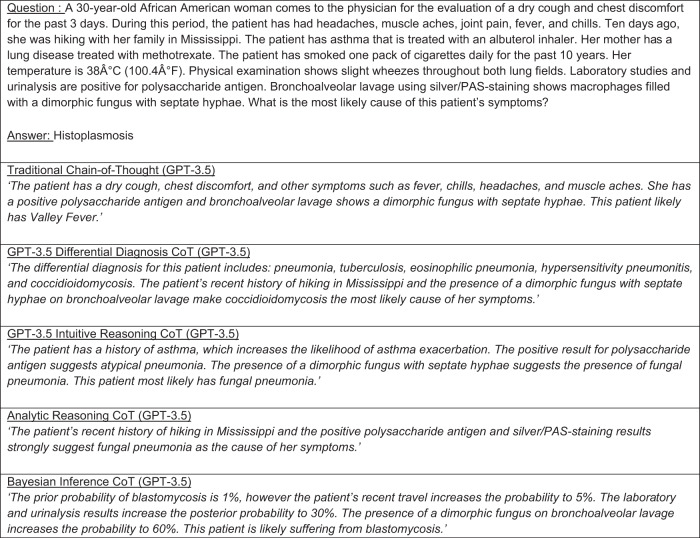
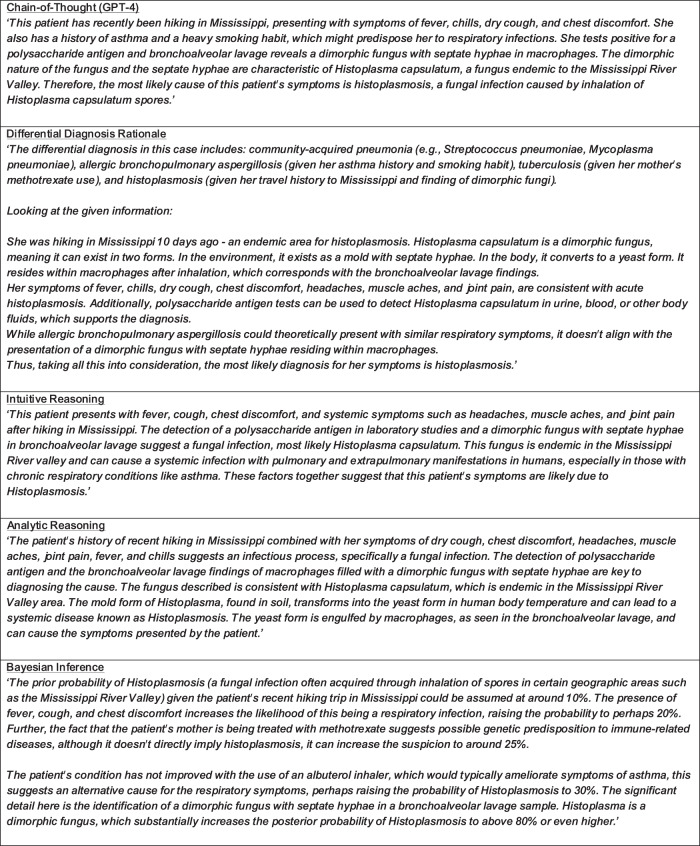
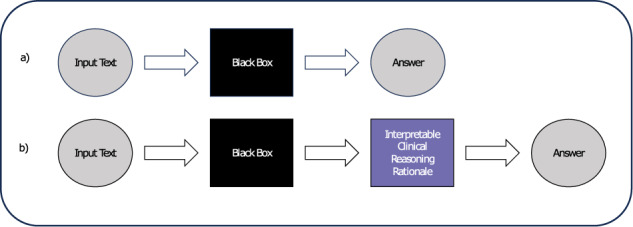
One of the major barriers to using large language models (LLMs) in medicine is the perception they use uninterpretable methods to make clinical decisions that are inherently different from the cognitive processes of clinicians. In this manuscript we develop diagnostic reasoning prompts to study whether LLMs can imitate clinical reasoning while accurately forming a diagnosis. We find that GPT-4 can be prompted to mimic the common clinical reasoning processes of clinicians without sacrificing diagnostic accuracy. This is significant because an LLM that can imitate clinical reasoning to provide an interpretable rationale offers physicians a means to evaluate whether an LLMs response is likely correct and can be trusted for patient care. Prompting methods that use diagnostic reasoning have the potential to mitigate the “black box” limitations of LLMs, bringing them one step closer to safe and effective use in medicine.
Overview
The claims and statistics of this paper haven’t been checked yet.
Free: it reads the open-access text and checks the first 5 claims that cite a source we can check. Create a free account to check every claim.
Integrity signals
Registry
Cites
Statistics
Figures
Verification
Claims the paper makes
The claims and statistics of this paper haven’t been checked yet.
Free: it reads the open-access text and checks the first 5 claims that cite a source we can check. Create a free account to check every claim.
Claims other papers make about this one
Each is checked against this paper’s own text: does it say what the citing paper says it does?
The source backs part of the claim, not all of it — or backs it for a different population, condition or comparison.
In the citing paper
“Most have been tested only with text-based, low-stakes interactions,33–38”
From Review of Artificial Intelligence for Clinical Use in Alzheimer's Disease and Related Dementias (2026) · cites this paper as [38]
Experimental — accuracy not yet measuredThe source backs part of the claim, not all of it — or backs it for a different population, condition or comparison.
In the citing paper
“Large language models (LLMs) have been shown to interpret complex clinical situations and offer recommendations, from differential diagnoses to care management, leading to growing interest in their application in the medical field [13-16].”
From Identifying Deprescribing Opportunities With Large Language Models in Older Adults: Retrospective Cohort Study (2025) · cites this paper as [16]
Experimental — accuracy not yet measuredThe source backs part of the claim, not all of it — or backs it for a different population, condition or comparison.
In the citing paper
“the majority of reviewed studies leverage the inherent text generation capabilities of LLMs to produce explanations as a natural by-product of inference [62,71,72,78,97,112].”
From Explainability of decoder-only clinical large language models: A scoping review (2026) · cites this paper as [62]
Experimental — accuracy not yet measuredThe cited source says what the claim attributes to it.
In the citing paper
“In our review, twenty studies relied exclusively on closed-source models [62,63,79,89,105,118]”
From Explainability of decoder-only clinical large language models: A scoping review (2026) · cites this paper as [62]
The cited source says what the claim attributes to it.
In the citing paper
“Chain-of-Thought prompting [62,64,78] and natural language explanation generation [72,74,75] produce outputs that align with clinical reasoning conventions, mimicking the differential diagnosis process familiar to practitioners.”
From Explainability of decoder-only clinical large language models: A scoping review (2026) · cites this paper as [62]
1 more claim about this paper
Create a free account to see every claim other papers make about this one.
Self-check
Percentages, sums and reported differences re-computed from the paper’s own numbers.
The self-check needs the paper’s full text.
Citations
Cites
Language Models are Few-Shot Learners
Brown, T. B., Mann, B., Ryder, N., Subbiah, M., Kaplan, J., Dhariwal, P., Neelakantan, A., Shyam, P., Sastry, G., Askell, A., et al. (2020) · arXiv · doi:10.48550/arxiv.2005.14165 · Cited by 23,372 · cited 2×
“Prompt engineering is emerging as a discipline in response to the phenomena that LLMs can perform substantially differently depending on how questions and prompts are posed to them 14,15 .”
BackgroundMethodChain-Of-Thought Prompting Elicits Reasoning in Large Language Models
Wei, J., Wang, X., Schuurmans, D., Bosma, M., Ichter, B., Xia, F., Chi, E., Le, Q. V., & Zhou, D. (2022) · Advances in Neural Information Processing Systems 35 · doi:10.52202/068431-1800 · Cited by 4,505
Chain-of-Thought Prompting Elicits Reasoning in Large Language Models
Wei, J., Wang, X., Schuurmans, D., Bosma, M., Ichter, B., Xia, F., Chi, E., Le, Q., & Zhou, D. (2022) · arXiv · doi:10.48550/arxiv.2201.11903 · Cited by 4,263 · cited 2×
“A notable example is Chain-of-thought (CoT) prompting, which involves instructing the LLM to divide its task into smaller reasoning steps and then complete the task step-by-step 17 .”
BackgroundKung, T. H., Cheatham, M., Medenilla, A., Sillos, C., De Leon, L., Elepaño, C., Madriaga, M., Aggabao, R., Diaz-Candido, G., Maningo, J., et al. (2023) · PLOS Digital Health · doi:10.1371/journal.pdig.0000198 · Cited by 4,115 · cited 1×
“Within medicine, initial efforts have demonstrated that LLMs can write clinical notes 3 , pass standardized medical exams 4 , and draft responses to patient questions 5,6 .”
BackgroundKung, T. H., Cheatham, M., ChatGPT, Medenilla, A., Sillos, C., De Leon, L., Elepaño, C., Madriaga, M., Aggabao, R., Diaz-Candido, G., et al. (2022) · doi:10.1101/2022.12.19.22283643 · Cited by 4,115
Large language models encode clinical knowledge
Singhal, K., Azizi, S., Tu, T., Mahdavi, S. S., Wei, J., Chung, H. W., Scales, N., Tanwani, A., Cole-Lewis, H., Pfohl, S., et al. (2023) · Nature · doi:10.1038/s41586-023-06291-2 · Cited by 4,083
Large Language Models Encode Clinical Knowledge
Singhal, K., Azizi, S., Tu, T., Mahdavi, S. S., Wei, J., Chung, H. W., Scales, N., Tanwani, A., Cole-Lewis, H., Pfohl, S., et al. (2022) · arXiv · doi:10.48550/arxiv.2212.13138 · Cited by 4,083
Large language models in medicine
Thirunavukarasu, A. J., Ting, D. S. J., Elangovan, K., Gutierrez, L., Tan, T. F., & Ting, D. S. W. (2023) · Nature Medicine · doi:10.1038/s41591-023-02448-8 · Cited by 3,944 · cited 8×
“5 accuracy on the MEDQA training set (Supplementary Data 3).”
BackgroundInfluentialAyers, J. W., Poliak, A., Dredze, M., Leas, E. C., Zhu, Z., Kelley, J. B., Faix, D. J., Goodman, A. M., Longhurst, C. A., Hogarth, M., et al. (2023) · JAMA Internal Medicine · doi:10.1001/jamainternmed.2023.1838 · Cited by 2,613 · cited 10×
“5 accuracy on the MEDQA training set (Supplementary Data 3).”
BackgroundInfluentialBenefits, Limits, and Risks of GPT-4 as an AI Chatbot for Medicine
Lee, P., Bubeck, S., & Petro, J. (2023) · New England Journal of Medicine · doi:10.1056/nejmsr2214184 · Cited by 1,738 · cited 3×
“Note that the full text of the example questions has been omitted for readability. rationale compared to correct answers.”
MethodInfluential
Research works printed but not linked: 2
- Case records of the Massachusetts General Hospital articles. 2020-2023. N. Engl. J. Med. Accessed: May 2023. https://www.nejm.org/medical-articles/case-records-of-the-massachusetts-general-hospital.
- UpToDate: industry-leading clinical decision support. Wolters Kluwer. Accessed: June 2023. https://www.wolterskluwer.com/en/solutions/uptodate.
Cited by
Items 201–268 of 268
AI Prompt Engineering for Neurologists and Trainees
Junior, V. F. M., Hadar, P., Murphy, S. N., & Moura, L. M. V. R. (2025) · Seminars in Neurology · doi:10.1055/a-2742-2349 · Cited by 3
“11,28 Neurology educators, including attending physicians and senior trainees, can leverage structured prompts to support learning goals, guide interactive case-based reasoning, and facilitate Socratic-style dialogue.”
InfluentialClinical reasoning from real-world oncology reports using large language models
Park, J. H., Kim, S., & Heo, J. (2025) · Digital Health · doi:10.1177/20552076251394622 · Cited by 5
Hu, S.-M., Chang, T.-J., Lin, L. H.-M., & Tsai, R. T. (2025) · IEEE International Conference on Computation, Big-Data and Engineering (ICCBE) · doi:10.1109/iccbe65177.2025.11255949
Zhao, F.-F., Zhan-chi, H., Liang, J.-J., Liu, Z., He, X., Chen, Y., Guo, B., Wang, Y., Tham, Y. C., & Cen, L. (2025) · BMJ Open Ophthalmology · doi:10.1136/bmjophth-2025-002185
Artificial intelligence in oral cancer: a feasibility study informed by Freud's case
Truppe, M. J., Schicho, K., Figl, M., Holawe, S., & Perisanidis, C. (2025) · Oral Oncology Reports · doi:10.1016/j.oor.2025.100773
Leveraging evidence-guided LLMs to enhance trustworthy depression diagnosis
Yuan, Y., Ben Tamo, J., Nnamdi, M. C., Wang, Y., & Wang, M. D. (2025) · 2025 IEEE EMBS International Conference on Biomedical and Health Informatics (BHI) · doi:10.1109/bhi67747.2025.11269522
Personalized Case- and Evidence-Based TBI Prognosis with Small Language Models
Manjunath, P., Adil, S. M., Wissel, B. D., Sexton, D. P., Lerner, B., & Dunn, T. (2025) · IEEE-EMBS International Conference on Biomedical and Health Informatics (BHI ...) · doi:10.1109/bhi67747.2025.11269507 · Cited by 1
“Beyond generating predictions, LLMs can also provide clinically relevant reasoning, offering justifications that reflect underlying clinical logic and support more transparent decision-making [13], [14].”
Multimorbidity measurement strategies for predicting hospital visits
Neves, B. D., Moreira, J. M., Gonçalves, S., Cerejo, J., Mota, I., Silva, N. A., Leite, F., & Silva, M. J. (2025) · BMC Health Services Research · doi:10.1186/s12913-025-13817-z
Shao, M., & Zhang, H. (2025) · npj Digital Medicine · doi:10.1038/s41746-025-02146-4 · Cited by 4
“We also observed that diagnostic accuracy declined as case complexity increased, consistent with previous fi ndings 47,48 .”
NooGenie: Unlocking Noonan Syndrome with Llama 3
Dutta, K., Pachal, S., Roy, D. G., Datta, P., & Karras, D. A. (2026) · Lecture notes in networks and systems · doi:10.1007/978-981-96-8998-9_7
Hagler, S., Adibuzzaman, M., McWeeney, S. K., & Cohen, A. M. (2026) · medRxiv · doi:10.64898/2026.01.09.26343792 · Cited by 1
Exposing the fragility of LLM reasoning through bias-inducing prompts: evidence from BiasMedQA
Kim, S. H., Ziegelmayer, S., Busch, F., Mertens, C. J., Keicher, M., Adams, L. C., Bressem, K. K., Braren, R., Makowski, M. R., Kirschke, J. S., et al. (2026) · BMJ Digital Health & AI · doi:10.1136/bmjdhai-2025-000189 · Cited by 3
“These findings have profound implications for various clinical applications of LLMs. LLM-based triage tools might inadvertently prioritise certain symptom descriptions over others due to biased responses induced by irrelevant information related to the clinical presentation or history of the patient.”
InfluentialNagao, T., & Kawakita, T. (2026) · American Journal of Perinatology · doi:10.1055/a-2793-9092
Han, W., Zhu, W., Feng, G., Wang, Y., Chen, G., Zhou, H., Quan, B., Wu, Q., Yang, J., Jin, K., et al. (2026) · Advances in Medical Education and Practice · doi:10.2147/amep.s576651
Marjanović, M., & Latinović, L. (2026) · Serbian Journal of Engineering Management · doi:10.5937/sjem2600076m
The Impact of Prompting Strategies on the Quality of LLM-Generated Biomedical Explanations
Kızılırrmak, M., Alper, B. M., Bon, M., & Nazlıoğlu, S. (2026) · International Informatics and Software Engineering Conference (IISEC) · doi:10.1109/iisec69317.2026.11418489
Integrating Generative AI into Nomograms for Breast Cancer Nodal Risk Predictions
Shah, A., Love, J. A., Butler, M., Butler, L. N., Mittendorf, E. A., King, T. A., & Park, K. U. (2026) · Annals of Surgical Oncology · doi:10.1245/s10434-026-19482-8
“24 The limited transparency and reliability of LLM reasoning processes hinders confident utilization of these tools by clinicians.”
Thawinwisan, N., (35901), C. L., Yamamoto, G., Kishimoto, K., Mori, Y., & Kuroda, T. (2026) · doi:10.2196/preprints.94614
DeepSeek-R1 vs. OpenAI o1 in colorectal cancer screening: a binational evaluation
Chen, Y., Deng, S., Hakenberg, P., Li, C., Zhan, T., Fan, D., Lin, X., Li, X., Yang, C., & hu, J. (2026) · BMC Gastroenterology · doi:10.1186/s12876-026-04810-9 · Cited by 1
“…GPT family of LLMs and stands out for its implementation of the chain-of-thought (CoT) reasoning method [9], which enables the model to break down complex questions into a series of successive logical steps, improving consistency and reducing the risk of incorrect or incomplete answers [10, 11].”
Maruyama, K., & Besold, T. R. (2026) · CHI Conference on Human Factors in Computing Systems · doi:10.1145/3772318.3791402
Evaluating open-source LLMs for dental EMR generation
Wang, H., Du, W., Yang, B., Liu, M., Xu, C., Zhang, W., Xu, C., He, L., Zhang, W., Yu, Y., et al. (2026) · BMC Oral Health · doi:10.1186/s12903-026-08346-y
“The pronounced gains in Profes-sionalism (+ 0.50) and Structure (+ 0.43) suggest that the CRISPE framework effectively guides models toward generating professionally formatted documentation [25, 26].”
InfluentialNarasimha, S. V. G., Brown, N., & Sridhar, S. (2026) · medRxiv · doi:10.64898/2026.04.17.26351127
Wu, P., Han, Y., Zhang, J., Li, Y., Jiang, M., Lu, X., Zhang, H., Xu, D., Hao, M., Wang, L., et al. (2026) · medRxiv · doi:10.64898/2026.04.26.26351793
Azevedo, M. A. (2026) · Springer eBooks · doi:10.1007/978-3-032-15112-4_32
Xiang, L., Fang, Y., & Zhanzhan (2026) · BMC Medical Informatics and Decision Making · doi:10.1186/s12911-026-03548-4 · Cited by 1
“Integrating AI diagnostic tools with telemedicine platforms can create “hub-and-spoke” models, allowing experts at comprehensive stroke centers to remotely guide spoke-site clinicians with AI-interpreted images, democratizing access to expertise [83–85].”
Case Studies of Explainable LLMs in Diagnosis, Treatment Planning, and Patient Interaction
Tabatabaei, A., Gorji, M., & Rahimi, A. (2026) · Springer eBooks · doi:10.1007/978-3-032-15088-2_8
Core Techniques for Explaining LLMs in Healthcare
Farhadi, A., & Siasifar, R. (2026) · Springer eBooks · doi:10.1007/978-3-032-15088-2_4 · Cited by 1
Artificial Intelligence Applications
Li, B., (4829), Y. L., Hou, B., Li, T., Lin, T., Wei, D., Gan, W., Liu, Z., Zhou, M., Li, S., et al. (2026) · Advanced topics in science and technology in China · doi:10.1007/978-981-95-8037-8_7
Sultanov, R., Aarthi, S., Srinivasan, S., Ravikumar, R. N., & Umarov, D. (2026) · Advances in computational intelligence and robotics book series · doi:10.4018/979-8-3373-7862-6.ch013
Large reasoning models as thinking machines for medicine
Zhou, H.-Y., Rodman, A. M., Liu, P., Rajpurkar, P., Hu, Y., Wong, T. Y., & Topol, E. J. (2026) · Nature Biomedical Engineering · doi:10.1038/s41551-026-01701-y · Cited by 1
“When prompts mirror clinical intent, responses can become more purpose-aligned and easier for clinicians to audit 65,66 .”
Zhang, T., Ding, J.-E., Ozolcer, M., Hung, F., Yang, A. C.-C., Liu, F., Ji, Y.-R., & Bae, S. W. (2026) · International Conference on Activity and Behavior Computing (ABC) · doi:10.1109/abc68169.2026.11567305 · Cited by 1
Zhou, S., Liu, R., Su, B., Wang, J., Wang, Y., & Jiang, B. (2026) · Chinese Control and Decision Conference (CCDC) · doi:10.1109/ccdc69976.2026.11560033
“Recent advances in large language models (LLMs) have demonstrated remarkable capabilities in natural language comprehension and complex reasoning [12].”
Utilizing large language models for early disease identification
Asraf, S. S., & Palanigurupackiam, N. (2026) · Elsevier eBooks · doi:10.1016/b978-0-443-44021-2.00008-7
Cao, W., Lloyd, I., Dichmann, M., Halder, N., Thomas, D., Chen, Z., Blomain, E. S., Adejolu, F., Beck, K., Faherty, P., et al. (2026) · International Journal of Radiation Oncology*Biology*Physics · doi:10.1016/j.ijrobp.2026.06.3060
Paulino, D., Netto, A. T. C., Jardim, R. R.-A. J., Rocha, A., & Paredes, H. (2026) · International Journal of Human-Computer Interaction · doi:10.1080/10447318.2026.2690095
Gómez-Gutiérrez, O. A., Imbrognio, F., la Torre, O. A. D., Herrera-Vegas, D., & Fabiani, M. A. (2026) · Annals of Vascular Surgery · doi:10.1016/j.avsg.2026.07.004
Potential risks of generative artificial intelligence in kidney care
Viera, E., de Arizón, L. F., Torrá, R., & de Maeztu, G. (2026) · Clinical Kidney Journal · doi:10.1093/ckj/sfag200
“Similarly, prompts requesting stepwise reasoning or clinical justification influence diagnostic explanations and clinical reasoning [ 31 ].”
EviCare: Enhancing Diagnosis Prediction with Deep Model-Guided Evidence for In-Context Reasoning
Zhang, H., Zhang, X., Zhan, P., Luo, L., Lv, H., Tan, Y., Pan, S., & Yang, C. (2026) · ACM SIGKDD Conference on Knowledge Discovery and Data Mining (KDD) · doi:10.1145/3770854.3780257 · Cited by 1
Can AI assist in reducing diagnostic error? A narrative review
Scott, I. A. (2026) · Diagnosis · doi:10.1515/dx-2026-0021
“LLMs perform worse when applying analytical or probabilistic reasoning vs. deductive reasoning [124], under-scoring the need for appropriate prompts in optimising performance [125].”
Sun, C., Fang, J., Ni, L., Yu, K., Lu, Y., & Lu, Y. (2026) · Information Processing & Management · doi:10.1016/j.ipm.2026.105071 · Cited by 1
Hybrid CNN and LLM for Image-Based Classification of Plant Leaf Diseases
Pratama, F. R. G., Surono, S., & Thobirin, A. (2026) · International Journal of Advances in Data and Information Systems · doi:10.59395/ijadis.v7i2.1559
“…GPT-4o, the system supports explainable AI (XAI) principles: the CNN performs accurate visual recognition, while the LLM transforms predictions into clear diagnostic explanations, highlights key symptoms, differentiates similar diseases, and provides practical early recommendations [36].”
Roberts, L. J. (2026) · Research Square · doi:10.21203/rs.3.rs-10563856/v1
Shi, J., Ma, Y., Liu, Y., & Shi, B. (2026) · Frontiers in Public Health · doi:10.3389/fpubh.2026.1904062 · Cited by 1
“Retrieval-augmented generation and prompt-based reasoning can improve access to external evidence and make model outputs more auditable (17– 20).”
Pokharel, B. B., Hsu, M., Hedden, L., Nimmon, L., Bloom, D. E., & Tsuei, S. H. (2026) · PLoS ONE · doi:10.1371/journal.pone.0355491
Zhu, J., Huang, X., Shi, J., Chen, S., Chen, D., Gao, Z., Lü, Y., Yang, T., Wang, X., Lin, Y., et al. (2026) · Journal of Medical Internet Research · doi:10.2196/92919
“The significant impact of multimodal prompt configuration design on model performance is well documented [36], and our study confirms that multimodal prompting enhances all MLLMs’ performance by radiology-description prompting.”
Gao, J., Dong, L., & Hu, J. (2026) · doi:10.2196/preprints.109941
A Practical Guide to Becoming a Clinical Problem Solving Discussant
Dhaliwal, G., Goglin, S. E., & Sofair, A. N. (2026) · Journal of General Internal Medicine · doi:10.1007/s11606-026-10699-7
Kim, J.-W., Yoon, H., Jung, D., Oh, W., Choi, D., Yoon, S.-H., Kim, D.-J., Lee, S.-Y., Kim, B.-N., & Yang, C.-M. (2026) · IEEE Access · doi:10.1109/access.2026.3727881 · Cited by 1
“…processing tasks by leveraging instruction-based learning paradigms [21], [22], [23], zero-shot and few-shot generalization [19], [24], prompt engineering methodologies such as Chain-of-Thought reasoning [25], [26], [27], abstractive summarization [28], structured logical reasoning [29], [30].”
What clinicians should know about how large language models reason
Lyndon, S., & Benrimoh, D. A. (2026) · Nature Reviews Psychology · doi:10.1038/s44159-026-00617-3
“An LLM can produce a plausible explanation for a wrong conclusion or a correct conclusion accompanied by an explanation that does not faithfully reflect how the output was generated 6 .”
Generative Language Models in Medical Education: From Advent to Entrustment
Patil, S., Karabacak, M., Bisdas, S., & Margetis, K. D. (2026) · JMIR Medical Education · doi:10.2196/105347 · Cited by 1
“Studies of diagnostic reasoning suggest that AI tools may influence clinician reasoning and that prompting models to display reasoning can make outputs more interpretable [25,26].”
Yu, R., Peng, M., Li, H., Liu, S., Su, T., Guan, H., Shen, Y., Deng, Y., & Zhao, D. (2026) · Medicine · doi:10.1097/md.0000000000050485
“[18,19] In the present dataset, however, DeepSeek’s advantage should be interpreted cautiously.”
Kim, J., Son, K.-L., Yeom, C.-W., Kim, W.-H., Lee, S. H., Shin, J. S., Yang, H., Yoo, D., & Hahm, B. (2026) · Journal of Medical Internet Research · doi:10.2196/91405
“This observation is broadly consistent with prior studies showing that eliciting explicit reasoning may improve interpretability without reliably improving task performance [29,30].”
The answer is not the reasoning: protecting clinical judgement in medical education
Jerjes, W., El-Osta, A. A. R., & Majeed, A. (2026) · Postgraduate Medical Journal · doi:10.1093/postmj/qgag126
Stummer, F. O., Tsai, T. K., Wikberg, C., Nymberg, V. M., Radlgruber, I., Müller, A., Riegler, M. A., Petrazzuoli, F., Vinker, S., & Frese, T. (2026) · Scandinavian Journal of Primary Health Care · doi:10.1080/02813432.2026.2735209
“…clinical reasoning, it does not reason as a clinician does, which is why models must generate a rationale clinicians can inspect and validate [31]. hallucination is the sharpest instance, and it is a general property of current llMs rather than a primary-care problem as such: faced with…”
Large language and reasoning models in forensic sciences
Orrù, G., Pietrini, P., & Sartori, G. (2026) · Forensic Sciences Research · doi:10.3788/tfsr20260038
A survey of LLM reasoning in healthcare and medicine: Individual modeling and collaborative agents
Lin, Q., Xiao, L., Pu, B., Shi, K., Du, Y., Xu, J., He, K., Zhao, S., Zhang, J., Cambria, E., et al. (2026) · Information Fusion · doi:10.1016/j.inffus.2026.104827 · Cited by 7
BAYDİLİ, I., Taşçı, B., Taşçı, G., Doğan, Ş., & Tuncer, T. (2026) · Bioengineering · doi:10.3390/bioengineering13101175 · Cited by 1
Roberts, L. J. (2026) · Rheumatology International · doi:10.1007/s00296-026-06317-8
Elfadaly, L. S., & Shafik, M. (2026) · Odontology · doi:10.1007/s10266-026-01569-z
Inteligencia artificial y razonamiento clínico en educación médica: una revisión sistemática
Quispe, R. E. S., Janto, J. M. P., Jáuregui-Figueroa, M. D. R., & Jauregui, M. D. R. F. B. D. (2026) · Revista Simón Rodríguez · doi:10.62319/simonrodriguez.v.6i13.239
“…estas explicaciones no demuestran acceso fiel a su proceso interno, lo que abre una vía prometedora para que los docentes utilicen estas explicaciones como material didáctico y para que los estudiantes aprendan a evaluar la plausibilidad de las respuestas generadas (Savage et al., 2024).”
Angioni, D., Tirotta, D., Bello, F. D., & Montagnani, A. (2026) · Italian Journal of Medicine · doi:10.4081/itjm.2026.2648
Venkatesh, S., DelSignore, M., Wu, X., Morris, M. M., Kerr, W. T., Visweswaran, S., Wang, Y., & Xia, Z. (2026) · Multiple Sclerosis and Related Disorders · doi:10.1016/j.msard.2026.108024
A[I] see. A[I] reason. A[I] act. What is left for the physiotherapist?
Liew, B. X. W., Black, C. R. M., & Falla, D. (2026) · Musculoskeletal Science and Practice · doi:10.1016/j.msksp.2026.103677
Retrieval-Augmented Agentic Rubric Generation for Reliable Medical Response Evaluation
Chen, Y., Maiga, A., Rahmani, H. A., & Yilmaz, E. (2026) · arXiv · doi:10.48550/arxiv.2601.15161
Metadata
- Authors
- Savage, T., Nayak, A., Gallo, R., Rangan, E., & Chen, J. H.
- Affiliations
- Stanford Medicine (US)
- Stanford University (US)
- Corresponding author
- Savage, Thomas
- Venue
- npj Digital Medicine
- Published
- 2024-01-24
- Volume
- 7
- Issue
- 1
- Pages
- 20-20
- ISSN
- 2398-6352 (ISSN-L)
- PMC
- PMC10808088
- OpenAlex
- W4391170193
- Cited by
- 265
- References
- 22
- Citations by year
- 2026: 90 · 2025: 123 · 2024: 52
- FWCI
- 24.77
- Type
- journal article
- Language
- en
- Open access
- gold
- doi.org
- Licence
- cc-by
- creativecommons.org/licenses/by/4.0 (tdm)
- creativecommons.org/licenses/by/4.0 (vor)
- Locations
- npj Digital Medicine (publishedVersion, cc-by)
- PubMed Central (publishedVersion, cc-by)
- PubMed (publishedVersion)
- arXiv (Cornell University) (submittedVersion, cc-by)
- DOAJ (DOAJ: Directory of Open Access Journals) (submittedVersion, cc-by-sa)
- arXiv (Cornell University) (cc-by)
- Funders
- U.S. Department of Veterans Affairs
- Gordon and Betty Moore Foundation (#12409)
- American Heart Association
- Georgia Clinical and Translational Science Alliance (UL1TR003142)
- National Institutes of Health (UL1TR003142)
- National Institute on Drug Abuse (UG1DA015815)
- National Institute of Allergy and Infectious Diseases (R01AI178121)
- National Center for Advancing Translational Sciences
- Topics
- Health Sciences › Medicine › Health Informatics › Artificial Intelligence in Healthcare and Education
- Physical Sciences › Computer Science › Artificial Intelligence › Explainable Artificial Intelligence (XAI)
- Physical Sciences › Computer Science › Artificial Intelligence › Machine Learning in Healthcare
- Keywords
- large language models, interpretability, clinical reasoning, GPT-4, diagnostic accuracy, black box problem, trust in AI, prompting, clinical decision support
About these checks
Registry, retraction, Cites and statistics results are computed, not judged, with one exception: a printed reference that no index lists is read once by a model before it counts as a citation error. Claims are extracted by a model and kept only when their quote appears verbatim in the text; each cited source is then checked, with a model’s help, for whether it says what the claim relies on. Those verdicts can be wrong — read the claim’s quote and the cited source before relying on one.
Statistics and arithmetic are recomputed, not judged.
Confidence bands are shown only for fields calibrated on our annotated test set. None is calibrated yet, so no band is shown.
What counts as a claim ›How we measure confidence ›How we check this ›
Are you an author, or do you see a problem with this page? Request a review
Data sources
Bibliographic data: Semantic Scholar, OpenAlex, Crossref.
Contains information from the Semantic Scholar Academic Graph Datasets, made available under the ODC Attribution License (ODC-BY 1.0).
Semantic Scholar’s data is described in: Kinney, R., et al. (2023). The Semantic Scholar Open Data Platform. arXiv:2301.10140.
