

FFA-GPT: an automated pipeline for fundus fluorescein angiography interpretation and question-answer
Open accessPublished version of a preprint
The DOI matches its Crossref record; 56 of the 56 references it cites were found in a registry or an index.
Abstract
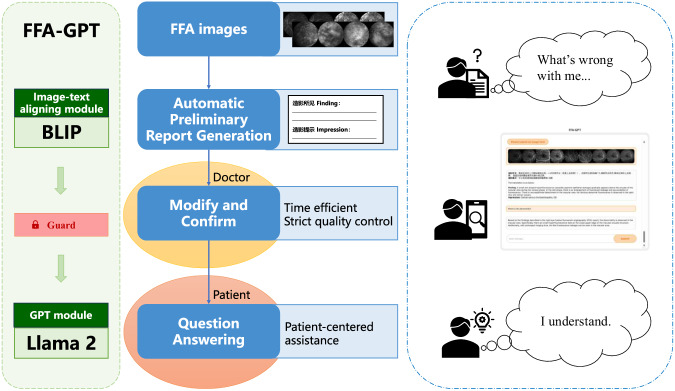
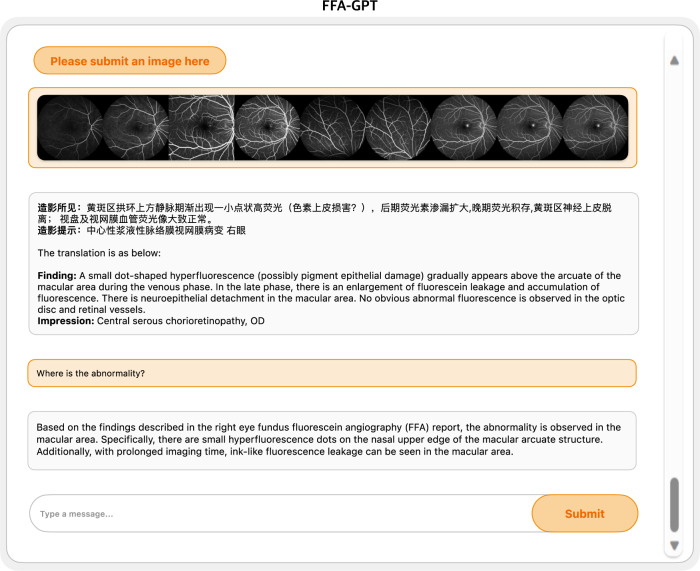
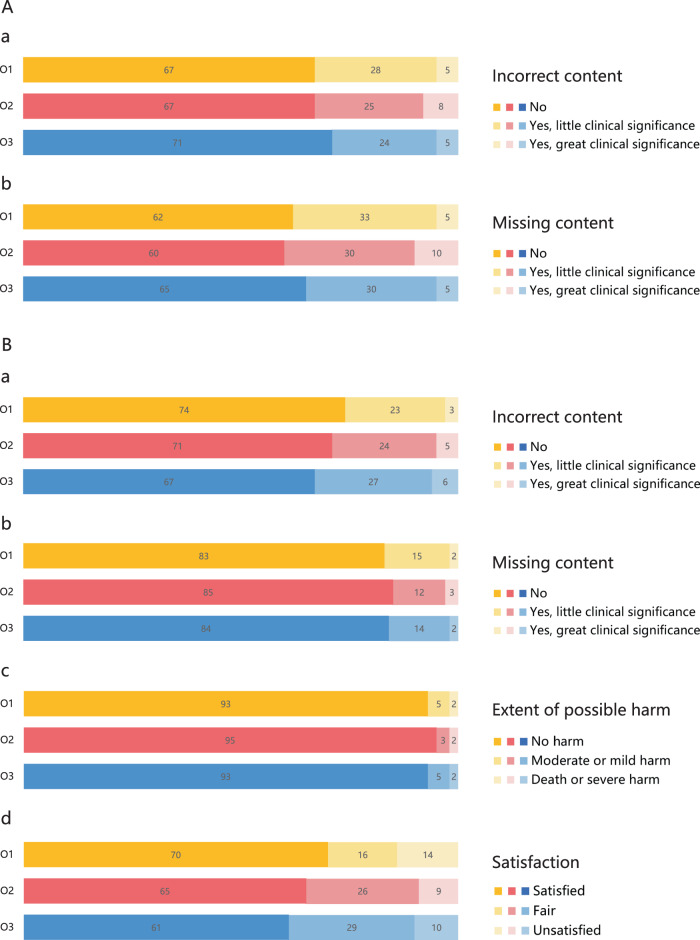
Fundus fluorescein angiography (FFA) is a crucial diagnostic tool for chorioretinal diseases, but its interpretation requires significant expertise and time. Prior studies have used Artificial Intelligence (AI)-based systems to assist FFA interpretation, but these systems lack user interaction and comprehensive evaluation by ophthalmologists. Here, we used large language models (LLMs) to develop an automated interpretation pipeline for both report generation and medical question-answering (QA) for FFA images. The pipeline comprises two parts: an image-text alignment module (Bootstrapping Language-Image Pre-training) for report generation and an LLM (Llama 2) for interactive QA. The model was developed using 654,343 FFA images with 9392 reports. It was evaluated both automatically, using language-based and classification-based metrics, and manually by three experienced ophthalmologists. The automatic evaluation of the generated reports demonstrated that the system can generate coherent and comprehensible free-text reports, achieving a BERTScore of 0.70 and F1 scores ranging from 0.64 to 0.82 for detecting top-5 retinal conditions. The manual evaluation revealed acceptable accuracy (68.3%, Kappa 0.746) and completeness (62.3%, Kappa 0.739) of the generated reports. The generated free-form answers were evaluated manually, with the majority meeting the ophthalmologists’ criteria (error-free: 70.7%, complete: 84.0%, harmless: 93.7%, satisfied: 65.3%, Kappa: 0.762–0.834). This study introduces an innovative framework that combines multi-modal transformers and LLMs, enhancing ophthalmic image interpretation, and facilitating interactive communications during medical consultation.
Overview
The claims and statistics of this paper haven’t been checked yet.
Free: it reads the open-access text and checks the first 5 claims that cite a source we can check. Create a free account to check every claim.
Integrity signals
Registry
Cites
Statistics
Figures
Verification
Claims the paper makes
The claims and statistics of this paper haven’t been checked yet.
Free: it reads the open-access text and checks the first 5 claims that cite a source we can check. Create a free account to check every claim.
Self-check
Percentages, sums and reported differences re-computed from the paper’s own numbers.
The self-check needs the paper’s full text.
Citations
Cites
BERT: Pre-training of Deep Bidirectional Transformers for Language Understanding
Devlin, J., Chang, M.-W., Lee, K., & Toutanova, K. (2018) · arXiv · doi:10.48550/arxiv.1810.04805 · Cited by 73,173
An Image is Worth 16x16 Words: Transformers for Image Recognition at Scale
Dosovitskiy, A., Beyer, L., Kolesnikov, A., Weissenborn, D., Zhai, X., Unterthiner, T., Dehghani, M., Minderer, M., Heigold, G., Gelly, S., et al. (2020) · arXiv · doi:10.48550/arxiv.2010.11929 · Cited by 47,472
BLEU: a method for automatic evaluation of machine translation
Papineni, K., Roukos, S., Ward, T., & Zhu, W.-J. (2001) · Proceedings of the 40th Annual Meeting on Association for Computational Linguistics - ACL '02 · doi:10.3115/1073083.1073135 · Cited by 21,344 · cited 7×
“BLEU 33 is a widely used automatic metric for evaluating the quality of machine translations and scores by calculating the overlap of n-grams between the generated text and reference texts.”
BackgroundInfluentialDermatologist-level classification of skin cancer with deep neural networks
Esteva, A., Kuprel, B., Novoa, R. A., Ko, J., Swetter, S. M., Blau, H. M., & Thrun, S. (2017) · Nature · doi:10.1038/nature21056 · Cited by 14,362
Show and tell: A neural image caption generator
Vinyals, O., Toshev, A., Bengio, S., & Erhan, D. (2015) · 2015 IEEE Conference on Computer Vision and Pattern Recognition (CVPR) · doi:10.1109/cvpr.2015.7298935 · Cited by 6,318
CIDEr: Consensus-based image description evaluation
Vedantam, R., Zitnick, C. L., & Parikh, D. (2015) · 2015 IEEE Conference on Computer Vision and Pattern Recognition (CVPR) · doi:10.1109/cvpr.2015.7299087 · Cited by 4,845
Identifying Medical Diagnoses and Treatable Diseases by Image-Based Deep Learning
Kermany, D. S., Goldbaum, M., Cai, W., Valentim, C. C. S., Liang, H., Baxter, S. L., McKeown, A., Yang, G., Wu, X., Yan, F., et al. (2018) · Cell · doi:10.1016/j.cell.2018.02.010 · Cited by 4,842
A Survey on Evaluation of Large Language Models
Chang, Y., Wang, X., Wang, J., Wu, Y., Yang, L., Zhu, K., Chen, H., Yi, X., Wang, C., Wang, Y., et al. (2024) · ACM Transactions on Intelligent Systems and Technology · doi:10.1145/3641289 · Cited by 4,254
Large language models encode clinical knowledge
Singhal, K., Azizi, S., Tu, T., Mahdavi, S. S., Wei, J., Chung, H. W., Scales, N., Tanwani, A., Cole-Lewis, H., Pfohl, S., et al. (2023) · Nature · doi:10.1038/s41586-023-06291-2 · Cited by 4,083 · cited 2×
“In addition to accuracy and completeness, we added two dimensions of harmfulness and satisfaction to the evaluation criteria 39 .”
MethodLarge Language Models Encode Clinical Knowledge
Singhal, K., Azizi, S., Tu, T., Mahdavi, S. S., Wei, J., Chung, H. W., Scales, N., Tanwani, A., Cole-Lewis, H., Pfohl, S., et al. (2022) · arXiv · doi:10.48550/arxiv.2212.13138 · Cited by 4,083 · cited 2×
“In addition to accuracy and completeness, we added two dimensions of harmfulness and satisfaction to the evaluation criteria 39 .”
Method
Research works printed but not linked: 3
- Loshchilov, I. & Hutter, F. Decoupled Weight Decay Regularization. International Conference on Learning Representations (2018).
- Lin, C.-Y. ROUGE: A Package for Automatic Evaluation of Summaries. Text. Summariz. Branches Out. 74, 81 (2004).
- Zhang, T., Kishore, V., Wu, F., Weinberger, K. Q. & Artzi, Y. BERTScore: Evaluating Text Generation with BERT. International Conference on Learning Representations (2020). https://doi.org/10.1038/s41746-024-01101-z
Cited by
Large language models for disease diagnosis: a scoping review
Zhou, S., Xu, Z., Zhang, M., Xu, C., Guo, Y., Zhan, Z., Fang, Y., Ding, S., Wang, J., Xu, K., et al. (2025) · npj Artificial Intelligence · doi:10.1038/s44387-025-00011-z · Cited by 122
A multimodal visual–language foundation model for computational ophthalmology
Shi, D., Zhang, W., Yang, J., Huang, S., Chen, X., Xu, P., Jin, K., Lin, S. C., Wei, J., Yusufu, M., et al. (2025) · npj Digital Medicine · doi:10.1038/s41746-025-01772-2 · Cited by 163
Self-citationEvaluating large language models and agents in healthcare: key challenges in clinical applications
Chen, X., Xiang, J., Lu, S., Liu, Y., He, M., & Shi, D. (2025) · Intelligent Medicine · doi:10.1016/j.imed.2025.03.002 · Cited by 68
Self-citationBuess, L., Keicher, M., Navab, N., Maier, A., & Arasteh, S. T. (2025) · Biomedical Engineering Letters · doi:10.1007/s13534-025-00497-1 · Cited by 109
“…Reports Classification, Reporting, Grounding COMG [112] X-ray, Reports, Masks Reporting CT-CHAT [14] CT, Reports Reporting, Visual QA FFA-GPT [113] Fundus fluorescein angiography, Reports Reporting, Visual QA GenerateCT [114] CT, Reports Image generation Huh et al. [115] X-ray, Reports…”
Large language models in biomedicine and healthcare
Zhou, J., Li, H., Chen, S., Chen, Z., Han, Z., & Gao, X. (2025) · Yearbook of pediatric endocrinology · doi:10.1038/s44387-025-00047-1 · Cited by 77
An eyecare foundation model for clinical assistance: a randomized controlled trial
Wu, Y.-L., Qian, B., Li, T., Qin, Y., Guan, Z., Chen, T., Jia, Y., Zhang, P., Zeng, D., Moroi, S. E., et al. (2025) · Nature Medicine · doi:10.1038/s41591-025-03900-7 · Cited by 97
“The grading was anchored to four axes 26,27 : the extent of unrelated information, factual errors, incomplete information and potential harm.”
Self-citationXu, P., Chen, X., Zhao, Z., & Shi, D. (2024) · British Journal of Ophthalmology · doi:10.1136/bjo-2023-325054 · Cited by 63
“An average of 25”
Self-citationXu, P., Wu, Y., Jin, K., Chen, X., He, M., & Shi, D. (2025) · Advances in Ophthalmology Practice and Research · doi:10.1016/j.aopr.2025.05.001 · Cited by 65
“13 For example, Bahir et al. found that Gemini Advanced only got a 66% accuracy rate in an ophthalmology residency exam.”
Self-citationChen, X., Zhao, Z., Zhang, W., Xu, P., Wu, Y., Xu, M., Gao, L., Li, Y., Shang, X., Shi, D., et al. (2024) · Journal of Medical Internet Research · doi:10.2196/60063 · Cited by 65
“Future iterations should prioritize enhancing the model’s image interpretation capabilities [7,39,45], crucial for ophthalmology given its heavy reliance on multimodal imaging.”
Self-citationEyeFound: A Multimodal Generalist Foundation Model for Ophthalmic ImagingPreprint
Shi, D., Zhang, W., Chen, X., Liu, Y., Yang, J., Huang, S., Tham, Y. C., Zheng, Y., & He, M. (2024) · arXiv (Cornell University) · doi:10.48550/arxiv.2405.11338 · Cited by 69
Self-citationHuman–large language model collaboration in clinical medicine: a systematic review and meta-analysis
Wang, G., Zhang, K., Jiang, J., Wang, C., Bi, H., Liang, H., Qi, Z., Huang, Y., Li, Y., & Yang, X. (2026) · npj Digital Medicine · doi:10.1038/s41746-026-02382-2 · Cited by 68
VaxBot-HPV: a GPT-based chatbot for answering HPV vaccine-related questions
Li, Y., Li, J., Li, M., Yu, E., Rhee, D., Amith, M. “., Tang, L., Savas, L. S., Cui, L., & Tao, C. (2024) · JAMIA Open · doi:10.1093/jamiaopen/ooaf005 · Cited by 46
Evaluating Large Language Models in Ophthalmology: Systematic Review
Zhang, Z., Zhang, H., Pan, Z., Bi, Z., Wan, Y., Song, X., & Fan, X. (2025) · Journal of Medical Internet Research · doi:10.2196/76947 · Cited by 50
“…despite their several irreplaceable advantages over closed-source ones in clinical settings (Table 4), yet they appeared much more frequently after new model development, confirming their suitability for customization for specific ophthalmic tasks (eg, fundus image analysis [36-38]).”
Understanding natural language: Potential application of large language models to ophthalmology
Yang, Z., Wang, D., Zhou, F., Song, D., Zhang, Y., Jiang, J., Kong, K., Liu, X., Qiao, Y., Chang, R. T., et al. (2024) · Asia-Pacific Journal of Ophthalmology · doi:10.1016/j.apjo.2024.100085 · Cited by 50
Automating expert-level medical reasoning evaluation of large language models
Zhou, S., Xie, W., Li, J., Zhan, Z., Song, M., Yang, H., Espinoza, C., Welton, L., Mai, X., Jin, Y., et al. (2025) · npj Digital Medicine · doi:10.1038/s41746-025-02208-7 · Cited by 30
“To address these gaps, we introduce MedThink-Bench, a benchmark tailored for rigorous, explainable, and scalable evaluation of LLMs ’ medical reasoning (Fig.”
Chen, X., Xu, P., Li, Y., Zhang, W., Song, F., He, M., & Shi, D. (2024) · iScience · doi:10.1016/j.isci.2024.110021 · Cited by 32
Self-citationLarge Language Models in Medical Image Analysis: A Systematic Survey and Future Directions
Urooj, B., Fayaz, M., Ali, S., Dang, L. M., & Kim, K. W. (2025) · Bioengineering · doi:10.3390/bioengineering12080818 · Cited by 37
Performance of ChatGPT in Ophthalmic Registration and Clinical Diagnosis: Cross-Sectional Study
Ming, S., Yao, X., Guo, X., Guo, Q., Xie, K., Chen, D., & Lei, B. (2024) · Journal of Medical Internet Research · doi:10.2196/60226 · Cited by 26
A systematic review of multi-modal large language models on domain-specific applications
Li, S., Wong, K. W., Wang, G., & Duong, T.-T. (2025) · Artificial Intelligence Review · doi:10.1007/s10462-025-11398-1 · Cited by 27
“15 Chen et al. (2024) focus on chorioretinal diseases and propose a framework named FFA-GPT.”
InfluentialYu, T., Shao, A., Wu, H., Su, Z., Shen, W., Zhou, J., Lin, X., Shi, D., Grzybowski, A., Wu, J., et al. (2025) · Ophthalmology and Therapy · doi:10.1007/s40123-025-01109-y · Cited by 23
“An AI system for automating the interpretation of FFA images, including report generation and medical question-answering, was developed by Chen et al. [6, 7].”
Self-citationEmbodied artificial intelligence in ophthalmology
Qiu, Y., Chen, X., Wu, X., Li, Y., Xu, P., Jin, K., Shang, X., Chotcomwongse, P., He, M., & Shi, D. (2025) · npj Digital Medicine · doi:10.1038/s41746-025-01754-4 · Cited by 31
Self-citationZhuang, W., Pan, X., Wen, S., Yu, W., Li, X., & Bao, J. (2025) · International Journal of Production Research · doi:10.1080/00207543.2025.2509155 · Cited by 23
Evaluating large language models in medical applications: a surveyPreprint
Chen, X., Xiang, J., Lu, S., Liu, Y., He, M., & Shi, D. (2024) · arXiv (Cornell University) · doi:10.48550/arxiv.2405.07468 · Cited by 30
Self-citationExplainable differential diagnosis with dual-inference large language models
Zhou, S., Lin, M., Ding, S., Wang, J., Chen, C., Melton, G. B., Zou, J., & Zhang, R. (2025) · npj Health Systems · doi:10.1038/s44401-025-00015-6 · Cited by 20
“Errorswerecategorizedasmissingcontent(missingatleasttwopiecesof evidence),factualerrors(medicallyincorrect),orlowrelevance(evidence nothighlypertinent)basedonpriorstudies 30,31 .”
Zhao, Z., Zhang, W., Chen, X., Song, F., Gunasegaram, J. R., Huang, W., Shi, D., He, M., & Liu, N. (2024) · Journal of Medical Internet Research · doi:10.2196/54047 · Cited by 18
“Based on our experience in ophthalmic QA tasks and LLMs, including fundus fluorescein angiography and indocyanine green angiography QA [12,28,29] we aim to extend these methodologies to slit lamp imaging by developing a novel slit lamp–GPT system, using BLIP and LLMs specifically tailored for…”
Self-citationAI in Medical Questionnaires: Scoping Review
Luo, X., Li, Y. L., Xu, J., Zheng, Z., Ying, F., & Huang, G. (2025) · Journal of Medical Internet Research · doi:10.2196/72398 · Cited by 18
“One approach involves using NLP-enhanced questionnaires; AI models such as ChatGPT or Bard can provide immediate explanations of terminology, thereby reducing the difficulty and improving the efficiency of questionnaire completion for individuals with lower educational levels [124,125].”
Shao, A., Liu, X., Shen, W., Li, Y., Wu, H., Pan, X., Yang, Z., Xu, Y., Zhu, T., Wang, Y., et al. (2025) · npj Digital Medicine · doi:10.1038/s41746-025-01759-z · Cited by 16
“Chen et al. introduced a pipeline that combines multi-modal transformers and an LLM-based question-answer module to enhance FFA and ICGA report interpretation 17,25 .”
ChatMyopia: An AI agent for myopia-related consultation in primary eye care settings
Wu, Y. Y., Chen, X., Zhang, W., Liu, S., Sum, W. M. R., Wu, X., Shang, X., Kee, C., He, M., & Shi, D. (2025) · iScience · doi:10.1016/j.isci.2025.113768 · Cited by 19
“10,28 While some studies attempted to combine LLMs with diagnostic models in interactive pipe-lines, 12,13 these approaches often rely on predefined interactions, limiting flexibility in addressing diverse needs and placing greater demands on user prompts.”
Self-citationGeneration of Fundus Fluorescein Angiography Videos for Health Care Data Sharing
Wu, X., Wang, L., Chen, R., Liu, B., Zhang, W., Yang, X., Feng, Y., He, M., & Shi, D. (2025) · JAMA Ophthalmology · doi:10.1001/jamaophthalmol.2025.1419 · Cited by 16
Self-citationArtiaga, J. C. M., Guevarra, M. C. B., Sosuan, G. M. N., Agnihotri, A. P., Nagel, I. D., & Kalaw, F. G. P. (2025) · Eye · doi:10.1038/s41433-025-03935-7 · Cited by 14
“Both studies uniquely employed the use of an image-to-text alignment module (Bootstrapping Language-Image Pre-training, or BLIP, framework) in generating reports, which were then inputted into the LLM Llama 2 for analysis to answer prompted questions [11, 12].”
Zhang, W., Chotcomwongse, P., Li, Y., Xu, P., Yao, R., Zhou, L., Zhou, Y., Feng, H., Zhou, Q., Wang, X., et al. (2026) · Medical Image Analysis · doi:10.1016/j.media.2026.103942 · Cited by 12
Self-citationIzhar, A., Idris, N., & Japar, N. B. (2025) · Artificial Intelligence in Medicine · doi:10.1016/j.artmed.2025.103220 · Cited by 19
From visual question answering to intelligent AI agents in ophthalmology
Chen, X., Chen, R., Xu, P., Wan, X., Zhang, W., Yan, B., Shang, X., He, M., & Shi, D. (2025) · British Journal of Ophthalmology · doi:10.1136/bjo-2024-326097 · Cited by 12
“63 For AI agent systems, evaluation must extend beyond final outputs to examine intermediate steps, such as tool usage, reasoning processes, workflow orchestration and autonomous decision-making capabilities.”
Self-citationTang, W., Chen, R., Long, X., Yu, D., Zhao, S., & Chen, B. (2026) · Journal of Orthopaedic Translation · doi:10.1016/j.jot.2026.101050 · Cited by 10
“Multimodal Predictive Models: Next-generation prognostic models are expected to be multimodal [78 – 80], incorporating structured clinical data (e.g., age, comorbidities), quantitative imaging features derived from radiomics, and even “ digital phenotype ” data from wearable devices (e.g., gait,…”
Jaradat, S., Elhenawy, M. M. Z., Nayak, R., Paz, A., Ashqar, H. I., & Glaser, S. (2025) · AI · doi:10.3390/ai6040072 · Cited by 13
Benchmarking large multimodal models for ophthalmic visual question answering with OphthalWeChat
Xu, P., Gong, X., Chen, X., Zhang, W., Yang, J., Yan, B., Yuan, M., Yalin, Z., He, M., & Shi, D. (2025) · Advances in Ophthalmology Practice and Research · doi:10.1016/j.aopr.2025.10.006 · Cited by 12
Self-citationJin, K., Sun, Q., Kang, D., Luo, Z., Yu, T., Han, W., Zhang, Y., Wang, M., Shi, D., & Grzybowski, A. E. (2026) · npj Digital Medicine · doi:10.1038/s41746-025-02300-y · Cited by 13
Self-citationAngioReport: dataset and baseline methods for fundus angiography report generation
Xu, P., Chotcomwongse, P., Zhang, W., Chen, X., Wu, X., Chung, F. H. T., Zhang, X., He, M., Shi, D., & Ruamviboonsuk, P. (2025) · British Journal of Ophthalmology · doi:10.1136/bjo-2024-327006 · Cited by 6
“Although previous studies have achieved promising results for FFA and ICGA report generation, 8 9 23 there is currently no AI model that has been deployed into clinical practice, underscoring the need for future investigation.”
Self-citationChen, R., Xu, K., Zheng, K., Zhang, W., Lu, Y., He, M., & Shi, D. (2025) · Ophthalmology Retina · doi:10.1016/j.oret.2025.08.002 · Cited by 5
Self-citationYang, S., Jing, M., Wang, S., Huang, Z., Wang, J., Kou, J., Shi, M., Xia, Z., Wei, Q., Xing, W., et al. (2025) · Artificial Intelligence in Medicine · doi:10.1016/j.artmed.2025.103310 · Cited by 5
Interpretable Brain MRI Report Generation Anchored by Lesion Topography
Lei, J., Zhang, X., Chaoyi, W. U., Dai, L., Zhang, Y., Zhang, Y., Wang, Y., Xie, W., & Li, Y. (2025) · IEEE Journal of Biomedical and Health Informatics · doi:10.1109/jbhi.2025.3646647 · Cited by 8
“Radiolo-gists, especially those early in their training, face substantial workloads, which can increase the risk of diagnostic errors and reporting delays—factors that may ultimately compromise patient outcomes [1].”
You, J., & Shin, H. (2026) · Journal of the American Medical Informatics Association · doi:10.1093/jamia/ocaf230 · Cited by 5
Yang, Z., Tian, D., Zhao, X., Zhang, L., Xu, Y., Lü, X., & Chen, Y. (2024) · Quantitative Imaging in Medicine and Surgery · doi:10.21037/qims-24-1406 · Cited by 6
“For instance, researchers have developed an AI system that uses LLMs to generate reports of FFA images and answer patients’ questions about the images (54).”
Shen, Y., Chen, Q., He, X., Agrawal, R. V., Grzybowski, A. E., Jin, K., & Ye, X. (2026) · Ophthalmology and Therapy · doi:10.1007/s40123-026-01316-1 · Cited by 4
Generative artificial intelligence for ophthalmic images: developments, applications and challenges
Li, T.-Y., Wang, Z.-Y., Jiang, Z., Zhong, H., & Qin, Y.-M. (2025) · The Visual Computer · doi:10.1007/s00371-025-03988-5 · Cited by 5
“…high-resolution, multimodal ophthalmic imaging and its integration with clinical narratives, several specialized models and benchmarks have been developed, including VisionCLIP [134], FLAIR [115], Eye-Found [112], Slit Lamp-GPT [157], ICGA-GPT [18], FFA-GPT [17], VisionUnite [79], and LMOD [101].”
Zhao, D., Wang, C., Jiang, Z., Xu, Y., Xia, Y., Zhang, P., & Ye, H. (2026) · Frontiers in Pharmacology · doi:10.3389/fphar.2026.1809139 · Cited by 3
“Innovations like FFA-GPT (2024), which integrates multimodal transformers and large language models, automate image interpretation and enable real-time quantification of dye leakage patterns, thereby enhancing sensitivity for microaneurysm detection in DR (Chen X. et al., 2024).”
Research Trends and Hotspots of Big Data in Ophthalmology: A Bibliometric Analysis and Visualization
Chen, J., Yuan, X., Liao, Z., Zhu, W., Zhou, X., & Duan, X. (2024) · Seminars in Ophthalmology · doi:10.1080/08820538.2024.2421478 · Cited by 3
“43”
FFA Sora, video generation as fundus fluorescein angiography simulatorPreprint
Wu, X., Wang, L., Chen, R., Liu, B., Zhang, W., Yang, X., Feng, Y., He, M., & Shi, D. (2024) · arXiv (Cornell University) · doi:10.48550/arxiv.2412.17346 · Cited by 3
“15 FFA data were obtained from a tertiary hospital in China.”
Self-citationHaghighi, T., Gholami, S., Sokol, J. T., Biswas, A., Lim, J. I., Leng, T., Thompson, A. C., Tabkhi, H., & Alam, M. N. (2025) · Communications Medicine · doi:10.1038/s43856-025-01293-9 · Cited by 6
Report Generation System for Slit-Lamp Image Interpretation Using Vision-Language Models
Ye, X., Shen, Y., Chen, Q., He, X., Lü, X., Grzybowski, A. E., Jin, K., & Xie, W. (2026) · Ophthalmology and Therapy · doi:10.1007/s40123-026-01352-x · Cited by 2
“For example, FFA-GPT integrates the Bootstrapping Language-Image Pretraining (BLIP) framework with an LLM (Llama2) to generate automated reports and question answering for fundus fluorescein angiography images, demonstrating high accuracy, completeness, and interpretability [6].”
Key concept learning for medical vision language model with reasoning capabilities
Lou, W., Wu, Y., Xu, P., Zhang, W., Chen, X., Yang, J., He, M., & Shi, D. (2026) · npj Digital Medicine · doi:10.1038/s41746-026-02676-5 · Cited by 3
“To accurately capture medical knowledge related to image-based questions while preventing the model from overemphasizing the form of responses, we have designed an algorithm for constructing a medical key concept dictionary 5,51,52 .”
Self-citationMetzger, A., Patil, S., Sugarmann, L., Karabacak, M., & Margetis, K. D. (2026) · JMIR AI · doi:10.2196/81134 · Cited by 2
Toward Autonomous Clinics: Human–Robot Collaboration in Clinical Care
Wu, X., Zhang, J., Xu, M., Chu, H. K., Chen, X., Zhong, P., Liu, B., He, M., & Shi, D. (2026) · MedComm · doi:10.1002/mco2.70885 · Cited by 2
Self-citationGuo, Z., Deng, Y., Liang, C., Zhang, H., Li, D., & Huang, M. T. (2025) · International Journal of Surgery · doi:10.1097/js9.0000000000004034 · Cited by 2
Zhao, Z., Huang, S., Song, F., Zhang, W., Lu, Y., Shang, X., Zheng, Y., Shi, D., & He, M. (2026) · Frontiers in Medicine · doi:10.3389/fmed.2026.1762735 · Cited by 2
Self-citationDynamic Detection of Global Microfeatures in Multimodal Retinal Images
Li, Z., Deng, Y., Bian, G., Yu, W., & Yu, Z. (2024) · IEEE Transactions on Instrumentation and Measurement · doi:10.1109/tim.2024.3470950 · Cited by 1
“These images include fundus photographs (FPs) [8], fluorescein angiography (FA) [9], optical coherence tomography (OCT) [10], OCT angiography (OCTA) [11], and scanning laser ophthalmoscopy (SLO) [12].”
BackgroundXu, Y., Kang, D., Shi, D., Tham, Y. C., Grzybowski, A., & Jin, K. (2025) · Ophthalmology and Therapy · doi:10.1007/s40123-025-01248-2 · Cited by 1
Self-citationXu, M., Gu, R., Lu, Z., Cheng, H., Zhou, Y., Chen, P., Sun, Y., Cao, J., Chen, Z., Jia, G., et al. (2026) · The EPMA Journal · doi:10.1007/s13167-025-00434-3 · Cited by 1
Self-citationVisualization methods for explainable medical imaging diagnosis: A survey
Yang, L., Liu, Y., He, L., & Hu, D. (2026) · Computer Science Review · doi:10.1016/j.cosrev.2026.100930 · Cited by 1
IVCM-Insight: automated interactive interpretation of in vivo confocal microscopy
Zhang, Z., Jiang, S., Wang, Z., Zhang, Y., Chen, K., Wei, M., Shi, Q., Wei, Y., Pang, J., Xx, L., et al. (2026) · npj Digital Medicine · doi:10.1038/s41746-026-02926-6 · Cited by 1
“For example, Chen et al. 18 developed a contrastive learning framework based on the BLIP model for fundus fl uorescein angiography (FFA) image – report pairs, which was further integrated with the LLaMA-2 model to enable automated report gen-erationandinteractivequestion – answering.”
He, Q., Jiang, H., Fang, D., Yang, D., Nguyen, T. X., Ran, A. R., Tham, C. C. Y., Szeto, S., Sivaprasad, S., & Cheung, C. Y.-L. (2026) · Translational Vision Science & Technology · doi:10.1167/tvst.15.6.29 · Cited by 1
Gan, F., chen, L., Qin, W., Long, X., Fan, H., Li, X., Yu, H., Zhang, J., Cao, J., & You, Z. (2025) · SSRN Electronic Journal · doi:10.2139/ssrn.5256382
Hastuti, K., Hidayat, E. Y., Alzami, F., Risqa, I., Ahmad, S., & Fahmi, H. (2026) · Expert Systems with Applications · doi:10.1016/j.eswa.2026.133228
Artificial Intelligence Using the Eye as a Biomarker of Systemic Risk
Wang, J., Tseng, R. M. W. W., Rim, T. H., Cheung, C. Y.-L., & Wong, T. Y. (2025) · Springer eBooks · doi:10.1007/978-3-031-83756-2_21
Application of AI in Angle Closure Diagnosis and Management
Aung, T., & Zhang, X. (2025) · Springer eBooks · doi:10.1007/978-3-031-83756-2_12
RetSTA: An LLM-Based Approach for Standardizing Clinical Fundus Image Reports
Cai, J., Zhang, W., Liu, H., Wang, N., & Li, H. (2025) · Lecture notes in computer science · doi:10.1007/978-3-032-04978-0_52 · Cited by 1
Self-citationAI-powered virtual eye: perspective, challenges and opportunitiesPreprint
Wu, Y., Guo, Y., Yan, Y., Yang, J., Zhou, X., Cheng, C.-Y., Shi, D., & He, M. (2025) · arXiv (Cornell University) · doi:10.48550/arxiv.2505.05516
Self-citationXia, Y., Zhu, Y.-K., Liu, C., Hong, X., Zhang, R.-X., Zhang, N., Chen, M., Zhang, G., & Sun, C. (2025) · Asian Journal of Andrology · doi:10.4103/aja202559
Siying, 孙. S., Shunxin, 王. W., Qiming, 夏. X., Yixuan, 李. L., Zhenjie, 刘. L., & Qian, J. (2025) · Chinese Journal of Lasers · doi:10.3788/cjl251096
OBUSight: Clinically Aligned Generative AI for Ophthalmic Ultrasound Interpretation and Diagnosis
Liu, X., Shao, A., Guan, B., Luo, Z., Lai, W., Huang, X., Liu, J., Yan, J., Li, H., Pan, X., et al. (2026) · Advanced Science · doi:10.1002/advs.202515864
“BLIP-based architectures such as FFA-GPT [ 30 ] and OphthUS-GPT [ 25 ] combined a visual encoder with a bidirectional text encoder-decoder for cross-modal representation learning.”
Anatomically guided vision–language model for efficient OCT disease classification and reporting
Haghighi, T., Gholami, S., Sokol, J. T., Biswas, A., Lim, J. I., Leng, T., Thompson, A. C., Tabkhi, H., & Alam, M. N. (2026) · Ophthalmic Technologies · doi:10.1117/12.3077527
Kim, H., Yin, Y., Cao, Z., Liu, C., Li, A., Chen, Z., Ai, X., Chung, Y., Ma, F., Peng, X., et al. (2026) · Research Square · doi:10.21203/rs.3.rs-8819770/v1
Large-scale screening of blinding eye diseases from routine blood tests
Li, S., Ren, J., Wu, J., Li, Y., Wang, X., Zhang, M., Hu, H., Song, Y., Gao, S., Cao, W., et al. (2026) · Nature Health · doi:10.1038/s44360-026-00101-5
“Under the 5% threshold, both median (Supplementary Table 37 and Supplementary Fig.”
Angiography-free diagnosis of retinal diseases via interpretable multi-modal learning
Hao, J., Li, W., Qi, H., Zheng, Y., Fu, H., Frangi, A. F., & ZHAO, Y. (2026) · npj Digital Medicine · doi:10.1038/s41746-026-02641-2
Self-citationLarge Language Models in Ophthalmology: A Bibliographic Analysis
Köseoğlu, N. D., & Liu, T. Y. A. (2026) · Turkish Journal of Ophthalmology · doi:10.4274/tjo.galenos.2026.79484
Zhiyong, 王. W., Lu, X., Fuwang, 吴. W., Hongtao, 韦. W., & Song, W. (2026) · Chinese Journal of Lasers · doi:10.3788/cjl251548
Wang, W. J., Chen, Z., Li, M., Li, S., Wang, K., & Li, H. (2026) · Bioengineering · doi:10.3390/bioengineering13070791
“The LLM-assisted system explored interactive report generation [18].”
Su, Z., Liu, X., Guan, B., Shao, A., Liu, X., Yan, Y., Luo, Z., Li, Z. H., Xu, Y., Wu, J., et al. (2026) · npj Digital Medicine · doi:10.1038/s41746-026-02932-8
Alharbi, M. M., Alharbi, E. M., Al-Hakmani, Z. A., Arafat, A. A., Alotaibi, M., Alatawi, R., Asiri, H., & Aljurayyad, A. (2026) · Healthcare · doi:10.3390/healthcare14152270
Multimodal natural language processing in ophthalmology: bridging clinical text and medical imaging
Qin, S., Zhao, N., Shen, L., Zhang, Y., & Ge, S. (2026) · Frontiers in Medicine · doi:10.3389/fmed.2026.1762586
“The FFA-GPT (54), an automated pipeline, and the InterpreFFA (55), a diagnosis-supervised contrastive learning framework, were demonstrated the ability to generate structured reports, achieving cli-nician-approved accuracy.”
Deobhakta, A. A., Rosen, R. B., Chadha, N., Tsai, J. C., Harris, A., & Pasquale, L. R. (2026) · Current Ophthalmology Reports · doi:10.1007/s40135-026-00355-y
“[8 , 9 ].”
KINNERA, R., Kauser, T., Giammanco, M. M., AlHussen, H. A., Khachikian, A., Rukh, S., Alansaari, M., & Ali, W. (2026) · Cureus · doi:10.7759/cureus.114560
“For instance, Chen et al. proposed a multimodal framework that integrates the bootstrapping language-image pretraining framework with the LLaMA 2 language model to produce free-text diagnostic reports and support interactive Q&A functionalities [54].”
范泽月, Qin, Y., Chen, L., Yuan, J., Xiong, Z., Chen, X., Lai, S., Tham, Y. C., Sheng, B., Wang, X., et al. (2026) · PLOS Digital Health · doi:10.1371/journal.pdig.0001347
Self-citationWang, C., Chakrabarty, K., Anesi, S. D., & Chang, P. Y. (2026) · Frontiers in Ophthalmology · doi:10.3389/fopht.2026.1901237
Capability of multimodal large language models to describe gravitational wave images
Kim, Y., Min, J., & Jung, H. (2026) · Machine Learning Science and Technology · doi:10.1088/2632-2153/aea5d4
Gan, F., Chen, X., Shao, Y., Li, H., Chen, W., Qin, W., Long, X., Fan, H., Hu, H., Yu, Z., et al. (2026) · Translational Vision Science & Technology · doi:10.1167/tvst.15.10.16
“The second category uses end-to-end models, such as FFA-GPT, 12 to generate reports directly from images.”
Self-citationDeobhakta, A. A., & Rosen, R. B. (2026) · JMIR Medical Informatics · doi:10.2196/101576
Omaña, M. G. S., Hernández, R. D., & Altamirano-Robles, L. (2026) · Lecture notes in computer science · doi:10.1007/978-3-032-44179-9_11
Metadata
- Authors
- Chen, X., Zhang, W., Xu, P., Zhao, Z., Zheng, Y., Shi, D., & He, M.
- Affiliations
- Hong Kong Polytechnic University (HK)
- Sun Yat-sen University (CN)
- Corresponding author
- Shi, Danli
- Venue
- npj Digital Medicine
- Published
- 2024-05-03
- Volume
- 7
- Issue
- 1
- Pages
- 111-111
- ISSN
- 2398-6352 (ISSN-L)
- PMC
- PMC11068733
- OpenAlex
- W4396605652
- Cited by
- 72
- References
- 50
- Citations by year
- 2026: 25 · 2025: 37 · 2024: 10
- FWCI
- 18.34
- Type
- journal article
- Language
- en
- Open access
- gold
- doi.org
- Licence
- cc-by
- creativecommons.org/licenses/by/4.0 (tdm)
- creativecommons.org/licenses/by/4.0 (vor)
- Locations
- npj Digital Medicine (publishedVersion, cc-by)
- Research Square (acceptedVersion, cc-by)
- PubMed Central (publishedVersion, cc-by)
- PubMed (publishedVersion)
- PolyU Institutional Research Archive (Hong Kong Polytechnic University) (submittedVersion, cc-by)
- DOAJ (DOAJ: Directory of Open Access Journals) (submittedVersion, cc-by-sa)
- Minerva Access (University of Melbourne) (submittedVersion, cc-by)
- Funders
- Start-up Fund for RAPs under the Strategic Hiring Scheme
- National Natural Science Foundation of China (82171034)
- Global STEM Professorship Scheme from HKSAR
- Topics
- Health Sciences › Medicine › Radiology, Nuclear Medicine and Imaging › Retinal Imaging and Analysis
- Health Sciences › Medicine › Health Informatics › Artificial Intelligence in Healthcare and Education
- Physical Sciences › Computer Science › Computer Vision and Pattern Recognition › Multimodal Machine Learning Applications
- Keywords
- fundus fluorescein angiography, automated reporting, medical question answering, large language models, Llama 2, image-text alignment, chorioretinal diseases, multimodal transformer
About these checks
Registry, retraction, Cites and statistics results are computed, not judged, with one exception: a printed reference that no index lists is read once by a model before it counts as a citation error. Claims are extracted by a model and kept only when their quote appears verbatim in the text; each cited source is then checked, with a model’s help, for whether it says what the claim relies on. Those verdicts can be wrong — read the claim’s quote and the cited source before relying on one.
Statistics and arithmetic are recomputed, not judged.
Confidence bands are shown only for fields calibrated on our annotated test set. None is calibrated yet, so no band is shown.
What counts as a claim ›How we measure confidence ›How we check this ›
Are you an author, or do you see a problem with this page? Request a review
Data sources
Bibliographic data: Semantic Scholar, OpenAlex, Crossref.
Contains information from the Semantic Scholar Academic Graph Datasets, made available under the ODC Attribution License (ODC-BY 1.0).
Semantic Scholar’s data is described in: Kinney, R., et al. (2023). The Semantic Scholar Open Data Platform. arXiv:2301.10140.
