

Orchestrating explainable artificial intelligence for multimodal and longitudinal data in medical imaging
Open accessThe DOI matches its Crossref record; 94 of the 95 references it cites were found in a registry or an index; 61 of the 76 sources its claims cite were checked for support.
Abstract
Explainable artificial intelligence (XAI) has experienced a vast increase in recognition over the last few years. While the technical developments are manifold, less focus has been placed on the clinical applicability and usability of systems. Moreover, not much attention has been given to XAI systems that can handle multimodal and longitudinal data, which we postulate are important features in many clinical workflows. In this study, we review, from a clinical perspective, the current state of XAI for multimodal and longitudinal datasets and highlight the challenges thereof. Additionally, we propose the XAI orchestrator, an instance that aims to help clinicians with the synopsis of multimodal and longitudinal data, the resulting AI predictions, and the corresponding explainability output. We propose several desirable properties of the XAI orchestrator, such as being adaptive, hierarchical, interactive, and uncertainty-aware.
Overview
CoChat Summary
## TL;DR
This narrative review argues that explainable AI for medical imaging needs to better handle multimodal and longitudinal data, because clinical decisions are usually made from the synopsis of many information sources over time. The paper does not present a new experimental study; instead, it proposes an “XAI orchestrator” concept and a set of desirable properties for such a system.
## Key findings
- The authors state that there is a lack of studies that enrich radiological XAI systems with other clinical data types or use longitudinal datasets, and that merging these data types into a meaningful overall explanation has received little attention.
- In a cited multimodal XAI example, Soenksen et al.’s HAIM framework tested “over 14’000 different prediction models,” and multimodal predictions outperformed unimodal comparators by “6-30%.”
- For the XAI orchestrator, the paper proposes properties including being adaptive, hierarchical, uncertainty-aware, interactive, time effective, causality- and co-dependency aware, modular, privacy preserving, resilient to data drift, and up to date.
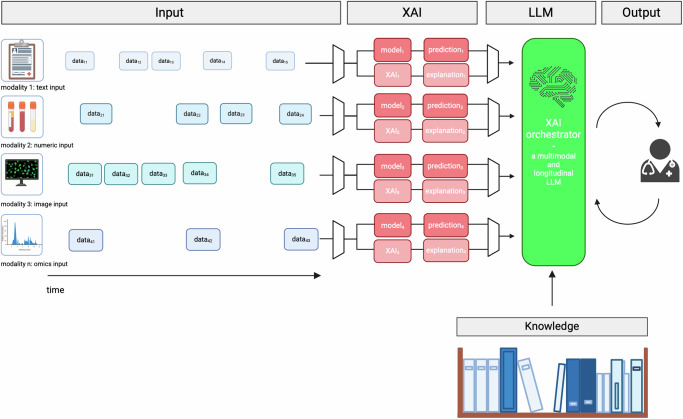
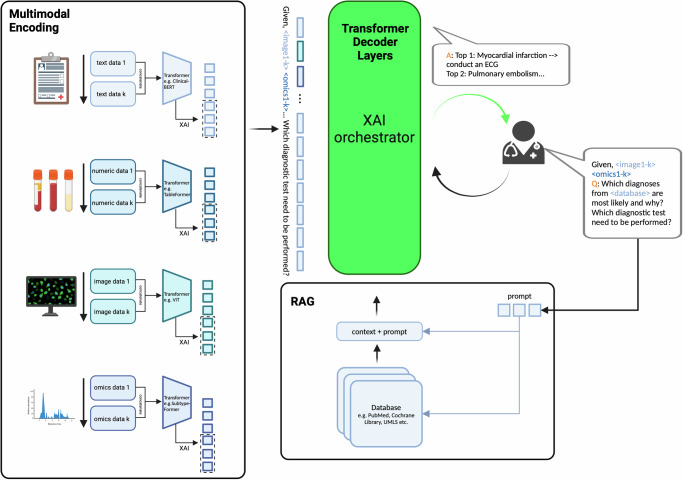
- The authors suggest future implementations could combine modality-specific encoders, a central LLM-based decoder, and retrieval-augmented generation to produce user-friendly explanations and answer follow-up questions.
## Methods
- Narrative review from a clinical perspective of the current state of XAI for multimodal and longitudinal datasets in medical imaging.
- Synthesis of prior work on multimodal XAI, longitudinal XAI, XAI toolkits, and LLM-based medical applications; the paper also discusses illustrative clinical case examples in the supplementary materials.
- Conceptual proposal of the “XAI orchestrator,” including desirable properties, functionalities, and metrics, but no original dataset analysis or model evaluation is reported.
## Limitations
- The paper explicitly states: “we do not provide a full implementation and results of the XAI orchestrator.”
- It also notes that the review is limited by the current state of the literature, where many methods remain at a prototype level and have not yet been extensively applied to real-world clinical questions.
- Evident from the text: the article is conceptual and does not validate the proposed orchestrator on patient data, so its effectiveness, reliability, and clinical utility are not empirically tested in this paper.
Model-written summary. Check it against the paper before relying on it.
Integrity signals
Registry
Cites
Statistics
Figures
Verification
Claims the paper makes
35 Valid · 12 Not valid · 3 Not checked · 21 Own results and interpretations
Some cited sources support this claim and some don’t — read each source’s verdict below.
In the paper
“In this situation, XAI becomes crucial as interpretability methods can help to find and eliminate spurious correlations and shortcut learning46–48.”
§ Orchestrating explainable artificial intelligence for multimodal and longitudinal data in medical imaging > Challenges of XAI for multimodal data
What the sources say
- Not checked — no full text of the sourcecites [46] Ben Ahmed, K., Hall, L. O., Goldgof, D. B. & Fogarty, R. Achieving multisite generalization for CNN-based disease diagnosis models by mitigating shortcut learning. IEEE Access 10, 78726–78738 (2022). 10.1109/ACCESS.2022.3193700 source
- Disputedcites [47] Gichoya, J. W. et al. AI recognition of patient race in medical imaging: a modelling study. Lancet Digit. Health 4, e406–e414 (2022). PMC9650160 35568690 sourceExperimental — accuracy not yet measured
The Discussion reports that saliency mapping was non-contributory: the authors could not isolate the image features responsible for race recognition. It also says that attempts to remove the relevant information were ineffective and that similar technical solutions were unlikely to succeed. Thus, this study does not support the attributed claim that interpretability methods can find and eliminate such shortcuts in this setting. (LLM, conf=0.86)
Checked by a reasoning model — may be wrong.
- Partly supportedcites [48] Geirhos, R. et al. Shortcut learning in deep neural networks. Nat. Mach. Intell. 2, 665–673 (2020). 10.1038/s42256-020-00257-z sourceExperimental — accuracy not yet measured
Section 6, “Diagnosing and understanding shortcut learning” (page unavailable), advocates diagnosing and analysing shortcuts, and the Conclusion recommends careful interpretation of results. This supports the idea that interpretation can help uncover shortcuts, but the passages do not establish that interpretability methods can eliminate spurious correlations or shortcut learning. (LLM, conf=0.78)
plainstates a cause- Asserted: passes — The authors put it forward as true.
- Checkable: passes — It can be checked against evidence.
- Load-bearing: passes — The paper’s conclusions depend on it.
- Based: passes — The paper gives a reason why it holds.
Every source the paper cites for this claim was checked and supports it.
In the paper
“Just as for multimodal data, introducing explainability methods for the analysis of longitudinal data may contribute to the systems’ stability, robustness, and confidence19.”
§ Orchestrating explainable artificial intelligence for multimodal and longitudinal data in medical imaging > XAI for multimodal and longitudinal data
What the sources say
- Supportedcites [19] Rojat, T. et al. Explainable artificial intelligence (XAI) on TimeSeries data: a survey. Preprint at http://arxiv.org/abs/2104.00950 (2021). source
The Confidence section (p. 9) says explainability methods might help time-series models become more robust and stable and describes methods providing confidence in model outcomes. The claim’s tentative “may contribute” reflects that possibility; the Terminology section (p. 2) cautions that most existing methods cannot yet establish those properties. (LLM, conf=0.90)
hedgedstates a possible cause- Asserted: passes — The authors put it forward as true.
- Checkable: passes — It can be checked against evidence.
- Load-bearing: passes — The paper’s conclusions depend on it.
- Based: passes — The paper gives a reason why it holds.
- Rests on an assumption not shown here.
- Supported
Every source the paper cites for this claim was checked and supports it.
In the paper
“In healthcare, diagnoses and treatment decisions are rarely based on a single scan or blood draw - they are made in the synopsis of all relevant information available8.”
§ Orchestrating explainable artificial intelligence for multimodal and longitudinal data in medical imaging > XAI for multimodal and longitudinal data
What the sources say
- Supportedcites [8] Acosta, J. N., Falcone, G. J., Rajpurkar, P. & Topol, E. J. Multimodal biomedical AI. Nat. Med. 28, 1773–1784 (2022). 36109635 10.1038/s41591-022-01981-2 source
The Abstract contrasts AI tools that use a single modality, such as a CT scan, with clinicians who process multiple sources and modalities when diagnosing and deciding on treatment plans. This supports the citing sentence’s broad paraphrase; our copy does not provide a page number for the passage. (LLM, conf=0.90)
plain- Asserted: passes — The authors put it forward as true.
- Checkable: passes — It can be checked against evidence.
- Load-bearing: passes — The paper’s conclusions depend on it.
- Based: passes — The paper gives a reason why it holds.
- Supported
Every source the paper cites for this claim was checked and supports it.
In the paper
“Beyond model comparison at the level of performance, XAI techniques could enhance comparison regarding pathophysiological plausibility by providing influential features, for example, the volume of the hippocampus and amygdala as biomarkers of cognitive impairment33.”
§ Orchestrating explainable artificial intelligence for multimodal and longitudinal data in medical imaging > Discussion of previous work on XAI for multimodal data
What the sources say
- Supportedcites [33] Sheng, J. et al. Predictive classification of Alzheimer’s disease using brain imaging and genetic data. Sci. Rep. 12, 2405 (2022). 35165327 10.1038/s41598-022-06444-9 PMC8844076 source
The Results section (“Selection of biomarkers”) identifies hippocampal volume as an indicator of cognitive decline and reports that amygdala volume was selected for early diagnosis. These selected features support the cited example; the proposed use of XAI for model comparison is the citing authors’ own framing. (LLM, conf=0.91)
hedgedstates a possible cause- Asserted: passes — The authors put it forward as true.
- Checkable: passes — It can be checked against evidence.
- Load-bearing: unclear — It is unclear whether the paper’s conclusions depend on it.
- Based: passes — The paper gives a reason why it holds.
- Supported
The cited sources support only part of this claim — read each source’s verdict below.
In the paper
“There are multiple toolkits, such as AIX-36037, Alibi38, Captum39, EthicalML-XAI40, iNNvestigate41, Quantus42, among others, offering readily implemented XAI methods for a wide variety of tasks applicable to medical imaging (Table 1).”
§ Orchestrating explainable artificial intelligence for multimodal and longitudinal data in medical imaging > Discussion of previous work on XAI for multimodal data
What the sources say
- Supportedcites [37] Arya, V. et al. One explanation does not fit all: a toolkit and taxonomy of ai explainability techniques. Preprint at 10.48550/arXiv.1909.03012 (2019). source
The citation identifies AIX360 as one of the toolkits in the list. The Discussion (p. 10) identifies AIX360 as an open-source toolkit containing eight explainability algorithms, and the Introduction (p. 2) lists the types of explanations it offers. (LLM, conf=0.92)
- Not matchedcites [38] Klaise, Janis, J., Van Looveren, A., Vacanti, G. & Coca, A. Alibi explain: algorithms for explaining machine learning models. JMLR. 22, 1–7 (2021).
Its entry has no title and year that we can search by.
- Supportedcites [39] Kokhlikyan, N. et al. Captum: a unified and generic model interpretability library for PyTorch. Preprint at 10.48550/arXiv.2009.07896 (2020). source
The Abstract (p. 1) identifies Captum as an open-source interpretability library with implemented attribution algorithms for image and other inputs. The Introduction (p. 1) says its algorithms can be applied to any PyTorch model of any modality, supporting its inclusion as a toolkit offering methods applicable to medical imaging. (LLM, conf=0.91)
plain- Asserted: passes — The authors put it forward as true.
- Checkable: passes — It can be checked against evidence.
- Load-bearing: unclear — It is unclear whether the paper’s conclusions depend on it.
- Based: passes — The paper gives a reason why it holds.
- Supported
15 more claims · 9 with their cited sources checked
Create a free account to see all 71 claims and to verify the 2 references still open.
- It may state two separate claims as one. 24
- Probably not a substantial claim. 42
Claims other papers make about this one
Each is checked against this paper’s own text: does it say what the citing paper says it does?
The cited source says what the claim attributes to it.
In the citing paper
“Incorporating explainable AI into current deep learning research can improve trustworthiness by addressing the limitations of AI's ''black box'' nature (Pahud De Mortanges et al., 2024).”
From Navigating the landscape of multimodal AI in medicine: A scoping review on technical challenges and clinical applications (2025) · cites this paper as Pahud De Mortanges et al., 2024
Citations
Cites
Proceedings of the 24th international conference on Machine learning
(2007) · doi:10.1145/1273496 · Cited by 11,630
BioBERT: a pre-trained biomedical language representation model for biomedical text mining
Lee, J., Yoon, W., Kim, S., Kim, D., Kim, S., So, C. H., & Kang, J. (2020) · Bioinformatics · doi:10.1093/bioinformatics/btz682 · Cited by 7,218 · cited 1×
“BioBERT was pre-trained on PubMed abstracts and PubMedCentralfull-textarticlesandexceededpreviousmodelsintaskslike namedentityrecognition,relationextraction,andquestionanswering 60 .”
Multimodal Machine Learning: A Survey and Taxonomy
Baltrusaitis, T., Ahuja, C., & Morency, L.-P. (2019) · IEEE Transactions on Pattern Analysis and Machine Intelligence · doi:10.1109/tpami.2018.2798607 · Cited by 5,018 · cited 2×
“Additional organizational or technical challenges regarding multi-modal machine learning and AI in healthcare have previously been pointed out 20,44,52 .”
Sallam, M. (2023) · Healthcare · doi:10.3390/healthcare11060887 · Cited by 3,126
Sallam, M. (2023) · doi:10.1101/2023.02.19.23286155 · Cited by 3,123 · cited 1×
“LLMs have many potentially bene fi cial applications in healthcare practice and research, including diagnostic (e.g., prediction of disease risk and outcomes) and procedural (e.g., streamlining of clinical work fl ows, documentation, cost-effectiveness) tasks 59 .”
A Survey on Explainable Artificial Intelligence (XAI): Toward Medical XAI
Tjoa, E., & Guan, C. (2021) · IEEE Transactions on Neural Networks and Learning Systems · doi:10.1109/tnnls.2020.3027314 · Cited by 2,524
Shortcut learning in deep neural networks
Geirhos, R., Jacobsen, J.-H., Michaelis, C., Zemel, R., Brendel, W., Bethge, M., & Wichmann, F. A. (2020) · Nature Machine Intelligence · doi:10.1038/s42256-020-00257-z · Cited by 2,224
Artificial intelligence in cancer imaging: Clinical challenges and applications
Bi, W. L., Hosny, A., Schabath, M. B., Giger, M. L., Birkbak, N. J., Mehrtash, A., Allison, T., Arnaout, O., Abbosh, C., Dunn, I. F., et al. (2019) · CA: A Cancer Journal for Clinicians · doi:10.3322/caac.21552 · Cited by 1,846
The Alzheimer's Disease Neuroimaging Initiative
Mueller, S. G., Weiner, M. W., Thal, L. J., Petersen, R. C., Jack, C., Jagust, W., Trojanowski, J. Q., Toga, A. W., & Beckett, L. (2005) · Neuroimaging Clinics of North America · doi:10.1016/j.nic.2005.09.008 · Cited by 1,525 · cited 1×
“For example, the prediction of Mild Cognitive Impairment or Alzheimer ’ s disease based on the ADNI dataset is frequently investigated 27 – 32 .”
Acosta, J. N., Falcone, G. J., Rajpurkar, P., & Topol, E. J. (2022) · Nature Medicine · doi:10.1038/s41591-022-01981-2 · Cited by 1,365
Research works printed but not linked: 3
- Klaise, Janis, J., Van Looveren, A., Vacanti, G. & Coca, A. Alibi explain: algorithms for explaining machine learning models. JMLR. 22, 1–7 (2021).
- Ribeiro, F. D. S., Xia, T., Monteiro, M., Pawlowski, N. & Glocker, B. High fidelity image counterfactuals with probabilistic causal models. Proceedings of the 40th International Conference on Machine Learning. PMLR202. (2023).
- Li, X. et al. InterpretDL: explaining deep models in PaddlePaddle. JMLR 23, 1–6 (2022).
Cited by
The STARD-AI reporting guideline for diagnostic accuracy studies using artificial intelligence
Sounderajah, V., Guni, A., Liu, X., Collins, G. S., Karthikesalingam, A., Markar, S. R., Golub, R. M., Denniston, A. K., Shetty, S., Moher, D., et al. (2025) · Nature Medicine · doi:10.1038/s41591-025-03953-8 · Cited by 592
“Further advances in fields such as reinforcement learning 48,49 , graph neural networks 50,51 and explainable AI (XAI) solutions 52 may also substantially change the landscape of health AI and require new considerations in the next iteration of reporting guidelines.”
Schouten, D., Nicoletti, G., Dille, B., Chia, C., Vendittelli, P., Schuurmans, M., Litjens, G., & Khalili, N. (2025) · Medical Image Analysis · doi:10.1016/j.media.2025.103621 · Cited by 162
Ahmed, F., Naz, N. S., Khan, S., Rehman, A. U., Ismael, W. M., & Khan, M. A. (2026) · BMC Medical Imaging · doi:10.1186/s12880-025-02118-w · Cited by 104
Explainability in the age of large language models for healthcare
Mesinovic, M., Watkinson, P., & Zhu, T. (2025) · Communications Engineering · doi:10.1038/s44172-025-00453-y · Cited by 54
Yan, Z., Fan, K.-Q., Zhang, Q., Wu, X., Chen, Y., Wu, X., Yu, T., Su, N., Zou, Y., Chi, H., et al. (2025) · World Journal of Urology · doi:10.1007/s00345-025-05757-4 · Cited by 24
Xu, Y., Li, Y., Wang, F., Zhang, Y., & Huang, D. (2025) · Frontiers in Medicine · doi:10.3389/fmed.2025.1674397 · Cited by 39
“Developing models that provide transparent and explainable outputs will enhance trust among clinicians, enabling them to understand the rationale behind Longitudinal studies are also urgently needed to evaluate the long-term impact of AI-Radiomics on patient outcomes (58).”
Bashir, Z., Lin, M., Feragen, A., Mikolaj, K. W., Taksøe‐Vester, C., Christensen, A. N., Svendsen, M. B. S., Fabricius, M. H., Andreasen, L. A., Nielsen, M., et al. (2025) · Scientific Reports · doi:10.1038/s41598-025-86536-4 · Cited by 29
“…generally recognized in the literature that they may face limitations in precision and contextual detail, which can affect their clinical relevance 9–11, 31 , 33 In addition to developing an XAI model that allowed insights into the model’s predictions, our study is the first to use an AI model to…”
Artificial intelligence in tumor drug resistance: Mechanisms and treatment prospects
Gu, J., Zhang, J., Zeng, S., Zhang, W., Xia, R., Wang, X., Zhou, Q., Guo, S., Wang, H., & Chen, Z.-S. (2025) · Intelligent Oncology · doi:10.1016/j.intonc.2025.02.001 · Cited by 26
Multimodal integration strategies for clinical application in oncology
Zhang, B., Wan, Z., Luo, Y., Zhao, X., Samayoa, J. A., Zhao, W., & Wu, S. (2025) · Frontiers in Pharmacology · doi:10.3389/fphar.2025.1609079 · Cited by 36
Osman, K. A. Y. A., Shah, A. F. M. S., Karabulut, M. A., Karahan, S. N., Osmanca, M. S., & Acır, N. (2026) · IEEE Access · doi:10.1109/access.2026.3663161 · Cited by 40
“For example, multimodal medical AI systems that integrate imaging data, clinical notes, and structured patient records outperform unimodal approaches by up to 6.2 percentage points in AUC [106].”
InfluentialLiquid Biopsy-Based Detection and Response Prediction for Depression
Kim, S., Kang, Y., Shin, H., Lee, E. B., Ham, B., & Choi, Y. (2024) · ACS Nano · doi:10.1021/acsnano.4c08233 · Cited by 15
Face-based machine learning diagnostics: applications, challenges and opportunities
Song, J., He, M., Zheng, X., Zhang, Y., Bi, C., Feng, J., Du, J., Li, H., & Shen, B. (2025) · Artificial Intelligence Review · doi:10.1007/s10462-025-11246-2 · Cited by 19
The tumor microenvironment across four dimensions: assessing space and time in cancer biology
Larson, C. R., Mandloi, A., Acharyya, S., & Carstens, J. L. (2025) · Frontiers in Immunology · doi:10.3389/fimmu.2025.1554114 · Cited by 19
Clinician perspectives on explainability in AI-driven closed-loop neurotechnology
Schopp, L., Starke, G., & Ienca, M. (2025) · Scientific Reports · doi:10.1038/s41598-025-19510-9 · Cited by 22
“XAI implementation in the field is further complicated by the difficulty of applying standard XAI models to time series data, such as electroencephalography (EEG), as recently stressed by two reviews 24,25 .”
Bridging modalities with AI: a review of AI advances in multimodal biomedical imaging
Doan, L. M. T., Shahhosseini, K., Verma, S., Marefat, A., Locicero, G., Verma, S., Angione, C., & Occhipinti, A. (2026) · Communications Engineering · doi:10.1038/s44172-026-00602-x · Cited by 32
A review of medical text analysis: Theory and practice
Chen, Y., Zhang, C., Bai, R., Sun, T., Ding, W., & Wang, R. (2025) · Information Fusion · doi:10.1016/j.inffus.2025.103024 · Cited by 13
Wang, H., Zhang, T., Ruan, J., Zheng, S., Zheng, S., Liu, Q., He, F., Sun, B., Zhang, Q., Zhu, Y., et al. (2025) · Placenta · doi:10.1016/j.placenta.2025.05.004 · Cited by 12
Anatomy at the threshold: Teaching the human body in a hybrid age
Cortese, K., & Falletta, P. (2025) · Anatomical Sciences Education · doi:10.1002/ase.70121 · Cited by 13
“19,20 As Leonelli 21 argues, this data-centric turn represents not merely a technical evolution but a philosophical shift, compelling educators, and practitioners to reconsider what counts as anatomical “truth” in an era when structure is increasingly inferred rather than directly observed.”
Tran, H. H.-V., Thu, A., Twayana, A. R., Fuertes, A., Gonzalez, M., Basta, M., James, M., Mehta, K. A., Eliáš, D., Figaro, Y. M., et al. (2025) · Cardiology in Review · doi:10.1097/crd.0000000000001052 · Cited by 12
Hadjileontiadis, L. J., Charisis, V. S., Hadjidimitriou, S., Dias, S. B., Apostolidis, G., Dimaridis, G., Kitsas, I. K., Karlas, A., Fasoula, N., Levi‐Schaffer, F., et al. (2025) · EClinicalMedicine · doi:10.1016/j.eclinm.2025.103243 · Cited by 11
Thaker, N. G., Redjal, N., Dicker, A. P., Loaiza‐Bonilla, A., Royce, T. J., Subbiah, V., Deendyal, V., Gabriel, J. R., Shetty, N., Choudhri, A., et al. (2025) · JCO Clinical Cancer Informatics · doi:10.1200/cci-25-00220 · Cited by 13
Foundation model embeddings for multimodal oncology data integration
Menon, T. P., Mahajan, A., & Powell, D. (2026) · npj Digital Medicine · doi:10.1038/s41746-025-02312-8 · Cited by 9
Multimodal artificial intelligence in medicine: a task-oriented framework for clinical translation
Zhang, R., Chen, Y., Yue, W., Zhang, Y., Li, X., Feng, S., Yuan, F., & Luo, M. (2026) · Frontiers in Medicine · doi:10.3389/fmed.2025.1736272 · Cited by 27
Kanavos, T., Birbas, E., & Zanos, T. P. (2024) · Cancers · doi:10.3390/cancers17010069 · Cited by 8
Sekar, K., Bavashree, G. S., Niraimathi, A. K., & Dheepa, T. (2025) · International Conference on Signal Processing, Computing and Control (ISPCC) · doi:10.1109/ispcc66872.2025.11039577 · Cited by 6
“Beyond transparency, the system improves diagnostic precision by generating counterfactual explanations, which explore alternative diagnostic possibilities [2].”
XAI-based Data Visualization in Multimodal Medical DataPreprint
Sharma, S., Singh, M., Mcdaid, L. J., & Bhattacharyya, S. (2025) · bioRxiv (Cold Spring Harbor Laboratory) · doi:10.1101/2025.07.11.664302 · Cited by 16
Explainable artificial intelligence for multi-modal cancer analysis: from genomics to immunology
Zhang, M., & Yin, L. (2026) · Critical Reviews in Oncology/Hematology · doi:10.1016/j.critrevonc.2025.105040 · Cited by 5
Artificial intelligence in chemical exchange saturation transfer magnetic resonance imaging
Pan, S. Q., Hum, Y. C., Lai, K. W., Yap, W., Zhang, Y., Heo, H., & Tee, Y. K. (2025) · Artificial Intelligence Review · doi:10.1007/s10462-025-11227-5 · Cited by 6
“However, challenges remain in balancing model complexity with interpretability (Pahud de Mortanges et al. 2024 ).”
Li, S., Lu, Y., Ruan, C., Shen, H., Wang, M., Zhang, H. J., Chen, Q., Wang, D., Alvarez, P. J. J., & Yu, P. (2025) · Chemical Engineering Journal · doi:10.1016/j.cej.2025.167592 · Cited by 4
Empowering scientific discovery with explainable small domain-specific and large language models
Yu, H., Wang, Y., Cheng, T., Yan, Y., Dawson, K. A., Li, S. F. Y., Zheng, Y., & Jin, Y. (2025) · Artificial Intelligence Review · doi:10.1007/s10462-025-11365-w · Cited by 5
“High-dimensional explanation: In scientific research, data is often high-dimensional, as seen in fields like genomics, which imposes additional challenges for explanation (Pahud de Mortanges et al. 2024 ).”
Kang, L., Zhu, J., Ni, H., Zhu, S., Liu, L., Lin, J., Wang, Y., Shi, X., & Li, R. (2025) · Scientific Reports · doi:10.1038/s41598-025-06172-w · Cited by 6
“In recent years, explainable AI has emerged as a prominent area of inquiry within the domain of AI research 15,16 .”
Ahmed, M. U., Barua, A., Islam, M. R., et al. (2025) · doi:10.1109/amlds63918.2025.11159370 · Cited by 2
Yan, Y., & Abdullah, E. (2025) · Journal of korean Academy of Child and Adolescent Psychiatry · doi:10.5765/jkacap.250041 · Cited by 7
Suo, M., Ma, C., Chen, X., Guan, Y., Wang, X., & Li, Z. (2026) · Journal of Orthopaedic Translation · doi:10.1016/j.jot.2026.101062 · Cited by 5
A survey on multimodal explainable Artificial Intelligence
Giovannoni, C., Metta, C., Monreale, A., & Rinzivillo, S. (2026) · Intelligent Systems with Applications · doi:10.1016/j.iswa.2026.200671 · Cited by 5
On the Interplay of Human-AI Alignment, Fairness, and Performance Trade-Offs in Medical Imaging
Luo, H., Zhou, Z., Shu, S. Z., de Mortanges, A. P., Berke, R., & Reyes, M. (2025) · Lecture notes in computer science · doi:10.1007/978-3-032-05185-1_41 · Cited by 8
Self-citationA Multi-Dimensional Framework for Data Quality Assurance in Cancer Imaging Repositories
Tsave, O., Kosvyra, A., Filos, D., Fotopoulos, D. T., & Chouvarda, I. (2025) · Cancers · doi:10.3390/cancers17193213 · Cited by 1
Towards building robust models for unimodal and multimodal medical imaging data
Dhar, J., Goyal, P., Haghighat, M., Zaidi, N. A., Sohel, F. A., Vo, Q. B., & Santosh, K. (2025) · Information Fusion · doi:10.1016/j.inffus.2025.103822 · Cited by 5
Al-Nussairi, A. K. J., Malik, S., Alzubaidi, Y. T., Patro, S. G. K., Abass, K. S., Basheti, I. A., & Khishe, M. (2026) · Intelligence-Based Medicine · doi:10.1016/j.ibmed.2026.100346 · Cited by 7
Color-CAM: Color-Coded Explainable AI for Dental Caries Segmentation
Viswa, A. V., Abhjit, P. A., Kamalesh, L., Hariish, G., & Priya, S. S. (2026) · Lecture notes in networks and systems · doi:10.1007/978-3-032-14044-9_2 · Cited by 1
Explainable Artificial Intelligence for the Mayo Endoscopic Score in Ulcerative Colitis
Zhu, J., Zhu, S., Ding, X., Liu, L., Xu, C., Ni, H., Lin, J., Liu, X., Wang, Y., Li, Y., et al. (2026) · Digestion · doi:10.1159/000550610 · Cited by 1
LymphAware: Domain-Aware Bias Disruption for Reliable Lymphoma Cancer AI Diagnosis
Panboonyuen, T., & Dechsupa, C. (2026) · IEEE Access · doi:10.1109/access.2026.3667575 · Cited by 1
“Multimodal interpretability studies [20], [21] suggest that human-aligned guidance can partially expose non-causal dependencies.”
Kakulavarapu, R., Delbarre, E., Sharma, A., Jahanlu, D., Riegler, M. A., Haugen, T. B., Iliceto, M., & Stensen, M. H. (2026) · Frontiers in Reproductive Health · doi:10.3389/frph.2026.1778326 · Cited by 1
“Building upon these observations, explainable artificial intelligence (XAI) is emerging to bridge the gap between accuracy and agreement (5, 38, 42–44), a distinction that is critical when model classifications must be justified or explained.”
Giovannoni, C., Metta, C., Berti, A., Colantonio, S., Monreale, A., Pratesi, F., & Rinzivillo, S. (2026) · Machine Learning · doi:10.1007/s10994-026-07033-x · Cited by 1
“In reference (Pahud de Mortanges et al., 2024), the authors propose multimodal explainability through XAI orchestration: an adaptive and interactive tool endowed with a multimodally extrinsic explanation process, enabled though integration of retrieval aug - mented generation (RAG) technique,…”
Efficiency Pitfalls of Explainable AI in Clinical Diagnostic and Treatment Human-AI Workflows
Hunsicker, T., Schulz, A., Leist, R. A., Kiefer, S., Boden, K., Rothaus, K., König, C. J., & Langer, M. (2026) · Human Factors The Journal of the Human Factors and Ergonomics Society · doi:10.1177/00187208261443764 · Cited by 3
Multi-level information fusion for explainable diagnosis of melanoma using dermoscopic images
Sun, R., & Rostami, M. (2026) · Computerized Medical Imaging and Graphics · doi:10.1016/j.compmedimag.2026.102761 · Cited by 2
Artificial intelligence in diagnostics and medical decision making
Levi, M. M. (2026) · European Journal of Internal Medicine · doi:10.1016/j.ejim.2026.107056 · Cited by 2
Benani, A., Ohayon, S., Laleye, F., Bauvin, P., Messas, E., Bodard, S., & Tannier, X. (2025) · medRxiv · doi:10.1101/2025.03.12.25322656 · Cited by 15
Skew-pair fusion theory: An interpretable multimodal fusion frameworkPreprint
Zhi, H., Hong, H., Cai, X., Li, L., Ren, Z., Xiao, M., Jiang, H., & Wang, X. (2024) · Research Square · doi:10.21203/rs.3.rs-5208094/v1 · Cited by 1
Ray, P. P. (2025) · European Journal of Radiology Artificial Intelligence · doi:10.1016/j.ejrai.2025.100015
Morgan, S. J., Salman, S. D., Walker, J., & Freeman, W. D. (2025) · medRxiv · doi:10.1101/2025.09.26.25336583
Ghadekar, P. P., Jadhav, P., Kulkarni, S., Kulkarni, I., Lohade, O., & Mahajan, I. (2025) · International Conference on Artificial Intelligence and Emerging Technologies (ICAIET) · doi:10.1109/icaiet65052.2025.11211450 · Cited by 1
“Explainable AI (XAI) techniques, including concept-based and visual explanation methods, help improve model transparency [11].”
ІНТЕЛЕКТУАЛЬНІ ІНФОРМАЦІЙНІ ТЕХНОЛОГІЇ МОДЕЛЮВАННЯ ПРОЦЕСІВ У СИСТЕМІ ОХОРОНИ ЗДОРОВ’Я
Івченко, І., & Грібенюк, Д. (2025) · Економіка та суспільство · doi:10.32782/2524-0072/2025-80-42 · Cited by 1
Explainable Artificial Intelligence in Healthcare: Techniques, Applications and Challenges
Booshanan, N., & M, L. N. M. (2025) · International Conference on Responsible, Generative and Explainable AI (ResGenXAI) · doi:10.1109/resgenxai64788.2025.11344020 · Cited by 1
“Rule based systems: they enable clinical rule on the simple IF-THEN logic and they as well are so commendable due to its features of simplicity but the extent of its scope is much down sized [9].”
InfluentialA Multimodal Explainability Framework for Retinal Clinical Decision Support Systems
Agarwal, V., & Yesha, Y. (2025) · International Conference on Ubiquitous Computing and Intelligent Information Systems (ICUIS) · doi:10.1109/icuis67429.2025.11380676 · Cited by 1
Ogundokun, R. O., Bello, R.-W., Owolawi, P. A., Wyk, E. V., & Tu, C. (2026) · Technology in Cancer Research & Treatment · doi:10.1177/15330338251391080 · Cited by 2
Dong, L., Li, H., Han, K., Tang, Z., Liao, X., Long, J., Liu, X., Lin, T., & Zhang, H. (2026) · Research Square · doi:10.21203/rs.3.rs-8959330/v1
AI in designing novel cancer treatments
Kumar, P., Umar, M., Naeem, A., & Khan, E. (2026) · Elsevier eBooks · doi:10.1016/b978-0-443-45004-4.00011-6
Multimodal Federated Learning for Undiagnosed Diabetes Detection with Explainable AI
Perera, T. R., Ekanayake, H., Vibodha, O., Sanjula, M., Fernando, H., Rajapakse, K., & Meegammana, N. W. (2026) · International Research Conference on Smart Computing and Systems Engineering (SCSE) · doi:10.1109/scse70081.2026.11499967
“Additionally, we employ Gradient-weighted Class Activation Mapping (Grad-CAM) to visualize salient regions in retinal images [11], providing clinicians with interpretable reasoning behind the model’s predictions [19], [20].”
Farhadi, A., Hosseinian, A., Zamanifar, A., & Taherkordi, A. (2026) · Springer eBooks · doi:10.1007/978-3-032-15088-2_2 · Cited by 1
Bai, D., Wu, X., Liu, Y., Zhao, B., Wang, Z., & Zheng, Z. (2026) · BMC Medical Imaging · doi:10.1186/s12880-026-02691-8
Li, M. M., & Zhang, Q. (2026) · Archives of Microbiology · doi:10.1007/s00203-026-04942-2
Kudatarkar, V. R., Patil, A. P., & Shetty, S. K. (2026) · Engineering Technology & Applied Science Research · doi:10.48084/etasr.18746
Iglesias, V. S., Modi, N. J., Purackal, R. S., Shoukat, K., Koyun, A., Nangolo, M. N., & Park, K. (2026) · Westcliff International Journal of Applied Research · doi:10.47670/wuwijar20262vnrkamk
Li, S., & Liu, Y. (2026) · Frontiers in Cardiovascular Medicine · doi:10.3389/fcvm.2026.1798922
EIGNN: An Explainable Imaging-Genetic Neural Network for Robust Alzheimer's Disease Risk Prediction
Zhang, Z.-C., Cai, Z., Zhao, X., Cao, J., Chen, F., Ding, J., Yang, Y., & Zhao, X. (2026) · IEEE Transactions on Medical Imaging · doi:10.1109/tmi.2026.3704478
“A few studies have explored the development of explain-able methods for multi-modal data [65].”
Detection and Predicting Plant Stress Using Remote Sensing and AI
de Figueiredo, R. M., de Arruda, D. C., Bender, E., Müller, L. E., Souza, G. E., Salem, M. C., Gonçalves, S. R. D. S., Nogueira, B. D. S., Gallo, C. B. A. B. B., & Gallo, B. B. (2026) · IntechOpen eBooks · doi:10.5772/intechopen.1015985
Designing Human-Centered AI Control Panels for Industrial Automation with Explainable AI
Rishi Jayanath, A., Sajikumar, A., Sundar, G. N., et al. (2026) · doi:10.1109/iehns68708.2026.11607101
Mohee, K., Antoun, I., Ambrogetti, R., Eldesouky, M., Somani, R., NG, A. G., & Bhandari, S. (2026) · Cardiology Research and Practice · doi:10.1155/crp/5956965
Yang, D., Li, X., & Lam, D. C.-L. (2026) · Respirology · doi:10.1002/resp.70298
Robustness evaluation of explainable AI methods under natural image corruptions
Zhang, G., Guo, W., Tan, Z., Wang, P., & Jiang, H. (2026) · Applied Intelligence · doi:10.1007/s10489-026-07414-8 · Cited by 1
Klein, C., Heuser, P., Trunz, E., Kristiansen, G., Brossart, P., Ritter, M., & Krausewitz, P. (2026) · Scientific Reports · doi:10.1038/s41598-026-68074-9
Islam, M. M., Alam, A. M. T., Rony, M. S. R., & Das, S. (2026) · International Journal of Medical Informatics · doi:10.1016/j.ijmedinf.2026.106684
Resolution-Aware Evidential Fusion for Scale-Invariant Attribution in 3D Lung Nodule Detection
Haddar, B., & Elleuch, M. A. (2026) · Journal of Imaging Informatics in Medicine · doi:10.1007/s10278-026-02237-y
Chung, S. W., Park, S.-J., Yoon, Y. S., Kim, D.-H., Cho, C., Kim, J.-Y., & Yoon, J. P. (2026) · Clinics in Shoulder and Elbow · doi:10.5397/cise.2026.00661
“Future data-labeling strategies must therefore shift from static categories toward continuous, time-aware vectors that explicitly encode longitudinal progression [37,38]. https://doi.org/10.5397/cise.2026.00661 Fig.”
InfluentialAl-Qahtani, Y., Al-Salem, F., & Al-Harbi, A. (2023) · Journal of Health Informatics and Digital Systems · doi:10.68159/z335746456
Liang, W., Chen, Z., Jiang, X., Li, Q., & Wang, J. (2026) · Applied Sciences · doi:10.3390/app16199423
Mehmood, A., Mehmood, F., & Kim, J. (2026) · Mathematics · doi:10.3390/math14193542
LucidCare: An Explainable Multimodal AI System for Patient-Centric Clinical Report Interpretation
Pinheiro, A., Biju, A., Mathew, J. S., Reji, R., & Gopan, G. (2026) · International Conference on Smart Communication and Sustainable Technologies (ICSCST) · doi:10.1109/icscst70031.2026.11709597
“The authors dedication towards the development of inherently interpretable models is further supported in the paper [6], which elaborates on how various modes and time series provide a challenge in the orchestration of XAI.”
A Latent Measurement Layer with IRT Components for Explainable Machine Learning
Rodionov, A. V., & Я.А., К. (2026) · International Conference on Advanced Algorithms and Neural Networks (AANN) · doi:10.1109/aann71145.2026.11709232
Reddy, G. V. R., & Reddy, T. B. (2026) · NED University Journal of Research · doi:10.35453/nedjr-ascn-2025-045.r2
Ji, C. (2026) · Neuroscience Informatics · doi:10.1016/j.neuri.2026.100296
Yang, Q., Lu, K., & Fang, X. (2026) · Information Systems · doi:10.1016/j.is.2026.102809
Meena, K. P., & Dhilipan, J. (2026) · International Conference on Natural Language Processing and Computer Vision (ICNPCV) · doi:10.1109/icnpcv69434.2026.11708830
Metadata
- Authors
- Pahud de Mortanges, A., Luo, H., Shu, S. Z., Kamath, A., Suter, Y., Shelan, M., Pöllinger, A., & Reyes, M.
- Affiliations
- University of Bern (CH)
- University Hospital of Bern (CH)
- ORCID
- Venue
- npj Digital Medicine
- Published
- 2024-07-22
- Volume
- 7
- Issue
- 1
- Pages
- 195-195
- ISSN
- 2398-6352 (ISSN-L)
- PMC
- PMC11263688
- OpenAlex
- W4400879250
- Cited by
- 93
- References
- 89
- Citations by year
- 2026: 52 · 2025: 37 · 2024: 3
- FWCI
- 3.15
- Type
- journal article
- Language
- en
- Open access
- gold
- doi.org
- Licence
- cc-by
- creativecommons.org/licenses/by/4.0 (tdm)
- creativecommons.org/licenses/by/4.0 (vor)
- Locations
- npj Digital Medicine (publishedVersion, cc-by)
- PubMed Central (publishedVersion, cc-by)
- PubMed (publishedVersion)
- Bern Open Repository and Information System (University of Bern) (submittedVersion, cc-by)
- DOAJ (DOAJ: Directory of Open Access Journals) (submittedVersion, cc-by-sa)
- Open Access CRIS of the University of Bern
- Funders
- Schweizerischer Nationalfonds zur Förderung der Wissenschaftlichen Forschung (205320_212939)
- Topics
- Physical Sciences › Computer Science › Artificial Intelligence › Explainable Artificial Intelligence (XAI)
- Health Sciences › Medicine › Health Informatics › Artificial Intelligence in Healthcare and Education
- Physical Sciences › Computer Science › Artificial Intelligence › Machine Learning in Healthcare
- Keywords
- explainable AI, multimodal data, longitudinal data, diagnostic imaging, clinical usability, clinical decision support
About these checks
Registry, retraction, Cites and statistics results are computed, not judged, with one exception: a printed reference that no index lists is read once by a model before it counts as a citation error. Claims are extracted by a model and kept only when their quote appears verbatim in the text; each cited source is then checked, with a model’s help, for whether it says what the claim relies on. Those verdicts can be wrong — read the claim’s quote and the cited source before relying on one.
The claim verdicts this report counts are experimental: their accuracy is not yet measured.
A language model drew the claims from the paper on 2026-10-09, under version 3 of the claim definition (model deepseek-v4.1-flash, prompt extract-v3).
A second model labelled each claim on 2026-10-09 (model jev-1.13-20260917, definition revision gold-guideline-v0.2).
Cited sources are checked with a language model’s help (gpt-6-sol).
Statistics and arithmetic are recomputed, not judged.
Confidence bands are shown only for fields calibrated on our annotated test set. None is calibrated yet, so no band is shown.
What counts as a claim ›How we measure confidence ›How we check this ›
Are you an author, or do you see a problem with this page? Request a review
Data sources
Bibliographic data: Semantic Scholar, OpenAlex, Crossref.
Contains information from the Semantic Scholar Academic Graph Datasets, made available under the ODC Attribution License (ODC-BY 1.0).
Semantic Scholar’s data is described in: Kinney, R., et al. (2023). The Semantic Scholar Open Data Platform. arXiv:2301.10140.
