

Orchestrating explainable artificial intelligence for multimodal and longitudinal data in medical imaging
Open accessThe DOI matches its Crossref record; 94 of the 95 references it cites were found in a registry or an index; 61 of the 76 sources its claims cite were checked for support.
Abstract
Explainable artificial intelligence (XAI) has experienced a vast increase in recognition over the last few years. While the technical developments are manifold, less focus has been placed on the clinical applicability and usability of systems. Moreover, not much attention has been given to XAI systems that can handle multimodal and longitudinal data, which we postulate are important features in many clinical workflows. In this study, we review, from a clinical perspective, the current state of XAI for multimodal and longitudinal datasets and highlight the challenges thereof. Additionally, we propose the XAI orchestrator, an instance that aims to help clinicians with the synopsis of multimodal and longitudinal data, the resulting AI predictions, and the corresponding explainability output. We propose several desirable properties of the XAI orchestrator, such as being adaptive, hierarchical, interactive, and uncertainty-aware.
Overview
CoChat Summary
## TL;DR
This narrative review argues that explainable AI for medical imaging needs to better handle multimodal and longitudinal data, because clinical decisions are usually made from the synopsis of many information sources over time. The paper does not present a new experimental study; instead, it proposes an “XAI orchestrator” concept and a set of desirable properties for such a system.
## Key findings
- The authors state that there is a lack of studies that enrich radiological XAI systems with other clinical data types or use longitudinal datasets, and that merging these data types into a meaningful overall explanation has received little attention.
- In a cited multimodal XAI example, Soenksen et al.’s HAIM framework tested “over 14’000 different prediction models,” and multimodal predictions outperformed unimodal comparators by “6-30%.”
- For the XAI orchestrator, the paper proposes properties including being adaptive, hierarchical, uncertainty-aware, interactive, time effective, causality- and co-dependency aware, modular, privacy preserving, resilient to data drift, and up to date.
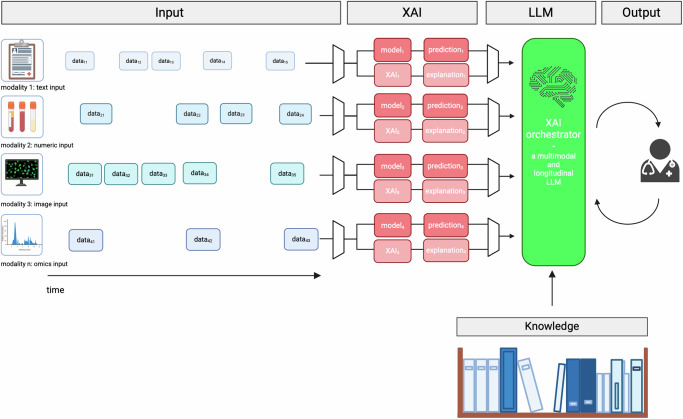
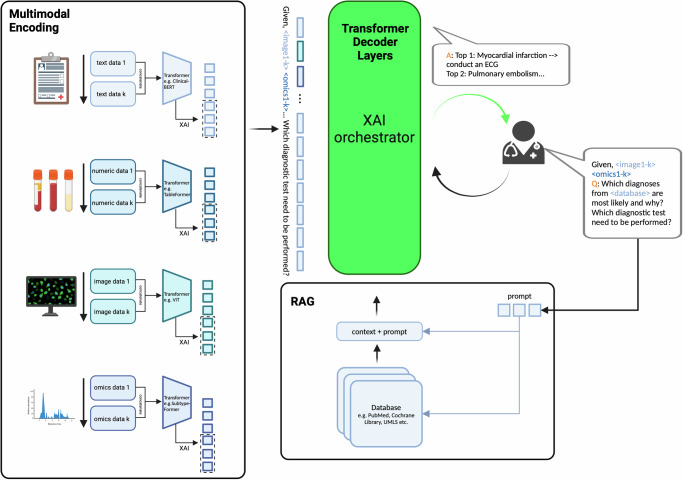
- The authors suggest future implementations could combine modality-specific encoders, a central LLM-based decoder, and retrieval-augmented generation to produce user-friendly explanations and answer follow-up questions.
## Methods
- Narrative review from a clinical perspective of the current state of XAI for multimodal and longitudinal datasets in medical imaging.
- Synthesis of prior work on multimodal XAI, longitudinal XAI, XAI toolkits, and LLM-based medical applications; the paper also discusses illustrative clinical case examples in the supplementary materials.
- Conceptual proposal of the “XAI orchestrator,” including desirable properties, functionalities, and metrics, but no original dataset analysis or model evaluation is reported.
## Limitations
- The paper explicitly states: “we do not provide a full implementation and results of the XAI orchestrator.”
- It also notes that the review is limited by the current state of the literature, where many methods remain at a prototype level and have not yet been extensively applied to real-world clinical questions.
- Evident from the text: the article is conceptual and does not validate the proposed orchestrator on patient data, so its effectiveness, reliability, and clinical utility are not empirically tested in this paper.
Model-written summary. Check it against the paper before relying on it.
Integrity signals
Registry
Cites
Statistics
Figures
Verification
Claims the paper makes
35 Valid · 12 Not valid · 3 Not checked · 21 Own results and interpretations
Some cited sources support this claim and some don’t — read each source’s verdict below.
In the paper
“In this situation, XAI becomes crucial as interpretability methods can help to find and eliminate spurious correlations and shortcut learning46–48.”
§ Orchestrating explainable artificial intelligence for multimodal and longitudinal data in medical imaging > Challenges of XAI for multimodal data
What the sources say
- Not checked — no full text of the sourcecites [46] Ben Ahmed, K., Hall, L. O., Goldgof, D. B. & Fogarty, R. Achieving multisite generalization for CNN-based disease diagnosis models by mitigating shortcut learning. IEEE Access 10, 78726–78738 (2022). 10.1109/ACCESS.2022.3193700 source
- Disputedcites [47] Gichoya, J. W. et al. AI recognition of patient race in medical imaging: a modelling study. Lancet Digit. Health 4, e406–e414 (2022). PMC9650160 35568690 sourceExperimental — accuracy not yet measured
The Discussion reports that saliency mapping was non-contributory: the authors could not isolate the image features responsible for race recognition. It also says that attempts to remove the relevant information were ineffective and that similar technical solutions were unlikely to succeed. Thus, this study does not support the attributed claim that interpretability methods can find and eliminate such shortcuts in this setting. (LLM, conf=0.86)
Checked by a reasoning model — may be wrong.
- Partly supportedcites [48] Geirhos, R. et al. Shortcut learning in deep neural networks. Nat. Mach. Intell. 2, 665–673 (2020). 10.1038/s42256-020-00257-z sourceExperimental — accuracy not yet measured
Section 6, “Diagnosing and understanding shortcut learning” (page unavailable), advocates diagnosing and analysing shortcuts, and the Conclusion recommends careful interpretation of results. This supports the idea that interpretation can help uncover shortcuts, but the passages do not establish that interpretability methods can eliminate spurious correlations or shortcut learning. (LLM, conf=0.78)
plainstates a cause- Asserted: passes — The authors put it forward as true.
- Checkable: passes — It can be checked against evidence.
- Load-bearing: passes — The paper’s conclusions depend on it.
- Based: passes — The paper gives a reason why it holds.
Every source the paper cites for this claim was checked and supports it.
In the paper
“Just as for multimodal data, introducing explainability methods for the analysis of longitudinal data may contribute to the systems’ stability, robustness, and confidence19.”
§ Orchestrating explainable artificial intelligence for multimodal and longitudinal data in medical imaging > XAI for multimodal and longitudinal data
What the sources say
- Supportedcites [19] Rojat, T. et al. Explainable artificial intelligence (XAI) on TimeSeries data: a survey. Preprint at http://arxiv.org/abs/2104.00950 (2021). source
The Confidence section (p. 9) says explainability methods might help time-series models become more robust and stable and describes methods providing confidence in model outcomes. The claim’s tentative “may contribute” reflects that possibility; the Terminology section (p. 2) cautions that most existing methods cannot yet establish those properties. (LLM, conf=0.90)
hedgedstates a possible cause- Asserted: passes — The authors put it forward as true.
- Checkable: passes — It can be checked against evidence.
- Load-bearing: passes — The paper’s conclusions depend on it.
- Based: passes — The paper gives a reason why it holds.
- Rests on an assumption not shown here.
- Supported
Every source the paper cites for this claim was checked and supports it.
In the paper
“In healthcare, diagnoses and treatment decisions are rarely based on a single scan or blood draw - they are made in the synopsis of all relevant information available8.”
§ Orchestrating explainable artificial intelligence for multimodal and longitudinal data in medical imaging > XAI for multimodal and longitudinal data
What the sources say
- Supportedcites [8] Acosta, J. N., Falcone, G. J., Rajpurkar, P. & Topol, E. J. Multimodal biomedical AI. Nat. Med. 28, 1773–1784 (2022). 36109635 10.1038/s41591-022-01981-2 source
The Abstract contrasts AI tools that use a single modality, such as a CT scan, with clinicians who process multiple sources and modalities when diagnosing and deciding on treatment plans. This supports the citing sentence’s broad paraphrase; our copy does not provide a page number for the passage. (LLM, conf=0.90)
plain- Asserted: passes — The authors put it forward as true.
- Checkable: passes — It can be checked against evidence.
- Load-bearing: passes — The paper’s conclusions depend on it.
- Based: passes — The paper gives a reason why it holds.
- Supported
Every source the paper cites for this claim was checked and supports it.
In the paper
“Beyond model comparison at the level of performance, XAI techniques could enhance comparison regarding pathophysiological plausibility by providing influential features, for example, the volume of the hippocampus and amygdala as biomarkers of cognitive impairment33.”
§ Orchestrating explainable artificial intelligence for multimodal and longitudinal data in medical imaging > Discussion of previous work on XAI for multimodal data
What the sources say
- Supportedcites [33] Sheng, J. et al. Predictive classification of Alzheimer’s disease using brain imaging and genetic data. Sci. Rep. 12, 2405 (2022). 35165327 10.1038/s41598-022-06444-9 PMC8844076 source
The Results section (“Selection of biomarkers”) identifies hippocampal volume as an indicator of cognitive decline and reports that amygdala volume was selected for early diagnosis. These selected features support the cited example; the proposed use of XAI for model comparison is the citing authors’ own framing. (LLM, conf=0.91)
hedgedstates a possible cause- Asserted: passes — The authors put it forward as true.
- Checkable: passes — It can be checked against evidence.
- Load-bearing: unclear — It is unclear whether the paper’s conclusions depend on it.
- Based: passes — The paper gives a reason why it holds.
- Supported
The cited sources support only part of this claim — read each source’s verdict below.
In the paper
“There are multiple toolkits, such as AIX-36037, Alibi38, Captum39, EthicalML-XAI40, iNNvestigate41, Quantus42, among others, offering readily implemented XAI methods for a wide variety of tasks applicable to medical imaging (Table 1).”
§ Orchestrating explainable artificial intelligence for multimodal and longitudinal data in medical imaging > Discussion of previous work on XAI for multimodal data
What the sources say
- Supportedcites [37] Arya, V. et al. One explanation does not fit all: a toolkit and taxonomy of ai explainability techniques. Preprint at 10.48550/arXiv.1909.03012 (2019). source
The citation identifies AIX360 as one of the toolkits in the list. The Discussion (p. 10) identifies AIX360 as an open-source toolkit containing eight explainability algorithms, and the Introduction (p. 2) lists the types of explanations it offers. (LLM, conf=0.92)
- Not matchedcites [38] Klaise, Janis, J., Van Looveren, A., Vacanti, G. & Coca, A. Alibi explain: algorithms for explaining machine learning models. JMLR. 22, 1–7 (2021).
Its entry has no title and year that we can search by.
- Supportedcites [39] Kokhlikyan, N. et al. Captum: a unified and generic model interpretability library for PyTorch. Preprint at 10.48550/arXiv.2009.07896 (2020). source
The Abstract (p. 1) identifies Captum as an open-source interpretability library with implemented attribution algorithms for image and other inputs. The Introduction (p. 1) says its algorithms can be applied to any PyTorch model of any modality, supporting its inclusion as a toolkit offering methods applicable to medical imaging. (LLM, conf=0.91)
plain- Asserted: passes — The authors put it forward as true.
- Checkable: passes — It can be checked against evidence.
- Load-bearing: unclear — It is unclear whether the paper’s conclusions depend on it.
- Based: passes — The paper gives a reason why it holds.
- Supported
15 more claims · 9 with their cited sources checked
Create a free account to see all 71 claims and every source verdict.
- It may state two separate claims as one. 24
- Probably not a substantial claim. 42
Claims other papers make about this one
Each is checked against this paper’s own text: does it say what the citing paper says it does?
The cited source says what the claim attributes to it.
In the citing paper
“Incorporating explainable AI into current deep learning research can improve trustworthiness by addressing the limitations of AI's ''black box'' nature (Pahud De Mortanges et al., 2024).”
From Navigating the landscape of multimodal AI in medicine: A scoping review on technical challenges and clinical applications (2025) · cites this paper as Pahud De Mortanges et al., 2024
Citations
Cites
Proceedings of the 24th international conference on Machine learning
(2007) · doi:10.1145/1273496 · Cited by 11,630
BioBERT: a pre-trained biomedical language representation model for biomedical text mining
Lee, J., Yoon, W., Kim, S., Kim, D., Kim, S., So, C. H., & Kang, J. (2020) · Bioinformatics · doi:10.1093/bioinformatics/btz682 · Cited by 7,218 · cited 1×
“BioBERT was pre-trained on PubMed abstracts and PubMedCentralfull-textarticlesandexceededpreviousmodelsintaskslike namedentityrecognition,relationextraction,andquestionanswering 60 .”
Multimodal Machine Learning: A Survey and Taxonomy
Baltrusaitis, T., Ahuja, C., & Morency, L.-P. (2019) · IEEE Transactions on Pattern Analysis and Machine Intelligence · doi:10.1109/tpami.2018.2798607 · Cited by 5,018 · cited 2×
“Additional organizational or technical challenges regarding multi-modal machine learning and AI in healthcare have previously been pointed out 20,44,52 .”
Sallam, M. (2023) · Healthcare · doi:10.3390/healthcare11060887 · Cited by 3,126
Sallam, M. (2023) · doi:10.1101/2023.02.19.23286155 · Cited by 3,123 · cited 1×
“LLMs have many potentially bene fi cial applications in healthcare practice and research, including diagnostic (e.g., prediction of disease risk and outcomes) and procedural (e.g., streamlining of clinical work fl ows, documentation, cost-effectiveness) tasks 59 .”
A Survey on Explainable Artificial Intelligence (XAI): Toward Medical XAI
Tjoa, E., & Guan, C. (2021) · IEEE Transactions on Neural Networks and Learning Systems · doi:10.1109/tnnls.2020.3027314 · Cited by 2,524
Shortcut learning in deep neural networks
Geirhos, R., Jacobsen, J.-H., Michaelis, C., Zemel, R., Brendel, W., Bethge, M., & Wichmann, F. A. (2020) · Nature Machine Intelligence · doi:10.1038/s42256-020-00257-z · Cited by 2,224
Artificial intelligence in cancer imaging: Clinical challenges and applications
Bi, W. L., Hosny, A., Schabath, M. B., Giger, M. L., Birkbak, N. J., Mehrtash, A., Allison, T., Arnaout, O., Abbosh, C., Dunn, I. F., et al. (2019) · CA: A Cancer Journal for Clinicians · doi:10.3322/caac.21552 · Cited by 1,846
The Alzheimer's Disease Neuroimaging Initiative
Mueller, S. G., Weiner, M. W., Thal, L. J., Petersen, R. C., Jack, C., Jagust, W., Trojanowski, J. Q., Toga, A. W., & Beckett, L. (2005) · Neuroimaging Clinics of North America · doi:10.1016/j.nic.2005.09.008 · Cited by 1,525 · cited 1×
“For example, the prediction of Mild Cognitive Impairment or Alzheimer ’ s disease based on the ADNI dataset is frequently investigated 27 – 32 .”
Acosta, J. N., Falcone, G. J., Rajpurkar, P., & Topol, E. J. (2022) · Nature Medicine · doi:10.1038/s41591-022-01981-2 · Cited by 1,365
A critical review of the Delphi technique as a research methodology for nursing
Keeney, S., Hasson, F., & McKenna, H. P. (2001) · International Journal of Nursing Studies · doi:10.1016/s0020-7489(00)00044-4 · Cited by 1,324
Human-in-the-loop machine learning: a state of the art
Mosqueira-Rey, E., Hernández-Pereira, E., Alonso-Ríos, D., Bobes-Bascarán, J., & Fernández-Leal, Á. (2023) · Artificial Intelligence Review · doi:10.1007/s10462-022-10246-w · Cited by 1,025
Huang, S.-C., Pareek, A., Seyyedi, S., Banerjee, I., & Lungren, M. P. (2020) · npj Digital Medicine · doi:10.1038/s41746-020-00341-z · Cited by 934 · cited 2×
“%) stated in a survey that clinical information impacts image interpretation signi fi cantly 9,10 .”
Using machine learning approaches for multi-omics data analysis: A review
Reel, P. S., Reel, S., Pearson, E., Trucco, E., & Jefferson, E. (2021) · Biotechnology Advances · doi:10.1016/j.biotechadv.2021.107739 · Cited by 903 · cited 2×
“Additional organizational or technical challenges regarding multi-modal machine learning and AI in healthcare have previously been pointed out 20,44,52 .”
Rasmy, L., Xiang, Y., Xie, Z., Tao, C., & Zhi, D. (2021) · npj Digital Medicine · doi:10.1038/s41746-021-00455-y · Cited by 886
Mittelstadt, B., Russell, C., & Wachter, S. (2019) · Proceedings of the Conference on Fairness, Accountability, and Transparency · doi:10.1145/3287560.3287574 · Cited by 794 · cited 1×
“For userstotrustasystem,theyneedtoknowoverwhichdomainamodelis reliable,whereitisuncertain,andwhereitislikelytobreakdown 86 .”
Artificial intelligence for multimodal data integration in oncology
Lipkova, J., Chen, R. J., Chen, B., Lu, M. Y., Barbieri, M., Shao, D., Vaidya, A. J., Chen, C., Zhuang, L., Williamson, D. F. K., et al. (2022) · Cancer Cell · doi:10.1016/j.ccell.2022.09.012 · Cited by 777
MedCLIP: Contrastive Learning from Unpaired Medical Images and Text
Wang, Z., Wu, Z., Agarwal, D., & Sun, J. (2022) · Proceedings of the 2022 Conference on Empirical Methods in Natural Language Processing · doi:10.18653/v1/2022.emnlp-main.256 · Cited by 761
A Deep Learning Mammography-based Model for Improved Breast Cancer Risk Prediction
Yala, A., Lehman, C., Schuster, T., Portnoi, T., & Barzilay, R. (2019) · Radiology · doi:10.1148/radiol.2019182716 · Cited by 758 · cited 1×
“Radiological data has been combined with other data types for predictive AI systems in various clinical disciplines like oncology 21 – 24 or neurology 25,26 .”
Albahri, A. S., Duhaim, A. M., Fadhel, M. A., Alnoor, A., Baqer, N. S., Alzubaidi, L., Albahri, O. S., Alamoodi, A. H., Bai, J., Salhi, A., et al. (2023) · Information Fusion · doi:10.1016/j.inffus.2023.03.008 · Cited by 716
Harnessing multimodal data integration to advance precision oncology
Boehm, K. M., Khosravi, P., Vanguri, R., Gao, J., & Shah, S. P. (2022) · Nature Reviews Cancer · doi:10.1038/s41568-021-00408-3 · Cited by 662
Captum: A unified and generic model interpretability library for PyTorch
Kokhlikyan, N., Miglani, V., Martin, M., Wang, E., Alsallakh, B., Reynolds, J., Melnikov, A., Kliushkina, N., Araya, C., Yan, S., et al. (2020) · arXiv · doi:10.48550/arxiv.2009.07896 · Cited by 658 · cited 3×
“While many of these libraries can process multiple input data types separately, only Captum explicitly offers multimodality for the joint processing of input features stemming from different data types.”
AI recognition of patient race in medical imaging: a modelling study
Gichoya, J. W., Banerjee, I., Bhimireddy, A. R., Burns, J. L., Celi, L. A., Chen, L.-C., Correa, R., Dullerud, N., Ghassemi, M., Huang, S.-C., et al. (2022) · The Lancet Digital Health · doi:10.1016/s2589-7500(22)00063-2 · Cited by 611
Understanding Deep Networks via Extremal Perturbations and Smooth Masks
Fong, R., Patrick, M., & Vedaldi, A. (2019) · IEEE/CVF International Conference on Computer Vision (ICCV) · doi:10.1109/iccv.2019.00304 · Cited by 546
Huang, S.-C., Shen, L., Lungren, M. P., & Yeung, S. (2021) · 2021 IEEE/CVF International Conference on Computer Vision (ICCV) · doi:10.1109/iccv48922.2021.00391 · Cited by 489
On the interpretability of artificial intelligence in radiology: challenges and opportunities
Reyes, M., Meier, R., Pereira, S., Silva, C. A., Dahlweid, F.-M., Tengg-Kobligk, H. V., Summers, R. M., & Wiest, R. (2020) · Radiology: Artificial Intelligence · doi:10.1148/ryai.2020190043 · Cited by 484
Self-citationMultimodal data fusion for cancer biomarker discovery with deep learning
Steyaert, S., Pizurica, M., Nagaraj, D., Khandelwal, P., Hernandez-Boussard, T., Gentles, A. J., & Gevaert, O. (2023) · Nature Machine Intelligence · doi:10.1038/s42256-023-00633-5 · Cited by 402 · cited 1×
“Thiscanboosttheirrobustnessand accuracy,enablethediscoveryofnewbiomarkersandtherapeutictargets 6,14 , as well as improve model performance 15 – 17 .”
Integrated multimodal artificial intelligence framework for healthcare applications
Soenksen, L. R., Ma, Y., Zeng, C., Boussioux, L., Villalobos Carballo, K., Na, L., Wiberg, H. M., Li, M. L., Fuentes, I., & Bertsimas, D. (2022) · npj Digital Medicine · doi:10.1038/s41746-022-00689-4 · Cited by 380
Causality matters in medical imaging
Castro, D. C., Walker, I., & Glocker, B. (2020) · Nature Communications · doi:10.1038/s41467-020-17478-w · Cited by 364 · cited 1×
“Never-theless, causality has recently enjoyed increasing attention again, with discussion about causality in deep learning 68 and medical imaging 69,70 .”
Digital medicine and the curse of dimensionality
Berisha, V., Krantsevich, C., Hahn, P. R., Hahn, S., Dasarathy, G., Turaga, P., & Liss, J. (2021) · npj Digital Medicine · doi:10.1038/s41746-021-00521-5 · Cited by 344
Causality matters in medical imaging
Castro, D. C., Walker, I. D., & Glocker, B. (2020) · RePEc: Research Papers in Economics · Cited by 288
One Explanation Does Not Fit All: A Toolkit and Taxonomy of AI Explainability Techniques
Arya, V., Bellamy, R. K. E., Chen, P.-Y., Dhurandhar, A., Hind, M., Hoffman, S. C., Houde, S., Liao, Q. V., Luss, R., Mojsilović, A., et al. (2019) · arXiv · doi:10.48550/arxiv.1909.03012 · Cited by 268
Cao, R., Yang, F., Ma, S.-C., Liu, L., Zhao, Y., Li, Y., Wu, D.-H., Wang, T., Lu, W.-J., Cai, W.-J., et al. (2020) · Theranostics · doi:10.7150/thno.49864 · Cited by 261 · cited 1×
“Finally,Caoetal.predictedcolorectalcancermicrosatelliteinstability (MSI)fromhistopathologicalwholeslideimages(WSIs) 34 .”
Huisman, M., Ranschaert, E., Parker, W., Mastrodicasa, D., Koci, M., Pinto de Santos, D., Coppola, F., Morozov, S., Zins, M., Bohyn, C., et al. (2021) · European Radiology · doi:10.1007/s00330-021-07781-5 · Cited by 243
Explainable AI for clinical and remote health applications: A survey on tabular and time series data
Di Martino, F., & Delmastro, F. (2023) · Artificial Intelligence Review · doi:10.1007/s10462-022-10304-3 · Cited by 216 · cited 1×
“Saliencymapssuitedforradiologicaldatamight notbeapplicable forotherdata types, such astabulardata 43 .”
A Review on Explainability in Multimodal Deep Neural Nets
Joshi, G., Walambe, R., & Kotecha, K. (2021) · IEEE Access · doi:10.1109/access.2021.3070212 · Cited by 204 · cited 1×
“Thiscanboosttheirrobustnessand accuracy,enablethediscoveryofnewbiomarkersandtherapeutictargets 6,14 , as well as improve model performance 15 – 17 .”
Sandoval, Y., Apple, F. S., Mahler, S. A., Body, R., Collinson, P. O., Jaffe, A. S., & on behalf of the International Federation of Clinical Chemistry and Laboratory Medicine Committee on the Clinical Application of Cardiac Biomarkers (2022) · Circulation · doi:10.1161/circulationaha.122.059678 · Cited by 202 · cited 2×
“Thisallowstodistinguish AMI-relatedelevationsfromchronicconditionssuchaschronickidney disease 58 .”
European Society of Radiology (ESR) (2019) · Insights into Imaging · doi:10.1186/s13244-019-0798-3 · Cited by 196
Shaik, T., Tao, X., Li, L., Xie, H., & Velásquez, J. D. (2024) · Information Fusion · doi:10.1016/j.inffus.2023.102040 · Cited by 196
Hyun, S. H., Ahn, M. S., Koh, Y. W., & Lee, S. J. (2019) · Clinical Nuclear Medicine · doi:10.1097/rlu.0000000000002810 · Cited by 185 · cited 1×
“Radiological data has been combined with other data types for predictive AI systems in various clinical disciplines like oncology 21 – 24 or neurology 25,26 .”
Solving the Explainable AI Conundrum by Bridging Clinicians’ Needs and Developers’ Goals
Bienefeld, N., Boss, J. M., Lüthy, R., Brodbeck, D., Azzati, J., Blaser, M., Willms, J., & Keller, E. (2023) · npj Digital Medicine · doi:10.1038/s41746-023-00837-4 · Cited by 159
Bhagwat, N., Viviano, J. D., Voineskos, A. N., Chakravarty, M. M., & Initiative, A. D. N. (2018) · PLOS Computational Biology · doi:10.1371/journal.pcbi.1006376 · Cited by 157
Rahim, N., El–Sappagh, S., Ali, S., Muhammad, K., Ser, J. D., & Abuhmed, T. (2022) · Information Fusion · doi:10.1016/j.inffus.2022.11.028 · Cited by 141 · cited 1×
“Regardingthecombinationoflongitudinalimagedatawithotherdatatypes, Rahimetal.aimedtopredictAlzheimer ’ s Disease from three-dimensional (3D) magnetic resonance imaging (MRI) data with three time points, in combination with non-imaging data 53 .”
Huisman, M., Ranschaert, E., Parker, W., Mastrodicasa, D., Koci, M., Pinto de Santos, D., Coppola, F., Morozov, S., Zins, M., Bohyn, C., et al. (2021) · European Radiology · doi:10.1007/s00330-021-07782-4 · Cited by 139
Joo, S., Ko, E. S., Kwon, S., Jeon, E., Jung, H., Kim, J.-Y., Chung, M. J., & Im, Y.-H. (2021) · Scientific Reports · doi:10.1038/s41598-021-98408-8 · Cited by 137
Graziani, M., Dutkiewicz, L., Calvaresi, D., Amorim, J. P., Yordanova, K., Vered, M., Nair, R., Abreu, P. H., Blanke, T., Pulignano, V., et al. (2023) · Artificial Intelligence Review · doi:10.1007/s10462-022-10256-8 · Cited by 126 · cited 3×
“4.”
InfluentialExplainable Prediction of Acute Myocardial Infarction Using Machine Learning and Shapley Values
Ibrahim, L., Mesinovic, M., Yang, K.-W., & Eid, M. A. (2020) · IEEE Access · doi:10.1109/access.2020.3040166 · Cited by 123
van Hoek, J., Huber, A., Leichtle, A., Härmä, K., Hilt, D., von Tengg-Kobligk, H., Heverhagen, J., & Poellinger, A. (2019) · European Journal of Radiology · doi:10.1016/j.ejrad.2019.108742 · Cited by 120
Deep Learning Role in Early Diagnosis of Prostate Cancer
Reda, I., Khalil, A., Elmogy, M., Abou El-Fetouh, A., Shalaby, A., Abou El-Ghar, M., Elmaghraby, A., Ghazal, M., & El-Baz, A. (2018) · Technology in Cancer Research & Treatment · doi:10.1177/1533034618775530 · Cited by 119
Explainable Artificial Intelligence (XAI) on TimeSeries Data: A Survey
Rojat, T., Puget, R., Filliat, D., Del Ser, J., Gelin, R., & Díaz-Rodríguez, N. (2021) · arXiv · doi:10.48550/arxiv.2104.00950 · Cited by 116 · cited 2×
“For an overview of XAI methods that can be applied to time series data not speci fi c to medical imaging, we refer the reader to Rojat et al. 19 .”
Hedström, A., Weber, L., Bareeva, D., Krakowczyk, D., Motzkus, F., Samek, W., Lapuschkin, S., & Höhne, M. M. C. (2022) · arXiv · doi:10.48550/arxiv.2202.06861 · Cited by 116
MedKLIP: Medical Knowledge Enhanced Language-Image Pre-Training for X-ray Diagnosis
Wu, C., Zhang, X., Zhang, Y., Wang, Y., & Xie, W. (2023) · 2023 IEEE/CVF International Conference on Computer Vision (ICCV) · doi:10.1109/iccv51070.2023.01954 · Cited by 115
Qiu, S., Chang, G. H., Panagia, M., Gopal, D. M., Au, R., & Kolachalama, V. B. (2018) · Alzheimer's & Dementia: Diagnosis, Assessment & Disease Monitoring · doi:10.1016/j.dadm.2018.08.013 · Cited by 110 · cited 1×
“For example, the prediction of Mild Cognitive Impairment or Alzheimer ’ s disease based on the ADNI dataset is frequently investigated 27 – 32 .”
DeepAISE – An interpretable and recurrent neural survival model for early prediction of sepsis
Shashikumar, S. P., Josef, C. S., Sharma, A., & Nemati, S. (2021) · Artificial Intelligence in Medicine · doi:10.1016/j.artmed.2021.102036 · Cited by 109 · cited 1×
“Shashikumar et al. used longitudinal data from EHRs for early sepsis prediction in intensive care patients 55 .”
Liu, J., Chen, Y., Lan, L., Lin, B., Chen, W., Wang, M., Li, R., Yang, Y., Zhao, B., Hu, Z., et al. (2018) · European Radiology · doi:10.1007/s00330-017-5300-3 · Cited by 107
MedKLIP: Medical Knowledge Enhanced Language-Image Pre-TrainingPreprint
Wu, C., Zhang, X., Zhang, Y., Wang, Y., & Xie, W. (2023) · medRxiv · doi:10.1101/2023.01.10.23284412 · Cited by 106 · cited 1×
“ForabetterunderstandingbytheXAIorchestrator, they could be augmented and enriched by another LLM, for example, as in MedKLIP, wherea medical knowledgebaseisqueried forentitytranslation, enabling understanding of unseen entities 76 .”
Ejaz, H., McGrath, H., Wong, B. L., Guise, A., Vercauteren, T., & Shapey, J. (2022) · DIGITAL HEALTH · doi:10.1177/20552076221089099 · Cited by 105
TSViz: Demystification of Deep Learning Models for Time-Series Analysis
Siddiqui, S. A., Mercier, D., Munir, M., Dengel, A., & Ahmed, S. (2019) · IEEE Access · doi:10.1109/access.2019.2912823 · Cited by 95
Counterfactual Explanations for Multivariate Time Series
Ates, E., Aksar, B., Leung, V. J., & Coskun, A. K. (2021) · 2021 International Conference on Applied Artificial Intelligence (ICAPAI) · doi:10.1109/icapai49758.2021.9462056 · Cited by 88 · cited 1×
“Similarly, various techniques have been proposed to analyze longitudinal datawithXAI 57,87 – 90 ,butmosthavenotyetbeenextensivelyappliedtoreal-world clinical questions.”
Li, H., & Fan, Y. (2019) · 2019 IEEE 16th International Symposium on Biomedical Imaging (ISBI 2019) · doi:10.1109/isbi.2019.8759397 · Cited by 83
ContIG: Self-supervised Multimodal Contrastive Learning for Medical Imaging with Genetics
Taleb, A., Kirchler, M., Monti, R., & Lippert, C. (2022) · 2022 IEEE/CVF Conference on Computer Vision and Pattern Recognition (CVPR) · doi:10.1109/cvpr52688.2022.02024 · Cited by 83
A Multi-modal Convolutional Neural Network Framework for the Prediction of Alzheimer’s Disease
Spasov, S. E., Passamonti, L., Duggento, A., Lio, P., & Toschi, N. (2018) · 2018 40th Annual International Conference of the IEEE Engineering in Medicine and Biology Society (EMBC) · doi:10.1109/embc.2018.8512468 · Cited by 73
ChatCAD: Interactive Computer-Aided Diagnosis on Medical Image using Large Language Models
Wang, S., Zhao, Z., Ouyang, X., Wang, Q., & Shen, D. G. (2023) · arXiv (Cornell University) · doi:10.48550/arxiv.2302.07257 · Cited by 69 · cited 1×
“For example, Wang et al. propose ChatCAD, a system that takes Chest X-rays as input, and passes them to different computer-aided diagnosis systems, which produce vectors of output 62 .”
Yoo, Y., Tang, L. Y. W., Li, D. K. B., Metz, L., Kolind, S., Traboulsee, A. L., & Tam, R. C. (2019) · Computer Methods in Biomechanics and Biomedical Engineering: Imaging & Visualization · doi:10.1080/21681163.2017.1356750 · Cited by 67
Thung, K.-H., Yap, P.-T., & Shen, D. (2017) · Lecture Notes in Computer Science · doi:10.1007/978-3-319-67558-9_19 · Cited by 63
Anguita-Ruiz, A., Segura-Delgado, A., Alcalá, R., Aguilera, C. M., & Alcalá-Fdez, J. (2020) · PLOS Computational Biology · doi:10.1371/journal.pcbi.1007792 · Cited by 62
Radiologist Use of and Perceived Need for Patient Data Access
Boonn, W. W., & Langlotz, C. P. (2009) · Journal of Digital Imaging · doi:10.1007/s10278-008-9115-2 · Cited by 60
Predictive classification of Alzheimer’s disease using brain imaging and genetic data
Sheng, J., Xin, Y., Zhang, Q., Wang, L., Yang, Z., & Yin, J. (2022) · Scientific Reports · doi:10.1038/s41598-022-06444-9 · Cited by 50
Artificial intelligence and cancer
Troyanskaya, O., Trajanoski, Z., Carpenter, A., Thrun, S., Razavian, N., & Oliver, N. (2020) · Nature Cancer · doi:10.1038/s43018-020-0034-6 · Cited by 47
Explaining Any Time Series Classifier
Guidotti, R., Monreale, A., Spinnato, F., Pedreschi, D., & Giannotti, F. (2020) · 2020 IEEE Second International Conference on Cognitive Machine Intelligence (CogMI) · doi:10.1109/cogmi50398.2020.00029 · Cited by 46 · cited 1×
“Similarly, various techniques have been proposed to analyze longitudinal datawithXAI 57,87 – 90 ,butmosthavenotyetbeenextensivelyappliedtoreal-world clinical questions.”
Wu, C., Lei, J., Zheng, Q., Zhao, W., Lin, W., Zhang, X., Zhou, X., Zhao, Z., Zhang, Y., Wang, Y., et al. (2023) · arXiv · doi:10.48550/arxiv.2310.09909 · Cited by 43 · cited 1×
“Even the capabilities of non-medicine-speci fi c models are tested: Although Open AI states that GPT-4V is not suitable for the interpretation of medicalimages 65 , itsperformanceonmultimodalmedical imageswithor without other types of clinical data has been evaluated 66 .”
Agrawal, A., Khatri, G. D., Khurana, B., Sodickson, A. D., Liang, Y., & Dreizin, D. (2023) · Emergency Radiology · doi:10.1007/s10140-023-02121-0 · Cited by 41
Prelaj, A., Galli, E. G., Miskovic, V., Pesenti, M., Viscardi, G., Pedica, B., Mazzeo, L., Bottiglieri, A., Provenzano, L., Spagnoletti, A., et al. (2023) · Frontiers in Oncology · doi:10.3389/fonc.2022.1078822 · Cited by 39
Explainable AI for time series via Virtual Inspection Layers
Vielhaben, J., Lapuschkin, S., Montavon, G., & Samek, W. (2024) · Pattern Recognition · doi:10.1016/j.patcog.2024.110309 · Cited by 38
Beyond Medical Imaging - A Review of Multimodal Deep Learning in RadiologyPreprint
Heiliger, L., Sekuboyina, A., Menze, B. H., Egger, J., & Kleesiek, J. (2022) · doi:10.36227/techrxiv.19103432.v1 · Cited by 38
On Measuring Faithfulness or Self-consistency of Natural Language Explanations
Parcalabescu, L., & Frank, A. (2024) · Proceedings of the 62nd Annual Meeting of the Association for Computational Linguistics (Volume 1: Long Papers) · doi:10.18653/v1/2024.acl-long.329 · Cited by 38
Vaidhya Venkadesh, K., Aleef, T. A., Scholten, E. T., Saghir, Z., Silva, M., Sverzellati, N., Pastorino, U., van Ginneken, B., Prokop, M., & Jacobs, C. (2023) · Radiology · doi:10.1148/radiol.223308 · Cited by 32
The Case for User-Centered Artificial Intelligence in Radiology
Filice, R. W., & Ratwani, R. M. (2020) · Radiology: Artificial Intelligence · doi:10.1148/ryai.2020190095 · Cited by 30
On Measuring Faithfulness or Self-consistency of Natural Language Explanations
Parcalabescu, L., & Frank, A. (2023) · arXiv · doi:10.48550/arxiv.2311.07466 · Cited by 27
Gradient Obfuscation Gives a False Sense of Security in Federated Learning
Yue, K., Jin, R., Wong, C.-W., Baron, D., & Dai, H. (2022) · arXiv · doi:10.48550/arxiv.2206.04055 · Cited by 26 · cited 1×
“However, it needs to be considered that also obfuscated gradients may become subject to reconstruction attacks and leak information 71,72 .”
Binder, A., Weber, L., Lapuschkin, S., Montavon, G., Müller, K.-R., & Samek, W. (2023) · 2023 IEEE/CVF Conference on Computer Vision and Pattern Recognition (CVPR) · doi:10.1109/cvpr52729.2023.01549 · Cited by 21 · cited 1×
“Also, for existing methods, the discussion of what a good or reliable explanation constitutes is ongoing ( 91 , inter alia ).”
Is Multi-Modal Necessarily Better? Robustness Evaluation of Multi-Modal Fake News Detection
Chen, J., Jia, C., Zheng, H., Chen, R., & Fu, C. (2023) · IEEE Transactions on Network Science and Engineering · doi:10.1109/tnse.2023.3249290 · Cited by 17 · cited 1×
“This susceptibility to adversarial 49 – 51 .”
Investigating Vulnerability to Adversarial Examples on Multimodal Data Fusion in Deep Learning
Yu, Y., Lee, H. J., Kim, B. C., Kim, J. U., & Ro, Y. M. (2020) · arXiv · doi:10.48550/arxiv.2005.10987 · Cited by 15 · cited 1×
“This susceptibility to adversarial 49 – 51 .”
Beyond Medical Imaging - A Review of Multimodal Deep Learning in Radiology
Heiliger, L., Sekuboyina, A., Menze, B., Egger, J., & Kleesiek, J. (2022) · doi:10.36227/techrxiv.19103432 · Cited by 13 · cited 1×
“Combiningthesedifferentdatatypes,hereafterreferredtoas multimodaldata,fordeeplearningtasksisapromisingandincreasingly popular approach 11 – 13 .”
Ben Ahmed, K., Hall, L. O., Goldgof, D. B., & Fogarty, R. (2022) · IEEE Access · doi:10.1109/access.2022.3193700 · Cited by 12 · cited 1×
“In this situation, XAI becomes crucial as interpretability methods can help to fi nd and eliminate spurious correlations and shortcut learning 46 – 48 .”
Conceptual Explanations of Neural Network Prediction for Time Series
Kusters, F., Schichtel, P., Ahmed, S., & Dengel, A. (2020) · 2020 International Joint Conference on Neural Networks (IJCNN) · doi:10.1109/ijcnn48605.2020.9207341 · Cited by 8
Berrevoets, J., Kacprzyk, K., Qian, Z., & van der Schaar, M. (2023) · arXiv · doi:10.48550/arxiv.2303.02186 · Cited by 8
Shaik, T., Tao, X., Li, L., et al. (2023) · arXiv (Cornell University) · doi:10.48550/arxiv.2306.11963 · Cited by 8
Meudec, R. (2021) · Zenodo (CERN European Organization for Nuclear Research) · doi:10.5281/zenodo.5711703 · Cited by 8
Introduction to Human‐Machine Interface
Mujawar, S., Deshpande, A., Gherkar, A., Simon, S. E., & Prajapati, B. G. (2023) · Wiley eBooks · doi:10.1002/9781394200344.ch1 · Cited by 6
SetQuence & SetOmic: Deep Set Transformer-based Representations of Cancer Multi-Omics
Jurenaite, N., León-Periñán, D., Donath, V., Torge, S., & Jäkel, R. (2022) · 2022 IEEE Conference on Computational Intelligence in Bioinformatics and Computational Biology (CIBCB) · doi:10.1109/cibcb55180.2022.9863058 · Cited by 5 · cited 1×
“For example, Jurenaite et al. used non-fi xed sets of mutated genome sequences (mutomes) and transcriptomes in a transformer-based deep neural network, aiming to predict seven common tumor types 35 .”
Schotman, E. H. H., & İren, D. (2022) · IEEE Conference on Business Informatics · doi:10.1109/cbi54897.2022.00032 · Cited by 4 · cited 1×
“A recent article describes a Delphi study among experts in the insurance industry to gain insight into their preferences and opinions about XAI 85 .”
Quantifying and Localizing Usable Information Leakage from Neural Network Gradients
Mo, F., Borovykh, A., Malekzadeh, M., Demetriou, S., Gündüz, D., & Haddadi, H. (2021) · arXiv · doi:10.48550/arxiv.2105.13929 · Cited by 1 · cited 1×
“However, it needs to be considered that also obfuscated gradients may become subject to reconstruction attacks and leak information 71,72 .”
Meudec, R. (2021) · Zenodo · doi:10.5281/zenodo.5711704
Explainable Ai for Time Series Via Virtual Inspection Layers
Vielhaben, J., Lapuschkin, S., Montavon, G., & Samek, W. (2023) · doi:10.2139/ssrn.4399242
Research works printed but not linked: 3
- Klaise, Janis, J., Van Looveren, A., Vacanti, G. & Coca, A. Alibi explain: algorithms for explaining machine learning models. JMLR. 22, 1–7 (2021).
- Ribeiro, F. D. S., Xia, T., Monteiro, M., Pawlowski, N. & Glocker, B. High fidelity image counterfactuals with probabilistic causal models. Proceedings of the 40th International Conference on Machine Learning. PMLR202. (2023).
- Li, X. et al. InterpretDL: explaining deep models in PaddlePaddle. JMLR 23, 1–6 (2022).
Cited by
The STARD-AI reporting guideline for diagnostic accuracy studies using artificial intelligence
Sounderajah, V., Guni, A., Liu, X., Collins, G. S., Karthikesalingam, A., Markar, S. R., Golub, R. M., Denniston, A. K., Shetty, S., Moher, D., et al. (2025) · Nature Medicine · doi:10.1038/s41591-025-03953-8 · Cited by 592
“Further advances in fields such as reinforcement learning 48,49 , graph neural networks 50,51 and explainable AI (XAI) solutions 52 may also substantially change the landscape of health AI and require new considerations in the next iteration of reporting guidelines.”
Schouten, D., Nicoletti, G., Dille, B., Chia, C., Vendittelli, P., Schuurmans, M., Litjens, G., & Khalili, N. (2025) · Medical Image Analysis · doi:10.1016/j.media.2025.103621 · Cited by 162
Ahmed, F., Naz, N. S., Khan, S., Rehman, A. U., Ismael, W. M., & Khan, M. A. (2026) · BMC Medical Imaging · doi:10.1186/s12880-025-02118-w · Cited by 104
Explainability in the age of large language models for healthcare
Mesinovic, M., Watkinson, P., & Zhu, T. (2025) · Communications Engineering · doi:10.1038/s44172-025-00453-y · Cited by 54
Yan, Z., Fan, K.-Q., Zhang, Q., Wu, X., Chen, Y., Wu, X., Yu, T., Su, N., Zou, Y., Chi, H., et al. (2025) · World Journal of Urology · doi:10.1007/s00345-025-05757-4 · Cited by 24
Metadata
- Authors
- Pahud de Mortanges, A., Luo, H., Shu, S. Z., Kamath, A., Suter, Y., Shelan, M., Pöllinger, A., & Reyes, M.
- Affiliations
- University of Bern (CH)
- University Hospital of Bern (CH)
- ORCID
- Venue
- npj Digital Medicine
- Published
- 2024-07-22
- Volume
- 7
- Issue
- 1
- Pages
- 195-195
- ISSN
- 2398-6352 (ISSN-L)
- PMC
- PMC11263688
- OpenAlex
- W4400879250
- Cited by
- 93
- References
- 89
- Citations by year
- 2026: 52 · 2025: 37 · 2024: 3
- FWCI
- 3.15
- Type
- journal article
- Language
- en
- Open access
- gold
- doi.org
- Licence
- cc-by
- creativecommons.org/licenses/by/4.0 (tdm)
- creativecommons.org/licenses/by/4.0 (vor)
- Locations
- npj Digital Medicine (publishedVersion, cc-by)
- PubMed Central (publishedVersion, cc-by)
- PubMed (publishedVersion)
- Bern Open Repository and Information System (University of Bern) (submittedVersion, cc-by)
- DOAJ (DOAJ: Directory of Open Access Journals) (submittedVersion, cc-by-sa)
- Open Access CRIS of the University of Bern
- Funders
- Schweizerischer Nationalfonds zur Förderung der Wissenschaftlichen Forschung (205320_212939)
- Topics
- Physical Sciences › Computer Science › Artificial Intelligence › Explainable Artificial Intelligence (XAI)
- Health Sciences › Medicine › Health Informatics › Artificial Intelligence in Healthcare and Education
- Physical Sciences › Computer Science › Artificial Intelligence › Machine Learning in Healthcare
- Keywords
- explainable AI, multimodal data, longitudinal data, diagnostic imaging, clinical usability, clinical decision support
About these checks
Registry, retraction, Cites and statistics results are computed, not judged, with one exception: a printed reference that no index lists is read once by a model before it counts as a citation error. Claims are extracted by a model and kept only when their quote appears verbatim in the text; each cited source is then checked, with a model’s help, for whether it says what the claim relies on. Those verdicts can be wrong — read the claim’s quote and the cited source before relying on one.
The claim verdicts this report counts are experimental: their accuracy is not yet measured.
A language model drew the claims from the paper on 2026-10-09, under version 3 of the claim definition (model deepseek-v4.1-flash, prompt extract-v3).
A second model labelled each claim on 2026-10-09 (model jev-1.13-20260917, definition revision gold-guideline-v0.2).
Cited sources are checked with a language model’s help (gpt-6-sol).
Statistics and arithmetic are recomputed, not judged.
Confidence bands are shown only for fields calibrated on our annotated test set. None is calibrated yet, so no band is shown.
What counts as a claim ›How we measure confidence ›How we check this ›
Are you an author, or do you see a problem with this page? Request a review
Data sources
Bibliographic data: Semantic Scholar, OpenAlex, Crossref.
Contains information from the Semantic Scholar Academic Graph Datasets, made available under the ODC Attribution License (ODC-BY 1.0).
Semantic Scholar’s data is described in: Kinney, R., et al. (2023). The Semantic Scholar Open Data Platform. arXiv:2301.10140.
