

A systematic review and meta-analysis of diagnostic performance comparison between generative AI and physicians
Open accessPublished version of a preprint
The DOI matches its Crossref record; 135 of the 135 references it cites were found in a registry or an index.
Abstract
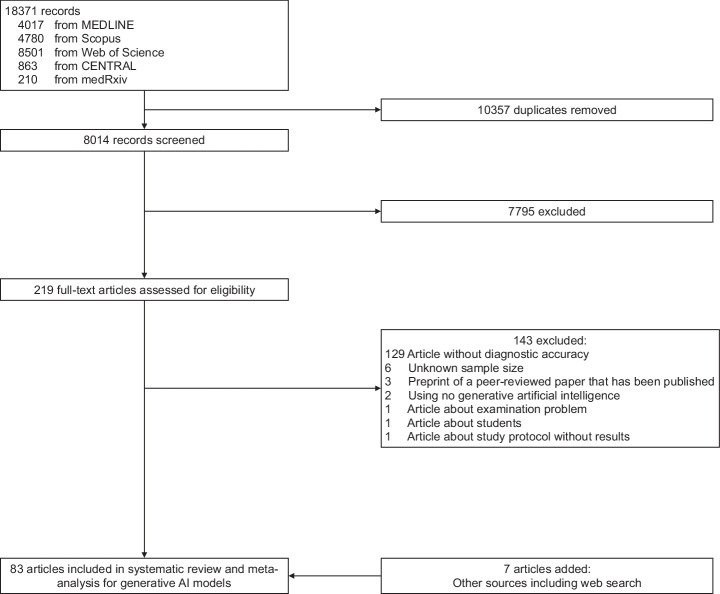
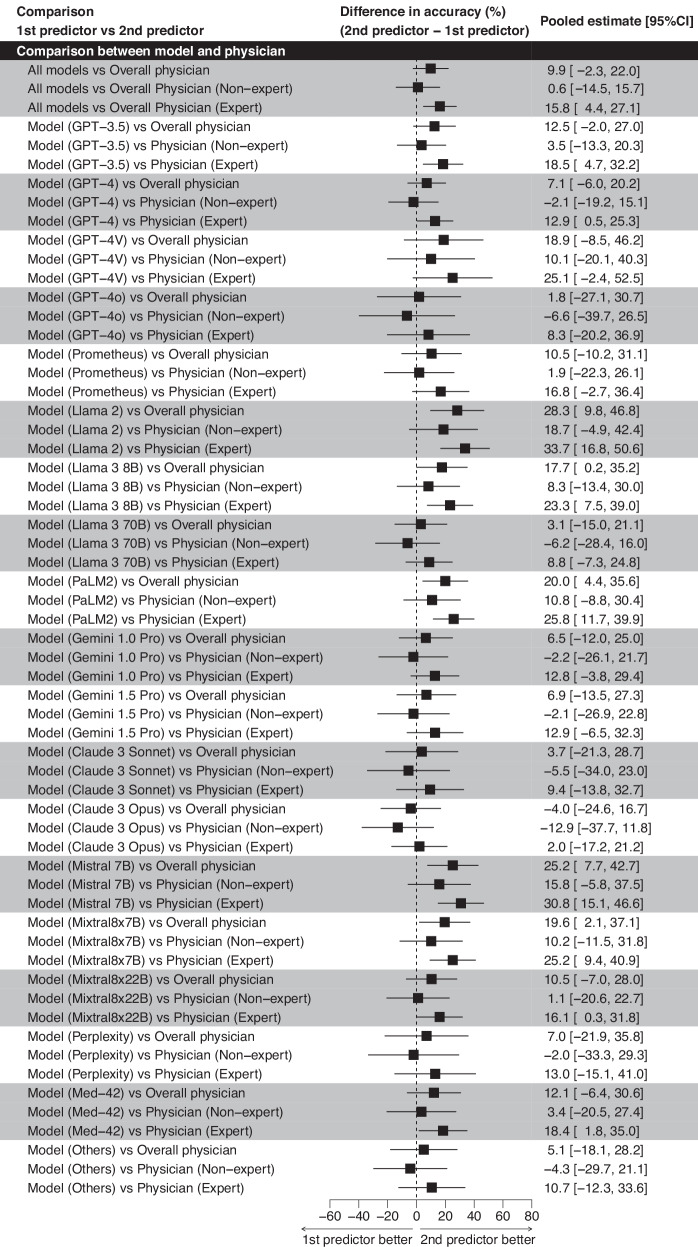
While generative artificial intelligence (AI) has shown potential in medical diagnostics, comprehensive evaluation of its diagnostic performance and comparison with physicians has not been extensively explored. We conducted a systematic review and meta-analysis of studies validating generative AI models for diagnostic tasks published between June 2018 and June 2024. Analysis of 83 studies revealed an overall diagnostic accuracy of 52.1%. No significant performance difference was found between AI models and physicians overall ( p = 0.10) or non-expert physicians ( p = 0.93). However, AI models performed significantly worse than expert physicians ( p = 0.007). Several models demonstrated slightly higher performance compared to non-experts, although the differences were not significant. Generative AI demonstrates promising diagnostic capabilities with accuracy varying by model. Although it has not yet achieved expert-level reliability, these findings suggest potential for enhancing healthcare delivery and medical education when implemented with appropriate understanding of its limitations.
Overview
The claims and statistics of this paper haven’t been checked yet.
Free: it reads the open-access text and checks the first 5 claims that cite a source we can check. Create a free account to check every claim.
Integrity signals
Registry
Cites
Statistics
Figures
Verification
Claims the paper makes
The claims and statistics of this paper haven’t been checked yet.
Free: it reads the open-access text and checks the first 5 claims that cite a source we can check. Create a free account to check every claim.
Claims other papers make about this one
Each is checked against this paper’s own text: does it say what the citing paper says it does?
The source backs part of the claim, not all of it — or backs it for a different population, condition or comparison.
In the citing paper
“AI has moderate accuracy overall but performs better in controlled settings.”
From Artificial Intelligence in Detecting Statistical Errors: Implications for Authors, Reviewers, and Editors (2025) · cites this paper as [27]
Experimental — accuracy not yet measuredThe cited source says what the claim attributes to it.
In the citing paper
“For instance, a meta-analysis by Takita et al.27 evaluated studies between 2018–2024, and concluded that among different AI models, AI had a diagnostic accuracy of 52% (95% confidence interval, 47.0–57.1%).”
From Artificial Intelligence in Detecting Statistical Errors: Implications for Authors, Reviewers, and Editors (2025) · cites this paper as [27]
Self-check
Percentages, sums and reported differences re-computed from the paper’s own numbers.
The self-check needs the paper’s full text.
Citations
Cites
Preferred Reporting Items for Systematic Reviews and Meta-Analyses: the PRISMA statement
Moher, D., Liberati, A., Tetzlaff, J., Altman, D. G., & for the PRISMA Group (2009) · BMJ · doi:10.1136/bmj.b2535 · Cited by 83,823
Bias in meta-analysis detected by a simple, graphical test
Egger, M., Smith, G. D., Schneider, M., & Minder, C. (1997) · BMJ · doi:10.1136/bmj.315.7109.629 · Cited by 56,722
Preferred reporting items for systematic reviews and meta-analyses: the PRISMA Statement.
(2009) · PubMed Central · Cited by 44,859
Preferred reporting items for systematic reviews and meta-analyses: The PRISMA statement
Moher, D., Liberati, A., Tetzlaff, J., Altman, D. G., & the PRISMA Group* (2009) · Annals of Internal Medicine · doi:10.7326/0003-4819-151-4-200908180-00135 · Cited by 37,554
Language Models are Few-Shot Learners
Brown, T. B., Mann, B., Ryder, N., Subbiah, M., Kaplan, J., Dhariwal, P., Neelakantan, A., Shyam, P., Sastry, G., Askell, A., et al. (2020) · arXiv · doi:10.48550/arxiv.2005.14165 · Cited by 23,372
LLaMA: Open and Efficient Foundation Language Models
Touvron, H., Lavril, T., Izacard, G., Martinet, X., Lachaux, M.-A., Lacroix, T., Rozière, B., Goyal, N., Hambro, E., Azhar, F., et al. (2023) · arXiv · doi:10.48550/arxiv.2302.13971 · Cited by 4,602
Large Language Models Encode Clinical Knowledge
Singhal, K., Azizi, S., Tu, T., Mahdavi, S. S., Wei, J., Chung, H. W., Scales, N., Tanwani, A., Cole-Lewis, H., Pfohl, S., et al. (2022) · arXiv · doi:10.48550/arxiv.2212.13138 · Cited by 4,083
Large language models encode clinical knowledge
Singhal, K., Azizi, S., Tu, T., Mahdavi, S. S., Wei, J., Chung, H. W., Scales, N., Tanwani, A., Cole-Lewis, H., Pfohl, S., et al. (2023) · Nature · doi:10.1038/s41586-023-06291-2 · Cited by 4,083
Large language models in medicine
Thirunavukarasu, A. J., Ting, D. S. J., Elangovan, K., Gutierrez, L., Tan, T. F., & Ting, D. S. W. (2023) · Nature Medicine · doi:10.1038/s41591-023-02448-8 · Cited by 3,944
McInnes, M. D. F., Moher, D., Thombs, B. D., McGrath, T. A., Bossuyt, P. M., and the PRISMA-DTA Group, Clifford, T., Cohen, J. F., Deeks, J. J., Gatsonis, C., et al. (2018) · JAMA · doi:10.1001/jama.2017.19163 · Cited by 3,210
Cited by
Haltaufderheide, J., & Ranisch, R. (2024) · npj Digital Medicine · doi:10.1038/s41746-024-01157-x · Cited by 396
Human–AI collectives most accurately diagnose clinical vignettes
Zöller, N., Berger, J., Lin, I., Fu, N., Komarneni, J., Barabucci, G., Laskowski, K., Shia, V., Harack, B., Chu, E. A., et al. (2025) · Proceedings of the National Academy of Sciences · doi:10.1073/pnas.2426153122 · Cited by 98
Chalmers, D., Hunt, R., Pachidi, S., Potočnik, K., & Townsend, D. M. (2026) · Journal of Management Studies · doi:10.1111/joms.70063 · Cited by 49
Shan, G., Chen, X., Wang, C., Liu, L., Gu, Y., Jiang, H., & Shi, T. (2025) · JMIR Medical Informatics · doi:10.2196/64963 · Cited by 71
Human–large language model collaboration in clinical medicine: a systematic review and meta-analysis
Wang, G., Zhang, K., Jiang, J., Wang, C., Bi, H., Liang, H., Qi, Z., Huang, Y., Li, Y., & Yang, X. (2026) · npj Digital Medicine · doi:10.1038/s41746-026-02382-2 · Cited by 68
Mendel, T., Singh, N., Mann, D. M., Wiesenfeld, B., & Nov, O. (2025) · Journal of Medical Internet Research · doi:10.2196/64290 · Cited by 64
Gupta, N., Khatri, K., Malik, Y., Lakhani, A., Kanwal, A., Aggarwal, S., & Dahuja, A. (2024) · BMC Medical Education · doi:10.1186/s12909-024-06592-8 · Cited by 58
BRIDGE: benchmarking large language models for understanding real-world clinical practice texts
Wu, J., Gu, B., Zhou, R., Xie, K., Snyder, D., Jiang, Y., Carducci, V., Wyss, R., Desai, R. J., Alsentzer, E., et al. (2026) · Nature Biomedical Engineering · doi:10.1038/s41551-026-01719-2 · Cited by 51
Oura, T., Tatekawa, H., Horiuchi, D., Matsushita, S., Takita, H., Atsukawa, N., Mitsuyama, Y., Yoshida, A., Murai, K., Tanaka, R., et al. (2024) · Japanese Journal of Radiology · doi:10.1007/s11604-024-01633-0 · Cited by 48
Self-citationArtificial intelligence tool development: what clinicians need to know?
Chew, B.-H., & Ngiam, K. Y. (2025) · BMC Medicine · doi:10.1186/s12916-025-04076-0 · Cited by 41
Benchmarking large language model-based agent systems for clinical decision tasks
Liu, Y., Carrero, Z. I., Jiang, X., Ferber, D., Wölflein, G., Zhang, L., Jayabalan, S., Lenz, T., Hui, Z., & Kather, J. N. (2026) · npj Digital Medicine · doi:10.1038/s41746-026-02443-6 · Cited by 37
Evaluation of large language models within GenAI in qualitative research
Mehta, S. D., Paul, S., Awiti, E., Young, S., Zulaika, G., Otieno, F., Phillips‐Howard, P. A., Mason, L., & Bhaumik, R. (2025) · Scientific Reports · doi:10.1038/s41598-025-18969-w · Cited by 36
Effects of GenAI Interventions on Student Academic Performance: A Meta-Analysis
Gu, J., & Yan, Z. (2025) · Journal of Educational Computing Research · doi:10.1177/07356331251349620 · Cited by 30
Wang, X., Wang, Q., Ding, G., Wang, J., Tang, Y., & Feng, Y. (2025) · iScience · doi:10.1016/j.isci.2025.114082 · Cited by 28
Prakashan, D., Ramya, P. R., Kaushik, A. K., & Gandhi, S. (2025) · BME Frontiers · doi:10.34133/bmef.0150 · Cited by 28
Ma, M. D., Ye, C., Yan, Y., Wang, X., Ping, P., Chang, T. S., & Wang, W. (2024) · arXiv (Cornell University) · doi:10.48550/arxiv.2406.09923 · Cited by 25
Wolff, B. (2025) · The Clinical Neuropsychologist · doi:10.1080/13854046.2025.2547934 · Cited by 23
Chen, M., Wu, Y., Ma, J., Jia, X., Gao, C., Zhao, F., & Qiao, Y. (2026) · npj Digital Medicine · doi:10.1038/s41746-026-02409-8 · Cited by 22
Pantelidis, P., Dilaveris, P., Ruipérez-Campillo, S., Goliopoulou, A., Giannakodimos, A., Theofilis, P., LUCIA, R. D., Κατσαρού, Ο., Zisimos, K., Kalogeras, K. I., et al. (2025) · Biomedicines · doi:10.3390/biomedicines13051019 · Cited by 20
Scott, I. A., Reddy, S., Kelly, T., Miller, T., & van der Vegt, A. H. (2025) · The Medical Journal of Australia · doi:10.5694/mja2.70057 · Cited by 20
Bayala, Y. L. T., Tiendrébeogo, W. J. S. Z., Ouedraogo, D., Kaboré, F., Sougué, C., Yaméogo, R. A., Nacanabo, W. M., Tinni, I. A., Ouédraogo, A., & Zongo, E. (2025) · BMC Rheumatology · doi:10.1186/s41927-025-00512-z · Cited by 18
Holistic AI in medicine; improved performance and explainability
Petridis, P., Margaritis, G., Stoumpou, V., & Bertsimas, D. (2026) · npj Digital Medicine · doi:10.1038/s41746-025-02298-3 · Cited by 17
Sato, H., Ogasawara, K., & Sakurai, H. (2025) · JMIR Medical Education · doi:10.2196/76925 · Cited by 17
von Conta, J., Engelke, M., Bahnsen, F. H., Dada, A., Liebert, E., Nensa, F., Kleesiek, J., & Diehl, A. (2025) · Bundesgesundheitsblatt - Gesundheitsforschung - Gesundheitsschutz · doi:10.1007/s00103-025-04086-6 · Cited by 17
Atsukawa, N., Tatekawa, H., Oura, T., Matsushita, S., Horiuchi, D., Takita, H., Mitsuyama, Y., Omori, A., Shimono, T., Miki, Y., et al. (2025) · Japanese Journal of Radiology · doi:10.1007/s11604-025-01764-y · Cited by 17
Self-citationAlami, K., Willemse, E., Quiriny, M., Lipski, S. M., Laurent, C., Donquier, V., & Digonnet, A. (2024) · Cureus · doi:10.7759/cureus.68808 · Cited by 16
Hack, S., Attal, R., Geva, K., Farzad, A., Alsleibi, S., Saleh, N., Gvili, B., Yogev, D., Shahal, D., Kaminer, B. M., et al. (2025) · Oral Oncology · doi:10.1016/j.oraloncology.2025.107813 · Cited by 16
Takita, H., Walston, S. L., Mitsuyama, Y., Watanabe, K., Ishimaru, S., & Ueda, D. (2025) · Japanese Journal of Radiology · doi:10.1007/s11604-025-01799-1 · Cited by 13
Self-citationTscholl, D. W., Ebensperger, M., RahrischRahrisch, A., Wang, H. J., Heckel, H., Thomasius, M., Kaserer, A., Grande, B., Seelandt, J., & Kolbe, M. (2026) · Advances in Simulation · doi:10.1186/s41077-026-00407-0 · Cited by 12
Alain, G., Crick, J. P., Snead, E., Quatman‐Yates, C. C., & Quatman, C. E. (2025) · Journal of Medical Internet Research · doi:10.2196/73918 · Cited by 11
Haberal, M., & Hançerlioğulları, D. (2026) · BMC Oral Health · doi:10.1186/s12903-025-07612-9 · Cited by 11
Meyer, N. S., & Meyer, J. W. (2025) · Cureus · doi:10.7759/cureus.81802 · Cited by 11
The Effect of LLM Assistance on Diagnostic Accuracy: A Systematic Review and Meta-AnalysisPreprint
Tretow, I., Ergon, E., Schwebel, M., Treffers, T., Welpe, I. M., & Feuerriegel, S. (2025) · medRxiv · doi:10.64898/2025.12.11.25341476 · Cited by 10
Artificial superintelligence alignment in healthcare
Ueda, D., Walston, S. L., Kurokawa, R., Saida, T., Honda, M., Iima, M., Watabe, T., Yanagawa, M., Nishioka, K., Sofue, K., et al. (2025) · Japanese Journal of Radiology · doi:10.1007/s11604-025-01907-1 · Cited by 10
Self-citationPatterns of AI Use in Clinical Work by Hospitalists: Survey Study
Bagla, P., Hanna, J., Marthambadi, B., & Watkins, S. (2026) · Journal of Medical Internet Research · doi:10.2196/85973 · Cited by 10
Artificial intelligence in forensic psychiatry: potential applications and key considerations
Blott, H., Hind, E., Brown, C., & Forrester, A. (2025) · Journal of Forensic and Legal Medicine · doi:10.1016/j.jflm.2025.103016 · Cited by 10
A systematic review on the generative AI applications in human medical genetics
Changalidis, A. I., Barbitoff, Y. A., Nasykhova, Y. A., & Glotov, A. S. (2026) · Frontiers in Genetics · doi:10.3389/fgene.2025.1694070 · Cited by 9
Yamamura, Y., Fujii, K., Nakashima, C., & Otsuka, A. (2025) · Cureus · doi:10.7759/cureus.77067 · Cited by 9
Heinz, M., Hakam, H. T., Salzmann, M., Prill, R., & Ramadanov, N. (2025) · Medicina · doi:10.3390/medicina61122080 · Cited by 9
Wong, H. M., Heesen, P., Janetzky, P., Bendszus, M., & Feuerriegel, S. (2026) · arXiv (Cornell University) · doi:10.48550/arxiv.2602.17308 · Cited by 9
Corpman, D. W., Auyong, D. B., Walters, A. M., & Gray, A. T. (2025) · Regional Anesthesia & Pain Medicine · doi:10.1136/rapm-2025-106850 · Cited by 9
Prediction of Lupus Classification Criteria via Generative AI Medical Record Profiling
Nair, S., Lushington, G. H., Purushothaman, M., Rubin, B., Jupe, E., & Gattam, S. (2025) · BioTech · doi:10.3390/biotech14010015 · Cited by 8
Papageorgiou, P. S., Christodoulou, R. C., Pitsillos, R., Petrou, V., Vamvouras, G., Kormentza, E. V., Papagelopoulos, P. J., & Georgiou, M. F. (2025) · Applied Sciences · doi:10.3390/app15169005 · Cited by 8
Wang, Z., Zhang, R., Ji, C., Zhang, J., Yue, B., & Wang, F. (2025) · World Journal of Gastrointestinal Oncology · doi:10.4251/wjgo.v17.i10.111339 · Cited by 8
Firoozeh, N., Mastrodicasa, D., Behr, S. C., Muglia, V. F., & Westphalen, A. C. (2025) · Radiology Imaging Cancer · doi:10.1148/rycan.250119 · Cited by 8
Xiang, Z., Deng, J., Liang, H., Jiang, M., Liang, Y., Liu, Z., Wu, Y., Peng, L., Dai, X., & Zhu, Z. (2025) · Annals of Medicine · doi:10.1080/07853890.2025.2568118 · Cited by 8
Romero-Rodríguez, L. M., & Castillo-Abdul, B. (2025) · Journal of Primary Care & Community Health · doi:10.1177/21501319251381878 · Cited by 8
Chen, Z., Li, W., & Lin, Z. (2026) · PLOS Digital Health · doi:10.1371/journal.pdig.0001283 · Cited by 7
Scherenberg, V. (2026) · Frontiers in Public Health · doi:10.3389/fpubh.2026.1891658 · Cited by 7
Understanding Large Language Models
Sreerakuvandana, S., Pappachan, P., & Arya, V. (2024) · Advances in computational intelligence and robotics book series · doi:10.4018/979-8-3693-3860-5.ch001 · Cited by 7
In the search for the perfect prompt in medical AI queries
Berghea, F., Berghea, E. C., Daia, C. O., Ciuc, D. M., & Dincă, G. V. (2025) · Frontiers in Artificial Intelligence · doi:10.3389/frai.2025.1689178 · Cited by 7
Abdullah, Fatima, Z., Ather, M. A., & Rodríguez, J. L. O. (2026) · Scientific Reports · doi:10.1038/s41598-026-50418-0 · Cited by 7
Multimodal large language models challenge NEJM image challenge
Sheng, C., Shen, S., Wang, L., Chen, J., Chen, W. J., Wang, S., & Wang, N. (2026) · Scientific Reports · doi:10.1038/s41598-026-39201-3 · Cited by 7
Burla, L., Metzler, J. M., Kalaitzopoulos, D. R., Kamm, S., Ormos, M., Passweg, D. E., Schraag, S. M., Samartzis, E. P., Samartzis, N., Witzel, I., et al. (2025) · European Journal of Obstetrics & Gynecology and Reproductive Biology · doi:10.1016/j.ejogrb.2025.114625 · Cited by 7
Sisca, L., Polito, M. G., Sisca, E., Iuliani, M., Cortellini, A., Vincenzi, B., Tonini, G., & Pantano, F. (2026) · Frontiers in Oncology · doi:10.3389/fonc.2026.1850705 · Cited by 6
Kwon, C. (2025) · Healthcare · doi:10.3390/healthcare13162018 · Cited by 6
Habibi, G., Firouzabadi, S. R., Mohammadi, I., & Gargari, O. K. (2025) · PLoS ONE · doi:10.1371/journal.pone.0332196 · Cited by 6
Performance Review of Meta LLaMa 3.1 in Thoracic Imaging and Diagnostics
Lotfian, G., Parekh, K., & Suthar, P. P. (2025) · iRadiology · doi:10.1002/ird3.70013 · Cited by 6
Joseph, A., Joseph, K., & Joseph, A. (2024) · Translational Neuroscience · doi:10.1515/tnsci-2022-0361 · Cited by 6
Ettadili, H., & Darvishmohammadi, T. (2025) · SN Comprehensive Clinical Medicine · doi:10.1007/s42399-025-02218-2 · Cited by 5
Quo Vadis, AI-Empowered Doctor?
Takahashi, G., von Liechti, L., & Tarshizi, E. (2025) · JMIR Medical Education · doi:10.2196/70079 · Cited by 5
Leveraging Artificial Intelligence for Advancements in Mental Disorders: A Short Review
Kasereka, S. K., Tshibangu, K. N., Nyembo, M. M., Tshitenge, L. K., Muzindusi, M. K., Ilunga, G. W. K., Amor, S. B., Bope, C. D., Tashev, T., & Kyamakya, K. (2025) · Procedia Computer Science · doi:10.1016/j.procs.2025.03.087 · Cited by 5
Large language models in neuropsychology: Emerging applications and ethical considerations
Kronenberger, O. R., Gottlieb, M. C., & Cullum, C. M. (2025) · The Clinical Neuropsychologist · doi:10.1080/13854046.2025.2604094 · Cited by 5
Artificial intelligence, health empowerment, and the general practitioner scheme
Krumsvik, R. J., Johansen, M. O., & Slettvoll, V. (2025) · Digital Health · doi:10.1177/20552076251365006 · Cited by 5
Can artificial intelligence models provide reliable medical counselling to fertility patients?
Alcalay, I., Weissman, A., Herman, H. G., Tsafrir, A., Friedman, M., Weiner, E., Orvieto, R., Polyzos, N. P., Dahan, M. H., Polyakov, A., et al. (2025) · Reproductive BioMedicine Online · doi:10.1016/j.rbmo.2025.105237 · Cited by 5
He, Y., Zhang, X., Wu, X., Fang, M., Zheng, S., & Zhu, H. (2026) · BMC Health Services Research · doi:10.1186/s12913-026-14010-6 · Cited by 5
Ho, A. Z. T., Law, J. Z. F., Wang, A., Lim, D. Y. Z., & Ong, J. (2026) · Pharmacotherapy The Journal of Human Pharmacology and Drug Therapy · doi:10.1002/phar.70131 · Cited by 5
Aftab, S., Koyyada, G., Nazir, G., Khalid, A., Assiri, M. A., Rubab, N., & Kim, J. H. (2025) · Journal of environmental chemical engineering · doi:10.1016/j.jece.2025.117836 · Cited by 5
Integrating trust into artificial intelligence for medicine: using diabetes as the exemplar disease
Shao, M. M., Scheideman, A. F., Kerr, D. E., Wong, T. Y., Espinoza, J., Shah, S. N., Al‐Sofiani, M. E., Beecy, A., BRUNO, D., Healey, E., et al. (2026) · Journal of Translational Medicine · doi:10.1186/s12967-026-07774-2 · Cited by 5
Alnaimat, F., AlSamhori, A. R. F., El Sharu, H., Othman, L., Oralbek, A., & Zimba, O. (2025) · Journal of Korean Medical Science · doi:10.3346/jkms.2025.40.e342 · Cited by 4
“For instance, a meta-analysis by Takita et al. 27 evaluated studies between 2018–2024, and concluded that among different AI models, AI had a diagnostic accuracy of 52% (95% confidence interval, 47.0–57.1%).”
InfluentialBenchmarking large language models against practicing clinicians on psychopathological assessment
Lenz, E., Naamanka, J., Trabert, W., Bottlender, R., Malchow, B., Meyer‐Lindenberg, A., Gradinger, T., & Schwarz, E. (2026) · npj Digital Medicine · doi:10.1038/s41746-026-02852-7 · Cited by 4
Cheng, S., Kim, E., Bhalodi, R. G., Um, T. S., Wong, D., & Yuen, E. Y. (2026) · Current Psychiatry Reports · doi:10.1007/s11920-026-01691-3 · Cited by 4
Trust is all you Need: Reinforcing the Patient-physician Bond in Times of AI
Reis, F., Reis, M., Drzeniek, N. M., & Balzer, F. (2025) · Journal of Medical Systems · doi:10.1007/s10916-025-02296-8 · Cited by 4
Soe, N. N., Latt, P. M., Lee, D. J., Aung, E. T., Horn, R., Ong, J. J., Fairley, C. K., & Chow, E. P. F. (2026) · The Journal of Infectious Diseases · doi:10.1093/infdis/jiag258 · Cited by 4
Corral-Gudino, L., Montano, I. H., Díez, I. D. L. T., & Miramontes‐González, J. P. (2026) · Applied Sciences · doi:10.3390/app16125946 · Cited by 4
Ekingen, E., & Üçdal, M. T. (2026) · Journal of Clinical Medicine · doi:10.3390/jcm15051730 · Cited by 4
Pediatrics 4.0: the Transformative Impacts of the Latest Industrial Revolution on Pediatrics
Onur, D., & Ozbakir, C. (2025) · Health Care Analysis · doi:10.1007/s10728-025-00536-z · Cited by 4
Afroughi, F., SeyedAlinaghi, S., Mirzapour, P., Shirdel, S., Parmoon, Z., Khorshidi, M. M., Mansouri, S., Sheykhi, M., Popoola, Y., & Mehraeen, E. (2025) · Intelligence-Based Medicine · doi:10.1016/j.ibmed.2025.100338 · Cited by 4
Folasole, A., Noah, G. U., Akangbe, B., Omohoro, M. U., & Elesho, O. E. (2025) · Cureus · doi:10.7759/cureus.98540 · Cited by 4
Ordak, M. (2026) · Polskie Archiwum Medycyny Wewnętrznej · doi:10.20452/pamw.17243 · Cited by 4
Sallam, M., Beaini, C., Mijwil, M. M., & Sallam, M. (2025) · Journal of Studies in Medical Sciences · doi:10.20849/jsms.v1i1.1515 · Cited by 4
Aftahee, S., Farhad, A. F. M., Mallik, A., Dhar, R., Karim, J., Noor, N. B., & Solaiman, I. A. (2025) · arXiv (Cornell University) · doi:10.48550/arxiv.2511.05627 · Cited by 4
AI Prompt Engineering for Neurologists and Trainees
Junior, V. F. M., Hadar, P., Murphy, S. N., & Moura, L. M. V. R. (2025) · Seminars in Neurology · doi:10.1055/a-2742-2349 · Cited by 3
Karni, J. E., Simon, C., & Hack, S. (2026) · Digital Health · doi:10.1177/20552076261450749 · Cited by 3
Dığış, M., Kaya, K., Demir, B., Cicek, I. N., Akdağ, D., & Akdağ, Ş. (2026) · Cutaneous and Ocular Toxicology · doi:10.1080/15569527.2026.2711643 · Cited by 3
Liu, J., Cao, W., Yuan, B., Xie, W., Wang, C., & Liu, S. (2025) · medRxiv · doi:10.1101/2025.08.28.25331796 · Cited by 3
Leveraging ChatGPT in K-12 School Discipline: Potential Applications and Ethical Considerations
Kush, J. C. (2025) · AI · doi:10.3390/ai6070139 · Cited by 3
Evaluating the Quality of Health Information: Comparison of Human and Artificial Intelligence
Arcot, D., Pondicherry, N., & Chakraborty, S. (2025) · Neurogastroenterology & Motility · doi:10.1111/nmo.70164 · Cited by 3
Mahdaoui, E. H. E., & Mykhalko, Y. O. (2025) · Polski Merkuriusz Lekarski · doi:10.36740/merkur202506117 · Cited by 3
Vinas, A., Blanco, F., & Matute, H. (2026) · PLOS Digital Health · doi:10.1371/journal.pdig.0001490 · Cited by 3
The Generalist–Specialist Paradox of Medical AI
Murthy, V. L. (2025) · NEJM AI · doi:10.1056/aie2500529 · Cited by 3
Artificial intelligence fails to outperform orthopaedic surgeons: A systematic review
Russell, J., Rosen, J., & Vella‐Baldacchino, M. (2025) · Journal of Experimental Orthopaedics · doi:10.1002/jeo2.70548 · Cited by 3
Martini, S., Schluessel, S., Aghamaliyev, U., Rippl, M., Deißler, L., Tausendfreund, O., Nuebler, D., Mueller, K., Schmidmaier, R., & Drey, M. (2026) · JMIR AI · doi:10.2196/91369 · Cited by 3
MedGemma vs GPT-4: Open-Source and Proprietary Zero-shot Medical Disease Classification from Images
Prottasha, M. S. I., & Rafi, N. W. (2025) · Journal of Machine Learning and Deep Learning · doi:10.64820/aepjmldl.22.1.9.122025 · Cited by 3
Generative-AI and the transformation of workforce. A job postings-driven analysisPreprint
Popa, D. M., Oprea, S., & Bârã, A. (2026) · arXiv · doi:10.48550/arxiv.2605.00843 · Cited by 3
Automatic Construction of Clinical Scoring Systems with LLM AgentsPreprint
Estévez, S. R., Chiu, C., & van der Schaar, M. (2026) · arXiv (Cornell University) · doi:10.48550/arxiv.2601.22324 · Cited by 3
Młodawski, M., Deniziak, S. R., Płaza, M., Kwiatkowska, A., Jaszczyk, D., Gajda, A., & Twardowski, K. (2026) · IEEE Access · doi:10.1109/access.2026.3703248 · Cited by 3
Abaluck, J., Pless, R. B., Ravi, N., Sautmann, A., & Schwartz, A. L. (2026) · National Bureau of Economic Research · doi:10.3386/w34660 · Cited by 3
Meer, R. M., Alqarni, A., Akily, B., Zaki, H., Fayad, M. I., AbdElaziz, M. H., & Elboraey, M. O. (2026) · Medical Science Monitor · doi:10.12659/msm.951721 · Cited by 3
Okoroafor, D. O., Panwal, N. E., Okeoma, O. I., Markus, S. N., Nyimwadang, F. A., Oladosu, T. A., & Osunde., A. B. (2025) · Oncology Nuclear Medicine and Transplantology · doi:10.63946/onmt/17316 · Cited by 3
Metadata
- Authors
- Takita, H., Kabata, D., Walston, S. L., Tatekawa, H., Saito, K., Tsujimoto, Y., Miki, Y., & Ueda, D.
- Affiliations
- Osaka Metropolitan University (JP)
- Center for Mathematical and Data Sciences, Kobe University (JP)
- Kyoto University (JP)
- Corresponding author
- Ueda, Daiju
- ORCID
- Venue
- npj Digital Medicine
- Published
- 2025-03-22
- Volume
- 8
- Issue
- 1
- Pages
- 175-175
- ISSN
- 2398-6352 (ISSN-L)
- PMC
- PMC11929846
- OpenAlex
- W4408736524
- Semantic Scholar
- b93c3f0763e3e1768b4448aea9f0bb80492eeda9
- Cited by
- 203
- References
- 123
- Citations by year
- 2026: 122 · 2025: 74
- FWCI
- 11.59
- Type
- journal article
- Language
- en
- Open access
- gold
- doi.org
- Licence
- cc-by
- creativecommons.org/licenses/by/4.0 (tdm)
- creativecommons.org/licenses/by/4.0 (vor)
- Locations
- npj Digital Medicine (publishedVersion, cc-by)
- medRxiv (acceptedVersion, cc-by)
- Europe PMC (PubMed Central) (publishedVersion, cc-by)
- PubMed Central (publishedVersion, cc-by)
- PubMed (publishedVersion)
- DOAJ (DOAJ: Directory of Open Access Journals) (submittedVersion, cc-by-sa)
- Topics
- Health Sciences › Medicine › Health Informatics › Artificial Intelligence in Healthcare and Education
- Health Sciences › Health Professions › Health Information Management › Artificial Intelligence in Healthcare
- Physical Sciences › Computer Science › Artificial Intelligence › AI in cancer detection
- Keywords
- generative AI, diagnosis, diagnostic accuracy, AI validation, clinical decision support, medical education
About these checks
Registry, retraction, Cites and statistics results are computed, not judged, with one exception: a printed reference that no index lists is read once by a model before it counts as a citation error. Claims are extracted by a model and kept only when their quote appears verbatim in the text; each cited source is then checked, with a model’s help, for whether it says what the claim relies on. Those verdicts can be wrong — read the claim’s quote and the cited source before relying on one.
Statistics and arithmetic are recomputed, not judged.
Confidence bands are shown only for fields calibrated on our annotated test set. None is calibrated yet, so no band is shown.
What counts as a claim ›How we measure confidence ›How we check this ›
Are you an author, or do you see a problem with this page? Request a review
Data sources
Bibliographic data: Semantic Scholar, OpenAlex, Crossref.
Contains information from the Semantic Scholar Academic Graph Datasets, made available under the ODC Attribution License (ODC-BY 1.0).
Semantic Scholar’s data is described in: Kinney, R., et al. (2023). The Semantic Scholar Open Data Platform. arXiv:2301.10140.
