

When better data meets better design: How EHR data usability and system usability shape physicians' cognitive load
Open accessThe DOI matches its Crossref record; 64 of the 64 references it cites were found in a registry or an index; 17 of the 46 sources its claims cite were checked for support.
Abstract
Electronic health record (EHR) systems were designed to enhance clinical decision-making, yet the way data is organized and displayed can create significant cognitive demands for physicians. This study examines how EHR data usability (data quality, data completeness, and data-driven use) and system usability jointly shape physicians' cognitive load. Using survey responses from 564 physicians across 32 specialties, we tested a mediated model with covariance-based structural equation modeling. Reliability and validity were assessed through standard psychometric criteria. Findings show that stronger data usability increases germane cognitive load, promoting deeper engagement with clinically meaningful information. In contrast, higher system usability reduces extraneous cognitive load by aligning interface design with clinical workflow and minimizing navigation-related effort. Information overload partially mediated these effects, suggesting that better data usability helps physicians better filter irrelevant data and stay focused on diagnostically relevant cues. Overall, the results highlight two levers for improving cognitive performance: enhancing system usability lowers unnecessary cognitive effort and documentation-related errors, while improving data usability supports reasoning-intensive diagnostic work. Optimizing both fosters balanced cognitive load and more sustainable, error-resilient clinical decision-making.
Overview
CoChat Summary
## TL;DR
This cross-sectional survey of 564 U.S. physicians found that EHR data usability and EHR system usability affect physicians’ cognitive load in different ways. Better data usability increased cognitive load and reduced information overload, while better system usability reduced cognitive load by lowering interface-related effort.
## Key findings
- Survey data from 564 physicians across 32 specialties were analyzed; the largest EHR platform group used Epic (51.6%), followed by Cerner (12.2%), Allscripts (6.6%), and Meditech (5.7%).
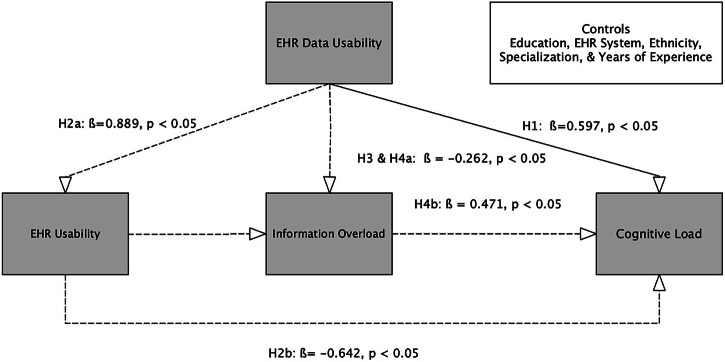
- The final structural model fit well (χ2 = 15.993, df = 10, CFI = 0.995, TLI = 0.979, RMSEA = 0.048, SRMR = 0.036), and it explained 34.1% of the variance in cognitive load.
- EHR data usability had a strong direct positive effect on cognitive load (β = 0.597, p = 0.000*).
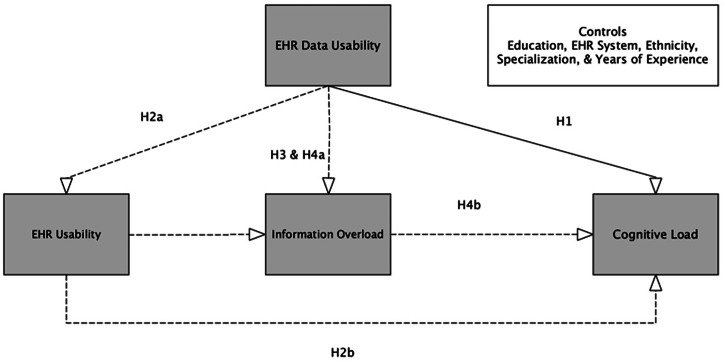
- EHR system usability partially and negatively mediated the data usability–cognitive load relationship (indirect β = −0.571, p = 0.019*), and also directly reduced information overload (β = −0.262, p = 0.000*). Information overload also mediated the data usability–cognitive load link (β = −0.137, p = 0.014*).
- Among controls, only years of experience was significant, with more experienced physicians reporting lower cognitive load (β = −0.145, p = 0.005).
## Methods
- Design: Cross-sectional online survey; hypotheses tested with covariance-based structural equation modeling (SEM).
- Sample/data: 564 practicing physicians in the United States, recruited through SBH Global, surveyed between February and May 2022; eligibility required active EHR use and at least 4.84 years of EHR experience.
- Analysis: Exploratory factor analysis, confirmatory factor analysis, mediation testing with bootstrapping (5,000 resamples, 95% CIs), and SEM in Mplus; common method bias and multicollinearity were also checked.
## Limitations
- The paper explicitly says the findings should be interpreted in the context of U.S.-based physicians using major commercial EHR platforms, and notes that international systems may differ.
- The final model explained 34.1% of cognitive load, which the paper states indicates additional antecedents were not captured.
- The paper states it could not account for dynamic variation in cognitive load by patient complexity, data density, or situational factors, nor examine how cognitive load fluctuations affect clinical performance.
Model-written summary. Check it against the paper before relying on it.
Integrity signals
Registry
Cites
Statistics
Figures
Verification
Claims the paper makes
5 Valid · 5 Not valid · 15 Not checked · 59 Own results and interpretations
Some cited sources support this claim and some don’t — read each source’s verdict below.
In the paper
“Generally, because EHRs have higher data usability prompts, they encourage physicians to engage more deeply with patient information3,4,44,49,54.”
§ When better data meets better design: How EHR data usability and system usability shape physicians’ cognitive load > Methods
What the sources say
- Partly supportedcites [3] Pollack, A. H. & Pratt, W. Association of health record visualizations with physicians’ cognitive load when prioritizing hospitalized patients. JAMA Netw. Open 3, e1919301 (2020). 31940040 PMC6991320 sourceExperimental — accuracy not yet measured
The Discussion reports that a visualization with high usability scores helped physicians recognize and process meaningful patterns in patient data. It does not report that EHRs generally have higher data-usability prompts or that such prompts cause physicians to engage more deeply with patient information; the Introduction instead describes shortcomings of conventional EHRs. (LLM, conf=0.83)
- Partly supportedcites [4] Mazur, L. M., Mosaly, P. R., Moore, C. & Marks, L. Association of the usability of electronic health records with cognitive workload and performance levels among physicians. JAMA Netw. Open 2, e191709 (2019). 30951160 PMC6450327 sourceExperimental — accuracy not yet measured
The Methods (Intervention) describe an enhanced EHR that prominently displayed patient status and instructions for next steps. The Discussion reports that its users were more likely to contact patients and schedulers about missed follow-up, but the study did not establish that physicians engaged more deeply with patient information generally. (LLM, conf=0.84)
- Disputedcites [44] Collins, R. Clinician cognitive overload and its implications for nurse leaders. Nurse Lead. 18, 44–47 (2020). sourceExperimental — accuracy not yet measured
Our copy nowhere mentions 'data usability prompts' or EHRs prompting physicians to engage more deeply with patient information; searches on those phrases returned only the paper's EHR and contextual-information sections. On the contrary, the Impact of Electronic Health Records and Other Technologies section states that EHRs 'have created additional tasks and distractions for clinicians' and are 'a tool designed for order-entry and storing medical records, not for care teams to communicate and collaborate,' and that EHR information 'often lacks context, adding to the germane cognitive load.' The only usability statement in the paper (Standardized Communication Regardless of Device) reports that clinical leaders in a 2019 survey valued interface usability as a way to reduce cognitive overload — credited to the Definitive Healthcare/HIMSS Analytics report (reference 8), not a claim that EHRs deepen engagement. (LLM, conf=0.65)
Checked by a reasoning model — may be wrong.
- Not checked — no full text of the sourcecites [49] Deck, C. & Jahedi, S. The effect of cognitive load on economic decision making: a survey and new experiments. Eur. Econ. Rev. 78, 97–119 (2015). source
- Not matchedcites [54] Harmon, C. S., Adams, S. A. & Davis, J. E. Nursing cognitive-overload and electronic documentation burden: a literature review. J. Inform. Nurs. 5, 16–30 (2020).
Its entry has no title and year that we can search by.
plainstates a cause- Asserted: passes — The authors put it forward as true.
- Checkable: passes — It can be checked against evidence.
- Load-bearing: passes — The paper’s conclusions depend on it.
- Based: passes — The paper gives a reason why it holds.
- Partly supported
The cited sources support only part of this claim — read each source’s verdict below.
In the paper
“Emerging evidence shows that these activities introduce substantial cognitive load, particularly after nurse intake and the initial patient-physician encounter for established patients3,4.”
§ When better data meets better design: How EHR data usability and system usability shape physicians’ cognitive load > Introduction
What the sources say
- Partly supportedcites [3] Pollack, A. H. & Pratt, W. Association of health record visualizations with physicians’ cognitive load when prioritizing hospitalized patients. JAMA Netw. Open 3, e1919301 (2020). 31940040 PMC6991320 sourceExperimental — accuracy not yet measured
The Introduction (page not provided) says searching and synthesizing information across EHR sections increases physicians’ cognitive workload. The paper examines prioritization of hospitalized patients; it does not establish that workload is particularly high after nurse intake or an initial patient–physician encounter for established patients. (LLM, conf=0.89)
- Partly supportedcites [4] Mazur, L. M., Mosaly, P. R., Moore, C. & Marks, L. Association of the usability of electronic health records with cognitive workload and performance levels among physicians. JAMA Netw. Open 2, e191709 (2019). 30951160 PMC6450327 sourceExperimental — accuracy not yet measured
The Results (Perceived and Physiological Workload; page unavailable) report higher cognitive workload with the baseline EHR than with the enhanced EHR in simulated abnormal-test-result tasks. The paper does not locate that workload particularly after nurse intake or an initial patient-physician encounter for established patients. (LLM, conf=0.86)
plainstates a cause- Asserted: passes — The authors put it forward as true.
- Checkable: passes — It can be checked against evidence.
- Load-bearing: passes — The paper’s conclusions depend on it.
- Based: passes — The paper gives a reason why it holds.
- Partly supported
The cited sources that could be checked couldn’t confirm or dispute this claim.
In the paper
“Importantly, information overload decreases when physicians encounter highly usable patient data, as they are better able to focus more on task-relevant cues and filter out noise47.”
§ When better data meets better design: How EHR data usability and system usability shape physicians’ cognitive load > Discussion
What the sources say
- Could not verifycites [47] Rieke, N. et al. The future of digital health with federated learning. npj Digit. Med. 3, 119 (2020). 33015372 PMC7490367 sourceExperimental — accuracy not yet measured
The 'Impact on stakeholders—Clinicians' passage discusses ML-assisted diagnosis and presenting information in a commonly understood format, not whether usable patient data reduces physicians’ information overload. Searches for task-relevant cues, filtering noise, and reduced cognitive load found no passage addressing that claim. Page numbers were not available in our copy. (LLM, conf=0.76)
plainstates a cause- Asserted: passes — The authors put it forward as true.
- Checkable: passes — It can be checked against evidence.
- Load-bearing: passes — The paper’s conclusions depend on it.
- Based: passes — The paper gives a reason why it holds.
- Could not verify
The cited sources that could be checked couldn’t confirm or dispute this claim.
In the paper
“In this view, enhanced data usability mitigates overload not by limiting information volume, but by structuring and contextualizing data to reduce extraneous cognitive effort47.”
§ When better data meets better design: How EHR data usability and system usability shape physicians’ cognitive load > Methods
What the sources say
- Could not verifycites [47] Rieke, N. et al. The future of digital health with federated learning. npj Digit. Med. 3, 119 (2020). 33015372 PMC7490367 sourceExperimental — accuracy not yet measured
The 'Impact on stakeholders' section discusses using a common format to present information to collaborators, while 'The reliance on data' concerns data quality and availability; page numbers are unavailable in our copy. Neither addresses whether structuring and contextualizing data reduces information overload or extraneous cognitive effort. Searches for those terms and for clinician cognitive load found no supporting passage. (LLM, conf=0.75)
plainstates a cause- Asserted: passes — The authors put it forward as true.
- Checkable: passes — It can be checked against evidence.
- Load-bearing: passes — The paper’s conclusions depend on it.
- Based: passes — The paper gives a reason why it holds.
- Could not verify
A result the paper reports from its own data — it cites no other source for it, so there is none to check. The quote shows it is in the paper.
In the paper
“Information overload partially mediated these effects, suggesting that better data usability helps physicians better filter irrelevant data and stay focused on diagnostically relevant cues.”
§ When better data meets better design: How EHR data usability and system usability shape physicians’ cognitive load > Abstract
hedgedstates a cause- Asserted: passes — The authors put it forward as true.
- Checkable: passes — It can be checked against evidence.
- Load-bearing: passes — The paper’s conclusions depend on it.
- Based: passes — The paper gives a reason why it holds.
- Rests on an assumption not shown here.
25 more claims
Create a free account to see all 84 claims and to verify the 7 references still open.
- It may state two separate claims as one. 34
- Probably not a substantial claim. 31
Self-check
Percentages, sums and reported differences re-computed from the paper’s own numbers.
Each contradiction between two passages listed here was confirmed by an independent check.
Rated major: it would touch a result — a value a result rests on, reported and recomputed p-values on opposite sides of the significance level, two passages that conflict with no sign which is right, or a cited work retracted before this paper was published.
In the paper
§ When better data meets better design: How EHR data usability and system usability shape physicians’ cognitive load > Methods > Measures and variables
“Preliminary analysis indicated that none of these variables had significant direct effects on the dependent constructs; therefore, they were excluded from the final structural model to maintain parsimony.”
§ When better data meets better design: How EHR data usability and system usability shape physicians’ cognitive load > Results > Hypothesis testing
“All controls were nonsignificant with one exception: years of experience were negatively associated with cognitive load (β = −0.145, ρ = 0.005**), indicating that more experienced physicians reported lower cognitive load.”
Rated minor: it would not touch a result — a value no result rests on, a p-value that stays on the same side of the significance level, or a conflict that is clerical, resolved elsewhere in the paper, or outside its own findings.
In the paper
§ When better data meets better design: How EHR data usability and system usability shape physicians’ cognitive load > Results > Participant characteristics
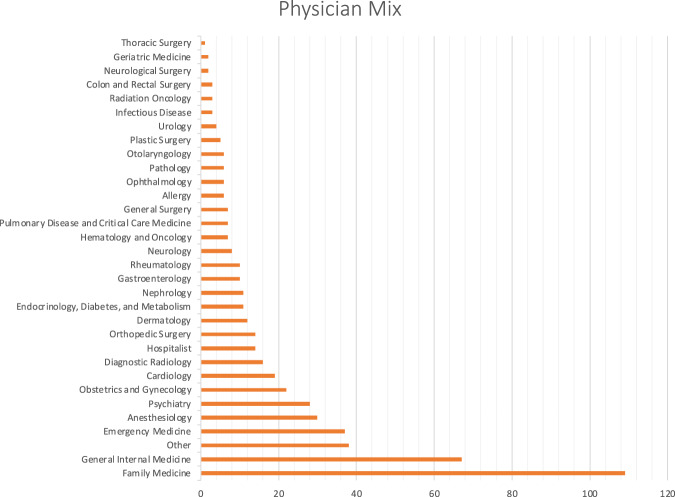
“A total of N = 564 physicians representing 32 specialties, from Family Medicine to Thoracic Surgery, completed the survey (see Fig. 2).”
§ When better data meets better design: How EHR data usability and system usability shape physicians’ cognitive load > Results > Participant characteristics
“Overall, the sample included physicians from 35 medical specialties, reference Fig. 1.”
Citations
Cites
Hu, L., & Bentler, P. M. (1999) · Structural Equation Modeling A Multidisciplinary Journal · doi:10.1080/10705519909540118 · Cited by 108,788
Sources of method bias in social science research and recommendations on how to control it
Podsakoff, P. M., MacKenzie, S. B., & Podsakoff, N. P. (2012) · Annual Review of Psychology · doi:10.1146/annurev-psych-120710-100452 · Cited by 15,744
Cognitive Load During Problem Solving: Effects on Learning
Sweller, J. (1988) · Cognitive Science · doi:10.1016/0364-0213(88)90023-7 · Cited by 11,048
Sweller, J., Ayres, P., & Kalyuga, S. (2011) · doi:10.1007/978-1-4419-8126-4 · Cited by 5,531
Cacioppo, J. T., & Petty, R. E. (1982) · Journal of Personality and Social Psychology · doi:10.1037/0022-3514.42.1.116 · Cited by 5,359 · cited 1×
“Cognitive load is essential for interpreting, integrating, and deriving meaning from patient information duringclinical decision-making 42,43 .”
Sweller, J. (2011) · Psychology of Learning and Motivation · doi:10.1016/b978-0-12-387691-1.00002-8 · Cited by 4,856
Sweller, J. (2012) · Encyclopedia of the Sciences of Learning · doi:10.1007/978-1-4419-1428-6_446 · Cited by 4,405
The future of digital health with federated learning
Rieke, N., Hancox, J., Li, W., Milletarì, F., Roth, H. R., Albarqouni, S., Bakas, S., Galtier, M. N., Landman, B. A., Maier-Hein, K., et al. (2020) · npj Digital Medicine · doi:10.1038/s41746-020-00323-1 · Cited by 4,015 · cited 2×
“Importantly, information overload decreases when physicians encounter highly usable patient data, as they are better able to focus more on task-relevant cues and fi lter out noise 47 .”
The Future of Digital Health with Federated Learning
Rieke, N., Hancox, J., Li, W., Milletari, F., Roth, H., Albarqouni, S., Bakas, S., Galtier, M. N., Landman, B., Maier-Hein, K., et al. (2020) · arXiv · doi:10.48550/arxiv.2003.08119 · Cited by 3,495
Barriers and facilitators to utilizing digital health technologies by healthcare professionals
Borges do Nascimento, I. J., Abdulazeem, H., Vasanthan, L. T., Martinez, E. Z., Zucoloto, M. L., Østengaard, L., Azzopardi-Muscat, N., Zapata, T., & Novillo-Ortiz, D. (2023) · npj Digital Medicine · doi:10.1038/s41746-023-00899-4 · Cited by 673 · cited 1×
“EHR usability has long been recognized as a barrier to high-quality patient care 33 .”
A framework for digital health equity
Richardson, S., Lawrence, K., Schoenthaler, A. M., & Mann, D. (2022) · npj Digital Medicine · doi:10.1038/s41746-022-00663-0 · Cited by 607 · cited 1×
“Because this study examined U.S.-based physicians using majorcommercialEHRplatforms,the fi ndingsshouldbeinterpretedwithin this context 40 .”
An experimental investigation of need for cognition.
Cohen, A. R., Stotland, E., & Wolfe, D. M. (1955) · The Journal of Abnormal and Social Psychology · doi:10.1037/h0042761 · Cited by 573 · cited 1×
“Cognitive load is essential for interpreting, integrating, and deriving meaning from patient information duringclinical decision-making 42,43 .”
Physician Burnout in the Electronic Health Record Era: Are We Ignoring the Real Cause?
Downing, N. L., Bates, D. W., & Longhurst, C. A. (2018) · Annals of Internal Medicine · doi:10.7326/m18-0139 · Cited by 418
Melnick, E. R., Dyrbye, L. N., Sinsky, C. A., Trockel, M., West, C. P., Nedelec, L., Tutty, M. A., & Shanafelt, T. (2020) · Mayo Clinic Proceedings · doi:10.1016/j.mayocp.2019.09.024 · Cited by 413 · cited 2×
“Anationalstudyof8274 U.S. physicians reported a mean EHR usability score of 45.9 on the System Usability Scale, equivalenttoafailing grade( “ F ” ), whichre fl ectswidespread dissatisfactionwithEHRdesignandwork fl owintegration 12 – 15 .”
InfluentialGuo, C., Ashrafian, H., Ghafur, S., Fontana, G., Gardner, C., & Prime, M. (2020) · npj Digital Medicine · doi:10.1038/s41746-020-00314-2 · Cited by 316 · cited 1×
“The model addresses a key question: what explains a physician ’ s cognitive load during EHR use in a clinical setting 48 ?”
The effect of cognitive load on economic decision making: A survey and new experiments
Deck, C., & Jahedi, S. (2015) · European Economic Review · doi:10.1016/j.euroecorev.2015.05.004 · Cited by 304 · cited 2×
“Generally,becauseEHRshavehigherdatausabilityprompts,theyencourage physicianstoengagemoredeeplywithpatientinformation 3,4,44,49,54 .”
TURF: Toward a unified framework of EHR usability
Zhang, J., & Walji, M. F. (2011) · Journal of Biomedical Informatics · doi:10.1016/j.jbi.2011.08.005 · Cited by 301 · cited 1×
“EHR usability is de fi ned as how user-friendly, useful, and likableasystemisforitsclinicaluserswhenperformingmedicaltasks 61 .”
Marwaha, J. S., Landman, A. B., Brat, G. A., Dunn, T., & Gordon, W. J. (2022) · npj Digital Medicine · doi:10.1038/s41746-022-00557-1 · Cited by 241 · cited 1×
“Toaddressthisresearch question, we fi rstreviewEHRsystemswithinasociotechnicalframework,focusingon howinformationoverload and system usability shape clinical cognition 24 – 28 .”
Information overload within the health care system: a literature review
Hall, A., & Walton, G. (2004) · Health Information & Libraries Journal · doi:10.1111/j.1471-1842.2004.00506.x · Cited by 238 · cited 1×
“Another way to reduce cognitive load is to minimize the physician ’ s attention to extraneous information in the environment and decrease information overload 56 .”
Burnout Related to Electronic Health Record Use in Primary Care
Budd, J. (2023) · Journal of Primary Care & Community Health · doi:10.1177/21501319231166921 · Cited by 223
The Evolving Use of Electronic Health Records (EHR) for Research
Kim, E., Rubinstein, S. M., Nead, K. T., Wojcieszynski, A. P., Gabriel, P. E., & Warner, J. L. (2019) · Seminars in Radiation Oncology · doi:10.1016/j.semradonc.2019.05.010 · Cited by 172
From Theory to Practice: The Application of Cognitive Load Theory to the Practice of Medicine
Szulewski, A., Howes, D., van Merriënboer, J. J. G., & Sweller, J. (2021) · Academic Medicine · doi:10.1097/acm.0000000000003524 · Cited by 171 · cited 4×
“Cognitive load must be managed for effective problem-solving and clinical decision-making (correct decisions/reduction of errors), as levels of cognitive load in fl uence decisions and outcomes 38,49 – 53 .”
InfluentialChallenges of developing a digital scribe to reduce clinical documentation burden
Quiroz, J. C., Laranjo, L., Kocaballi, A. B., Berkovsky, S., Rezazadegan, D., & Coiera, E. (2019) · npj Digital Medicine · doi:10.1038/s41746-019-0190-1 · Cited by 162 · cited 1×
“These sociotechnical challenges persist even with the introduction of digital scribe technologies, underscoring the need to differentiate betweentheEHRasadatainfrastructureandtheuserinterface(UI)through whichphysiciansinteractwiththatinfrastructure 11 .”
The digital scribe in clinical practice: a scoping review and research agenda
van Buchem, M. M., Boosman, H., Bauer, M. P., Kant, I. M. J., Cammel, S. A., & Steyerberg, E. W. (2021) · npj Digital Medicine · doi:10.1038/s41746-021-00432-5 · Cited by 152 · cited 1×
“Poor data organization, suboptimal information presentation, and complex interfaces often make it challenging for physicians to identify clinically salient information, while extensive documentation requirements demand continuous attention 8 – 10 .”
Q-sorting and MIS Research: A Primer
Thomas, D. M., & Watson, R. T. (2002) · Communications of the Association for Information Systems · doi:10.17705/1cais.00809 · Cited by 144
Patient Safety Issues From Information Overload in Electronic Medical Records
Nijor, S., Rallis, G., Lad, N., & Gokcen, E. (2022) · Journal of Patient Safety · doi:10.1097/pts.0000000000001002 · Cited by 137 · cited 1×
“As EHRs accumulate increasingly large volumes of structured and unstructured data, physicians face additional challenges in fi nding relevant information, resulting in information overload and further elevating cognitive load 19 – 21 .”
Coiera, E., Kocaballi, B., Halamka, J., & Laranjo, L. (2018) · npj Digital Medicine · doi:10.1038/s41746-018-0066-9 · Cited by 132
Mazur, L. M., Mosaly, P. R., Moore, C., & Marks, L. (2019) · JAMA Network Open · doi:10.1001/jamanetworkopen.2019.1709 · Cited by 127 · cited 1×
“Generally,becauseEHRshavehigherdatausabilityprompts,theyencourage physicianstoengagemoredeeplywithpatientinformation 3,4,44,49,54 .”
The Development of the Brief Social Desirability Scale (BSDS)
Haghighat, R. (2007) · Europe’s Journal of Psychology · doi:10.5964/ejop.v3i4.417 · Cited by 114 · cited 2×
“Social desirability refers to a participant ’ s tendency to give “ desirable ” answers to create a more socially acceptable self-image 64 .”
Melnick, E. R., West, C. P., Nath, B., Cipriano, P. F., Peterson, C., Satele, D. V., Shanafelt, T., & Dyrbye, L. N. (2021) · Journal of the American Medical Informatics Association · doi:10.1093/jamia/ocab059 · Cited by 105
Macroergonomics in Health Care Quality and Patient Safety
Carayon, P., Karsh, B., Gürses, A. P., Holden, R. J., Hoonakker, P., Hundt, A. S., Montague, E. N. H., Rodriguez, A. J., & Wetterneck, T. B. (2013) · Reviews of Human Factors and Ergonomics · doi:10.1177/1557234x13492976 · Cited by 105 · cited 1×
“Collectively, these design shortcomings create friction between clinical reasoning and system interaction 34,35 .”
Varpio, L., Rashotte, J., Day, K., King, J., Kuziemsky, C. E., & Parush, A. (2015) · International Journal of Medical Informatics · doi:10.1016/j.ijmedinf.2015.09.004 · Cited by 103
Do Electronic Health Records Affect Quality of Care? Evidence from the HITECH Act
Lin, Y.-K., Lin, M., & Chen, H. (2019) · Information Systems Research · doi:10.1287/isre.2018.0813 · Cited by 101
How has healthcare research performance been assessed? A systematic review
Patel, V., Ashrafian, H., Ahmed, K., Arora, S., Jiwan, S., Nicholson, J. K., Darzi, A. W., & Athanasiou, T. (2011) · Journal of the Royal Society of Medicine · doi:10.1258/jrsm.2011.110005 · Cited by 101 · cited 1×
“For example, a recent study suggests that EHR systems provide limited support forcore cognitive tasks, imposesigni fi cant cognitive load 3,17 , and can hinder physicians ’ ability toprocesspatientinformationand engageinhigher-level reasoning 18 .”
Meeks, D. W., Takian, A., Sittig, D. F., Singh, H., & Barber, N. (2014) · Journal of the American Medical Informatics Association · doi:10.1136/amiajnl-2013-001762 · Cited by 91
Singh, H., & Sittig, D. F. (2020) · Annals of Internal Medicine · doi:10.7326/m19-0879 · Cited by 76 · cited 1×
“Thedif fi culty of using EHR systems during clinical work has even been likened to texting while driving 16 .”
Information overload: context and causes
Allen, D., & Wilson, T. D. (2003) · The New Review of Information Behaviour Research · doi:10.1080/14716310310001631426 · Cited by 63
Dunn Lopez, K., Chin, C.-L., Leitão Azevedo, R. F., Kaushik, V., Roy, B., Schuh, W., Banks, K., Sousa, V., & Morrow, D. (2021) · Applied Ergonomics · doi:10.1016/j.apergo.2021.103359 · Cited by 62
Clinician Cognitive Overload and Its Implications for Nurse Leaders
Collins, R. (2020) · Nurse Leader · doi:10.1016/j.mnl.2019.11.007 · Cited by 57 · cited 2×
“Generally,becauseEHRshavehigherdatausabilityprompts,theyencourage physicianstoengagemoredeeplywithpatientinformation 3,4,44,49,54 .”
Yu, W., Liu, Q., Zhao, G., & Song, Y. (2021) · IEEE Transactions on Engineering Management · doi:10.1109/tem.2021.3098541 · Cited by 55 · cited 2×
“Deci-sionsarebasedonempiricalevidence andnotspeculationorgutfeeling 59 .”
Pollack, A. H., & Pratt, W. (2020) · JAMA Network Open · doi:10.1001/jamanetworkopen.2019.19301 · Cited by 53 · cited 3×
“For example, a recent study suggests that EHR systems provide limited support forcore cognitive tasks, imposesigni fi cant cognitive load 3,17 , and can hinder physicians ’ ability toprocesspatientinformationand engageinhigher-level reasoning 18 .”
Human factors and ergonomics systems approach to the COVID-19 healthcare crisis
Carayon, P., & Perry, S. J. (2020) · International Journal for Quality in Health Care · doi:10.1093/intqhc/mzaa109 · Cited by 51
Gans, D., White, J., Nath, R., Pohl, J., & Tanner, C. (2015) · Applied Clinical Informatics · doi:10.4338/aci-2014-11-ra-0099 · Cited by 47
Learning from the EHR to implement AI in healthcare
Rose, C. C., & Chen, J. H. (2024) · npj Digital Medicine · doi:10.1038/s41746-024-01340-0 · Cited by 47 · cited 1×
“These adjustments reduce unnecessary cognitive switching and better align visual hierarchies with clinical reasoning 39 .”
Collaborative Intelligence to catalyze the digital transformation of healthcare
Bhatt, A. B., & Bae, J. (2023) · npj Digital Medicine · doi:10.1038/s41746-023-00920-w · Cited by 38 · cited 1×
“Emerging collaborative intelligence approaches may further reduce documentation and navigation demands by distributing cognitive work across human-arti fi cial intelligence (AI) teams 37 .”
Annals Clinical Decision Making: Avoiding Cognitive Errors in Clinical Decision Making
Restrepo, D., Armstrong, K. A., & Metlay, J. P. (2020) · Annals of Internal Medicine · doi:10.7326/m19-3692 · Cited by 36
The new platforms of health care
Dorsey, E. R. (2021) · npj Digital Medicine · doi:10.1038/s41746-021-00478-5 · Cited by 31
Physician Mental Workload Scale in China: Development and Psychometric Evaluation
Lu, C., Hu, Y., Fu, Q. J., Governor, S., Wang, L., Li, C., Deng, L., & Xie, J. (2019) · BMJ Open · doi:10.1136/bmjopen-2019-030137 · Cited by 26 · cited 1×
“We used Lu et al. ’ s Physician Mental Workload Scale 57 .”
Jacob, C., Lindeque, J. P., Müller, R., Klein, A., Metcalfe, T., Connolly, S. L., Koerber, F., Maguire, R., Denis, F., Heuss, S., et al. (2023) · npj Digital Medicine · doi:10.1038/s41746-023-00982-w · Cited by 20 · cited 1×
“Toaddressthisresearch question, we fi rstreviewEHRsystemswithinasociotechnicalframework,focusingon howinformationoverload and system usability shape clinical cognition 24 – 28 .”
Documentation Burden and Cognitive Burden: How Much is Too Much Information?
Padden, J. (2019) · CIN: Computers, Informatics, Nursing · doi:10.1097/cin.0000000000000522 · Cited by 19
Physician use of outpatient electronic health records to improve care.
Wilcox, A. B., Bowes, W., Thornton, S. N., Narus, S. P., & Narus, S. (2008) · PubMed · Cited by 19
EMR usability and patient safety: a national survey of physicians
Schwappach, D., Hautz, W., Krummrey, G., Pfeiffer, Y., & Ratwani, R. M. (2025) · npj Digital Medicine · doi:10.1038/s41746-025-01657-4 · Cited by 17 · cited 1×
“Anationalstudyof8274 U.S. physicians reported a mean EHR usability score of 45.9 on the System Usability Scale, equivalenttoafailing grade( “ F ” ), whichre fl ectswidespread dissatisfactionwithEHRdesignandwork fl owintegration 12 – 15 .”
InfluentialThe development of the Brief Social Desirability Scale (BSDS)
Haghighat, R. (2007) · PsycEXTRA Dataset · doi:10.1037/e677112011-006 · Cited by 14
Electronic Health Records: Physician's Perspective on Usability
Schumacher, R. M., Berkowitz, L., Abramson, P. R., & Liebovitz, D. (2010) · Proceedings of the Human Factors and Ergonomics Society Annual Meeting · doi:10.1177/154193121005401202 · Cited by 13 · cited 1×
“Reexamining data effectiveness and data-use practices 41 , promoting structured, reliable, and contextually meaningful information for clinical work MultiplepathsexisttoimproveEHRusability,butmeaningfulprogress will require disruptive innovation that prioritizes user-friendly, physician-centered…”
Do we need AI guardians to protect us from health information overload?
Mahajan, A., & Gilbert, S. (2025) · npj Digital Medicine · doi:10.1038/s41746-025-02093-0 · Cited by 13 · cited 1×
“Recent work in npj Digital Medicine further emphasizes that physicians face persistent information overload, requiring advanced fi ltering or design interventions 22 .”
Essential activities for electronic health record safety: A qualitative study
Ash, J. S., Singh, H., Wright, A., Chase, D., & Sittig, D. F. (2020) · Health Informatics Journal · doi:10.1177/1460458219833109 · Cited by 12
Electronic Health Record's Effects on the Outpatient Office Visit and Clinical Education
Sandoval, M. B., Palumbo, M. V., & Hart, V. (2017) · Journal of Innovation in Health Informatics · doi:10.14236/jhi.v23i4.151 · Cited by 11
Investigation of Information Overload in Electronic Health Records: Protocol for Usability Study
Khairat, S., Morelli, J., Boynton, M. H., Bice, T., Gold, J. A., & Carson, S. S. (2025) · JMIR Research Protocols · doi:10.2196/66127 · Cited by 9 · cited 2×
“…41 , promoting structured, reliable, and contextually meaningful information for clinical work MultiplepathsexisttoimproveEHRusability,butmeaningfulprogress will require disruptive innovation that prioritizes user-friendly, physician-centered design with an integrated system architecture 23 .”
A sociotechnical approach to defining clinical responsibilities for patient-generated health data
Griffin, A. C., Moyer, M. F., Anoshiravani, A., Hornsey, S., & Sharp, C. (2025) · npj Digital Medicine · doi:10.1038/s41746-025-01680-5 · Cited by 7 · cited 1×
“A sociotechnical perspective further underscores how data fl ows, particularly those involving patient-generated data, shape physicians ’ cognitive burden 36 .”
Digital health: how to govern during a never-ending data tsunami
Muntz, D. S. (2021) · npj Digital Medicine · doi:10.1038/s41746-021-00491-8 · Cited by 4
Empirical study of Data Completeness in Electronic Health Records in China
Caihua, L., Zowghi, D., Talaei‐Khoei, A., & Jin, Z. G. (2020) · Pacific Asia journal of the Association for Information Systems · doi:10.17705/1pais.12204 · Cited by 4
Electronic Health Record (EHR) System Use and Antecedent Influences on Cognitive Load
Merriweather, C. (2023) · Academy of Management Proceedings · doi:10.5465/amproc.2023.16068abstract · Cited by 3
Self-citationEHR Data Usability And Decision-Making: The Effect Of Cognitive Load On Clinical Decision-Making
Merriweather, C. (2025) · Academy of Management Proceedings · doi:10.5465/amproc.2025.13116abstract · Cited by 1
Self-citationElectronic health records: Physician's perspective on usability: (578732012-002)
Schumacher, R. M., Berkowitz, L., Abramson, P., & Liebovitz, D. (2010) · PsycEXTRA Dataset · doi:10.1037/e578732012-002
Research works printed but not linked: 5
- Drews, S., Thompson, C. & Gerlach, H. Usability of electronic health records by clinicians in acute care: a scoping review. Can. J. Nurs. Inform.20, 2 (2025).
- Hair, J. F., Black, W. C., Babin, B. J. & Anderson, R. E. Canonical Correlation: A Supplement to Multivariate Data Analysis: A Global Perspective (Pearson Prentice Hall, 2010).
- Harmon, C. S., Adams, S. A. & Davis, J. E. Nursing cognitive-overload and electronic documentation burden: a literature review. J. Inform. Nurs. 5, 16–30 (2020).
- Shultz, S. & Hand, M. Usability optimization of the electronic health record. J. Inform. Nurs. 2, 14–19 (2017).
- Weber, S., Beck, R. & König, W. Instant messaging—blessing or curse for enterprises? In Proc. Int. Conf. Inf. Syst. (ICIS) 2012 (Association for Information Systems, 2012).
Cited by
Less Is More: Radiologists Prefer Brief Narratives in LLM-Generated Clinical History Summaries
Lyo, S. K., Tripathi, S., Tejani, A. S., Vu, D., Dogra, S., Alizai, H., & Cook, T. S. (2026) · Journal of Imaging Informatics in Medicine · doi:10.1007/s10278-026-02229-y
Bajaj, S., Goh, E. C. D., Ng, Y. Y., & Lee, Z. (2026) · Medical Education Online · doi:10.1080/10872981.2026.2726067
Liu, M., Zhang, P., Wu, Y., Pan, L., & Li, L. (2026) · Nursing Open · doi:10.1002/nop2.70855
Chin, A. T., Zhu, N., Vangala, S., Woo, H. E., Wisk, L. E., Kingsley, T., Mafi, J. N., & Lukac, P. J. (2026) · medRxiv · doi:10.64898/2026.08.26.26361496
Berger, M. F., Augustin, T., Kamolz, L., & Lumenta, D. B. (2026) · Frontiers in Digital Health · doi:10.3389/fdgth.2026.1938990
“This combined approach would ensure that systems are not just broadly acceptable but optimized to reduce cognitive load and prevent critical errors in high stakes clinical environments (58, 59).”
Metadata
- Authors
- Merriweather, Lyytinen, K., Aron, D., & Cauley, M. R.
- Affiliations
- Duke University (US)
- Case Western Reserve University (US)
- Vanderbilt University Medical Center (US)
- Corresponding author
- Merriweather,, Curtis A.
- Venue
- npj Digital Medicine
- Published
- 2026-01-14
- Volume
- 9
- Issue
- 1
- Pages
- 104-104
- ISSN
- 2398-6352 (ISSN-L)
- PMC
- PMC12864774
- OpenAlex
- W7123486818
- Semantic Scholar
- 5628fa63b436984698f5655c8c4ed8384fdd6e18
- Cited by
- 9
- References
- 54
- Citations by year
- 2026: 9
- FWCI
- 67.56
- Type
- journal article
- Language
- en
- Open access
- gold
- doi.org
- Licence
- cc-by
- creativecommons.org/licenses/by/4.0 (tdm)
- creativecommons.org/licenses/by/4.0 (vor, 19 d)
- Locations
- npj Digital Medicine (publishedVersion, cc-by)
- Europe PMC (PubMed Central) (publishedVersion, cc-by)
- PubMed (publishedVersion)
- DOAJ (DOAJ: Directory of Open Access Journals) (submittedVersion, cc-by-sa)
- Topics
- Health Sciences › Health Professions › Health Information Management › Electronic Health Records Systems
- Health Sciences › Medicine › Family Practice › Clinical Reasoning and Diagnostic Skills
- Physical Sciences › Computer Science › Human-Computer Interaction › Usability and User Interface Design
- Keywords
- electronic health records, system usability, germane cognitive load, extraneous cognitive load, information overload, clinical decision-making, clinical workflow, documentation errors, data completeness, data quality
About these checks
Registry, retraction, Cites and statistics results are computed, not judged, with one exception: a printed reference that no index lists is read once by a model before it counts as a citation error. Claims are extracted by a model and kept only when their quote appears verbatim in the text; each cited source is then checked, with a model’s help, for whether it says what the claim relies on. Those verdicts can be wrong — read the claim’s quote and the cited source before relying on one.
The claim verdicts this report counts are experimental: their accuracy is not yet measured.
A language model drew the claims from the paper on 2026-10-10, under version 3 of the claim definition (model deepseek-v4.1-flash, prompt extract-v3).
A second model labelled each claim on 2026-10-10 (model jev-1.13-20260917, definition revision gold-guideline-v0.2).
Cited sources are checked with a language model’s help (gpt-6-sol and qwen3.8-omni-flash).
Statistics and arithmetic are recomputed, not judged.
Confidence bands are shown only for fields calibrated on our annotated test set. None is calibrated yet, so no band is shown.
What counts as a claim ›How we measure confidence ›How we check this ›
Are you an author, or do you see a problem with this page? Request a review
Data sources
Bibliographic data: Semantic Scholar, OpenAlex, Crossref.
Contains information from the Semantic Scholar Academic Graph Datasets, made available under the ODC Attribution License (ODC-BY 1.0).
Semantic Scholar’s data is described in: Kinney, R., et al. (2023). The Semantic Scholar Open Data Platform. arXiv:2301.10140.
