

Fungal acetylome comparative analysis identifies an essential role of acetylation in human fungal pathogen virulence
Open accessThe DOI matches its Crossref record; 47 of the 47 references it cites were found in a registry or an index.
Abstract
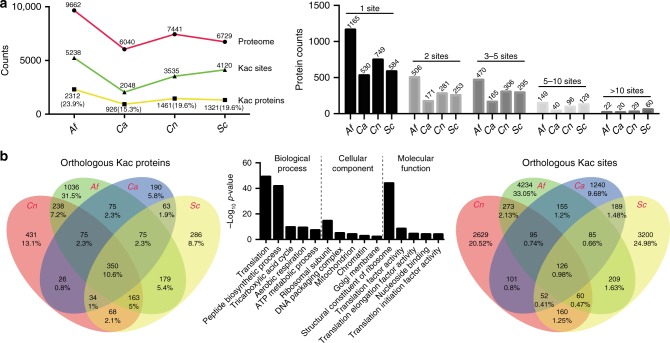
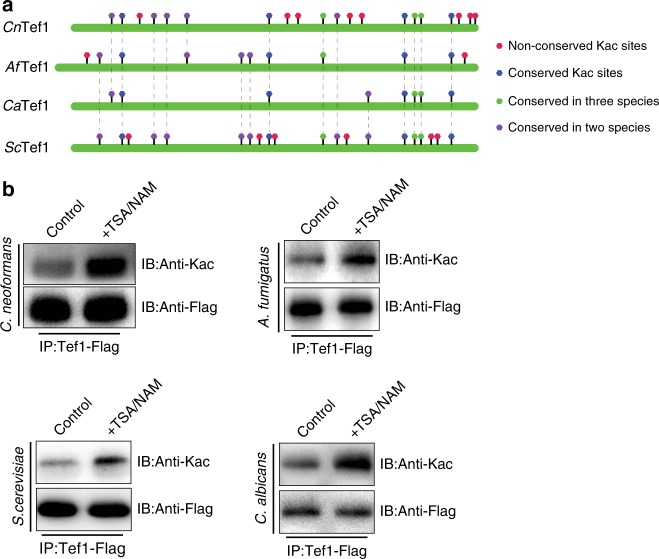
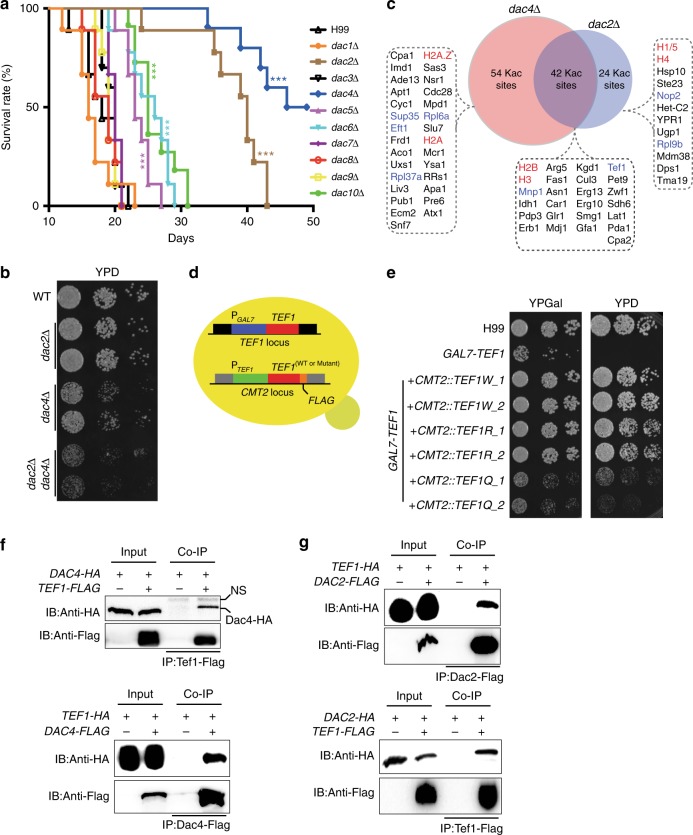
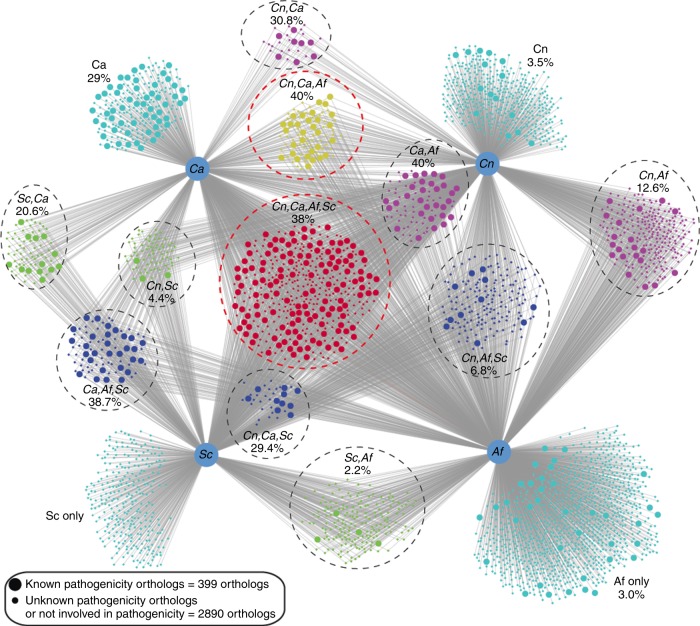
Lysine acetylation is critical in regulating important biological processes in many organisms, yet little is known about acetylome evolution and its contribution to phenotypic diversity. Here, we compare the acetylomes of baker’s yeast and the three deadliest human fungal pathogens, Cryptococcus neoformans, Candida albicans, and Aspergillus fumigatus. Using mass spectrometry enriched for acetylated peptides together with public data from Saccharomyces cerevisiae, we show that fungal acetylomes are characterized by dramatic evolutionary dynamics and limited conservation in core biological processes. Notably, the levels of protein acetylation in pathogenic fungi correlate with their pathogenicity. Using gene knockouts and pathogenicity assays in mice, we identify deacetylases with critical roles in virulence and protein translation elongation. Finally, through mutational analysis of deactylation motifs we find evidence of positive selection at specific acetylation motifs in fungal pathogens. These results shed new light on the pathogenicity regulation mechanisms underlying the evolution of fungal acetylomes.
Overview
The claims and statistics of this paper haven’t been checked yet.
Free: it reads the open-access text and checks the first 5 claims that cite a source we can check. Create a free account to check every claim.
Integrity signals
Registry
Cites
Statistics
Figures
Verification
Claims the paper makes
The claims and statistics of this paper haven’t been checked yet.
Free: it reads the open-access text and checks the first 5 claims that cite a source we can check. Create a free account to check every claim.
Claims other papers make about this one
Each is checked against this paper’s own text: does it say what the citing paper says it does?
The source backs part of the claim, not all of it — or backs it for a different population, condition or comparison.
In the citing paper
“Chromatin modification factors, including KATs such as GCN5, HAT1, and RTT109, as well as KDACs like SET3, HAD1, RPD31, and HST3, are implicated in the virulence processes of Candida species, including filamentous growth and biofilm formation, as well as in their resistance and sensitivity to antifungal drugs (14–16).”
From Potential role of lysine acetylation in the stepwise adaptation of Candida albicans to fluconazole (2025) · cites this paper as [15]
Experimental — accuracy not yet measured
Self-check
Percentages, sums and reported differences re-computed from the paper’s own numbers.
The self-check needs the paper’s full text.
Citations
Cites
The Sequence Alignment/Map format and SAMtools
Li, H., Handsaker, B., Wysoker, A., Fennell, T., Ruan, J., Homer, N., Marth, G., Abecasis, G., Durbin, R., & 1000 Genome Project Data Processing Subgroup (2009) · Bioinformatics · doi:10.1093/bioinformatics/btp352 · Cited by 62,041
Self-citationFast gapped-read alignment with Bowtie 2
Langmead, B., & Salzberg, S. L. (2012) · Nature Methods · doi:10.1038/nmeth.1923 · Cited by 56,400
Cytoscape: A software Environment for integrated models of biomolecular interaction networks
Shannon, P., Markiel, A., Ozier, O., Baliga, N. S., Wang, J. T., Ramage, D., Amin, N., Schwikowski, B., & Ideker, T. (2003) · Genome Research · doi:10.1101/gr.1239303 · Cited by 51,888
Self-citationModel-based Analysis of ChIP-Seq (MACS)
Zhang, Y., Liu, T., Meyer, C. A., Eeckhoute, J., Johnson, D. S., Bernstein, B. E., Nusbaum, C., Myers, R. M., Brown, M., Li, W., et al. (2008) · Genome Biology · doi:10.1186/gb-2008-9-9-r137 · Cited by 18,386
Differential expression analysis for sequence count data
Anders, S., & Huber, W. (2010) · Genome Biology · doi:10.1186/gb-2010-11-10-r106 · Cited by 15,581
Robinson, J. T., Thorvaldsdóttir, H., Winckler, W., Guttman, M., Lander, E. S., Getz, G., & Mesirov, J. P. (2011) · Nature Biotechnology · doi:10.1038/nbt.1754 · Cited by 15,390
Trapnell, C., Roberts, A., Goff, L., Pertea, G., Kim, D., Kelley, D. R., Pimentel, H., Salzberg, S. L., Rinn, J. L., & Pachter, L. (2012) · Nature Protocols · doi:10.1038/nprot.2012.016 · Cited by 12,116
OrthoMCL: Identification of Ortholog Groups for Eukaryotic Genomes
Li, L., Stoeckert, C. J., & Roos, D. S. (2003) · Genome Research · doi:10.1101/gr.1224503 · Cited by 5,707
Regulation of cellular metabolism by protein lysine acetylation
Zhao, S., Xu, W., Jiang, W., Yu, W., Lin, Y., Zhang, T., Yao, J., Zhou, L., Zeng, Y., Li, H., et al. (2010) · Science · doi:10.1126/science.1179689 · Cited by 1,910
Self-citationMolecular evidence for an ancient duplication of the entire yeast genome
Wolfe, K. H., & Shields, D. C. (1997) · Nature · doi:10.1038/42711 · Cited by 1,785
Cited by
Post‐translational modifications drive secondary metabolite biosynthesis in Aspergillus : a review
Yang, K., Tian, J., & Keller, N. P. (2022) · Environmental Microbiology · doi:10.1111/1462-2920.16034 · Cited by 67
“Recently, a global comparative acetylome was studied in three human fungal pathogens, A. fumigatus, Cryptococcus neoformans and C. albicans, of which 2312 lysine acetylated (Kac) proteins were identified in A. fumigatus (Li et al., 2019).”
BackgroundPost-Translational Modifications Drive Success and Failure of Fungal–Host Interactions
Retanal, C., Ball, B., & Geddes‐McAlister, J. (2021) · Journal of Fungi · doi:10.3390/jof7020124 · Cited by 56
“Essential roles for acetylation in these fungal pathogens were identified and determined that protein acetylation levels correlate to fungal pathogenicity [76].”
BackgroundYang, G., Yue, Y., Ren, S., Yang, M., Zhang, Y., Cao, X., Wang, Y., Zhang, J., Ge, F., & Wang, S. (2019) · Environmental Microbiology · doi:10.1111/1462-2920.14825 · Cited by 48
Substrate and Functional Diversity of Protein Lysine Post-translational Modifications
Hao, B., Chen, K., Zhai, L., Liu, M., Liu, B., & Tan, M. (2024) · Genomics Proteomics & Bioinformatics · doi:10.1093/gpbjnl/qzae019 · Cited by 47
“…three deadliest human fungal pathogens, Cryptococcus neoformans , Candida albicans , and Aspergillus fumigatus , Li et al. characterized dramatic evolutionary dynamics and limited conservation of Kac in core biological processes, such as protein translation, histone modifications, TCA cycle [279].”
Protein Acetylation/Deacetylation: A Potential Strategy for Fungal Infection Control
Chen, J.-Z., Liu, Q., Zeng, L., & Huang, X. (2020) · Frontiers in Microbiology · doi:10.3389/fmicb.2020.574736 · Cited by 38
Epigenetic Regulation of Antifungal Drug Resistance
Patra, S., Raney, M., Pareek, A., & Kaur, R. (2022) · Journal of Fungi · doi:10.3390/jof8080875 · Cited by 38
Zhang, Y., Fan, J., Ye, J., & Lü, L. (2020) · Molecular Microbiology · doi:10.1111/mmi.14665 · Cited by 41
“Lysine acetylome analysis revealed that the A. fumigatus proteome contains 2,312 putative acetylated proteins, some of which are involved in core fungal biological processes, such as protein translation and tricarboxylic acid (TCA) cycle (Li et al., 2019).”
BackgroundSelf-citationExploring the Histone Acetylation Cycle in the Protozoan Model Tetrahymena thermophila
Wahab, S., Saettone, A., Nabeel‐Shah, S., Dannah, N. S., & Fillingham, J. (2020) · Frontiers in Cell and Developmental Biology · doi:10.3389/fcell.2020.00509 · Cited by 26
Zhu, S., Li, Y., Gao, H., Hou, G., Cui, X., Chen, S., & Ding, C. (2021) · Spectrochimica Acta Part A Molecular and Biomolecular Spectroscopy · doi:10.1016/j.saa.2021.119978 · Cited by 22
Self-citationOn and Off: Epigenetic Regulation of C. albicans Morphological Switches
Iracane, E., Vega, S. B. P., & Buscaino, A. (2021) · Pathogens · doi:10.3390/pathogens10111463 · Cited by 21
Protein acetylation effects on enzyme activity and metabolic pathway fluxes
Marín‐Hernández, Á., Rodríguez‐Zavala, J. S., Jasso‐Chávez, R., Saavedra, E., & Moreno‐Sánchez, R. (2021) · Journal of Cellular Biochemistry · doi:10.1002/jcb.30197 · Cited by 21
“In acetylome studies of pathogenic yeasts, a correlation between a high level of acetylated proteins at K residues and pathogenicity has been found in Cryptococcus neoformans, Candida albicans, and Aspergillus fumigatus.(25) In the oleaginous yeast Yarrowia lipolytica, 36% of its acetylated proteins belong to metaboli…”
BackgroundColabardini, A. C., Wang, F., Miao, Z., Pardeshi, L. A., Valero, C., de Castro, P. A., Akiyama, D. Y., Tan, K., Nora, L. C., Silva‐Rocha, R., et al. (2022) · PLoS Genetics · doi:10.1371/journal.pgen.1010001 · Cited by 18
Integrative Proteome and Acetylome Analyses of Murine Responses to Cryptococcus neoformans Infection
Li, H., Li, Y., Sun, T., Du, W., Zhang, Z., Li, D., & Ding, C. (2020) · Frontiers in Microbiology · doi:10.3389/fmicb.2020.00575 · Cited by 16
Self-citationThe function and regulation of heat shock transcription factor in Cryptococcus
Suo, C., Gao, Y., Ding, C., & Sun, T. (2023) · Frontiers in Cellular and Infection Microbiology · doi:10.3389/fcimb.2023.1195968 · Cited by 14
“neoformans, according to a recent comprehensive acetylome investigation, which failed to detect Hsf1 acetylation (Li et al., 2019).”
BackgroundSelf-citationLi, H., Han, X., Du, W., Meng, Y., Li, Y., Sun, T., Liang, Q., Li, C., Suo, C., Gao, X., et al. (2022) · Emerging Microbes & Infections · doi:10.1080/22221751.2022.2081619 · Cited by 13
Self-citationSirtuin E deacetylase is required for full virulence of Aspergillus fumigatus
Wassano, N. S., Silva, G. B., Reis, A. H., Gerhardt, J. A., Antoniel, E. P., Akiyama, D. Y., Rezende, C. P., Neves, L. X., Vasconcelos, E. J. R., de Figueiredo, F. L., et al. (2024) · Communications Biology · doi:10.1038/s42003-024-06383-3 · Cited by 12
Fungal Lysine Deacetylases in Virulence, Resistance, and Production of Small Bioactive Compounds
Bauer, I., & Graessle, S. (2021) · Genes · doi:10.3390/genes12101470 · Cited by 14
Lysine acetylation as drug target in fungi: an underexplored potential in Aspergillus spp.
Wassano, N. S., Leite, A. B., Reichert‐Lima, F., Schreiber, A. Z., Moretti, N. S., & Damásio, A. (2020) · Brazilian Journal of Microbiology · doi:10.1007/s42770-020-00253-w · Cited by 12
“90% [62] Braz J Microbiol (2020) 51:673–683 675”
BackgroundInfluentialImproving signal-to-noise ratio of Raman measurements based on ensemble learning approach
Jia, Y., Gao, Y., Xu, W., Wang, Y., Yan, Z., Chen, K., & Chen, S. (2024) · Analytical and Bioanalytical Chemistry · doi:10.1007/s00216-024-05676-0 · Cited by 9
The yeast mitochondrial succinylome: Implications for regulation of mitochondrial nucleoids
Frankovský, J., Keresztesová, B., Bellová, J., Kunová, N., Čanigová, N., Hanáková, K., Bauer, J., Ondrovičová, G., Lukáčová, V., Siváková, B., et al. (2021) · Journal of Biological Chemistry · doi:10.1016/j.jbc.2021.101155 · Cited by 9
“As Abf2p and its orthologs from several fungal pathogens (including Gcf1p of Candida albicans) were shown to have several acetylated lysine residues (49, 59), we tested whether acetylation also inhibits the DNA-binding activity of Abf2p.”
BackgroundMeng, Y., Ni, Y., Li, Z., Jiang, T., Sun, T., Li, Y., Gao, X., Li, H., Suo, C., Li, C., et al. (2024) · eLife · doi:10.7554/elife.85728 · Cited by 7
Self-citationLi, Y., Li, H., Sun, T., & Ding, C. (2021) · Frontiers in Cellular and Infection Microbiology · doi:10.3389/fcimb.2021.774340 · Cited by 6
Self-citationLu, J., Fang, X., Liang, H., Guo, Z., & Zou, H. (2022) · Fish & Shellfish Immunology · doi:10.1016/j.fsi.2022.09.018 · Cited by 6
Chen, X., Wu, L., Zhang, Y., Wang, S., & Wang, S. (2024) · mBio · doi:10.1128/mbio.02665-24 · Cited by 4
“For example, the acetylomes of the three deadliest human fungal pathogens, Cryptococcus neoformans , Candida albicans , and Aspergillus fumigatus show that the level of acetylation in pathogenic fungi correlates with their pathogenicity (7).”
Raman spectromics method for fast and label-free genotype screening
Zhu, S., Li, Y., Zhang, F., Xiong, C., Gao, H., Yao, Y., Qian, W., Ding, C., & Chen, S. (2023) · Biomedical Optics Express · doi:10.1364/boe.493524 · Cited by 4
Self-citationLü, Y., Liu, B., Mao, Z., Huang, Y., Yan, Q., Chen, F., & Shao, Y. (2023) · Food Bioscience · doi:10.1016/j.fbio.2023.103510 · Cited by 4
Exploring emerging drug responses in Cryptococcus
Liu, W., Gao, Y., & Ding, C. (2024) · Trends in Microbiology · doi:10.1016/j.tim.2024.07.002 · Cited by 4
Self-citationYou, J., You, L., Tang, T., Wang, F., Huang, H., Duan, Y., Zheng, L., Wang, X., Zhou, W., & Zhang, Y. (2025) · Scientific Data · doi:10.1038/s41597-025-06137-8 · Cited by 4
“Genomic studies have revealed virulence-related gene families in many plant-pathogenic fungi, including glycoside hydrolases, peptidoglycanases, and secondary metabolite biosynthetic gene clusters, which play key roles in host infection and tissue colonization 11,12 .”
Proteome‐wide analyses reveal diverse functions of acetylation proteins in Neurospora crassa
Wang, T., Guan, W., Du, Y., Xu, Y., He, Z., Zhang, Y., Kang, C., Wan, X., Chi, X., Sun, K., et al. (2021) · PROTEOMICS · doi:10.1002/pmic.202000212 · Cited by 3
Beyond Histones: Unveiling the Functional Roles of Protein Acetylation in Prokaryotes and Eukaryotes
(2025) · doi:10.1002/cbin.70055 · Cited by 2
Insights from Mass Spectrometry-Based Proteomics on Cryptococcus neoformans
Betancourt, J. J., & Nielsen, K. (2025) · Journal of Fungi · doi:10.3390/jof11070529 · Cited by 2
“Comparative proteomics methods are used to analyze proteomic changes caused by experimental or clinical manipulations, or to make comparisons between different organisms’ proteomes [46–49].”
Proteome-Wide Analysis of Lysine 2-Hydroxyisobutyrylation in Aspergillus fumigatus
Zheng, H., Mei, H., Li, X., Li, D., & Liu, W. (2024) · Current Microbiology · doi:10.1007/s00284-023-03565-w · Cited by 2
“With these parameters, we identified a total of 18,091 Khib modification sites across 3494 proteins (Table S1), accounting for 36% of the total proteins (9662) in A. fumigatus [28].”
InfluentialSelf-citationChai, Z., Li, Y., Zhang, J., Ding, C., Tong, X., & Zhang, Z. (2024) · Microbiology Spectrum · doi:10.1128/spectrum.00038-24 · Cited by 1
“The R and Q mutants of YPK1 WT were provided by Ding’s Lab (16).”
BackgroundMethodInfluentialSelf-citationPotential role of lysine acetylation in the stepwise adaptation of Candida albicans to fluconazole
Song, N., Huang, Y., Zhou, X., Li, D., Liu, W., & Li, X. (2025) · Microbiology Spectrum · doi:10.1128/spectrum.02797-24
Self-citationShivarathri, R., Chauhan, M., Mazumdar, R., Phan-Canh, T., Reiter, W., Hartl, M., Kuchler, K., & Chauhan, N. (2022) · Methods in molecular biology · doi:10.1007/978-1-0716-2549-1_3
Proteomics and Its Application to the Human Pathogenic Fungus Aspergillus fumigatus
Krüger, T., & Kniemeyer, O. (2024) · The mycota · doi:10.1007/978-3-031-64853-3_11
Wang, L., Li, M., Sheng, R., Li, H., Xu, M. Z., Li, Y., Wang, Y., & Chen, F. (2025) · Pest Management Science · doi:10.1002/ps.70375
Self-citationMolecular basis of the fungal infection and pathogenesis
Patra, S., & Gajbhiye, V. (2025) · Elsevier eBooks · doi:10.1016/b978-0-443-29273-6.00016-3
Wog, K. (2025) · Mspace (University of Manitoba)
Wog, K., Sumanarathne, W. G. A. S., Gerstein, A. C., & Bakker, M. G. (2026) · Applied and Environmental Microbiology · doi:10.1128/aem.02342-25
“Epigenetic mechanisms are increasingly recognized as key regulators of fungal biology, influencing development, phenotypic plasticity, and the acquisition of antifungal resistance (41–45).”
Wang, H., Zhao, Q., Xiong, X., Lü, Q., Yu, Z., Li, D., Kong, Z., Sun, J., Liu, J., Tian, Y., et al. (2026) · Journal of Fungi · doi:10.3390/jof12070471
Self-citationAntifungal resistance: from classical mechanisms to the expanding role of acetyltransferases
Werneck, S. M. C., Gouveia‐Eufrásio, L., de Freitas, G. J. C., de Carvalho, D. S., César, I. C., Rossato, L. L., Bastos, R. W., Peres, N. T. A., & Santos, D. A. (2026) · Journal of Biomedical Science · doi:10.1186/s12929-026-01273-8
Investigating the host-pathogen characteristics of latent Cryptococcus neoformans infection
Betancourt, J. J. (2025) · University of Minnesota Digital Conservancy (University of Minnesota)
Ni, Y., Meng, Y., Qiao, Y., Li, C., Li, H., Sun, T., Chen, L., Zheng, Q., Li, Y., Yu, K., et al. (2026) · Microbiological Research · doi:10.1016/j.micres.2026.128807
Self-citationColabardini, A. C., Wang, F., Miao, Z., Pardeshi, L., Valero, C., de Castro, P. A., Akiyama, D. Y., Tan, K., Nora, L. C., Silva-Rocha, R., et al. (2022) · doi:10.1371/journal.pgen.1010001.r003
Metadata
- Authors
- Li, Y., Li, H., Sui, M., Li, M., Wang, J., Meng, Y., Sun, T., Liang, Q., Suo, C., Gao, X., Li, C., Li, Z., Du, W., Zhang, B., Sai, S., Zhang, Z., Ye, J., Wang, H., Yue, S., Li, J., Zhong, M., Chen, C., Qi, S., Lu, L., Li, D., & Ding, C.
- Affiliations
- Northeastern University (CN)
- Chinese Academy of Medical Sciences & Peking Union Medical College (CN)
- Binzhou Medical University (CN)
- Nanjing Normal University (CN)
- Lund University (SE)
- Chinese Academy of Sciences (CN)
- Corresponding author
- Ding, Chen
- ORCID
- Venue
- Communications Biology
- Published
- 2019-05-01
- Volume
- 2
- Issue
- 1
- Pages
- 154-154
- ISSN
- 2399-3642 (ISSN-L)
- PMC
- PMC6494858
- OpenAlex
- W2943411914
- Cited by
- 42
- References
- 47
- Citations by year
- 2026: 3 · 2025: 6 · 2024: 9 · 2023: 4 · 2022: 6 · 2021: 8 · 2020: 5 · 2019: 1
- FWCI
- 1.66
- Type
- journal article
- Language
- en
- Open access
- gold
- doi.org
- Licence
- cc-by
- creativecommons.org/licenses/by/4.0 (tdm)
- creativecommons.org/licenses/by/4.0 (vor)
- Locations
- Communications Biology (publishedVersion, cc-by)
- Europe PMC (PubMed Central) (publishedVersion, cc-by)
- PubMed Central (publishedVersion, cc-by)
- PubMed (publishedVersion)
- Funders
- the Fundamental Research Funds for Central Universities of China
- Topics
- Life Sciences › Biochemistry, Genetics and Molecular Biology › Molecular Biology › Fungal and yeast genetics research
- Health Sciences › Medicine › Infectious Diseases › Fungal Infections and Studies
- Physical Sciences › Chemistry › Spectroscopy › Advanced Proteomics Techniques and Applications
- Keywords
- lysine acetylation, protein acetylation, fungal virulence, Cryptococcus neoformans, Candida albicans, Aspergillus fumigatus, deacetylase, translation elongation, positive selection, comparative evolution, Saccharomyces cerevisiae
- MeSH terms
- Acetylation, Amidohydrolases, Animals, Aspergillus fumigatus, Candida albicans, Cryptococcosis, Cryptococcus neoformans, Disease Models, Animal, Female, Fungal Proteins, Humans, Lysine, Mice, Inbred C57BL, Peptide Chain Elongation, Translational, Peptides, Protein Processing, Post-Translational, Saccharomyces cerevisiae, Virulence, Survival Analysis, Proteomics, Mice, Host-Pathogen Interactions
About these checks
Registry, retraction, Cites and statistics results are computed, not judged, with one exception: a printed reference that no index lists is read once by a model before it counts as a citation error. Claims are extracted by a model and kept only when their quote appears verbatim in the text; each cited source is then checked, with a model’s help, for whether it says what the claim relies on. Those verdicts can be wrong — read the claim’s quote and the cited source before relying on one.
Statistics and arithmetic are recomputed, not judged.
Confidence bands are shown only for fields calibrated on our annotated test set. None is calibrated yet, so no band is shown.
What counts as a claim ›How we measure confidence ›How we check this ›
Are you an author, or do you see a problem with this page? Request a review
Data sources
Bibliographic data: Semantic Scholar, OpenAlex, Crossref.
Contains information from the Semantic Scholar Academic Graph Datasets, made available under the ODC Attribution License (ODC-BY 1.0).
Semantic Scholar’s data is described in: Kinney, R., et al. (2023). The Semantic Scholar Open Data Platform. arXiv:2301.10140.
