

Post-training TMS abolishes performance improvement and releases future learning from interference
Open accessThe DOI matches its Crossref record; 56 of the 56 references it cites were found in a registry or an index.
Abstract
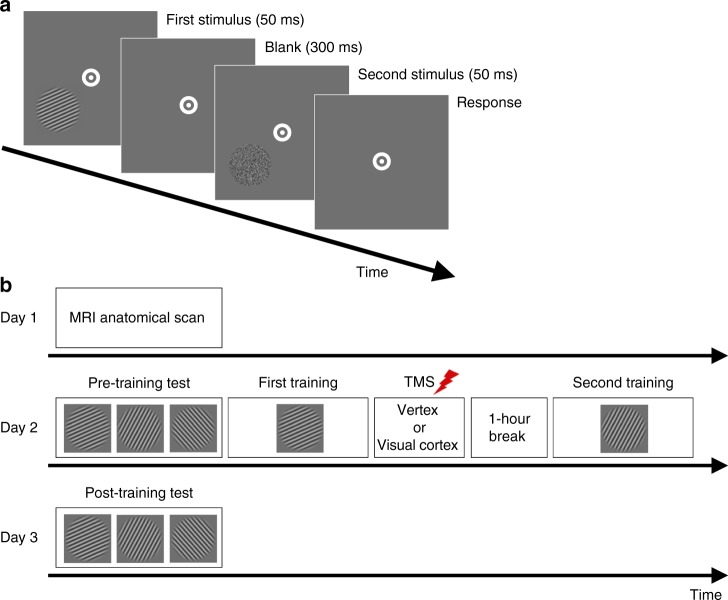
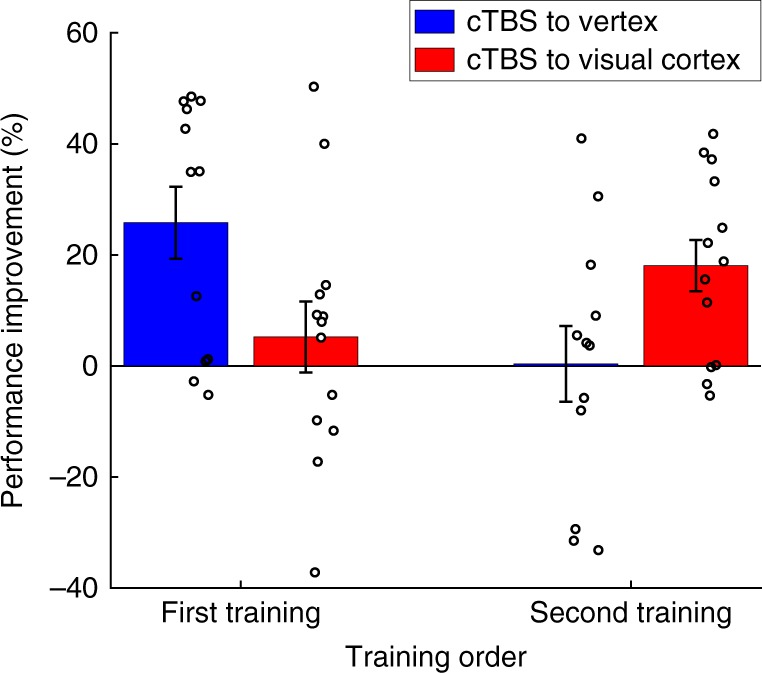
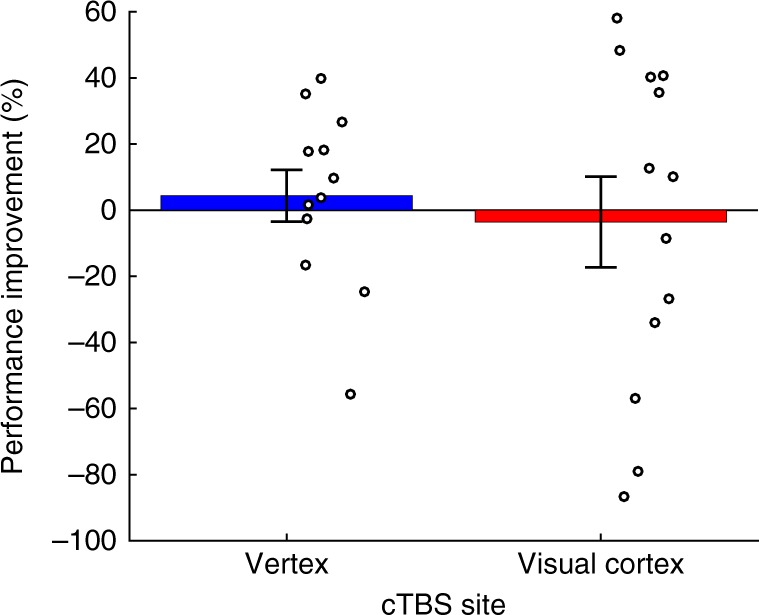
The period immediately after the offset of visual training is thought to be critical for memory consolidation. Nevertheless, we still lack direct evidence for the causal role of this period to perceptual learning of either previously or subsequently trained material. To address these issues, we had human subjects complete two consecutive trainings with different tasks (detecting different Gabor orientations). We applied continuous theta burst stimulation (cTBS) to either the visual cortex or a control site (vertex) immediately after the offset of the first training. In the vertex cTBS condition, subjects showed improvement on the first task but not on the second task, suggesting the presence of anterograde interference. Critically, cTBS to the visual cortex abolished the performance improvement on the first task and released the second training from the anterograde interference. These results provide causal evidence for a role of the immediate post-training period in the consolidation of perceptual learning.
Overview
The claims and statistics of this paper haven’t been checked yet.
Free: it reads the open-access text and checks the first 5 claims that cite a source we can check. Create a free account to check every claim.
Integrity signals
Registry
Cites
Statistics
Figures
Verification
Claims the paper makes
The claims and statistics of this paper haven’t been checked yet.
Free: it reads the open-access text and checks the first 5 claims that cite a source we can check. Create a free account to check every claim.
Claims other papers make about this one
Each is checked against this paper’s own text: does it say what the citing paper says it does?
The source backs part of the claim, not all of it — or backs it for a different population, condition or comparison.
In the citing paper
“but will be impervious to external fields once learnt, as has also been demonstrated (Bang et al., 2019).”
From Consciousness: Matter or EMF? (2023) · cites this paper as Bang et al., 2019
Experimental — accuracy not yet measuredThe cited source says what the claim attributes to it.
In the citing paper
“the cemi field theory proposes that EM fields are involved in memory and learning and so would predict that external EM fields, such as those delivered by TMS, will interfere with these processes, as found in several studies (Ferrari et al., 2018; Bang et al., 2019)”
From Consciousness: Matter or EMF? (2023) · cites this paper as Bang et al., 2019
Self-check
Percentages, sums and reported differences re-computed from the paper’s own numbers.
The self-check needs the paper’s full text.
Citations
Cites
Brainard, D. H. (1997) · Spatial Vision · doi:10.1163/156856897x00357 · Cited by 19,702
Memory - A century of consolidation
McGaugh, J. L. (2000) · Science · doi:10.1126/science.287.5451.248 · Cited by 4,250
Theta Burst Stimulation of the Human Motor Cortex
Huang, Y.-Z., Edwards, M. J., Rounis, E., Bhatia, K. P., & Rothwell, J. C. (2005) · Neuron · doi:10.1016/j.neuron.2004.12.033 · Cited by 4,158
Sleep-Dependent Learning and Memory Consolidation
Walker, M. P., & Stickgold, R. (2004) · Neuron · doi:10.1016/j.neuron.2004.08.031 · Cited by 1,113
Consolidation in human motor memory
Brashers-Krug, T., Shadmehr, R., & Bizzi, E. (1996) · Nature · doi:10.1038/382252a0 · Cited by 985
Practising orientation identification improves orientation coding in V1 neurons
Schoups, A., Vogels, R., Qian, N., & Orban, G. (2001) · Nature · doi:10.1038/35087601 · Cited by 856
A Brief History of Long-Term Potentiation
Nicoll, R. A. (2017) · Neuron · doi:10.1016/j.neuron.2016.12.015 · Cited by 841
Early consolidation in human primary motor cortex
Muellbacher, W., Ziemann, U., Wissel, J., Dang, N., Kofler, M., Facchini, S., Boroojerdi, B., Poewe, W., & Hallett, M. (2002) · Nature · doi:10.1038/nature712 · Cited by 803
Functional Stages in the Formation of Human Long-Term Motor Memory
Shadmehr, R., & Brashers-Krug, T. (1997) · The Journal of Neuroscience · doi:10.1523/jneurosci.17-01-00409.1997 · Cited by 706
The after-effect of human theta burst stimulation is NMDA receptor dependent
Huang, Y.-Z., Chen, R.-S., Rothwell, J. C., & Wen, H.-Y. (2007) · Clinical Neurophysiology · doi:10.1016/j.clinph.2007.01.021 · Cited by 618
Cited by
Ferrarelli, F., & Phillips, M. L. (2021) · American Journal of Psychiatry · doi:10.1176/appi.ajp.2020.20071050 · Cited by 126
Haddara, N., & Rahnev, D. (2022) · Psychological Science · doi:10.1177/09567976211032887 · Cited by 68
Self-citationCausal Contribution of Awake Post-encoding Processes to Episodic Memory Consolidation
Tambini, A., & D’Esposito, M. (2020) · Current Biology · doi:10.1016/j.cub.2020.06.063 · Cited by 55
“8 Current Biology 30, 1–11, September 21, 2020 perceptual [70] ormotormemories [71].”
BackgroundMcFadden, J. (2023) · Frontiers in Human Neuroscience · doi:10.3389/fnhum.2022.1024934 · Cited by 27
“, 2019) but will be impervious to external fields once learnt, as has also been demonstrated (Bang et al., 2019).”
BackgroundMethodPlasticity–stability dynamics during post-training processing of learning
Yamada, T., Watanabe, T., & Sasaki, Y. (2023) · Trends in Cognitive Sciences · doi:10.1016/j.tics.2023.09.002 · Cited by 31
Self-citationEarly Visual Cortex Stimulation Modifies Well-Consolidated Perceptual Gains
Shmuel, D., Frank, S., Sharon, H., Sasaki, Y., Watanabe, T., & Censor, N. (2020) · Cerebral Cortex · doi:10.1093/cercor/bhaa215 · Cited by 20
Self-citationRafiei, F., Safrin, M., Wokke, M. E., Lau, H. C., & Rahnev, D. (2021) · Human Brain Mapping · doi:10.1002/hbm.25466 · Cited by 14
Self-citationIyer, S., Collier, E., Broom, T. W., Finn, E. S., & Meyer, M. L. (2023) · Proceedings of the National Academy of Sciences · doi:10.1073/pnas.2306295121 · Cited by 19
“Prior work has shown that processes during post - encoding rest play a causal role in subsequent perceptual and episodic learning and memory, above and beyond encoding effects (28, 41–44).”
Training at asymptote stabilizes motor memories by reducing intracortical excitation
Mooney, R. A., Bastian, A. J., & Celnik, P. A. (2021) · Cortex · doi:10.1016/j.cortex.2021.06.014 · Cited by 14
Visual Plasticity in Adulthood: Perspectives from Hebbian and Homeostatic Plasticity
Bang, J. W., Hamilton-Fletcher, G., & Chan, K. C. (2021) · The Neuroscientist · doi:10.1177/10738584211037619 · Cited by 19
Self-citationLin, S.-H. N., Lien, Y. R., Shibata, K., Sasaki, Y., Watanabe, T., Lin, C., & Chang, L.-H. (2023) · Scientific Reports · doi:10.1038/s41598-023-32985-8 · Cited by 11
Self-citationHaddara, N., & Rahnev, D. (2020) · doi:10.31234/osf.io/p8zyw · Cited by 9
Self-citationInducing Cortical Plasticity to Manipulate and Consolidate Subjective Time Interval Production
Honma, M., Saito, S., Atsumi, T., Tokushige, S., Inomata‐Terada, S., Chiba, A., & Terao, Y. (2021) · Neuromodulation Technology at the Neural Interface · doi:10.1111/ner.13413 · Cited by 3
Ning, R., & Wright, B. A. (2023) · Learning & Memory · doi:10.1101/lm.053710.122 · Cited by 4
“…learning [Underwood 1957], associative learning [Bouton 1993], predictive learning [Castro et al. 2002], motor learning [Brashers-Krug et al. 1996; Sing and Smith 2010; Cantarero et al. 2013; Leow et al. 2013; Lerner et al. 2020], and perceptual learning [Shibata et al. 2017; Bang et al. 2019]).”
InfluentialAwake suppression after brief exposure to a familiar stimulus
Bang, J. W., & Rahnev, D. (2021) · Communications Biology · doi:10.1038/s42003-021-01863-2 · Cited by 2
Self-citationAnterograde interference in multitask perceptual learning
Yang, J., Yan, F.-F., Wang, T., Wang, Z., Ma, Q., Xiao, J., Yang, X., Lu, Z., & Huang, C. (2025) · npj Science of Learning · doi:10.1038/s41539-025-00312-7 · Cited by 2
TMS alters multivoxel patterns in the absence of overall activity changesPreprint
Rafiei, F., Safrin, M., Wokke, M. E., Lau, H. C., & Rahnev, D. (2020) · bioRxiv (Cold Spring Harbor Laboratory) · doi:10.1101/2020.03.25.008334 · Cited by 1
“We determined the resting motor threshold (RMT), immediately prior to starting the main experiment as in our previous work (Rahnev et al., 2016; Shekhar and Rahnev, 2018; Bang et al., 2019).”
MethodSelf-citationSequence-dependent effects of iTBS and perceptual learning on binocular balance
Wang, J., & Chang, D. H. F. (2026) · Cortex · doi:10.1016/j.cortex.2026.04.012 · Cited by 1
Meng, H., Zhao, Q., Jiang, L., Lu, W., & Zhang, J. (2026) · Experimental Brain Research · doi:10.1007/s00221-026-07407-6
“Closely spaced motor-learning experiences can interfere with the acquisition or stabilization of newly acquired skills, particularly during early phases of learning (Bang et al. 2019; Mooney et al. 2021).”
Metadata
- Authors
- Bang, J. W., Milton, D., Sasaki, Y., Watanabe, T., & Rahnev, D.
- Affiliations
- Georgia Institute of Technology (US)
- Brown University (US)
- Corresponding author
- Bang, Ji Won
- Venue
- Communications Biology
- Published
- 2019-08-27
- Volume
- 2
- Issue
- 1
- Pages
- 320-320
- ISSN
- 2399-3642 (ISSN-L)
- PMC
- PMC6711956
- OpenAlex
- W2970224861
- Cited by
- 19
- References
- 54
- Citations by year
- 2026: 2 · 2025: 1 · 2023: 5 · 2022: 1 · 2021: 6 · 2020: 4
- FWCI
- 1.60
- Type
- journal article
- Language
- en
- Open access
- gold
- doi.org
- Licence
- cc-by
- creativecommons.org/licenses/by/4.0 (tdm)
- creativecommons.org/licenses/by/4.0 (vor)
- Locations
- Communications Biology (publishedVersion, cc-by)
- PubMed Central (publishedVersion, cc-by)
- PubMed (publishedVersion)
- DOAJ (DOAJ: Directory of Open Access Journals) (submittedVersion)
- Funders
- Georgia Institute of Technology
- National Institute of Mental Health (R01MH119189)
- National Eye Institute (R21EY028329, R01EY027841, R01EY019466)
- Topics
- Life Sciences › Neuroscience › Cognitive Neuroscience › Visual perception and processing mechanisms
- Life Sciences › Neuroscience › Neurology › Transcranial Magnetic Stimulation Studies
- Life Sciences › Neuroscience › Cognitive Neuroscience › Memory and Neural Mechanisms
- Keywords
- perceptual learning, memory consolidation, continuous theta burst stimulation, visual cortex, visual training, transfer of learning
- MeSH terms
- Adolescent, Adult, Female, Humans, Learning, Male, Task Performance and Analysis, Theta Rhythm, Transcranial Magnetic Stimulation, Young Adult
About these checks
Registry, retraction, Cites and statistics results are computed, not judged, with one exception: a printed reference that no index lists is read once by a model before it counts as a citation error. Claims are extracted by a model and kept only when their quote appears verbatim in the text; each cited source is then checked, with a model’s help, for whether it says what the claim relies on. Those verdicts can be wrong — read the claim’s quote and the cited source before relying on one.
Statistics and arithmetic are recomputed, not judged.
Confidence bands are shown only for fields calibrated on our annotated test set. None is calibrated yet, so no band is shown.
What counts as a claim ›How we measure confidence ›How we check this ›
Are you an author, or do you see a problem with this page? Request a review
Data sources
Bibliographic data: Semantic Scholar, OpenAlex, Crossref.
Contains information from the Semantic Scholar Academic Graph Datasets, made available under the ODC Attribution License (ODC-BY 1.0).
Semantic Scholar’s data is described in: Kinney, R., et al. (2023). The Semantic Scholar Open Data Platform. arXiv:2301.10140.
