

Applying deep learning to single-trial EEG data provides evidence for complementary theories on action control
Open accessThe DOI matches its Crossref record; 70 of the 70 references it cites were found in a registry or an index.
Abstract
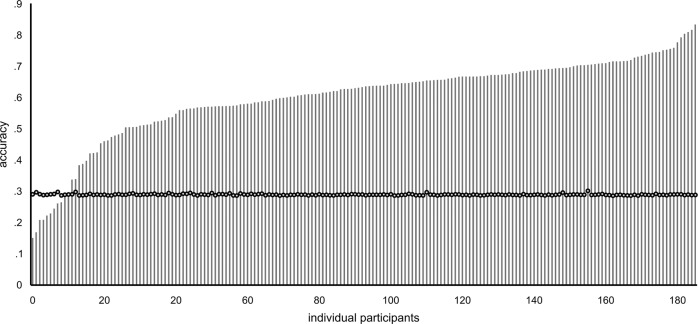
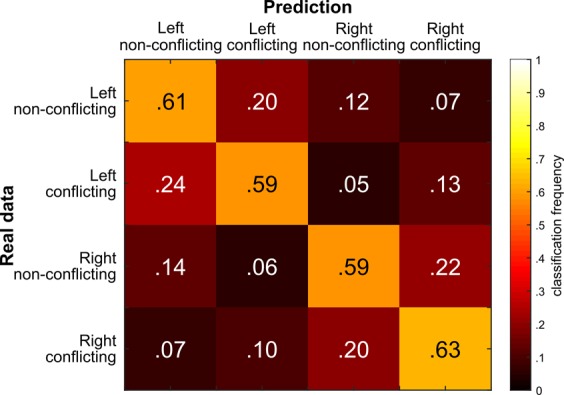
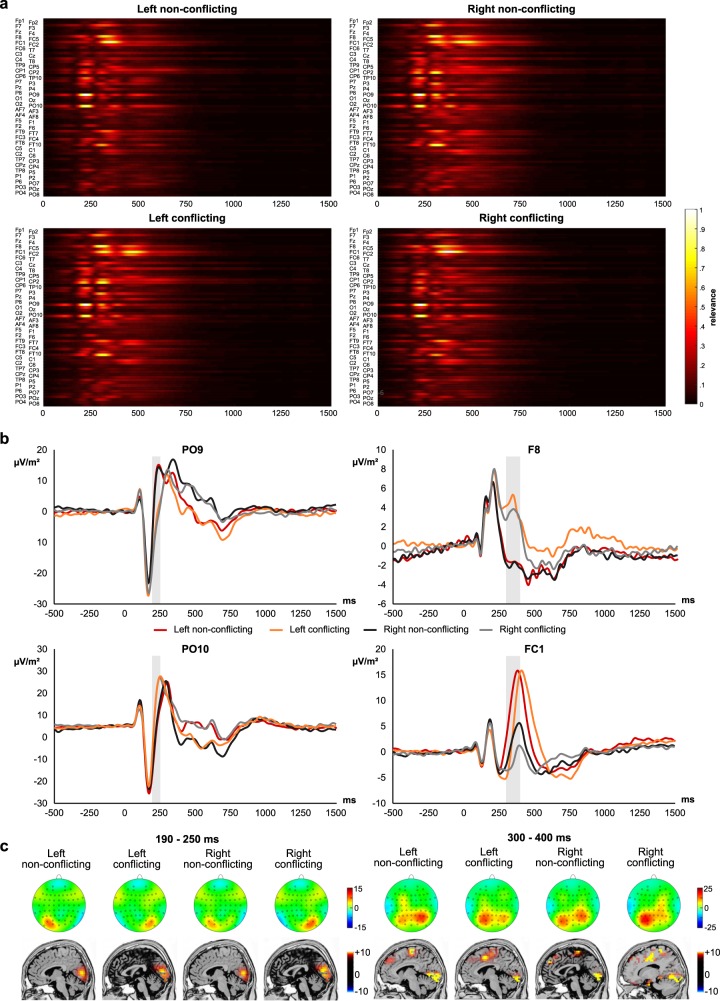
Efficient action control is indispensable for goal-directed behaviour. Different theories have stressed the importance of either attention or response selection sub-processes for action control. Yet, it is unclear to what extent these processes can be identified in the dynamics of neurophysiological (EEG) processes at the single-trial level and be used to predict the presence of conflicts in a given moment. Applying deep learning, which was blind to cognitive theory, on single-trial EEG data allowed to predict the presence of conflict in ~95% of subjects ~33% above chance level. Neurophysiological features related to attentional and motor response selection processes in the occipital cortex and the superior frontal gyrus contributed most to prediction accuracy. Importantly, deep learning was able to identify predictive neurophysiological processes in single-trial neural dynamics. Hence, mathematical (artificial intelligence) approaches may be used to foster the validation and development of links between cognitive theory and neurophysiology of human behavior.
Overview
The claims and statistics of this paper haven’t been checked yet.
Free: it reads the open-access text and checks the first 5 claims that cite a source we can check. Create a free account to check every claim.
Integrity signals
Registry
Cites
Statistics
Figures
Verification
Claims the paper makes
The claims and statistics of this paper haven’t been checked yet.
Free: it reads the open-access text and checks the first 5 claims that cite a source we can check. Create a free account to check every claim.
Claims other papers make about this one
Each is checked against this paper’s own text: does it say what the citing paper says it does?
The source backs part of the claim, not all of it — or backs it for a different population, condition or comparison.
In the citing paper
“EEGNet [13] is one of the most widely used classification algorithms in the EEG based BCI system [72]. And it is also the current SOTA approach which can classify EEG across BCI paradigms with limited training data.”
From IENet: a robust convolutional neural network for EEG based brain-computer interfaces (2022) · cites this paper as [72]
Experimental — accuracy not yet measured
Self-check
Percentages, sums and reported differences re-computed from the paper’s own numbers.
The self-check needs the paper’s full text.
Citations
Cites
1 retracted
Chmielewski, W. X., & Beste, C. (2019) · Cortex · doi:10.1016/j.cortex.2019.02.006 · Cited by 7
Self-citationRetractedAdam: A Method for Stochastic Optimization
Kingma, D. P., & Ba, J. (2014) · arXiv · doi:10.48550/arxiv.1412.6980 · Cited by 98,946
LeCun, Y., Bengio, Y., & Hinton, G. (2015) · Nature · doi:10.1038/nature14539 · Cited by 84,126
Conflict monitoring and cognitive control
Botvinick, M. M., Braver, T. S., Barch, D. M., Carter, C. S., & Cohen, J. D. (2001) · Psychological Review · doi:10.1037/0033-295x.108.3.624 · Cited by 7,351
(2005) · Cited by 5,977
EEGNet: a compact convolutional neural network for EEG-based brain-computer interfaces
Lawhern, V. J., Solon, A. J., Waytowich, N. R., Gordon, S. M., Hung, C. P., & Lance, B. J. (2018) · Journal of Neural Engineering · doi:10.1088/1741-2552/aace8c · Cited by 5,115
EEGNet: A Compact Convolutional Network for EEG-based Brain-Computer Interfaces
Lawhern, V. J., Solon, A. J., Waytowich, N. R., Gordon, S. M., Hung, C. P., & Lance, B. J. (2016) · arXiv · doi:10.48550/arxiv.1611.08024 · Cited by 5,105
Standardized low-resolution brain electromagnetic tomography (sLORETA): technical details.
Pascual-Marqui, R. D. (2002) · PubMed · Cited by 4,070
Deep learning with convolutional neural networks for EEG decoding and visualization
Schirrmeister, R. T., Springenberg, J. T., Fiederer, L. D. J., Glasstetter, M., Eggensperger, K., Tangermann, M., Hutter, F., Burgard, W., & Ball, T. (2017) · Human Brain Mapping · doi:10.1002/hbm.23730 · Cited by 3,751
Conflict monitoring and anterior cingulate cortex: an update
Botvinick, M. M., Cohen, J. D., & Carter, C. S. (2004) · Trends in Cognitive Sciences · doi:10.1016/j.tics.2004.10.003 · Cited by 3,623
Research works printed but not linked: 1
- Shenhav A Botvinick MM Cohen JD The expected value of control: an integrative theory of anterior cingulate cortex function Neuron 2013 79 217 240 10.1016/j.neuron.2013.07.007 23889930 PMC3767969 · DOI · Paper page
Cited by
Halkiopoulos, C., & Gkintoni, E. (2024) · Electronics · doi:10.3390/electronics13183762 · Cited by 328
Gkintoni, E., Aroutzidis, A., Antonopoulou, H., & Halkiopoulos, C. (2025) · Brain Sciences · doi:10.3390/brainsci15030220 · Cited by 224
Sundaresan, A., Penchina, B., Cheong, S., Grace, V., Valero‐Cabré, A., & Martel, A. (2021) · Brain Informatics · doi:10.1186/s40708-021-00133-5 · Cited by 95
Fricke, C., Alizadeh, J., Zakhary, N., Woost, T. B., Bogdan, M., & Claßen, J. (2021) · Frontiers in Neurology · doi:10.3389/fneur.2021.666458 · Cited by 78
Ravindran, A. S., & Contreras-Vidal, J. L. (2023) · Scientific Reports · doi:10.1038/s41598-023-43871-8 · Cited by 71
Hannah, R., Muralidharan, V., Sundby, K. K., & Aron, A. R. (2020) · NeuroImage · doi:10.1016/j.neuroimage.2020.117222 · Cited by 67
Decoding movement kinematics from EEG using an interpretable convolutional neural network
Borra, D., Mondini, V., Magosso, E., & Müller-Putz, G. (2023) · Computers in Biology and Medicine · doi:10.1016/j.compbiomed.2023.107323 · Cited by 55
Torres, J. M. M., Clarkson, T., Hauschild, K. M., Luhmann, C. C., Lerner, M. D., & Riccardi, G. (2021) · Biological Psychiatry Cognitive Neuroscience and Neuroimaging · doi:10.1016/j.bpsc.2021.03.015 · Cited by 51
Energy-Efficient EEG-Based Scheme for Autism Spectrum Disorder Detection Using Wearable Sensors
Alhassan, S., Soudani, A., & AlMusallam, M. (2023) · Sensors · doi:10.3390/s23042228 · Cited by 50
Universum based Lagrangian twin bounded support vector machine to classify EEG signals
Kumar, B., & Gupta, D. (2021) · Computer Methods and Programs in Biomedicine · doi:10.1016/j.cmpb.2021.106244 · Cited by 45
Pretrial Theta Band Activity Affects Context-dependent Modulation of Response Inhibition
Wendiggensen, P., Ghin, F., Koyun, A. H., Stock, A., & Beste, C. (2022) · Journal of Cognitive Neuroscience · doi:10.1162/jocn_a_01816 · Cited by 42
Self-citationConvolutional Neural Networks for Risso’s Dolphins Identification
Maglietta, R., Renò, V., Caccioppoli, R., Seller, E., Bellomo, S., Santacesaria, F. C., Colella, R., Cipriano, G., Stella, E., Hartman, K. L., et al. (2020) · IEEE Access · doi:10.1109/access.2020.2990427 · Cited by 42
Borra, D., Magosso, E., Castelo-Branco, M. S., & Simões, M. A. (2022) · Journal of Neural Engineering · doi:10.1088/1741-2552/ac7908 · Cited by 41
Borra, D., Fantozzi, S., & Magosso, E. (2021) · Frontiers in Human Neuroscience · doi:10.3389/fnhum.2021.655840 · Cited by 36
“Thus, a total number of K 1 ST = K 0 ST · D 1 ST = 16 spatial filters were learned and constrained to have a norm upper bounded by c = 1 (kernel max-norm constraint) as in previous studies (Lawhern et al., 2018; Borra et al., 2020a; Vahid et al., 2020).”
BackgroundResultIENet: a robust convolutional neural network for EEG based brain-computer interfaces
Du, Y., & Liu, J. (2022) · Journal of Neural Engineering · doi:10.1088/1741-2552/ac7257 · Cited by 34
“EEGNet [13] is one of the most widely used classification algorithms in the EEG based BCI sys-tem [72].”
MethodBunterngchit, C., Wang, J., & Hou, Z. (2024) · IEEE Journal of Translational Engineering in Health and Medicine · doi:10.1109/jtehm.2024.3448457 · Cited by 34
Borra, D., Bossi, F., Rivolta, D., & Magosso, E. (2023) · Scientific Reports · doi:10.1038/s41598-023-34487-z · Cited by 34
Rough Transformers: Lightweight and Continuous Time Series Modelling through Signature Patching
Moreno-Pino, F., Arroyo, Á., Waldon, H., Dong, X., & Cartea, Á. (2024) · neural information processing systems · doi:10.52202/079017-3371 · Cited by 34
EEG-Based Emotion Recognition Using Deep Learning and M3GP
Aguiñaga, A. R., Muñoz, L., López‐López, V. R., & Téllez, A. C. (2022) · Applied Sciences · doi:10.3390/app12052527 · Cited by 27
Emotion Recognition by Correlating Facial Expressions and EEG Analysis
Aguiñaga, A. R., Hernandez, D. E., Quezada, Á., & Téllez, A. C. (2021) · Applied Sciences · doi:10.3390/app11156987 · Cited by 23
Lin, P.-J., Li, W., Zhai, X., Sun, J., Pan, Y., Ji, L., & Li, C. (2024) · Neurocomputing · doi:10.1016/j.neucom.2024.127622 · Cited by 23
Prediction of Methylene Blue Removal by Nano TiO2 Using Deep Neural Network
Amor, N., Noman, M. T., & Petrů, M. (2021) · Polymers · doi:10.3390/polym13183104 · Cited by 23
Amor, N., Noman, M. T., Ismail, A., Petrů, M., & Sebastian, N. (2022) · Polymers · doi:10.3390/polym14050937 · Cited by 23
Vahid, A., Mückschel, M., Stober, S., Stock, A., & Beste, C. (2022) · Communications Biology · doi:10.1038/s42003-022-03091-8 · Cited by 22
Self-citationGholamipourbarogh, N., Ghin, F., Mückschel, M., Frings, C., Stock, A., & Beste, C. (2022) · Human Brain Mapping · doi:10.1002/hbm.26135 · Cited by 21
Self-citationGordienko, Y. G., Gordienko, N., Taran, V., Rojbi, A., Telenyk, S., & Stirenko, S. (2025) · Frontiers in Neuroinformatics · doi:10.3389/fninf.2025.1521805 · Cited by 21
Self supervised learning based emotion recognition using physiological signals
Zhang, M., & Cui, Y. (2024) · Frontiers in Human Neuroscience · doi:10.3389/fnhum.2024.1334721 · Cited by 21
Dzianok, P., Antonova, I., Wojciechowski, J., Dreszer, J., & Kublik, E. (2022) · GigaScience · doi:10.1093/gigascience/giac015 · Cited by 19
Aellen, F. M., Göktepe-Kavis, P., Apostolopoulos, S., & Tzovara, A. (2021) · Journal of Neuroscience Methods · doi:10.1016/j.jneumeth.2021.109367 · Cited by 19
Motor decoding from the posterior parietal cortex using deep neural networks
Borra, D., Filippini, M., Ursino, M., Fattori, P., & Magosso, E. (2023) · Journal of Neural Engineering · doi:10.1088/1741-2552/acd1b6 · Cited by 18
Prasad, R., Tarai, S., & Bit, A. (2022) · Cognitive Neurodynamics · doi:10.1007/s11571-022-09888-x · Cited by 17
A Novel Activation Maximization-based Approach for Insight into Electrophysiology Classifiers
Ellis, C. A., Sendi, M. S. E., Miller, R. L., & Calhoun, V. D. (2021) · IEEE International Conference on Bioinformatics and Biomedicine (BIBM) · doi:10.1109/bibm52615.2021.9669593 · Cited by 17
Gholamipourbarogh, N., Eggert, E., Münchau, A. M., Frings, C., & Beste, C. (2024) · NeuroImage · doi:10.1016/j.neuroimage.2024.120667 · Cited by 16
Self-citationA hybrid autoencoder framework of dimensionality reduction for brain-computer interface decoding
Ran, X., Chen, W., Yvert, B., & Zhang, S. (2022) · Computers in Biology and Medicine · doi:10.1016/j.compbiomed.2022.105871 · Cited by 16
Rough Transformers for Continuous and Efficient Time-Series ModellingPreprint
Moreno-Pino, F., Arroyo, Á., Waldon, H., Dong, X., & Cartea, Á. (2024) · arXiv (Cornell University) · doi:10.48550/arxiv.2403.10288 · Cited by 15
A Model Visualization-based Approach for Insight into Waveforms and Spectra Learned by CNNs
Ellis, C. A., Miller, R. L., & Calhoun, V. D. (2022) · Annual International Conference of the IEEE Engineering in Medicine and Biology Society (EMBC) · doi:10.1109/embc48229.2022.9871414 · Cited by 15
Using Deep Learning to Classify Saccade Direction from Brain Activity
Kastrati, A., Płomecka, M. B., Wattenhofer, R. P., & Langer, N. (2021) · ACM Symposium on Eye Tracking Research and Applications (ETRA) · doi:10.1145/3448018.3458014 · Cited by 14
Adelhöfer, N., Stock, A., & Beste, C. (2021) · Brain Structure and Function · doi:10.1007/s00429-021-02245-4 · Cited by 14
Self-citationCategorizing objects from MEG signals using EEGNet
Shi, R., Zhao, Y., Cao, Z., Liu, C., Kang, Y., & Zhang, J. (2021) · Cognitive Neurodynamics · doi:10.1007/s11571-021-09717-7 · Cited by 14
Standardizing EEG preprocessing for cross-site integration - the CLEAN pipeline
Böttcher, A., Wendiggensen, P., Mückschel, M., Hoffmann, S. F., Buß, C., Kölch, M., Koerte, I. K., Li, S.-C., Mall, V., Marschik, P. B., et al. (2026) · NeuroImage · doi:10.1016/j.neuroimage.2026.121812 · Cited by 14
Self-citationIdentification of Breathing Patterns through EEG Signal Analysis Using Machine Learning
Hong, Y., Kim, H.-K., Son, Y., & Kang, C. (2021) · Brain Sciences · doi:10.3390/brainsci11030293 · Cited by 14
Ellis, C. A., Sattiraju, A., Miller, R. L., & Calhoun, V. D. (2023) · bioRxiv (Cold Spring Harbor Laboratory) · doi:10.1101/2023.03.20.533467 · Cited by 13
Raoof, I., & Gupta, M. K. (2023) · Neural Computing and Applications · doi:10.1007/s00521-023-08927-w · Cited by 13
Sharma, Y., & Singh, B. K. (2023) · IEEE Transactions on Medical Robotics and Bionics · doi:10.1109/tmrb.2023.3315742 · Cited by 13
Borra, D., Paissan, F., & Ravanelli, M. (2024) · Computers in Biology and Medicine · doi:10.1016/j.compbiomed.2024.109097 · Cited by 11
Event-related variability is modulated by task and development
Naik, S., Adibpour, P., Dubois, J., Dehaene‐Lambertz, G., & Battaglia, D. A. (2023) · NeuroImage · doi:10.1016/j.neuroimage.2023.120208 · Cited by 11
Early categorization of social affordances during the visual encoding of bodily stimuli
Moreau, Q., Parrotta, E., Pesci, U. G., Era, V., & Candidi, M. (2023) · NeuroImage · doi:10.1016/j.neuroimage.2023.120151 · Cited by 11
Using deep learning to decode abnormal brain neural activity in MDD from single-trial EEG signals
Liu, M., Tan, J., Jiang, Y., & Tian, Y. (2022) · Brain-Apparatus Communication A Journal of Bacomics · doi:10.1080/27706710.2022.2075242 · Cited by 10
Kostiukevych, K., Stirenko, S., Gordienko, N., Rokovyi, O., Alienin, O., & Gordienko, Y. G. (2021) · IEEE International Conference on Intelligent Data Acquisition and Advanced Computing Systems: Technology and Applications (IDAACS) · doi:10.1109/idaacs53288.2021.9660880 · Cited by 10
Kim, H., Seo, P., Kim, M. J., Huh, J. I., Sunwoo, J., Cha, K. S., Jeong, E., Kim, H.-J., Jung, K., & Kim, K. H. (2023) · Computer Methods and Programs in Biomedicine · doi:10.1016/j.cmpb.2023.107496 · Cited by 10
Gordienko, Y. G., Kostiukevych, K., Gordienko, N., Rokovyi, O., Alienin, O., & Stirenko, S. (2021) · Lecture notes on data engineering and communications technologies · doi:10.1007/978-3-030-80475-6_1 · Cited by 9
Warsi, N. M., Wong, S. M., Germann, J., Boutet, A., Arski, O. N., Anderson, R., Erdman, L., Yan, H., Suresh, H., Gouveia, F. V., et al. (2023) · Neural Networks · doi:10.1016/j.neunet.2023.07.019 · Cited by 10
On the Role of Stimulus-Response Context in Inhibitory Control in Alcohol Use Disorder
Ghin, F., Beste, C., & Stock, A. (2022) · Journal of Clinical Medicine · doi:10.3390/jcm11216557 · Cited by 8
Self-citationA protocol for trustworthy EEG decoding with neural networks
Borra, D., Magosso, E., & Ravanelli, M. (2024) · Neural Networks · doi:10.1016/j.neunet.2024.106847 · Cited by 8
Kim, M., Kim, H., Seo, P., Jung, K., & Kim, K. H. (2022) · Sensors · doi:10.3390/s22207792 · Cited by 8
Decoding neural activity to assess individual latent state in ecologically valid contexts
Gordon, S. M., McDaniel, J. R., King, K., Lawhern, V. J., & Touryan, J. (2023) · Journal of Neural Engineering · doi:10.1088/1741-2552/acee20 · Cited by 8
Goelz, C., Reuter, E., Fröhlich, S. M., Rudisch, J., Godde, B., Vieluf, S., & Voelcker‐Rehage, C. (2023) · Brain Informatics · doi:10.1186/s40708-023-00190-y · Cited by 8
Rough Transformers: Lightweight Continuous-Time Sequence Modelling with Path SignaturesPreprint
Moreno-Pino, F., Arroyo, Á., Waldon, H., Dong, X., & Cartea, Á. (2024) · SSRN Electronic Journal · doi:10.2139/ssrn.4850217 · Cited by 7
Dzianok, P., Kołodziej, M., & Kublik, E. (2021) · IEEE International Conference on Bioinformatics and Bioengineering (BIBE) · doi:10.1109/bibe52308.2021.9635187 · Cited by 7
Altered Resting-State Electroencephalogram Microstate Characteristics in Stroke Patients
Lu, H., Ma, Z., Zhang, J.-P., Wu, J., Zheng, M., Hua, X., & Xu, J. (2024) · Journal of Integrative Neuroscience · doi:10.31083/j.jin2309176 · Cited by 7
Borra, D., Filippini, M., Ursino, M., Fattori, P., & Magosso, E. (2024) · Computers in Biology and Medicine · doi:10.1016/j.compbiomed.2024.108188 · Cited by 6
Gordienko, Y. G., Kostiukevych, K., Gordienko, N., Rokovyi, O., Alienin, O., & Stirenko, S. (2021) · International Conference on Soft Computing & Machine Intelligence (ISCMI) · doi:10.1109/iscmi53840.2021.9654829 · Cited by 6
Ghin, F., Eggert, E., Gholamipourbarogh, N., Talebi, N., & Beste, C. (2024) · Human Brain Mapping · doi:10.1002/hbm.26643 · Cited by 5
Self-citationBorra, D., & Magosso, E. (2025) · Computer Methods and Programs in Biomedicine · doi:10.1016/j.cmpb.2025.109008 · Cited by 5
Secure Storage and Access Control for Personal and EEG Data using Blockchain
Nemes, G. Á., Tureczki, B., Szenes, K., & Eigner, G. (2023) · IEEE International Symposium on Computational Intelligence and Informatics (CINTI) · doi:10.1109/cinti59972.2023.10382044 · Cited by 5
Alves, C. L., Ciba, M., Toutain, T. G. L. D. O., Porto, J. A. M., de Sena, E. P., Thielemann, C., & Rodrigues, F. A. (2024) · Journal of Physics Complexity · doi:10.1088/2632-072x/ad1c68 · Cited by 4
Naveilhan, C., Zory, R., & Ramanoël, S. (2025) · Journal of Vision · doi:10.1167/jov.25.10.15 · Cited by 4
Deep Learning Amplified Early Stopping Bias: Overestimating Performance on Small Datasets
Rajabi, N., Ribeiro, A. H., Vasco, M., & Kragić, D. (2025) · IEEE International Conference on Acoustics Speech and Signal Processing · doi:10.1109/icassp49660.2025.10890439 · Cited by 4
Giesbrecht, B., & Garrett, J. (2023) · Elsevier eBooks · doi:10.1016/b978-0-12-820480-1.00007-3 · Cited by 4
Mapping the Digital Mind: A Meta-Analysis of EEG Biomarkers in Cognition, Emotion, and Mental Health
Halkiopoulos, C., Gkintoni, E., & Boutsinas, B. (2026) · Brain Sciences · doi:10.3390/brainsci16040368 · Cited by 3
Vahid, A., Stock, A., Mückschel, M., & Beste, C. (2022) · Neuroimage Reports · doi:10.1016/j.ynirp.2022.100118 · Cited by 3
Self-citationGholamipourbarogh, N., Vahid, A., Mückschel, M., & Beste, C. (2023) · Psychophysiology · doi:10.1111/psyp.14328 · Cited by 3
Self-citationMing, Y., & Lin, C. (2021) · IEEE Systems Man and Cybernetics Magazine · doi:10.1109/msmc.2021.3090569 · Cited by 3
Anders, C., Curio, G., Arnrich, B., & Waterstraat, G. (2023) · Network Computation in Neural Systems · doi:10.1080/0954898x.2023.2263083 · Cited by 3
Holker, R., & Susan, S. (2025) · Signal Image and Video Processing · doi:10.1007/s11760-025-04589-4 · Cited by 3
Joo, H., Quan, L. D. A., Trang, L. T., Kim, D., & Woo, J. (2023) · IEEE Access · doi:10.1109/access.2023.3325283 · Cited by 2
A deep learning-enriched framework for analyzing brain functional connectivity
Borra, D., & Magosso, E. (2025) · Scientific Reports · doi:10.1038/s41598-025-17635-5 · Cited by 2
What does my network learn? Assessing interpretability of deep learning for EEG
Göktepe-Kavis, P., Aellen, F. M., Alnes, S. L., & Tzovara, A. (2025) · Imaging Neuroscience · doi:10.1162/imag.a.1033 · Cited by 2
Borra, D., Bonsangue, V., Straudi, S., & Magosso, E. (2025) · Computer Methods and Programs in Biomedicine · doi:10.1016/j.cmpb.2025.109159 · Cited by 2
Jounghani, A. R., Backer, K. C., Vahid, A., Comstock, D. C., Zamani, J., Hosseini, S. M. H., Balasubramaniam, R., & Bortfeld, H. (2024) · Cerebral Cortex · doi:10.1093/cercor/bhae427 · Cited by 2
Self-citationSkaug, K. A., Leonardsen, E. H., & Huster, R. J. (2025) · bioRxiv (Cold Spring Harbor Laboratory) · doi:10.1101/2025.04.15.648695 · Cited by 1
Deep Learning for Holistic Mental Illness Diagnosis with Multimodal Imaging
-, V. K. R., & -, K. R. (2024) · International Journal For Multidisciplinary Research · doi:10.36948/ijfmr.2024.v06i01.12148
An integration of BCI and vision system for robotics applications: A review
Zhang, S., Ali, M. A. H., Mokhtar, N. B., Nukman, Y., Chen, H., Huang, Z., & Alkhedher, M. (2026) · Chinese Journal of Mechanical Engineering · doi:10.1016/j.cjme.2025.100188 · Cited by 3
Gordienko, N., Rokovyi, O., Gordienko, Y. G., & Stirenko, S. (2022) · Lecture notes in computer science · doi:10.1007/978-3-031-17618-0_32
Testing for interactions in multivariate data
Penny, W. D., Sambrook, T., & Renoult, L. (2026) · PLoS ONE · doi:10.1101/2025.11.26.690868
Kaszyńska, A. A. (2022) · Studia Humanistyczne/Studia Humanistyczne AGH · doi:10.7494/human.2022.21.1.23
Processing brain signals with machine learning
Nemes, G. Á. (2025) · doi:10.12700/aiamdi.phd.2025.ngya
Tiwari, R., Beste, C., & Gholamipourbarough, N. (2026) · bioRxiv (Cold Spring Harbor Laboratory) · doi:10.64898/2026.10.01.755897
Self-citationGhosh, A., Tyagi, N., & Guha, K. (2026) · doi:10.1109/aidml70736.2026.11749205
Incorporating sequential and geometric structure into deep neural networks
Arroyo Nunez, A. (2025) · Oxford University Research Archive (ORA) (University of Oxford) · doi:10.5287/ora-6gj8m88d9
Yağış, S., Salman, D., Yildiz, H. E., & Güçlü, B. (2026) · Scientific Reports · doi:10.1038/s41598-026-59917-6
Inferring Arm Movement Direction from EEG Signals Using Explainable Deep Learning
Fraternali, M., Magosso, E., & Borra, D. (2026) · Sensors · doi:10.3390/s26041235
EEG Analysis for BCI and Epilepsy Detection
Chetana, R., Mahantesh, K., & Channabasava, A. (2021) · IJARCCE · doi:10.17148/ijarcce.2021.101252
Action Lab Annual Research Report 2020: Linking theory, signals and intervention
Beste, C. (2026) · Qucosa (Saxon State and University Library Dresden)
Self-citation
Metadata
- Authors
- Vahid, A., Mückschel, M., Stober, S., Stock, A.-K., & Beste, C.
- Affiliations
- Technische Universität Dresden (DE)
- Otto-von-Guericke-Universität Magdeburg (DE)
- Corresponding author
- Beste, Christian
- Venue
- Communications Biology
- Published
- 2020-03-09
- Volume
- 3
- Issue
- 1
- Pages
- 112-112
- ISSN
- 2399-3642 (ISSN-L)
- PMC
- PMC7062698
- OpenAlex
- W3009188842
- Cited by
- 87
- References
- 68
- Citations by year
- 2026: 3 · 2025: 11 · 2024: 15 · 2023: 19 · 2022: 17 · 2021: 20 · 2020: 2
- FWCI
- 7.79
- Type
- journal article
- Language
- en
- Open access
- gold
- doi.org
- Licence
- cc-by
- creativecommons.org/licenses/by/4.0 (tdm)
- creativecommons.org/licenses/by/4.0 (vor)
- Locations
- Communications Biology (publishedVersion, cc-by)
- PubMed Central (publishedVersion, cc-by)
- PubMed (publishedVersion)
- Funders
- Deutsche Forschungsgemeinschaft (SFB 940 project B8, SFB TRR 265)
- Topics
- Life Sciences › Neuroscience › Cognitive Neuroscience › Neural and Behavioral Psychology Studies
- Life Sciences › Neuroscience › Cognitive Neuroscience › EEG and Brain-Computer Interfaces
- Social Sciences › Arts and Humanities › Philosophy › Free Will and Agency
- Keywords
- action control, single-trial EEG, conflict prediction, attention, response selection, cognitive control, neural dynamics, occipital cortex, superior frontal gyrus, deep learning
- MeSH terms
- Deep Learning, Adolescent, Adult, Attention, Brain, Cognition, Conflict, Psychological, Electroencephalography, Female, Goals, Humans, Male, Motor Activity, Neuropsychological Tests, Predictive Value of Tests, Reaction Time, Signal Processing, Computer-Assisted, Young Adult, Brain Waves, Support Vector Machine
About these checks
Registry, retraction, Cites and statistics results are computed, not judged, with one exception: a printed reference that no index lists is read once by a model before it counts as a citation error. Claims are extracted by a model and kept only when their quote appears verbatim in the text; each cited source is then checked, with a model’s help, for whether it says what the claim relies on. Those verdicts can be wrong — read the claim’s quote and the cited source before relying on one.
Statistics and arithmetic are recomputed, not judged.
Confidence bands are shown only for fields calibrated on our annotated test set. None is calibrated yet, so no band is shown.
What counts as a claim ›How we measure confidence ›How we check this ›
Are you an author, or do you see a problem with this page? Request a review
Data sources
Bibliographic data: Semantic Scholar, OpenAlex, Crossref.
Contains information from the Semantic Scholar Academic Graph Datasets, made available under the ODC Attribution License (ODC-BY 1.0).
Semantic Scholar’s data is described in: Kinney, R., et al. (2023). The Semantic Scholar Open Data Platform. arXiv:2301.10140.
