

Applying deep learning to single-trial EEG data provides evidence for complementary theories on action control
Open accessThe DOI matches its Crossref record; 70 of the 70 references it cites were found in a registry or an index.
Abstract
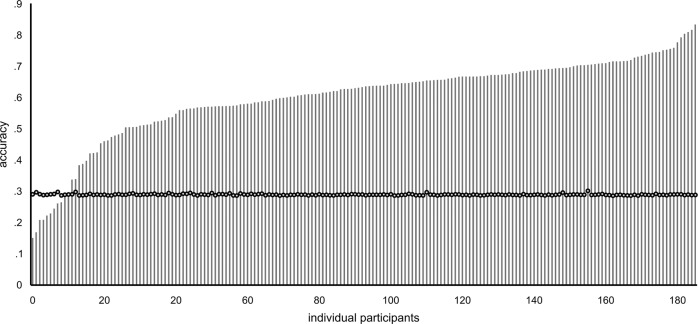
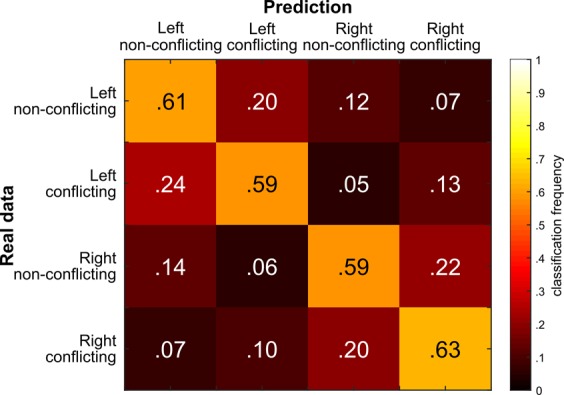
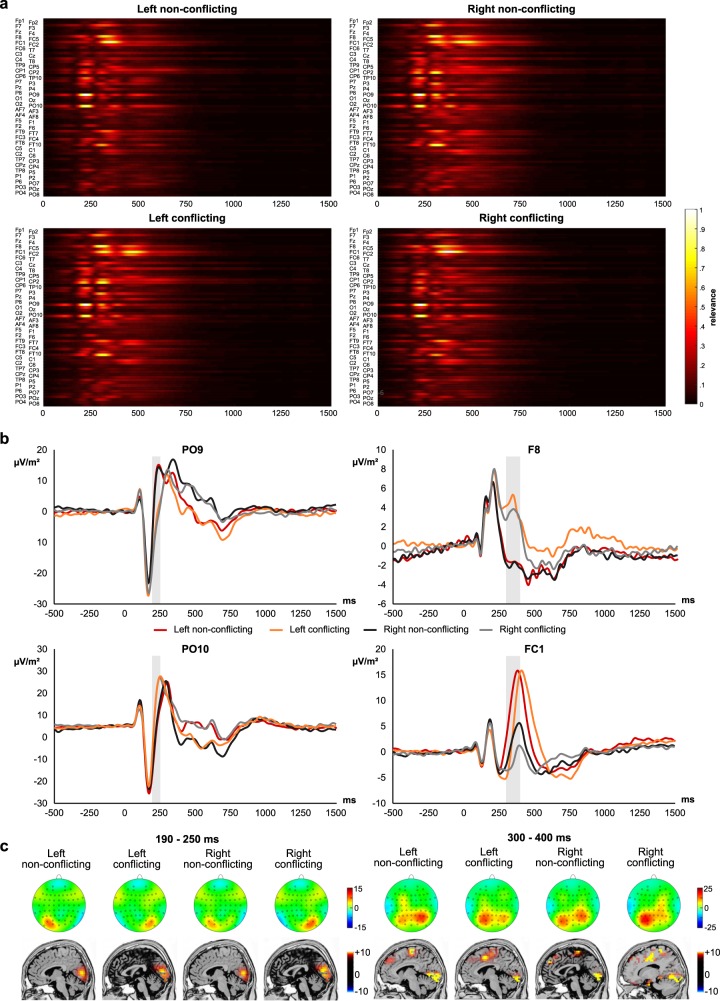
Efficient action control is indispensable for goal-directed behaviour. Different theories have stressed the importance of either attention or response selection sub-processes for action control. Yet, it is unclear to what extent these processes can be identified in the dynamics of neurophysiological (EEG) processes at the single-trial level and be used to predict the presence of conflicts in a given moment. Applying deep learning, which was blind to cognitive theory, on single-trial EEG data allowed to predict the presence of conflict in ~95% of subjects ~33% above chance level. Neurophysiological features related to attentional and motor response selection processes in the occipital cortex and the superior frontal gyrus contributed most to prediction accuracy. Importantly, deep learning was able to identify predictive neurophysiological processes in single-trial neural dynamics. Hence, mathematical (artificial intelligence) approaches may be used to foster the validation and development of links between cognitive theory and neurophysiology of human behavior.
Overview
The claims and statistics of this paper haven’t been checked yet.
Free: it reads the open-access text and checks the first 5 claims that cite a source we can check. Create a free account to check every claim.
Integrity signals
Registry
Cites
Statistics
Figures
Verification
Claims the paper makes
The claims and statistics of this paper haven’t been checked yet.
Free: it reads the open-access text and checks the first 5 claims that cite a source we can check. Create a free account to check every claim.
Claims other papers make about this one
Each is checked against this paper’s own text: does it say what the citing paper says it does?
The source backs part of the claim, not all of it — or backs it for a different population, condition or comparison.
In the citing paper
“EEGNet [13] is one of the most widely used classification algorithms in the EEG based BCI system [72]. And it is also the current SOTA approach which can classify EEG across BCI paradigms with limited training data.”
From IENet: a robust convolutional neural network for EEG based brain-computer interfaces (2022) · cites this paper as [72]
Experimental — accuracy not yet measured
Self-check
Percentages, sums and reported differences re-computed from the paper’s own numbers.
The self-check needs the paper’s full text.
Citations
Cites
1 retracted
Chmielewski, W. X., & Beste, C. (2019) · Cortex · doi:10.1016/j.cortex.2019.02.006 · Cited by 7
Self-citationRetractedAdam: A Method for Stochastic Optimization
Kingma, D. P., & Ba, J. (2014) · arXiv · doi:10.48550/arxiv.1412.6980 · Cited by 98,946
LeCun, Y., Bengio, Y., & Hinton, G. (2015) · Nature · doi:10.1038/nature14539 · Cited by 84,126
Conflict monitoring and cognitive control
Botvinick, M. M., Braver, T. S., Barch, D. M., Carter, C. S., & Cohen, J. D. (2001) · Psychological Review · doi:10.1037/0033-295x.108.3.624 · Cited by 7,351
(2005) · Cited by 5,977
EEGNet: a compact convolutional neural network for EEG-based brain-computer interfaces
Lawhern, V. J., Solon, A. J., Waytowich, N. R., Gordon, S. M., Hung, C. P., & Lance, B. J. (2018) · Journal of Neural Engineering · doi:10.1088/1741-2552/aace8c · Cited by 5,115
EEGNet: A Compact Convolutional Network for EEG-based Brain-Computer Interfaces
Lawhern, V. J., Solon, A. J., Waytowich, N. R., Gordon, S. M., Hung, C. P., & Lance, B. J. (2016) · arXiv · doi:10.48550/arxiv.1611.08024 · Cited by 5,105
Standardized low-resolution brain electromagnetic tomography (sLORETA): technical details.
Pascual-Marqui, R. D. (2002) · PubMed · Cited by 4,070
Deep learning with convolutional neural networks for EEG decoding and visualization
Schirrmeister, R. T., Springenberg, J. T., Fiederer, L. D. J., Glasstetter, M., Eggensperger, K., Tangermann, M., Hutter, F., Burgard, W., & Ball, T. (2017) · Human Brain Mapping · doi:10.1002/hbm.23730 · Cited by 3,751
Conflict monitoring and anterior cingulate cortex: an update
Botvinick, M. M., Cohen, J. D., & Carter, C. S. (2004) · Trends in Cognitive Sciences · doi:10.1016/j.tics.2004.10.003 · Cited by 3,623
The Theory of Event Coding (TEC): A framework for perception and action planning
Hommel, B., Müsseler, J., Aschersleben, G., & Prinz, W. (2001) · Behavioral and Brain Sciences · doi:10.1017/s0140525x01000103 · Cited by 3,091
Deep learning for healthcare: review, opportunities and challenges
Miotto, R., Wang, F., Wang, S., Jiang, X., & Dudley, J. T. (2018) · Briefings in Bioinformatics · doi:10.1093/bib/bbx044 · Cited by 3,076
The role of the medial frontal cortex in cognitive control
Ridderinkhof, K. R., Ullsperger, M., Crone, E. A., & Nieuwenhuis, S. (2004) · Science · doi:10.1126/science.1100301 · Cited by 2,974
The expected value of control: an integrative theory of anterior cingulate cortex function
Shenhav, A., Botvinick, M. M., & Cohen, J. D. (2013) · Neuron · doi:10.1016/j.neuron.2013.07.007 · Cited by 2,321
The Oxford Handbook of Event-Related Potential Components
(2011) · doi:10.1093/oxfordhb/9780195374148.001.0001 · Cited by 2,263
Functional role of the supplementary and pre-supplementary motor areas
Nachev, P., Kennard, C., & Husain, M. (2008) · Nature Reviews Neuroscience · doi:10.1038/nrn2478 · Cited by 1,928
The neural basis of error detection: Conflict monitoring and the error-related negativity
Yeung, N., Botvinick, M. M., & Cohen, J. D. (2004) · Psychological Review · doi:10.1037/0033-295x.111.4.931 · Cited by 1,924
Deep learning for healthcare applications based on physiological signals: A review
Faust, O., Hagiwara, Y., Hong, T. J., Lih, O. S., & Acharya, U. R. (2018) · Computer Methods and Programs in Biomedicine · doi:10.1016/j.cmpb.2018.04.005 · Cited by 1,026
Action sets and decisions in the medial frontal cortex
RUSHWORTH, M., WALTON, M., KENNERLEY, S., & BANNERMAN, D. (2004) · Trends in Cognitive Sciences · doi:10.1016/j.tics.2004.07.009 · Cited by 1,004
Learning Representations from EEG with Deep Recurrent-Convolutional Neural Networks
Bashivan, P., Rish, I., Yeasin, M., & Codella, N. (2015) · arXiv · doi:10.48550/arxiv.1511.06448 · Cited by 836
De Jong, R., Liang, C.-C., & Lauber, E. (1994) · Journal of Experimental Psychology: Human Perception and Performance · doi:10.1037/0096-1523.20.4.731 · Cited by 806
Assessing and tuning brain decoders: Cross-validation, caveats, and guidelines
Varoquaux, G., Raamana, P. R., Engemann, D. A., Hoyos-Idrobo, A., Schwartz, Y., & Thirion, B. (2017) · NeuroImage · doi:10.1016/j.neuroimage.2016.10.038 · Cited by 792
Action control according to TEC (theory of event coding)
Hommel, B. (2009) · Psychological Research Psychologische Forschung · doi:10.1007/s00426-009-0234-2 · Cited by 603
Mechanisms of human attention: event-related potentials and oscillations
Herrmann, C. S., & Knight, R. T. (2001) · Neuroscience & Biobehavioral Reviews · doi:10.1016/s0149-7634(01)00027-6 · Cited by 600
Combrisson, E., & Jerbi, K. (2015) · Journal of Neuroscience Methods · doi:10.1016/j.jneumeth.2015.01.010 · Cited by 599
Micro- and macro-adjustments of task set: activation and suppression in conflict tasks
Ridderinkhof, R. (2002) · Psychological Research · doi:10.1007/s00426-002-0104-7 · Cited by 531
The Simon effect as tool and heuristic
Hommel, B. (2011) · Acta Psychologica · doi:10.1016/j.actpsy.2010.04.011 · Cited by 492
Sekihara, K., Sahani, M., & Nagarajan, S. S. (2005) · NeuroImage · doi:10.1016/j.neuroimage.2004.11.051 · Cited by 477
Making sense of all the conflict: A theoretical review and critique of conflict-related ERPs
Larson, M. J., Clayson, P. E., & Clawson, A. (2014) · International Journal of Psychophysiology · doi:10.1016/j.ijpsycho.2014.06.007 · Cited by 454
Sources of attention-sensitive visual event-related potentials
Gonzalez, C. M. G., Clark, V. P., Fan, S., Luck, S. J., & Hillyard, S. A. (1994) · Brain Topography · doi:10.1007/bf01184836 · Cited by 354
Kornblum, S. (1994) · Psychological Research · doi:10.1007/bf00419699 · Cited by 272
Egner, T. (2014) · Frontiers in Psychology · doi:10.3389/fpsyg.2014.01247 · Cited by 253
On the benefits of using surface Laplacian (current source density) methodology in electrophysiology
Kayser, J., & Tenke, C. E. (2015) · International Journal of Psychophysiology · doi:10.1016/j.ijpsycho.2015.06.001 · Cited by 249
Combined ICA-LORETA analysis of mismatch negativity
Marco-Pallarés, J., Grau, C., & Ruffini, G. (2005) · NeuroImage · doi:10.1016/j.neuroimage.2004.11.028 · Cited by 238
Dippel, G., & Beste, C. (2015) · Nature Communications · doi:10.1038/ncomms7587 · Cited by 195
Self-citationComputational Models of Performance Monitoring and Cognitive Control
Alexander, W. H., & Brown, J. W. (2010) · Topics in Cognitive Science · doi:10.1111/j.1756-8765.2010.01085.x · Cited by 193
Neural correlates of conflict processing
West, R., Jakubek, K., Wymbs, N., Perry, M., & Moore, K. (2005) · Experimental Brain Research · doi:10.1007/s00221-005-2366-y · Cited by 189
Vahid, A., Mückschel, M., Neuhaus, A., Stock, A.-K., & Beste, C. (2018) · Scientific Reports · doi:10.1038/s41598-018-34727-7 · Cited by 186
Self-citationAttention shifts produce spatial stimulus codes
Nicoletti, R., & Umilt�, C. (1994) · Psychological Research · doi:10.1007/bf00419701 · Cited by 166
Mars, R. B., Klein, M. C., Neubert, F.-X., Olivier, E., Buch, E. R., Boorman, E. D., & Rushworth, M. F. S. (2009) · The Journal of Neuroscience · doi:10.1523/jneurosci.1396-09.2009 · Cited by 161
Wylie, S. A., Ridderinkhof, K. R., Bashore, T. R., & van den Wildenberg, W. P. M. (2010) · Journal of Cognitive Neuroscience · doi:10.1162/jocn.2009.21326 · Cited by 123
The Simon effect in cognitive electrophysiology: A short review
Leuthold, H. (2010) · Acta Psychologica · doi:10.1016/j.actpsy.2010.08.001 · Cited by 121
Deep Learning Based on Event-Related EEG Differentiates Children with ADHD from Healthy Controls
Vahid, A., Bluschke, A., Roessner, V., Stober, S., & Beste, C. (2019) · Journal of Clinical Medicine · doi:10.3390/jcm8071055 · Cited by 115
Self-citationMulti-class filter bank common spatial pattern for four-class motor imagery BCI
Chin, Z. Y., Ang, K. K., Wang, C., Guan, C., & Zhang, H. (2009) · 2009 Annual International Conference of the IEEE Engineering in Medicine and Biology Society · doi:10.1109/iembs.2009.5332383 · Cited by 107
Moving Beyond ERP Components: A Selective Review of Approaches to Integrate EEG and Behavior
Bridwell, D. A., Cavanagh, J. F., Collins, A. G. E., Nunez, M. D., Srinivasan, R., Stober, S., & Calhoun, V. D. (2018) · Frontiers in Human Neuroscience · doi:10.3389/fnhum.2018.00106 · Cited by 99
Self-citationClayson, P. E., & Larson, M. J. (2013) · Psychophysiology · doi:10.1111/psyp.12138 · Cited by 98
Interacting sources of interference during sensorimotor integration processes
Mückschel, M., Stock, A.-K., Dippel, G., Chmielewski, W., & Beste, C. (2016) · NeuroImage · doi:10.1016/j.neuroimage.2015.09.075 · Cited by 88
Self-citationMotivational Tuning of Fronto-Subthalamic Connectivity Facilitates Control of Action Impulses
Herz, D. M., Christensen, M. S., Bruggemann, N., Hulme, O. J., Ridderinkhof, K. R., Madsen, K. H., & Siebner, H. R. (2014) · The Journal of Neuroscience · doi:10.1523/jneurosci.4081-13.2014 · Cited by 76
Opitz, A., Beste, C., & Stock, A. (2020) · NeuroImage · doi:10.1016/j.neuroimage.2020.116524 · Cited by 75
Self-citationAccessory Stimuli Affect the Emergence of Conflict, Not Conflict Control: A Simon-Task ERP Study
Böckler, A., Alpay, G., & Stürmer, B. (2010) · Experimental Psychology (formerly Zeitschrift für Experimentelle Psychologie) · doi:10.1027/1618-3169/a000073 · Cited by 72
Beste, C., Baune, B. T., Falkenstein, M., & Konrad, C. (2010) · Journal of Neurophysiology · doi:10.1152/jn.00561.2010 · Cited by 66
Self-citationChmielewski, W. X., & Beste, C. (2016) · NeuroImage · doi:10.1016/j.neuroimage.2016.10.015 · Cited by 64
Self-citationAttentional origins of the Simon effect: Behavioral and electrophysiological evidence
Melara, R. D., Wang, H., Vu, K. L., & Proctor, R. W. (2008) · Brain Research · doi:10.1016/j.brainres.2008.03.026 · Cited by 61
Deep Feature Learning for EEG Recordings
Stober, S., Sternin, A., Owen, A. M., & Grahn, J. A. (2015) · arXiv (Cornell University) · doi:10.48550/arxiv.1511.04306 · Cited by 61
Self-citationSpapé, M., Band, G. P. H., & Hommel, B. (2011) · Biological Psychology · doi:10.1016/j.biopsycho.2011.07.001 · Cited by 60
Individual differences in response conflict adaptations
Keye, D., Wilhelm, O., Oberauer, K., & Stürmer, B. (2013) · Frontiers in Psychology · doi:10.3389/fpsyg.2013.00947 · Cited by 58
Stock, A., Wascher, E., & Beste, C. (2013) · PLoS ONE · doi:10.1371/journal.pone.0062335 · Cited by 52
Self-citationSingle-subject prediction of response inhibition behavior by event-related potentials
Stock, A.-K., Popescu, F., Neuhaus, A. H., & Beste, C. (2016) · Journal of Neurophysiology · doi:10.1152/jn.00969.2015 · Cited by 50
Self-citationDharmadhikari, S., Ma, R., Yeh, C.-L., Stock, A.-K., Snyder, S., Zauber, S. E., Dydak, U., & Beste, C. (2015) · NeuroImage · doi:10.1016/j.neuroimage.2015.06.066 · Cited by 47
Self-citationNeuhaus, A. H., Popescu, F. C., Grozea, C., Hahn, E. W., Hahn, C., Opgen‐Rhein, C., Urbanek, C., & Dettling, M. (2010) · NeuroImage · doi:10.1016/j.neuroimage.2010.12.038 · Cited by 44
Catecholaminergic Modulation of Conflict Control Depends on the Source of Conflicts
Bensmann, W., Roessner, V., Stock, A.-K., & Beste, C. (2018) · International Journal of Neuropsychopharmacology · doi:10.1093/ijnp/pyy063 · Cited by 41
Self-citationBeste, C., Mückschel, M., Rosales, R. L., Domingo, A., Lee, L., Ng, A. R., Klein, C., & Münchau, A. M. (2017) · Cerebral Cortex · doi:10.1093/cercor/bhx125 · Cited by 36
Self-citationSubliminally and consciously induced cognitive conflicts interact at several processing levels
Stock, A., Friedrich, J., & Beste, C. (2016) · Cortex · doi:10.1016/j.cortex.2016.09.027 · Cited by 35
Self-citationNeuhaus, A. H., Popescu, F. C., Bates, J. A., Goldberg, T. E., & Malhotra, A. K. (2012) · European Archives of Psychiatry and Clinical Neuroscience · doi:10.1007/s00406-012-0326-7 · Cited by 29
Opposite effects of binge drinking on consciously vs. subliminally induced cognitive conflicts
Stock, A., Wolff, N., & Beste, C. (2017) · NeuroImage · doi:10.1016/j.neuroimage.2017.08.066 · Cited by 26
Self-citationTowards better understanding of gradient-based attribution methods for Deep Neural NetworksPreprint
Ancona, M., Ceolini, E., Öztireli, C., et al. (2017) · Zurich Open Repository and Archive (University of Zurich) · doi:10.48550/arxiv.1711.06104 · Cited by 26
A Large-Scale Evaluation Framework for EEG Deep Learning Architectures
Heilmeyer, F., Schirrmeister, R. T., Fiederer, L. D. J., Volker, M., Behncke, J., & Ball, T. (2018) · Conference proceedings/Conference proceedings - IEEE International Conference on Systems, Man, and Cybernetics · doi:10.1109/smc.2018.00185 · Cited by 24
Classifying Response Correctness across Different Task Sets: A Machine Learning Approach
Plewan, T., Wascher, E., Falkenstein, M., & Hoffmann, S. F. (2016) · PLoS ONE · doi:10.1371/journal.pone.0152864 · Cited by 20
Zhang, R., Schrempf, W., Brandt, M., Mückschel, M., Beste, C., & Stock, A. (2017) · Clinical Neurophysiology · doi:10.1016/j.clinph.2017.10.022 · Cited by 14
Self-citationStock, A., Vanessa Ness, A., & Beste, C. (2015) · NeuroImage · doi:10.1016/j.neuroimage.2015.08.036 · Cited by 12
Self-citation
Research works printed but not linked: 1
- Shenhav A Botvinick MM Cohen JD The expected value of control: an integrative theory of anterior cingulate cortex function Neuron 2013 79 217 240 10.1016/j.neuron.2013.07.007 23889930 PMC3767969 · DOI · Paper page
Cited by
Halkiopoulos, C., & Gkintoni, E. (2024) · Electronics · doi:10.3390/electronics13183762 · Cited by 328
Gkintoni, E., Aroutzidis, A., Antonopoulou, H., & Halkiopoulos, C. (2025) · Brain Sciences · doi:10.3390/brainsci15030220 · Cited by 224
Sundaresan, A., Penchina, B., Cheong, S., Grace, V., Valero‐Cabré, A., & Martel, A. (2021) · Brain Informatics · doi:10.1186/s40708-021-00133-5 · Cited by 95
Fricke, C., Alizadeh, J., Zakhary, N., Woost, T. B., Bogdan, M., & Claßen, J. (2021) · Frontiers in Neurology · doi:10.3389/fneur.2021.666458 · Cited by 78
Ravindran, A. S., & Contreras-Vidal, J. L. (2023) · Scientific Reports · doi:10.1038/s41598-023-43871-8 · Cited by 71
Metadata
- Authors
- Vahid, A., Mückschel, M., Stober, S., Stock, A.-K., & Beste, C.
- Affiliations
- Technische Universität Dresden (DE)
- Otto-von-Guericke-Universität Magdeburg (DE)
- Corresponding author
- Beste, Christian
- Venue
- Communications Biology
- Published
- 2020-03-09
- Volume
- 3
- Issue
- 1
- Pages
- 112-112
- ISSN
- 2399-3642 (ISSN-L)
- PMC
- PMC7062698
- OpenAlex
- W3009188842
- Cited by
- 87
- References
- 68
- Citations by year
- 2026: 3 · 2025: 11 · 2024: 15 · 2023: 19 · 2022: 17 · 2021: 20 · 2020: 2
- FWCI
- 7.79
- Type
- journal article
- Language
- en
- Open access
- gold
- doi.org
- Licence
- cc-by
- creativecommons.org/licenses/by/4.0 (tdm)
- creativecommons.org/licenses/by/4.0 (vor)
- Locations
- Communications Biology (publishedVersion, cc-by)
- PubMed Central (publishedVersion, cc-by)
- PubMed (publishedVersion)
- Funders
- Deutsche Forschungsgemeinschaft (SFB 940 project B8, SFB TRR 265)
- Topics
- Life Sciences › Neuroscience › Cognitive Neuroscience › Neural and Behavioral Psychology Studies
- Life Sciences › Neuroscience › Cognitive Neuroscience › EEG and Brain-Computer Interfaces
- Social Sciences › Arts and Humanities › Philosophy › Free Will and Agency
- Keywords
- action control, single-trial EEG, conflict prediction, attention, response selection, cognitive control, neural dynamics, occipital cortex, superior frontal gyrus, deep learning
- MeSH terms
- Deep Learning, Adolescent, Adult, Attention, Brain, Cognition, Conflict, Psychological, Electroencephalography, Female, Goals, Humans, Male, Motor Activity, Neuropsychological Tests, Predictive Value of Tests, Reaction Time, Signal Processing, Computer-Assisted, Young Adult, Brain Waves, Support Vector Machine
About these checks
Registry, retraction, Cites and statistics results are computed, not judged, with one exception: a printed reference that no index lists is read once by a model before it counts as a citation error. Claims are extracted by a model and kept only when their quote appears verbatim in the text; each cited source is then checked, with a model’s help, for whether it says what the claim relies on. Those verdicts can be wrong — read the claim’s quote and the cited source before relying on one.
Statistics and arithmetic are recomputed, not judged.
Confidence bands are shown only for fields calibrated on our annotated test set. None is calibrated yet, so no band is shown.
What counts as a claim ›How we measure confidence ›How we check this ›
Are you an author, or do you see a problem with this page? Request a review
Data sources
Bibliographic data: Semantic Scholar, OpenAlex, Crossref.
Contains information from the Semantic Scholar Academic Graph Datasets, made available under the ODC Attribution License (ODC-BY 1.0).
Semantic Scholar’s data is described in: Kinney, R., et al. (2023). The Semantic Scholar Open Data Platform. arXiv:2301.10140.
