

Single-cell transcriptomes of the human skin reveal age-related loss of fibroblast priming
Open accessPublished version of a preprint
The DOI matches its Crossref record; 69 of the 70 references it cites were found in a registry or an index.
Abstract
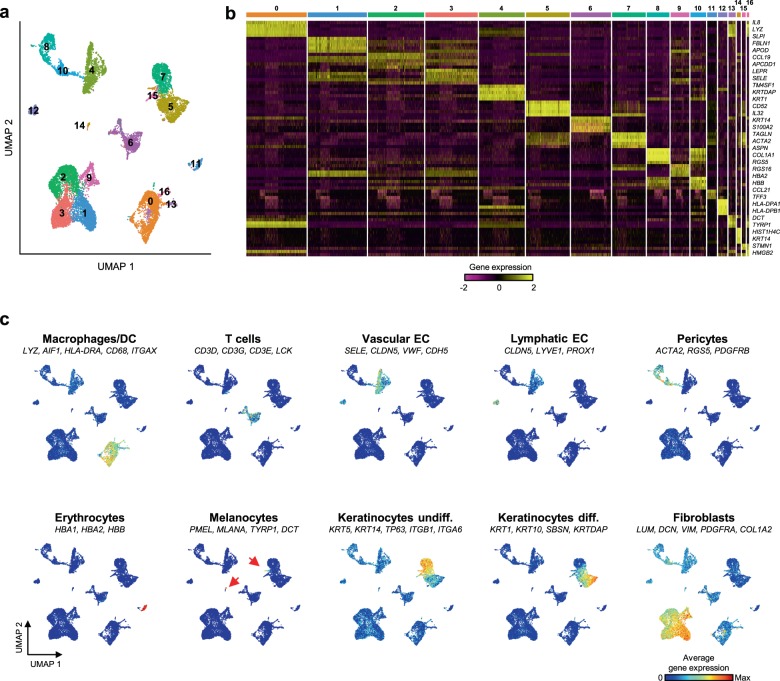
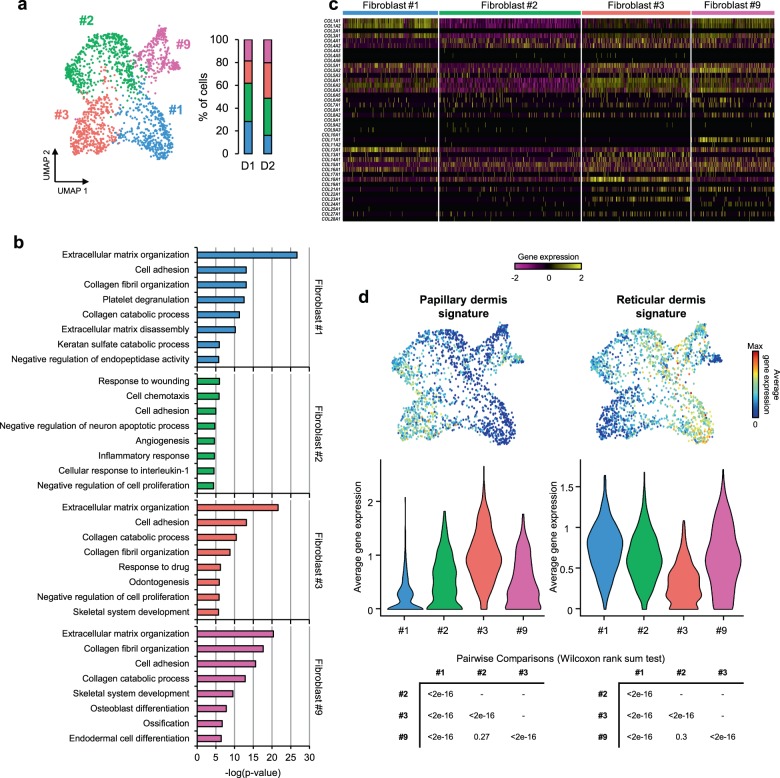
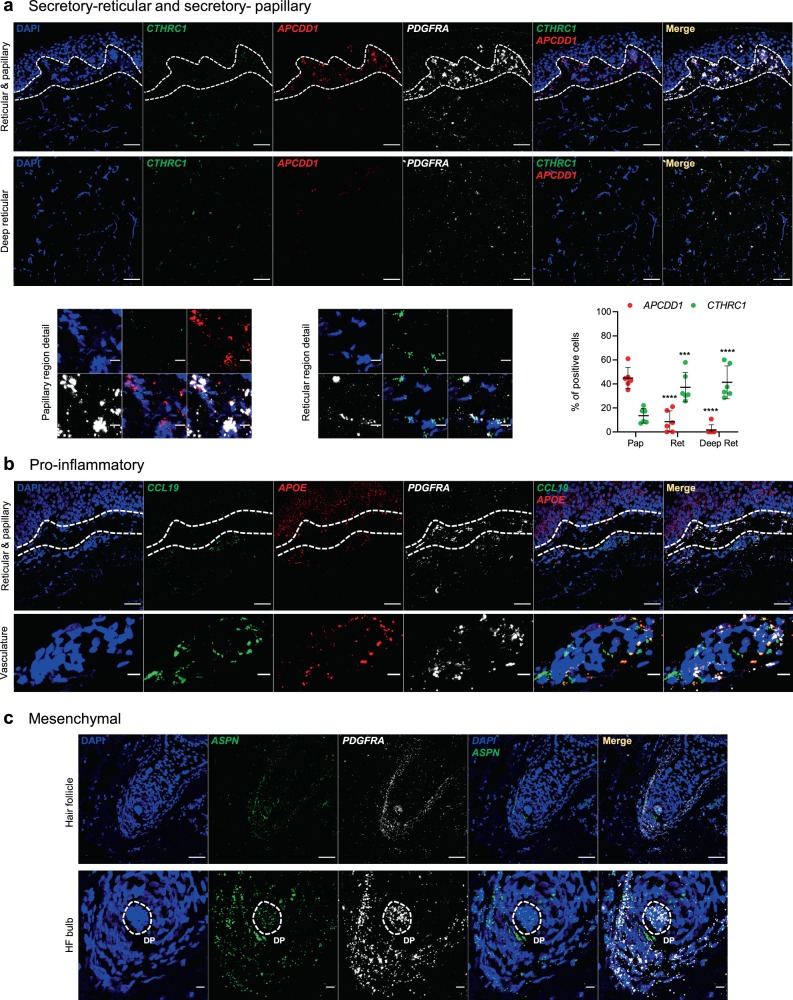
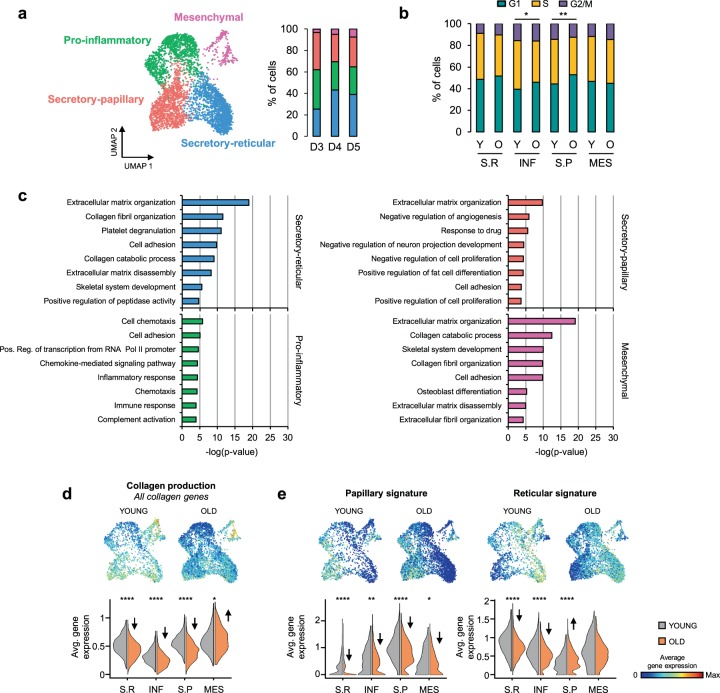
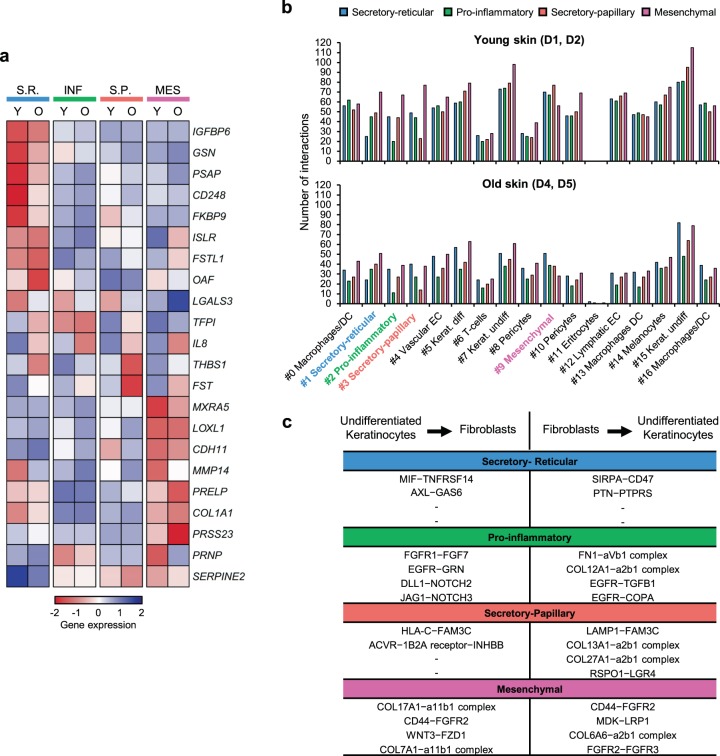
Fibroblasts are an essential cell population for human skin architecture and function. While fibroblast heterogeneity is well established, this phenomenon has not been analyzed systematically yet. We have used single-cell RNA sequencing to analyze the transcriptomes of more than 5,000 fibroblasts from a sun-protected area in healthy human donors. Our results define four main subpopulations that can be spatially localized and show differential secretory, mesenchymal and pro-inflammatory functional annotations. Importantly, we found that this fibroblast ‘priming’ becomes reduced with age. We also show that aging causes a substantial reduction in the predicted interactions between dermal fibroblasts and other skin cells, including undifferentiated keratinocytes at the dermal-epidermal junction. Our work thus provides evidence for a functional specialization of human dermal fibroblasts and identifies the partial loss of cellular identity as an important age-related change in the human dermis. These findings have important implications for understanding human skin aging and its associated phenotypes.
Overview
The claims and statistics of this paper haven’t been checked yet.
Free: it reads the open-access text and checks the first 5 claims that cite a source we can check. Create a free account to check every claim.
Integrity signals
Registry
Cites
Statistics
Figures
Verification
Claims the paper makes
The claims and statistics of this paper haven’t been checked yet.
Free: it reads the open-access text and checks the first 5 claims that cite a source we can check. Create a free account to check every claim.
Claims other papers make about this one
Each is checked against this paper’s own text: does it say what the citing paper says it does?
The source backs part of the claim, not all of it — or backs it for a different population, condition or comparison.
In the citing paper
“human epidermis is more heterogeneous than previously thought.”
From Single-cell transcriptomics of human-skin-equivalent organoids (2023) · cites this paper as [26]
Experimental — accuracy not yet measuredThe cited source says what the claim attributes to it.
In the citing paper
“We independently confirmed these findings using another human skin dataset (Solé-Boldo et al, 2020) (Fig. EV10E–J).”
From Distinct senotypes in p16- and p21-positive cells across human and mouse aging tissues (2025) · cites this paper as Solé-Boldo et al, 2020
In the citing paper
“Keratinocytes and fibroblasts can be further divided into different subtypes.”
From Guidelines for minimal information on cellular senescence experimentation in vivo (2024) · cites this paper as [58]
In the citing paper
“Keratinocytes display different properties across different strata of the epidermis”
From Guidelines for minimal information on cellular senescence experimentation in vivo (2024) · cites this paper as [58]
In the citing paper
“fibroblasts present not only papillary and reticular phenotypes, but also heterogeneous populations if studied at the single-cell level58,59.”
From Guidelines for minimal information on cellular senescence experimentation in vivo (2024) · cites this paper as [58]
Self-check
Percentages, sums and reported differences re-computed from the paper’s own numbers.
The self-check needs the paper’s full text.
Citations
Cites
R: A Language and Environment for Statistical Computing
R Core Team (2025) · doi:10.32614/r.manuals · Cited by 352,181
Fiji: an open-source platform for biological-image analysis
Schindelin, J., Arganda-Carreras, I., Frise, E., Kaynig, V., Longair, M., Pietzsch, T., Preibisch, S., Rueden, C., Saalfeld, S., Schmid, B., et al. (2012) · Nature Methods · doi:10.1038/nmeth.2019 · Cited by 66,890
Highly parallel genome-wide expression profiling of individual cells using nanoliter droplets.
Macosko, E. Z., Basu, A., Satija, R., Nemesh, J., Shekhar, K., Goldman, M., Tirosh, I., Bialas, A. R., Kamitaki, N., Martersteck, E. M., et al. (2015) · Cell · doi:10.1016/j.cell.2015.05.002 · Cited by 7,110
Spatial reconstruction of single-cell gene expression data
Satija, R., Farrell, J. A., Gennert, D., Schier, A. F., & Regev, A. (2015) · Nature Biotechnology · doi:10.1038/nbt.3192 · Cited by 7,055
Dimensionality reduction for visualizing single-cell data using UMAP
Becht, E., McInnes, L., Healy, J., Dutertre, C.-A., Kwok, I. W. H., Ng, L. G., Ginhoux, F., & Newell, E. W. (2019) · Nature Biotechnology · doi:10.1038/nbt.4314 · Cited by 5,358
Single-cell reconstruction of the early maternal–fetal interface in humans
Vento-Tormo, R., Efremova, M., Botting, R. A., Turco, M. Y., Vento-Tormo, M., Meyer, K. B., Park, J.-E., Stephenson, E., Polański, K., Goncalves, A., et al. (2018) · Nature · doi:10.1038/s41586-018-0698-6 · Cited by 2,358
The Technology and Biology of Single-Cell RNA Sequencing
Kolodziejczyk, A. A., Kim, J. K., Svensson, V., Marioni, J. C., & Teichmann, S. A. (2015) · Molecular Cell · doi:10.1016/j.molcel.2015.04.005 · Cited by 1,487
The human keratins: biology and pathology
Moll, R., Divo, M., & Langbein, L. (2008) · Histochemistry and Cell Biology · doi:10.1007/s00418-008-0435-6 · Cited by 1,465
Keratinocyte–Fibroblast Interactions in Wound Healing
Werner, S., Krieg, T., & Smola, H. (2007) · Journal of Investigative Dermatology · doi:10.1038/sj.jid.5700786 · Cited by 1,276
Fibroblasts in fibrosis: novel roles and mediators
Kendall, R. T., & Feghali-Bostwick, C. A. (2014) · Frontiers in Pharmacology · doi:10.3389/fphar.2014.00123 · Cited by 1,082
Cited by
Items 601–603 of 603
Yan, Y., Yan, G., Cao, Z., Wang, B., Zeng, Q., Shi, L., Chang, Q., Chen, C., Zhang, L., Liao, C., et al. (2023) · doi:10.3389/fimmu.2023.1183709.s001
Gong, T., Wang, Y., Dong, S., Ma, X., Du, D., Zou, C., Zheng, Q., & Wen, Z. (2022) · doi:10.3389/fmed.2022.1000324.s004
Dube, C. T., Ong, Y. H. B., Wemyss, K., Krishnan, S., Tan, T. J., Janela, B., Grainger, J. R., Ronshaugen, M., Mace, K. A., & Lim, C. Y. (2022) · doi:10.3389/fimmu.2022.943159.s001
Metadata
- Authors
- Solé-Boldo, L., Raddatz, G., Schütz, S., Mallm, J.-P., Rippe, K., Lonsdorf, A. S., Rodríguez-Paredes, M., & Lyko, F.
- Affiliations
- German Cancer Research Center (DE)
- Heidelberg University (DE)
- Corresponding author
- Lyko, Frank
- ORCID
- Venue
- Communications Biology
- Published
- 2020-04-23
- Volume
- 3
- Issue
- 1
- Pages
- 188-188
- ISSN
- 2399-3642 (ISSN-L)
- PMC
- PMC7181753
- OpenAlex
- W3020212197
- Cited by
- 559
- References
- 70
- Citations by year
- 2026: 102 · 2025: 107 · 2024: 92 · 2023: 90 · 2022: 96 · 2021: 45 · 2020: 24
- FWCI
- 21.39
- Type
- journal article
- Language
- en
- Open access
- gold
- doi.org
- Licence
- cc-by
- creativecommons.org/licenses/by/4.0 (tdm)
- creativecommons.org/licenses/by/4.0 (vor)
- Locations
- Communications Biology (publishedVersion, cc-by)
- bioRxiv (Cold Spring Harbor Laboratory) (acceptedVersion)
- PubMed Central (publishedVersion, cc-by)
- PubMed (publishedVersion)
- Funders
- Helmholtz Association (ZT0026)
- Topics
- Life Sciences › Biochemistry, Genetics and Molecular Biology › Molecular Biology › Single-cell and spatial transcriptomics
- Health Sciences › Medicine › Dermatology › Skin Protection and Aging
- Life Sciences › Biochemistry, Genetics and Molecular Biology › Cell Biology › Skin and Cellular Biology Research
- Keywords
- dermal fibroblasts, skin aging, fibroblast heterogeneity, fibroblast subpopulations, basement membrane zone, keratinocytes, extracellular matrix secretion
- MeSH terms
- RNA-Seq, Adult, Age Factors, Aged, Aged, 80 and over, Cell Communication, Female, Fibroblasts, Humans, Male, Middle Aged, Phenotype, Skin, Skin Aging, Cellular Senescence, Gene Expression Profiling, Single-Cell Analysis, Transcriptome
About these checks
Registry, retraction, Cites and statistics results are computed, not judged, with one exception: a printed reference that no index lists is read once by a model before it counts as a citation error. Claims are extracted by a model and kept only when their quote appears verbatim in the text; each cited source is then checked, with a model’s help, for whether it says what the claim relies on. Those verdicts can be wrong — read the claim’s quote and the cited source before relying on one.
Statistics and arithmetic are recomputed, not judged.
Confidence bands are shown only for fields calibrated on our annotated test set. None is calibrated yet, so no band is shown.
What counts as a claim ›How we measure confidence ›How we check this ›
Are you an author, or do you see a problem with this page? Request a review
Data sources
Bibliographic data: Semantic Scholar, OpenAlex, Crossref.
Contains information from the Semantic Scholar Academic Graph Datasets, made available under the ODC Attribution License (ODC-BY 1.0).
Semantic Scholar’s data is described in: Kinney, R., et al. (2023). The Semantic Scholar Open Data Platform. arXiv:2301.10140.
