

The brain and its time: intrinsic neural timescales are key for input processing
Open accessThe DOI matches its Crossref record; 138 of the 139 references it cites were found in a registry or an index.
Abstract
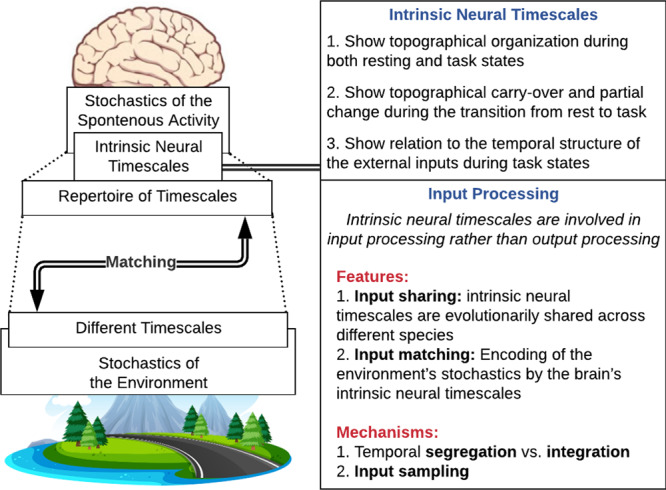
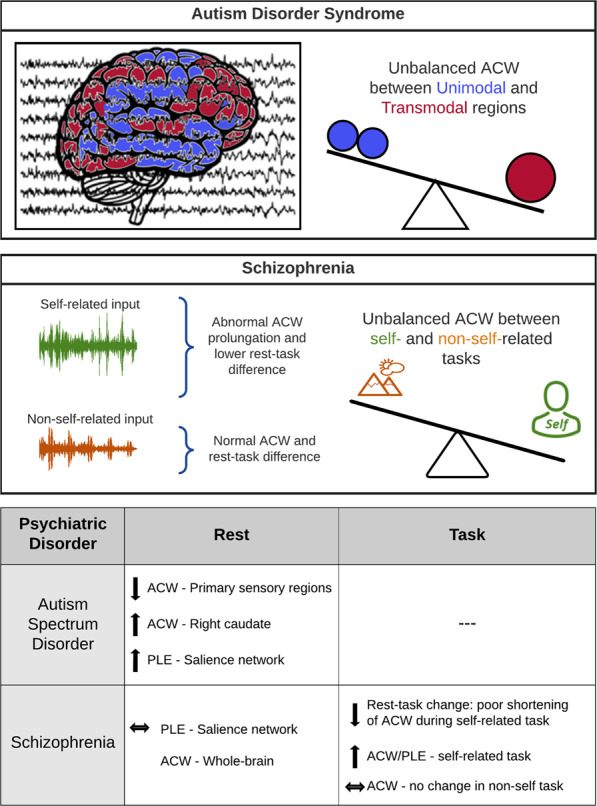
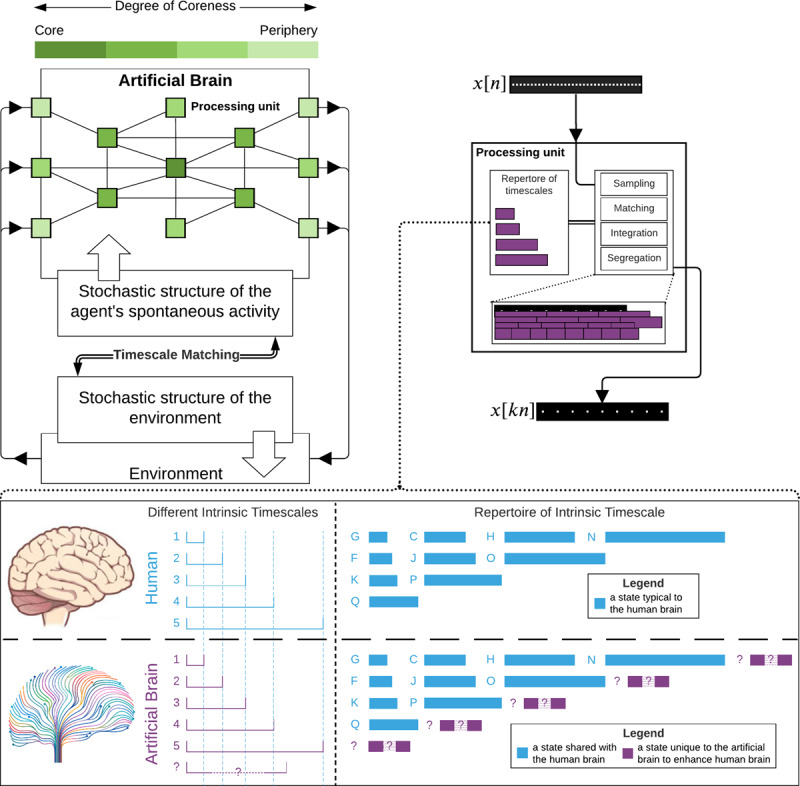
We process and integrate multiple timescales into one meaningful whole. Recent evidence suggests that the brain displays a complex multiscale temporal organization. Different regions exhibit different timescales as described by the concept of intrinsic neural timescales (INT); however, their function and neural mechanisms remains unclear. We review recent literature on INT and propose that they are key for input processing. Specifically, they are shared across different species, i.e., input sharing. This suggests a role of INT in encoding inputs through matching the inputs’ stochastics with the ongoing temporal statistics of the brain’s neural activity, i.e., input encoding. Following simulation and empirical data, we point out input integration versus segregation and input sampling as key temporal mechanisms of input processing. This deeply grounds the brain within its environmental and evolutionary context. It carries major implications in understanding mental features and psychiatric disorders, as well as going beyond the brain in integrating timescales into artificial intelligence.
Overview
The claims and statistics of this paper haven’t been checked yet.
Free: it reads the open-access text and checks the first 5 claims that cite a source we can check. Create a free account to check every claim.
Integrity signals
Registry
Cites
Statistics
Figures
Verification
Claims the paper makes
The claims and statistics of this paper haven’t been checked yet.
Free: it reads the open-access text and checks the first 5 claims that cite a source we can check. Create a free account to check every claim.
Claims other papers make about this one
Each is checked against this paper’s own text: does it say what the citing paper says it does?
The source backs part of the claim, not all of it — or backs it for a different population, condition or comparison.
In the citing paper
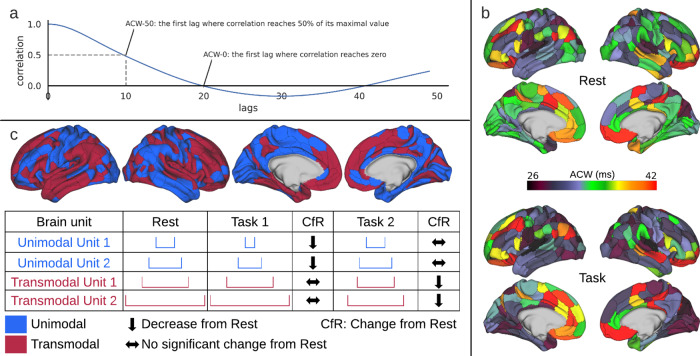
“The ACW is the correlation between a signal and a time-lagged version of itself and represents the stability of a signal.15”
From Altered spatiotemporal brain dynamics of interoception in behavioural-variant frontotemporal dementia (2025) · cites this paper as [15]
Experimental — accuracy not yet measuredIn the citing paper
“One way to directly measure intrinsic neural timescales is via autocorrelation windows (ACW).15”
From Altered spatiotemporal brain dynamics of interoception in behavioural-variant frontotemporal dementia (2025) · cites this paper as [15]
In the citing paper
“Additionally, in the current work we focused on the time-domain of INT,15 in line with previous works.35,70”
From Altered spatiotemporal brain dynamics of interoception in behavioural-variant frontotemporal dementia (2025) · cites this paper as [15]
Self-check
Percentages, sums and reported differences re-computed from the paper’s own numbers.
The self-check needs the paper’s full text.
Citations
Cites
A default mode of brain function
Raichle, M. E., MacLeod, A. M., Snyder, A. Z., Powers, W. J., Gusnard, D. A., & Shulman, G. L. (2001) · Proceedings of the National Academy of Sciences · doi:10.1073/pnas.98.2.676 · Cited by 12,190
Communication in the presence of noise
Shannon, C. E. (1949) · Proceedings of the IRE · doi:10.1109/jrproc.1949.232969 · Cited by 6,539
Buzsáki, G. (2006) · doi:10.1093/acprof:oso/9780195301069.001.0001 · Cited by 4,873
Communication In The Presence Of Noise
Shannon, C. E. (1998) · Proceedings of the IEEE · doi:10.1109/jproc.1998.659497 · Cited by 4,804
Self-referential processing in our brain—A meta-analysis of imaging studies on the self
Northoff, G., Heinzel, A., de Greck, M., Bermpohl, F., Dobrowolny, H., & Panksepp, J. (2006) · NeuroImage · doi:10.1016/j.neuroimage.2005.12.002 · Cited by 2,792
Self-citationMulti-task connectivity reveals flexible hubs for adaptive task control
Cole, M. W., Reynolds, J. R., Power, J. D., Repovs, G., Anticevic, A., & Braver, T. S. (2013) · Nature Neuroscience · doi:10.1038/nn.3470 · Cited by 1,704
The future of memory: remembering, imagining, and the brain
Schacter, D. L., Addis, D. R., Hassabis, D., Martin, V. C., Spreng, R. N., & Szpunar, K. K. (2012) · Neuron · doi:10.1016/j.neuron.2012.11.001 · Cited by 1,398
Mind-wandering as spontaneous thought: a dynamic framework
Christoff, K., Irving, Z. C., Fox, K. C. R., Spreng, R. N., & Andrews-Hanna, J. R. (2016) · Nature Reviews Neuroscience · doi:10.1038/nrn.2016.113 · Cited by 1,376
Jansen, B. H., & Rit, V. G. (1995) · Biological Cybernetics · doi:10.1007/bf00199471 · Cited by 1,159
A hierarchy of intrinsic timescales across primate cortex
Murray, J. D., Bernacchia, A., Freedman, D. J., Romo, R., Wallis, J. D., Cai, X., Padoa-Schioppa, C., Pasternak, T., Seo, H., Lee, D., et al. (2014) · Nature Neuroscience · doi:10.1038/nn.3862 · Cited by 990
Research works printed but not linked: 4
- Northoff, G. Unlocking the Brain (Oxford, 2014) https://doi.org/10.1093/ acprof:oso/9780199826995.001.0001. · doi:10.1093/acprof:oso/9780199826995.001.0001
- Zilio, F. et al. Are intrinsic neural timescales related to sensory processing? Evidence from abnormal behavioral states. NeuroImage 226, 117579, https:// doi.org/10.1016/j.neuroimage.2020.117579Get (2021). · doi:10.1016/j.neuroimage.2020.117579get
- Stephens, G. J., Honey, C. J. & Hasson, U. A place for time: the spatiotemporal structure of neural dynamics during natural audition. J. Neurophysiol. 110, 2019-2026 (2013). · DOI · Paper page
- Oppenheim, A. V. Signals, Systems and Interference (Pearson, 2016).
Cited by
Items 201–241 of 241
Intrinsic neural timescales during working memory under 60-day simulated microgravityPreprint
Zhou, L., Wang, R., Liu, X., Wu, D., Liu, Z., Sun, X., Chen, B., & Wu, Y. (2026) · Research Square · doi:10.21203/rs.3.rs-10588590/v1
Wei, X., Zhou, X., Liu, X., Zang, Y., & Yu, Q. (2026) · Neural Networks · doi:10.1016/j.neunet.2026.108830
Parkes, L., Sydnor, V. J., Howell, A. M., France, J. M., Westbrook, A., & Larsen, B. (2026) · bioRxiv (Cold Spring Harbor Laboratory) · doi:10.64898/2026.10.21.760719
Schizophrenia: temporal imprecision in phase, time, and frequency domains
Kholghi, S., & Northoff, G. (2026) · Schizophrenia · doi:10.1038/s41537-026-00792-5
Self-citationIntrinsic and inside-out models of brain
Northoff, G. (2024) · Elsevier eBooks · doi:10.1016/b978-0-12-821935-5.00027-2
Self-citationDifferent Temporal Dynamics of Cognitive and Motor Components for Planning and Problem-SolvingPreprint
Ventura, B., Fogel, S. M., & Northoff, G. (2025) · SSRN Electronic Journal · doi:10.2139/ssrn.5258360
Self-citationEvolutionary Origins of Linguistic Prosody
Oderbolz, C., & Meyer, M. E. (2026) · Elsevier eBooks · doi:10.1016/b978-0-323-95504-1.01371-5
Yu, F.-L., He, Y.-Z., Hu, Z.-X., Zheng, Z.-L., & Huang, X. (2026) · Brain Research · doi:10.1016/j.brainres.2026.150304
Brain—global synchronization and its topography
Northoff, G. (2024) · Elsevier eBooks · doi:10.1016/b978-0-12-821935-5.00025-9
Self-citationInfra-Slow Neural Oscillations: A Gateway to Understanding Cognition and Brain Aging
Ao, Y. (2026) · uO Research (University of Ottawa) · doi:10.20381/ruor-32178
Strock, A., Nghiem, T.-A. E., Trouvain, N., Mistry, P. K., Hinaut, X., & Menon, V. (2025) · bioRxiv (Cold Spring Harbor Laboratory) · doi:10.1101/2025.11.06.687057
Liu, X., He, Y., Li, L., Hu, Z., Li, H., Wu, L., Zhang, L., Su, Z., Liu, H., Wu, G., et al. (2026) · BMC Psychiatry · doi:10.1186/s12888-026-08477-0
Persistent decisions in mice and primates across experimental settings
Laurie, V.-J. (2025) · doi:10.71781/439
Kagan, B. J., Zhou, J., Habibollahi, F., & Baccetti, V. (2026) · arXiv (Cornell University) · doi:10.48550/arxiv.2610.11142
Gui, S.-G., Hu, Z.-X., He, Y.-Z., Huang, X., & Chen, H.-Y. (2026) · Brain Research · doi:10.1016/j.brainres.2026.150483
Hirsch, F., Wohlschläger, A., & München, T. U. (2024) · mediaTUM (Technical University of Munich)
From Heterogeneity to Function: Enhanced Modular Dynamic Range in Hierarchical Brain NetworksPreprint
Torres, F. V., Copelli, M., & Gollo, L. L. (2026) · arXiv (Cornell University) · doi:10.48550/arxiv.2610.32328
Hassan, G., Cuntis, I. D., Gaglioti, G., Furregoni, G., Focacci, E., Baglio, F., Bottari, D., Bernardi, G., Calcagno, A., Pietrini, P., et al. (2026) · bioRxiv (Cold Spring Harbor Laboratory) · doi:10.64898/2026.09.18.752597
Protocol for analyzing slow cortical dynamics in mouse neuronal recordings
Shymkiv, Y., & Yuste, R. (2026) · STAR Protocols · doi:10.1016/j.xpro.2026.104804
Temporal structure of task engagement reorganizes infra-slow BOLD dynamicsPreprint
Ao, Y., Chi, M., Çatal, Y., Huang, Z., Wang, C., Song, X. M., Liu, Z. Y., Zuo, X., Wang, Y., & Northoff, G. (2026) · bioRxiv (Cold Spring Harbor Laboratory) · doi:10.64898/2026.05.27.727996
Self-citationHuang, N., Wang, H., Triebkorn, P., Wheeler‐Kingshott, C. A. M. G., Jedyank, M., David, O., Destexhe, A., D'Angelo, E. U., Pedersen, N. P., & Jirsa, V. (2026) · bioRxiv (Cold Spring Harbor Laboratory) · doi:10.64898/2026.06.16.732559
Hayashi, S., & 林, シ. (2026) · Institutional Repositories DataBase (IRDB) · doi:10.15102/0002001099
Solomon, A., Yu, W., Rasero, J., & Zhang, A. (2026) · Research Square · doi:10.21203/rs.3.rs-8765879/v1
Altered flow of information in temporal lobe epilepsy
Keshmiri, S., Wang, S., & Kühn, B. (2026) · Neurobiology of Disease · doi:10.1016/j.nbd.2026.107370
Nenning, K., Zengin, E., Xu, T., Freund, E., Markowitz, N., Johnson, S., Bonelli, S. B., Franco, A. R., Colcombe, S. J., Milham, M. P., et al. (2026) · bioRxiv (Cold Spring Harbor Laboratory) · doi:10.64898/2026.04.15.718821
FSM-net: Dual-path signal classification with learned frequency decomposition
Liu, J., Qiu, W., & Wu, Z. (2026) · Signal Image and Video Processing · doi:10.1007/s11760-026-05562-5
Zou, Q., Zhang, L., Hua, S., Gan, P., 鄭如惠, Jin, T., & Guo, X. (2026) · Advanced Functional Materials · doi:10.1002/adfm.78728
Yamaki, N., & Churiki, T. (2026) · Psychiatry Research Neuroimaging · doi:10.1016/j.pscychresns.2026.112359
33rd Annual Computational Neuroscience Meeting: CNS*2024
Aristimunha, B., Moreau, T., Chevallier, S., Camargo, R. Y. D., & Corsi, M. (2025) · Journal of Computational Neuroscience · doi:10.1007/s10827-024-00889-9
Pousa, I. A. (2026) · Tesis Doctorals en Xarxa (Consorci de Serveis Universitaris de Catalunya)
Temporal Dynamics at the Neurobehavioral Interface: In Search of a Common Currency
Chuipka, N. (2024) · Carleton University's Institutional Repository (MacOdrum Library, Carleton University) · doi:10.22215/etd/2024-16206
It's About Time - Dynamics Link Breathing and Behaviour
Goheen, J. C. (2025) · Carleton University's Institutional Repository (MacOdrum Library, Carleton University) · doi:10.22215/etd/2025-16696
Neural Timescale of Adolescents Major Depressive DisorderPreprint
Liu, X. Y., Fan, T., Han, Y., Wang, S., Yu, Q., Wei, H., Gao, Y., Liu, G., Guo, X., Liu, L., et al. (2026) · Research Square · doi:10.21203/rs.3.rs-9807065/v1
Person-specific intrinsic-timescale topographies persist from rest into sentence processingPreprint
Giovanni, D. A. D., Toivonen, I., & Northoff, G. (2026) · bioRxiv (Cold Spring Harbor Laboratory) · doi:10.64898/2026.09.28.755139
Self-citationGil-Rodrigo, S., López-Martín, R., Yener, G., Wiersema, J. R., Güntekin, B., & Zanin, M. (2024) · arXiv (Cornell University) · doi:10.48550/arxiv.2411.01522
Fan, L., An, S., Li, Y., Li, Y., Wu, Y., Yao, N., Zhu, Q., Guo, D., Yao, D., Zhang, M., et al. (2026) · Translational Psychiatry · doi:10.1038/s41398-026-04387-7
Wei, W., Liu, L., Dai, R., Zhan, W., Zhan, Z., Hu, H., Chen, D., Feng, X., Ye, J., 李汝聪, et al. (2026) · Brain Sciences · doi:10.3390/brainsci16111230
Cognition-Inspired Dual-Stream Semantic Enhancement for Vision-Based Dynamic Emotion Modeling
Wang, H., Zhou, Z., Tao, Z., Li, A. L., Zhao, Y., Lin, Y., Wang, Y., & Zhang, W. (2026) · Proceedings - IEEE International Conference on Robotics and Automation/Proceedings · doi:10.1109/icra57385.2026.11697075
Laswick, Z., Lifer, A., Beaumont, C., Hayoun, L., Cavassin, P., Hamid, Z., Meli, D., Dupont, W., Lauhon, L. J., McCulloch, I. A., et al. (2026) · Advanced Materials · doi:10.1002/adma.75538
Resolving the backbone of multiscale interactions through mutual information ratesPreprint
Raiola, A., Nicoletti, G., & Busiello, D. M. (2026) · arXiv (Cornell University) · doi:10.48550/arxiv.2611.12554
Metadata
- Authors
- Golesorkhi, M., Gomez-Pilar, J., Zilio, F., Berberian, N., Wolff, A., Yagoub, M. C. E., & Northoff, G.
- Affiliations
- University of Ottawa (CA)
- University of Padua (IT)
- Corresponding author
- Northoff, Georg
- ORCID
- Venue
- Communications Biology
- Published
- 2021-08-16
- Volume
- 4
- Issue
- 1
- Pages
- 970-970
- ISSN
- 2399-3642 (ISSN-L)
- PMC
- PMC8368044
- OpenAlex
- W3193752863
- Cited by
- 198
- References
- 139
- Citations by year
- 2026: 41 · 2025: 51 · 2024: 48 · 2023: 35 · 2022: 20 · 2021: 3
- FWCI
- 3.88
- Type
- journal article
- Language
- en
- Open access
- gold
- doi.org
- Licence
- cc-by
- creativecommons.org/licenses/by/4.0 (tdm)
- creativecommons.org/licenses/by/4.0 (vor)
- Locations
- Communications Biology (publishedVersion, cc-by)
- PubMed Central (publishedVersion, cc-by)
- PubMed (publishedVersion)
- Padua Research Archive (University of Padova) (submittedVersion, cc-by)
- DOAJ (DOAJ: Directory of Open Access Journals) (submittedVersion, cc-by-sa)
- Minerva Access (University of Melbourne) (submittedVersion, cc-by)
- Funders
- Wellcome Trust (088130/Z/09/Z)
- European Commission (HORIZON2020, 785907)
- Canadian Institutes of Health Research (ES/T01279X/1)
- Natural Sciences and Engineering Research Council of Canada
- Economic and Social Research Council (ES/T01279X/1)
- Topics
- Life Sciences › Neuroscience › Cognitive Neuroscience › Neural dynamics and brain function
- Life Sciences › Neuroscience › Cognitive Neuroscience › Functional Brain Connectivity Studies
- Life Sciences › Neuroscience › Cognitive Neuroscience › Memory and Neural Mechanisms
- Keywords
- intrinsic neural timescales, input processing, input encoding, cross-species comparison, mental illness, artificial intelligence
- MeSH terms
- Cognitive Neuroscience, Brain, Humans, Nerve Net, Neural Pathways, Computational Biology
About these checks
Registry, retraction, Cites and statistics results are computed, not judged, with one exception: a printed reference that no index lists is read once by a model before it counts as a citation error. Claims are extracted by a model and kept only when their quote appears verbatim in the text; each cited source is then checked, with a model’s help, for whether it says what the claim relies on. Those verdicts can be wrong — read the claim’s quote and the cited source before relying on one.
Statistics and arithmetic are recomputed, not judged.
Confidence bands are shown only for fields calibrated on our annotated test set. None is calibrated yet, so no band is shown.
What counts as a claim ›How we measure confidence ›How we check this ›
Are you an author, or do you see a problem with this page? Request a review
Data sources
Bibliographic data: Semantic Scholar, OpenAlex, Crossref.
Contains information from the Semantic Scholar Academic Graph Datasets, made available under the ODC Attribution License (ODC-BY 1.0).
Semantic Scholar’s data is described in: Kinney, R., et al. (2023). The Semantic Scholar Open Data Platform. arXiv:2301.10140.
