

Real-time synthesis of imagined speech processes from minimally invasive recordings of neural activity
Open accessPublished version of a preprint
The DOI matches its Crossref record; 60 of the 60 references it cites were found in a registry or an index.
Abstract
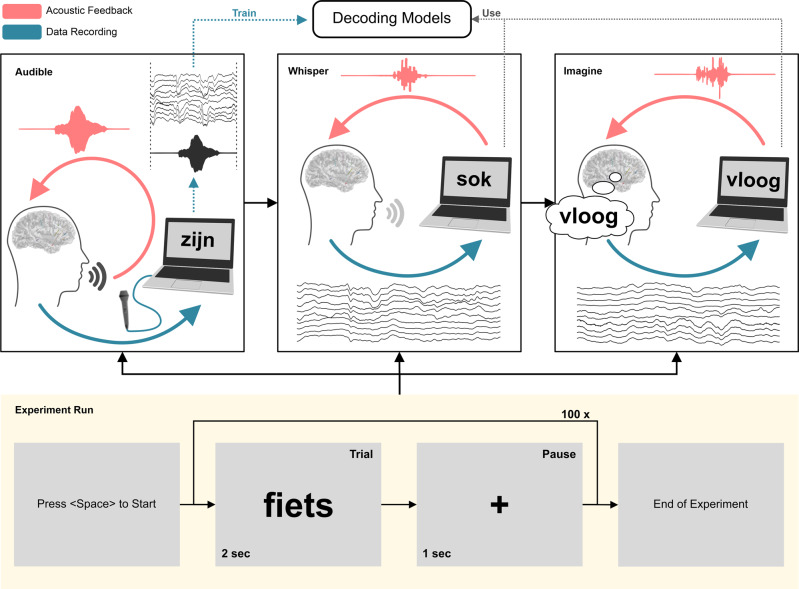
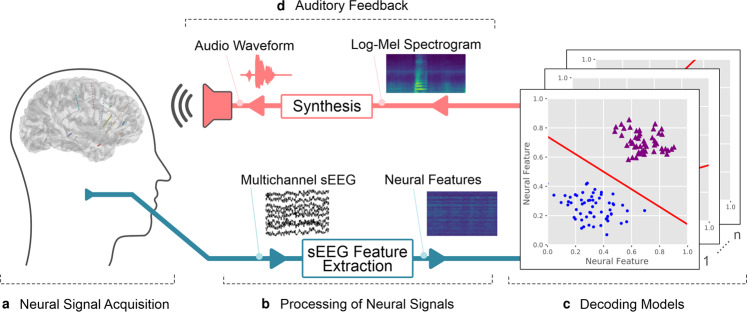
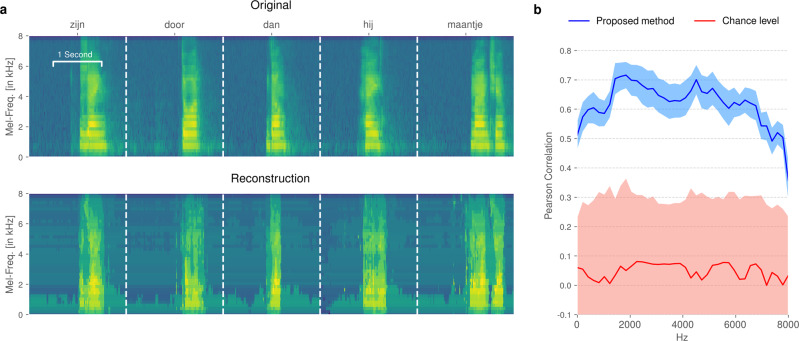
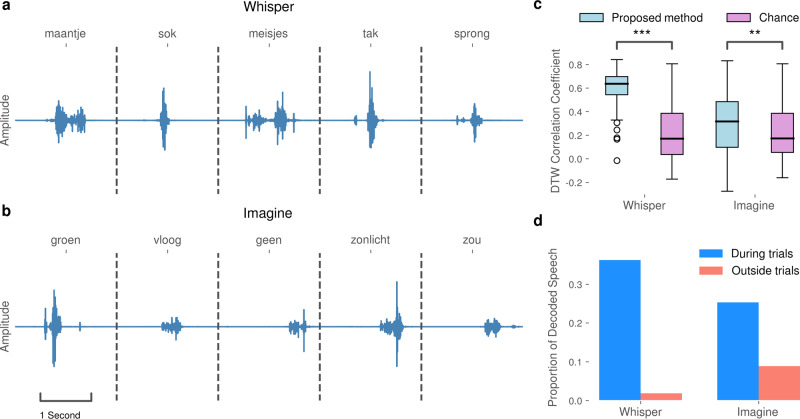
Speech neuroprosthetics aim to provide a natural communication channel to individuals who are unable to speak due to physical or neurological impairments. Real-time synthesis of acoustic speech directly from measured neural activity could enable natural conversations and notably improve quality of life, particularly for individuals who have severely limited means of communication. Recent advances in decoding approaches have led to high quality reconstructions of acoustic speech from invasively measured neural activity. However, most prior research utilizes data collected during open-loop experiments of articulated speech, which might not directly translate to imagined speech processes. Here, we present an approach that synthesizes audible speech in real-time for both imagined and whispered speech conditions. Using a participant implanted with stereotactic depth electrodes, we were able to reliably generate audible speech in real-time. The decoding models rely predominately on frontal activity suggesting that speech processes have similar representations when vocalized, whispered, or imagined. While reconstructed audio is not yet intelligible, our real-time synthesis approach represents an essential step towards investigating how patients will learn to operate a closed-loop speech neuroprosthesis based on imagined speech.
Overview
The claims and statistics of this paper haven’t been checked yet.
Free: it reads the open-access text and checks the first 5 claims that cite a source we can check. Create a free account to check every claim.
Integrity signals
Registry
Cites
Statistics
Figures
Verification
Claims the paper makes
The claims and statistics of this paper haven’t been checked yet.
Free: it reads the open-access text and checks the first 5 claims that cite a source we can check. Create a free account to check every claim.
Claims other papers make about this one
Each is checked against this paper’s own text: does it say what the citing paper says it does?
The source backs part of the claim, not all of it — or backs it for a different population, condition or comparison.
In the citing paper
“Neuroprosthetic studies using electrocorticography (ECoG) have shown that inner speech can be decoded from particular regions of the cortex but differ in their conclusions about which regions contribute45,49–51.”
From Inner speech in motor cortex and implications for speech neuroprostheses (2025) · cites this paper as [51]
Experimental — accuracy not yet measuredThe source backs part of the claim, not all of it — or backs it for a different population, condition or comparison.
In the citing paper
“Studies on inner speech have also shown overlapping mechanisms between attempted and inner speech production 34,45,49–52.”
From Inner speech in motor cortex and implications for speech neuroprostheses (2025) · cites this paper as [51]
Experimental — accuracy not yet measured
Self-check
Percentages, sums and reported differences re-computed from the paper’s own numbers.
The self-check needs the paper’s full text.
Citations
Cites
Scikit-learn: Machine Learning in Python
Pedregosa, F., Varoquaux, G., Gramfort, A., Michel, V., Thirion, B., Grisel, O., Blondel, M., Müller, A., Nothman, J., Louppe, G., et al. (2012) · arXiv · doi:10.48550/arxiv.1201.0490 · Cited by 71,016
Fischl, B. (2012) · NeuroImage · doi:10.1016/j.neuroimage.2012.01.021 · Cited by 9,526
The cortical organization of speech processing
Hickok, G., & Poeppel, D. (2007) · Nature Reviews Neuroscience · doi:10.1038/nrn2113 · Cited by 5,495
Kaldi Speech Recognition Toolkit
Povey, D. (2024) · Infoscience (Ecole Polytechnique Fédérale de Lausanne) · doi:10.57702/jb3fvbn9 · Cited by 4,609
Automatically Parcellating the Human Cerebral Cortex
Fischl, B. (2004) · Cerebral Cortex · doi:10.1093/cercor/bhg087 · Cited by 4,253
Reach and grasp by people with tetraplegia using a neurally controlled robotic arm
Hochberg, L. R., Bacher, D., Jarosiewicz, B., Masse, N. Y., Simeral, J. D., Vogel, J., Haddadin, S., Liu, J., Cash, S. S., van der Smagt, P., et al. (2012) · Nature · doi:10.1038/nature11076 · Cited by 2,719
An Algorithm for Intelligibility Prediction of Time–Frequency Weighted Noisy Speech
Taal, C. H., Hendriks, R. C., Heusdens, R., & Jensen, J. (2011) · IEEE Transactions on Audio, Speech, and Language Processing · doi:10.1109/tasl.2011.2114881 · Cited by 2,254
Signal estimation from modified short-time Fourier transform
Griffin, D., & Lim, J. (1984) · IEEE Transactions on Acoustics, Speech, and Signal Processing · doi:10.1109/tassp.1984.1164317 · Cited by 2,095
Toward accurate dynamic time warping in linear time and space
Salvador, S., & Chan, P. (2007) · Intelligent Data Analysis · doi:10.3233/ida-2007-11508 · Cited by 1,705
Deep brain stimulation: current challenges and future directions
Lozano, A. M., Lipsman, N., Bergman, H., Brown, P., Chabardes, S., Chang, J. W., Matthews, K., McIntyre, C. C., Schlaepfer, T. E., Schulder, M., et al. (2019) · Nature Reviews Neurology · doi:10.1038/s41582-018-0128-2 · Cited by 1,450
Research works printed but not linked: 1
- 20. Kothe, C. Lab streaming layer (LSL). https://github.com/sccn/labstreaminglayer. 26, 2015 (2014).
Cited by
Items 101–132 of 132
Learning discrete neural latent spaces for high-performance speech decoding
Jia, Y., Lian, Q., Wang, L., Wang, Y., & Qi, Y. (2025) · Journal of Neural Engineering · doi:10.1088/1741-2552/ae2ccd · Cited by 1
Using Artificial Intelligence Systems in Modern Neurobehavioral Research
Apukhtin, K. V., Zolotova, A. E., Leunenko, A. O., Perfilova, V. N., & Kalueff, A. V. (2025) · Journal of Evolutionary Biochemistry and Physiology · doi:10.1134/s0022093025060080 · Cited by 1
Word classification across speech modes from low-density electrocorticography signals
de Borman, A., Dyck, B. V., Rooy, K. V., Carrette, E., Meurs, A., Roost, D. V., & Hulle, M. M. V. (2026) · Journal of Neural Engineering · doi:10.1088/1741-2552/ae3a1b · Cited by 1
Subject-Independent Imagined Speech Detection via Cross-Subject Generalization and Calibration
Ko, B.-K., Kim, S.-W., & Lee, S.-H. (2026) · International Winter Conference on Brain-Computer Interface (BCI) · doi:10.1109/bci69045.2026.11435045 · Cited by 3
Feng, C., Zhang, E., Jia, Y., Zhu, Z., Zhu, J., Wu, D., & Xu, K. (2026) · Frontiers in Neuroscience · doi:10.3389/fnins.2026.1816455 · Cited by 1
Melby, S. R., Kumar, J. N. A., Bigus, E. R., & Kellis, S. (2026) · Frontiers in Human Neuroscience · doi:10.3389/fnhum.2026.1771146 · Cited by 1
Meyer, L. M., & Zamani, M. (2026) · Journal of Neural Engineering · doi:10.1088/1741-2552/ae6dfd · Cited by 1
Temporally structured motor and auditory representations in covert syllable production
Orpella, J., Mantegna, F., Oderbolz, C., Assaneo, M. F., & Poeppel, D. (2026) · Proceedings of the National Academy of Sciences · doi:10.1073/pnas.2536563123 · Cited by 1
Reconstruction of speech spectrogram based on non-invasive EEG signal
Zhou, D., Unoki, M., Zhang, G., & Dang, J. (2022) · International Symposium on Chinese Spoken Language Processing (ISCSLP) · doi:10.1109/iscslp57327.2022.10038234 · Cited by 2
An Interpretable and Generalizable Speech Detector Based on a CNN-LSTM Framework
Wan, Z., Wu, Y., Ticha, M. B. B., Godais, G. L., Kahane, P., Chabardès, S., Chen, W., Zhang, S., & Yvert, B. (2024) · IEEE International Conference on Acoustics Speech and Signal Processing · doi:10.1109/icassp48485.2024.10445835 · Cited by 2
Speech Sensitivity Analysis of Spatially Distributed Brain Areas Using Stereotactic EEG
Ivucic, D., Dexheimer, M. G., Soroush, P. Z., Riès, S., Shih, J. J., Krusienski, D. J., & Schultz, T. (2024) · Annual International Conference of the IEEE Engineering in Medicine and Biology Society (EMBC) · doi:10.1109/embc53108.2024.10782208 · Cited by 1
Self-citationKomeiji, S., Shigemi, K., Mitsuhashi, T., Iimura, Y., Suzuki, H., Sugano, H., Shinoda, K., Yatabe, K., & Tanaka, T. (2024) · bioRxiv (Cold Spring Harbor Laboratory) · doi:10.1101/2024.08.21.608927 · Cited by 2
Semantic-Aware Decoding of Covert Inner Speech: A Multimodal EEG–EMG–Audio FrameworkPreprint
Ahmadi, H., Santamaría-Vázquez, E., Mesin, L., & Hornero, R. (2026) · Research Square · doi:10.21203/rs.3.rs-9365678/v1 · Cited by 1
(2022) · Sprache · Stimme · Gehör · doi:10.1055/a-1666-7303
Feasibility of decoding covert speech in ECoG with a Transformer trained on overt speechPreprint
Komeiji, S., Mitsuhashi, T., Iimura, Y., Suzuki, H., Sugano, H., Shinoda, K., & Tanaka, T. (2024) · Research Square · doi:10.21203/rs.3.rs-3927907/v1
Roussel, P., Bocquelet, F., Chabardès, S., & Yvert, B. (2024) · bioRxiv (Cold Spring Harbor Laboratory) · doi:10.1101/2024.03.21.586130 · Cited by 1
Cortical dynamics underlying vocal production in freely moving minipigs
Lion, M. (2023) · theses.fr (ABES) · doi:10.70675/1d929a0fz5730z4303z8880z74f4fd54522c
Lee, H., Hwang, J., Kim, K., Lee, G., Chung, C. K., & Im, C. (2025) · Machine Learning with Applications · doi:10.1016/j.mlwa.2025.100805
A beszéd artikulációs mozgásának predikciója agyi jel alapján – kezdeti eredmények
Csapó, T. G., Arthur, F. V., Nagy, P., & Boncz, Á. (2023) · Repository of the Academy's Library (Library of the Hungarian Academy of Sciences) · Cited by 3
Ticha, M. B. B., Ran, X., Saldanha, G., Godais, G. L., Roussel, P., Aubert, M., Fontanell, A., Costecalde, T., Struber, L., Karakas, S., et al. (2025) · arXiv (Cornell University) · doi:10.48550/arxiv.2512.04618
Soft Multiaxial Strain Mapping Interface with AI-Driven Decoding for Silent Speech in Noise
Hong, S., Yoo, J., & Park, S. (2026) · Cyborg and Bionic Systems · doi:10.34133/cbsystems.0536 · Cited by 1
Lightweight Diffusion-based Framework for Online Imagined Speech Decoding in Aphasia
Ko, E., Kim, S.-W., & Jo, H.-N. (2026) · International Winter Conference on Brain-Computer Interface (BCI) · doi:10.1109/bci69045.2026.11435091
Cross‑modal diffusion for region‑aligned vocal tract MRI synthesis
Pérez-Toro, P. A., Arias‐Vergara, T., Buess, L., Hutter, J. M., Woo, J., & Maier, A. (2026) · SPIE Medical Imaging: Imaging Informatics for Healthcare, Research, and Applications · doi:10.1117/12.3087986
Analysis of cortical activity for the development of brain-computer interfaces for speech
Roussel, P. (2021) · theses.fr (ABES) · doi:10.70675/809449c4z0d5az4ed2zb815z6c2c02ce8521 · Cited by 1
Reconstruction of overt speech from Electrocorticographic (ECoG) data using deep neural networks
Ticha, M. B. B. (2025) · theses.fr (ABES) · doi:10.70675/12c589a0z38bdz4a87zbe17zc60eac7a3e60
Lee, S., Lee, S.-H., & Lee, S. (2026) · Expert Systems with Applications · doi:10.1016/j.eswa.2026.132526
Synthesizing vocal tract magnetic resonance imaging sequences with phoneme-aware diffusion models
Pérez-Toro, P. A., Arias‐Vergara, T., Buess, L., Hutter, J., Woo, J., & Maier, A. (2026) · Journal of medical imaging · doi:10.1117/1.jmi.13.s1.s11206
Wang, R., Zhang, X., Peng, D., Ma, D., Cai, S., & Li, H. (2026) · Lecture notes in computer science · doi:10.1007/978-981-95-9578-5_7
Rani, S., & Sherly, E. (2026) · Elsevier eBooks · doi:10.1016/b978-0-443-41594-4.00001-0
A stereoencephalography study of internal speech
Naumov, A. V., Soghoyan, G. A., Makarova, A. V., Syrov, N., Skripnikov, A. A., Kustov, Y. V., Sufianov, A. A., & Lebedev, M. A. (2026) · Cognitive Neurodynamics · doi:10.1007/s11571-026-10554-9
Semantic-aware decoding of covert inner speech: A multimodal EEG–EMG–audio framework
Ahmadi, H., Santamaría-Vázquez, E., Mesin, L., & Hornero, R. (2026) · Biomedical Signal Processing and Control · doi:10.1016/j.bspc.2026.111527
季荣, & 李星星 (2026) · 临床诊断与治疗杂志 · doi:10.62177/fcdt.v2i5.1774
Metadata
- Authors
- Angrick, M., Ottenhoff, M. C., Diener, L., Ivucic, D., Ivucic, G., Goulis, S., Saal, J., Colon, A. J., Wagner, L., Krusienski, D. J., Kubben, P. L., Schultz, T., & Herff, C.
- Affiliations
- University of Bremen (DE)
- Maastricht University (NL)
- Maastricht University Medical Centre (NL)
- Virginia Commonwealth University (US)
- Corresponding author
- Angrick, Miguel
- Herff, Christian
- ORCID
- Venue
- Communications Biology
- Published
- 2021-09-23
- Volume
- 4
- Issue
- 1
- Pages
- 1055-1055
- ISSN
- 2399-3642 (ISSN-L)
- PMC
- PMC8460739
- OpenAlex
- W3198923947
- Cited by
- 125
- References
- 60
- Citations by year
- 2026: 17 · 2025: 32 · 2024: 21 · 2023: 24 · 2022: 26 · 2021: 5
- FWCI
- 9.99
- Type
- journal article
- Language
- en
- Open access
- gold
- doi.org
- Licence
- cc-by
- creativecommons.org/licenses/by/4.0 (tdm)
- creativecommons.org/licenses/by/4.0 (vor)
- Locations
- Communications Biology (publishedVersion, cc-by)
- bioRxiv (Cold Spring Harbor Laboratory) (acceptedVersion)
- PubMed Central (publishedVersion, cc-by)
- PubMed (publishedVersion)
- Research Publications (Maastricht University) (publishedVersion, cc-by)
- DOAJ (DOAJ: Directory of Open Access Journals) (submittedVersion, cc-by-sa)
- Research Publications (Maastricht University) (submittedVersion, other-oa)
- Funders
- Bundesministerium für Bildung und Forschung (01GQ1602)
- National Science Foundation (1902395, 2011595)
- Nederlandse Organisatie voor Wetenschappelijk Onderzoek (VI.Veni.194.02)
- Topics
- Life Sciences › Neuroscience › Cognitive Neuroscience › EEG and Brain-Computer Interfaces
- Physical Sciences › Computer Science › Artificial Intelligence › Speech Recognition and Synthesis
- Life Sciences › Neuroscience › Cellular and Molecular Neuroscience › Neuroscience and Neural Engineering
- Keywords
- imagined speech, whispered speech, real-time speech synthesis, neural decoding, depth electrodes, speech motor control
- MeSH terms
- Electrodes, Implanted, Female, Humans, Quality of Life, Speech, Young Adult, Neural Prostheses, Brain-Computer Interfaces
About these checks
Registry, retraction, Cites and statistics results are computed, not judged, with one exception: a printed reference that no index lists is read once by a model before it counts as a citation error. Claims are extracted by a model and kept only when their quote appears verbatim in the text; each cited source is then checked, with a model’s help, for whether it says what the claim relies on. Those verdicts can be wrong — read the claim’s quote and the cited source before relying on one.
Statistics and arithmetic are recomputed, not judged.
Confidence bands are shown only for fields calibrated on our annotated test set. None is calibrated yet, so no band is shown.
What counts as a claim ›How we measure confidence ›How we check this ›
Are you an author, or do you see a problem with this page? Request a review
Data sources
Bibliographic data: Semantic Scholar, OpenAlex, Crossref.
Contains information from the Semantic Scholar Academic Graph Datasets, made available under the ODC Attribution License (ODC-BY 1.0).
Semantic Scholar’s data is described in: Kinney, R., et al. (2023). The Semantic Scholar Open Data Platform. arXiv:2301.10140.
