

Complex networks from classical to quantum
Open accessThe DOI matches its Crossref record; 112 of the 112 references it cites were found in a registry or an index; 142 of the 185 sources its claims cite were checked for support.
Abstract
Abstract Recent progress in applying complex network theory to problems in quantum information has resulted in a beneficial cross-over. Complex network methods have successfully been applied to transport and entanglement models while information physics is setting the stage for a theory of complex systems with quantum information-inspired methods. Novel quantum induced effects have been predicted in random graphs—where edges represent entangled links—and quantum computer algorithms have been proposed to offer enhancement for several network problems. Here we review the results at the cutting edge, pinpointing the similarities and the differences found at the intersection of these two fields.
Overview
CoChat Summary
TL;DR
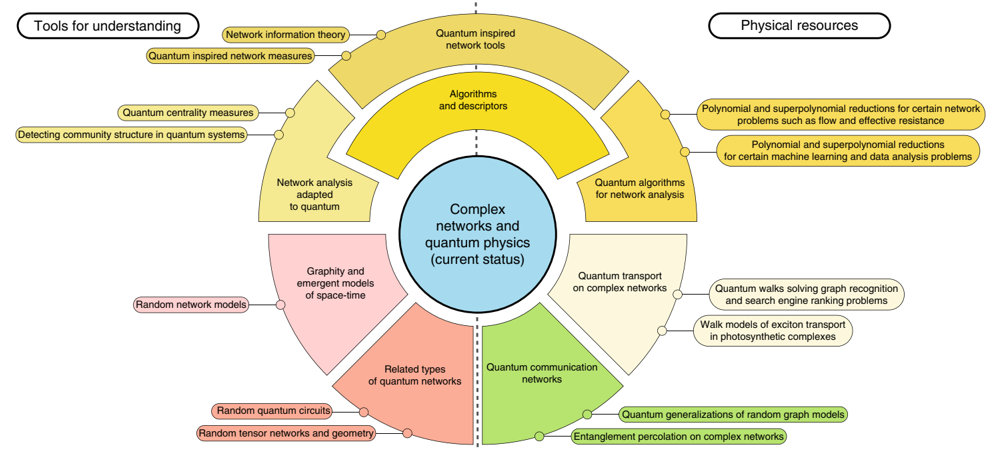
This review surveys the cross-pollination between complex network theory and quantum information science, focusing on quantum networks built from entangled states and on physically connected quantum systems. It argues that network information theory may provide a unified framework for classical and quantum networked systems.
Key findings
- Two main classes of quantum networks are reviewed: networks whose edges are entangled states, and networks of physically interconnected quantum systems such as atoms or superconducting circuits.
- In entanglement-based random graphs, replacing links with entangled pairs lets the probability of link existence map to entanglement; LOCC conversion succeeds with optimal probability \(p\), and for \(N \to \infty\) and \(z=-2\), a quantum state with the topology of any finite subgraph can be obtained with probability approaching unity.
- Quantum PageRank approaches resolve degeneracy issues in classical PageRank, enhance the importance of secondary hubs, and for certain values of \(\alpha\) exhibit faster convergence.
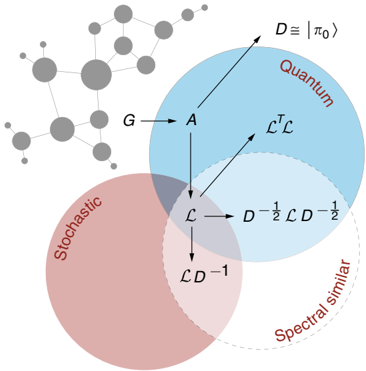
- Quantum walks on complex networks show key differences from stochastic walks: the stochastic and quantum generators are spectrally similar and share eigenvalues, with eigenvectors related by \(D^{-1/2}\), while a quantumness measure \(\varepsilon\) quantifies departure from classical occupation probabilities.
Methods
- Review article synthesizing prior theoretical, experimental, and computational work at the intersection of complex networks and quantum information.
- No dataset was generated or analyzed; the paper states “No data set were generated or analyzed during the current study.”
- The review is organized around entangled-state quantum networks, physically connected quantum networks, quantum walks and PageRank, and unified information-theoretic analyses of network complexity.
Limitations
- The authors state that they do not cover several topics, including quantum gravity theories based on complex networks, synchronization in and on quantum networks, quantum random circuits, classical spin models, and quantum statistics used in complex network theory.
- The authors state that the scale-free quantum network result is a toy model with theoretical predictions still to be verified experimentally, and that the interplay between structure and dynamics in quantum networks is almost entirely unclear.
- Evident from the text: as a narrative review, it does not report a systematic search strategy or inclusion criteria, and its coverage is explicitly selective rather than exhaustive.
Model-written summary. Check it against the paper before relying on it.
Integrity signals
Registry
Cites
Statistics
Figures
Verification
Claims the paper makes
76 Valid · 3 Not valid · 12 Not checked · 17 Own results and interpretations
The cited sources support only part of this claim — read each source’s verdict below.
In the paper
“Rapid experimental progress has pushed quantum computing and communication devices into truly data-intensive domains”
What the sources say
- Could not verifycites [6] 6. Acín, A., Cirac, J. I. & Lewenstein, M. Entanglement percolation in quantum networks. Nat. Phys. 3 , 256 -259 (2007). This paper discovers several properties of entanglement-based complex quantum networks . sourceExperimental — accuracy not yet measured
The Abstract discusses quantum-network protocols and describes quantum networks as a basis for future communication. It does not say that rapid experimental progress has moved quantum computing or communication devices into data-intensive domains; searches for experimental progress and data complexity found no passage addressing that claim. (LLM, conf=0.73)
- Not matchedcites [7] 7. Faccin, M., Johnson, T., Biamonte, J., Kais, S. & Migda ł , P. Degree distribution in quantum walks on complex networks. Phys. Rev. X 3 , 041007 (2013).
More than one paper fits this citation.
- Partly supportedcites [8] 8. Paparo, G. D. & Martin-Delgado, M. A. Google in a quantum network. Sci. Rep. 2 , 444 (2012). sourceExperimental — accuracy not yet measured
The Abstract (page unavailable) reports recent experimental progress and says modest quantum networks have been realized. It does not say that quantum computing and communication devices have entered data-intensive domains; instead, it says a scalable quantum computer is not yet available. The Discussion (page unavailable) says applying the proposed algorithm to very large networks remains future work. (LLM, conf=0.85)
- Could not verifycites [9] 9. Garnerone, S. Thermodynamic formalism for dissipative quantum walks. Phys. Rev. A 86 , 032342 (2012). sourceExperimental — accuracy not yet measured
The Introduction (p. 1) describes quantum walks as tools for quantum computation and discusses their use in complex networks, but it does not link experimental progress to data-intensive quantum computing or communication devices. Searches for experimental progress, data-intensive applications, and quantum communication found no passage addressing that claim. (LLM, conf=0.72)
- Not checked yetcites [10] 10. Paparo, G., Müller, M., Comellas, F. & Martin-Delgado, M. Quantum google algorithm. EPJ Plus 129 , 150 (2014). source
Checked before — its earlier verdict is held back until a new check runs.
- Partly supportedcites [11] 11. Sánchez-Burillo, E., Duch, J., Gómez-Gardeñes, J. & Zueco, D. Quantum navigation and ranking in complex networks. Sci. Rep. 2 , 650 (2012). sourceExperimental — accuracy not yet measured
The Discussion (page not available) says that as quantum-network nodes and connections increase, the quantum information community encounters complex network structures. It does not say that rapid experimental progress has already pushed quantum computing and communication devices into data-intensive domains; the paper describes its own quantum-navigation method as implementable without quantum hardware. (LLM, conf=0.79)
- Could not verifycites [12] 12. Lu, D. et al. Chiral Quantum Walks. Phys. Rev. A 93 , 0423902 (2016). This paper experimentally realizes chiral quantum walks (walks that direct transport modulated time-symmetry breaking as proposed in [65] . sourceExperimental — accuracy not yet measured
The Introduction describes emerging quantum technologies and a complex-network approach, while the Discussion reports a three-qubit experiment. Neither section says that rapid experimental progress has moved quantum computing or communication devices into data-intensive domains; searches for that claim and for a paradigm shift in complexity found no supporting passage in our copy. (LLM, conf=0.74)
- Could not verifycites [13] 13. Faccin, M., Migda ł , P., Johnson, T. H., Bergholm, V. & Biamonte, J. D. Community detection in quantum complex. Netw. Phys. Rev. X 4 , 041012 (2014). sourceExperimental — accuracy not yet measured
The Introduction says researchers are exploring quantum networks of increasing size, and the Discussion describes methods suitable for networks with thousands of nodes. Neither passage addresses rapid experimental progress in quantum computing or communication devices, or says those devices have entered data-intensive domains (searched those terms and paraphrases). (LLM, conf=0.74)
plainstates a cause- Asserted: passes — The authors put it forward as true.
- Checkable: passes — It can be checked against evidence.
- Load-bearing: passes — The paper’s conclusions depend on it.
- Based: passes — The paper gives a reason why it holds.
- Could not verify
The cited sources support only part of this claim — read each source’s verdict below.
In the paper
“quantum computer algorithms have been proposed to offer enhancement for several network problems”
What the sources say
- Partly supportedcites [8] 8. Paparo, G. D. & Martin-Delgado, M. A. Google in a quantum network. Sci. Rep. 2 , 444 (2012). sourceExperimental — accuracy not yet measured
The Abstract reports a quantum PageRank protocol that outperforms its classical counterpart for ranking web pages. But this is one network problem, not several, and the paper says its protocol is designed for a scenario in which no quantum computer is available. The Results section separately mentions a proposed quantum-computer approach to improving PageRank efficiency. (LLM, conf=0.85)
- Partly supportedcites [9] 9. Garnerone, S. Thermodynamic formalism for dissipative quantum walks. Phys. Rev. A 86 , 032342 (2012). sourceExperimental — accuracy not yet measured
The Introduction (p. 1) describes quantum walks as useful for algorithm design, and Section IV (p. 3) discusses a quantum analogue of PageRank, a network-ranking problem. These passages support a proposed quantum approach to a network problem, but do not establish enhancement for several network problems. (LLM, conf=0.78)
- Not checked yetcites [10] 10. Paparo, G., Müller, M., Comellas, F. & Martin-Delgado, M. Quantum google algorithm. EPJ Plus 129 , 150 (2014). source
Checked before — its earlier verdict is held back until a new check runs.
- Partly supportedcites [11] 11. Sánchez-Burillo, E., Duch, J., Gómez-Gardeñes, J. & Zueco, D. Quantum navigation and ranking in complex networks. Sci. Rep. 2 , 650 (2012). sourceExperimental — accuracy not yet measured
The Discussion (page not specified) reports that the proposed quantum navigation method improves network ranking, supporting the general idea of a quantum approach enhancing a network task. But it explicitly says the algorithm does not rely on a quantum implementation; our copy does not establish quantum-computer algorithms enhancing several network problems. (LLM, conf=0.86)
plainstates a possible cause- Asserted: passes — The authors put it forward as true.
- Checkable: passes — It can be checked against evidence.
- Load-bearing: unclear — It is unclear whether the paper’s conclusions depend on it.
- Based: passes — The paper gives a reason why it holds.
- Partly supported
The cited sources support only part of this claim — read each source’s verdict below.
In the paper
“Novel quantum induced effects have been predicted in random graphs -where edges represent entangled links”
What the sources say
- Partly supportedcites [6] 6. Acín, A., Cirac, J. I. & Lewenstein, M. Entanglement percolation in quantum networks. Nat. Phys. 3 , 256 -259 (2007). This paper discovers several properties of entanglement-based complex quantum networks . sourceExperimental — accuracy not yet measured
The paper’s Abstract (page unavailable) predicts novel entanglement-percolation effects in networks whose connected nodes share entangled states. But it specifies that the networks studied have regularly arranged nodes, including lattices; it does not describe the underlying networks as random graphs. (LLM, conf=0.88)
plainstates a cause- Asserted: passes — The authors put it forward as true.
- Checkable: passes — It can be checked against evidence.
- Load-bearing: unclear — It is unclear whether the paper’s conclusions depend on it.
- Based: passes — The paper gives a reason why it holds.
- Partly supported
The cited sources that could be checked couldn’t confirm or dispute this claim.
In the paper
“The striking result is that it is possible to obtain, with probability approaching unity, a quantum state with the topology of any fi nite subgraph for N approaching in fi nity and z = -2.”
What the sources say
- Could not verifycites [6] 6. Acín, A., Cirac, J. I. & Lewenstein, M. Entanglement percolation in quantum networks. Nat. Phys. 3 , 256 -259 (2007). This paper discovers several properties of entanglement-based complex quantum networks . sourceExperimental — accuracy not yet measured
The paper discusses entanglement paths in two-dimensional lattices and says their probability can be unity in an infinite network (section labeled Abstract; page unavailable). Our copy does not address obtaining a quantum state with the topology of any finite subgraph, or a condition z = -2; searches for those terms and paraphrases found no such result. (LLM, conf=0.76)
hedgedstates a cause- Asserted: passes — The authors put it forward as true.
- Checkable: passes — It can be checked against evidence.
- Load-bearing: passes — The paper’s conclusions depend on it.
- Based: passes — The paper gives a reason why it holds.
- Could not verify
The cited sources support only part of this claim — read each source’s verdict below.
In the paper
“in the case of qubits, it has been shown that the probability of having an entangled path with in fi nite length -i.e., an in fi nite sequence of entangled states connecting an in fi nite number of qubits -is unity.”
What the sources say
- Partly supportedcites [6] 6. Acín, A., Cirac, J. I. & Lewenstein, M. Entanglement percolation in quantum networks. Nat. Phys. 3 , 256 -259 (2007). This paper discovers several properties of entanglement-based complex quantum networks . sourceExperimental — accuracy not yet measured
The passage labeled Abstract (page unavailable) says that, for two-dimensional lattices of qubits, the probability of an infinitely connected entangled path is unity over a continuous interval of entanglement values. The claim omits those conditions and presents the result as applying to qubits generally; the same passage says the probability is zero for product states. (LLM, conf=0.88)
boosted- Asserted: passes — The authors put it forward as true.
- Checkable: passes — It can be checked against evidence.
- Load-bearing: unclear — It is unclear whether the paper’s conclusions depend on it.
- Based: passes — The paper gives a reason why it holds.
- Partly supported
45 more claims · 37 with their cited sources checked
Create a free account to see all 108 claims and to verify the 22 references still open.
- It may state two separate claims as one. 27
- Probably not a substantial claim. 35
Self-check
Percentages, sums and reported differences re-computed from the paper’s own numbers.
Each contradiction between two passages listed here was confirmed by an independent check.
Rated minor: it would not touch a result — a value no result rests on, a p-value that stays on the same side of the significance level, or a conflict that is clerical, resolved elsewhere in the paper, or outside its own findings.
In the paper
§ Quantum networks based on entangled states · p. 3
“The probability scales with the size of the network following a power law p ∝ N -z , with z ≥ 0.”
§ Quantum networks based on entangled states · p. 3
“The striking result is that it is possible to obtain, with probability approaching unity, a quantum state with the topology of any fi nite subgraph for N approaching in fi nity and z = -2.”
Citations
Cites
Collective dynamics of ‘small-world’ networks
Watts, D. J., & Strogatz, S. H. (1998) · Nature · doi:10.1038/30918 · Cited by 43,060 · cited 2×
“Building on several fundamental discoveries [14, 15], complex network theory has demonstrated that many (non-quantum) systems exhibit similarities in their complex features [14–18], in the organization of their structure and dynamics [19–24], the controllability of their constituents [25] and their…”
Emergence of Scaling in Random Networks
Barabási, A.-L., & Albert, R. (1999) · Science · doi:10.1126/science.286.5439.509 · Cited by 36,135
Statistical mechanics of complex networks
Albert, R., & Barabási, A.-L. (2002) · Reviews of Modern Physics · doi:10.1103/revmodphys.74.47 · Cited by 20,471 · cited 1×
“Many real world networks have been found to follow a widely heterogeneous distribution of degree values [88].”
The Structure and Function of Complex Networks
Newman, M. E. J. (2003) · SIAM Review · doi:10.1137/s003614450342480 · Cited by 18,719 · cited 2×
“We refer to [16, 53] for reviews of network concepts and models.”
Fortunato, S. (2010) · Physics Reports · doi:10.1016/j.physrep.2009.11.002 · Cited by 11,293 · cited 1×
“Community detection, and in general mesoscopic structure detection, has been widely studied in the literature of classical complex networks [90, 91].”
Complex networks: structure and dynamics
BOCCALETTI, S., LATORA, V, MORENO, Y., CHAVEZ, M., & HWANG, D. (2006) · Physics Reports · doi:10.1016/j.physrep.2005.10.009 · Cited by 11,010
Error and attack tolerance of complex networks
Albert, R., Jeong, H., & Barabási, A.-L. (2000) · Nature · doi:10.1038/35019019 · Cited by 7,534 · cited 3×
“The development of quantum error correction techniques that make quantum computing and quantum communication possible can not prescind from the study of ‘system resilience’, a topic that found uncountable applications in classical network science [26, 28, 31, 98, 99].”
Kimble, H. J. (2008) · Nature · doi:10.1038/nature07127 · Cited by 6,023 · cited 2×
“…that are natural for classical systems, such as targeted attacks of network hubs [26] or cascade-based attacks [100], still have no clear quantum counterpart and their study, from both theoretical and experimental perspectives, will play a key role in the development of a quantum Internet [5].”
The Theory of Open Quantum Systems
Breuer, H.-P., & Petruccione, F. (2007) · doi:10.1093/acprof:oso/9780199213900.001.0001 · Cited by 5,938
Approximate entropy as a measure of system complexity.
Pincus, S. M. (1991) · Proceedings of the National Academy of Sciences · doi:10.1073/pnas.88.6.2297 · Cited by 5,811
Cited by
Signal propagation in complex networks
Ji, P., Ye, J., Mu, Y., Lin, W., Tian, Y., Hens, C., Perc, M., Tang, Y., Sun, J., & Kurths, J. (2023) · Physics Reports · doi:10.1016/j.physrep.2023.03.005 · Cited by 360
Quantum walk and its application domains: A systematic review
Kadian, K., Garhwal, S., & Kumar, A. (2021) · Computer Science Review · doi:10.1016/j.cosrev.2021.100419 · Cited by 204
Complex systems in the spotlight: next steps after the 2021 Nobel Prize in Physics
Bianconi, G., Arenas, À., Biamonte, J., Carr, L. D., Kahng, B., Kertész, J., Kurths, J., Lü, L., Masoller, C., Motter, A. E., et al. (2023) · Journal of Physics Complexity · doi:10.1088/2632-072x/ac7f75 · Cited by 126
Self-citationMachine intelligence in non-invasive endocrine cancer diagnostics
Thomasian, N. M., Kamel, I. R., & Bai, H. X. (2021) · Nature Reviews Endocrinology · doi:10.1038/s41574-021-00543-9 · Cited by 66
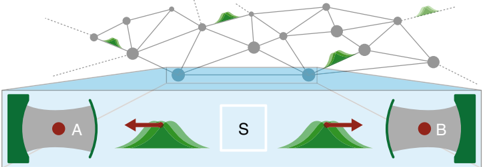
“Previous studies 177,178 depicted quantum networks as two nodes with the cutout region between nodes illustrating the induction of dependent quantum states among two particles (A and B, where S refers to a shared source of squeezed light) and this particle ‘entanglement’ is at the crux of quantum…”
BackgroundIdentifying key players in complex networks via network entanglement
Huang, Y., Wang, H., Ren, X.-L., & Lü, L. (2024) · Communications Physics · doi:10.1038/s42005-023-01483-8 · Cited by 57
“A cutting-edge research direction in complex networks is the integration of quantum information theory 15,16 .”
Deterministic Microwave-Optical Transduction Based on Quantum Teleportation
Wu, J., Cui, C., Fan, L., & Zhuang, Q. (2021) · Physical Review Applied · doi:10.1103/physrevapplied.16.064044 · Cited by 56
Artificial Intelligence Computing at the Quantum Level
Ayoade, O., Rivas, P., & Orduz, J. (2022) · Data · doi:10.3390/data7030028 · Cited by 58
“Despite the prevalent concept that quantum mechanics is limited to subatomic particles, predictions have been made that QM will solve computational difficulties in domains such as chemistry, physics, machine learning, and communication system security enhancement [5].”
BackgroundComplex quantum networks: a topical review
Nokkala, J., Piilo, J., & Bianconi, G. (2024) · Journal of Physics A Mathematical and Theoretical · doi:10.1088/1751-8121/ad41a6 · Cited by 74
Towards quantum advantage via topological data analysis
Gyurik, C., Cade, C., & Dunjko, V. (2022) · Quantum · doi:10.22331/q-2022-11-10-855 · Cited by 101
“Recently, several quantum information-inspired entropic measures for complex network analysis have been proposed [60, 61].”
BackgroundExploring complex graphs using three-dimensional quantum walks of correlated photons
Ehrhardt, M., Keil, R., Maczewsky, L. J., Dittel, C., Heinrich, M., & Szameit, A. (2021) · Science Advances · doi:10.1126/sciadv.abc5266 · Cited by 42
“Despite the comparably miniscule number of nodes, discrete quantum systems face a similar challenge: Complex network topologies with a high degree of connectivity allow for potent applications (4) such as efficient multipartite quantum communication (5) or search algorithms (6, 7), but the physical implementation of s…”
BackgroundThe topological Dirac equation of networks and simplicial complexes
Bianconi, G. (2021) · Journal of Physics Complexity · doi:10.1088/2632-072x/ac19be · Cited by 79
“An important question is whether topology can also be explored to investigate the properties of quantum complex networks [24].”
BackgroundComplex networks with complex weights
Böttcher, L., & Porter, M. A. (2024) · Physical review. E · doi:10.1103/physreve.109.024314 · Cited by 65
“Network analysis has yielded insights into individual quantum systems, quantum networks that one can construct using entangled states or physically interconnected systems, and a variety of other quantum phenomena [70,71].”
BackgroundConcurrence Percolation in Quantum Networks
Meng, X., Gao, J., & Havlin, S. (2021) · Physical Review Letters · doi:10.1103/physrevlett.126.170501 · Cited by 55
Hansenne, K., Xu, Z., Kraft, T., & Gühne, O. (2022) · Nature Communications · doi:10.1038/s41467-022-28006-3 · Cited by 49
Multilayer Network Science: From Cells to Societies
Artime, O., Benigni, B., Bertagnolli, G., d’Andrea, V., Gallotti, R., Ghavasieh, A., Raimondo, S., & Domenico, M. D. (2022) · Cambridge University Press eBooks · doi:10.1017/9781009085809 · Cited by 47
Self-citationUnraveling the effects of multiscale network entanglement on empirical systems
Ghavasieh, A., Stella, M., Biamonte, J., & Domenico, M. D. (2021) · Communications Physics · doi:10.1038/s42005-021-00633-0 · Cited by 33
Self-citationFinite-Time Synchronization of Coupled Fractional-Order Systems via Intermittent IT-2 Fuzzy Control
Tang, R., Shi, P., Yang, X., et al. (2025) · IEEE Transactions on Systems Man and Cybernetics Systems · doi:10.1109/tsmc.2024.3518513 · Cited by 29
From classical to quantum walks with stochastic resetting on networks
Wald, S., & Böttcher, L. (2021) · Physical review. E · doi:10.1103/physreve.103.012122 · Cited by 42
The emergence of multiscale connectomics-based approaches in stroke recovery
Latifi, S., & Carmichael, S. T. (2024) · Trends in Neurosciences · doi:10.1016/j.tins.2024.01.003 · Cited by 30
Ghavasieh, A., Bontorin, S., Artime, O., Verstraete, N., & Domenico, M. D. (2021) · Communications Physics · doi:10.1038/s42005-021-00582-8 · Cited by 32
Self-citationControlled state reconstruction and quantum secret sharing
Singh, P., & Chakrabarty, I. (2024) · Physical Review A · doi:10.1103/physreva.109.032406 · Cited by 26
Multimode squeezed state for reconfigurable quantum networks at telecommunication wavelengths
Rodriguez, V. R., Fainsin, D., Zanin, G. L., Treps, N., Diamanti, E., & Parigi, V. (2024) · Physical Review Research · doi:10.1103/physrevresearch.6.043113 · Cited by 47
Quantum communication capacity transition of complex quantum networks
Zhuang, Q., & Zhang, B. (2021) · Physical Review A · doi:10.1103/physreva.104.022608 · Cited by 33
“Therefore, to unleash the full power of QI processing in distributed tasks, a quantum network (QN) [7–11] aiming at entanglement distribution and QI transmission is the key.”
BackgroundConcurrence percolation threshold of large-scale quantum networks
Malik, O., Meng, X., Havlin, S., Korniss, G., Szymanski, B. K., & Gao, J. (2022) · Communications Physics · doi:10.1038/s42005-022-00958-4 · Cited by 29
“T he application of network science to problems in quantum physics is a relatively new and rapidly developing fi eld 1 . represent Quantum networks, where the links between nodes entangled qubits 2 – 6 , are expected to form the basis of the quantum internet.”
BackgroundPairwise tomography networks for many-body quantum systems
García-Pérez, G., Rossi, M. A. C., Sokolov, B., Borrelli, E.-M., & Maniscalco, S. (2020) · Physical Review Research · doi:10.1103/physrevresearch.2.023393 · Cited by 39
“We are now more than ever in need of novel multi-disciplinary approaches, drawing on recent advances in complex network science, to tackle the formidable task of describing emergent and collective behaviour of quantum systems of increasing size and complexity [6].”
BackgroundTowards quantum computing based community detection
Akbar, S., & Saritha, S. K. (2020) · Computer Science Review · doi:10.1016/j.cosrev.2020.100313 · Cited by 27
Entanglement in highly symmetric multipartite quantum states
Burchardt, A., Czartowski, J., & Życzkowski, K. (2021) · Physical Review A · doi:10.1103/physreva.104.022426 · Cited by 28
“Implementation of such communication networks is expected to be developed in the near future [24, 29], with a variety of possible applications [30].”
BackgroundEntanglement-assisted capacity regions and protocol designs for quantum multiple-access channels
Shi, H., Hsieh, M.-H., Guha, S., Zhang, Z., & Zhuang, Q. (2021) · npj Quantum Information · doi:10.1038/s41534-021-00412-3 · Cited by 34
Identification of Network Topology Variations Based on Spectral Entropy
Su, H., Chen, D., Pan, G.-J., & Zeng, Z. (2021) · IEEE Transactions on Cybernetics · doi:10.1109/tcyb.2021.3070080 · Cited by 26
“This quantum-inspired framework provides a powerful basis to develop an information theory of complex networks, and it has been used to compare networks for several purposes [23], [24].”
BackgroundMethodAnalytical Methods for High-Rate Global Quantum Networks
Harney, C., & Pirandola, S. (2022) · PRX Quantum · doi:10.1103/prxquantum.3.010349 · Cited by 28
“Questions of network topology have been recently considered via the statistical study of complex, random quantum networks [5, 20, 21, 23], which reveal insightful phenomena associated with large-scale network properties.”
BackgroundPercolation Theories for Quantum Networks
Meng, X., Hu, X., Tian, Y., Dong, G., Lambiotte, R., Gao, J., & Havlin, S. (2023) · Entropy · doi:10.3390/e25111564 · Cited by 34
TensorFlow solver for quantum PageRank in large-scale networks
Tang, H. L., Shi, R., He, T.-S., Zhu, Y.-Y., Wang, T., Lee, M., & Jin, X. (2020) · 中国科学通报:英文版 · doi:10.1016/j.scib.2020.09.009 · Cited by 24
“Quantum stochastic walk [9,10] is a flexible blending of classical randomwalk and quantumwalk to have more complex matrix element transition options (see Fig.”
BackgroundEntanglement formation in continuous-variable random quantum networks
Zhang, B., & Zhuang, Q. (2021) · npj Quantum Information · doi:10.1038/s41534-021-00370-w · Cited by 27
Teleportation of quantum coherence
Sohail, S., Pati, A. K., Aradhya, V., Chakrabarty, I., & Patro, S. (2023) · Physical Review A · doi:10.1103/physreva.108.042620 · Cited by 26
Continuous-time quantum-walk spatial search on the Bollobás scale-free network
Osada, T., Coutinho, B. C., Omar, Y., Sanaka, K., Munro, W. J., & Nemoto, K. (2020) · Physical Review A · doi:10.1103/physreva.101.022310 · Cited by 21
Generalized network density matrices for analysis of multiscale functional diversity
Ghavasieh, A., & Domenico, M. D. (2023) · Physical review. E · doi:10.1103/physreve.107.044304 · Cited by 23
“[5, 6, 13, 36].”
Self-citationQuantivine: A Visualization Approach for Large-scale Quantum Circuit Representation and Analysis
Wen, Z., Liu, Y., Tan, S., Chen, J., Zhu, M., Han, D., Yin, J., Xu, M., & Chen, W. (2023) · IEEE Transactions on Visualization and Computer Graphics · doi:10.1109/tvcg.2023.3327148 · Cited by 29
“Besides, the network and graph theory is also applied to quantum circuit analysis [4, 33].”
MethodAtomic Quantum Technologies for Quantum Matter and Fundamental Physics Applications
Malo, J. Y., Lepori, L., Gentini, L., & Chiofalo, M. L. (2024) · Technologies · doi:10.3390/technologies12050064 · Cited by 32
Analytical evidence of nonlinearity in qubits and continuous-variable quantum reservoir computing
Mujal, P., Nokkala, J., Martínez‐Peña, R., Giorgi, G. L., Soriano, M. C., & Zambrini, R. (2021) · Journal of Physics Complexity · doi:10.1088/2632-072x/ac340e · Cited by 36
Wu, B., Zhang, Z., & Zhuang, Q. (2022) · Quantum Science and Technology · doi:10.1088/2058-9565/ac4f6b · Cited by 24
Deterministic entanglement distribution on series-parallel quantum networks
Meng, X., Cui, Y., Gao, J., Havlin, S., & Ruckenstein, A. E. (2023) · Physical Review Research · doi:10.1103/physrevresearch.5.013225 · Cited by 20
“A number of QN-based protocols have since been introduced, e.g., q -swapping [11] and path routing [12], combining communication protocols with network science [13].”
MethodThe mass of simple and higher-order networks
Bianconi, G. (2023) · Journal of Physics A Mathematical and Theoretical · doi:10.1088/1751-8121/ad0fb5 · Cited by 26
Complexity of life sciences in quantum and AI era
Pyrkov, A. N., Aliper, A., Bezrukov, D. S., Podolskiy, D. I., Ren, F., & Zhavoronkov, A. A. (2024) · Wiley Interdisciplinary Reviews Computational Molecular Science · doi:10.1002/wcms.1701 · Cited by 30
“It was shown that quantum computation methods allow us to analyze more complex network topologies in comparison with classical methods 164 and may pave the way to addressing nonscale-free networks.”
MethodMulti-particle quantum walks on 3D integrated photonic chip
Zhou, W.-H., Wang, X.-W., Ren, R.-J., Fu, Y.-X., Chang, Y.-J., Xu, X.-Y., Tang, H., & Jin, X.-M. (2024) · Light: Science & Applications · doi:10.1038/s41377-024-01627-7 · Cited by 16
“Complex graphs with a high degree of connectivity offer potential applications 37 , including the graph isomorphism problems 38 , quantum search algorithms 39,40 and multi-partite quantum communication 41 .”
BackgroundEmergent complex quantum networks in continuous-variables non-Gaussian states
Walschaers, M., Sundar, B., Treps, N., Carr, L. D., & Parigi, V. (2023) · Quantum Science and Technology · doi:10.1088/2058-9565/accdfd · Cited by 28
Quantum walks defined by digraphs and generalized Hermitian adjacency matrices
Kubota, S., Segawa, E., & Taniguchi, T. (2021) · Quantum Information Processing · doi:10.1007/s11128-021-03033-z · Cited by 18
Quantum Communication Networks for Energy Applications: Review and Perspective
Paudel, H. P., Crawford, S. E., Lee, Y., Shugayev, R., Leuenberger, M. N., Syamlal, M., Ohodnicki, P. R., Lu, P., Mollot, D., & Duan, Y. (2023) · Advanced Quantum Technologies · doi:10.1002/qute.202300096 · Cited by 32
Cooperation and synchronization in evolutionary opinion changing rate games
Huang, C., Luo, Y., & Han, W. (2023) · Chaos Solitons & Fractals · doi:10.1016/j.chaos.2023.113563 · Cited by 13
Dirac gauge theory for topological spinors in 3+1 dimensional networks
Bianconi, G. (2023) · Journal of Physics A Mathematical and Theoretical · doi:10.1088/1751-8121/acdc6a · Cited by 17
Complex quantum network models from spin clusters
Chepuri, R., & Kovács, I. A. (2023) · Communications Physics · doi:10.1038/s42005-023-01394-8 · Cited by 14
Highly clustered complex networks in the configuration model: Random regular small-world network
Jeong, W., Jang, H., & Yu, U. (2019) · Europhysics Letters (EPL) · doi:10.1209/0295-5075/128/16001 · Cited by 12
Continuous Variables Graph States Shaped as Complex Networks: Optimization and Manipulation
Sansavini, F., & Parigi, V. (2019) · Entropy · doi:10.3390/e22010026 · Cited by 17
Energy-dependent barren plateau in bosonic variational quantum circuits
Zhang, B., & Zhuang, Q. (2024) · Quantum Science and Technology · doi:10.1088/2058-9565/ad80bf · Cited by 22
Exploring Multiverses: Generative AI and Neuroaesthetic Perspectives
Forte, M. (2025) · Heritage · doi:10.3390/heritage8030102 · Cited by 14
“The idea of the multiverse—a concept suggesting the existence of multiple, parallel realities [16]—has traditionally been the domain of physics [17] and speculative fiction.”
Quantum internet under random breakdowns and intentional attacks
Zhang, B., & Zhuang, Q. (2021) · Quantum Science and Technology · doi:10.1088/2058-9565/ac1041 · Cited by 12
Structural Balance and Random Walks on Complex Networks with Complex Weights
Tian, Y., & Lambiotte, R. (2024) · SIAM Journal on Mathematics of Data Science · doi:10.1137/23m1584265 · Cited by 29
Cuadra, L., & Borge, J. C. N. (2021) · Nanomaterials · doi:10.3390/nano11020375 · Cited by 12
“More examples belonging to this first framework can be found in [62] and in the references therein.”
BackgroundKoponen, I. T. (2021) · Systems · doi:10.3390/systems9020022 · Cited by 9
Probing the spectral dimension of quantum network geometries
Nokkala, J., Piilo, J., & Bianconi, G. (2020) · Journal of Physics Complexity · doi:10.1088/2632-072x/abaf9b · Cited by 9
“During the recent years, network theory has also opened significant possibilities within the framework of quantum physics [4, 16].”
BackgroundNovo, L., & Ribeiro, S. (2021) · Physical Review A · doi:10.1103/physreva.103.042219 · Cited by 11
“More complicated highly connected networks have been considered in a variety of contexts, such as in models of energy transport in specific biological systems [18–20], in the analysis of quantum walks on complex networks [21, 22] or in spatial search algorithms [23–25].”
BackgroundQuantum mechanical model of information sharing in social networks
Rajesh Kumar., K., Kumari, S., & Bala, M. (2021) · Social Network Analysis and Mining · doi:10.1007/s13278-021-00741-3 · Cited by 12
“Apart from this, there is a paradigm shift from classical mechanics to quantum mechanics to explore the complex systems Biamonte et al. (2019).”
BackgroundModeling Small-Granularity Expressway Traffic Volumes With Quantum Walks
Yu, Z., Li, D., Hu, X. L., Zhou, X., Luo, W., Yuan, L., & Zhu, A. (2022) · IEEE Transactions on Intelligent Transportation Systems · doi:10.1109/tits.2022.3151262 · Cited by 10
“In quantum walk, when an observation is not available, the driver can choose any feasible node with different probabilities at the same time [27], [28].”
BackgroundRecruitment: A Problem of Entangled Temporal Parts
Caetano‐Anollés, G., Aziz, M. F., Mughal, F., Koç, İ., Caetano-Anollés, K., & Caetano-Anollés, D. (2022) · Frontiers in Bioscience-Landmark · doi:10.31083/j.fbl2704128 · Cited by 9
“In addition, complex network theory has been applied to problems in quantum physics and is setting the stage for a theory of complexity that uses quantum information-inspired methods [99].”
BackgroundSpatial search by continuous-time quantum walks on renormalized Internet networks
Malmi, J., Rossi, M. A. C., García-Pérez, G., & Maniscalco, S. (2022) · Physical Review Research · doi:10.1103/physrevresearch.4.043185 · Cited by 13
“They have recently received large attention from the quantum physics community [22], and in particular, they are studied in the context of CTQWs for coherent transport [23], for example in biological systems [24, 25], community detection [26], and link prediction [27].”
BackgroundRevisiting one-dimensional discrete-time quantum walks with general coin
Jayakody, M. N., Meena, C., & Pradhan, P. (2023) · Physics Open · doi:10.1016/j.physo.2023.100189 · Cited by 16
Impact of graph energy on a measurement of resilience for tipping points in complex systems
Edwards, C. M., Nilchiani, R., & Miller, I. M. (2024) · Systems Engineering · doi:10.1002/sys.21749 · Cited by 12
Wu, J., Fan, L., & Zhuang, Q. (2024) · Physical Review A · doi:10.1103/physreva.109.022619 · Cited by 9
Measuring dynamical systems on directed hypergraphs
Faccin, M. (2022) · Physical review. E · doi:10.1103/physreve.106.034306 · Cited by 13
“Another topic of interest for further studies is determining when this framework is applicable to non-linear dynamics such non-Markovian [35] dynamics or quantum mechanical systems [36, 37].”
BackgroundSelf-citationLightcone bounds for quantum circuit mapping via uncomplexity
Steinberg, M., Bandić, M., Szkudlarek, S., Almudéver, C. G., Sarkar, A., & Feld, S. (2024) · npj Quantum Information · doi:10.1038/s41534-024-00909-7 · Cited by 14
Emergent entanglement structures and self-similarity in quantum spin chains
Sokolov, B., Rossi, M. A. C., García-Pérez, G., & Maniscalco, S. (2022) · Philosophical Transactions of the Royal Society A Mathematical Physical and Engineering Sciences · doi:10.1098/rsta.2020.0421 · Cited by 15
Antipin, K. V. (2022) · Physics Letters A · doi:10.1016/j.physleta.2022.128248 · Cited by 7
Tian, Y., Kojaku, S., Sayama, H., & Lambiotte, R. (2025) · Physical Review Letters · doi:10.1103/jw1k-6s7w · Cited by 17
Multiscale Information Propagation in Emergent Functional Networks
Ghavasieh, A., & Domenico, M. D. (2021) · Entropy · doi:10.3390/e23101369 · Cited by 6
“Resolving the discussed issues related to the previous definitions, the network Gibbs state has been introduced [26,27,37] to quantify and compare the information content of complex networks.”
BackgroundSelf-citationMultinode State Transfer and Nonlocal State Preparation via a Unidirectional Quantum Network
Ai, H., Fang, Y.-Y., Feng, C.-R., Peng, Z., & Xiang, Z.-L. (2022) · Physical Review Applied · doi:10.1103/physrevapplied.17.054021 · Cited by 6
Analyzing the multi‐scale characteristic for online car‐hailing traffic volume with quantum walk
Hu, X. L., Niu, X., Qian, L., Pan, B., & Yu, Z. (2022) · IET Intelligent Transport Systems · doi:10.1049/itr2.12209 · Cited by 6
Koponen, I. T. (2020) · Systems · doi:10.3390/systems9010001 · Cited by 4
Modeling Random Exit Selection in Intercity Expressway Traffic with Quantum Walk
Li, D., Hu, X. L., Zhou, X., Luo, W., Zhu, A., & Yu, Z. (2022) · Applied Sciences · doi:10.3390/app12042139 · Cited by 5
Method for Measuring Resilience of Complex Systems Using Network Theory and Graph Energy
Edwards, C. M., Vierlboeck, M., Nilchiani, R., & Miller, I. M. (2024) · IEEE Open Journal of Systems Engineering · doi:10.1109/ojse.2024.3366939 · Cited by 5
“The research that has built on that work mostly includes investigating the practical application of Gao et al.’s methods, e.g., [43], [44], and [45], or comparing other methods or models for measuring large network stability or resilience, e.g., [46] and [47].”
MethodThermal state entanglement entropy on a quantum graph
Verga, A., & Elías, R. G. (2019) · Physical review. E · doi:10.1103/physreve.100.062137 · Cited by 6
Engineering Transport via Collisional Noise: A Toolbox for Biology Systems
Civolani, A., Stanzione, V., Chiofalo, M. L., & Malo, J. Y. (2023) · Entropy · doi:10.3390/e26010020 · Cited by 6
“Moreover, some of these applications have been more recently equipped with the toolbox of complex networks [35], creating a platform to study both the underlying microscopic transport phenomena together with the emergence of macroscopic properties, and leading to the development of a generalised…”
BackgroundLocating sources of Szegedy's quantum network
Wang, H., Hu, Z.-L., Shao, S., Zhang, F.-F., & Li, T. (2024) · Physical review. E · doi:10.1103/physreve.109.014311 · Cited by 4
Multiscale Field Theory for Network Flows
Mikaberidze, G., Artime, O., Díaz-Guilera, A., & D’Souza, R. M. (2025) · Physical Review X · doi:10.1103/physrevx.15.021044 · Cited by 3
Characterising heavy-tailed networks using q-generalised entropy and q-adjacency kernels
Koponen, I. T., Palmgren, E., & Keski-Vakkuri, E. (2020) · Physica A Statistical Mechanics and its Applications · doi:10.1016/j.physa.2020.125666 · Cited by 4
“However, taking the networks as holistic systems, that is, as connected sets of items, requires different approaches based on the description of the networks on macro-level [7,8].”
BackgroundMethodInfluentialPanyukov, S. (2023) · Polymer Science Series C · doi:10.1134/s1811238223700236 · Cited by 3
Bhattacharya, P., & Verma, A. (2025) · Elsevier eBooks · doi:10.1016/b978-0-443-29654-3.00012-0 · Cited by 4
Complex networks for random lasers and photonic computing
Tsarev, D. V., Zakharenko, P. V., & Alodjants, A. P. (2025) · Physical Review A · doi:10.1103/1mqj-61yh · Cited by 5
Unitary coined discrete-time quantum walks on directed multigraphs
Wing-Bocanegra, A., & Venegas-Andraca, S. E. (2023) · Quantum Information Processing · doi:10.1007/s11128-023-04004-2 · Cited by 4
“Webelieve ourwork could be especially useful to extent the applications of quantum walks in the domain of complex networks [18], since there are only a few algorithms based on UCDTQW in this domain (e.”
BackgroundQuantum community detection via deterministic elimination
Umeano, C., Scali, S., & Kyriienko, O. (2025) · Physical Review A · doi:10.1103/s7cm-c9qy · Cited by 7
“To date, the attempts to connect quantum systems and complex networks mostly remained at a conceptual level [58] and much work is needed to bring full QC benefits to hard community detection and graph partitioning problems.”
Quantum simulations of complex systems
Morsch, O., Palma, G. M., & Rossini, D. (2025) · Rivista Del Nuovo Cimento · doi:10.1007/s40766-025-00069-0 · Cited by 5
Network structure and dynamics of effective models of nonequilibrium quantum transport
Poteshman, A. N., Ouellet, M., Bassett, L. C., & Bassett, D. S. (2023) · Physical Review Research · doi:10.1103/physrevresearch.5.023125 · Cited by 3
“The intersection of network science and quantum physics is an emerging area of interdisciplinary research [1].”
BackgroundLocating sources of complex quantum networks
Wang, H., & Zhang, F. (2022) · New Journal of Physics · doi:10.1088/1367-2630/ac8db3 · Cited by 2
Paths in quantum communication networks
Brosco, V., Pilozzi, L., & Conti, C. (2022) · IEEE Workshop on Low Temperature Electronics (WOLTE) · doi:10.1109/wolte55422.2022.9882653 · Cited by 2
“Quantum network theory [2] not only provides useful mathematical tools to model this kind of phenomena but also enables the optimization of the topology and structure of networks for practical quantum applications.”
BackgroundRandom Apollonian networks with tailored clustering coefficient
Souza, E. M. K., & Almeida, G. M. A. (2024) · Physical review. E · doi:10.1103/physreve.109.054311 · Cited by 4
Applications of the Lambert-Tsallis W function in graph theory and quantum networks
da Silva, J. L. E. (2025) · Physica A Statistical Mechanics and its Applications · doi:10.1016/j.physa.2025.130468 · Cited by 2
A mathematical framework for maze solving using quantum walks
Matsuoka, L., Ohno, H., & Segawa, E. (2025) · Quantum Information Processing · doi:10.1007/s11128-025-04711-y · Cited by 4
“From the study of networks, a larger field known as complex networks has emerged [5, 34], which has recently expanded its focus to include quantum mechanics [4].”
Discovering hidden layers in quantum graphs
Gajewski, Ł. G., Sienkiewicz, J., & Hołyst, J. A. (2021) · Physical review. E · doi:10.1103/physreve.104.034311 · Cited by 6
“[30] Jacob Biamonte, Mauro Faccin, and Manlio”
Multilevel Neuron Model Construction Related to Structural Brain Changes Using Hypergraph
Ramanathan, S., & Ramasundaram, M. (2020) · Advances in intelligent systems and computing · doi:10.1007/978-981-15-6353-9_19 · Cited by 2
Quantum transfer through small networks coupled to phonons: Effects of topology versus phonons
Hou, B., & Krems, R. V. (2021) · Physical review. E · doi:10.1103/physreve.104.045302 · Cited by 3
Distinguishability of graphs: a case for quantum-inspired measures
Polychronopoulou, A., Alshehri, J. S., & Obradovic, Z. (2021) · IEEE/ACM International Conference on Advances in Social Networks Analysis and Mining (ASONAM) · doi:10.1145/3487351.3488330 · Cited by 2
“Quantum mechanics is a valuable resource for the investigation of the behavior of complex networks [7].”
BackgroundKoponen, I. T., & Södervik, I. (2022) · Entropy · doi:10.3390/e24081058 · Cited by 2
Metadata
- Authors
- Biamonte, J., Faccin, M., & De Domenico, M.
- Affiliations
- Skolkovo Institute of Science and Technology (RU)
- UCLouvain (BE)
- Corresponding author
- Biamonte, Jacob
- Faccin, Mauro
- Venue
- Communications Physics
- Published
- 2019-05-21
- Volume
- 2
- Issue
- 1
- ISSN
- 2399-3650 (ISSN-L)
- OpenAlex
- W2593971698
- Cited by
- 149
- References
- 101
- Citations by year
- 2026: 10 · 2025: 17 · 2024: 22 · 2023: 26 · 2022: 24 · 2021: 29 · 2020: 12 · 2019: 5
- FWCI
- 8.10
- Type
- journal article
- Language
- en
- Open access
- gold
- doi.org
- Licence
- cc-by
- creativecommons.org/licenses/by/4.0 (tdm)
- creativecommons.org/licenses/by/4.0 (vor)
- Locations
- Communications Physics (publishedVersion, cc-by)
- arXiv (Cornell University) (acceptedVersion)
- DOAJ (DOAJ: Directory of Open Access Journals) (submittedVersion)
- Padua Research Archive (University of Padova) (submittedVersion, cc-by)
- arXiv (Cornell University)
- Funders
- Foundational Questions Institute (FQXi-RFP3-1322)
- University of Waterloo
- Institut Périmètre de physique théorique
- Topics
- Physical Sciences › Physics and Astronomy › Statistical and Nonlinear Physics › Complex Network Analysis Techniques
- Physical Sciences › Physics and Astronomy › Atomic and Molecular Physics, and Optics › Quantum Information and Cryptography
- Physical Sciences › Mathematics › Discrete Mathematics and Combinatorics › Graph theory and applications
- Keywords
- complex networks, quantum information, entanglement, random graphs, quantum transport, information physics, complex systems, quantum algorithms, entanglement network
About these checks
Registry, retraction, Cites and statistics results are computed, not judged, with one exception: a printed reference that no index lists is read once by a model before it counts as a citation error. Claims are extracted by a model and kept only when their quote appears verbatim in the text; each cited source is then checked, with a model’s help, for whether it says what the claim relies on. Those verdicts can be wrong — read the claim’s quote and the cited source before relying on one.
The claim verdicts this report counts are experimental: their accuracy is not yet measured.
A language model drew the claims from the paper on 2026-10-10, under version 3 of the claim definition (model deepseek-v4.1-flash, prompt extract-v3).
A second model labelled each claim on 2026-10-10 (model jev-1.13-20260917, definition revision gold-guideline-v0.2).
Cited sources are checked with a language model’s help (gpt-6-sol).
Statistics and arithmetic are recomputed, not judged.
Confidence bands are shown only for fields calibrated on our annotated test set. None is calibrated yet, so no band is shown.
What counts as a claim ›How we measure confidence ›How we check this ›
Are you an author, or do you see a problem with this page? Request a review
Data sources
Bibliographic data: Semantic Scholar, OpenAlex, Crossref.
Contains information from the Semantic Scholar Academic Graph Datasets, made available under the ODC Attribution License (ODC-BY 1.0).
Semantic Scholar’s data is described in: Kinney, R., et al. (2023). The Semantic Scholar Open Data Platform. arXiv:2301.10140.
