

Complex networks from classical to quantum
Open accessThe DOI matches its Crossref record; 112 of the 112 references it cites were found in a registry or an index; 142 of the 185 sources its claims cite were checked for support.
Abstract
Abstract Recent progress in applying complex network theory to problems in quantum information has resulted in a beneficial cross-over. Complex network methods have successfully been applied to transport and entanglement models while information physics is setting the stage for a theory of complex systems with quantum information-inspired methods. Novel quantum induced effects have been predicted in random graphs—where edges represent entangled links—and quantum computer algorithms have been proposed to offer enhancement for several network problems. Here we review the results at the cutting edge, pinpointing the similarities and the differences found at the intersection of these two fields.
Overview
CoChat Summary
TL;DR
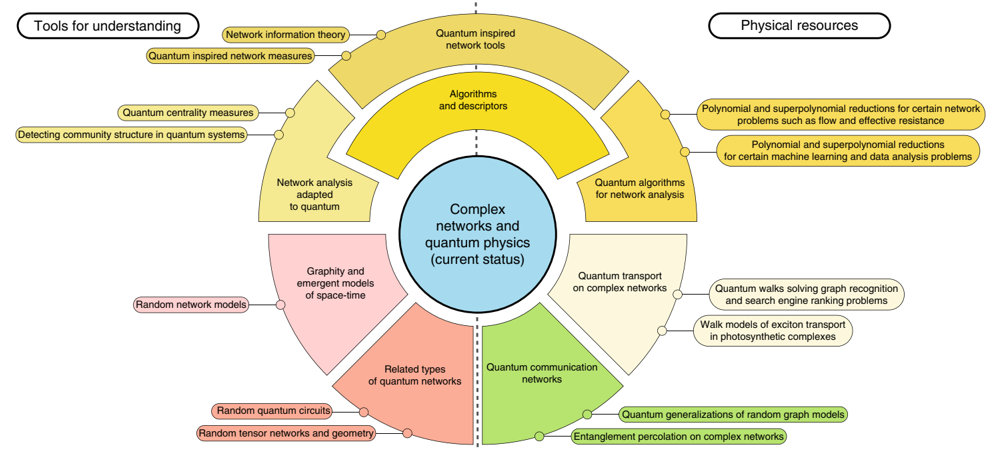
This review surveys the cross-pollination between complex network theory and quantum information science, focusing on quantum networks built from entangled states and on physically connected quantum systems. It argues that network information theory may provide a unified framework for classical and quantum networked systems.
Key findings
- Two main classes of quantum networks are reviewed: networks whose edges are entangled states, and networks of physically interconnected quantum systems such as atoms or superconducting circuits.
- In entanglement-based random graphs, replacing links with entangled pairs lets the probability of link existence map to entanglement; LOCC conversion succeeds with optimal probability \(p\), and for \(N \to \infty\) and \(z=-2\), a quantum state with the topology of any finite subgraph can be obtained with probability approaching unity.
- Quantum PageRank approaches resolve degeneracy issues in classical PageRank, enhance the importance of secondary hubs, and for certain values of \(\alpha\) exhibit faster convergence.
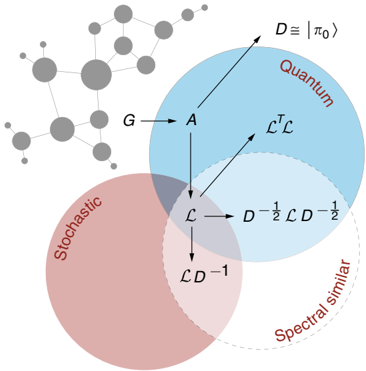
- Quantum walks on complex networks show key differences from stochastic walks: the stochastic and quantum generators are spectrally similar and share eigenvalues, with eigenvectors related by \(D^{-1/2}\), while a quantumness measure \(\varepsilon\) quantifies departure from classical occupation probabilities.
Methods
- Review article synthesizing prior theoretical, experimental, and computational work at the intersection of complex networks and quantum information.
- No dataset was generated or analyzed; the paper states “No data set were generated or analyzed during the current study.”
- The review is organized around entangled-state quantum networks, physically connected quantum networks, quantum walks and PageRank, and unified information-theoretic analyses of network complexity.
Limitations
- The authors state that they do not cover several topics, including quantum gravity theories based on complex networks, synchronization in and on quantum networks, quantum random circuits, classical spin models, and quantum statistics used in complex network theory.
- The authors state that the scale-free quantum network result is a toy model with theoretical predictions still to be verified experimentally, and that the interplay between structure and dynamics in quantum networks is almost entirely unclear.
- Evident from the text: as a narrative review, it does not report a systematic search strategy or inclusion criteria, and its coverage is explicitly selective rather than exhaustive.
Model-written summary. Check it against the paper before relying on it.
Integrity signals
Registry
Cites
Statistics
Figures
Verification
Claims the paper makes
76 Valid · 3 Not valid · 12 Not checked · 17 Own results and interpretations
The cited sources support only part of this claim — read each source’s verdict below.
In the paper
“Rapid experimental progress has pushed quantum computing and communication devices into truly data-intensive domains”
What the sources say
- Could not verifycites [6] 6. Acín, A., Cirac, J. I. & Lewenstein, M. Entanglement percolation in quantum networks. Nat. Phys. 3 , 256 -259 (2007). This paper discovers several properties of entanglement-based complex quantum networks . sourceExperimental — accuracy not yet measured
The Abstract discusses quantum-network protocols and describes quantum networks as a basis for future communication. It does not say that rapid experimental progress has moved quantum computing or communication devices into data-intensive domains; searches for experimental progress and data complexity found no passage addressing that claim. (LLM, conf=0.73)
- Not matchedcites [7] 7. Faccin, M., Johnson, T., Biamonte, J., Kais, S. & Migda ł , P. Degree distribution in quantum walks on complex networks. Phys. Rev. X 3 , 041007 (2013).
More than one paper fits this citation.
- Partly supportedcites [8] 8. Paparo, G. D. & Martin-Delgado, M. A. Google in a quantum network. Sci. Rep. 2 , 444 (2012). sourceExperimental — accuracy not yet measured
The Abstract (page unavailable) reports recent experimental progress and says modest quantum networks have been realized. It does not say that quantum computing and communication devices have entered data-intensive domains; instead, it says a scalable quantum computer is not yet available. The Discussion (page unavailable) says applying the proposed algorithm to very large networks remains future work. (LLM, conf=0.85)
- Could not verifycites [9] 9. Garnerone, S. Thermodynamic formalism for dissipative quantum walks. Phys. Rev. A 86 , 032342 (2012). sourceExperimental — accuracy not yet measured
The Introduction (p. 1) describes quantum walks as tools for quantum computation and discusses their use in complex networks, but it does not link experimental progress to data-intensive quantum computing or communication devices. Searches for experimental progress, data-intensive applications, and quantum communication found no passage addressing that claim. (LLM, conf=0.72)
- Not checked yetcites [10] 10. Paparo, G., Müller, M., Comellas, F. & Martin-Delgado, M. Quantum google algorithm. EPJ Plus 129 , 150 (2014). source
Checked before — its earlier verdict is held back until a new check runs.
- Partly supportedcites [11] 11. Sánchez-Burillo, E., Duch, J., Gómez-Gardeñes, J. & Zueco, D. Quantum navigation and ranking in complex networks. Sci. Rep. 2 , 650 (2012). sourceExperimental — accuracy not yet measured
The Discussion (page not available) says that as quantum-network nodes and connections increase, the quantum information community encounters complex network structures. It does not say that rapid experimental progress has already pushed quantum computing and communication devices into data-intensive domains; the paper describes its own quantum-navigation method as implementable without quantum hardware. (LLM, conf=0.79)
- Could not verifycites [12] 12. Lu, D. et al. Chiral Quantum Walks. Phys. Rev. A 93 , 0423902 (2016). This paper experimentally realizes chiral quantum walks (walks that direct transport modulated time-symmetry breaking as proposed in [65] . sourceExperimental — accuracy not yet measured
The Introduction describes emerging quantum technologies and a complex-network approach, while the Discussion reports a three-qubit experiment. Neither section says that rapid experimental progress has moved quantum computing or communication devices into data-intensive domains; searches for that claim and for a paradigm shift in complexity found no supporting passage in our copy. (LLM, conf=0.74)
- Could not verifycites [13] 13. Faccin, M., Migda ł , P., Johnson, T. H., Bergholm, V. & Biamonte, J. D. Community detection in quantum complex. Netw. Phys. Rev. X 4 , 041012 (2014). sourceExperimental — accuracy not yet measured
The Introduction says researchers are exploring quantum networks of increasing size, and the Discussion describes methods suitable for networks with thousands of nodes. Neither passage addresses rapid experimental progress in quantum computing or communication devices, or says those devices have entered data-intensive domains (searched those terms and paraphrases). (LLM, conf=0.74)
plainstates a cause- Asserted: passes — The authors put it forward as true.
- Checkable: passes — It can be checked against evidence.
- Load-bearing: passes — The paper’s conclusions depend on it.
- Based: passes — The paper gives a reason why it holds.
- Could not verify
The cited sources support only part of this claim — read each source’s verdict below.
In the paper
“quantum computer algorithms have been proposed to offer enhancement for several network problems”
What the sources say
- Partly supportedcites [8] 8. Paparo, G. D. & Martin-Delgado, M. A. Google in a quantum network. Sci. Rep. 2 , 444 (2012). sourceExperimental — accuracy not yet measured
The Abstract reports a quantum PageRank protocol that outperforms its classical counterpart for ranking web pages. But this is one network problem, not several, and the paper says its protocol is designed for a scenario in which no quantum computer is available. The Results section separately mentions a proposed quantum-computer approach to improving PageRank efficiency. (LLM, conf=0.85)
- Partly supportedcites [9] 9. Garnerone, S. Thermodynamic formalism for dissipative quantum walks. Phys. Rev. A 86 , 032342 (2012). sourceExperimental — accuracy not yet measured
The Introduction (p. 1) describes quantum walks as useful for algorithm design, and Section IV (p. 3) discusses a quantum analogue of PageRank, a network-ranking problem. These passages support a proposed quantum approach to a network problem, but do not establish enhancement for several network problems. (LLM, conf=0.78)
- Not checked yetcites [10] 10. Paparo, G., Müller, M., Comellas, F. & Martin-Delgado, M. Quantum google algorithm. EPJ Plus 129 , 150 (2014). source
Checked before — its earlier verdict is held back until a new check runs.
- Partly supportedcites [11] 11. Sánchez-Burillo, E., Duch, J., Gómez-Gardeñes, J. & Zueco, D. Quantum navigation and ranking in complex networks. Sci. Rep. 2 , 650 (2012). sourceExperimental — accuracy not yet measured
The Discussion (page not specified) reports that the proposed quantum navigation method improves network ranking, supporting the general idea of a quantum approach enhancing a network task. But it explicitly says the algorithm does not rely on a quantum implementation; our copy does not establish quantum-computer algorithms enhancing several network problems. (LLM, conf=0.86)
plainstates a possible cause- Asserted: passes — The authors put it forward as true.
- Checkable: passes — It can be checked against evidence.
- Load-bearing: unclear — It is unclear whether the paper’s conclusions depend on it.
- Based: passes — The paper gives a reason why it holds.
- Partly supported
The cited sources support only part of this claim — read each source’s verdict below.
In the paper
“Novel quantum induced effects have been predicted in random graphs -where edges represent entangled links”
What the sources say
- Partly supportedcites [6] 6. Acín, A., Cirac, J. I. & Lewenstein, M. Entanglement percolation in quantum networks. Nat. Phys. 3 , 256 -259 (2007). This paper discovers several properties of entanglement-based complex quantum networks . sourceExperimental — accuracy not yet measured
The paper’s Abstract (page unavailable) predicts novel entanglement-percolation effects in networks whose connected nodes share entangled states. But it specifies that the networks studied have regularly arranged nodes, including lattices; it does not describe the underlying networks as random graphs. (LLM, conf=0.88)
plainstates a cause- Asserted: passes — The authors put it forward as true.
- Checkable: passes — It can be checked against evidence.
- Load-bearing: unclear — It is unclear whether the paper’s conclusions depend on it.
- Based: passes — The paper gives a reason why it holds.
- Partly supported
The cited sources that could be checked couldn’t confirm or dispute this claim.
In the paper
“The striking result is that it is possible to obtain, with probability approaching unity, a quantum state with the topology of any fi nite subgraph for N approaching in fi nity and z = -2.”
What the sources say
- Could not verifycites [6] 6. Acín, A., Cirac, J. I. & Lewenstein, M. Entanglement percolation in quantum networks. Nat. Phys. 3 , 256 -259 (2007). This paper discovers several properties of entanglement-based complex quantum networks . sourceExperimental — accuracy not yet measured
The paper discusses entanglement paths in two-dimensional lattices and says their probability can be unity in an infinite network (section labeled Abstract; page unavailable). Our copy does not address obtaining a quantum state with the topology of any finite subgraph, or a condition z = -2; searches for those terms and paraphrases found no such result. (LLM, conf=0.76)
hedgedstates a cause- Asserted: passes — The authors put it forward as true.
- Checkable: passes — It can be checked against evidence.
- Load-bearing: passes — The paper’s conclusions depend on it.
- Based: passes — The paper gives a reason why it holds.
- Could not verify
The cited sources support only part of this claim — read each source’s verdict below.
In the paper
“in the case of qubits, it has been shown that the probability of having an entangled path with in fi nite length -i.e., an in fi nite sequence of entangled states connecting an in fi nite number of qubits -is unity.”
What the sources say
- Partly supportedcites [6] 6. Acín, A., Cirac, J. I. & Lewenstein, M. Entanglement percolation in quantum networks. Nat. Phys. 3 , 256 -259 (2007). This paper discovers several properties of entanglement-based complex quantum networks . sourceExperimental — accuracy not yet measured
The passage labeled Abstract (page unavailable) says that, for two-dimensional lattices of qubits, the probability of an infinitely connected entangled path is unity over a continuous interval of entanglement values. The claim omits those conditions and presents the result as applying to qubits generally; the same passage says the probability is zero for product states. (LLM, conf=0.88)
boosted- Asserted: passes — The authors put it forward as true.
- Checkable: passes — It can be checked against evidence.
- Load-bearing: unclear — It is unclear whether the paper’s conclusions depend on it.
- Based: passes — The paper gives a reason why it holds.
- Partly supported
45 more claims · 37 with their cited sources checked
Create a free account to see all 108 claims and to verify the 22 references still open.
- It may state two separate claims as one. 27
- Probably not a substantial claim. 35
Self-check
Percentages, sums and reported differences re-computed from the paper’s own numbers.
Each contradiction between two passages listed here was confirmed by an independent check.
Rated minor: it would not touch a result — a value no result rests on, a p-value that stays on the same side of the significance level, or a conflict that is clerical, resolved elsewhere in the paper, or outside its own findings.
In the paper
§ Quantum networks based on entangled states · p. 3
“The probability scales with the size of the network following a power law p ∝ N -z , with z ≥ 0.”
§ Quantum networks based on entangled states · p. 3
“The striking result is that it is possible to obtain, with probability approaching unity, a quantum state with the topology of any fi nite subgraph for N approaching in fi nity and z = -2.”
Citations
Cites
Collective dynamics of ‘small-world’ networks
Watts, D. J., & Strogatz, S. H. (1998) · Nature · doi:10.1038/30918 · Cited by 43,060 · cited 2×
“Building on several fundamental discoveries [14, 15], complex network theory has demonstrated that many (non-quantum) systems exhibit similarities in their complex features [14–18], in the organization of their structure and dynamics [19–24], the controllability of their constituents [25] and their…”
Emergence of Scaling in Random Networks
Barabási, A.-L., & Albert, R. (1999) · Science · doi:10.1126/science.286.5439.509 · Cited by 36,135
Statistical mechanics of complex networks
Albert, R., & Barabási, A.-L. (2002) · Reviews of Modern Physics · doi:10.1103/revmodphys.74.47 · Cited by 20,471 · cited 1×
“Many real world networks have been found to follow a widely heterogeneous distribution of degree values [88].”
The Structure and Function of Complex Networks
Newman, M. E. J. (2003) · SIAM Review · doi:10.1137/s003614450342480 · Cited by 18,719 · cited 2×
“We refer to [16, 53] for reviews of network concepts and models.”
Fortunato, S. (2010) · Physics Reports · doi:10.1016/j.physrep.2009.11.002 · Cited by 11,293 · cited 1×
“Community detection, and in general mesoscopic structure detection, has been widely studied in the literature of classical complex networks [90, 91].”
Complex networks: structure and dynamics
BOCCALETTI, S., LATORA, V, MORENO, Y., CHAVEZ, M., & HWANG, D. (2006) · Physics Reports · doi:10.1016/j.physrep.2005.10.009 · Cited by 11,010
Error and attack tolerance of complex networks
Albert, R., Jeong, H., & Barabási, A.-L. (2000) · Nature · doi:10.1038/35019019 · Cited by 7,534 · cited 3×
“The development of quantum error correction techniques that make quantum computing and quantum communication possible can not prescind from the study of ‘system resilience’, a topic that found uncountable applications in classical network science [26, 28, 31, 98, 99].”
Kimble, H. J. (2008) · Nature · doi:10.1038/nature07127 · Cited by 6,023 · cited 2×
“…that are natural for classical systems, such as targeted attacks of network hubs [26] or cascade-based attacks [100], still have no clear quantum counterpart and their study, from both theoretical and experimental perspectives, will play a key role in the development of a quantum Internet [5].”
The Theory of Open Quantum Systems
Breuer, H.-P., & Petruccione, F. (2007) · doi:10.1093/acprof:oso/9780199213900.001.0001 · Cited by 5,938
Approximate entropy as a measure of system complexity.
Pincus, S. M. (1991) · Proceedings of the National Academy of Sciences · doi:10.1073/pnas.88.6.2297 · Cited by 5,811
Uncovering the overlapping community structure of complex networks in nature and society
Palla, G., Derényi, I., Farkas, I., & Vicsek, T. (2005) · Nature · doi:10.1038/nature03607 · Cited by 5,373
Biamonte, J., Wittek, P., Pancotti, N., Rebentrost, P., Wiebe, N., & Lloyd, S. (2017) · Nature · doi:10.1038/nature23474 · Cited by 4,779
Self-citationCatastrophic cascade of failures in interdependent networks
Buldyrev, S. V., Parshani, R., Paul, G., Stanley, H. E., & Havlin, S. (2010) · Nature · doi:10.1038/nature08932 · Cited by 4,513 · cited 1×
“The development of quantum error correction techniques that make quantum computing and quantum communication possible can not prescind from the study of ‘system resilience’, a topic that found uncountable applications in classical network science [26, 28, 31, 98, 99].”
Functional cartography of complex metabolic networks
Guimerà, R., & Nunes Amaral, L. A. (2005) · Nature · doi:10.1038/nature03288 · Cited by 3,983
Quantum information and computation
Bennett, C. H., & DiVincenzo, D. P. (2000) · Nature · doi:10.1038/35005001 · Cited by 3,263
Kivela, M., Arenas, A., Barthelemy, M., Gleeson, J. P., Moreno, Y., & Porter, M. A. (2014) · Journal of Complex Networks · doi:10.1093/comnet/cnu016 · Cited by 3,235 · cited 1×
“This entropy has been generalized to the case of multilayer systems [109], composite networks where units exhibit different types of relationships that are generally modeled as different layers (see [17, 18, 110] for a thorough review).”
Controllability of complex networks
Liu, Y.-Y., Slotine, J.-J., & Barabási, A.-L. (2011) · Nature · doi:10.1038/nature10011 · Cited by 3,215 · cited 1×
“…network theory has demonstrated that many (non-quantum) systems exhibit similarities in their complex features [14–18], in the organization of their structure and dynamics [19–24], the controllability of their constituents [25] and their resilience to structural and dynamical perturbations [26–31].”
Multiscale Entropy Analysis of Complex Physiologic Time Series
Costa, M., Goldberger, A. L., & Peng, C.-K. (2002) · Physical Review Letters · doi:10.1103/physrevlett.89.068102 · Cited by 3,207 · cited 1×
“Historically, the concept of entropy has been successfully used to quantify the complexity of many systems [105, 106].”
The structure and dynamics of multilayer networks
Boccaletti, S., Bianconi, G., Criado, R., del Genio, C. I., Gómez-Gardeñes, J., Romance, M., Sendiña-Nadal, I., Wang, Z., & Zanin, M. (2014) · Physics Reports · doi:10.1016/j.physrep.2014.07.001 · Cited by 3,125
Network Robustness and Fragility: Percolation on Random Graphs
Callaway, D. S., Newman, M. E. J., Strogatz, S. H., & Watts, D. J. (2000) · Physical Review Letters · doi:10.1103/physrevlett.85.5468 · Cited by 2,480
Critical phenomena in complex networks
Dorogovtsev, S. N., Goltsev, A. V., & Mendes, J. F. F. (2008) · Reviews of Modern Physics · doi:10.1103/revmodphys.80.1275 · Cited by 2,220 · cited 1×
“…in no particular order, quantum gravity theories based on complex networks [42–45], synchronization in and on quantum networks [46], quantum random circuits [47, 48], classical spin models and quantum statistics successfully used in complex network theory [49–51] (see [52] for a thorough review).”
Quantum State Transfer and Entanglement Distribution among Distant Nodes in a Quantum Network
Cirac, J. I., Zoller, P., Kimble, H. J., & Mabuchi, H. (1997) · Physical Review Letters · doi:10.1103/physrevlett.78.3221 · Cited by 2,215
Anticipating Critical Transitions
Scheffer, M., Carpenter, S. R., Lenton, T. M., Bascompte, J., Brock, W., Dakos, V., van de Koppel, J., van de Leemput, I. A., Levin, S. A., van Nes, E. H., et al. (2012) · Science · doi:10.1126/science.1225244 · Cited by 2,208 · cited 1×
“The development of quantum error correction techniques that make quantum computing and quantum communication possible can not prescind from the study of ‘system resilience’, a topic that found uncountable applications in classical network science [26, 28, 31, 126, 127].”
Greenberger, D. M., Horne, M. A., & Zeilinger, A. (1989) · Bell’s Theorem, Quantum Theory and Conceptions of the Universe · doi:10.1007/978-94-017-0849-4_10 · Cited by 1,513 · cited 1×
“This is useful to create special multipartite states, such as the Greenberger-Horne-Zeilinger state which exhibits non-classical correlations [54].”
Networks, Dynamics, and the Small‐World Phenomenon
Watts, D. J. (1999) · American Journal of Sociology · doi:10.1086/210318 · Cited by 1,510
Self-similarity of complex networks
Song, C., Havlin, S., & Makse, H. A. (2005) · Nature · doi:10.1038/nature03248 · Cited by 1,495
String-net condensation: A physical mechanism for topological phases
Levin, M. A., & Wen, X.-G. (2005) · Physical Review B · doi:10.1103/physrevb.71.045110 · Cited by 1,470
Universal resilience patterns in complex networks
Gao, J., Barzel, B., & Barabási, A.-L. (2016) · Nature · doi:10.1038/nature16948 · Cited by 1,217
Networks formed from interdependent networks
Gao, J., Buldyrev, S. V., Stanley, H. E., & Havlin, S. (2012) · Nature Physics · doi:10.1038/nphys2180 · Cited by 1,216
Quantum random-walk search algorithm
Shenvi, N., Kempe, J., & Whaley, K. B. (2003) · Physical Review A · doi:10.1103/physreva.67.052307 · Cited by 1,150
Random Walks on Complex Networks
Noh, J. D., & Rieger, H. (2004) · Physical Review Letters · doi:10.1103/physrevlett.92.118701 · Cited by 1,148
Silica-on-silicon waveguide quantum circuits
Politi, A., Cryan, M. J., Rarity, J. G., Yu, S., & O'Brien, J. L. (2008) · Science · doi:10.1126/science.1155441 · Cited by 1,084
Detecting rich-club ordering in complex networks
Colizza, V., Flammini, A., Serrano, M. A., & Vespignani, A. (2006) · Nature Physics · doi:10.1038/nphys209 · Cited by 1,001
Aspuru-Guzik, A., & Walther, P. (2012) · Nature Physics · doi:10.1038/nphys2253 · Cited by 952
Mathematical Formulation of Multilayer Networks
De Domenico, M., Solé-Ribalta, A., Cozzo, E., Kivelä, M., Moreno, Y., Porter, M. A., Gómez, S., & Arenas, A. (2013) · Physical Review X · doi:10.1103/physrevx.3.041022 · Cited by 930 · cited 2×
“This entropy has been generalized to the case of multilayer systems [87], composite networks where units exhibit different types of relationships that are generally modeled as different layers (see [17, 18, 88] for a thorough review).”
An elementary quantum network of single atoms in optical cavities
Ritter, S., Nölleke, C., Hahn, C., Reiserer, A., Neuzner, A., Uphoff, M., Mücke, M., Figueroa, E., Bochmann, J., & Rempe, G. (2012) · Nature · doi:10.1038/nature11023 · Cited by 894
Dynamics and associations of microbial community types across the human body
Ding, T., & Schloss, P. D. (2014) · Nature · doi:10.1038/nature13178 · Cited by 885
Bose-Einstein Condensation in Complex Networks
Bianconi, G., & Barabási, A.-L. (2001) · Physical Review Letters · doi:10.1103/physrevlett.86.5632 · Cited by 808
Towards quantum chemistry on a quantum computer
Lanyon, B. P., Whitfield, J. D., Gillett, G. G., Goggin, M. E., Almeida, M. P., Kassal, I., Biamonte, J. D., Mohseni, M., Powell, B. J., Barbieri, M., et al. (2010) · Nature Chemistry · doi:10.1038/nchem.483 · Cited by 796
Self-citationScale-Free Networks from Varying Vertex Intrinsic Fitness
Caldarelli, G., Capocci, A., De Los Rios, P., & Muñoz, M. A. (2002) · Physical Review Letters · doi:10.1103/physrevlett.89.258702 · Cited by 794 · cited 1×
“Several models, based on mechanisms like preferential attachment [15], fitness [117] or constrained random wiring [55], to mention some of them, were developed to reproduce degree distributions commonly observed in empirical systems.”
Communities, modules and large-scale structure in networks
Newman, M. E. J. (2012) · Nature Physics · doi:10.1038/nphys2162 · Cited by 787 · cited 1×
“Community detection, and in general mesoscopic structure detection, has been widely studied in the literature of classical complex networks [90, 91].”
Storage and retrieval of single photons transmitted between remote quantum memories
Chanelière, T., Matsukevich, D. N., Jenkins, S. D., Lan, S.-Y., Kennedy, T. A. B., & Kuzmich, A. (2005) · Nature · doi:10.1038/nature04315 · Cited by 785
Cascade Control and Defense in Complex Networks
Motter, A. E. (2004) · Physical Review Letters · doi:10.1103/physrevlett.93.098701 · Cited by 776
Kómár, P., Kessler, E. M., Bishof, M., Jiang, L., Sørensen, A. S., Ye, J., & Lukin, M. D. (2014) · Nature Physics · doi:10.1038/nphys3000 · Cited by 768 · cited 1×
“Quantum mechanics has long been predicted to help solve computational problems in physics [1], chemistry [2], and machine learning [3] and to offer quantum security enhancement in communications [4], including a quantum secure Internet [5].”
Structural reducibility of multilayer networks
De Domenico, M., Nicosia, V., Arenas, A., & Latora, V. (2015) · Nature Communications · doi:10.1038/ncomms7864 · Cited by 661
Modelling dynamical processes in complex socio-technical systems
Vespignani, A. (2012) · Nature Physics · doi:10.1038/nphys2160 · Cited by 652 · cited 1×
“…network theory has demonstrated that many (non-quantum) systems exhibit similarities in their complex features [14–18], in the organization of their structure and dynamics [19–24], the controllability of their constituents [25] and their resilience to structural and dynamical perturbations [26–31].”
The physics of spreading processes in multilayer networks
De Domenico, M., Granell, C., Porter, M. A., & Arenas, A. (2016) · Nature Physics · doi:10.1038/nphys3865 · Cited by 649 · cited 3×
“…discoveries [14, 15], complex network theory has demonstrated that many (non-quantum) systems exhibit similarities in their complex features [14–18], in the organization of their structure and dynamics [19–24], the controllability of their constituents [25] and their resilience to structural…”
QUANTUM WALKS AND THEIR ALGORITHMIC APPLICATIONS
AMBAINIS, A. (2003) · International Journal of Quantum Information · doi:10.1142/s0219749903000383 · Cited by 632
(2004) · doi:10.1109/focs.2004.53 · Cited by 599
Detecting Fuzzy Community Structures in Complex Networks with a Potts Model
Reichardt, J., & Bornholdt, S. (2004) · Physical Review Letters · doi:10.1103/physrevlett.93.218701 · Cited by 593
Navigability of interconnected networks under random failures
De Domenico, M., Solé-Ribalta, A., Gómez, S., & Arenas, A. (2014) · Proceedings of the National Academy of Sciences · doi:10.1073/pnas.1318469111 · Cited by 548 · cited 1×
“The development of quantum error correction techniques that make quantum computing and quantum communication possible can not prescind from the study of ‘system resilience’, a topic that found uncountable applications in classical network science [26, 28, 31, 126, 127].”
Self-citationSingle-Atom Single-Photon Quantum Interface
Wilk, T., Webster, S. C., Kuhn, A., & Rempe, G. (2007) · Science · doi:10.1126/science.1143835 · Cited by 509
Limits on fundamental limits to computation
Markov, I. L. (2014) · Nature · doi:10.1038/nature13570 · Cited by 494
Navigability of complex networks
Boguñá, M., Krioukov, D., & Claffy, K. C. (2009) · Nature Physics · doi:10.1038/nphys1130 · Cited by 486
An Example of the Difference Between Quantum and Classical Random Walks
Childs, A. M., Farhi, E., & Gutmann, S. (2002) · Quantum Information Processing · doi:10.1023/a:1019609420309 · Cited by 481
Emergence of a 4D World from Causal Quantum Gravity
Ambjørn, J., Jurkiewicz, J., & Loll, R. (2004) · Physical Review Letters · doi:10.1103/physrevlett.93.131301 · Cited by 447 · cited 1×
“These include, in no particular order, quantum gravity theories based on complex networks [42–45], synchronization in and on quantum networks [46], quantum random circuits [47, 48], classical spin models and quantum statistics successfully used in complex network theory [49–51] (see [52] for a…”
Abrupt transition in the structural formation of interconnected networks
Radicchi, F., & Arenas, A. (2013) · Nature Physics · doi:10.1038/nphys2761 · Cited by 348
The Multilayer Connectome of Caenorhabditis elegans
Bentley, B., Branicky, R., Barnes, C. L., Chew, Y. L., Yemini, E., Bullmore, E. T., Vértes, P. E., & Schafer, W. R. (2016) · PLOS Computational Biology · doi:10.1371/journal.pcbi.1005283 · Cited by 269
The structure and function of networks
Newman, M. E. J. (2002) · Computer Physics Communications · doi:10.1016/s0010-4655(02)00201-1 · Cited by 269
Entanglement percolation in quantum networks
Acín, A., Cirac, J. I., & Lewenstein, M. (2007) · Nature Physics · doi:10.1038/nphys549 · Cited by 255 · cited 7×
“For instance, in the case of regular lattices, it has been shown that the probability popt to establish a perfect quantum channel between the nodes can be mapped to the probability of distributing links among each pair of nodes in the lattice [6], a scenario that can be studied using the well-established bond-percolat…”
InfluentialSuperinsulator and quantum synchronization
Vinokur, V. M., Baturina, T. I., Fistul, M. V., Mironov, A. Y., Baklanov, M. R., & Strunk, C. (2008) · Nature · doi:10.1038/nature06837 · Cited by 243 · cited 1×
“These include, in no particular order, quantum gravity theories based on complex networks [42–45], synchronization in and on quantum networks [46], quantum random circuits [47, 48], classical spin models and quantum statistics successfully used in complex network theory [49–51] (see [52] for a…”
Quantification of network structural dissimilarities
Schieber, T. A., Carpi, L., Díaz-Guilera, A., Pardalos, P. M., Masoller, C., & Ravetti, M. G. (2017) · Nature Communications · doi:10.1038/ncomms13928 · Cited by 237
Pseudo-Random Unitary Operators for Quantum Information Processing
Emerson, J., Weinstein, Y. S., Saraceno, M., Lloyd, S., & Cory, D. G. (2003) · Science · doi:10.1126/science.1090790 · Cited by 233 · cited 1×
“…in no particular order, quantum gravity theories based on complex networks [42–45], synchronization in and on quantum networks [46], quantum random circuits [47, 48], classical spin models and quantum statistics successfully used in complex network theory [49–51] (see [52] for a thorough review).”
Quantum graphity: A model of emergent locality
Konopka, T., Markopoulou, F., & Severini, S. (2008) · Physical Review D · doi:10.1103/physrevd.77.104029 · Cited by 197
Localization of the Maximal Entropy Random Walk
Burda, Z., Duda, J., Luck, J. M., & Waclaw, B. (2009) · Physical Review Letters · doi:10.1103/physrevlett.102.160602 · Cited by 187 · cited 1×
“However, many works have compared properties of stochastic [65, 66] and quantum random walks [60–62] on complex networks [67].”
Spatial Search by Quantum Walk is Optimal for Almost all Graphs
Chakraborty, S., Novo, L., Ambainis, A., & Omar, Y. (2016) · Physical Review Letters · doi:10.1103/physrevlett.116.100501 · Cited by 164 · cited 2×
“…for a quantum computer can be translated into a quantum walk on a graph—and, additionally, quantum walks have been widely studied in the realm of quantum search on graphs, in both continuous and discrete time via coined walks (see e.g. [55–58]—in particular the graph optimality results [63]).”
Spectral Entropies as Information-Theoretic Tools for Complex Network Comparison
De Domenico, M., & Biamonte, J. (2016) · Physical Review X · doi:10.1103/physrevx.6.041062 · Cited by 160 · cited 10×
“[32] De Domenico, M.”
InfluentialSelf-citationNetwork geometry with flavor: From complexity to quantum geometry
Bianconi, G., & Rahmede, C. (2016) · Physical Review E · doi:10.1103/physreve.93.032315 · Cited by 150
Generalized Bose-Fermi Statistics and Structural Correlations in Weighted Networks
Garlaschelli, D., & Loffredo, M. I. (2009) · Physical Review Letters · doi:10.1103/physrevlett.102.038701 · Cited by 145
Braunstein, S. L., Ghosh, S., & Severini, S. (2006) · Annals of Combinatorics · doi:10.1007/s00026-006-0289-3 · Cited by 145 · cited 1×
“For classical complex networks, von Neumann’s entropy has been applied over one decade ago [107].”
Mapping Multiplex Hubs in Human Functional Brain Networks
De Domenico, M., Sasai, S., & Arenas, A. (2016) · Frontiers in Neuroscience · doi:10.3389/fnins.2016.00326 · Cited by 144
Perseguers, S., Lewenstein, M., Acín, A., & Cirac, J. I. (2010) · Nature Physics · doi:10.1038/nphys1665 · Cited by 139
Shannon and von Neumann entropy of random networks with heterogeneous expected degree
Anand, K., Bianconi, G., & Severini, S. (2011) · Physical Review E · doi:10.1103/physreve.83.036109 · Cited by 137 · cited 1×
“The normalization of the matrix L guarantees that the corresponding eigenvalues are non-negative and sum up to 1—in order to be interpreted as probabilities [80]—and some other properties which makes the resulting object similar to a quantum density matrix ρ .”
Paparo, G. D., & Martin-Delgado, M. A. (2012) · Scientific Reports · doi:10.1038/srep00444 · Cited by 136
Johnson, T. H., Clark, S. R., & Jaksch, D. (2014) · EPJ Quantum Technology · doi:10.1140/epjqt10 · Cited by 127
Quantum stochastic walks: A generalization of classical random walks and quantum walks
Whitfield, J. D., Rodríguez-Rosario, C. A., & Aspuru-Guzik, A. (2010) · Physical Review A · doi:10.1103/physreva.81.022323 · Cited by 126
Interdisciplinary and physics challenges of network theory
Bianconi, G. (2015) · EPL (Europhysics Letters) · doi:10.1209/0295-5075/111/56001 · Cited by 126
Johnson, T., Clark, S. R. L., & Jaksch, D. (2014) · doi:10.1186/epjqt10 · Cited by 116
Quantum Navigation and Ranking in Complex Networks
Sánchez-Burillo, E., Duch, J., Gómez-Gardeñes, J., & Zueco, D. (2012) · Scientific Reports · doi:10.1038/srep00605 · Cited by 115 · cited 3×
“The authors [8, 10, 11] show how this definition of quantum Page-Rank resolves problems of degeneracy in the classical Page-Rank definition, enhances the importance of secondary hubs and, for certain values of α, the algorithm exhibits faster convergence.”
InfluentialErratum: correction: Error and attack tolerance of complex networks
Albert, R., Jeong, H., & Barabási, A.-Ĺ. (2001) · Nature · doi:10.1038/35054111 · Cited by 110
Adiabatic Quantum Algorithm for Search Engine Ranking
Garnerone, S., Zanardi, P., & Lidar, D. A. (2012) · Physical Review Letters · doi:10.1103/physrevlett.108.230506 · Cited by 102
Geometry of loop quantum gravity on a graph
Rovelli, C., & Speziale, S. (2010) · Physical Review D · doi:10.1103/physrevd.82.044018 · Cited by 91 · cited 1×
“These include, in no particular order, quantum gravity theories based on complex networks [42–45], synchronization in and on quantum networks [46], quantum random circuits [47, 48], classical spin models and quantum statistics successfully used in complex network theory [49–51] (see [52] for a…”
Convergence Rates for Arbitrary Statistical Moments of Random Quantum Circuits
Brown, W. G., & Viola, L. (2010) · Physical Review Letters · doi:10.1103/physrevlett.104.250501 · Cited by 91 · cited 1×
“…in no particular order, quantum gravity theories based on complex networks [42–45], synchronization in and on quantum networks [46], quantum random circuits [47, 48], classical spin models and quantum statistics successfully used in complex network theory [49–51] (see [52] for a thorough review).”
Entanglement Percolation in Quantum Complex Networks
Cuquet, M., & Calsamiglia, J. (2009) · Physical Review Letters · doi:10.1103/physrevlett.103.240503 · Cited by 90
Experimental violation of local causality in a quantum network
Carvacho, G., Andreoli, F., Santodonato, L., Bentivegna, M., Chaves, R., & Sciarrino, F. (2017) · Nature Communications · doi:10.1038/ncomms14775 · Cited by 81
Symmetry and the thermodynamics of currents in open quantum systems
Manzano, D., & Hurtado, P. I. (2014) · Physical Review B · doi:10.1103/physrevb.90.125138 · Cited by 80 · cited 1×
“The adiabatic version of Page-Rank [9] uses a quantum stochastic quantum walk as proposed by [65] (see also [78, 79] for studies on open walks).”
Erratum: Universal resilience patterns in complex networks
Gao, J., Barzel, B., & Barabási, A.-Ĺ. (2016) · Nature · doi:10.1038/nature18019 · Cited by 71
Quantum Transport Enhancement by Time-Reversal Symmetry Breaking
Zimborás, Z., Faccin, M., Kádár, Z., Whitfield, J. D., Lanyon, B. P., & Biamonte, J. (2013) · Scientific Reports · doi:10.1038/srep02361 · Cited by 64
Self-citationLu, D., Biamonte, J. D., Li, J., Li, H., Johnson, T. H., Bergholm, V., Faccin, M., Zimborás, Z., Laflamme, R., Baugh, J., et al. (2016) · Physical Review A · doi:10.1103/physreva.93.042302 · Cited by 58 · cited 4×
“These complex phases in many cases do not effect transfer probabilities: the theory explaining this finding was developed in [12, 62], without relying on approximations or averaging.”
InfluentialSelf-citationOptimal Quantum Spatial Search on Random Temporal Networks
Chakraborty, S., Novo, L., Giorgio, S. D., & Omar, Y. (2017) · Physical Review Letters · doi:10.1103/physrevlett.119.220503 · Cited by 55 · cited 1×
“These types of systems provide fertile ground where quantum algorithms are tested [55–59] and quantum information transport systems are studied [60–62].”
Dynamic quantum clustering: A method for visual exploration of structures in data
Weinstein, M., & Horn, D. (2009) · Physical Review E · doi:10.1103/physreve.80.066117 · Cited by 51 · cited 1×
“In[92, 93] the authors propose a method for data clustering similar to kernel density estimators, in a quantum framework.”
Magnetic eigenmaps for community detection in directed networks
Fanuel, M., Alaíz, C. M., & Suykens, J. A. K. (2017) · Physical Review E · doi:10.1103/physreve.95.022302 · Cited by 50
Rossi, L., Torsello, A., & Hancock, E. R. (2015) · Physical Review E · doi:10.1103/physreve.91.022815 · Cited by 46
Degree Distribution in Quantum Walks on Complex Networks
Faccin, M., Johnson, T., Biamonte, J., Kais, S., & Migdał, P. (2013) · Physical Review X · doi:10.1103/physrevx.3.041007 · Cited by 45
Self-citationCommunity Detection in Quantum Complex Networks
Faccin, M., Migdał, P., Johnson, T. H., Bergholm, V., & Biamonte, J. D. (2014) · Physical Review X · doi:10.1103/physrevx.4.041012 · Cited by 43 · cited 6×
“On the other hand an algorithm to find communities in complex quantum systems was proposed in [13].”
InfluentialSelf-citationHorn, D. (2001) · Physica A: Statistical Mechanics and its Applications · doi:10.1016/s0378-4371(01)00442-3 · Cited by 38
Magnetic Eigenmaps for the visualization of directed networks
Fanuel, M., Alaíz, C. M., Fernández, Á., & Suykens, J. A. K. (2018) · Applied and Computational Harmonic Analysis · doi:10.1016/j.acha.2017.01.004 · Cited by 35 · cited 1×
“A similar approach, involving a modified Laplacian matrix, has been recently used for revealing the mesoscale structure of complex directed networks [83, 84].”
Universal state transfer on graphs
Cameron, S., Fehrenbach, S., Granger, L., Hennigh, O., Shrestha, S., & Tamon, C. (2014) · Linear Algebra and its Applications · doi:10.1016/j.laa.2014.05.004 · Cited by 26
Complex quantum networks: From universal breakdown to optimal transport
Mülken, O., Dolgushev, M., & Galiceanu, M. (2016) · Physical Review E · doi:10.1103/physreve.93.022304 · Cited by 26
Thermodynamic formalism for dissipative quantum walks
Garnerone, S. (2012) · Physical Review A · doi:10.1103/physreva.86.032342 · Cited by 23
Quantum–classical transitions in complex networks
Alberto Javarone, M., & Armano, G. (2013) · Journal of Statistical Mechanics: Theory and Experiment · doi:10.1088/1742-5468/2013/04/p04019 · Cited by 21 · cited 1×
“The cross-pollination between the two fields—including, among others, quantum statistics for modeling the dynamics of classical networks and their geometry [83, 104] (see also Ref.”
Quantized recurrence time in unital iterated open quantum dynamics
Sinkovicz, P., Kurucz, Z., Kiss, T., & Asbóth, J. K. (2015) · Physical Review A · doi:10.1103/physreva.91.042108 · Cited by 21
Quantum walks on complex networks with connection instabilities and community structure
Tsomokos, D. I. (2011) · Physical Review A · doi:10.1103/physreva.83.052315 · Cited by 18
Quantum Google algorithm: Construction and application to complex networks
Paparo, G. D., Müller, M., Comellas, F., & Martin-Delgado, M. A. (2014) · The European Physical Journal Plus · doi:10.1140/epjp/i2014-14150-y · Cited by 17 · cited 4×
“Several recent studies embed G into a quantum system and consider quantum versions of Google’s Page-Rank [8– 10].”
InfluentialInformation sharing in quantum complex networks
Cardillo, A., Galve, F., Zueco, D., & Gómez-Gardeñes, J. (2013) · Physical Review A · doi:10.1103/physreva.87.052312 · Cited by 17
High-performance dynamic quantum clustering on graphics processors
Wittek, P. (2013) · Journal of Computational Physics · doi:10.1016/j.jcp.2012.08.048 · Cited by 16
Quantum walks and their algorithmic applicationsPreprint
Ambainis, A. (2004) · arXiv (Cornell University) · doi:10.48550/arxiv.quant-ph/0403120 · Cited by 16
Irreconcilable difference between quantum walks and adiabatic quantum computing
Wong, T. G., & Meyer, D. A. (2016) · Physical Review A · doi:10.1103/physreva.93.062313 · Cited by 13
Continuous-time quantum walks on directed bipartite graphs
Tödtli, B., Laner, M., Semenov, J., Paoli, B., Blattner, M., & Kunegis, J. (2016) · Physical Review A · doi:10.1103/physreva.94.052338 · Cited by 9 · cited 3×
“in [62] and realized experimentally in [12] append complex numbers to the adjacency matrix (playing the role of the system Hamiltonian) while still maintaining the Hermitian property [12, 62, 68, 69].”
Quantum Techniques for Stochastic Mechanics
Baez, J. C., & Biamonte, J. (2012) · arXiv · doi:10.48550/arxiv.1209.3632 · Cited by 4
Self-citationRandom walks and diffusion on networks
Masuda, N., Porter, M. A., & Lambiotte, R. (2016) · arXiv · doi:10.48550/arxiv.1612.03281
Continuous-Time Quantum Walks on Directed Bipartite Graphs
Tödtli, B., Laner, M., Semenov, J., et al. (2016) · arXiv · doi:10.48550/arxiv.1606.00992
Cited by
Signal propagation in complex networks
Ji, P., Ye, J., Mu, Y., Lin, W., Tian, Y., Hens, C., Perc, M., Tang, Y., Sun, J., & Kurths, J. (2023) · Physics Reports · doi:10.1016/j.physrep.2023.03.005 · Cited by 360
Quantum walk and its application domains: A systematic review
Kadian, K., Garhwal, S., & Kumar, A. (2021) · Computer Science Review · doi:10.1016/j.cosrev.2021.100419 · Cited by 204
Complex systems in the spotlight: next steps after the 2021 Nobel Prize in Physics
Bianconi, G., Arenas, À., Biamonte, J., Carr, L. D., Kahng, B., Kertész, J., Kurths, J., Lü, L., Masoller, C., Motter, A. E., et al. (2023) · Journal of Physics Complexity · doi:10.1088/2632-072x/ac7f75 · Cited by 126
Self-citationMachine intelligence in non-invasive endocrine cancer diagnostics
Thomasian, N. M., Kamel, I. R., & Bai, H. X. (2021) · Nature Reviews Endocrinology · doi:10.1038/s41574-021-00543-9 · Cited by 66
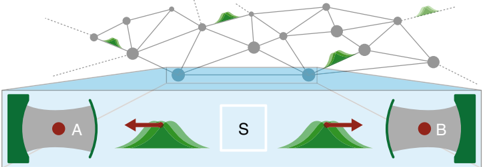
“Previous studies 177,178 depicted quantum networks as two nodes with the cutout region between nodes illustrating the induction of dependent quantum states among two particles (A and B, where S refers to a shared source of squeezed light) and this particle ‘entanglement’ is at the crux of quantum…”
BackgroundIdentifying key players in complex networks via network entanglement
Huang, Y., Wang, H., Ren, X.-L., & Lü, L. (2024) · Communications Physics · doi:10.1038/s42005-023-01483-8 · Cited by 57
“A cutting-edge research direction in complex networks is the integration of quantum information theory 15,16 .”
Metadata
- Authors
- Biamonte, J., Faccin, M., & De Domenico, M.
- Affiliations
- Skolkovo Institute of Science and Technology (RU)
- UCLouvain (BE)
- Corresponding author
- Biamonte, Jacob
- Faccin, Mauro
- Venue
- Communications Physics
- Published
- 2019-05-21
- Volume
- 2
- Issue
- 1
- ISSN
- 2399-3650 (ISSN-L)
- OpenAlex
- W2593971698
- Cited by
- 149
- References
- 101
- Citations by year
- 2026: 10 · 2025: 17 · 2024: 22 · 2023: 26 · 2022: 24 · 2021: 29 · 2020: 12 · 2019: 5
- FWCI
- 8.10
- Type
- journal article
- Language
- en
- Open access
- gold
- doi.org
- Licence
- cc-by
- creativecommons.org/licenses/by/4.0 (tdm)
- creativecommons.org/licenses/by/4.0 (vor)
- Locations
- Communications Physics (publishedVersion, cc-by)
- arXiv (Cornell University) (acceptedVersion)
- DOAJ (DOAJ: Directory of Open Access Journals) (submittedVersion)
- Padua Research Archive (University of Padova) (submittedVersion, cc-by)
- arXiv (Cornell University)
- Funders
- Foundational Questions Institute (FQXi-RFP3-1322)
- University of Waterloo
- Institut Périmètre de physique théorique
- Topics
- Physical Sciences › Physics and Astronomy › Statistical and Nonlinear Physics › Complex Network Analysis Techniques
- Physical Sciences › Physics and Astronomy › Atomic and Molecular Physics, and Optics › Quantum Information and Cryptography
- Physical Sciences › Mathematics › Discrete Mathematics and Combinatorics › Graph theory and applications
- Keywords
- complex networks, quantum information, entanglement, random graphs, quantum transport, information physics, complex systems, quantum algorithms, entanglement network
About these checks
Registry, retraction, Cites and statistics results are computed, not judged, with one exception: a printed reference that no index lists is read once by a model before it counts as a citation error. Claims are extracted by a model and kept only when their quote appears verbatim in the text; each cited source is then checked, with a model’s help, for whether it says what the claim relies on. Those verdicts can be wrong — read the claim’s quote and the cited source before relying on one.
The claim verdicts this report counts are experimental: their accuracy is not yet measured.
A language model drew the claims from the paper on 2026-10-10, under version 3 of the claim definition (model deepseek-v4.1-flash, prompt extract-v3).
A second model labelled each claim on 2026-10-10 (model jev-1.13-20260917, definition revision gold-guideline-v0.2).
Cited sources are checked with a language model’s help (gpt-6-sol).
Statistics and arithmetic are recomputed, not judged.
Confidence bands are shown only for fields calibrated on our annotated test set. None is calibrated yet, so no band is shown.
What counts as a claim ›How we measure confidence ›How we check this ›
Are you an author, or do you see a problem with this page? Request a review
Data sources
Bibliographic data: Semantic Scholar, OpenAlex, Crossref.
Contains information from the Semantic Scholar Academic Graph Datasets, made available under the ODC Attribution License (ODC-BY 1.0).
Semantic Scholar’s data is described in: Kinney, R., et al. (2023). The Semantic Scholar Open Data Platform. arXiv:2301.10140.
