

Variational quantum algorithms
Open accessThe DOI matches its Crossref record; 333 of the 334 references it cites were found in a registry or an index, and 1 are not checked yet; 179 of the 264 sources its claims cite were checked for support.
Abstract
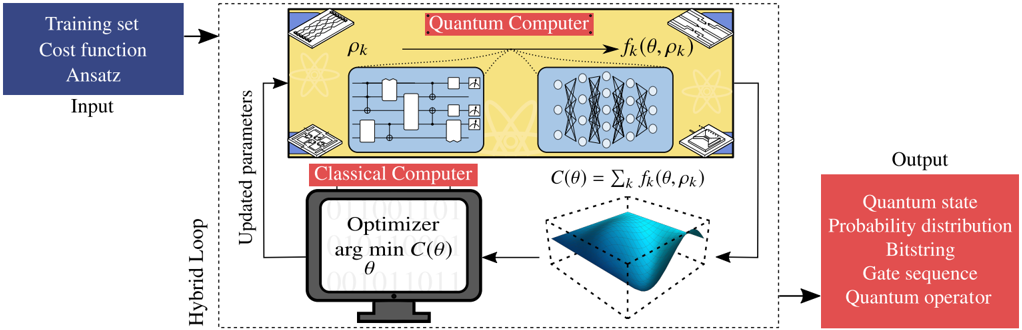
Applications such as simulating complicated quantum systems or solving large-scale linear algebra problems are very challenging for classical computers, owing to the extremely high computational cost. Quantum computers promise a solution, although fault-tolerant quantum computers will probably not be available in the near future. Current quantum devices have serious constraints, including limited numbers of qubits and noise processes that limit circuit depth. Variational quantum algorithms (VQAs), which use a classical optimizer to train a parameterized quantum circuit, have emerged as a leading strategy to address these constraints. VQAs have now been proposed for essentially all applications that researchers have envisaged for quantum computers, and they appear to be the best hope for obtaining quantum advantage. Nevertheless, challenges remain, including the trainability, accuracy and efficiency of VQAs. Here we overview the field of VQAs, discuss strategies to overcome their challenges and highlight the exciting prospects for using them to obtain quantum advantage. The advent of commercial quantum devices has ushered in the era of near-term quantum computing. Variational quantum algorithms are promising candidates to make use of these devices for achieving a practical quantum advantage over classical computers. Variational quantum algorithms (VQAs) are the leading proposal for achieving quantum advantage using near-term quantum computers. VQAs have been developed for a wide range of applications, including finding ground states of molecules, simulating dynamics of quantum systems and solving linear systems of equations. VQAs share a common structure, where a task is encoded into a parameterized cost function that is evaluated using a quantum computer, and a classical optimizer trains the parameters in the VQA. The adaptive nature of VQAs is well suited to handle the constraints of near-term quantum computers. Trainability, accuracy and efficiency are three challenges that arise when applying VQAs to large-scale applications, and strategies are currently being developed to address these challenges. Variational quantum algorithms (VQAs) are the leading proposal for achieving quantum advantage using near-term quantum computers. VQAs have been developed for a wide range of applications, including finding ground states of molecules, simulating dynamics of quantum systems and solving linear systems of equations. VQAs share a common structure, where a task is encoded into a parameterized cost function that is evaluated using a quantum computer, and a classical optimizer trains the parameters in the VQA. The adaptive nature of VQAs is well suited to handle the constraints of near-term quantum computers. Trainability, accuracy and efficiency are three challenges that arise when applying VQAs to large-scale applications, and strategies are currently being developed to address these challenges.
Verified 2026-11-25 · 1 reference not checked yet
Overview
CoChat Summary
TL;DR
Variational quantum algorithms (VQAs) train parametrized quantum circuits with a classical optimizer and are presented as the leading strategy for obtaining quantum advantage on noisy intermediate-scale quantum (NISQ) devices. The review surveys VQA components, applications, challenges, and prospects, emphasizing that trainability, accuracy, and efficiency remain central obstacles.
Key findings
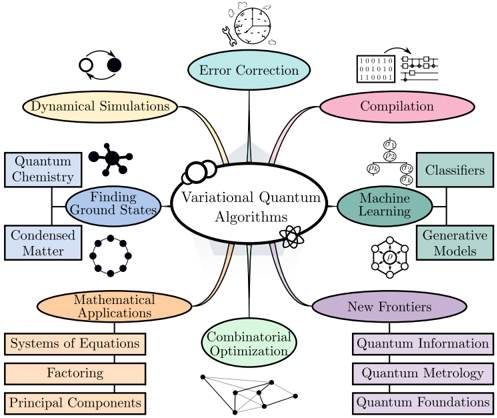
- VQAs have been proposed for essentially all applications envisioned for quantum computers, including finding ground and excited states, dynamical quantum simulation, combinatorial optimization, linear systems, compiling, error correction, machine learning, and metrology.
- Current state-of-the-art device size ranges from 50 to 100 qubits, and VQAs are argued to be the best hope for near-term quantum advantage because they keep circuit depth shallow and outsource parameter optimization to classical optimizers.
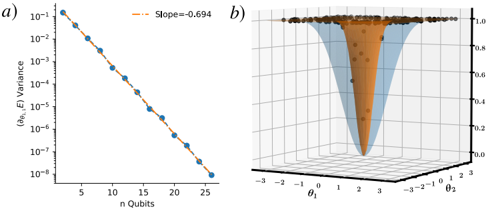
- Trainability is threatened by barren plateaus, where cost-function partial derivatives vanish exponentially with system size on average; noise can also induce barren plateaus regardless of the ansatz.
- Resource and scaling examples reported include: VQE requires \(O(1/\epsilon^2)\) measurements for precision \(\epsilon\), whereas quantum phase estimation requires \(O(\log(1/\epsilon))\); chemical Hamiltonians have Pauli-string counts scaling as \(n^4\), with commuting groupings reducing measurement scaling to \(n^3\); classical shadows scale logarithmically with \(n\); and a variational quantum linear solver study used \(n=10,\ldots,30\) qubits for Ising-inspired systems and \(n=2,\ldots,7\) qubits for random sparse linear systems.
Methods
- Design: narrative review/overview of the VQA field, not a primary experimental or theoretical study.
- Data or sample: no primary data or sample; the paper synthesizes prior literature and cites numerical and experimental results from other works.
- Main analysis: conceptual description of VQA architecture (cost function, ansatz, gradients, optimizers), applications, challenges, and opportunities for near-term quantum advantage.
Limitations
- The paper states that challenges remain including the trainability, accuracy, and efficiency of VQAs, and that barren plateaus could erase a potential quantum advantage.
- The paper states that the degree to which error mitigation can correct noise effects is still an open question, and that measurement efficiency is not guaranteed even without barren plateaus.
- Evident from the text: as a review, it presents no new experimental results, and many performance claims rely on cited heuristic or numerical studies rather than a systematic meta-analysis.
Model-written summary. Check it against the paper before relying on it.
Integrity signals
Registry
Cites
Statistics
Figures
Verification
Claims the paper makes
53 Valid · 74 Not valid · 51 Not checked · 84 Own results and interpretations
At least one cited source doesn’t support this claim or points to a different paper, and none confirmed it — see the verdicts below.
In the paper
“Hence, a VQA for factoring as a potential near-term alternative was introduced in Ref. [145].”
What the sources say
- Disputedcites [145] [145] Eric Anschuetz, Jonathan Olson, Alán Aspuru-Guzik, and Yudong Cao, 'Variational quantum factoring,' in International Workshop on Quantum Technology and Optimization Problems (Springer, 2019) pp. 74-85. - sourceExperimental — accuracy not yet measured
The Introduction says factoring is typically a longer-term application because of its high resource requirements, while identifying other applications as nearer term. The paper introduces variational quantum state diagonalization, not a variational algorithm for factoring. (LLM, conf=0.88)
Checked by a reasoning model — may be wrong.
plain- Asserted: passes — The authors put it forward as true.
- Checkable: passes — It can be checked against evidence.
- Load-bearing: unclear — It is unclear whether the paper’s conclusions depend on it.
- Based: passes — The paper gives a reason why it holds.
- Disputed
At least one cited source doesn’t support this claim or points to a different paper, and none confirmed it — see the verdicts below.
In the paper
“This qubit requirement can be reduced with the VQA of Ref. [113], which requires only n qubits.”
What the sources say
- Disputedcites [113] [113] M. Cerezo, Kunal Sharma, Andrew Arrasmith, and Patrick J Coles, 'Variational quantum state eigensolver,' arXiv preprint arXiv:2004.01372 (2020). - sourceExperimental — accuracy not yet measured
Section II B (p. 3) describes an (n+1)-qubit controlled sign flip in the proposed algorithm and says its cited implementation requires additional ancillas. That contradicts the claim that this VQA requires only n qubits; the paper discusses reductions in measurements and circuit depth, not a reduction to n qubits. (LLM, conf=0.84)
Checked by a reasoning model — may be wrong.
plainstates a cause- Asserted: passes — The authors put it forward as true.
- Checkable: passes — It can be checked against evidence.
- Load-bearing: unclear — It is unclear whether the paper’s conclusions depend on it.
- Based: passes — The paper gives a reason why it holds.
- Disputed
The cited sources that could be checked couldn’t confirm or dispute this claim.
In the paper
“The classical optimization problems associated with VQAs are expected to be NP-hard in general as they involve cost functions that can have many local minima [94].”
What the sources say
- Could not verifycites [94] [94] Lennart Bittel and Martin Kliesch, 'Training variational quantum algorithms is np-hard-even for logarithmically many qubits and free fermionic systems,' arXiv preprint arXiv:2101.07267 (2021). - sourceExperimental — accuracy not yet measured
The Introduction (p. 1) describes hybrid quantum-classical cost functions and the need for gradients, but does not address the complexity of optimizing them. Searches for “NP-hard,” “local minima,” and related terms found no passage saying that VQA optimization is generally NP-hard or attributing that difficulty to many local minima. (LLM, conf=0.74)
hedgedstates a cause- Asserted: passes — The authors put it forward as true.
- Checkable: passes — It can be checked against evidence.
- Load-bearing: unclear — It is unclear whether the paper’s conclusions depend on it.
- Based: passes — The paper gives a reason why it holds.
- Could not verify
The cited sources that could be checked couldn’t confirm or dispute this claim.
In the paper
“Numerical simulations showed that QVECTOR can find quantum codes that outperform existing ones [152].”
What the sources say
- Could not verifycites [152] [152] Peter D Johnson, Jonathan Romero, Jonathan Olson, Yudong Cao, and Alán Aspuru-Guzik, 'Qvector: an algorithm for device-tailored quantum error correction,' arXiv preprint arXiv:1711.02249 (2017). - sourceExperimental — accuracy not yet measured
The closest discussion in our copy, “Designing and controlling quantum systems” (p. 12), concerns machine-learning methods for improving quantum gates, not finding quantum codes. Searches for QVECTOR and for simulations of codes outperforming existing ones found no passage addressing the claim. (LLM, conf=0.76)
plainstates a cause- Asserted: passes — The authors put it forward as true.
- Checkable: passes — It can be checked against evidence.
- Load-bearing: passes — The paper’s conclusions depend on it.
- Based: passes — The paper gives a reason why it holds.
- Could not verify
The cited sources that could be checked couldn’t confirm or dispute this claim.
In the paper
“The importance of parameter initialization was made clear in Ref. [204] where it was noted that the optimal parameters in QAOA exhibit persistent patterns.”
What the sources say
- Could not verifycites [204] [204] Leo Zhou, Sheng-Tao Wang, Soonwon Choi, Hannes Pichler, and Mikhail D Lukin, 'Quantum approximate optimization algorithm: Performance, mechanism, and implementation on near-term devices,' Physical Review X 10 , 021067 (2020). - sourceExperimental — accuracy not yet measured
Appendix C (page unavailable) studies QAOA with parameters constrained to be equal across layers and describes that approach as suboptimal for the ring-of-disagrees problem. The Introduction and Conclusions discuss parameter correlation and trainability, but the passages found do not say that optimal QAOA parameters exhibit persistent patterns (searched: optimal parameters, QAOA patterns, initialization). (LLM, conf=0.76)
boosted- Asserted: passes — The authors put it forward as true.
- Checkable: passes — It can be checked against evidence.
- Load-bearing: passes — The paper’s conclusions depend on it.
- Based: passes — The paper gives a reason why it holds.
- Could not verify
125 more claims · 57 with their cited sources checked
Create a free account to see all 262 claims and to verify the 42 references still open.
- Probably not a substantial claim. 94
- It may state two separate claims as one. 57
Claims other papers make about this one
Each is checked against this paper’s own text: does it say what the citing paper says it does?
The source backs part of the claim, not all of it — or backs it for a different population, condition or comparison.
In the citing paper
“Google's recent proof of quantum supremacy is a major step forward for quantum computing [15].”
From Quantum Computing: Vision and Challenges (2025) · cites this paper as [15]
Experimental — accuracy not yet measuredThe cited source says what the claim attributes to it.
In the citing paper
“An important class of algorithms for NISQ hardware are socalled hybrid quantum-classical algorithms that partition the computational workload between a classical and a quantum computer.[124,125]”
From Quantum Computing for Molecular Biology** (2023) · cites this paper as [125]
The cited source says what the claim attributes to it.
In the citing paper
“In this regard, References [164] and [171] focus on gate-based algorithms that can be implemented on NISQ devices and therefore may be applied to various application areas with CO just as one example of those.”
From Quantum Combinatorial Optimization in the NISQ Era: A Systematic Mapping Study (2024) · cites this paper as [171]
Self-check
Percentages, sums and reported differences re-computed from the paper’s own numbers.
Each contradiction between two passages listed here was confirmed by an independent check.
Rated minor: it would not touch a result — a value no result rests on, a p-value that stays on the same side of the significance level, or a conflict that is clerical, resolved elsewhere in the paper, or outside its own findings.
In the paper
§ E. Error correction · p. 12
“two parametrized circuits V ( θ 1 ) (on n ≥ k qubits) and W ( θ 2 ) (on n + r qubits)”
§ E. Error correction · p. 12
“ρ out = W ( θ 1 ) V ( θ 1 )( ψ ⊗ | 0 〉〈 0 | ⊗ n -k + r ) V ( θ 1 ) † W ( θ 1 ) †”
Rated minor: it would not touch a result — a value no result rests on, a p-value that stays on the same side of the significance level, or a conflict that is clerical, resolved elsewhere in the paper, or outside its own findings.
In the paper
§ 1. Linear systems · p. 11
“the task is to prepare a normalized state | x 〉 such that A | x 〉 ∝ | b 〉”
§ 1. Linear systems · p. 11
“one can then construct a Hamiltonian whose ground state is the solution to the QLSP and apply a variational approach to minimize the cost C ( θ ) = 〈 ψ ( θ ) | H G | ψ ( ψ ) 〉 . Refs. [139-141] considered the Hamiltonian H G = A ( ✶ -| b 〉 〈 b | ) A †”
Citations
Cites
Adam: A Method for Stochastic Optimization
Kingma, D. P., & Ba, J. (2014) · arXiv · doi:10.48550/arxiv.1412.6980 · Cited by 98,946
Self-Consistent Equations Including Exchange and Correlation Effects
Kohn, W., & Sham, L. J. (1965) · Physical Review · doi:10.1103/physrev.140.a1133 · Cited by 64,135 · cited 1×
“Classical methods for materials simulations usually employ density-functional theory coupled with approximation methods, such as the local density approximation [234] to tackle weakly correlated materials.”
MethodQuantum Computing in the NISQ era and beyond
Preskill, J. (2018) · Quantum · doi:10.22331/q-2018-08-06-79 · Cited by 8,830 · cited 1×
“But excitement grew as to what could be done with these new devices, which have been called Noisy Intermediate-Scale Quantum (NISQ) computers [7].”
BackgroundAlgorithms for quantum computation: discrete logarithms and factoring
Shor, P. W. (2002) · Proceedings 35th Annual Symposium on Foundations of Computer Science · doi:10.1109/sfcs.1994.365700 · Cited by 8,713 · cited 1×
“Shor’s quantum algorithm was proposed to factor numbers with exponential speedup over classical methods [2], dynamical quantum simulation algorithms were developed [3], and quantum algorithms for solving linear systems of equations were identified [4].”
MethodQuantum Computation and Quantum Information: 10th Anniversary Edition
Nielsen, M. A., & Chuang, I. L. (2012) · doi:10.1017/cbo9780511976667 · Cited by 8,436
Quantum supremacy using a programmable superconducting processor
Arute, F., Arya, K., Babbush, R., Bacon, D., Bardin, J. C., Barends, R., Biswas, R., Boixo, S., Brandao, F. G. S. L., Buell, D. A., et al. (2019) · Nature · doi:10.1038/s41586-019-1666-5 · Cited by 7,720 · cited 1×
“This size actually allows one to achieve quantum supremacy, outperforming the best classical supercomputer, for certain contrived mathematical tasks [8, 9].”
BackgroundSelf-citationDensity matrix formulation for quantum renormalization groups
White, S. R. (1992) · Physical Review Letters · doi:10.1103/physrevlett.69.2863 · Cited by 7,702 · cited 1×
“These include approximate methods such as Hartree-Fock or density functional theory, or methods closely connected to quantum information, like the density matrix renormalization group approach that utilizes matrix product states as an ansatz [224, 225].”
MethodBiamonte, J., Wittek, P., Pancotti, N., Rebentrost, P., Wiebe, N., & Lloyd, S. (2017) · Nature · doi:10.1038/nature23474 · Cited by 4,779 · cited 1×
“to use quantum algorithms for machine learning applications [134, 148, 256, 257].”
MethodA variational eigenvalue solver on a photonic quantum processor
Peruzzo, A., McClean, J., Shadbolt, P., Yung, M.-H., Zhou, X.-Q., Love, P. J., Aspuru-Guzik, A., & O’Brien, J. L. (2014) · Nature Communications · doi:10.1038/ncomms5213 · Cited by 4,552 · cited 3×
“3, VQE is aimed at finding the ground state energy EG of a Hamiltonian H [16].”
BackgroundMethodSelf-citationQuantum Algorithm for Linear Systems of Equations
Harrow, A. W., Hassidim, A., & Lloyd, S. (2009) · Physical Review Letters · doi:10.1103/physrevlett.103.150502 · Cited by 3,325 · cited 2×
“The classical algorithmic complexity for this task scales polynomially in the dimension N , whereas the now-famous HHL quantum algorithm [4] has a complexity that scales logarithmically in N , with some scaling improvements having been proposed [113– 116].”
BackgroundMethod
Research works printed but not linked: 12
- [4] 'IBM Makes Quantum Computing Available on IBM Cloud to Accelerate Innovation,' (2016), press release at https://www-03.ibm.com/press/us/ en/pressrelease/49661.wss . -
- Bilkis, M., Cerezo, M., Verdon, G., Coles, P. J. & Cincio, L. A semi-agnostic ansatz with variable structure for quantum machine learning. Preprint at https://arxiv.org/abs/2103.06712 (2021). · arXiv
- [35] Arthur G Rattew, Shaohan Hu, Marco Pistoia, Richard Chen, and Steve Wood, 'A domain-agnostic, noiseresistant, hardware-efficient evolutionary variational quantum eigensolver,' arXiv preprint arXiv:1910.09694 (2019). - · arXiv
- [115] Guoming Wang, Dax Enshan Koh, Peter D Johnson, and Yudong Cao, 'Minimizing estimation runtime on noisy quantum computers,' Phys. Rev. X Quantum 2 , 010346 (2021). -
- [134] A Ambainis, 'Variable time amplitude amplification and a faster quantum algorithm for solving systems of linear equations 29th int,' in Symp. Theoretical Aspects of Computer Science (STACS 2012) , Vol. 14 (2012) pp. 636-47. -
- [159] Edwin Stoudenmire and David J Schwab, 'Supervised learning with tensor networks,' in Advances in Neural Information Processing Systems (2016) pp. 4799-4807. -
- [178] Lukas Franken and Bogdan Georgiev, 'Explorations in quantum neural networks with intermediate measurements,' in Proceedings of ESANN (2020). -
- [264] Bela Bauer, Dave Wecker, Andrew J Millis, Matthew B Hastings, and Matthias Troyer, 'Hybrid quantumclassical approach to correlated materials,' Physical Review X 6 , 031045 (2016). -
- [269] Hsuan-Hao Lu, Natalie Klco, Joseph M Lukens, Titus D Morris, Aaina Bansal, Andreas Ekström, Gaute Hagen, Thomas Papenbrock, Andrew M Weiner, Martin J Savage, et al. , 'Simulations of subatomic manybody physics on a quantum frequency processor,' Physical Review A 100 , 012320 (2019). -
- [271] Julian Bender, Erez Zohar, Alessandro Farace, and J Ignacio Cirac, 'Digital quantum simulation of lattice gauge theories in three spatial dimensions,' New Journal of Physics 20 , 093001 (2018). -
- [277] A Avkhadiev, PE Shanahan, and RD Young, 'Accelerating lattice quantum field theory calculations via interpolator optimization using noisy intermediate-scale quantum computing,' Physical Review Letters 124 , 080501 (2020). -
- [293] Yuval R Sanders, Dominic W Berry, Pedro CS Costa, Louis W Tessler, Nathan Wiebe, Craig Gidney, Hartmut Neven, and Ryan Babbush, 'Compilation of faulttolerant quantum heuristics for combinatorial optimization,' Physical Review X Quantum 1 , 020312 (2020).
Cited by
Items 1,901–2,000 of 3,232
Space-time trade-off in networked virtual distillation
Araki, T., Goodwin, J. F., & Koczor, B. (2025) · Physical Review A · doi:10.1103/t828-wvgl · Cited by 5
“Algorithms that are relatively robust to errors and therefore amenable to near-term quantum hardware have been proposed [1, 2], but noise levels on current devices are still limiting their practical efficacy [3].”
Distributing Quantum Computations, Shot-Wise
Bisicchia, G., Clemente, G., García-Alonso, J. M., Murillo, J. M., D’Elia, M., & Brogi, A. (2025) · Future Internet · doi:10.3390/fi17110507 · Cited by 15
“However, the shot-wise methodology could be applied even on a specific scenario (e.g., with Variation Quantum Algorithms (VQA) [12]) and optimize the calibration phase for that specific setting.”
Nonadiabatic molecular dynamics on quantum computers: challenges and opportunities
Gil, E. S., & González, L. (2025) · Pure and Applied Chemistry · doi:10.1515/pac-2025-0599 · Cited by 3
“97,98 The number of qubits required by an ansatz is generally proportional to the number of spin-orbitals included in the calculation.”
A Practical Quantum Solver for Multidimensional Partial Differential Equations
Chaudhary, M., El-Araby, K., Nobel, A., Islam, I., Singh, M., Ogundele, S., Egan, K., Thomas, S., Vordtriede, V., Bontrager, D., et al. (2025) · International Conference for High Performance Computing, Networking, Storage and Analysis (SC) · doi:10.1145/3731599.3767550 · Cited by 2
Variational Inference for Quantum HyperNetworks
Nepote, L., Lhéritier, A., Bondoux, N., Kountouris, M., & Filippone, M. (2025) · International Joint Conference on Neural Networks (IJCNN) · doi:10.1109/ijcnn64981.2025.11228637 · Cited by 2
“Specifically, we focus on Quantum Machine Learning (QML) and Variational Quantum Algorithms (VQAs) [10] to explore how quantum computing can be integrated into deep learning systems for more efficient and scalable training.”
Learning to Learn With Quantum Optimization Via Quantum Neural Networks
Chen, K., Matsuyama, H., & Huang, W. (2025) · IEEE International Conference on Quantum Computing and Engineering (QCE) · doi:10.1109/qce65121.2025.00172 · Cited by 8
“The QAOA and its variants [10], which are conceptually inspired by quantum annealing [42] and variational quantum algorithms [43], have been introduced to solve such combinatorial problems on noisy intermediate-scale quantum (NISQ) devices.”
Wadhwa, C., Lewis, L., Kashefi, E., & Doosti, M. (2025) · PRX Quantum · doi:10.1103/q2nb-zg9m · Cited by 16
Bhattacharyya, M., & Raina, A. (2026) · Quantum Information Processing · doi:10.1007/s11128-026-05074-8 · Cited by 3
“Variational quantum algorithms are an efficient alternative for such cases [14, 15].”
Variational Circuits as Machine Learning Models
Schuld, M., & Petruccione, F. (2021) · Quantum science and technology · doi:10.1007/978-3-030-83098-4_5 · Cited by 4
de Lima, E. F., Fernandes, M. E. F., & Castelano, L. K. (2022) · Physical Review A · doi:10.1103/physreva.105.032454 · Cited by 4
A Case for Noisy Shallow Gate-based Circuits in Quantum Machine Learning
Selig, P., Murphy, N., Ashwin Sundareswaran, R., Redmond, D., & Caton, S. J. (2021) · IEEE International Conference on Rebooting Computing (ICRC) · doi:10.1109/icrc53822.2021.00015 · Cited by 5
“An alternative direction makes use of variational circuits [12] which are suitable for the NISQ era.”
Quantum approximation of normalized Schatten norms and applications to learning
Chen, Y., Miyahara, H., Bouchard, L., & Roychowdhury, V. (2022) · Physical Review A · doi:10.1103/physreva.106.052409 · Cited by 4
“Researchers have started experimenting with quantum machine learning algorithms such as quantum neural networks (QNN) [5, 6] and quantum circuit learning [7–11] that are based on variational quantum algorithms [12, 13]; a recent work has studied the price of ansatz used in such variational methods[14].”
BackgroundNoise tailoring for robust amplitude estimation
Dalal, A., & Katabarwa, A. (2023) · New Journal of Physics · doi:10.1088/1367-2630/acb5bc · Cited by 8
Variational quantum semi-supervised classifier based on label propagation
Hou, Y.-Y., Li, J., Chen, X., & Ye, C. (2023) · Chinese Physics B · doi:10.1088/1674-1056/acb9fb · Cited by 3
The Role of Initial Entanglement in Adaptive Gibbs State Preparation on Quantum Computers
Economou, S. E., Warren, A., & Barnes, E. (2023) · IEEE International Conference on Acoustics Speech and Signal Processing · doi:10.1109/icassp49357.2023.10094697 · Cited by 7
“One such family of problems involves the creation of entangled many-qubit states that represent the ground states of molecules or other quantum systems of interest [1, 2, 3].”
BackgroundQuantum algorithm for twin extreme learning machine
Ning, T., Yang, Y., & Du, Z. (2023) · Physica Scripta · doi:10.1088/1402-4896/ace485 · Cited by 2
Netzer, G., & Markidis, S. (2023) · ACM International Conference on Computing Frontiers (CF) · doi:10.1145/3587135.3592191 · Cited by 4
“Hybrid algorithms, such as Shor’s algorithm or the quantum variational eigensolvers [1] or emerging quantum machine learning [9], partition the computation into both a quantum and classical part that work together to solve a given problem.”
MethodVariational Quantum Circuit Topology Grid Search for Hypocalcemia Following Thyroid Surgery
Salmeron, J. L., & Fernández-Palop, I. (2023) · Mathematics · doi:10.3390/math11173659 · Cited by 2
Towards real-world implementations of quantum machine learning
Liu, J. (2023) · doi:10.22331/qv-2023-11-29-77 · Cited by 2
Invited Paper: Introduction to Hybrid Quantum-Classical Programming Using C++ Quantum Extension
Wu, X.-C., Premaratne, S., & Rasch, K. (2023) · doi:10.1109/iccad57390.2023.10323946 · Cited by 5
Comparing Quantum Service Offerings
Obst, J., Barzen, J., Beisel, M., Leymann, F., Salm, M., & Truger, F. (2023) · IEEE International Conference on Quantum Computing and Engineering (QCE) · doi:10.1109/qce57702.2023.10206 · Cited by 6
“QAOA is a Variational Quantum Algorithm (VQA) , i.e., it employs a classical optimizer to train a parameterized quantum circuit [11].”
MethodAn Energy Estimation Benchmark for Quantum Computing Hardware
Woitzik, A. J. C., Hoffmann, L., Buchleitner, A., & Carnio, E. G. (2024) · Open Systems & Information Dynamics · doi:10.1142/s1230161224500069 · Cited by 6
Practical limitations of quantum data propagation on noisy quantum processors
Saxena, G., Shalabi, A., & Kyaw, T. H. (2024) · Physical Review Applied · doi:10.1103/physrevapplied.21.054014 · Cited by 3
“In the current noisy intermediate-scale quantum (NISQ) era [8], many interesting practical applications are evaluated through hybrid quantum-classical algorithms otherwise known as NISQ algorithms [9–11].”
MethodEnhancing scalability and accuracy of quantum poisson solver
Saha, K. K., Robson, W., Howington, C., Suh, I., Wang, Z., & Nabrzyski, J. (2024) · Quantum Information Processing · doi:10.1007/s11128-024-04420-y · Cited by 10
Mesman, K. J., Battistel, F., Reehuis, E., de Jong, D., Tiggelman, M. J., Gloudemans, J., van Oven, J. C., & Bultink, C. C. (2024) · IEEE International Conference on Quantum Software (QSW) · doi:10.1109/qsw62656.2024.00026 · Cited by 5
“In recent trends, hybrid classical/quantum algorithms are preferred [13].”
BackgroundDynamical transition in controllable quantum neural networks with large depth
Zhang, B., Liu, J., Wu, X.-C., Jiang, L., & Zhuang, Q. (2024) · Nature Communications · doi:10.1038/s41467-024-53769-2 · Cited by 10
“As a paradigm of near-term quantum computing, variational quantum algorithms 1 – 6 have been widely applied to chemistry 1,7 , optimization 2,8 , quantumsimulation 9,10 ,condensedmatterphysics 11 ,communication 12,13 , sensing 14,15 and machine learning 16 – 23 .”
MethodBounding entanglement entropy with Clifford double cosets
Keeler, C. A., Munizzi, W., & Pollack, J. (2025) · Physical Review A · doi:10.1103/hfhg-2z68 · Cited by 12
“In this paper, we generated all ( HC ) 1 , 2 and C 2 contracted graphs for n -qubit Dicke states, a class of non-stabilizer states heavily utilized in optimization algorithms [56, 57].”
Subuniversal variational circuits for combinatorial optimization problems
Weitz, G., Pira, L., Ferrie, C., & Combes, J. (2025) · Physical Review A · doi:10.1103/v1sh-fg6f · Cited by 9
“There is much interest in constructing parameterized quantum circuits as variational ansatzes to solve mathematical problems [1].”
Lee, J., & Kim, S. (2025) · Advances in computers · doi:10.1016/bs.adcom.2025.06.002 · Cited by 4
Variational Quantum Algorithms for Computational Fluid DynamicsPreprint
Jaksch, D., Givi, P., Daley, A. J., & Rung, T. (2022) · arXiv (Cornell University) · doi:10.48550/arxiv.2209.04915 · Cited by 2
“This approach to quantum computing has been rapidly developed over the past years, and has several beneficial properties for NISQ era devices [9].”
Algorithm-Aware Qubit MappingPreprint
Ji, Y., & Polian, I. (2023) · doi:10.36227/techrxiv.21786146 · Cited by 1
Qubit-Efficient Randomized Quantum Algorithms for Linear AlgebraPreprint
Wang, S., McArdle, S., & Berta, M. (2023) · arXiv (Cornell University) · doi:10.48550/arxiv.2302.01873 · Cited by 1
“Looking beyond NISQ technologies [1–3], it is reasonable to assume that, given continued progress in quantum hardware, so-called fault-tolerant algorithms will have an important place in the gamut of quantum computing applications.”
BackgroundError Estimation in Current Noisy Quantum ComputersPreprint
Borge, J., Aseguinolaza, U., Sobrino, N., Sobrino, G., & Jornet-Somoza, J. (2023) · SSRN Electronic Journal · doi:10.2139/ssrn.4537154 · Cited by 2
Automatic Generation of Efficient Oracles: The Less-Than CasePreprint
Sanchez-Rivero, J., Talaván, D., García-Alonso, J. M., et al. (2023) · SSRN Electronic Journal · doi:10.2139/ssrn.4594664 · Cited by 2
A Quantum LSTM Based Approach to Cyber Threat Detection in Virtual EnvironmentPreprint
Tripathi, S. M., Upadhyay, H., & Soni, J. (2024) · Research Square · doi:10.21203/rs.3.rs-4118482/v1 · Cited by 2
Xu, Z., Yang, T., Cai, P., Shen, K., Hu, Y., Lv, B., Chen, S., Zhu, Y., Wu, Z., Wang, J., et al. (2024) · Research Square · doi:10.21203/rs.3.rs-4195599/v1 · Cited by 3
Graph Neural Networks for Parameterized Quantum Circuits Expressibility Estimation (Rev.1)
Aktar, S., (NNSA), U. N. N. S. A., Bärtschi, A., Badawy, A. A., Oyen, D., & Eidenbenz, S. (2024) · OSTI OAI (U.S. Department of Energy Office of Scientific and Technical Information) · doi:10.2172/2350603 · Cited by 2
Le, D.-T., Nguyen, V.-L., Nguyen, H. C., Nguyen, H. Q., & Nguyen, V.-D. (2025) · Research Square · doi:10.21203/rs.3.rs-6497487/v1 · Cited by 3
Yahweh, B., Ekanem, A. M., George, N. J., Oduntan, E. O., Mohammed, S. S. N., Abdulhamid, A., Takim, B. N., Ante, J. E., Emmanuel, Y., & Essang, S. O. (2025) · Research Square · doi:10.21203/rs.3.rs-7262536/v1 · Cited by 1
A Quantum Compass for Materials Discovery: Navigating the Combinatorial Explosion
Kim, K. S. (2025) · ACS Central Science · doi:10.1021/acscentsci.5c01713 · Cited by 2
Yahweh, B., Ekanem, A. M., George, N. J., Oladapo, K. A., Edet, J., Oluwatobiloba, O., Essang, S. O., Oduntan, E. O., Mohammed, S. S. N., Abdulhamid, A., et al. (2025) · Research Square · doi:10.21203/rs.3.rs-7895822/v1 · Cited by 2
Mineh, L., & Montanaro, A. (2022) · Physical review. B./Physical review. B · doi:10.1103/physrevb.105.125117 · Cited by 32
Govia, L. C. G., Poole, C., Saffman, M. E., & Krovi, H. (2021) · Physical Review A · doi:10.1103/physreva.104.062428 · Cited by 20
Iterative Refinement for Variational Quantum Linear Solver
Saito, Y., Lee, X., Cai, D., Shin, J., & Asai, N. (2023) · Lecture notes in networks and systems · doi:10.1007/978-981-99-3878-0_2 · Cited by 5
Möller, M. (2023) · Computational methods in applied sciences · doi:10.1007/978-3-031-29082-4_21 · Cited by 3
Arbitrary Ground State Observables from Quantum Computed Moments
Vallury, H. J., & Hollenberg, L. C. L. (2023) · IEEE International Conference on Quantum Computing and Engineering (QCE) · doi:10.1109/qce57702.2023.00040 · Cited by 3
“This has been a popular road to follow towards the development of near-term applications of quantum computers, with much of the recent focus primarily on variational quantum algorithms [1]–[3].”
BackgroundVariational quantum entanglement classification discrimination
Wang, S., Shen, Y., Liu, X., Zhang, H., & Wang, Y. (2024) · Physica A Statistical Mechanics and its Applications · doi:10.1016/j.physa.2024.129530 · Cited by 4
HQNET: Harnessing Quantum Noise for Effective Training of Quantum Neural Networks in NISQ Era
Kashif, M., & Shafique, M. (2025) · IEEE International Conference on Quantum Artificial Intelligence (QAI) · doi:10.1109/qai63978.2025.00066 · Cited by 23
“Variational Quantum Algorithms (VQAs) are a class of quantum algorithms that have emerged as a promising approach for leveraging the capabilities of NISQ devices [10].”
Hull, I., Sattath, O., Diamanti, E., & Wendin, G. P. (2024) · Contributions to economics · doi:10.1007/978-3-031-50780-9_3 · Cited by 2
Goto, H. (2024) · Journal of the Atomic Energy Society of Japan · doi:10.3327/jaesjb.66.4_185 · Cited by 1
A Gradient-Based Adaptive Quantum-behaved Particle Swarm Optimization
Mei, H., Zhang, J., Wang, Q., Wu, Y.-C., & Guo, G. (2024) · International Conference on Advanced Algorithms and Control Engineering (ICAACE) · doi:10.1109/icaace61206.2024.10548727 · Cited by 2
“Many fields such as quantum computing [1], artificial intelligence [2], and engineering [3] can model complex problems as function optimization problems.”
BackgroundFinding eigenvectors with a quantum variational algorithm
García-Escartín, J. C. (2024) · Quantum Information Processing · doi:10.1007/s11128-024-04461-3 · Cited by 3
“This approach based on using quantum circuits with a classical control also plays a key role in quantum machine learning [11–15].”
Dense outputs from quantum simulations
Liu, J.-P., & Lin, L. (2024) · Journal of Computational Physics · doi:10.1016/j.jcp.2024.113213 · Cited by 5
Scalable and Differentiable Simulator for Quantum Computational Chemistry
Xu, Z., Shang, H., Fan, Y., Zeng, X., Zhang, Y., & Guo, C. (2024) · IEEE International Parallel and Distributed Processing Symposium (IPDPS) · doi:10.1109/ipdps57955.2024.00028 · Cited by 1
“…(VQE) is a near-term quantum algorithm for quantum chemistry problems that is much less resource-demanding compared to the quantum phase estimation al-gorithm in terms of the number of qubits, the depth and structure of quantum circuits and is believed to be more robust against noises [19]–[21].”
BackgroundGlobal optimization in variational quantum algorithms via dynamic tunneling method
Park, S., Baek, K., Lee, S., & Choi, M. (2024) · New Journal of Physics · doi:10.1088/1367-2630/ad64fc · Cited by 1
“We test the performance of the method with numerical simulation on the variational quantum eigensolver (VQE), one of the main applications of the VQA that seeks the ground-state energy of the given Hamiltonian.”
Gate-based quantum neurons in hybrid neural networks
Lu, C., Hu, M., Miao, F., & Hou, J. (2024) · New Journal of Physics · doi:10.1088/1367-2630/ad6f3d · Cited by 1
“This is usually the most important and complicated component and previous works on either QDNNs or HQDNNs tend to apply well-known variational ansatz like RealAmplitudes (RA) [46, 55] and quantum circuit Born machines (QCBMs) [37, 56], which are demonstrated in figures 1(b1) and (b2) respectively.”
Quantum Kernel Methods for Insar Phase Unwrapping
Glatting, K., Meyer, J., Huber, S., & Krieger, G. (2024) · IEEE International Geoscience and Remote Sensing Symposium (IGARSS) · doi:10.1109/igarss53475.2024.10640390 · Cited by 1
DiBrita, N. S., Leeds, D., Huo, Y., Ludmir, J., & Patel, T. (2024) · doi:10.1145/3676536.3676697 · Cited by 6
Resource-efficient quantum algorithm for linear systems of equations
Ghisoni, F., Scala, F., Bajoni, D., & Gerace, D. (2026) · Physical Review A · doi:10.1103/gwzg-4pls · Cited by 6
“In the meantime, so called Variational Quantum Algorithms (VQAs) [30] have been developing as a class of hybrid classical-quantum algorithms to make use of the available NISQ hardware in the nearest terms.”
Efficient large-scale quantum optimization via counterdiabatic ansatz
Liu, J., & Wang, X. (2025) · Physical Review A · doi:10.1103/physreva.111.052628 · Cited by 3
“Variational Quantum Algorithms (VQAs) provide an efficient way to tackle complex problems by merging classical optimization techniques with quantum computing circuits [1– 8].”
Quantum-data-driven dynamical transition in quantum learning
Zhang, B., Liu, J., Jiang, L., & Zhuang, Q. (2025) · npj Quantum Information · doi:10.1038/s41534-025-01079-w · Cited by 6
Chasing shadows with Gottesman-Kitaev-Preskill codes
Conrad, J., Eisert, J., & Flammia, S. T. (2026) · Quantum · doi:10.22331/q-2026-01-19-1973 · Cited by 5
“On the other hand, quantum experiments are being conducted to understand practical capabilities of present noisy quantum devices, e.g., through variational quantum algorithms [5], or to benchmark the readily accessible “quantumness" [6] through randomized sampling experiments.”
Quantum computing for partial differential equations in practice
Neumann, N. M. P., Verbree, J., & Hoek, C. R. (2024) · SPIE Quantum Technologies for Defence and Security · doi:10.1117/12.3033212 · Cited by 1
“6 9 In these variational algorithms a circuit with multiple free parameters is considered.”
When quantum and classical models disagree: learning beyond minimum norm least square
Thabet, S., Monbroussou, L., Mamon, E. Z., & Landman, J. (2026) · npj Quantum Information · doi:10.1038/s41534-026-01217-y · Cited by 13
“Another heavily explored area is the use of variational quantum circuits (VQCs) 9 to learn some functions of the data 10 .”
Sarsengeldin, M. M., Ahmad, Z., & Bağcı, U. (2024) · IEEE Holm Conference on Electrical Contacts (HOLM) · doi:10.1109/holm56222.2024.10768556 · Cited by 1
Quantum kernel t-distributed stochastic neighbor embedding
Kawase, Y., Mitarai, K., & Fujii, K. (2024) · Physical Review Research · doi:10.1103/physrevresearch.6.043234 · Cited by 1
Self-citationA Novel Single-Layer Quantum Neural Network for Approximate SRBB-Based Unitary Synthesis
Belli, G., Mordacci, M., & Amoretti, M. (2026) · Quantum · doi:10.22331/q-2026-03-20-2034 · Cited by 5
Wybo, E., & Leib, M. (2024) · Quantum · doi:10.22331/q-2024-12-10-1554 · Cited by 4
“Variational quantum algorithms are considered valuable candidates for providing useful quantum-computational results on near-term devices [1, 2].”
Shin, M., Lee, S., Lee, J., Lee, M., Ji, D., Yeo, H., & Jeong, K. (2024) · Physical Review A · doi:10.1103/physreva.110.062418 · Cited by 5
“Our DEQNN has significance as it is the first to propose a variational quantum algo-rithm [51] approach that reduces the Hilbert space while preserving these physical quantities.”
Short-time simulation of quantum dynamics by Pauli measurements
Faehrmann, P. K., Eisert, J., Kieferová, M., & Kueng, R. (2025) · Physical Review A · doi:10.1103/6ggs-y392 · Cited by 7
“…estimating the energy of some trial states necessary for the variational quantum eigensolver and most other variational quantum algorithms [14–16], such methods can also be used to estimate expectation values of observables with small Frobe-∗ nius norms, such as overlaps with pure states…”
Finding dense sublattices as low energy states of a Hamiltonian
Barberà-Rodríguez, J., Gama, N., Narayanan, A. K., & Joseph, D. (2024) · Physical Review Research · doi:10.1103/physrevresearch.6.043279 · Cited by 5
A practical quantum Hoare logic with classical variables, I
Ying, M. (2026) · Information and Computation · doi:10.1016/j.ic.2026.105417 · Cited by 14
Sparse non-Markovian Noise Modeling of Transmon-Based Multi-Qubit Operations
Oda, Y., Schultz, K., Norris, L., Shehab, O., & Quiroz, G. (2026) · PRX Quantum · doi:10.1103/lx8x-z29x · Cited by 12
On the Quantum Impact in Hybrid Classical-Quantum Transfer Learning
Sünkel, L., Altmann, P. J., Kölle, M., & Gabor, T. (2024) · IEEE International Conference on Quantum Computing and Engineering (QCE) · doi:10.1109/qce60285.2024.10244 · Cited by 1
“Variational quantum circuits (VQCs) [1], [3] are popular in quantum machine learning (QML) in the current era of quantum computing as they only require few qubits and a relatively low depth.”
He, Z., Re, L. D., Kemper, A. F., & Freericks, J. K. (2025) · Physical review. B./Physical review. B · doi:10.1103/p1mq-8xbg · Cited by 3
Hybrid Quantum-Classical Neural Networks and its Hyperparameter Optimization-A Study
Adithya, R., Dsa, J., Adarsh Rag, S., et al. (2024) · doi:10.1109/cosmic63293.2024.10871871 · Cited by 1
Sheng, Z., Li, W., & Shuai, Z. (2025) · Chinese Science Bulletin (Chinese Version) · doi:10.1360/tb-2024-1150 · Cited by 1
From Bits to Qubits: Challenges in Classical-Quantum Integration
Kulkarni, S. P., & Bethel, E. W. (2024) · IEEE International Conference on High Performance Computing, Data, and Analytics · doi:10.1109/hipc62374.2024.00025 · Cited by 3
“For example, Phillipson et al. [26] categorize hybrid computing approaches from a software architecture perspective, including models like Variational Quantum Algorithms (VQAs)[6], which iterate between quantum and classical computations to optimize solutions.”
Efficient particle-conserving symmetric quantum circuits
Ayeni, B. M. (2025) · Physical Review A · doi:10.1103/physreva.111.022629 · Cited by 7
Role of quantum computing in accelerating drug discovery process
Ganesan, N., Rahul, R., & Sidharth, S. S. (2025) · Elsevier eBooks · doi:10.1016/b978-0-443-30146-9.00013-7 · Cited by 3
Cheaper and more noise-resilient quantum state preparation using eigenvector continuation
Agrawal, A. A., Getelina, J. C., Francis, A., & Kemper, A. F. (2025) · Physical Review A · doi:10.1103/physreva.111.032607 · Cited by 4
Feedback-Based Quantum Algorithm for Constrained Optimization Problems
Rahman, S. A., Karabacak, Ö., & Wiśniewski, R. (2025) · Lecture notes in computer science · doi:10.1007/978-3-031-85700-3_20 · Cited by 9
“Two primary challenges VQAs face are the design of the ansatz and the need to solve a challenging classical optimization problem to update the parameters of the parameterized quantum circuit [2].”
BackgroundMethodDey, A., & Shrivastava, J. N. (2024) · Global AI Summit - International Conference on Artificial Intelligence and Emerging Technology (AI Summit) · doi:10.1109/globalaisummit62156.2024.10947885 · Cited by 1
“NISQ algorithms are the preeminent expectation for attaining quantum benefit in the fields such as quantum chemistry, optimization, and machine learning [17, 18, 19].”
Zhou, X., Wang, Y., Tao, W., Zhou, Z., & Luo, L. (2025) · Advanced Quantum Technologies · doi:10.1002/qute.202500067 · Cited by 1
A novel approach to reduce derivative costs in variational quantum algorithms
Minuto, G., Melegari, D., Caletti, S., & Solinas, P. (2025) · Journal of Physics A Mathematical and Theoretical · doi:10.1088/1751-8121/adcf62 · Cited by 3
Performance analysis of a filtering variational quantum algorithm
Marin-Sanchez, G., & Amaro, D. (2025) · New Journal of Physics · doi:10.1088/1367-2630/add365 · Cited by 4
“Through iterative adjustments, they approximate operations, adapt to diverse hardware and noise patterns [17, 18].”
Topical issue on quantum computing in low-energy nuclear theory
Ayral, T., Duguet, T., Lacroix, D., & Somà, V. (2025) · The European Physical Journal A · doi:10.1140/epja/s10050-025-01575-9 · Cited by 1
“In this context, there is presently a lot of scientific emulation and excitement among physicists, chemists, engineers and computer scientists to invent NISQ-friendly algorithms [13,14].”
Efficient estimation and sequential optimization of cost functions in variational quantum algorithms
Umer, M., Mastorakis, E., & Angelakis, D. G. (2025) · Quantum Science and Technology · doi:10.1088/2058-9565/add55e · Cited by 7
“One of the prominent areas of research for capitalizing NISQ devices is the development of variational quantum algorithms (VQAs) [9, 10], with applications spanning disciplines such as quantum chemistry [11–17], finance [18–20], fluid dynamics [21–23], quantum dynamics [24–26], optimization…”
Variational quantum Hamiltonian engineering
Zhao, B., & Fujii, K. (2025) · Physical Review Research · doi:10.1103/physrevresearch.7.023123 · Cited by 3
Self-citationHigh-fidelity initialization of a logical qubit with multiple injections
He, Z., & Xue, Z. (2025) · Physical Review A · doi:10.1103/physreva.111.052419 · Cited by 4
Computable Model-Independent Bounds for Adversarial Quantum Machine Learning
Li, B., Alpcan, T., Thapa, C., & Parampalli, U. (2025) · IEEE Transactions on Quantum Engineering · doi:10.1109/tqe.2025.3569922 · Cited by 8
“It achieved a comparable complexity scaling to the first algorithm of adversarial risk lower bound estimation [20].”
Computable and Faithful Lower Bound on Entanglement Cost
Wang, X., Jing, M., & Zhu, C. (2025) · Physical Review Letters · doi:10.1103/physrevlett.134.190202 · Cited by 12
Applications of Hybrid Machine Learning Methods to Large Datasets: A Case Study
Maragkopoulos, G., Stefanakos, N., Mandilara, A., & Syvridis, D. (2025) · International Conference on Quantum Communications, Networking, and Computing (QCNC) · doi:10.1109/qcnc64685.2025.00114 · Cited by 1
“Specifically, we demonstrate that replacing a deep classical neural network with a thoughtfully designed Variational Quantum Circuit (VQC) in an ML pipeline for multiclass classification of time-series data yields the same classification performance, while significantly reducing the number of…”
Quantum Algorithms for Reconfigurable Intelligent Surface Optimization: Barren Plateaus Analysis
Colella, E., Bastianelli, L., Primiani, V. M., Moglie, F., & Gradoni, G. (2025) · European Conference on Antennas and Propagation · doi:10.23919/eucap63536.2025.10999170 · Cited by 2
“These algorithms combine quantum computation with classical optimization to find near-optimal solutions to complex problems [4].”
The Symmetry‐Based Expressive QAOA for the MaxCut Problem
Xiumei, Z., Li, Y., Li, G., Shi, Y., Qin, S., & Gao, F. (2025) · Advanced Quantum Technologies · doi:10.1002/qute.202500199 · Cited by 7
Self-attention U-Net decoder for toric codes
Zhang, W., Xia, Z., Zhao, W., Pan, W., & Shi, H. (2025) · Physical Review Applied · doi:10.1103/xmp9-bh84 · Cited by 3
“…computers possess parallel computing capabilities that classical computers lack and have demonstrated their advantage in various fields including cryptography [2, 3], database searches [4–6], combinatorial optimization [7, 8], molecular dynamics simulations [9, 10], and machine learning [11–13].”
Efficient Quantum Algorithm for Weighted Partial Sums and Numerical Integration
Shukla, A., & Vedula, P. (2025) · Advanced Quantum Technologies · doi:10.1002/qute.202500084 · Cited by 5
“…goal is to compute the partial sum for any given M , with 1 M ≤ N = 2 n , where f = ( ) is the given normalized input vector, i.e., This problem is directly related to numerical integration, where partial sums are used as a discrete approximation to integrals of functions defined over intervals.”
Evaluating Parameter-Based Training Performance of Neural Networks and Variational Quantum Circuits
Kölle, M., Feist, A., Stein, J., Wölckert, S., & Linnhoff–Popien, C. (2025) · Lecture notes in computer science · doi:10.1007/978-3-031-97635-3_33 · Cited by 4
Variational-toolbox-based separability detection of multiqubit states
Liang, J.-M., Fei, S.-M., & He, Q. (2025) · Physical Review A · doi:10.1103/44wv-9qlf · Cited by 1
“Current VQAs focus on constructing PQCs and learning an optimal PQC to encode specific states by a hybrid quantum-classical optimization process [24, 25].”
Shi, H. J., 韩, C. 成. H., 王, P. 鹏. W., & Zhang, M. (2025) · Chinese Physics B · doi:10.1088/1674-1056/adefd7 · Cited by 1
Metadata
- Authors
- Cerezo, M., Arrasmith, A., Babbush, R., Benjamin, S. C., Endo, S., Fujii, K., McClean, J. R., Mitarai, K., Yuan, X., Cincio, L., & Coles, P. J.
- Affiliations
- Los Alamos National Laboratory (US)
- Google (United States) (US)
- University of Oxford (GB)
- NTT (Japan) (JP)
- RIKEN (JP)
- Japan Science and Technology Agency (JP)
- Peking University (CN)
- Corresponding author
- Cerezo, M.
- Coles, Patrick J.
- Venue
- Nature Reviews Physics
- Published
- 2021-08-12
- Volume
- 3
- Issue
- 9
- Pages
- 625-644
- ISSN
- 2522-5820 (ISSN-L)
- OpenAlex
- W3111162498
- Semantic Scholar
- c1cf657d1e13149ee575b5ca779e898938ada60a
- Cited by
- 3,385
- References
- 200
- Citations by year
- 2026: 874 · 2025: 896 · 2024: 699 · 2023: 521 · 2022: 317 · 2021: 78
- FWCI
- 29.21
- Type
- journal article
- Language
- en
- Open access
- green
- arxiv.org
- Licence
- www.springernature.com/gp/researchers/text-and-data-mining (tdm)
- www.springernature.com/gp/researchers/text-and-data-mining (vor)
- Locations
- Nature Reviews Physics (publishedVersion)
- arXiv (Cornell University) (publishedVersion)
- OSTI OAI (U.S. Department of Energy Office of Scientific and Technical Information) (submittedVersion, cc-by)
- arXiv (Cornell University)
- Funders
- U.S. Department of Energy (#89233218CNA000001, KA2401032, DE-AC52-06NA2-5396, AC52-06NA25396, 20190065DR)
- Ministry of Education, Culture, Sports, Science and Technology (JPMXS0118068682, JPMXS0118067394, JP-MXS0120319794, CREST)
- Office of Science (89233218CNA000001, KA2401032, DE-AC52-06NA25396)
- National Nuclear Security Administration (DEAC52- 06NA25396, 89233218C-NA000001)
- Horizon 2020 Framework Programme (820495)
- Engineering and Physical Sciences Research Council (820495, M013243/1, EP/T001062/1, EP/M013243/1, T001062, H2020)
- Japan Society for the Promotion of Science (JPMXS0118067394, 20K22330, JPMJER1601, JPMXS0120319794, CREST, 16H02211)
- Advanced Scientific Computing Research (DE-AC52-06NA25396, 89233218CNA000001)
- Laboratory Directed Research and Development (20200056DR, DE-AC52-06NA2-5396, 89233218CNA000001, 20190065DR, 20180628ECR)
- Core Research for Evolutional Science and Technology (JPMJCR1673)
- Precursory Research for Embryonic Science and Technology (JPMJPR2019)
- Exploratory Research for Advanced Technology (JPMJER1601)
- Los Alamos National Laboratory (20200056DR, 89233218CNA 000001, KA2401032, AC52-06NA25396, 20180628ECR, 20190065DR, DE-AC52-06NA25396)
- Topics
- Physical Sciences › Computer Science › Artificial Intelligence › Quantum Computing Algorithms and Architecture
- Physical Sciences › Physics and Astronomy › Atomic and Molecular Physics, and Optics › Quantum many-body systems
- Physical Sciences › Physics and Astronomy › Atomic and Molecular Physics, and Optics › Quantum Information and Cryptography
- Keywords
- variational quantum algorithms, variational quantum circuits, quantum advantage, near-term quantum computing, quantum chemistry simulation, quantum linear algebra, trainability, noisy quantum hardware, classical optimization
About these checks
Registry, retraction, Cites and statistics results are computed, not judged, with one exception: a printed reference that no index lists is read once by a model before it counts as a citation error. Claims are extracted by a model and kept only when their quote appears verbatim in the text; each cited source is then checked, with a model’s help, for whether it says what the claim relies on. Those verdicts can be wrong — read the claim’s quote and the cited source before relying on one.
The claim verdicts this report counts are experimental: their accuracy is not yet measured.
A language model drew the claims from the paper on 2026-10-10, under version 3 of the claim definition (model deepseek-v4.1-flash, prompt extract-v3).
A second model labelled each claim on 2026-10-10 (model jev-1.13-20260917, definition revision gold-guideline-v0.2).
Cited sources are checked with a language model’s help (gpt-6-sol).
Statistics and arithmetic are recomputed, not judged.
Confidence bands are shown only for fields calibrated on our annotated test set. None is calibrated yet, so no band is shown.
What counts as a claim ›How we measure confidence ›How we check this ›
Are you an author, or do you see a problem with this page? Request a review
Data sources
Bibliographic data: Semantic Scholar, OpenAlex, Crossref.
Contains information from the Semantic Scholar Academic Graph Datasets, made available under the ODC Attribution License (ODC-BY 1.0).
Semantic Scholar’s data is described in: Kinney, R., et al. (2023). The Semantic Scholar Open Data Platform. arXiv:2301.10140.
