

Augmenting large language models with chemistry tools
Open accessThe DOI matches its Crossref record; 94 of the 94 references it cites were found in a registry or an index.
Abstract
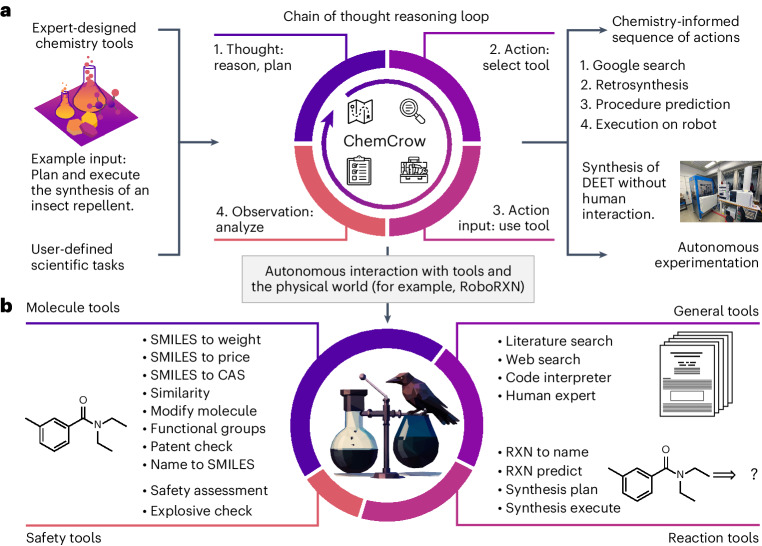
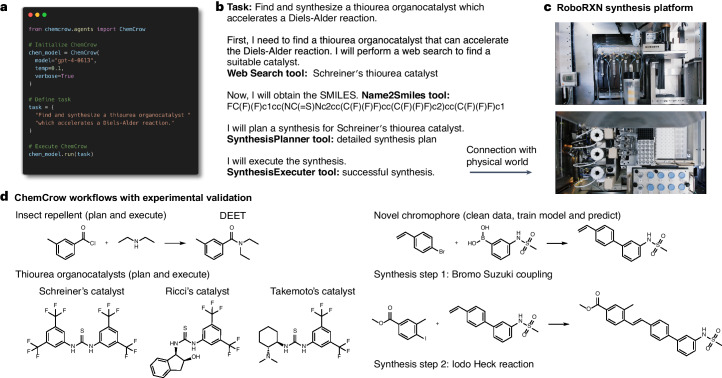
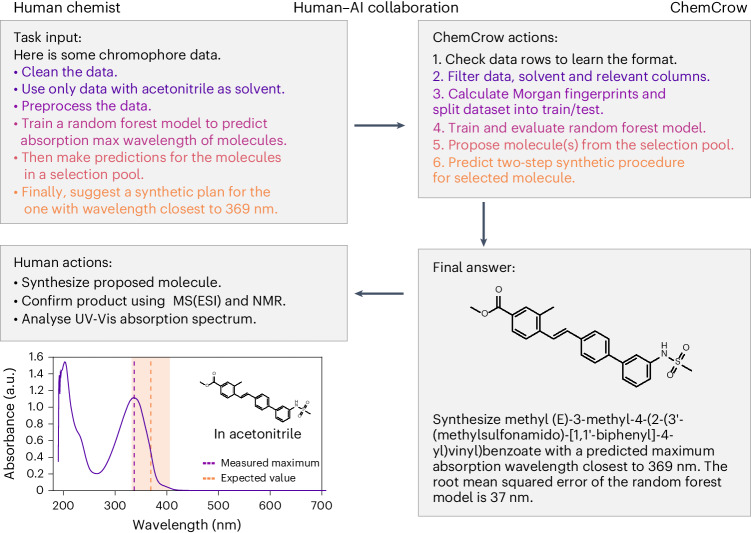
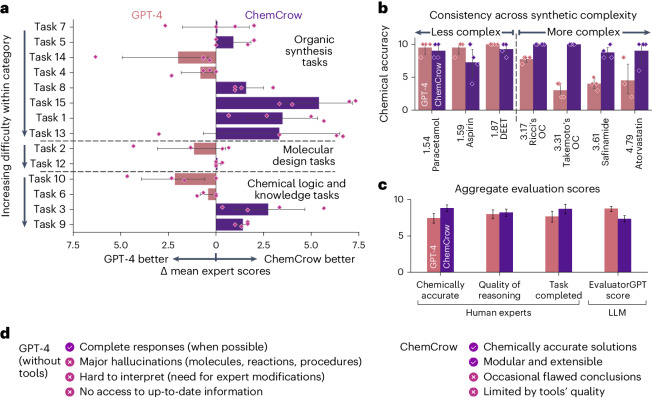
Large language models (LLMs) have shown strong performance in tasks across domains but struggle with chemistry-related problems. These models also lack access to external knowledge sources, limiting their usefulness in scientific applications. We introduce ChemCrow, an LLM chemistry agent designed to accomplish tasks across organic synthesis, drug discovery and materials design. By integrating 18 expert-designed tools and using GPT-4 as the LLM, ChemCrow augments the LLM performance in chemistry, and new capabilities emerge. Our agent autonomously planned and executed the syntheses of an insect repellent and three organocatalysts and guided the discovery of a novel chromophore. Our evaluation, including both LLM and expert assessments, demonstrates ChemCrow’s effectiveness in automating a diverse set of chemical tasks. Our work not only aids expert chemists and lowers barriers for non-experts but also fosters scientific advancement by bridging the gap between experimental and computational chemistry.
Overview
The claims and statistics of this paper haven’t been checked yet.
Free: it reads the open-access text and checks the first 5 claims that cite a source we can check. Create a free account to check every claim.
Integrity signals
Registry
Cites
Statistics
Figures
Verification
Claims the paper makes
The claims and statistics of this paper haven’t been checked yet.
Free: it reads the open-access text and checks the first 5 claims that cite a source we can check. Create a free account to check every claim.
Claims other papers make about this one
Each is checked against this paper’s own text: does it say what the citing paper says it does?
The source backs part of the claim, not all of it — or backs it for a different population, condition or comparison.
In the citing paper
“In parallel, chemistry-oriented reviews have shown that large language models can move beyond text generation toward tool use, retrieval, planning, code execution, and multi-agent coordination [5-10].”
From From Scientific Copilots to Tool-Grounded Autonomy: AI Agents in Simulation-Driven Materials Discovery (2026) · cites this paper as [7]
Experimental — accuracy not yet measuredThe source backs part of the claim, not all of it — or backs it for a different population, condition or comparison.
In the citing paper
“The broader literature on autonomous scientific systems has already argued for more rigorous evaluation protocols and transparent tool interfaces [3,5,7-12].”
From From Scientific Copilots to Tool-Grounded Autonomy: AI Agents in Simulation-Driven Materials Discovery (2026) · cites this paper as [7]
Experimental — accuracy not yet measuredThe source backs part of the claim, not all of it — or backs it for a different population, condition or comparison.
In the citing paper
“In scientific discovery, agents dynamically compose and execute hypothesis-testing pipelines spanning simulations, lab protocols, and data analysis [61, 62, 63, 64].”
From Code as Agent Harness (2026) · cites this paper as [61]
Experimental — accuracy not yet measuredThe source backs part of the claim, not all of it — or backs it for a different population, condition or comparison.
In the citing paper
“ChemCrow [61] similarly integrates RDKit, retrosynthesis engines, and reaction predictors so that an agent can 'execute' a candidate synthesis virtually before committing to a wet-lab run.”
From Code as Agent Harness (2026) · cites this paper as [61]
Experimental — accuracy not yet measuredThe source backs part of the claim, not all of it — or backs it for a different population, condition or comparison.
In the citing paper
“In chemistry, language-model tools, yield predictors, Bayesian optimization, and robotic laboratories provide complementary components for selecting and testing reactions [28, 42-46].”
From RSI-Anything: Unlocking Recursive Self-Improvement with World Models (2026) · cites this paper as [43]
Experimental — accuracy not yet measured
5 more claims about this paper
Create a free account to see every claim other papers make about this one.
Self-check
Percentages, sums and reported differences re-computed from the paper’s own numbers.
The self-check needs the paper’s full text.
Citations
Cites
Vaswani, A., Shazeer, N., Parmar, N., Uszkoreit, J., Jones, L., Gomez, A. N., Kaiser, L., & Polosukhin, I. (2017) · arXiv · doi:10.48550/arxiv.1706.03762 · Cited by 120,404 · cited 1×
“These specialized tools provide exact answers, thereby compensating for the inherent deficiencies of LLMs in specific domains and enhancing their overall performance and applicability.”
BackgroundLanguage Models are Few-Shot Learners
Brown, T. B., Mann, B., Ryder, N., Subbiah, M., Kaplan, J., Dhariwal, P., Neelakantan, A., Shyam, P., Sastry, G., Askell, A., et al. (2020) · arXiv · doi:10.48550/arxiv.2005.14165 · Cited by 23,372 · cited 1×
“…as a field, has been impacted through expert-designed artificial intelligence (AI) systems that tackle specific problems, such as reaction prediction 16–20 , retrosynthesis planning 21–27 , molecular property prediction 28–32 , de-novo molecular generation 33,34 , materials design 35,36 and,…”
BackgroundExtended-Connectivity Fingerprints
Rogers, D., & Hahn, M. (2010) · Journal of Chemical Information and Modeling · doi:10.1021/ci100050t · Cited by 7,524 · cited 1×
“Similarity The primary function of this tool is to evaluate the similarity between two molecules, utilizing the Tanimoto similarity measure 90 based on the ECFP2 molecular fingerprints 91 of the input molecules.”
MethodThe National Center for Biotechnology Information
Benson, D., Boguski, M., Lipman, D. J., & Ostell, J. (1990) · Genomics · doi:10.1016/0888-7543(90)90583-g · Cited by 5,126
LLaMA: Open and Efficient Foundation Language Models
Touvron, H., Lavril, T., Izacard, G., Martinet, X., Lachaux, M.-A., Lacroix, T., Rozière, B., Goyal, N., Hambro, E., Azhar, F., et al. (2023) · arXiv · doi:10.48550/arxiv.2302.13971 · Cited by 4,602 · cited 1×
“…is the lack of reproducibility of individual results under the current API-based approach to LLMs, as closed-source models provide limited control, see Appendix E. Recent open-source models 76–78 offer a potential solution to this issue, albeit with a possible trade-off in reasoning power.”
BackgroundChain-Of-Thought Prompting Elicits Reasoning in Large Language Models
Wei, J., Wang, X., Schuurmans, D., Bosma, M., Ichter, B., Xia, F., Chi, E., Le, Q. V., & Zhou, D. (2022) · Advances in Neural Information Processing Systems 35 · doi:10.52202/068431-1800 · Cited by 4,505
Chain-of-Thought Prompting Elicits Reasoning in Large Language Models
Wei, J., Wang, X., Schuurmans, D., Bosma, M., Ichter, B., Xia, F., Chi, E., Le, Q., & Zhou, D. (2022) · arXiv · doi:10.48550/arxiv.2201.11903 · Cited by 4,263 · cited 1×
“The tools used can be classified into general tools, molecular tools, and chemical reaction tools.”
MethodBillion-scale similarity search with GPUs
Johnson, J., Douze, M., & Jegou, H. (2021) · IEEE Transactions on Big Data · doi:10.1109/tbdata.2019.2921572 · Cited by 4,228
Training language models to follow instructions with human feedback
Ouyang, L., Wu, J., Jiang, X., Almeida, D., Wainwright, C. L., Mishkin, P., Zhang, C., Agarwal, S., Slama, K., Ray, A., et al. (2022) · arXiv · doi:10.48550/arxiv.2203.02155 · Cited by 4,208 · cited 2×
“5 13 cannot consistently and accurately multiply 12345*98765 or convert IUPAC names into the corresponding molecular graph 14 .”
BackgroundBillion-scale similarity search with GPUs
Johnson, J., Douze, M., & Jégou, H. (2017) · arXiv · doi:10.48550/arxiv.1702.08734 · Cited by 4,140 · cited 1×
“The CAS number serves as a precise and universally recognized chemical identifier, enabling researchers to access relevant data and resources with ease, and ensuring that they obtain accurate and consistent information about the target molecule 89 .”
Background
Research works printed but not linked: 4
- Devlin, J., Chang, M.-W., Lee, K. & Toutanova, K. Bert: pre-training of deep bidirectional transformers for language understanding. In Proc. Conference of the North American Chapter of the Association for Computational Linguistics: Human Language Technologies (eds Burstein, J. et al.) 4171–4186 (Association for Computational Linguistics, 2019).
- Li, R. et al. Starcoder: may the source be with you! Trans. Mach. Learn. Res. https://openreview.net/pdf?id=KoFOg41haE (2023).
- Zelikman E Wu Y Mu J Goodman N Star: bootstrapping reasoning with reasoning Adv. Neural Inf. Process. Syst. 2022 35 15476 15488
- Lowe, D. M. Extraction of Chemical Structures and Reactions from the Literature. PhD thesis, Univ. of Cambridge (2012).
Cited by
A survey on large language model based autonomous agents
Wang, L., Ma, C., Feng, X., Zhang, Z., Yang, H., Zhang, J., Chen, Z., Tang, J., Chen, X., Lin, Y., et al. (2024) · Frontiers of Computer Science · doi:10.1007/s11704-024-40231-1 · Cited by 1,941
Autonomous chemical research with large language models
Boiko, D. A., MacKnight, R., Kline, B., & Gomes, G. (2023) · Nature · doi:10.1038/s41586-023-06792-0 · Cited by 1,050
The Rise and Potential of Large Language Model Based Agents: A Survey
Xi, Z., Chen, W., Guo, X., He, W., Ding, Y., Hong, B., Zhang, M., Wang, J., Jin, S., Zhou, E., et al. (2023) · arXiv · doi:10.48550/arxiv.2309.07864 · Cited by 972
The rise and potential of large language model based agents: a survey
Xi, Z., Chen, W., Guo, X., He, W., Ding, Y., Hong, B., Zhang, M., Wang, J., Jin, S., Zhou, E., et al. (2025) · Science China Information Sciences · doi:10.1007/s11432-024-4222-0 · Cited by 970
Self-Driving Laboratories for Chemistry and Materials Science
Tom, G., Schmid, S. P., Baird, S. G., Cao, Y., Darvish, K., Hao, H., Lo, S., Pablo-García, S., Rajaonson, E. M., Skreta, M., et al. (2024) · Chemical Reviews · doi:10.1021/acs.chemrev.4c00055 · Cited by 707
Metadata
- Authors
- M. Bran, A., Cox, S., Schilter, O., Baldassari, C., White, A. D., & Schwaller, P.
- Affiliations
- Future House, Inc. (US)
- IBM Research - Zurich (CH)
- NCCR Catalysis (CH)
- Corresponding author
- White, Andrew D.
- Schwaller, Philippe
- Venue
- Nature Machine Intelligence
- Published
- 2024-05-08
- Volume
- 6
- Issue
- 5
- Pages
- 525-535
- ISSN
- 2522-5839 (ISSN-L)
- PMC
- PMC11116106
- OpenAlex
- W4396723768
- Cited by
- 794
- References
- 76
- Citations by year
- 2026: 395 · 2025: 305 · 2024: 83
- FWCI
- 76.42
- Type
- journal article
- Language
- en
- Open access
- hybrid
- doi.org
- Licence
- cc-by
- creativecommons.org/licenses/by/4.0 (tdm)
- creativecommons.org/licenses/by/4.0 (vor)
- Locations
- Nature Machine Intelligence (publishedVersion, cc-by)
- PubMed Central (publishedVersion, cc-by-nd)
- PubMed (publishedVersion)
- Infoscience (Ecole Polytechnique Fédérale de Lausanne) (submittedVersion, cc-by-nc-nd)
- Funders
- Schweizerischer Nationalfonds zur Förderung der Wissenschaftlichen Forschung (180544)
- National Science Foundation (1751471)
- Topics
- Physical Sciences › Materials Science › Materials Chemistry › Machine Learning in Materials Science
- Life Sciences › Pharmacology, Toxicology and Pharmaceutics › Drug Discovery › Computational Drug Discovery Methods
- Physical Sciences › Computer Science › Artificial Intelligence › Artificial Intelligence Applications
- Keywords
- large language models, GPT-4, organic synthesis planning, drug discovery, materials design, organocatalysts
About these checks
Registry, retraction, Cites and statistics results are computed, not judged, with one exception: a printed reference that no index lists is read once by a model before it counts as a citation error. Claims are extracted by a model and kept only when their quote appears verbatim in the text; each cited source is then checked, with a model’s help, for whether it says what the claim relies on. Those verdicts can be wrong — read the claim’s quote and the cited source before relying on one.
Statistics and arithmetic are recomputed, not judged.
Confidence bands are shown only for fields calibrated on our annotated test set. None is calibrated yet, so no band is shown.
What counts as a claim ›How we measure confidence ›How we check this ›
Are you an author, or do you see a problem with this page? Request a review
Data sources
Bibliographic data: Semantic Scholar, OpenAlex, Crossref.
Contains information from the Semantic Scholar Academic Graph Datasets, made available under the ODC Attribution License (ODC-BY 1.0).
Semantic Scholar’s data is described in: Kinney, R., et al. (2023). The Semantic Scholar Open Data Platform. arXiv:2301.10140.
