

Augmenting large language models with chemistry tools
Open accessThe DOI matches its Crossref record; 94 of the 94 references it cites were found in a registry or an index.
Abstract
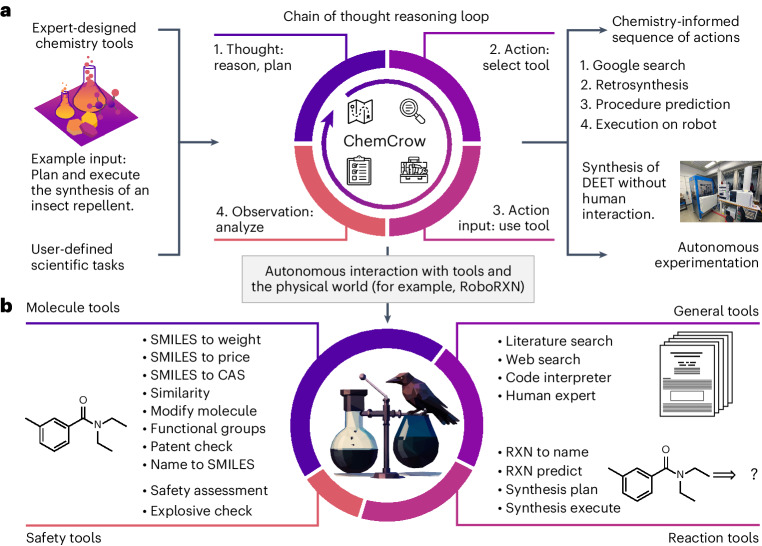
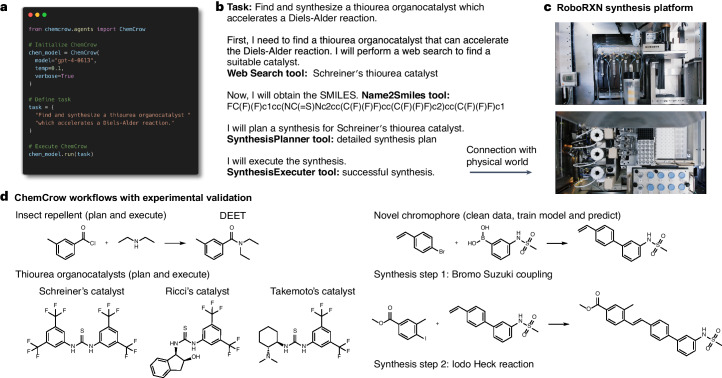
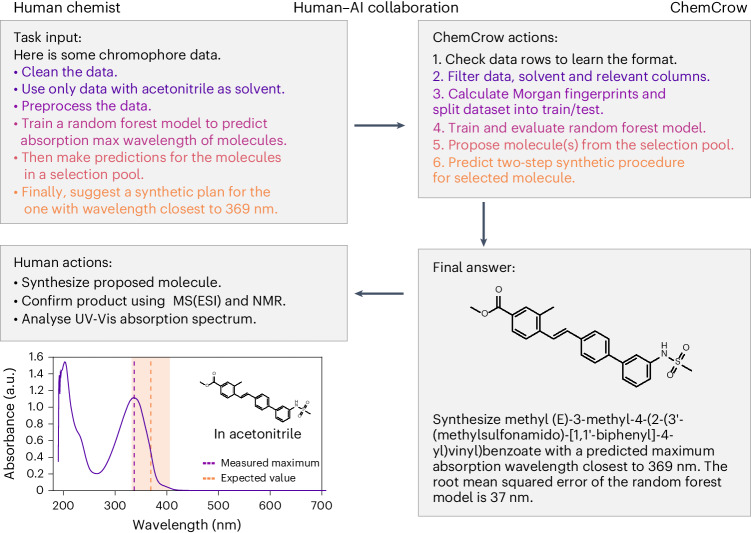
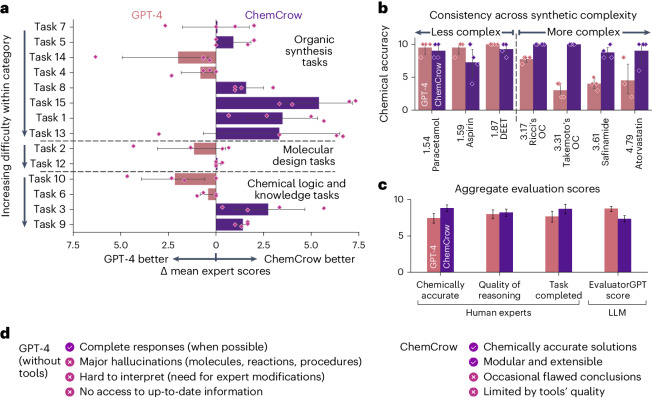
Large language models (LLMs) have shown strong performance in tasks across domains but struggle with chemistry-related problems. These models also lack access to external knowledge sources, limiting their usefulness in scientific applications. We introduce ChemCrow, an LLM chemistry agent designed to accomplish tasks across organic synthesis, drug discovery and materials design. By integrating 18 expert-designed tools and using GPT-4 as the LLM, ChemCrow augments the LLM performance in chemistry, and new capabilities emerge. Our agent autonomously planned and executed the syntheses of an insect repellent and three organocatalysts and guided the discovery of a novel chromophore. Our evaluation, including both LLM and expert assessments, demonstrates ChemCrow’s effectiveness in automating a diverse set of chemical tasks. Our work not only aids expert chemists and lowers barriers for non-experts but also fosters scientific advancement by bridging the gap between experimental and computational chemistry.
Overview
The claims and statistics of this paper haven’t been checked yet.
Free: it reads the open-access text and checks the first 5 claims that cite a source we can check. Create a free account to check every claim.
Integrity signals
Registry
Cites
Statistics
Figures
Verification
Claims the paper makes
The claims and statistics of this paper haven’t been checked yet.
Free: it reads the open-access text and checks the first 5 claims that cite a source we can check. Create a free account to check every claim.
Claims other papers make about this one
Each is checked against this paper’s own text: does it say what the citing paper says it does?
The source backs part of the claim, not all of it — or backs it for a different population, condition or comparison.
In the citing paper
“In parallel, chemistry-oriented reviews have shown that large language models can move beyond text generation toward tool use, retrieval, planning, code execution, and multi-agent coordination [5-10].”
From From Scientific Copilots to Tool-Grounded Autonomy: AI Agents in Simulation-Driven Materials Discovery (2026) · cites this paper as [7]
Experimental — accuracy not yet measuredThe source backs part of the claim, not all of it — or backs it for a different population, condition or comparison.
In the citing paper
“The broader literature on autonomous scientific systems has already argued for more rigorous evaluation protocols and transparent tool interfaces [3,5,7-12].”
From From Scientific Copilots to Tool-Grounded Autonomy: AI Agents in Simulation-Driven Materials Discovery (2026) · cites this paper as [7]
Experimental — accuracy not yet measuredThe source backs part of the claim, not all of it — or backs it for a different population, condition or comparison.
In the citing paper
“In scientific discovery, agents dynamically compose and execute hypothesis-testing pipelines spanning simulations, lab protocols, and data analysis [61, 62, 63, 64].”
From Code as Agent Harness (2026) · cites this paper as [61]
Experimental — accuracy not yet measuredThe source backs part of the claim, not all of it — or backs it for a different population, condition or comparison.
In the citing paper
“ChemCrow [61] similarly integrates RDKit, retrosynthesis engines, and reaction predictors so that an agent can 'execute' a candidate synthesis virtually before committing to a wet-lab run.”
From Code as Agent Harness (2026) · cites this paper as [61]
Experimental — accuracy not yet measuredThe source backs part of the claim, not all of it — or backs it for a different population, condition or comparison.
In the citing paper
“In chemistry, language-model tools, yield predictors, Bayesian optimization, and robotic laboratories provide complementary components for selecting and testing reactions [28, 42-46].”
From RSI-Anything: Unlocking Recursive Self-Improvement with World Models (2026) · cites this paper as [43]
Experimental — accuracy not yet measured
5 more claims about this paper
Create a free account to see every claim other papers make about this one.
Self-check
Percentages, sums and reported differences re-computed from the paper’s own numbers.
The self-check needs the paper’s full text.
Citations
Cites
Vaswani, A., Shazeer, N., Parmar, N., Uszkoreit, J., Jones, L., Gomez, A. N., Kaiser, L., & Polosukhin, I. (2017) · arXiv · doi:10.48550/arxiv.1706.03762 · Cited by 120,404 · cited 1×
“These specialized tools provide exact answers, thereby compensating for the inherent deficiencies of LLMs in specific domains and enhancing their overall performance and applicability.”
BackgroundLanguage Models are Few-Shot Learners
Brown, T. B., Mann, B., Ryder, N., Subbiah, M., Kaplan, J., Dhariwal, P., Neelakantan, A., Shyam, P., Sastry, G., Askell, A., et al. (2020) · arXiv · doi:10.48550/arxiv.2005.14165 · Cited by 23,372 · cited 1×
“…as a field, has been impacted through expert-designed artificial intelligence (AI) systems that tackle specific problems, such as reaction prediction 16–20 , retrosynthesis planning 21–27 , molecular property prediction 28–32 , de-novo molecular generation 33,34 , materials design 35,36 and,…”
BackgroundExtended-Connectivity Fingerprints
Rogers, D., & Hahn, M. (2010) · Journal of Chemical Information and Modeling · doi:10.1021/ci100050t · Cited by 7,524 · cited 1×
“Similarity The primary function of this tool is to evaluate the similarity between two molecules, utilizing the Tanimoto similarity measure 90 based on the ECFP2 molecular fingerprints 91 of the input molecules.”
MethodThe National Center for Biotechnology Information
Benson, D., Boguski, M., Lipman, D. J., & Ostell, J. (1990) · Genomics · doi:10.1016/0888-7543(90)90583-g · Cited by 5,126
LLaMA: Open and Efficient Foundation Language Models
Touvron, H., Lavril, T., Izacard, G., Martinet, X., Lachaux, M.-A., Lacroix, T., Rozière, B., Goyal, N., Hambro, E., Azhar, F., et al. (2023) · arXiv · doi:10.48550/arxiv.2302.13971 · Cited by 4,602 · cited 1×
“…is the lack of reproducibility of individual results under the current API-based approach to LLMs, as closed-source models provide limited control, see Appendix E. Recent open-source models 76–78 offer a potential solution to this issue, albeit with a possible trade-off in reasoning power.”
BackgroundChain-Of-Thought Prompting Elicits Reasoning in Large Language Models
Wei, J., Wang, X., Schuurmans, D., Bosma, M., Ichter, B., Xia, F., Chi, E., Le, Q. V., & Zhou, D. (2022) · Advances in Neural Information Processing Systems 35 · doi:10.52202/068431-1800 · Cited by 4,505
Chain-of-Thought Prompting Elicits Reasoning in Large Language Models
Wei, J., Wang, X., Schuurmans, D., Bosma, M., Ichter, B., Xia, F., Chi, E., Le, Q., & Zhou, D. (2022) · arXiv · doi:10.48550/arxiv.2201.11903 · Cited by 4,263 · cited 1×
“The tools used can be classified into general tools, molecular tools, and chemical reaction tools.”
MethodBillion-scale similarity search with GPUs
Johnson, J., Douze, M., & Jegou, H. (2021) · IEEE Transactions on Big Data · doi:10.1109/tbdata.2019.2921572 · Cited by 4,228
Training language models to follow instructions with human feedback
Ouyang, L., Wu, J., Jiang, X., Almeida, D., Wainwright, C. L., Mishkin, P., Zhang, C., Agarwal, S., Slama, K., Ray, A., et al. (2022) · arXiv · doi:10.48550/arxiv.2203.02155 · Cited by 4,208 · cited 2×
“5 13 cannot consistently and accurately multiply 12345*98765 or convert IUPAC names into the corresponding molecular graph 14 .”
BackgroundBillion-scale similarity search with GPUs
Johnson, J., Douze, M., & Jégou, H. (2017) · arXiv · doi:10.48550/arxiv.1702.08734 · Cited by 4,140 · cited 1×
“The CAS number serves as a precise and universally recognized chemical identifier, enabling researchers to access relevant data and resources with ease, and ensuring that they obtain accurate and consistent information about the target molecule 89 .”
Background
Research works printed but not linked: 4
- Devlin, J., Chang, M.-W., Lee, K. & Toutanova, K. Bert: pre-training of deep bidirectional transformers for language understanding. In Proc. Conference of the North American Chapter of the Association for Computational Linguistics: Human Language Technologies (eds Burstein, J. et al.) 4171–4186 (Association for Computational Linguistics, 2019).
- Li, R. et al. Starcoder: may the source be with you! Trans. Mach. Learn. Res. https://openreview.net/pdf?id=KoFOg41haE (2023).
- Zelikman E Wu Y Mu J Goodman N Star: bootstrapping reasoning with reasoning Adv. Neural Inf. Process. Syst. 2022 35 15476 15488
- Lowe, D. M. Extraction of Chemical Structures and Reactions from the Literature. PhD thesis, Univ. of Cambridge (2012).
Cited by
A survey on large language model based autonomous agents
Wang, L., Ma, C., Feng, X., Zhang, Z., Yang, H., Zhang, J., Chen, Z., Tang, J., Chen, X., Lin, Y., et al. (2024) · Frontiers of Computer Science · doi:10.1007/s11704-024-40231-1 · Cited by 1,941
Autonomous chemical research with large language models
Boiko, D. A., MacKnight, R., Kline, B., & Gomes, G. (2023) · Nature · doi:10.1038/s41586-023-06792-0 · Cited by 1,050
The Rise and Potential of Large Language Model Based Agents: A Survey
Xi, Z., Chen, W., Guo, X., He, W., Ding, Y., Hong, B., Zhang, M., Wang, J., Jin, S., Zhou, E., et al. (2023) · arXiv · doi:10.48550/arxiv.2309.07864 · Cited by 972
The rise and potential of large language model based agents: a survey
Xi, Z., Chen, W., Guo, X., He, W., Ding, Y., Hong, B., Zhang, M., Wang, J., Jin, S., Zhou, E., et al. (2025) · Science China Information Sciences · doi:10.1007/s11432-024-4222-0 · Cited by 970
Self-Driving Laboratories for Chemistry and Materials Science
Tom, G., Schmid, S. P., Baird, S. G., Cao, Y., Darvish, K., Hao, H., Lo, S., Pablo-García, S., Rajaonson, E. M., Skreta, M., et al. (2024) · Chemical Reviews · doi:10.1021/acs.chemrev.4c00055 · Cited by 707
AgentDojo: A Dynamic Environment to Evaluate Prompt Injection Attacks and Defenses for LLM Agents
Debenedetti, E., Zhang, J., Balunović, M., Beurer-Kellner, L., Fischer, M., & Tramèr, F. (2024) · arXiv · doi:10.48550/arxiv.2406.13352 · Cited by 616
Artificial intelligence in drug development
Zhang, K., Yang, X., Wang, Y., Yu, Y., Huang, N., Li, G., Li, X., Wu, J. C., & Yang, S. (2025) · Nature Medicine · doi:10.1038/s41591-024-03434-4 · Cited by 498
A survey on LLM-based multi-agent systems: Workflow, infrastructure, and challenges
Li, X., Wang, S., Zeng, S., Wu, Y., & Yang, Y. (2024) · Vicinagearth · doi:10.1007/s44336-024-00009-2 · Cited by 404
Managing extreme AI risks amid rapid progress
Bengio, Y., Hinton, G., Yao, A., Song, D., Abbeel, P., Darrell, T., Harari, Y. N., Zhang, Y.-Q., Xue, L., Shalev-Shwartz, S., et al. (2024) · Science · doi:10.1126/science.adn0117 · Cited by 349
Ghafarollahi, A., & Buehler, M. J. (2025) · Advanced Materials · doi:10.1002/adma.202413523 · Cited by 146
On LLMs-Driven Synthetic Data Generation, Curation, and Evaluation: A Survey
Long, L., Wang, R., Xiao, R., Zhao, J., Ding, X. H., Chen, G., & Wang, H. (2024) · Findings of the Association for Computational Linguistics: ACL (Findings of ACL) · doi:10.18653/v1/2024.findings-acl.658 · Cited by 522
Empowering biomedical discovery with AI agents
Gao, S., Fang, A., Huang, Y., Giunchiglia, V., Noori, A., Schwarz, J. R., Ektefaie, Y., Kondic, J., & Zitnik, M. (2024) · Cell · doi:10.1016/j.cell.2024.09.022 · Cited by 315
Large language models empowered agent-based modeling and simulation: a survey and perspectives
Gao, C., Lan, X., Li, N., Yuan, Y., Ding, J., Zhou, Z., Xu, F., & Li, Y. (2024) · Humanities and Social Sciences Communications · doi:10.1057/s41599-024-03611-3 · Cited by 294
Exploring Large Language Model‐Based Intelligent Agents: Definitions, Methods, and Prospects
Cheng, Y., Zhang, C., Zhang, Z., Meng, X., Hong, S., Li, W., Wang, Z., Wang, Z., Yin, F., Zhao, J., et al. (2026) · Wiley Interdisciplinary Reviews Data Mining and Knowledge Discovery · doi:10.1002/widm.70111 · Cited by 343
Mirza, A., Alampara, N., Kunchapu, S., Ríos-García, M., Emoekabu, B., Krishnan, A., Gupta, T., Schilling-Wilhelmi, M., Okereke, M., Aneesh, A., et al. (2025) · Nature Chemistry · doi:10.1038/s41557-025-01815-x · Cited by 380
Self-citationLarge Language Models on Graphs: A Comprehensive Survey
Jin, B., Liu, G., Han, C., Jiang, M., Ji, H., & Han, J. (2024) · IEEE Transactions on Knowledge and Data Engineering · doi:10.1109/tkde.2024.3469578 · Cited by 147
“Since string representations of molecular graphs usually carry new and in-depth domain knowledge, which is beyond the knowledge of LLMs, recent work [146], [157], [165] also attempts to utilize the reasoning ability of LLMs, instead of using them as a knowledge source for predicting the property of…”
BackgroundMethodInfluentialCRISPR-GPT for agentic automation of gene-editing experiments
Qu, Y., Huang, K., Yin, M., Zhan, K., Liu, D., Yin, D., Cousins, H. C., Johnson, W. A., Wang, X., Shah, M., et al. (2025) · Nature Biomedical Engineering · doi:10.1038/s41551-025-01463-z · Cited by 140
“To enhance the CRISPR-GPT agent’s capacity in answering advanced research questions, we build a Q&A mode that synthesizes information from multiple resources, including published literature, established protocols and discussions between human scientists, utilizing Article https://doi.org/10.1038/s41551-025-01463-z a c…”
InfluentialA review of large language models and autonomous agents in chemistry
Ramos, M. C., Collison, C. J., & White, A. D. (2025) · Chemical Science · doi:10.1039/d4sc03921a · Cited by 274
Self-citationChemLLM: A Chemical Large Language ModelPreprint
Zhang, D., Liu, W., Tan, Q., Chen, J., Yan, H., Yan, Y.-L., Li, J., Huang, W., Yue, X., Ouyang, W., et al. (2024) · arXiv (Cornell University) · doi:10.48550/arxiv.2402.06852 · Cited by 332
Machine learning for functional protein design
Notin, P., Rollins, N., Gal, Y., Sander, C., & Marks, D. (2024) · Nature Biotechnology · doi:10.1038/s41587-024-02127-0 · Cited by 270
Tool learning with large language models: a survey
Qu, C., Dai, S., Wei, X., Cai, H., Wang, S., Yin, D., Xu, J., & Wen, J.-R. (2025) · Frontiers of Computer Science · doi:10.1007/s11704-024-40678-2 · Cited by 99
“…the employment of search engine tool can enable LLMs to access contemporary information [17, 28, 47–51], while the integration of database tool allows LLMs to access structured databases to retrieve specific information or execute complex queries, thus expanding their knowledge base [52–57].”
Crystal structure generation with autoregressive large language modeling
Antunes, L. M., Butler, K. T., & Grau-Crespo, R. (2024) · Nature Communications · doi:10.1038/s41467-024-54639-7 · Cited by 157
GeoGPT: An assistant for understanding and processing geospatial tasks
Zhang, Y., Cheng, W., He, Z., & Yu, W. (2024) · International Journal of Applied Earth Observation and Geoinformation · doi:10.1016/j.jag.2024.103976 · Cited by 329
Kang, Y., & Kim, J. (2024) · Nature Communications · doi:10.1038/s41467-024-48998-4 · Cited by 236
Artificial Intelligence for Drug Discovery: Are We There Yet?
Hasselgren, C., & Oprea, T. I. (2024) · Annual Review of Pharmacology and Toxicology · doi:10.1146/annurev-pharmtox-040323-040828 · Cited by 236
The Impact of Large Language Models on Scientific Discovery: a Preliminary Study using GPT-4
Science, M. R. A., & Quantum, M. A. (2023) · arXiv (Cornell University) · doi:10.48550/arxiv.2311.07361 · Cited by 51
Jablonka, K. M., Ai, Q., Al-Feghali, A., Badhwar, S., Bocarsly, J. D., Bran, A. M., Bringuier, S., Brinson, L. C., Choudhary, K., Circi, D., et al. (2023) · Digital Discovery · doi:10.1039/d3dd00113j · Cited by 218
“[65] to create digital assistants that can call and combine various tools such as Google search and the IBM RXN retrosynthesis tool when prompted with natural language.”
MethodSelf-citationScientific Large Language Models: A Survey on Biological & Chemical Domains
Zhang, Q., Ding, K., Lv, T., Wang, X., Yin, Q., Zhang, Y., Yu, J., Wang, Y., Li, X., Xiang, Z., et al. (2025) · ACM Computing Surveys · doi:10.1145/3715318 · Cited by 122
“For example, ChemCrow [23] augmented the performance of ChatGPT in chemistry by incorporating 13 expert-designed tools, specifically tailored for accomplishing tasks related to organic synthesis, drug discovery, and materials design.”
Artificial intelligence for science in quantum, atomistic, and continuum systems
Zhang, X., Wang, L., Helwig, J., Luo, Y., Fu, C., Xie, Y., Liu, M., Lin, Y., Zhao, X., Yan, K., et al. (2025) · Foundations and Trends® in Machine Learning · doi:10.1561/2200000115 · Cited by 261
BioMedGPT: An Open Multimodal Large Language Model for BioMedicine
Luo, Y., Zhang, J., Fan, S., Yang, K., Hong, M., Wu, Y., Qiao, M., & Nie, Z. (2024) · IEEE Journal of Biomedical and Health Informatics · doi:10.1109/jbhi.2024.3505955 · Cited by 227
ORGANA: A robotic assistant for automated chemistry experimentation and characterization
Darvish, K., Skreta, M., Zhao, Y., Yoshikawa, N., Som, S., Bogdanović, M., Cao, Y., Hao, H., Xu, H., Aspuru‐Guzik, A., et al. (2024) · Matter · doi:10.1016/j.matt.2024.10.015 · Cited by 256
What can Large Language Models do in chemistry? A comprehensive benchmark on eight tasks
Guo, T., Guo, K., Nan, B., Liang, Z., Guo, Z., Chawla, N. V., Wiest, O., & Zhang, X. (2023) · neural information processing systems · doi:10.52202/075280-2607 · Cited by 94
“Consequently, as we harness the capabilities of LLMs in the field of chemistry, we concur with earlier research on generative models in chemistry [2, 3] that it is vital for developers to establish robust safeguards and ethical guidelines to deter harmful applications.”
MethodAn automatic end-to-end chemical synthesis development platform powered by large language models
Ruan, Y., Lu, C., Xu, N., He, Y., Chen, Y., Zhang, J., Xuan, J., Pan, J., Fang, Q., Gao, H., et al. (2024) · Nature Communications · doi:10.1038/s41467-024-54457-x · Cited by 116
RE-Bench: Evaluating frontier AI R&D capabilities of language model agents against human experts
Wijk, H., Lin, T., Becker, J., Jawhar, S., Parikh, N., Broadley, T., Chan, L., Chen, M., Clymer, J., Dhyani, J., et al. (2024) · arXiv · doi:10.48550/arxiv.2411.15114 · Cited by 187
From text to insight: large language models for chemical data extraction
Schilling-Wilhelmi, M., Ríos-García, M., Shabih, S., Gil, M. V., Miret, S., Koch, C. T., Márquez, J. A., & Jablonka, K. M. (2025) · Chemical Society Reviews · doi:10.1039/d4cs00913d · Cited by 142
Exploring DeepSeek: A Survey on Advances, Applications, Challenges and Future Directions
Deng, Z., Ma, W., Han, Q., Zhou, W., Zhu, X., Wen, S., & Xiang, Y. (2025) · IEEE/CAA Journal of Automatica Sinica · doi:10.1109/jas.2025.125498 · Cited by 231
AIOS: LLM Agent Operating SystemPreprint
Mei, K., Zhu, X., Xu, W., Hua, W., Jin, M., Li, Z., Xu, S., Ye, R., Ge, Y., & Zhang, Y. (2024) · arXiv (Cornell University) · doi:10.48550/arxiv.2403.16971 · Cited by 245
“For example, agents in virtual or digital environment may invoke APIs [7, 34, 35, 36, 37], browse websites [38, 22], or execute codes [39], while agents in the physical environment may manipulate objects [19, 40, 41], carry out lab experiments [42, 43], or make actionable decisions [44, 45].”
BackgroundMol-Instructions: A Large-Scale Biomolecular Instruction Dataset for Large Language Models
Fang, Y., Liang, X., Zhang, N., Liu, K., Huang, R., Chen, Z., Fan, X., & Chen, H. (2024) · International Conference on Learning Representations · doi:10.48550/arxiv.2306.08018 · Cited by 204
“Several studies have explored the intersection of text and biomolecules (Boiko et al., 2023; Bran et al., 2023; Zeng et al., 2022; Edwards et al., 2022; Nascimento & Pimentel, 2023; Zhang et al., 2023b).”
BackgroundTribulations and future opportunities for artificial intelligence in precision medicine
Carini, C., & Seyhan, A. A. (2024) · Journal of Translational Medicine · doi:10.1186/s12967-024-05067-0 · Cited by 173
Ghafarollahi, A., & Buehler, M. J. (2024) · Digital Discovery · doi:10.1039/d4dd00013g · Cited by 106
Seal, S., Mahale, M., García-Ortegón, M., Joshi, C. K., Hosseini-Gerami, L., Beatson, A., Greenig, M., Shekhar, M., Patra, A., Weis, C., et al. (2025) · Chemical Research in Toxicology · doi:10.1021/acs.chemrestox.5c00033 · Cited by 187
ChatGPT Research Group for Optimizing the Crystallinity of MOFs and COFs
Zheng, Z., Zhang, O., Nguyen, H. L., Rampal, N., Alawadhi, A. H., Rong, Z., Head-Gordon, T., Borgs, C., Chayes, J. T., & Yaghi, O. M. (2023) · ACS Central Science · doi:10.1021/acscentsci.3c01087 · Cited by 172
A Multiagent-Driven Robotic AI Chemist Enabling Autonomous Chemical Research On Demand
Song, T., Luo, M., Zhang, X., Chen, L., Huang, Y., Cao, J., Zhu, Q., Liu, D., Zhang, B., Zou, G., et al. (2025) · Journal of the American Chemical Society · doi:10.1021/jacs.4c17738 · Cited by 171
Artificial Intelligence for Materials Discovery, Development, and Optimization
Madika, B., Saha, A., Kang, C., Buyantogtokh, B., Agar, J., Wolverton, C. M., Voorhees, P., Littlewood, P., Kalinin, S., & Hong, S. (2025) · ACS Nano · doi:10.1021/acsnano.5c04200 · Cited by 171
The Virtual Lab of AI agents designs new SARS-CoV-2 nanobodies
Swanson, K., Wu, W., Bulaong, N. L., Pak, J. E., & Zou, J. (2025) · Nature · doi:10.1038/s41586-025-09442-9 · Cited by 169
“For example, ChemCrow is a framework that gives GPT-4 access to chemistry tools and can thus solve components of a chemistry research problem, but it cannot tackle an open-ended, interdisciplinary research problem 20 .”
Exploring the role of large language models in the scientific method: from hypothesis to discovery
Zhang, Y., Khan, S., Mahmud, A., Yang, H., Lavin, A., Levin, M., Frey, J., Dunnmon, J. A., Evans, J., Bundy, A., et al. (2025) · npj Artificial Intelligence · doi:10.1038/s44387-025-00019-5 · Cited by 186
“Furthermore, frameworks like ChemCrow 84 leverage the tool-using abilities of LLMs to connect with non-natural-language modalities, such as chemical analysis tools.”
A GPT‐4 Reticular Chemist for Guiding MOF Discovery**
Zheng, Z., Rong, Z., Rampal, N., Borgs, C., Chayes, J. T., & Yaghi, O. M. (2023) · Angewandte Chemie International Edition · doi:10.1002/anie.202311983 · Cited by 162
Scarfe, P., Watcham, K., Clarke, A., & Roesch, E. (2024) · PLOS ONE · doi:10.1371/journal.pone.0305354 · Cited by 108
Expel: LLM agents are experiential learners
Zhao, A., Huang, D., Xu, Q., Lin, M., Liu, Y.-J., & Huang, G. (2024) · Proceedings of the AAAI Conference on Artificial Intelligence · doi:10.1609/aaai.v38i17.29936 · Cited by 1,451
A Survey of Graph Meets Large Language Model: Progress and Future Directions
Li, Y., Li, Z., Wang, P., Li, J., Sun, X., Cheng, H., & Yu, J. X. (2024) · International Joint Conference on Artificial Intelligence · doi:10.24963/ijcai.2024/898 · Cited by 225
Foundation models for materials discovery – current state and future directions
Pyzer‐Knapp, E. O., Manica, M., Staar, P., Morin, L., Ruch, P., Laino, T., Smith, J. R., & Curioni, A. (2025) · npj Computational Materials · doi:10.1038/s41524-025-01538-0 · Cited by 187
“The introduction of domain-speci fi c LLMs 110,111 underscores the importance of fi ne-tuning with specialized data and integrating advanced chemistry tools 112 , signi fi cantly enhancing the predictive capabilities for synthetic tasks in organic chemistry.”
Enabling large language models for real-world materials discovery
Miret, S., & Krishnan, N. M. A. (2025) · Nature Machine Intelligence · doi:10.1038/s42256-025-01058-y · Cited by 166
“Hence, while proposing an IUPAC-style naming convention might seem like a natural solution to aid the deployment of LLMs in materials science, many proposals of such conventions have previously fallen short, given the vast diversity of the field.”
Risks of AI scientists: prioritizing safeguarding over autonomy
Tang, X., Jin, Q., Zhu, K., Yuan, T., Zhang, Y., Zhou, W., Qu, M., Zhao, Y., Tang, J., Zhang, Z., et al. (2025) · Nature Communications · doi:10.1038/s41467-025-63913-1 · Cited by 51
Accelerated end-to-end chemical synthesis development with large language models
Ruan, Y., Lu, C., Xu, N., Zhang, J., Xuan, J., Pan, J., Fang, Q., Gao, H., Shen, X., Ye, N., et al. (2024) · doi:10.26434/chemrxiv-2024-6wmg4 · Cited by 140
Sandbrink, J. B. (2023) · arXiv (Cornell University) · doi:10.48550/arxiv.2306.13952 · Cited by 163
“While foundation models are products of large and expensive training runs and are currently developed by a small number of companies, these systems can be optimisied and turned into applications for particular domains by more resource-constrained groups [4,5].”
BackgroundMethodDeveloping ChemDFM as a large language foundation model for chemistry
Zhao, Z., Ma, D., Chen, L., Sun, L., Li, Z., Xia, Y., Chen, B., Xu, H., Zhu, Z., Su, Z., et al. (2025) · Cell Reports Physical Science · doi:10.1016/j.xcrp.2025.102523 · Cited by 197
“…exploits LLMs’ strong natural language understanding and reasoning abilities, using them directly to handle complex chemical tasks described in natural language [Hatakeyama-Sato et al., 2023, Cao et al., 2023b, Boiko et al., 2023, Yoshikawa et al., 2023, M. Bran et al., 2024, Ruan et al., 2024].”
Large language models for reticular chemistry
Zheng, Z., Rampal, N., Inizan, T. J., Borgs, C., Chayes, J. T., & Yaghi, O. M. (2025) · Nature Reviews Materials · doi:10.1038/s41578-025-00772-8 · Cited by 134
“…of enabling, for instance, customizable extraction of chemical data from literature 14,15 and adaptable automation of synthesis on robotic platforms 16 , which may empower chemists to address societal problems faced today in climate change, clean energy, clean air, clean water and health more…”
InfluentialFine-Tuned Language Models Generate Stable Inorganic Materials as Text
Gruver, N., Sriram, A., Madotto, A., Wilson, A. G., Zitnick, C. L., & Ulissi, Z. W. (2024) · International Conference on Learning Representations · doi:10.48550/arxiv.2402.04379 · Cited by 197
“…in particular, has the potential to improve access to scientific discovery (White, 2023); LLMs can use text to describe new observations, or, in design applications (e.g. materials design, drug discovery), LLMs can ingest text that specifies desired properties or constraints (Bran et al., 2023).”
BackgroundA semantic-enhanced multi-modal remote sensing foundation model for Earth observation
Wu, K., Zhang, Y.-Y., Ru, L., Dang, B., Lao, J.-W., Yu, L., Luo, J.-W., Zhu, Z., Sun, Y., Zhang, J., et al. (2025) · Nature Machine Intelligence · doi:10.1038/s42256-025-01078-8 · Cited by 141
“Large language models (LLMs) have recently achieved tremendous success in many fields 8,12 .”
ORGANA: A Robotic Assistant for Automated Chemistry Experimentation and Characterization
Darvish, K., Skreta, M., Zhao, Y., Yoshikawa, N., Som, S., Bogdanovic, M., Cao, Y., Hao, H., Xu, H., Aspuru-Guzik, A., et al. (2024) · arXiv · doi:10.48550/arxiv.2401.06949 · Cited by 133
Materials science in the era of large language models: a perspective
Lei, G., Docherty, R., & Cooper, S. J. (2024) · Digital Discovery · doi:10.1039/d4dd00074a · Cited by 99
“Similarly, ‘ ChemCrow ’ 106 is an LLM chemistry agent designed to tackle tasks in organic synthesis, drug discovery, and materials design.”
LLM4SR: A Survey on Large Language Models for Scientific ResearchPreprint
Luo, Z., Yang, Z., Xu, Z., Yang, W., & Du, X. (2025) · arXiv (Cornell University) · doi:10.48550/arxiv.2501.04306 · Cited by 161
ChemOS 2.0: An orchestration architecture for chemical self-driving laboratories
Sim, M., Vakili, M. G., Strieth‐Kalthoff, F., Hao, H., Hickman, R. J., Miret, S., Pablo‐García, S., & Aspuru‐Guzik, A. (2024) · Matter · doi:10.1016/j.matt.2024.04.022 · Cited by 163
Li, J., Liu, Y., Fan, W., Wei, X.-Y., Liu, H., Tang, J., & Li, Q. (2024) · IEEE Transactions on Knowledge and Data Engineering · doi:10.1109/tkde.2024.3393356 · Cited by 83
AgentGym: Evolving Large Language Model-based Agents across Diverse EnvironmentsPreprint
Xi, Z., Ding, Y., Chen, W.-X., Hong, B., Guo, H., Wang, J., Yang, D., Liao, C., Guo, X., He, W., et al. (2024) · arXiv (Cornell University) · doi:10.48550/arxiv.2406.04151 · Cited by 169
“Moreover, it may harness a rich source of insights and wisdom from its own experiences as well as those of others, developing a certain level of generalization ability [10; 11].”
BackgroundHarnessing Large Language Models to Collect and Analyze Metal–Organic Framework Property Data Set
Kang, Y., Lee, W., Bae, T., Han, S., Jang, H., & Kim, J. (2025) · Journal of the American Chemical Society · doi:10.1021/jacs.4c11085 · Cited by 148
Large language models for drug discovery and development
Zheng, Y., Koh, H. Y., Ju, J., Yang, M., May, L. T., Webb, G. I., Li, L., Pan, S., & Church, G. M. (2025) · Patterns · doi:10.1016/j.patter.2025.101346 · Cited by 134
Adaptive Attacks Break Defenses Against Indirect Prompt Injection Attacks on LLM Agents
Zhan, Q., Fang, R., Panchal, H. S., & Kang, D. (2025) · Findings of the Association for Computational Linguistics: NAACL 2025 · doi:10.18653/v1/2025.findings-naacl.395 · Cited by 124
Automation and machine learning augmented by large language models in a catalysis study
Su, Y., Wang, X., Ye, Y., Xie, Y., Xu, Y., Jiang, Y., & Wang, C. (2024) · Chemical Science · doi:10.1039/d3sc07012c · Cited by 107
Lo, S., Baird, S. G., Schrier, J., Blaiszik, B. J., Carson, N., Foster, I. T., Aguilar‐Granda, A., Kalinin, S. V., Maruyama, B., Politi, M., et al. (2024) · Digital Discovery · doi:10.1039/d3dd00223c · Cited by 146
A Comprehensive Survey of Deep Research: Systems, Methodologies, and ApplicationsPreprint
Xu, R., & Peng, J. (2025) · arXiv (Cornell University) · doi:10.48550/arxiv.2506.12594 · Cited by 135
Autonomous ‘self-driving’ laboratories: a review of technology and policy implications
Tobias, A. V., & Wahab, A. (2025) · Royal Society Open Science · doi:10.1098/rsos.250646 · Cited by 153
“ChemCrow [79], for example, demonstrates how large language models can be augmented with chemistry-specific tools to autonomously observe, plan and execute actions.”
Large Language Models for Automated Open-domain Scientific Hypotheses Discovery
Yang, Z., Du, X., Li, J., Zheng, J., Poria, S., & Cambria, E. (2024) · Findings of the Association for Computational Linguistics: ACL (Findings of ACL) · doi:10.18653/v1/2024.findings-acl.804 · Cited by 180
HoneyComb: A Flexible LLM-Based Agent System for Materials Science
Zhang, H., Song, Y., Hou, Z., Miret, S., & Liu, B. (2024) · Findings of the Association for Computational Linguistics: EMNLP 2024 · doi:10.18653/v1/2024.findings-emnlp.192 · Cited by 41
LLMatDesign: Autonomous Materials Discovery with Large Language ModelsPreprint
Jia, S., Zhang, C., & Fung, V. (2024) · arXiv (Cornell University) · doi:10.48550/arxiv.2406.13163 · Cited by 129
“These autonomous agents are typically augmented with tools or action modules, empowering them to go beyond conventional text processing and directly interact with the physical world, such as robotic manipulation [18, 19] and scientific experimentation [20, 21].”
BackgroundEl Agente: An autonomous agent for quantum chemistry
Zou, Y., Cheng, A., Aldossary, A., Bai, J., Leong, S. X., Campos-Gonzalez-Angulo, J. A., Choi, C., Ser, C. T., Tom, G., Wang, A., et al. (2025) · Matter · doi:10.1016/j.matt.2025.102263 · Cited by 193
Large language models for chemistry robotics
Yoshikawa, N., Skreta, M., Darvish, K., Arellano-Rubach, S., Ji, Z., Bjørn Kristensen, L., Li, A. Z., Zhao, Y., Xu, H., Kuramshin, A., et al. (2023) · Autonomous Robots · doi:10.1007/s10514-023-10136-2 · Cited by 112
DARWIN Series: Domain Specific Large Language Models for Natural Science
Xie, T., Wan, Y., Huang, W. H., Yin, Z., Liu, Y., Wang, S., Linghu, Q., Kit, C., Grazian, C., Zhang, W., et al. (2023) · arXiv (Cornell University) · doi:10.48550/arxiv.2308.13565 · Cited by 33
Avalon's Game of Thoughts: Battle Against Deception through Recursive ContemplationPreprint
Wang, S.-Z., Liu, C., Zheng, Z., Qi, S., Chen, S., Yang, Q.-S., Zhao, A., Wang, C., Song, S.-J., & Huang, G. (2023) · arXiv.org · doi:10.48550/arxiv.2310.01320 · Cited by 111
“, 2023), natural sciences (Bran et al., 2023; Boiko et al., 2023), and robotics (Ha et al.”
BackgroundFrom Data to Discovery: Recent Trends of Machine Learning in Metal–Organic Frameworks
Park, J., Kim, H., Kang, Y., Lim, Y., & Kim, J. (2024) · JACS Au · doi:10.1021/jacsau.4c00618 · Cited by 112
A survey of geometric graph neural networks: data structures, models and applications
Han, J., Cen, J., Wu, L., Li, Z., Kong, X., Jiao, R., Yu, Z., Xu, T., Wu, F., Wang, Z., et al. (2025) · Frontiers of Computer Science · doi:10.1007/s11704-025-41426-w · Cited by 132
“Moreover, there has been a development of domain-specific Language Model Agents (LMAs) that exhibit high levels of expertise in specific areas [22, 165].”
LAVE: LLM-Powered Agent Assistance and Language Augmentation for Video Editing
Wang, B., Li, Y., Lv, Z., Xia, H., Xu, Y., & Sodhi, R. (2024) · Proceedings of the 29th International Conference on Intelligent User Interfaces · doi:10.1145/3640543.3645143 · Cited by 63
Accelerated chemical science with AI
Back, S., Aspuru‐Guzik, A., Ceriotti, M., Gryn’ova, G., Grzybowski, B. A., Gu, G. H., Hein, J. E., Hippalgaonkar, K., Hormázabal, R., Jung, Y., et al. (2024) · Digital Discovery · doi:10.1039/d3dd00213f · Cited by 113
Self-citationArtificial intelligence for quantum computing
Alexeev, Y., Farag, M. H., Patti, T. L., Wolf, M. E., Ares, N., Aspuru‐Guzik, A., Benjamin, S. C., Cai, Z., Cao, S., Chamberland, C., et al. (2025) · Nature Communications · doi:10.1038/s41467-025-65836-3 · Cited by 140
“…(LLMs) and vision-language models (VLMs), trained on a combination of visual media and text, have demonstrated strong capabilities in understanding human instructions and reasoning in both natural language and image data, and has been applied to many scienti fi c discovery applications 162 – 164 .”
Zhang, Y., He, Z., Li, J., Lin, J., Guan, Q., & Yu, W. (2024) · Cartography and Geographic Information Science · doi:10.1080/15230406.2024.2404868 · Cited by 119
OctoTools: A Multi-Agent Framework with Extensible Tools for Complex Reasoning
Pan, L., Chen, B., Liu, S., Thapa, R., Boen, J., & Zou, J. (2026) · Proceedings of the conference - Association for Computational Linguistics. Meeting · doi:10.18653/v1/2026.acl-long.1 · Cited by 104
Reinforcement Learning from Human FeedbackPreprint
Lambert, N. (2025) · arXiv (Cornell University) · doi:10.48550/arxiv.2504.12501 · Cited by 148
Flam-Shepherd, D., & Aspuru‐Guzik, A. (2023) · arXiv (Cornell University) · doi:10.48550/arxiv.2305.05708 · Cited by 106
Wei, T., Li, T.-W., Liu, Z., Ning, X., Yang, Z., Zou, J., Zeng, Z., Qiu, R., Lin, X., Fu, D., et al. (2026) · Transactions on machine learning research · doi:10.48550/arxiv.2601.12538 · Cited by 106
Yuan, M., Bao, P., Yuan, J., Shen, Y., Chen, Z., Xie, Y., Zhao, J., Li, Q., Chen, Y., Zhang, L., et al. (2024) · Medicine Plus · doi:10.1016/j.medp.2024.100030 · Cited by 70
Davlatshoevich, N. D., & Hojamberdiev, M. (2025) · Computational Condensed Matter · doi:10.1016/j.cocom.2025.e01139 · Cited by 101
Retrieval-Augmented Generation (RAG)
Klesel, M., & Wittmann, H. F. (2025) · Business & Information Systems Engineering · doi:10.1007/s12599-025-00945-3 · Cited by 92
“For instance, individuals can use CAs to access recipe information for cooking (Jaber et al. 2024) and to obtain assistance with complex chemistry-related tasks (Bran et al. 2024) and geometric problems (Trinh et al. 2024).”
Applied Artificial Intelligence in Materials Science and Material Design
Chávez‐Ángel, E., Eriksen, M., Castro‐Álvarez, A., García, J. H., Botifoll, M., Ávalos‐Ovando, Ó., Arbiol, J., & Mugarza, A. (2025) · Advanced Intelligent Systems · doi:10.1002/aisy.202400986 · Cited by 100
Probing the limitations of multimodal language models for chemistry and materials research
Alampara, N., Schilling-Wilhelmi, M., Ríos-García, M., Mandal, I., Khetarpal, P., Grover, H. S., Krishnan, N. M. A., & Jablonka, K. M. (2025) · Nature Computational Science · doi:10.1038/s43588-025-00836-3 · Cited by 124
Triguero, I., Molina, D., Poyatos, J., Del Ser, J., & Herrera, F. (2024) · Information Fusion · doi:10.1016/j.inffus.2023.102135 · Cited by 90
A Survey of Neural Code Intelligence: Paradigms, Advances and BeyondPreprint
Sun, Q., Chen, Z., Xu, F., Cheng, K., Ma, C., Yin, Z., Wang, J., Han, C., Zhu, R., Yuan, S., et al. (2024) · arXiv (Cornell University) · doi:10.48550/arxiv.2403.14734 · Cited by 106
SciToolAgent: a knowledge-graph-driven scientific agent for multitool integration
Ding, K., Yu, J., Huang, J., Yang, Y., Zhang, Q., & Chen, H. (2025) · Nature Computational Science · doi:10.1038/s43588-025-00849-y · Cited by 151
“These systems typically leverage in-context learning within established frameworks such as ReAct 21 , which combines LLM-based reasoning with tool execution.”
InfluentialLanguage models for biological research: a primer
Simon, E. P., Swanson, K., & Zou, J. (2024) · Nature Methods · doi:10.1038/s41592-024-02354-y · Cited by 94
A Perspective on Foundation Models in Chemistry
Choi, J., Nam, G., Choi, J., & Jung, Y. (2025) · JACS Au · doi:10.1021/jacsau.4c01160 · Cited by 107
Black-Box Access is Insufficient for Rigorous AI Audits
Casper, S., Ezell, C., Siegmann, C., Kolt, N., Curtis, T. L., Bucknall, B., Haupt, A., Wei, K., Scheurer, J., Hobbhahn, M., et al. (2024) · The 2024 ACM Conference on Fairness, Accountability, and Transparency · doi:10.1145/3630106.3659037 · Cited by 86
“Generative AI audits often attempt to elicit undesirable capabilities or behaviors (e.g., [30, 118, 140, 147, 198, 206, 266, 284, 292, 301]).”
Background
Metadata
- Authors
- M. Bran, A., Cox, S., Schilter, O., Baldassari, C., White, A. D., & Schwaller, P.
- Affiliations
- Future House, Inc. (US)
- IBM Research - Zurich (CH)
- NCCR Catalysis (CH)
- Corresponding author
- White, Andrew D.
- Schwaller, Philippe
- Venue
- Nature Machine Intelligence
- Published
- 2024-05-08
- Volume
- 6
- Issue
- 5
- Pages
- 525-535
- ISSN
- 2522-5839 (ISSN-L)
- PMC
- PMC11116106
- OpenAlex
- W4396723768
- Cited by
- 794
- References
- 76
- Citations by year
- 2026: 395 · 2025: 305 · 2024: 83
- FWCI
- 76.42
- Type
- journal article
- Language
- en
- Open access
- hybrid
- doi.org
- Licence
- cc-by
- creativecommons.org/licenses/by/4.0 (tdm)
- creativecommons.org/licenses/by/4.0 (vor)
- Locations
- Nature Machine Intelligence (publishedVersion, cc-by)
- PubMed Central (publishedVersion, cc-by-nd)
- PubMed (publishedVersion)
- Infoscience (Ecole Polytechnique Fédérale de Lausanne) (submittedVersion, cc-by-nc-nd)
- Funders
- Schweizerischer Nationalfonds zur Förderung der Wissenschaftlichen Forschung (180544)
- National Science Foundation (1751471)
- Topics
- Physical Sciences › Materials Science › Materials Chemistry › Machine Learning in Materials Science
- Life Sciences › Pharmacology, Toxicology and Pharmaceutics › Drug Discovery › Computational Drug Discovery Methods
- Physical Sciences › Computer Science › Artificial Intelligence › Artificial Intelligence Applications
- Keywords
- large language models, GPT-4, organic synthesis planning, drug discovery, materials design, organocatalysts
About these checks
Registry, retraction, Cites and statistics results are computed, not judged, with one exception: a printed reference that no index lists is read once by a model before it counts as a citation error. Claims are extracted by a model and kept only when their quote appears verbatim in the text; each cited source is then checked, with a model’s help, for whether it says what the claim relies on. Those verdicts can be wrong — read the claim’s quote and the cited source before relying on one.
Statistics and arithmetic are recomputed, not judged.
Confidence bands are shown only for fields calibrated on our annotated test set. None is calibrated yet, so no band is shown.
What counts as a claim ›How we measure confidence ›How we check this ›
Are you an author, or do you see a problem with this page? Request a review
Data sources
Bibliographic data: Semantic Scholar, OpenAlex, Crossref.
Contains information from the Semantic Scholar Academic Graph Datasets, made available under the ODC Attribution License (ODC-BY 1.0).
Semantic Scholar’s data is described in: Kinney, R., et al. (2023). The Semantic Scholar Open Data Platform. arXiv:2301.10140.
