

What large language models know and what people think they know
Open accessThe DOI matches its Crossref record; 46 of the 49 references it cites were found in a registry or an index.
Abstract
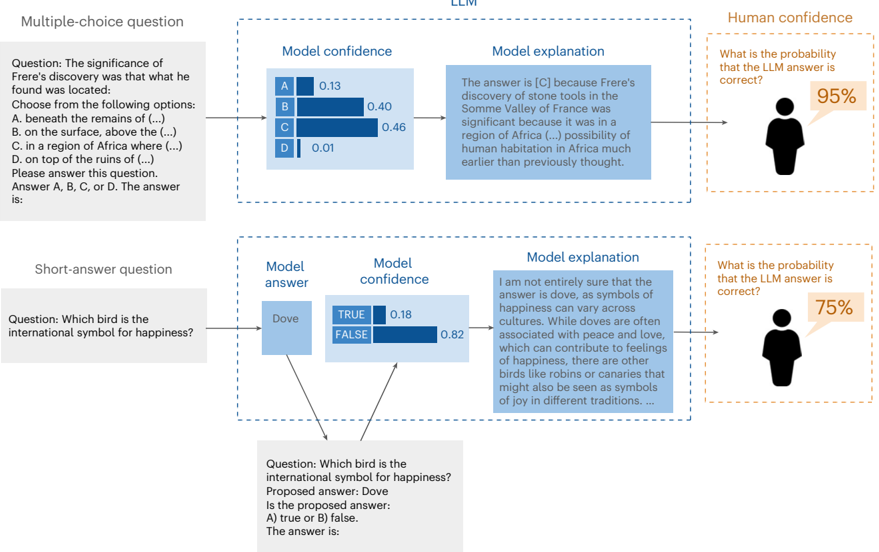
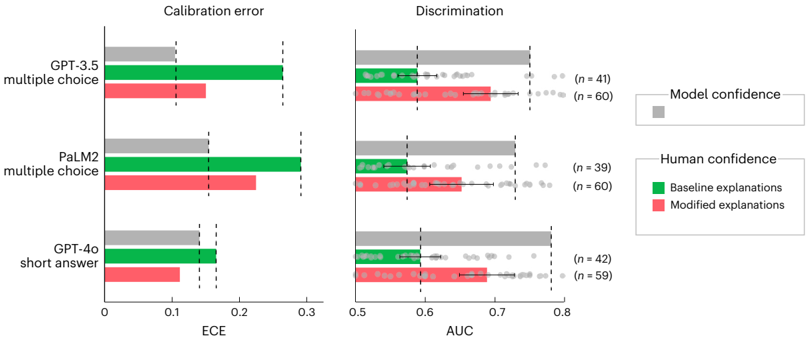
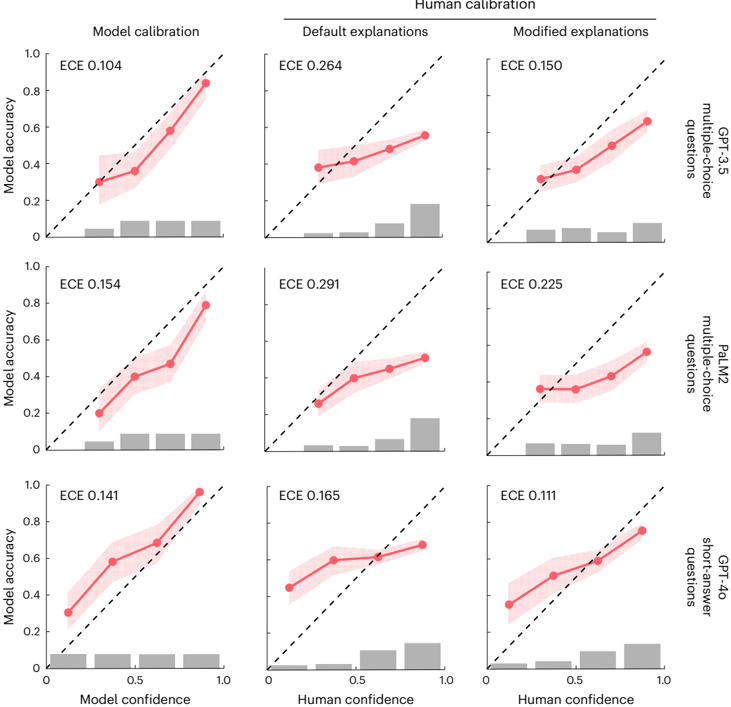
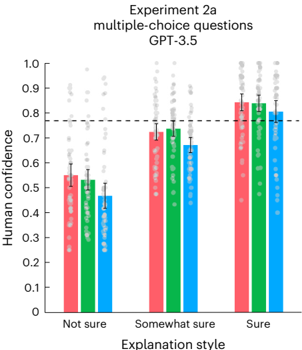
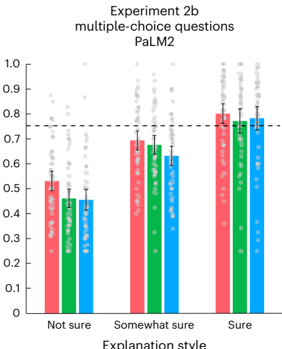
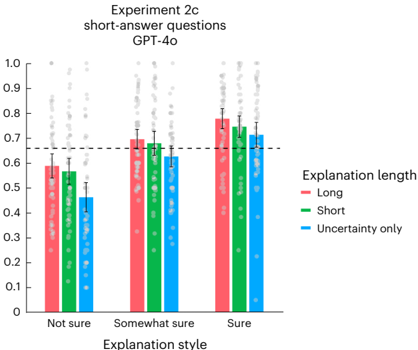
As artificial intelligence systems, particularly large language models (LLMs), become increasingly integrated into decision-making processes, the ability to trust their outputs is crucial. To earn human trust, LLMs must be well calibrated such that they can accurately assess and communicate the likelihood of their predictions being correct. Whereas recent work has focused on LLMs’ internal confidence, less is understood about how effectively they convey uncertainty to users. Here we explore the calibration gap, which refers to the difference between human confidence in LLM-generated answers and the models’ actual confidence, and the discrimination gap, which reflects how well humans and models can distinguish between correct and incorrect answers. Our experiments with multiple-choice and short-answer questions reveal that users tend to overestimate the accuracy of LLM responses when provided with default explanations. Moreover, longer explanations increased user confidence, even when the extra length did not improve answer accuracy. By adjusting LLM explanations to better reflect the models’ internal confidence, both the calibration gap and the discrimination gap narrowed, significantly improving user perception of LLM accuracy. These findings underscore the importance of accurate uncertainty communication and highlight the effect of explanation length in influencing user trust in artificial-intelligence-assisted decision-making environments.
Overview
The claims and statistics of this paper haven’t been checked yet.
Free: it reads the open-access text and checks the first 5 claims that cite a source we can check. Create a free account to check every claim.
Integrity signals
Registry
Cites
Statistics
Figures
Verification
Claims the paper makes
The claims and statistics of this paper haven’t been checked yet.
Free: it reads the open-access text and checks the first 5 claims that cite a source we can check. Create a free account to check every claim.
Claims other papers make about this one
Each is checked against this paper’s own text: does it say what the citing paper says it does?
The source backs part of the claim, not all of it — or backs it for a different population, condition or comparison.
In the citing paper
“AI is exceedingly confident and, unlike people, rarely indicates anything less than 100% confidence in the output,they do not use indicators like hedging language for example [48].”
From Incorporating generative AI into a writing-intensive undergraduate course without off-loading learning (2025) · cites this paper as [48]
Experimental — accuracy not yet measuredThe source backs part of the claim, not all of it — or backs it for a different population, condition or comparison.
In the citing paper
“However, current VLMs struggle to communicate their internal uncertainty through natural language [69, 117].”
From "It's trained by non-disabled people": Evaluating How Image Quality Affects Product Captioning with Vision-Language Models (2026) · cites this paper as [117]
Experimental — accuracy not yet measuredThe source backs part of the claim, not all of it — or backs it for a different population, condition or comparison.
In the citing paper
“Previous studies also show that users tend to associate larger models and longer results with greater precision and reliability [25], [26], [27]”
From Hollow-LLM Attack: Computationally Trivial Weights in Zero-Knowledge Verification of LLM Inference (2026) · cites this paper as [25]
Experimental — accuracy not yet measuredIn the citing paper
“and explanations can increase users’ confidence in AI outputs without improving the accuracy of their judgments (Steyvers et al., 2025).”
From Cognitive transparency and trust calibration in explainable AI systems: a psychological model of human-AI decision reliance (2026) · cites this paper as Steyvers et al., 2025
In the citing paper
“This concern is supported by recent evidence that users often overestimate the accuracy of AI outputs, particularly when explanations are provided (Steyvers et al., 2025)”
From Cognitive transparency and trust calibration in explainable AI systems: a psychological model of human-AI decision reliance (2026) · cites this paper as Steyvers et al., 2025
Self-check
Percentages, sums and reported differences re-computed from the paper’s own numbers.
The self-check needs the paper’s full text.
Citations
Cites
Huang, L., Yu, W., Ma, W., Zhong, W., Feng, Z., Wang, H., Chen, Q., Peng, W., Feng, X., Qin, B., et al. (2025) · ACM Transactions on Information Systems · doi:10.1145/3703155 · Cited by 4,688 · cited 1×
“One notable issue is the possibility of generating responses that, while convincing, may be inaccurate or nonsensical 9,10 .”
Training language models to follow instructions with human feedback
Ouyang, L., Wu, J., Jiang, X., Almeida, D., Wainwright, C. L., Mishkin, P., Zhang, C., Agarwal, S., Slama, K., Ray, A., et al. (2022) · arXiv · doi:10.48550/arxiv.2203.02155 · Cited by 4,208 · cited 1×
“Therefore, participants who considered themselves more knowledgeable about a topic were not more adept at estimating the LLM’s performance in that area.”
Training Language Models to Follow Instructions with Human Feedback
Ouyang, L., Wu, J., Jiang, X., Almeida, D., Wainwright, C., Mishkin, P., Zhang, C., Agarwal, S., Slama, K., Ray, A., et al. (2022) · Advances in Neural Information Processing Systems 35 · doi:10.52202/068431-2011 · Cited by 3,117 · cited 1×
“Therefore, participants who considered themselves more knowledgeable about a topic were not more adept at estimating the LLM’s performance in that area.”
Huang, L., Yu, W., Ma, W., Zhong, W., Feng, Z., Wang, H., Chen, Q., Peng, W., Feng, X., Qin, B., et al. (2023) · arXiv · doi:10.48550/arxiv.2311.05232 · Cited by 2,516 · cited 1×
“One notable issue is the possibility of generating responses that, while convincing, may be inaccurate or nonsensical 9,10 .”
Default Bayes factors for ANOVA designs
Rouder, J. N., Morey, R. D., Speckman, P. L., & Province, J. M. (2012) · Journal of Mathematical Psychology · doi:10.1016/j.jmp.2012.08.001 · Cited by 1,800
Petty, R. E., & Cacioppo, J. T. (1984) · Journal of Personality and Social Psychology · doi:10.1037/0022-3514.46.1.69 · Cited by 1,727 · cited 1×
“This result is consistent with studies in social psychology and communication research that suggest that longer answers or explanations may be perceived as more persuasive or credible, even when they do not contain more meaningful information 27,28 .”
TriviaQA: A Large Scale Distantly Supervised Challenge Dataset for Reading Comprehension
Joshi, M., Choi, E., Weld, D., & Zettlemoyer, L. (2017) · Proceedings of the 55th Annual Meeting of the Association for Computational Linguistics (Volume 1: Long Papers) · doi:10.18653/v1/p17-1147 · Cited by 1,690 · cited 2×
“Trivia QA is a dataset of trivia questions that can be answered in short answers 22 .”
TriviaQA: A Large Scale Distantly Supervised Challenge Dataset for Reading Comprehension
Joshi, M., Choi, E., Weld, D. S., & Zettlemoyer, L. (2017) · arXiv · doi:10.48550/arxiv.1705.03551 · Cited by 1,650 · cited 2×
“Trivia QA is a dataset of trivia questions that can be answered in short answers 22 .”
Fleming, S. M., & Lau, H. C. (2014) · Frontiers in Human Neuroscience · doi:10.3389/fnhum.2014.00443 · Cited by 1,408 · cited 1×
“The use of AUC in this context parallels various metrics in psychology for metacognitive discrimination or sensitivity, which similarly aim to evaluate the effectiveness of confidence scores in distinguishing between correct and incorrect answers 47 .”
Buçinca, Z., Malaya, M. B., & Gajos, K. Z. (2021) · arXiv · doi:10.48550/arxiv.2102.09692 · Cited by 1,124
Research works printed but not linked: 9
- Karelitz, T. M., Dhami, M. K., Budescu, D. V. & Wallsten, T. S. Toward a universal translator of verbal probabilities. In Proc. 15th International Florida Artificial Intelligence Research Society Conference (eds Haller, M. S. & Simmons, G.) 498-502 (AAAI Press, 2002).
- O'Brien, B. J. Words or numbers? The evaluation of probability expressions in general practice. J. R. Coll. Gen. Pract. 39, 98-100 (1989).
- Whalen, J. et al. ChatGPT: challenges, opportunities, and implications for teacher education. Contemp. Iss. Technol. Teach. Educ. 23, 1-23 (2023).
- Azaria, A. & Mitchell, T. in Findings of the Association for Computational Linguistics: EMNLP 2023 (eds Bouamor, H. et al.) 967-976 (ACL, 2023).
- Xiao, Y. et al. in Findings of the Association for Computational Linguistics: EMNLP 2022 (eds Goldberg, Y. et al.) 7273-7284 (ACL, 2022).
- Tanneru, S. H., Agarwal, C. & Lakkaraju, H. Quantifying uncertainty in natural language explanations of large language models. In International Conference on Artificial Intelligence and Statistics 1072-1080 (PMLR, 2024).
- Lin, S., Hilton, J. & Evans, O. Teaching models to express their uncertainty in words. Trans. Mach. Learn. Res. (2022).
- Guo, C., Pleiss, G., Sun, Y. & Weinberger, K. Q. On calibration of modern neural networks. In Proc. 34th International Conference on Machine Learning (eds Precup, D. & Teh, Y. W.) vol. 70 of Proceedings of Machine Learning Research 1321-1330 (PMLR, 2017).
- Kumar, A., Liang, P. S. & Ma, T. Verified uncertainty calibration. Adv. Neural Inf. Process. Syst. 32, (2019).
Cited by
A cognitive approach to human–AI complementarity in dynamic decision-making
González, C., & Heidari, H. (2025) · Nature Reviews Psychology · doi:10.1038/s44159-025-00499-x · Cited by 94
“AI must be capable of conveying uncertainty in ways that are understandable to users, providing intuitive explanations or calibrated confidence estimates 116 .”
LLM-Based Multi-Agent Decision-Making: Challenges and Future Directions
Sun, C., Huang, S., & Pompili, D. (2025) · IEEE Robotics and Automation Letters · doi:10.1109/lra.2025.3562371 · Cited by 106
“A more general comparison of different LLMs can be found in [66], [67].”
Generative Deep Learning for de Novo Drug Design─A Chemical Space Odyssey
Özçelik, R., Brinkmann, H., Criscuolo, E., & Grisoni, F. (2025) · Journal of Chemical Information and Modeling · doi:10.1021/acs.jcim.5c00641 · Cited by 74
The homogenizing effect of large language models on human expression and thought
Sourati, Z., Ziabari, A. S., & Dehghani, M. (2026) · Trends in Cognitive Sciences · doi:10.1016/j.tics.2026.01.003 · Cited by 131
Tiller, N. B., Marcon, A. R., Zenone, M. A., Kidd, K. E., Jeukendrup, A. E., Master, Z., & Caulfield, T. (2026) · BMJ Open · doi:10.1136/bmjopen-2025-112695 · Cited by 59
Mentalizing Without a Mind: Psychotherapeutic Potential of Generative AI
Yirmiya, K., & Fonagy, P. (2025) · Journal of Medical Internet Research · doi:10.2196/79156 · Cited by 49
“Research suggests that users frequently perceive LLMs as more intelligent, impartial, and truthful than human sources [35], often overestimating the factual accuracy of their outputs [36].”
Empowering Generalist Material Intelligence with Large Language Models
Yuan, W., Chen, G., Wang, Z., & You, F. (2025) · Advanced Materials · doi:10.1002/adma.202502771 · Cited by 55
The extended hollowed mind: why foundational knowledge is indispensable in the age of AI
Klein, C. R., & Klein, R. (2025) · Frontiers in Artificial Intelligence · doi:10.3389/frai.2025.1719019 · Cited by 41
“This marks a fundamental shift in cognitive offloading, presenting not only unprecedented opportunities for learning but also a challenge that is unique in its nature and scale (Heersmink, 2024; Steyvers et al., 2025; Zhou et al., 2024).”
Metacognitive sensitivity: The key to calibrating trust and optimal decision making with AI
Lee, D., Pruitt, J., Zhou, T., Du, J., & Odegaard, B. (2025) · PNAS Nexus · doi:10.1093/pnasnexus/pgaf133 · Cited by 44
Feedback by Design: Understanding and Overcoming User Feedback Barriers in Conversational Agents
Sharma, N., Zhang, Z., Lee, D., Krishnan, N., Ren, G.-J., Xiao, Z., & Li, Y. (2026) · Proceedings of the 2026 CHI Conference on Human Factors in Computing Systems · doi:10.1145/3772318.3791600 · Cited by 21
Metacognition and Uncertainty Communication in Humans and Large Language Models
Steyvers, M., & Peters, M. A. K. (2026) · Current Directions in Psychological Science · doi:10.1177/09637214251391158 · Cited by 18
“Recent findings show that users to interpret longer LLM responses as more confident, even when the model’s internal confidence remains unchanged (Steyvers, Tejeda, et al., 2025).”
InfluentialSelf-citationFrom Text to Trust: Empowering AI-assisted Decision Making with Adaptive LLM-powered Analysis
Li, Z., Zhu, H., Lu, Z., Xiao, Z., & Yin, M. (2025) · CHI Conference on Human Factors in Computing Systems · doi:10.1145/3706598.3713133 · Cited by 38
Digital twins for personalized treatment in uro-oncology in the era of artificial intelligence
Görtz, M., Brandl, C., Nitschke, A., Riediger, A. L., Stromer, D., Byczkowski, M., Heuveline, V., & Weidemüller, M. (2025) · Nature Reviews Urology · doi:10.1038/s41585-025-01096-6 · Cited by 30
“However, LLMs rely on learned statistical patterns rather than genuine comprehension and might, therefore, produce erroneous responses 75 .”
Show Me the Work: Fact-Checkers' Requirements for Explainable Automated Fact-Checking
Warren, G., Shklovski, I., & Augenstein, I. (2025) · CHI Conference on Human Factors in Computing Systems · doi:10.1145/3706598.3713277 · Cited by 67
“For example, while LLM expressions of uncertainty can reduce people’s over-reliance on them [65], LLMs tend to overestimate their own confidence [55, 107], so these scores are often unreliable.”
When large language models are reliable for judging empathic communication
Kumar, A., Poungpeth, N., Yang, D., Farrell, E. L., Lambert, B. L., & Groh, M. (2026) · Nature Machine Intelligence · doi:10.1038/s42256-025-01169-6 · Cited by 43
“However, LLM-based annotations are prone to variability across runs [56], inconsistencies across contexts [57], apparently sensible yet wrong answers [58], miscalibrated confidence [59], and a series of human-like cognitive biases [60, 61].”
Self-citationAn evaluation of estimative uncertainty in large language models
Tang, Z., Shen, K., & Kejriwal, M. (2026) · npj Complexity · doi:10.1038/s44260-026-00070-6 · Cited by 35
Tate, T. P., Harnick-Shapiro, B., Ritchie, D. R., Tseng, W., Dennin, M., & Warschauer, M. (2025) · Discover Computing · doi:10.1007/s10791-025-09563-9 · Cited by 14
“AI is exceedingly confident and, unlike people, rarely indicates anything less than 100% confidence in the output,they do not use indicators like hedging language for example [48].”
Quantifying uncert-AI-nty: Testing the accuracy of LLMs’ confidence judgments
Cash, T. N., Oppenheimer, D. M., Christie, S., & Devgan, M. (2025) · Memory & Cognition · doi:10.3758/s13421-025-01755-4 · Cited by 32
“In state-of-the-art generative AI chatbots, internal confidence is often assessed through token likeli-hoods—variables that essentially indicate how surprised the model is by the answer that was generated (Jiang et al., 2020; Kadavath et al., 2022; Steyvers et al., 2025; Xiao et al., 2022).”
wang, L., Zhang, L., & He, G. (2025) · Theoretical and Applied Mechanics Letters · doi:10.1016/j.taml.2025.100597 · Cited by 16
Recalibrating academic expertise in the age of generative AI
Lin, Z., & Sohail, A. (2026) · Patterns · doi:10.1016/j.patter.2025.101473 · Cited by 22
“25 Ritualized acceptance of AI authority manifests distinctively across scientific domains.”
Wu, L., Mai, L., Wang, H., Huang, J., He, X., Zhan, X., Khalemsky, A., Kumar, V. A., Paxton, J. H., Tsilimingras, D., et al. (2026) · npj Digital Medicine · doi:10.1038/s41746-026-02522-8 · Cited by 8
Aljohani, B., Aljuhani, A., & Alsanoosy, T. (2025) · International Journal of Advanced Computer Science and Applications · doi:10.14569/ijacsa.2025.01603103 · Cited by 12
“Humans, on the other hand, are always learning from their experiences, which helps them adapt to unexpected circumstances [33], [34].”
A self-correcting multi-agent LLM framework for language-based physics simulation and explanation
Park, D., Moon, H., & Ryu, S. (2026) · npj Artificial Intelligence · doi:10.1038/s44387-025-00057-z · Cited by 40
Torrielli, F., Locci, S., Rapp, A., & Di Caro, L. (2026) · Scientometrics · doi:10.1007/s11192-026-05695-x · Cited by 8
The Emergence of Applied Artificial Intelligence in the Realm of Value Based Musculoskeletal Care
Hunter, J., Dentino, P., & Jayakumar, P. (2025) · Current Reviews in Musculoskeletal Medicine · doi:10.1007/s12178-025-09982-7 · Cited by 9
“Further, developers will need to be wary and transparent of bias in detecting facial expressions across diverse cultural backgrounds, privacy concerns, differences in prompt strategies, and ethics of using emotions to triage and allocate healthcare resources [75].”
Lu, K., Zhao, X., Li, M., Wang, Z., Zhou, Y., & Wang, J. (2025) · International Journal of Geographical Information Science · doi:10.1080/13658816.2025.2566795 · Cited by 7
Comparative evaluation of LLMs in orthopedic surgery
Chundi, G., Dawar, A., Sarwar, S., Prasad, S., Vosbikian, M. M., & Ahmed, I. H. (2025) · Journal of Orthopaedic Reports · doi:10.1016/j.jorep.2025.100728 · Cited by 8
Wislocki, K. E., Sami, S., Liberzon, G., & Zalta, A. K. (2025) · JMIR Mental Health · doi:10.2196/80801 · Cited by 9
“Research has demonstrated that humans are often overconfident in the accuracy of GAI model responses [52], which may potentially result in greater bias in clinical decision-making in instances where GAI models make biased decisions.”
Cortiñas-Lorenzo, K., Cai, W., & Doherty, G. J. (2025) · ACM Transactions on Computer-Human Interaction · doi:10.1145/3769678 · Cited by 14
Passi, S., Dhanorkar, S., & Vorvoreanu, M. (2025) · Springer eBooks · doi:10.1007/978-981-95-3658-0_98 · Cited by 15
Sun, M., Zang, D., & Chen, J. (2026) · Frontiers in Bioengineering and Biotechnology · doi:10.3389/fbioe.2026.1750225 · Cited by 6
“…similar queries; whether they correctly frame the clinical utility, turnaround time, and financial aspects of organoid testing; and whether their language is sufficiently readable and actionable for users with diverse scientific literacy levels (Grippaudo et al., 2024; Steyvers et al., 2025).”
Characterizing the spiral: potential mechanisms in AI-associated delusions
Augustin, M., Pollak, T. A., & Morrin, H. (2026) · NPP—Digital Psychiatry and Neuroscience · doi:10.1038/s44277-026-00065-0 · Cited by 17
“Research shows that users consistently overestimate AI accuracy and that longer, elaborative explanations increase user con fi dence even when they do not improve answer accuracy [65].”
Bridging Expertise Gaps: The Role of LLMs in Human-AI Collaboration for CybersecurityPreprint
Tariq, S., Singh, R., Chhetri, M. B., Nepal, ., & Paris, C. L. (2025) · SSRN Electronic Journal · doi:10.2139/ssrn.5462737 · Cited by 14
del Río, J. S., Talavera, A., Fernández‐Pozo, N., Veredas, F. J., & Claros, M. G. (2025) · Journal of Experimental Botany · doi:10.1093/jxb/eraf498 · Cited by 11
Hu, H., Wang, L., Chen, L., Lin, H., Huang, L.-T., Wang, Z.-W., & Hou, X. (2026) · Journal of Medicinal Chemistry · doi:10.1021/acs.jmedchem.5c03511 · Cited by 5
Agentic AI has a Human Oversight ProblemPreprint
Passi, S. (2025) · SSRN Electronic Journal · doi:10.2139/ssrn.5529058 · Cited by 23
Same Prompt, Different Answer: Why AI Disagrees with Itself
Mee, T., Choi, J. J., & Baduashvili, A. (2025) · Journal of General Internal Medicine · doi:10.1007/s11606-025-10071-1 · Cited by 7
Barabas, L., Novotny, M., Jung, D., Müller, T., & Mertse, N. (2025) · Der Nervenarzt · doi:10.1007/s00115-025-01837-3 · Cited by 6
Jiang, T., Chu, S., Pan, J., Snåšel, V., & Wei, Y. (2026) · Engineering Applications of Artificial Intelligence · doi:10.1016/j.engappai.2026.113920 · Cited by 5
Toward Sustainable Agentic AI Systems: A Survey of Architectures and Methodologies
Lee, Y., & Park, E. (2026) · Sustainable Development · doi:10.1002/sd.70942 · Cited by 13
Competing Biases underlie Overconfidence and Underconfidence in LLMs
Kumaran, D., Fleming, S. M., Markeeva, L., Heyward, J., Banino, A., Mathur, M., Pascanu, R., Osindero, S., Martino, B. D., Veličković, P., et al. (2026) · Nature Machine Intelligence · doi:10.1038/s42256-026-01217-9 · Cited by 47
Growing up with Artificial Intelligence: Implications for Child Development
Xu, Y., & He, K. (2026) · Cambridge University Press eBooks · doi:10.1017/9781009503914 · Cited by 7
Schramm, S., Guellec, B. L., Topka, M., Svec, M., Backhaus, P., Eisenkolb, V. M., Riedel, E. O., Beyrle, M., Platzek, P., Ramschütz, C., et al. (2026) · Radiology · doi:10.1148/radiol.253477 · Cited by 9
Boie, S. D., Reis, F., Frey, N., Grünewald, E., & Balzer, F. (2026) · Journal of Medical Systems · doi:10.1007/s10916-026-02430-0 · Cited by 13
Schulte, N., & Kanbach, D. K. (2026) · Management Review Quarterly · doi:10.1007/s11301-026-00611-2 · Cited by 21
Probing Large Language Model Hidden States for Adverse Drug Reaction Knowledge
Berkowitz, J. S., Weissenbacher, D., Srinivasan, A., Friedrich, N. A., Cortina, J. M. A., Kivelson, S., Gonzalez‐Hernandez, G., & Tatonetti, N. P. (2025) · Lecture notes in computer science · doi:10.1007/978-3-031-95838-0_6 · Cited by 7
ChineseEcomQA: A Scalable E-commerce Concept Evaluation Benchmark for Large Language Models
Chen, H., LV, K., Hu, C., Li, Y., Yuan, Y., He, Y., Zhang, X., Liu, L., Liu, S., Su, W., et al. (2025) · ACM SIGKDD Conference on Knowledge Discovery and Data Mining (KDD) · doi:10.1145/3711896.3737374 · Cited by 25
What People Think of Machines as Doctors: Unveiling the Value of Gen-AI for e-HealthPreprint
Ozdemir, D. Y., Ayvaci, M., & Zentner, A. (2024) · SSRN Electronic Journal · doi:10.2139/ssrn.4765222 · Cited by 9
Garg, K., Tang, X., Heo, J., Morgan, D. R., Gergle, D., Sudderth, E. B., & Piper, A. M. (2026) · Proceedings of the 2026 CHI Conference on Human Factors in Computing Systems · doi:10.1145/3772318.3791309 · Cited by 3
“However, current VLMs struggle to communicate their internal uncertainty through natural language [69, 117].”
AI image enhancement for failure analysis in 3D quantum information technology
Wilhelmer, R., Laurent, F., Djuric-Rissner, T., Glantschnig, M., Strasser, J., Weinberger, S., Herrmann, T., Rössler, C., Czurratis, P., & Brunner, R. (2025) · Scientific Reports · doi:10.1038/s41598-025-08308-4 · Cited by 6
“In fact, the problem of hallucinations in highly generative models is gaining increasing attention in the last years 51,52 .”
Gimmelberg, D., & Ludviga, I. (2025) · International Journal of Financial Studies · doi:10.3390/ijfs13040210 · Cited by 9
Urbanite: A Dataflow-Based Framework for Human-AI Interactive Alignment in Urban Visual Analytics
Moreira, G., Ferreira, L., Veiga, C., Hosseini, M., & Miranda, F. (2025) · IEEE Transactions on Visualization and Computer Graphics · doi:10.1109/tvcg.2025.3634644 · Cited by 7
“For example, LLMs can generate plausible but incorrect outputs [49], and they lack transparency and structured mechanisms for iterative refinement of results.”
From algorithms to systems: integrating computation into drug discovery
Bradley, A. R., Rossall, A., Pairaudeau, G., & Deane, C. M. (2025) · Expert Opinion on Drug Discovery · doi:10.1080/17460441.2025.2601102 · Cited by 5
“LLMs often prefer verbose, confi-dent-sounding responses over accurate but uncertain ones [94].”
Shared Minds: The Cognitive Parallels Between Humans and Artificial Intelligence
Tremblay, S., Marois, A., Zare, M., & Lafond, D. (2026) · Human Behavior and Emerging Technologies · doi:10.1155/hbe2/9946143 · Cited by 5
Erlei, A., Cau, F. M., Georgiev, R., Kumar, S. C., Bizer, K., & Gadiraju, U. (2026) · CHI Conference on Human Factors in Computing Systems · doi:10.1145/3772318.3791420 · Cited by 7
“On the right side, participants saw the binary decision options for the current trial, and an AI pool of ten AI systems (A2).”
Zero-shot learning for clinical phenotyping: Comparing LLMs and rule-based methods
Neves, B. D., Moreira, J.-M., Gonçalves, S., Cerejo, J., da Silva, N. A., Leite, F., & Silva, M. J. (2025) · Computers in Biology and Medicine · doi:10.1016/j.compbiomed.2025.110181 · Cited by 13
Evaluating Psychological Competency via Chinese Q&A in Large Language Models
Gao, F., He, Y., Chen, Q., & Liu, F. (2025) · Applied Sciences · doi:10.3390/app15169089 · Cited by 3
Şimşek, A. C., Anders, G., Göth, J., Specht, L., & Huff, M. (2025) · Computers and Education Artificial Intelligence · doi:10.1016/j.caeai.2025.100512 · Cited by 8
Strategies for community-sourced biocuration in bioinformatics: a case study on MIBiG 4.0
Blin, K., Loureiro, C., Louwen, N. L. L., Navarro-Muñoz, J. C., Gerstmans, H., Robinson, S. L., Rutz, A., Reitz, Z. L., Doering, D. T., van der Hooft, J. J. J., et al. (2025) · Briefings in Bioinformatics · doi:10.1093/bib/bbaf659 · Cited by 2
Navigating the Future of HR NLP: Challenges and Prospects
Asim, Z., Susanto, H., Gahramanova, S., & Vasudevan, A. (2025) · IGI Global eBooks · doi:10.4018/979-8-3373-2135-6.ch007 · Cited by 2
GÜLDEN, B., Bilge, H., & Uysal, P. K. (2026) · International Journal of Assessment Tools in Education · doi:10.21449/ijate.1678002 · Cited by 4
“This observation appears consistent with research on large language models (LLMs), which indicates that they generate probabilistic rather than categorical outputs and may encounter difficulties in reliably expressing or calibrating their confidence (Kadavath et al ., 2022; Steyvers et al ., 2025).”
Ren, J. F., Li, B., Xu, Z., Zhang, X., Fayek, H. M., & Li, X. (2026) · International World Wide Web Conference (WWW) · doi:10.1145/3774904.3792358 · Cited by 13
Cheng, F., Li, Q., He, L., Li, H., Brooks, B. W., Yu, Z., & You, J. (2026) · Environmental Science & Technology · doi:10.1021/acs.est.6c01342 · Cited by 4
Reinhard, P., Li, M. M., Peters, C., & Leimeister, J. M. (2026) · Information Systems Frontiers · doi:10.1007/s10796-026-10716-4 · Cited by 13
“…effects of expla - nations in decision-support and recommender systems, our analysis points out that literature lacks the investigation of new types of AI systems such as GenAI (Kim et al., 2025; Steyvers et al., 2025) or agentic AI (Acharya et al., 2025) as well as the novel forms of delegation.”
Generative Artificial Intelligence and Large Language Models in Clinical Oncology
Yu, Y., Zhao, Z., Wang, Z., Lin, R., Tan, Y., Chen, Y., Li, T., Baptista‐Hon, D. T., Zhang, X., Wu, C., et al. (2026) · MedComm · doi:10.1002/mco2.70833 · Cited by 4
“In parallel, standardized clinical evaluation frameworks and structured training programs are essential to enhance AI literacy and strengthen clinician confidence, thereby facilitating the responsible and sustainable integration of LLMs into oncology practice [ 206, 207 ].”
Self-reported perception of statistical literacy: Evidence from a National Survey of U.S. Adults
Anyaso-Samuel, S., & Ramos, M. (2026) · PLoS ONE · doi:10.1371/journal.pone.0350282 · Cited by 2
Zhang, W., Ding, N., Fu, S., Shi, J., & Zhang, E. (2026) · Safety Science · doi:10.1016/j.ssci.2026.107377 · Cited by 2
Agentic AI: From Autonomous Agents to Enterprise Agentic AI Systems
Li, M. M., Reinhard, P., & Leimeister, J. M. (2026) · Business & Information Systems Engineering · doi:10.1007/s12599-026-01009-w · Cited by 9
“This underscores the need for explainability and observability (Kim et al. 2025; Steyvers et al. 2025).”
Cognitive Readiness for Human-AI Collaboration
Tremblay, S., de Hemptinne, D., Teyssier‐Roberge, G., Gallant, A., Marois, A., & Lafond, D. (2026) · Human Factors The Journal of the Human Factors and Ergonomics Society · doi:10.1177/00187208261474345 · Cited by 5
Ghaharian, K., Soligo, M., Young, R., Golab, L., Kraus, S. W., & Wells, S. A. (2025) · Journal of Gambling Studies · doi:10.1007/s10899-025-10430-x · Cited by 3
Bridging the gap between machine confidence and human perceptions
Yin, M. (2025) · Nature Machine Intelligence · doi:10.1038/s42256-025-01013-x · Cited by 2
van der Vet, I., & Malkki, L. (2025) · Open Research Europe · doi:10.12688/openreseurope.19612.1 · Cited by 1
“Additionally, Copilot is now integrated into Microsoft Office’s 365 applications, making it more functional for professional use.”
Evaluation and Improvement of Test Selection for Large Language Models
Quan, L., Jin, W., Hu, Q., Cordy, M., Huang, Y., Ma, L., & Li, X. (2025) · Journal of Software Evolution and Process · doi:10.1002/smr.70057 · Cited by 5
Are LLMs Really Knowledgeable for Knowledge Graph Completion?
Liu, Y., Sun, Z., Shao, Z., Cui, Y., & Hu, W. P. (2025) · Lecture notes in computer science · doi:10.1007/978-3-032-09530-5_5 · Cited by 4
Abumelha, M., ALGhamdi, A. S. A.-M., Fayoumi, A. G., & Ragab, M. (2025) · JMIR Medical Informatics · doi:10.2196/78432 · Cited by 4
“…literature gaps include traditional methods’ substantial difficulties when confronted with the inherent semantic variability characteristic of clinical terminology [9,10], LLMs’ data scarcity and the persistent risk of hallucination [13-15], and manual assessment’s scalability limitations [1,3,4].”
Confidence-weighted integration of human and machine judgments for superior decision-making
Yáñez, F., Luo, X., Minero, O. V., & Love, B. C. (2025) · Patterns · doi:10.1016/j.patter.2025.101423 · Cited by 4
“We will then evaluate a knowledge-intensive task in which large language models (LLMs) surpass humans in predicting the outcomes of neuroscience studies [14], posing a real challenge for effective team collaboration.”
Uncovering bias and variability in how large language models attribute cardiovascular risk
Chan, J. T. N., & Kwek, R. K. (2025) · Frontiers in Digital Health · doi:10.3389/fdgth.2025.1710594 · Cited by 2
“Through this design, we aimed to reproduce how users interact with LLMs realistically, especially when they do not know of specific risk tools, and also to observe the degree of confidence or precision the model determined was appropriate (17, 18).”
Evolution of Physical Intelligence Across Scales
Liu, K., Huang, T., Li, A., Lv, P., Qin, T., Chen, W., Wei, H., & Duan, H. (2026) · Advanced Intelligent Discovery · doi:10.1002/aidi.202500178 · Cited by 3
Calibrated Trust in Dealing with LLM Hallucinations: A Qualitative Study
Ryser, A., Allwein, F., & Schlippe, T. (2025) · International Conference on Foundation and Large Language Models (FLLM) · doi:10.1109/fllm67465.2025.11391250 · Cited by 7
“Trust has been identified as a key factor in user engagement—even in the absence of systematic verification [10], [15].”
InfluentialQuantum inspired feature engineering for explainable EEG signal classification
Alotaibi, F., Yagmahan, M. S. N., Alobaid, K. A., Jari, M., Göktaş, Ö. F., Bayğın, M., Doğan, Ş., & Tuncer, T. (2026) · Scientific Reports · doi:10.1038/s41598-026-41821-8 · Cited by 2
“Nowadays, we are living in the AI age, and AI applications, especially large language models (LLMs), have been used everywhere 62,63 .”
Who Does What? Archetypes of Roles Assigned to LLMs During Human-AI Decision-Making
Chappidi, S., Singh, J., & Krauze, A. V. (2026) · CHI Conference on Human Factors in Computing Systems · doi:10.1145/3772318.3791428 · Cited by 8
SceneScout: Towards AI-Driven Access to Street Level Imagery for Blind Users
Jain, G., Findlater, L., & Gleason, C. (2026) · CHI Conference on Human Factors in Computing Systems · doi:10.1145/3772318.3790449 · Cited by 14
Four Aspirations for Evaluating AI-Infused Technologies: A Narrative Review
Morey, D. A., Jalaeian, M., Reynolds, M. E., McGeorge, N., Oldham, H. K., & Rayo, M. F. (2026) · Journal of Cognitive Engineering and Decision Making · doi:10.1177/15553434261443032 · Cited by 1
“However, misleading outputs can be dif-fi cult for people to detect, and AI-generated con fi dence or explanations often make them more persuasive (Steyvers et al., 2025).”
Interactive Virtual-Physical safety training for manufacturing workshops via vision and LLMs
Wang, H., Ren, W., Han, C., Ji, S., Zhang, X., Huang, S., Sun, C., Zhuang, C., & Zhi, Y. (2026) · Digital engineering. · doi:10.1016/j.dte.2026.100124 · Cited by 1
Large language model-driven group consensus decision-making model: The case of local debt risk
Liu, M., & Zhang, L. (2026) · Expert Systems with Applications · doi:10.1016/j.eswa.2026.132901 · Cited by 1
Shallari, I., Gallo, V., Carratù, M., Hussain, M., Krapohl, D., & Mousavirad, S. J. (2026) · Education Sciences · doi:10.3390/educsci16050803 · Cited by 2
“Recent evidence shows that users may misjudge what LLMs know and may overestimate the reliability of model responses when these are expressed in a coherent and confident form (Steyvers et al., 2025).”
InfluentialTalking to Ourselves Through a Smart Mirror: Artificial Confidence in Human–AI Interaction
Hochman, G. (2026) · Systems · doi:10.3390/systems14060627 · Cited by 4
Deroy, O., & Bahrami, B. (2026) · La Presse Médicale · doi:10.1016/j.lpm.2026.104362 · Cited by 2
Chen, R. K., Warburton, A., Do, R., Chen, D. D., Katz, D., & Burnett, G. W. (2026) · Anesthesia & Analgesia · doi:10.1213/ane.0000000000008148 · Cited by 3
History and Artificial Intelligence
Hughes‐Warrington, M. (2026) · Cambridge University Press eBooks · doi:10.1017/9781009572187 · Cited by 1
Uncertainty-Aware Structural Attention Features for Hallucination Detection in LLMs
Lokesh, R., Mokshagna, C., Dinesh, K., & Usha, P. (2026) · International Conference on Signal Processing and Communications (SPCOM) · doi:10.1109/spcom71105.2026.11622967 · Cited by 1
“However, these models prioritize next-token prediction without ensuring factual correctness, making them prone to generating fluent but incorrect responses [10].”
An epistemological study of ‘AI psychosis’
Gan, N. (2026) · AI and Ethics · doi:10.1007/s43681-026-01281-2 · Cited by 1
“Users of LLMs have reported finding them useful for mental health support because of their sympathetic and human-like nature [ 41 , 45 , 69].”
Gong, M., Ma, Y., Pan, H., Bai, H., Dai, H., Chen, W., Liu, H., Gong, K., Zeng, Z., Wu, H., et al. (2026) · JME Practical Bioethics · doi:10.1136/jmepb-2026-000136 · Cited by 1
Human preferences are susceptible to covertly misaligned AI advice
Sabour, S., Liu, J. M., Liu, S., Yao, C. Z., Cui, S., Zhang, W., Zhang, X., Cao, Y., Bhat, A., Guan, J., et al. (2026) · Proceedings of the National Academy of Sciences · doi:10.1073/pnas.2600684123 · Cited by 4
Towards an integrative neuroscience of metacognition
Fleming, S. M. (2026) · Nature reviews. Neuroscience · doi:10.1038/s41583-026-01081-x · Cited by 5
“This can lead to a ‘calibration gap’, whereby humans assume artificial systems are more accurate than they really are 189 .”
Tijani, O., Mahoney, J., Vijaykumar, S., & Nicholson, J. (2026) · Proceedings of the ACM on Human-Computer Interaction · doi:10.1145/3817016 · Cited by 1
“Users often overestimate LLM accuracy, especially when the tool provides lengthier responses, resulting in an inflated sense of reliability [48].”
Five AI Agents, One Hidden Source: The Independence Illusion in Multi-Agent Decisions
Tan, K. H. (2026) · Journal of Advanced Multidisciplinary Studies (JAMS) · doi:10.68050/jams.2026.489 · Cited by 1
Du, Y. (2026) · Medical Hypotheses · doi:10.1016/j.mehy.2026.112172 · Cited by 1
Жакыпбеков, С. Ж., Bykov, A. A., Yеrmakova, V. A., Zhuginissova, A., & Vasquez, M. (2026) · Informatics · doi:10.3390/informatics13110179 · Cited by 2
Beliefs about accuracy shape confidence attributions to humans and artificial agents
Colombatto, C., & Fleming, S. M. (2026) · Communications Psychology · doi:10.1038/s44271-026-00445-4 · Cited by 6
Metadata
- Authors
- Steyvers, M., Tejeda, H., Kumar, A., Belem, C., Karny, S., Hu, X., Mayer, L. W., & Smyth, P.
- Affiliations
- University of California, Irvine (US)
- Corresponding author
- Steyvers, Mark
- ORCID
- Venue
- Nature Machine Intelligence
- Published
- 2025-01-21
- Volume
- 7
- Issue
- 2
- Pages
- 221-231
- ISSN
- 2522-5839 (ISSN-L)
- OpenAlex
- W4406679533
- Cited by
- 209
- References
- 36
- Citations by year
- 2026: 147 · 2025: 60
- FWCI
- 83.03
- Type
- journal article
- Language
- en
- Open access
- hybrid
- doi.org
- Licence
- cc-by
- creativecommons.org/licenses/by/4.0 (tdm)
- creativecommons.org/licenses/by/4.0 (vor)
- Locations
- Nature Machine Intelligence (publishedVersion, cc-by)
- arXiv (Cornell University) (submittedVersion, cc-by-sa)
- arXiv (Cornell University)
- Funders
- National Science Foundation (1900644)
- Hasso Plattner Institute (HPI) Research Center in Machine Learning and Data Science at the University of California, Irvine
- Topics
- Physical Sciences › Computer Science › Artificial Intelligence › Explainable Artificial Intelligence (XAI)
- Physical Sciences › Computer Science › Artificial Intelligence › Ethics and Social Impacts of AI
- Social Sciences › Human Factors and Ergonomics › Human-Automation Interaction and Safety
- Keywords
- large language models, uncertainty communication, user confidence, trust in AI, AI-assisted decision-making, confidence calibration, human-AI interaction
About these checks
Registry, retraction, Cites and statistics results are computed, not judged, with one exception: a printed reference that no index lists is read once by a model before it counts as a citation error. Claims are extracted by a model and kept only when their quote appears verbatim in the text; each cited source is then checked, with a model’s help, for whether it says what the claim relies on. Those verdicts can be wrong — read the claim’s quote and the cited source before relying on one.
Statistics and arithmetic are recomputed, not judged.
Confidence bands are shown only for fields calibrated on our annotated test set. None is calibrated yet, so no band is shown.
What counts as a claim ›How we measure confidence ›How we check this ›
Are you an author, or do you see a problem with this page? Request a review
Data sources
Bibliographic data: Semantic Scholar, OpenAlex, Crossref.
Contains information from the Semantic Scholar Academic Graph Datasets, made available under the ODC Attribution License (ODC-BY 1.0).
Semantic Scholar’s data is described in: Kinney, R., et al. (2023). The Semantic Scholar Open Data Platform. arXiv:2301.10140.
