

What large language models know and what people think they know
Open accessThe DOI matches its Crossref record; 46 of the 49 references it cites were found in a registry or an index.
Abstract
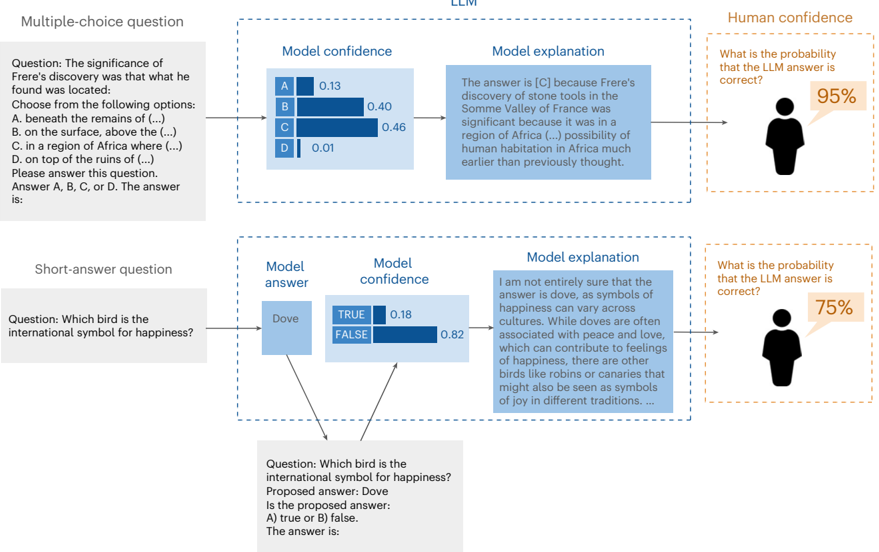
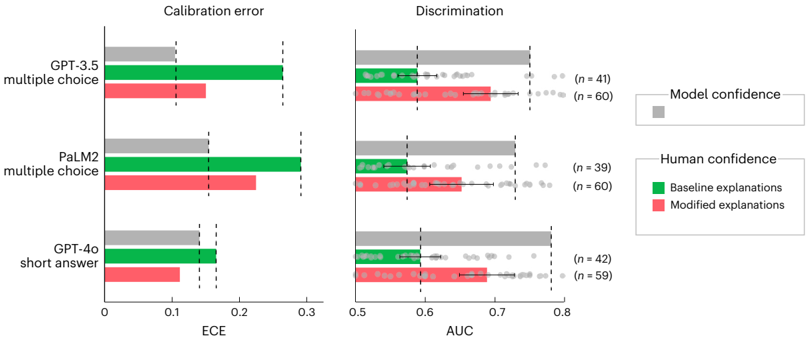
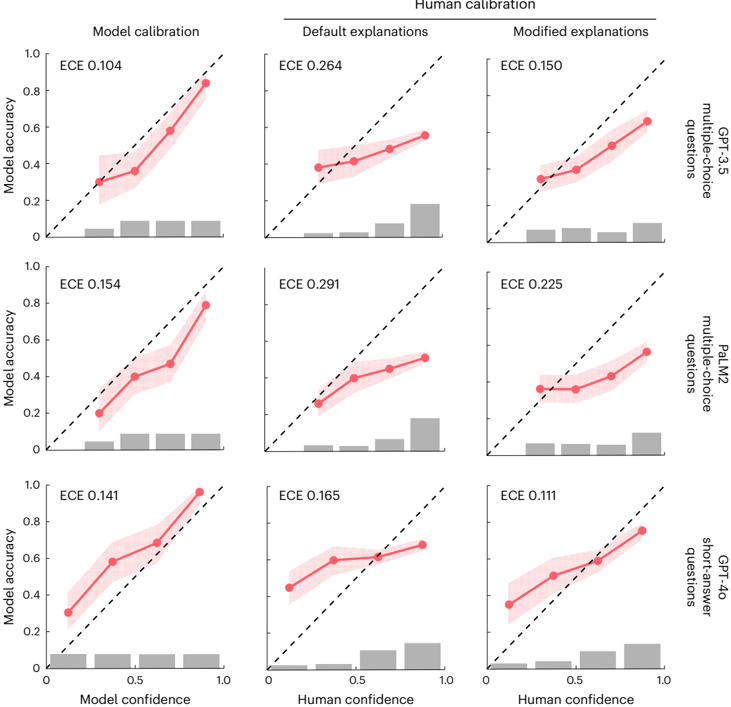
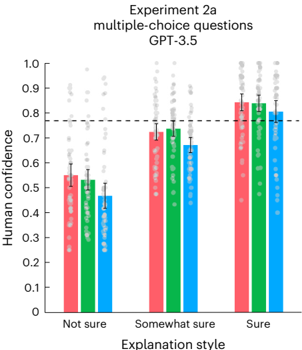
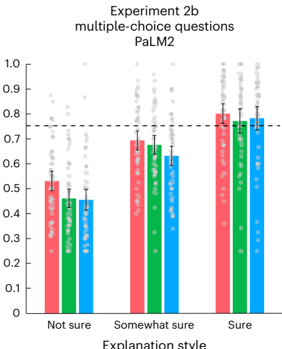
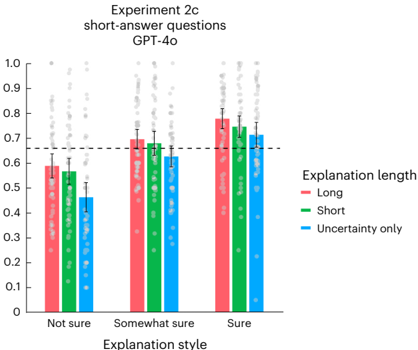
As artificial intelligence systems, particularly large language models (LLMs), become increasingly integrated into decision-making processes, the ability to trust their outputs is crucial. To earn human trust, LLMs must be well calibrated such that they can accurately assess and communicate the likelihood of their predictions being correct. Whereas recent work has focused on LLMs’ internal confidence, less is understood about how effectively they convey uncertainty to users. Here we explore the calibration gap, which refers to the difference between human confidence in LLM-generated answers and the models’ actual confidence, and the discrimination gap, which reflects how well humans and models can distinguish between correct and incorrect answers. Our experiments with multiple-choice and short-answer questions reveal that users tend to overestimate the accuracy of LLM responses when provided with default explanations. Moreover, longer explanations increased user confidence, even when the extra length did not improve answer accuracy. By adjusting LLM explanations to better reflect the models’ internal confidence, both the calibration gap and the discrimination gap narrowed, significantly improving user perception of LLM accuracy. These findings underscore the importance of accurate uncertainty communication and highlight the effect of explanation length in influencing user trust in artificial-intelligence-assisted decision-making environments.
Overview
The claims and statistics of this paper haven’t been checked yet.
Free: it reads the open-access text and checks the first 5 claims that cite a source we can check. Create a free account to check every claim.
Integrity signals
Registry
Cites
Statistics
Figures
Verification
Claims the paper makes
The claims and statistics of this paper haven’t been checked yet.
Free: it reads the open-access text and checks the first 5 claims that cite a source we can check. Create a free account to check every claim.
Claims other papers make about this one
Each is checked against this paper’s own text: does it say what the citing paper says it does?
The source backs part of the claim, not all of it — or backs it for a different population, condition or comparison.
In the citing paper
“AI is exceedingly confident and, unlike people, rarely indicates anything less than 100% confidence in the output,they do not use indicators like hedging language for example [48].”
From Incorporating generative AI into a writing-intensive undergraduate course without off-loading learning (2025) · cites this paper as [48]
Experimental — accuracy not yet measuredThe source backs part of the claim, not all of it — or backs it for a different population, condition or comparison.
In the citing paper
“However, current VLMs struggle to communicate their internal uncertainty through natural language [69, 117].”
From "It's trained by non-disabled people": Evaluating How Image Quality Affects Product Captioning with Vision-Language Models (2026) · cites this paper as [117]
Experimental — accuracy not yet measuredThe source backs part of the claim, not all of it — or backs it for a different population, condition or comparison.
In the citing paper
“Previous studies also show that users tend to associate larger models and longer results with greater precision and reliability [25], [26], [27]”
From Hollow-LLM Attack: Computationally Trivial Weights in Zero-Knowledge Verification of LLM Inference (2026) · cites this paper as [25]
Experimental — accuracy not yet measuredIn the citing paper
“and explanations can increase users’ confidence in AI outputs without improving the accuracy of their judgments (Steyvers et al., 2025).”
From Cognitive transparency and trust calibration in explainable AI systems: a psychological model of human-AI decision reliance (2026) · cites this paper as Steyvers et al., 2025
In the citing paper
“This concern is supported by recent evidence that users often overestimate the accuracy of AI outputs, particularly when explanations are provided (Steyvers et al., 2025)”
From Cognitive transparency and trust calibration in explainable AI systems: a psychological model of human-AI decision reliance (2026) · cites this paper as Steyvers et al., 2025
Self-check
Percentages, sums and reported differences re-computed from the paper’s own numbers.
The self-check needs the paper’s full text.
Citations
Cites
Huang, L., Yu, W., Ma, W., Zhong, W., Feng, Z., Wang, H., Chen, Q., Peng, W., Feng, X., Qin, B., et al. (2025) · ACM Transactions on Information Systems · doi:10.1145/3703155 · Cited by 4,688 · cited 1×
“One notable issue is the possibility of generating responses that, while convincing, may be inaccurate or nonsensical 9,10 .”
Training language models to follow instructions with human feedback
Ouyang, L., Wu, J., Jiang, X., Almeida, D., Wainwright, C. L., Mishkin, P., Zhang, C., Agarwal, S., Slama, K., Ray, A., et al. (2022) · arXiv · doi:10.48550/arxiv.2203.02155 · Cited by 4,208 · cited 1×
“Therefore, participants who considered themselves more knowledgeable about a topic were not more adept at estimating the LLM’s performance in that area.”
Training Language Models to Follow Instructions with Human Feedback
Ouyang, L., Wu, J., Jiang, X., Almeida, D., Wainwright, C., Mishkin, P., Zhang, C., Agarwal, S., Slama, K., Ray, A., et al. (2022) · Advances in Neural Information Processing Systems 35 · doi:10.52202/068431-2011 · Cited by 3,117 · cited 1×
“Therefore, participants who considered themselves more knowledgeable about a topic were not more adept at estimating the LLM’s performance in that area.”
Huang, L., Yu, W., Ma, W., Zhong, W., Feng, Z., Wang, H., Chen, Q., Peng, W., Feng, X., Qin, B., et al. (2023) · arXiv · doi:10.48550/arxiv.2311.05232 · Cited by 2,516 · cited 1×
“One notable issue is the possibility of generating responses that, while convincing, may be inaccurate or nonsensical 9,10 .”
Default Bayes factors for ANOVA designs
Rouder, J. N., Morey, R. D., Speckman, P. L., & Province, J. M. (2012) · Journal of Mathematical Psychology · doi:10.1016/j.jmp.2012.08.001 · Cited by 1,800
Petty, R. E., & Cacioppo, J. T. (1984) · Journal of Personality and Social Psychology · doi:10.1037/0022-3514.46.1.69 · Cited by 1,727 · cited 1×
“This result is consistent with studies in social psychology and communication research that suggest that longer answers or explanations may be perceived as more persuasive or credible, even when they do not contain more meaningful information 27,28 .”
TriviaQA: A Large Scale Distantly Supervised Challenge Dataset for Reading Comprehension
Joshi, M., Choi, E., Weld, D., & Zettlemoyer, L. (2017) · Proceedings of the 55th Annual Meeting of the Association for Computational Linguistics (Volume 1: Long Papers) · doi:10.18653/v1/p17-1147 · Cited by 1,690 · cited 2×
“Trivia QA is a dataset of trivia questions that can be answered in short answers 22 .”
TriviaQA: A Large Scale Distantly Supervised Challenge Dataset for Reading Comprehension
Joshi, M., Choi, E., Weld, D. S., & Zettlemoyer, L. (2017) · arXiv · doi:10.48550/arxiv.1705.03551 · Cited by 1,650 · cited 2×
“Trivia QA is a dataset of trivia questions that can be answered in short answers 22 .”
Fleming, S. M., & Lau, H. C. (2014) · Frontiers in Human Neuroscience · doi:10.3389/fnhum.2014.00443 · Cited by 1,408 · cited 1×
“The use of AUC in this context parallels various metrics in psychology for metacognitive discrimination or sensitivity, which similarly aim to evaluate the effectiveness of confidence scores in distinguishing between correct and incorrect answers 47 .”
Buçinca, Z., Malaya, M. B., & Gajos, K. Z. (2021) · arXiv · doi:10.48550/arxiv.2102.09692 · Cited by 1,124
Research works printed but not linked: 9
- Karelitz, T. M., Dhami, M. K., Budescu, D. V. & Wallsten, T. S. Toward a universal translator of verbal probabilities. In Proc. 15th International Florida Artificial Intelligence Research Society Conference (eds Haller, M. S. & Simmons, G.) 498-502 (AAAI Press, 2002).
- O'Brien, B. J. Words or numbers? The evaluation of probability expressions in general practice. J. R. Coll. Gen. Pract. 39, 98-100 (1989).
- Whalen, J. et al. ChatGPT: challenges, opportunities, and implications for teacher education. Contemp. Iss. Technol. Teach. Educ. 23, 1-23 (2023).
- Azaria, A. & Mitchell, T. in Findings of the Association for Computational Linguistics: EMNLP 2023 (eds Bouamor, H. et al.) 967-976 (ACL, 2023).
- Xiao, Y. et al. in Findings of the Association for Computational Linguistics: EMNLP 2022 (eds Goldberg, Y. et al.) 7273-7284 (ACL, 2022).
- Tanneru, S. H., Agarwal, C. & Lakkaraju, H. Quantifying uncertainty in natural language explanations of large language models. In International Conference on Artificial Intelligence and Statistics 1072-1080 (PMLR, 2024).
- Lin, S., Hilton, J. & Evans, O. Teaching models to express their uncertainty in words. Trans. Mach. Learn. Res. (2022).
- Guo, C., Pleiss, G., Sun, Y. & Weinberger, K. Q. On calibration of modern neural networks. In Proc. 34th International Conference on Machine Learning (eds Precup, D. & Teh, Y. W.) vol. 70 of Proceedings of Machine Learning Research 1321-1330 (PMLR, 2017).
- Kumar, A., Liang, P. S. & Ma, T. Verified uncertainty calibration. Adv. Neural Inf. Process. Syst. 32, (2019).
Cited by
Items 101–200 of 213
Rehman, U. (2026) · Frontiers in Psychology · doi:10.3389/fpsyg.2026.1924913 · Cited by 1
“Their benefit depends largely on whether they allow users to verify the correctness of an AI output (Fok and Weld, 2024), and explanations can increase users’ confidence in AI outputs without improving the accuracy of their judgments (Steyvers et al., 2025).”
A metacognitive approach to learning and performance in human-AI interaction
Fan, Y., Yan, L., Molenaar, I., Greiff, S., & Gašević, D. (2026) · Communications Psychology · doi:10.1038/s44271-026-00548-y · Cited by 1
Hollow-LLM Attack: Computationally Trivial Weights in Zero-Knowledge Verification of LLM Inference
Gong, C., Liu, B., & Li, M. (2026) · 2026 IEEE Symposium on Security and Privacy (SP) · doi:10.1109/sp63933.2026.00258
“Previous studies also show that users tend to associate larger models and longer results with greater precision and reliability [25], [26], [27], further motivating providers to overstate the scale of their models.”
How do you know that you don’t know?
Gronau, Q. F., Steyvers, M., & Brown, S. D. (2024) · Cognitive Systems Research · doi:10.1016/j.cogsys.2024.101232
Self-citationRecalibrating Academic Expertise in the Age of Generative AIPreprint
Sohail, A., & Lin, Z. (2025) · SSRN Electronic Journal · doi:10.2139/ssrn.5224452 · Cited by 1
Mind the Gap: How Explicit Uncertainty Cues Improve Decision MakingPreprint
Lawal, S., & Amir, O. (2025) · SSRN Electronic Journal · doi:10.2139/ssrn.5321014 · Cited by 1
Determinants of Verification Behavior in Generative Search: Evidence from a Conjoint ExperimentPreprint
Knor, E. L., Reiss, M. V., Möller, J. E., & Merten, L. (2025) · SSRN Electronic Journal · doi:10.2139/ssrn.5364791
Hughes‐Warrington, M., Martin, A. W., & O'Brien, L. Y. (2025) · Routledge eBooks · doi:10.4324/9781003275084-7
Li, H., Ren, W., Li, H., Feng, X., Wang, Y., Yan, Z., Huang, S., Ji, S., Guo, W., & Liu, H. (2025) · SSRN Electronic Journal · doi:10.2139/ssrn.5379237
Confidence Calibration for Multimodal LLMs: An Empirical Study Through Medical VQA
Du, Y., Wang, Y., Kong, M. C., Liang, T., Long, Q., Chen, B., & Zhu, Q. (2025) · Lecture notes in computer science · doi:10.1007/978-3-032-04978-0_9 · Cited by 8
“Specific calibration methods include temperature scaling [21,26,1], prompting strategy [28,17,24,22], and reinforcement learning-based methods [8,23].”
Do Llamas understand the periodic table?
Lei, G., & Cooper, S. J. (2025) · Digital Discovery · doi:10.1039/d5dd00374a · Cited by 2
Magic Numbers: An Algorithm for Mitigating Hallucinations in LLMs
Hällström, H. J. (2025) · Lecture notes in computer science · doi:10.1007/978-3-032-03711-4_2
Multimorbidity measurement strategies for predicting hospital visits
Neves, B. D., Moreira, J. M., Gonçalves, S., Cerejo, J., Mota, I., Silva, N. A., Leite, F., & Silva, M. J. (2025) · BMC Health Services Research · doi:10.1186/s12913-025-13817-z
Technikfolgen und Gesellschaft
Milkau, U. (2025) · Springer eBooks · doi:10.1007/978-3-658-48335-7_4
Liu, Y., Wu, X., Cai, X., & Wang, F. (2025) · doi:10.1109/powercon66300.2025.11295157
“As these models are increasingly incorporated into decision-making processes, establishing trust in their outputs becomes crucial [7].”
Revisiting Systems Principles for the Era of Generative AI
Oulasvirta, A., & Hartmann, B. (2025) · Computer · doi:10.1109/mc.2025.3602178
“For example, Steyvers et al. 4 introduced the discrimination gap as a difference between what an large language model (LLM) believes it knows and what people think they know.”
Qian, M., & Yang, L. (2026) · Lecture notes in computer science · doi:10.1007/978-3-032-13184-3_26 · Cited by 2
Multi-Scale Computational Analysis of Wikipedia’s Telling of Global HistoryPreprint
Buongiorno, S., Guldi, J., Hughes‐Warrington, M., Jiang, N., Larson, R., Bellam, S., & Palermo, G. J. (2026) · Research Square · doi:10.21203/rs.3.rs-8042139/v1
Rao, A., Cholankeril, G. T., Flores, A. G., Sood, G., White, T., Kanwal, F., & El‐Serag, H. B. (2026) · Hepatology Communications · doi:10.1097/hc9.0000000000000895 · Cited by 1
“Given that users often overestimate the capabilities and factual accuracy of LLMs, [18] mitigation strategies that eliminate hallucinations, rather than relying on clinician judgment to detect errors in responses, are vital for accurate and trustworthy AI-enhanced decision support.”
Xu, L., Choi, H. C. W., Wong, J. L. Y., Chan, R. W. Y., Choi, V. W. L., Chui, W. C. M., Chan, D. K. T., Wu, J. T., & Leung, K. S. M. (2026) · doi:10.2196/preprints.93527
Large language models show Dunning-Kruger-like effects in multilingual fact-checking
Qazi, I. A., Khan, Z., Ghani, A., Raza, A. A., Qazi, I. A., Sajjad, W., Ali, A., Javaid, A., Sohail, M. A., & Azeemi, A. H. (2026) · Scientific Reports · doi:10.1038/s41598-026-39046-w · Cited by 12
“Moreover, the P(True) self-evaluation method 15,53 , a sophisticated workaround for free-text outputs, is poorly calibrated, especially for lengthy responses, as models are often overconfident when assessing their own outputs 53 .”
Simulating Spectroscopy Measuring Processes and Results Using Large Language Models
Ren, G. (2025) · International Conference on Artificial Intelligence, Human-Computer Interaction and Robotics (AIHCIR) · doi:10.1109/aihcir67580.2025.11405289
Reimagining Reality: Innovations in AI Hallucination Management and Trustworthy Generation
Nag, A., & Chaudhuri, D. (2026) · Advances in computational intelligence and robotics book series · doi:10.4018/979-8-3373-7534-2.ch012 · Cited by 1
Implicit Humanization in Everyday LLM Moral Judgments
Ayad, H., & Mitra, T. (2026) · Conference on Human Information Interaction and Retrieval · doi:10.1145/3786304.3787880 · Cited by 1
The Calibration Gap: Model-Specific Confidence Thresholds for Reliable Customer Service LLMs
Kumar, N. A., Malhotra, M., & Kumar, R. (2025) · OITS International Conference on Information Technology (OCIT) · doi:10.1109/ocit66168.2025.11399871 · Cited by 1
“Research indicates that users frequently overrate the precision of LLM responses, particularly when presented with default or extensive explanations that do not inherently enhance answer accuracy [1][2].”
McCallion, B. (2026) · SSRN Electronic Journal · doi:10.2139/ssrn.6242458
Evaluating the Performance of Large Language Models in Vascular Surgery Cases: Cross-Sectional Study
Wijetunga, A., Wang, Y., Yaghi, C., & Vicaretti, M. (2026) · JMIR Perioperative Medicine · doi:10.2196/91973
“A 2025 study by Steyvers et al [24] involving 301 participants typified the phenomenon of “automation bias,” demonstrating that users place significant trust in LLMs due to their confidently worded responses—trust that grows proportionately to response length.”
CURE2026: Communicating Uncertainty to foster Realistic Expectations via Human-Centered Design
Gajcin, J., Jeromela, J., Wester, J., Schömbs, S., Kleanthous, S., Ramamurthy, K. N., Hauptmann, H., & Amin, R. M. (2026) · ACM International Conference on Intelligent User Interfaces (IUI) · doi:10.1145/3742414.3794961 · Cited by 2
“This issue is exacerbated with LLMs which can generate convincing content, leading users to overestimate their certainty [30].”
Influential Training Data Retrieval for Explaining Verbalized Confidence of LLMs
Xia, Y., Schoenegger, L., & Roth, B. (2026) · Lecture notes in computer science · doi:10.1007/978-3-032-21289-4_34 · Cited by 3
de Carvalho, M. Z., Penha, R., Vils, L., Bizarrias, F. S., & Serra, F. A. R. (2026) · Systems · doi:10.3390/systems14040366
Determinants of verification behavior in generative search: Evidence from a conjoint experiment
Knor, E. L., Reiss, M. V., Möller, J. E., & Merten, L. (2026) · Computers in Human Behavior Reports · doi:10.1016/j.chbr.2026.101056 · Cited by 5
Ejiyi, C. J., Obiora, S. C., Obiora, I., Wauk, G., Ejiako, M. O., Omotayo, T., & Bamisile, O. (2026) · Future Internet · doi:10.3390/fi18040196 · Cited by 2
More Isn't Always Better: Balancing Decision Accuracy and Conformity Pressures in Multi-AI Advice
Tsuchiya, Y., & Baba, Y. (2026) · CHI Conference on Human Factors in Computing Systems · doi:10.1145/3772318.3791648 · Cited by 4
“However, the confident and persuasive style of LLM outputs may foster overreliance, prompting recent work on interventions to mitigate this risk [85, 101].”
Kirmayr, J., Wennmacher, R., Huynh, K., Stappen, L., André, E., & Alt, F. (2026) · CHI Conference on Human Factors in Computing Systems · doi:10.1145/3772318.3790997 · Cited by 3
Determinants of Verification Behavior in Generative Search: Evidence from a Conjoint ExperimentPreprint
Reiss, M. V., & Knor, E. L. (2026) · OSF Preprints (OSF Preprints)
Qi, X., Gao, Y., & Sun, P. (2026) · Frontiers in Psychology · doi:10.3389/fpsyg.2026.1824256
“…fast-moving topic, yet the researcher must still decide whether key studies were omitted, whether the cited evidence is being interpreted in the right disciplinary context, whether the narrative overstates consensus, and whether confident prose is masking epistemic weakness (Steyvers et al., 2025).”
Evaluation of LLM Performance in Tool Selection: A Feasibility Study on AI-Based Tool Development
Han, H., Kim, A., Sim, J. Y., & Kim, Y. Y. (2026) · International Journal of Precision Engineering and Manufacturing · doi:10.1007/s12541-026-01477-w · Cited by 2
“The relatively lower clarity score compared to other evaluation metrics is also related to the verbosity compensation tendency commonly observed in large language models [22, 24, 25].”
Large language models as a conduit for value shifts in contemporary China
Cao, L., & Dai, L. (2026) · Chinese Sociological Review · doi:10.1080/21620555.2026.2656193
Large language models eroding science understanding: an empirical study of ‘malignment’
Collins, H., Grote, H., Newbury, P., Sutton, P. J., & Thorne, S. (2026) · AI and Ethics · doi:10.1007/s43681-026-01391-x · Cited by 1
“Users may misjudge what LLMs know, which matters because the risk of a Fringe-LLM is not only that it gives misleading answers, but that those answers look knowledgeable [10].”
Chen, N., Liu, N., & Ma, Y. (2026) · International Conference on Digital Society, Information Science and Risk Management (ICDIR) · doi:10.1145/3804504.3804585
“However, directly applying large models to industrial governance and decision-making remains challenging [4, 5].”
The Quality of AI-Generated CABG Counseling: A Blinded Comparison of Two Language Models
Özbakkaloğlu, A., Rahman, Ö. F., Keleş, E., Daylan, A., Cansu, D., & Bozok, Ş. (2026) · Journal of Clinical Medicine · doi:10.3390/jcm15103896 · Cited by 1
“…that large language models may generate longer and more elaborate responses in situations of uncertainty; on the other hand, an increased text length may create a perception of greater completeness, https://doi.org/10.3390/jcm15103896 leading users to evaluate such responses as more adequate [12].”
InfluentialCirasa, C., Høgsdal, H., & Conti, D. (2026) · Advances in computational intelligence and robotics book series · doi:10.4018/979-8-3373-6471-1.ch015
Khan, A., Khan, S., Khan, M. S. R., Su’ud, M. M., Alam, M. M., & Mallik, S. (2026) · Research Square · doi:10.21203/rs.3.rs-9707462/v1
Rao, A., Bali, A., Tran, V. V., Vasavada, S., Chu, J., Kanwal, F., Rusin, C., & El‐Serag, H. B. (2026) · Clinical Gastroenterology and Hepatology · doi:10.1016/j.cgh.2026.05.017 · Cited by 1
Can LLMs Acquire Human-Like World Models?
Teoharie, C. (2026) · Philosophies · doi:10.3390/philosophies11030094
“LLMs tell us very little about actual human language and cognition because similarities between model outputs and human language are purely functional and surface-level [2], acting as autocomplete engines [4] or simulating knowledge [5] rather than having commonsense human understanding.”
Sirgebayeva, A., Yergazy, Y., Jaxylykova, A., & Pak, A. A. (2026) · PeerJ Computer Science · doi:10.7717/peerj-cs.3862 · Cited by 1
First Steps Towards Automated Grading of Handwritten Short Answers with LLMs
Yarovenko-Kuzminykh, N., Nistal, M. L., Rodríguez, M. C., & Mikic-Fonte, F.-A. (2026) · IEEE World Engineering Education Conference (EDUNINE) · doi:10.1109/edunine62390.2026.11547041
“More recently, generative Large Language Models (LLMs) have opened new possibilities for producing richer and more adaptive feedback, although questions about their reliability and calibration still remain [19],[20].”
Zhu, Q., Cui, C., & Kong, P. (2026) · Applied Artificial Intelligence · doi:10.1080/08839514.2026.2684094
Evaluating LLMs for Explaining Insecure Code and Identifying Vulnerabilities in Java and Python
Mahmud, A., Rawajfih, Y., & Wu, F. (2026) · Communications in computer and information science · doi:10.1007/978-3-032-22211-4_12
Alwhishi, G., & Bentahar, J. (2026) · SSRN Electronic Journal · doi:10.2139/ssrn.6947162
Alencar, V. B., Teles, M. M., da Cunha, D. F., Piropo, P. H. N., Robazzi, P. S. M., & Faleiro, T. B. (2026) · Revista Brasileira de Ortopedia · doi:10.1055/s-0046-1820461
Alencar, V. B., Teles, M. M., da Cunha, D. F., Piropo, P. H. N., Robazzi, P. S. M., & Faleiro, T. B. (2026) · Revista Brasileira de Ortopedia · doi:10.1055/s-0046-1820460
“16”
Fraser, A. G. (2026) · European Heart Journal - Digital Health · doi:10.1093/ehjdh/ztag095
“37 Users who prefer longer responses and explanations overestimate the accuracy of LLMs 38 since that diminishes with increasing lengths of outputs.”
Beyond detection: can vision–language models redefine chest radiograph interpretation?
Johnstone, K., Soo, J., & Woznitza, N. (2026) · European Radiology · doi:10.1007/s00330-026-12693-3
“It is thus crucial to recognise common issues encountered with AI-generated content, such as a propensity for long and seemingly more comprehensive answers, irrespective of the actual content [10].”
Blanchard, S. J., Garvey, A. M., & O'Laughlin, L. (2026) · Current Opinion in Psychology · doi:10.1016/j.copsyc.2026.102427
Warren, G., Sun, J., Shklovski, I., & Augenstein, I. (2026) · ACM Conference on Fairness, Accountability, and Transparency (FAccT) · doi:10.1145/3805689.3812358 · Cited by 5
“Given that they can lead to overreliance, we evaluate two variants of natural language explanations – a verdict-based explanation that follows the typical approach of justifying system predictions, and an uncertainty explanation designed to reduce overreliance by explaining the system’s uncertainty…”
Xu, Z., Sheng, Z., Chen, S., & Chen, T. (2026) · Transportation Research Part C Emerging Technologies · doi:10.1016/j.trc.2026.105819
Leveraging AI Flaws for Human Learning
Sinha, T. (2026) · Communications in computer and information science · doi:10.1007/978-3-032-29791-4_32
Kurshan, E. (2026) · ACM International Conference on Computing Frontiers (CF) · doi:10.1145/3801487.3802805
VILLAVICENCIO, M., Pan, S., & Wang, Q. (2026) · ACM Conference on Fairness, Accountability, and Transparency (FAccT) · doi:10.1145/3805689.3812329 · Cited by 1
Künstliche Intelligenz in Gesundheitsinformationen
Köster, M.-J., Ruetters, D., & Rudnick, T. (2026) · Forum · doi:10.1007/s12312-026-01591-w
“Versucht man, LLMs das tun zu lassen, neigen sie dazu, ihre eigene Performance zu überschätzen: Sie sind mitunter hochgradig sicher, dass die Aussage stimmt, auch wenn sie faktisch falsch ist („overconfidence bias“ oder „ca-libration gap“; [13]).”
Воронин, А. Н. (2026) · Ученые записки Института психологи РАН · doi:10.38098/proceedings_2026_06_02_01
Möhle, M. H., Zall, M., Thorwart-Gumpert, T., Elbert, N., Thiesse, F., & Flath, C. M. (2026) · Lecture notes in computer science · doi:10.1007/978-3-032-30860-3_30 · Cited by 3
Can AI Replace the Statistician? Evidence From a Controlled Experiment
Jank, W., Klingenberg, B., Prabhune, S., & Zantedeschi, D. (2026) · International Statistical Review · doi:10.1111/insr.70056 · Cited by 1
Answer First, Evidence Second? Uncovering Hidden Risks in Well-Structured AI Search Summaries
Li, J., Chen, X., Xu, R., Lin, H., Lu, Y., Fan, Z., Han, X., & Sun, L. (2026) · International ACM SIGIR Conference on Research and Development in Information Retrieval (SIGIR) · doi:10.1145/3805712.3809913
Keeping Humans in the Driver’s Seat: A Conceptual Framework for GenAI and Competence Debt
Lüders, C. M., Krużycki, O., & Brandt, C. (2026) · ACM Joint European Software Engineering Conference and Symposium on the Foundations of Software Engineering (ESEC/FSE) · doi:10.1145/3803437.3806707 · Cited by 2
Linguistic Uncertainty Markers for Trust Calibration in AI-Assisted Decision-Making
Spillner, L., Rockstroh, J., Wenig, N., Zargham, N., Kiefner, L., Porzel, R., & Malaka, R. (2026) · ACM Conference on Conversational User Interfaces (CUI) · doi:10.1145/3816046.3816231 · Cited by 1
Logical consistency as a foundation for emotional persuasion by AI
Tsumura, T., & Terada, K. (2026) · Computers in Human Behavior Artificial Humans · doi:10.1016/j.chbah.2026.100363 · Cited by 1
An Integrated Framework for Human-Machine Trust Research in the Era of Large Language Models
朱, 孟., 陆, 文., & 柳, 林. (2026) · Global Journal of Media Studies · doi:10.26599/gjms.2026.9330013
Suryanarayanan, S. (2026) · International Conference on Computer Networks, Big Data and IoT (ICCBI) · doi:10.1109/iccbi68589.2026.11619652
“Furthermore, research on human-AI interaction demonstrates that discrepancies between model confidence and user perception significantly influence trust, reliance, and decision-making [12],[13],[14],[15].”
Hümmer, M., Durner, F., Shyiramunda, T., & Cummings-Koether, M. J. (2026) · International Conference on Human-AI Interaction and Experience Design (HAXD) · doi:10.1109/haxd70072.2026.11621047 · Cited by 5
“Yet, recent studies highlight that the fluency of LLM outputs can inflate perceived reliability, increasing the risk of miscalibrated reliance [21], [22].”
The Epistemic Illusion of Large Language ModelsPreprint
Vannacci, A. (2026) · SSRN Electronic Journal · doi:10.2139/ssrn.6608420
Halimeh, H., Kaltenpoth, S., Bösch, K., & Müller, O. (2026) · SSRN Electronic Journal · doi:10.2139/ssrn.6582539 · Cited by 1
Tan, Y., Wang, L.-J., Liang, T., Lai, Y.-J., Shih, C.-H., Guo, Y., Yasaka, T. M., Tseng, G. C., & Chiu, Y. (2026) · Nature Communications · doi:10.1038/s41467-026-75972-z · Cited by 1
“In such work fl ows, models such as GPT-4o generate functional hypotheses with con fi dence scores derived from prompting strategies rather than formal statistical testing 24 , limiting their ability to distinguish true biological signal from noise.”
Generalized Eye Tracking Metrics (GEMs): An Interactive Guide for Learning Eye Tracking Metrics
Horde, L. E., McGarry, S. P. D., Sibley, C. M., Brown, N. L., Foroughi, C. K., & Coyne, J. T. (2026) · Proceedings of the Human Factors and Ergonomics Society Annual Meeting · doi:10.1177/10711813261475183
Koohsari, M. J., Loo, B. P. Y., Zhao, J., Li, J., Long, Y., Lu, Y., Oka, K., & Kaczynski, A. T. (2026) · Developments in the Built Environment · doi:10.1016/j.dibe.2026.101007
Bai, Z., Ai, S., Gong, Q., Luo, D., & Shao, T. (2026) · SSRN Electronic Journal · doi:10.2139/ssrn.7315096
Tibbs, J., Tuvilleja, K., & Reck, R. M. (2026) · ASEE Annual Conference & Exposition · doi:10.18260/1-2--61137
Advanced Studies in Marine Data Analysis
Li, H., Zou, L., Xu, S., & Xu, Z. (2026) · Journal of Marine Science and Engineering · doi:10.3390/jmse14171567
Hyytiäinen, T., & Luukka, P. (2026) · International Journal of Human-Computer Interaction · doi:10.1080/10447318.2026.2721889
Psychias, S., Kierysch, J., Kandul, S., Hazan, D., & Christen, M. (2026) · SSRN Electronic Journal · doi:10.2139/ssrn.7372011
AI safety is a system property, not a sum of individual defenses
Chen, X., Lin, C., Zhu, L., Xu, Y., Su, J., & Wu, C. (2026) · Patterns · doi:10.1016/j.patter.2026.101686
“10 In contrast, potential ad-versaries can exploit detailed knowledge of defense mechanisms to bypass them.”
Asymmetric uncertainty regulation in human–artificial intelligence interaction
Abbaspour, K. C., Vaghefi, A. S., MirMashhouri, A., Abbaspour, N., Leippold, M., & Ghomshei, M. (2026) · Frontiers in Artificial Intelligence · doi:10.3389/frai.2026.1847409
Sakai, T., Fang, H., Kato, M. P., Bi, K., Joho, H., Clarke, C. L. A., Tao, S., Wang, J., Shi, H., Hiramatsu, R., et al. (2026) · ACM SIGIR Forum · doi:10.1145/3841298.3841301
“Prior work suggests that users tend to trust such answers [Steyvers et al., 2025], which implies that these two issues have greater potential to directly shape what users believe , especially for complex information needs.”
Shi, J., Yi, S., Ya, Y., Li, F., Liu, D., & Li, Q. (2026) · Cogent Food & Agriculture · doi:10.1080/23311932.2026.2716916
Brassesco, V., Schinca, H., & Schapachnik, F. (2026) · SSRN Electronic Journal · doi:10.2139/ssrn.7404232
Evaluating Retrieval-Augmented Generation Strategies with a Virtual Human Application
Boumans, R. (2026) · ACM International Conference on Intelligent Virtual Agents (IVA) · doi:10.1145/3806774.3832326
Authorship and Legitimation in AI-Mediated Scholarship: A Reflexive Case Study of Human–AI Agency
Li, S. (2026) · Springer eBooks · doi:10.1007/60490_2026_37
Baltezarević, R., Wei, L.-W., Izgarević, D., & Azdejković, M. (2026) · International Journal of Cognitive Research in Science Engineering and Education · doi:10.23947/2334-8496-2026-14-2-373-384 · Cited by 1
Behind the screen: laypersons' mental models about ChatGPT
Schneller, M., Seier, J., Huber, S. E., Loi, I., & Albert, D. (2026) · Frontiers in Computer Science · doi:10.3389/fcomp.2026.1915035
Causal evidence that language models use confidence to drive behaviour
Kumaran, D., Daw, N. D., Osindero, S., Veličković, P., & Pătrăucean, V. (2026) · Nature Machine Intelligence · doi:10.1038/s42256-026-01293-x · Cited by 26
“Following standard practice in the LLM verbal confidence literature 6,8,35 , verbal confidence was analysed in its raw (uncalibrated) form.”
InfluentialWhy we believe chatbots: trust calibration as a design problem
Jaidka, K., & Cai, M. (2026) · Frontiers in Psychology · doi:10.3389/fpsyg.2026.1935527 · Cited by 4
“As chatbots generate increasingly natu-ral and context-sensitive responses, users become more likely to treat their outputs as authoritative, even in the absence of sourcing or methodological transparency (Steyvers et al., 2025).”
Honecker, F., & Chalmers, D. (2026) · Journal of Applied Behavioral Science · doi:10.1177/00218863261488999
“We speculate that AI intensi fi es this dynamic, particularly when systems supply authoritative-sounding and reassuring interpretations (Rathi et al., 2025; Steyvers et al., 2025).”
Corpus-level behavioral intensity in human–AI conversations
Mera-Navarrete, A., Revelo-Tapia, S., Beltrán-Morales, J., & Villegas-Ch, W. E. (2026) · Frontiers in Artificial Intelligence · doi:10.3389/frai.2026.1914081
“Studies of LLM explanations further show that users can overestimate what models know, and that explanation length or uncertainty communication affects perceived accuracy (Steyvers et al., 2025).”
Student engagement patterns in conversational AI tutoring: evidence from physics problem-solving
Kim, E., & Jho, H. (2026) · Education and Information Technologies · doi:10.1007/s10639-026-14154-2
“…can include calibrated confidence markers — brief textual cues such as “I am confident in this answer” versus “This is one possible approach; you may want to verify” — that signal epistemic status and invite scrutiny rather than passive acceptance (Steyvers et al., 2025; Zhou et al., 2024).”
Durgungöz, A., Değirmenci, F., Buldum, A., Üzel, A., Emül, T. G., & YILMAZ, D. V. (2026) · Nurse Education Today · doi:10.1016/j.nedt.2026.107428
Explanation Transparency and Trust Perception After Generative AI Failure: A Dual-Path Model
Yang, Q., & Dong, H. (2026) · International Journal of Human-Computer Interaction · doi:10.1080/10447318.2026.2734323
Dorsch, J., Moll, M., & Deroy, O. D. (2026) · Philosophy & Technology · doi:10.1007/s13347-026-01166-6 · Cited by 1
“For present purposes, we take it that this criticism can apply to further reliability metrics tested and proposed in the literature (e.g., Steyvers et al., 2025).”
InfluentialChen, L., Shan, X., Qian, C., Cai, F., Tu, Y., Yu, J., Wang, P., Jin, Z., Cui, Z., Xu, J., et al. (2026) · 中国科学通报:英文版 · doi:10.1016/j.scib.2026.09.077
Metadata
- Authors
- Steyvers, M., Tejeda, H., Kumar, A., Belem, C., Karny, S., Hu, X., Mayer, L. W., & Smyth, P.
- Affiliations
- University of California, Irvine (US)
- Corresponding author
- Steyvers, Mark
- ORCID
- Venue
- Nature Machine Intelligence
- Published
- 2025-01-21
- Volume
- 7
- Issue
- 2
- Pages
- 221-231
- ISSN
- 2522-5839 (ISSN-L)
- OpenAlex
- W4406679533
- Cited by
- 209
- References
- 36
- Citations by year
- 2026: 147 · 2025: 60
- FWCI
- 83.03
- Type
- journal article
- Language
- en
- Open access
- hybrid
- doi.org
- Licence
- cc-by
- creativecommons.org/licenses/by/4.0 (tdm)
- creativecommons.org/licenses/by/4.0 (vor)
- Locations
- Nature Machine Intelligence (publishedVersion, cc-by)
- arXiv (Cornell University) (submittedVersion, cc-by-sa)
- arXiv (Cornell University)
- Funders
- National Science Foundation (1900644)
- Hasso Plattner Institute (HPI) Research Center in Machine Learning and Data Science at the University of California, Irvine
- Topics
- Physical Sciences › Computer Science › Artificial Intelligence › Explainable Artificial Intelligence (XAI)
- Physical Sciences › Computer Science › Artificial Intelligence › Ethics and Social Impacts of AI
- Social Sciences › Human Factors and Ergonomics › Human-Automation Interaction and Safety
- Keywords
- large language models, uncertainty communication, user confidence, trust in AI, AI-assisted decision-making, confidence calibration, human-AI interaction
About these checks
Registry, retraction, Cites and statistics results are computed, not judged, with one exception: a printed reference that no index lists is read once by a model before it counts as a citation error. Claims are extracted by a model and kept only when their quote appears verbatim in the text; each cited source is then checked, with a model’s help, for whether it says what the claim relies on. Those verdicts can be wrong — read the claim’s quote and the cited source before relying on one.
Statistics and arithmetic are recomputed, not judged.
Confidence bands are shown only for fields calibrated on our annotated test set. None is calibrated yet, so no band is shown.
What counts as a claim ›How we measure confidence ›How we check this ›
Are you an author, or do you see a problem with this page? Request a review
Data sources
Bibliographic data: Semantic Scholar, OpenAlex, Crossref.
Contains information from the Semantic Scholar Academic Graph Datasets, made available under the ODC Attribution License (ODC-BY 1.0).
Semantic Scholar’s data is described in: Kinney, R., et al. (2023). The Semantic Scholar Open Data Platform. arXiv:2301.10140.
