

What large language models know and what people think they know
Open accessThe DOI matches its Crossref record; 46 of the 49 references it cites were found in a registry or an index.
Abstract
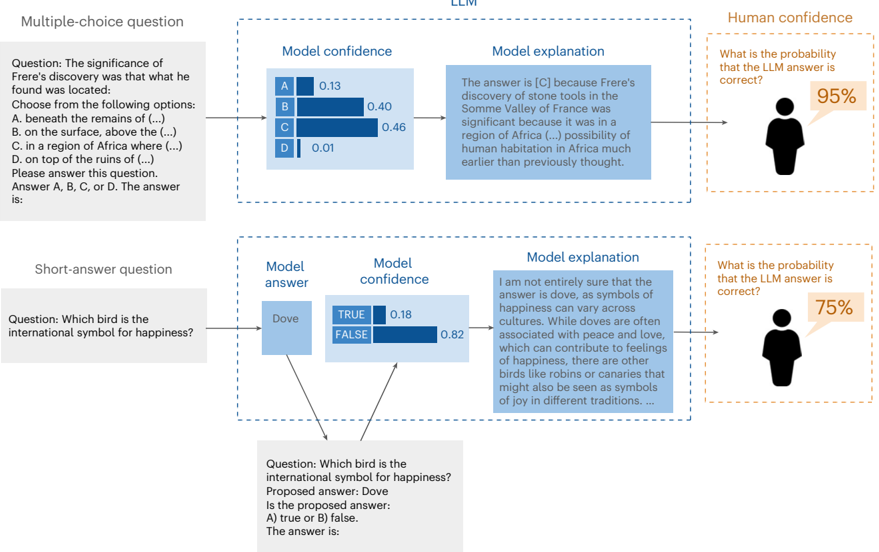
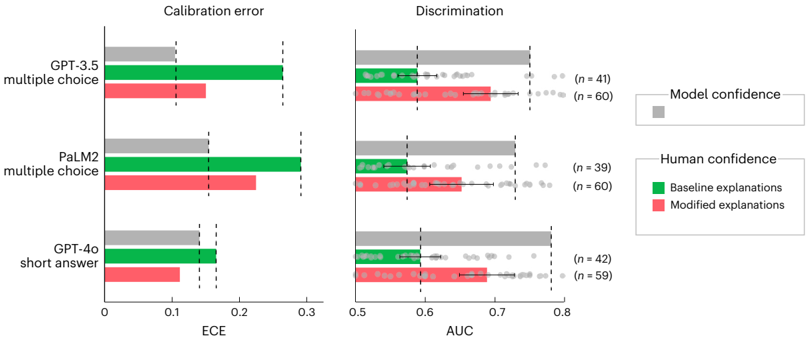
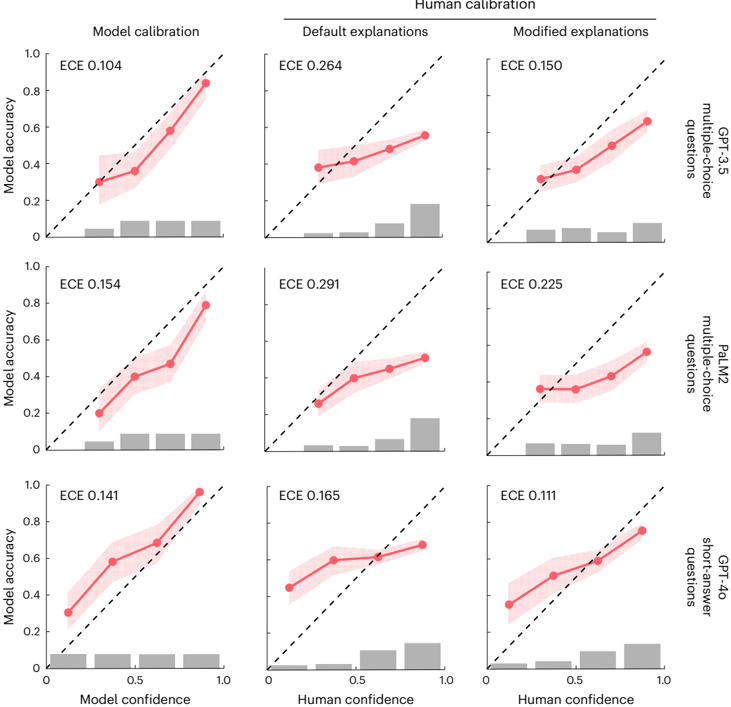
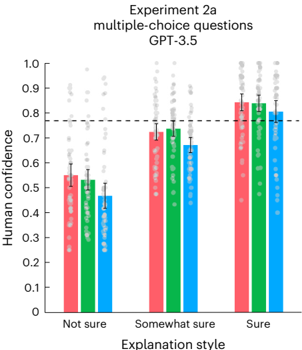
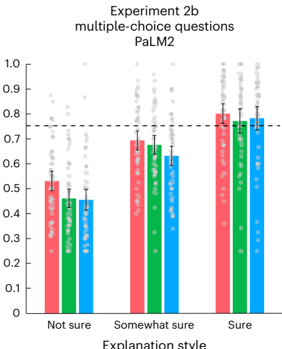
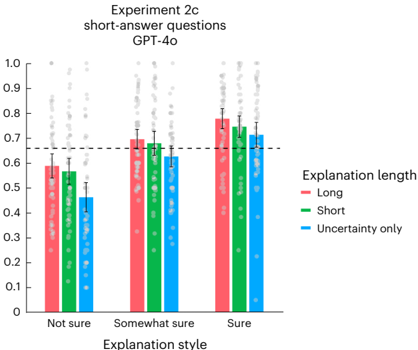
As artificial intelligence systems, particularly large language models (LLMs), become increasingly integrated into decision-making processes, the ability to trust their outputs is crucial. To earn human trust, LLMs must be well calibrated such that they can accurately assess and communicate the likelihood of their predictions being correct. Whereas recent work has focused on LLMs’ internal confidence, less is understood about how effectively they convey uncertainty to users. Here we explore the calibration gap, which refers to the difference between human confidence in LLM-generated answers and the models’ actual confidence, and the discrimination gap, which reflects how well humans and models can distinguish between correct and incorrect answers. Our experiments with multiple-choice and short-answer questions reveal that users tend to overestimate the accuracy of LLM responses when provided with default explanations. Moreover, longer explanations increased user confidence, even when the extra length did not improve answer accuracy. By adjusting LLM explanations to better reflect the models’ internal confidence, both the calibration gap and the discrimination gap narrowed, significantly improving user perception of LLM accuracy. These findings underscore the importance of accurate uncertainty communication and highlight the effect of explanation length in influencing user trust in artificial-intelligence-assisted decision-making environments.
Overview
The claims and statistics of this paper haven’t been checked yet.
Free: it reads the open-access text and checks the first 5 claims that cite a source we can check. Create a free account to check every claim.
Integrity signals
Registry
Cites
Statistics
Figures
Verification
Claims the paper makes
The claims and statistics of this paper haven’t been checked yet.
Free: it reads the open-access text and checks the first 5 claims that cite a source we can check. Create a free account to check every claim.
Claims other papers make about this one
Each is checked against this paper’s own text: does it say what the citing paper says it does?
The source backs part of the claim, not all of it — or backs it for a different population, condition or comparison.
In the citing paper
“AI is exceedingly confident and, unlike people, rarely indicates anything less than 100% confidence in the output,they do not use indicators like hedging language for example [48].”
From Incorporating generative AI into a writing-intensive undergraduate course without off-loading learning (2025) · cites this paper as [48]
Experimental — accuracy not yet measuredThe source backs part of the claim, not all of it — or backs it for a different population, condition or comparison.
In the citing paper
“However, current VLMs struggle to communicate their internal uncertainty through natural language [69, 117].”
From "It's trained by non-disabled people": Evaluating How Image Quality Affects Product Captioning with Vision-Language Models (2026) · cites this paper as [117]
Experimental — accuracy not yet measuredThe source backs part of the claim, not all of it — or backs it for a different population, condition or comparison.
In the citing paper
“Previous studies also show that users tend to associate larger models and longer results with greater precision and reliability [25], [26], [27]”
From Hollow-LLM Attack: Computationally Trivial Weights in Zero-Knowledge Verification of LLM Inference (2026) · cites this paper as [25]
Experimental — accuracy not yet measuredIn the citing paper
“and explanations can increase users’ confidence in AI outputs without improving the accuracy of their judgments (Steyvers et al., 2025).”
From Cognitive transparency and trust calibration in explainable AI systems: a psychological model of human-AI decision reliance (2026) · cites this paper as Steyvers et al., 2025
In the citing paper
“This concern is supported by recent evidence that users often overestimate the accuracy of AI outputs, particularly when explanations are provided (Steyvers et al., 2025)”
From Cognitive transparency and trust calibration in explainable AI systems: a psychological model of human-AI decision reliance (2026) · cites this paper as Steyvers et al., 2025
Self-check
Percentages, sums and reported differences re-computed from the paper’s own numbers.
The self-check needs the paper’s full text.
Citations
Cites
Huang, L., Yu, W., Ma, W., Zhong, W., Feng, Z., Wang, H., Chen, Q., Peng, W., Feng, X., Qin, B., et al. (2025) · ACM Transactions on Information Systems · doi:10.1145/3703155 · Cited by 4,688 · cited 1×
“One notable issue is the possibility of generating responses that, while convincing, may be inaccurate or nonsensical 9,10 .”
Training language models to follow instructions with human feedback
Ouyang, L., Wu, J., Jiang, X., Almeida, D., Wainwright, C. L., Mishkin, P., Zhang, C., Agarwal, S., Slama, K., Ray, A., et al. (2022) · arXiv · doi:10.48550/arxiv.2203.02155 · Cited by 4,208 · cited 1×
“Therefore, participants who considered themselves more knowledgeable about a topic were not more adept at estimating the LLM’s performance in that area.”
Training Language Models to Follow Instructions with Human Feedback
Ouyang, L., Wu, J., Jiang, X., Almeida, D., Wainwright, C., Mishkin, P., Zhang, C., Agarwal, S., Slama, K., Ray, A., et al. (2022) · Advances in Neural Information Processing Systems 35 · doi:10.52202/068431-2011 · Cited by 3,117 · cited 1×
“Therefore, participants who considered themselves more knowledgeable about a topic were not more adept at estimating the LLM’s performance in that area.”
Huang, L., Yu, W., Ma, W., Zhong, W., Feng, Z., Wang, H., Chen, Q., Peng, W., Feng, X., Qin, B., et al. (2023) · arXiv · doi:10.48550/arxiv.2311.05232 · Cited by 2,516 · cited 1×
“One notable issue is the possibility of generating responses that, while convincing, may be inaccurate or nonsensical 9,10 .”
Default Bayes factors for ANOVA designs
Rouder, J. N., Morey, R. D., Speckman, P. L., & Province, J. M. (2012) · Journal of Mathematical Psychology · doi:10.1016/j.jmp.2012.08.001 · Cited by 1,800
Petty, R. E., & Cacioppo, J. T. (1984) · Journal of Personality and Social Psychology · doi:10.1037/0022-3514.46.1.69 · Cited by 1,727 · cited 1×
“This result is consistent with studies in social psychology and communication research that suggest that longer answers or explanations may be perceived as more persuasive or credible, even when they do not contain more meaningful information 27,28 .”
TriviaQA: A Large Scale Distantly Supervised Challenge Dataset for Reading Comprehension
Joshi, M., Choi, E., Weld, D., & Zettlemoyer, L. (2017) · Proceedings of the 55th Annual Meeting of the Association for Computational Linguistics (Volume 1: Long Papers) · doi:10.18653/v1/p17-1147 · Cited by 1,690 · cited 2×
“Trivia QA is a dataset of trivia questions that can be answered in short answers 22 .”
TriviaQA: A Large Scale Distantly Supervised Challenge Dataset for Reading Comprehension
Joshi, M., Choi, E., Weld, D. S., & Zettlemoyer, L. (2017) · arXiv · doi:10.48550/arxiv.1705.03551 · Cited by 1,650 · cited 2×
“Trivia QA is a dataset of trivia questions that can be answered in short answers 22 .”
Fleming, S. M., & Lau, H. C. (2014) · Frontiers in Human Neuroscience · doi:10.3389/fnhum.2014.00443 · Cited by 1,408 · cited 1×
“The use of AUC in this context parallels various metrics in psychology for metacognitive discrimination or sensitivity, which similarly aim to evaluate the effectiveness of confidence scores in distinguishing between correct and incorrect answers 47 .”
Buçinca, Z., Malaya, M. B., & Gajos, K. Z. (2021) · arXiv · doi:10.48550/arxiv.2102.09692 · Cited by 1,124
Research works printed but not linked: 9
- Karelitz, T. M., Dhami, M. K., Budescu, D. V. & Wallsten, T. S. Toward a universal translator of verbal probabilities. In Proc. 15th International Florida Artificial Intelligence Research Society Conference (eds Haller, M. S. & Simmons, G.) 498-502 (AAAI Press, 2002).
- O'Brien, B. J. Words or numbers? The evaluation of probability expressions in general practice. J. R. Coll. Gen. Pract. 39, 98-100 (1989).
- Whalen, J. et al. ChatGPT: challenges, opportunities, and implications for teacher education. Contemp. Iss. Technol. Teach. Educ. 23, 1-23 (2023).
- Azaria, A. & Mitchell, T. in Findings of the Association for Computational Linguistics: EMNLP 2023 (eds Bouamor, H. et al.) 967-976 (ACL, 2023).
- Xiao, Y. et al. in Findings of the Association for Computational Linguistics: EMNLP 2022 (eds Goldberg, Y. et al.) 7273-7284 (ACL, 2022).
- Tanneru, S. H., Agarwal, C. & Lakkaraju, H. Quantifying uncertainty in natural language explanations of large language models. In International Conference on Artificial Intelligence and Statistics 1072-1080 (PMLR, 2024).
- Lin, S., Hilton, J. & Evans, O. Teaching models to express their uncertainty in words. Trans. Mach. Learn. Res. (2022).
- Guo, C., Pleiss, G., Sun, Y. & Weinberger, K. Q. On calibration of modern neural networks. In Proc. 34th International Conference on Machine Learning (eds Precup, D. & Teh, Y. W.) vol. 70 of Proceedings of Machine Learning Research 1321-1330 (PMLR, 2017).
- Kumar, A., Liang, P. S. & Ma, T. Verified uncertainty calibration. Adv. Neural Inf. Process. Syst. 32, (2019).
Cited by
Items 201–213 of 213
Coordination and leadership: The impact of artificial intelligence
Bigoni, M., & Paoli, D. (2026) · Journal of Economic Behavior & Organization · doi:10.1016/j.jebo.2026.107767
Talk to Me Kindly: Designing AI Companions to Foster Positive Self-Talk in Young Adults
Gedeus, A.-K., Wagener, N., Li, Y., Bai, Y., Felver, J. C., Difede, J., Yoon, S., & Taylor, A. M. (2026) · Nordic Conference on Human-Computer Interaction · doi:10.1145/3829807.3829873
Odilovna, M. Z., Mamatkulov, D. M., Иброгимовна, Т. Р., Rakhmonova, N. T., Shavqiyev, O., & Umbarovna, Z. S. (2026) · Eurasia Journal of Mathematics Science and Technology Education · doi:10.29333/ejmste/19481
“Steyvers et al. (2025) report a calibration gap between users ’ confidence in model answers and the models ’ internal confidence, and they also report that this gap narrows when explanations are adjusted to reflect internal confidence.”
InfluentialAgentic AI in der Unternehmenspraxis: Vom Werkzeug zum Akteur
Li, M. M., Reinhard, P., & Leimeister, J. M. (2026) · HMD Praxis der Wirtschaftsinformatik · doi:10.1365/s40702-026-01331-7
“Da LLM-basiertes Schlussfolgern, besonders bei der Konsensbildung, oft intrans-parent bleibt, gewinnen Erklärbarkeit und Beobachtbarkeit an Gewicht (Kim et al. 2025; Steyvers et al. 2025).”
Sulaima, M. F., Jyotsna, A., Herout, L., Gálvez, I. P., Krejcar, O., & Namazi, H. (2026) · Energy Nexus · doi:10.1016/j.nexus.2026.100870 · Cited by 1
AI-Based Image Enhancement Improves Detection of Interconnect Defects in Microelectronic Packaging
Wilhelmer, R., Djuric-Rissner, T., Czurratis, P., Ho, H.-W., Lee, C.-H., Kuo, C.-L., & Brunner, R. (2026) · Journal of Failure Analysis and Prevention · doi:10.1007/s11668-026-02537-z
Yilmazer, M., Şahin, S., & Karaköse, M. (2026) · Applied Sciences · doi:10.3390/app16199883
AI-Driven Decision Support for Systemic Innovation
Qin, Y., Luo, Y., & Wang, X. (2026) · Applied System Innovation · doi:10.3390/asi9100211
Bressan, M., Meijer, E. N., Hinić, V., Ellendorff, T., Goldman, J.-P., Kew, T., Nolte, O., Schneider, G., Egli, A., Ahlström, M., et al. (2026) · Clinical Microbiology and Infection · doi:10.1016/j.cmi.2026.09.035
Karlsson, M., Kuai, J., Brantner, C., Yu, H., & Meese, J. (2026) · Journal of Broadcasting & Electronic Media · doi:10.1080/08838151.2026.2751043
Gong, S., Yang, J., & Duan, Y. (2026) · Applied Sciences · doi:10.3390/app162110534
Lu, J. G., Zhao, G. G., & Zheng, A. (2026) · Strategic Entrepreneurship Journal · doi:10.1002/sej.70050 · Cited by 1
Metadata
- Authors
- Steyvers, M., Tejeda, H., Kumar, A., Belem, C., Karny, S., Hu, X., Mayer, L. W., & Smyth, P.
- Affiliations
- University of California, Irvine (US)
- Corresponding author
- Steyvers, Mark
- ORCID
- Venue
- Nature Machine Intelligence
- Published
- 2025-01-21
- Volume
- 7
- Issue
- 2
- Pages
- 221-231
- ISSN
- 2522-5839 (ISSN-L)
- OpenAlex
- W4406679533
- Cited by
- 209
- References
- 36
- Citations by year
- 2026: 147 · 2025: 60
- FWCI
- 83.03
- Type
- journal article
- Language
- en
- Open access
- hybrid
- doi.org
- Licence
- cc-by
- creativecommons.org/licenses/by/4.0 (tdm)
- creativecommons.org/licenses/by/4.0 (vor)
- Locations
- Nature Machine Intelligence (publishedVersion, cc-by)
- arXiv (Cornell University) (submittedVersion, cc-by-sa)
- arXiv (Cornell University)
- Funders
- National Science Foundation (1900644)
- Hasso Plattner Institute (HPI) Research Center in Machine Learning and Data Science at the University of California, Irvine
- Topics
- Physical Sciences › Computer Science › Artificial Intelligence › Explainable Artificial Intelligence (XAI)
- Physical Sciences › Computer Science › Artificial Intelligence › Ethics and Social Impacts of AI
- Social Sciences › Human Factors and Ergonomics › Human-Automation Interaction and Safety
- Keywords
- large language models, uncertainty communication, user confidence, trust in AI, AI-assisted decision-making, confidence calibration, human-AI interaction
About these checks
Registry, retraction, Cites and statistics results are computed, not judged, with one exception: a printed reference that no index lists is read once by a model before it counts as a citation error. Claims are extracted by a model and kept only when their quote appears verbatim in the text; each cited source is then checked, with a model’s help, for whether it says what the claim relies on. Those verdicts can be wrong — read the claim’s quote and the cited source before relying on one.
Statistics and arithmetic are recomputed, not judged.
Confidence bands are shown only for fields calibrated on our annotated test set. None is calibrated yet, so no band is shown.
What counts as a claim ›How we measure confidence ›How we check this ›
Are you an author, or do you see a problem with this page? Request a review
Data sources
Bibliographic data: Semantic Scholar, OpenAlex, Crossref.
Contains information from the Semantic Scholar Academic Graph Datasets, made available under the ODC Attribution License (ODC-BY 1.0).
Semantic Scholar’s data is described in: Kinney, R., et al. (2023). The Semantic Scholar Open Data Platform. arXiv:2301.10140.
