

The DOI matches its Crossref record; 60 of the 61 references it cites were found in a registry or an index.
Extended gate field-effect-transistor for sensing cortisol stress hormone
Open accessAbstract
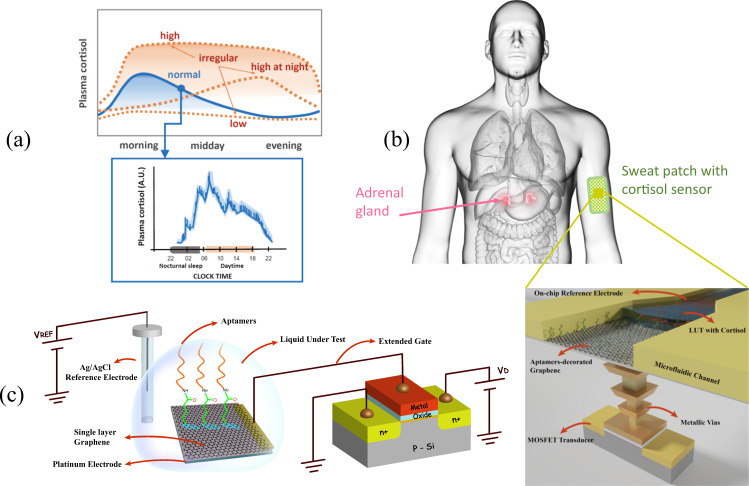
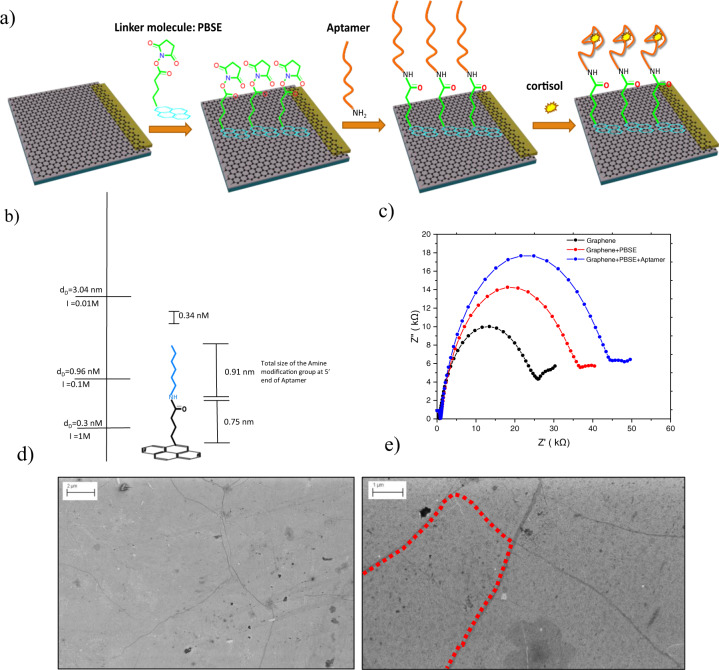
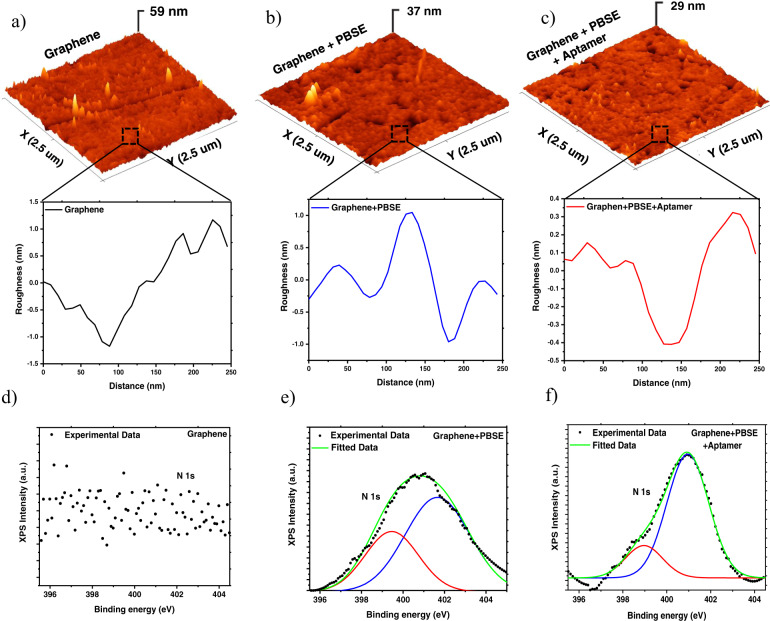
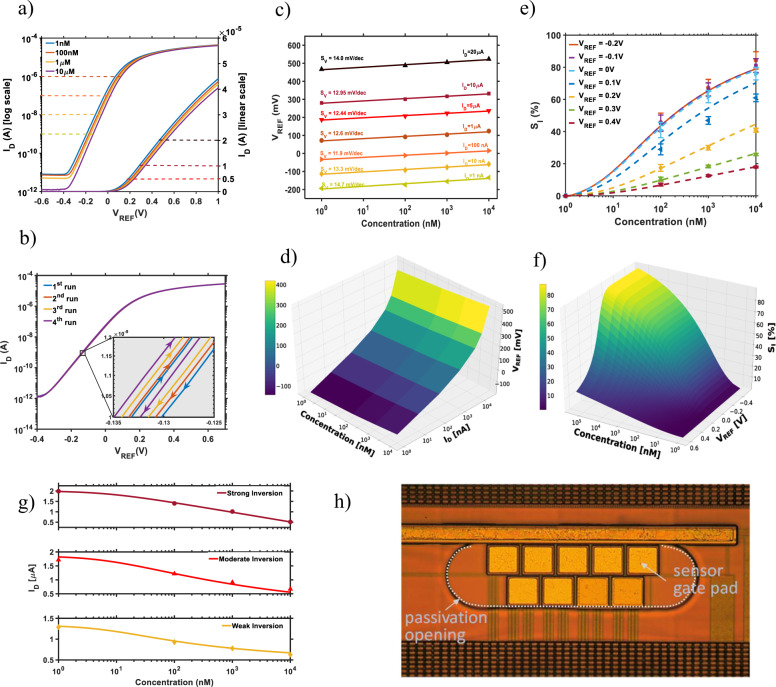
Cortisol is a hormone released in response to stress and is a major glucocorticoid produced by adrenal glands. Here, we report a wearable sensory electronic chip using label-free detection, based on a platinum/graphene aptamer extended gate field effect transistor (EG-FET) for the recognition of cortisol in biological buffers within the Debye screening length. The device shows promising experimental features for real-time monitoring of the circadian rhythm of cortisol in human sweat. We report a hysteresis-free EG-FET with a voltage sensitivity of the order of 14 mV/decade and current sensitivity up to 80% over the four decades of cortisol concentration. The detection limit is 0.2 nM over a wide range, between 1 nM and 10 µM, of cortisol concentrations in physiological fluid, with negligible drift over time and high selectivity. The dynamic range fully covers those in human sweat. We propose a comprehensive analysis and a unified, predictive analytical mapping of current sensitivity in all regimes of operation.
Overview
The claims and statistics of this paper haven’t been checked yet.
Run the check — free, no account needed. It reads the open-access text and checks the sources it cites.
Integrity signals
Registry
Cites
Statistics
Figures
Verification
Claims the paper makes
The claims and statistics of this paper haven’t been checked yet.
Run the check — free, no account needed. It reads the open-access text and checks the sources it cites.
Self-check
Percentages, sums and reported differences re-computed from the paper’s own numbers.
The self-check needs the paper’s full text.
Citations
Cites
Ror2 signaling regulates Golgi structure and transport through IFT20 for tumor invasiveness
Nishita, M., Park, S.-Y., Nishio, T., Kamizaki, K., Wang, Z., Tamada, K., Takumi, T., Hashimoto, R., Otani, H., Pazour, G. J., et al. (2017) · Scientific Reports · doi:10.1038/s41598-016-0028-x · Cited by 15,947
Stress and the brain: from adaptation to disease
de Kloet, E. R., Joëls, M., & Holsboer, F. (2005) · Nature Reviews Neuroscience · doi:10.1038/nrn1683 · Cited by 4,621
Stress and disorders of the stress system
Chrousos, G. P. (2009) · Nature Reviews Endocrinology · doi:10.1038/nrendo.2009.106 · Cited by 3,215
The Concepts of Stress and Stress System Disorders: Overview of Physical and Behavioral Homeostasis
Chrousos, G. P. (1992) · JAMA · doi:10.1001/jama.1992.03480090092034 · Cited by 2,689
Aptamer-Based Multiplexed Proteomic Technology for Biomarker Discovery
Gold, L., Ayers, D., Bertino, J., Bock, C., Bock, A., Brody, E. N., Carter, J., Dalby, A. B., Eaton, B. E., Fitzwater, T., et al. (2010) · PLoS ONE · doi:10.1371/journal.pone.0015004 · Cited by 1,754
Enz, C., Krummenacher, F., & Vittoz, E. A. (1995) · Analog Integrated Circuits and Signal Processing · doi:10.1007/bf01239381 · Cited by 1,272
Aptamers and Their Biological Applications
Song, K.-M., Lee, S., & Ban, C. (2012) · Sensors · doi:10.3390/s120100612 · Cited by 868
Reproducibility crisis: Blame it on the antibodies
Baker, M. (2015) · Nature · doi:10.1038/521274a · Cited by 830
Parlak, O., Keene, S. T., Marais, A., Curto, V. F., & Salleo, A. (2018) · Science Advances · doi:10.1126/sciadv.aar2904 · Cited by 603
Enamel peptides reveal the sex of the Late Antique ‘Lovers of Modena’
Lugli, F., Rocco, G. D., Vazzana, A., Genovese, F., Pinetti, D., Cilli, E., Carile, M. C., Silvestrini, S., Gabanini, G., Arrighi, S., et al. (2019) · Scientific Reports · doi:10.1038/s41598-019-49562-7 · Cited by 340
Cited by
Sorted by citations
End-to-end design of wearable sensors
Ates, H. C., Nguyen, P. Q., Gonzalez-Macia, L., Morales-Narváez, E., Güder, F., Collins, J. J., & Dincer, C. (2022) · Nature Reviews Materials · doi:10.1038/s41578-022-00460-x · Cited by 1,306
Skin-Interfaced Wearable Sweat Sensors for Precision Medicine
Min, J., Tu, J., Xu, C., Lukas, H., Shin, S., Yang, Y., Solomon, S. A., Mukasa, D., & Gao, W. F. (2023) · Chemical Reviews · doi:10.1021/acs.chemrev.2c00823 · Cited by 752
A physicochemical-sensing electronic skin for stress response monitoring
Xu, C., Song, Y., Sempionatto, J. R., Solomon, S. A., Yu, Y., Nyein, H. Y. Y., Tay, R. Y., Li, J., Heng, W., Min, J., et al. (2024) · Nature Electronics · doi:10.1038/s41928-023-01116-6 · Cited by 422
“…activity that can affect an individual’s stress; and despite recent progress on stress hormone analysis, continuous monitoring of sweat stress hormones at physiologically relevant levels using wearable sensors has not yet been achieved because of the hormones’ extremely low concentrations 35–37 .”
BackgroundTwo-Dimensional Field-Effect Transistor Sensors: The Road toward Commercialization
Dai, C., Liu, Y., & Wei, D. (2022) · Chemical Reviews · doi:10.1021/acs.chemrev.1c00924 · Cited by 312
Wearable Cortisol Aptasensor for Simple and Rapid Real-Time Monitoring
An, J. E., Kim, K. H., Park, S. J., Seo, S. E., Kim, J., Ha, S., Bae, J., & Kwon, O. S. (2022) · ACS Sensors · doi:10.1021/acssensors.1c01734 · Cited by 147
Metadata
- Authors
- Sheibani, S., Capua, L., Kamaei, S., Akbari, S. S. A., Zhang, J., Guerin, H., & Ionescu, A. M.
- Affiliations
- University of Tehran (IR)
- École Polytechnique Fédérale de Lausanne (CH)
- Corresponding author
- Ionescu, Adrian M.
- Venue
- Communications Materials
- Published
- 2021-01-19
- Volume
- 2
- Issue
- 1
- Pages
- 10-10
- ISSN
- 2662-4443 (ISSN-L)
- PMC
- PMC7815575
- OpenAlex
- W3123066175
- Cited by
- 158
- References
- 61
- Citations by year
- 2026: 17 · 2025: 30 · 2024: 40 · 2023: 28 · 2022: 28 · 2021: 15
- FWCI
- 13.06
- Type
- journal article
- Language
- en
- Open access
- gold
- doi.org
- Locations
- Communications Materials (publishedVersion, cc-by)
- PubMed Central (publishedVersion, cc-by)
- PubMed (publishedVersion)
- DOAJ (DOAJ: Directory of Open Access Journals) (submittedVersion, cc-by-sa)
- Infoscience (Ecole Polytechnique Fédérale de Lausanne) (submittedVersion, cc-by-nc-nd)
- Funders
- National Science Foundation
- Schweizerischer Nationalfonds zur Förderung der Wissenschaftlichen Forschung
- H2020 European Research Council (695459)
- Topics
- Physical Sciences › Chemistry › Analytical Chemistry › Analytical Chemistry and Sensors
- Physical Sciences › Chemistry › Analytical Chemistry › Electrochemical sensors and biosensors
- Life Sciences › Biochemistry, Genetics and Molecular Biology › Molecular Biology › Advanced biosensing and bioanalysis techniques
- Keywords
- extended-gate field-effect transistor, wearable biosensors, label-free detection, human sweat, circadian rhythm, Debye screening, current sensitivity, detection limit
About these checks
Registry, retraction, Cites and statistics results are computed, not judged, with one exception: a printed reference that no index lists is read once by a model before it counts as a citation error. Claims are extracted by a model and kept only when their quote appears verbatim in the text; each cited source is then checked, with a model’s help, for whether it says what the claim relies on. Those verdicts can be wrong — read the claim’s quote and the cited source before relying on one.
Statistics and arithmetic are recomputed, not judged.
Confidence bands are shown only for fields calibrated on our annotated test set. None is calibrated yet, so no band is shown.
What counts as a claim ›How we measure confidence ›How we check this ›
Are you an author, or do you see a problem with this page? Request a review
