

Enhanced coherence of all-nitride superconducting qubits epitaxially grown on silicon substrate
Open accessPublished version of a preprint
The DOI matches its Crossref record; 43 of the 43 references it cites were found in a registry or an index.
Abstract
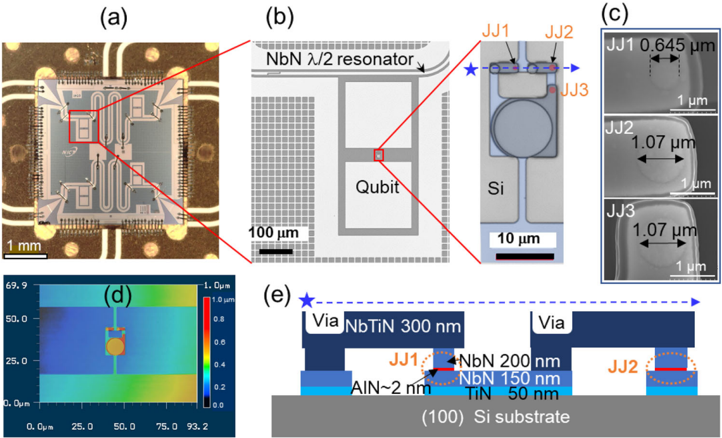
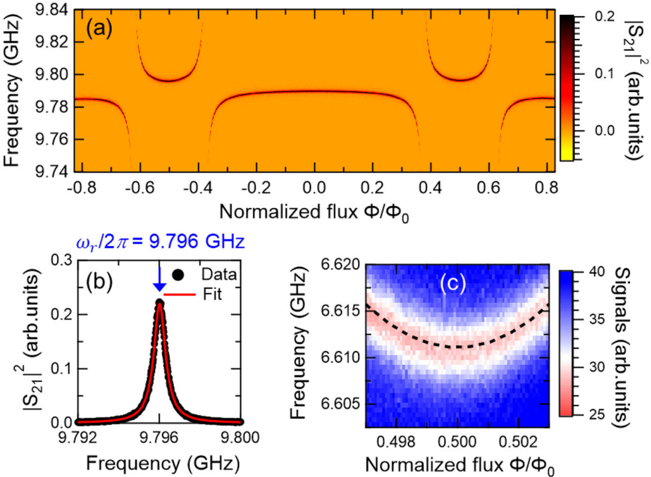
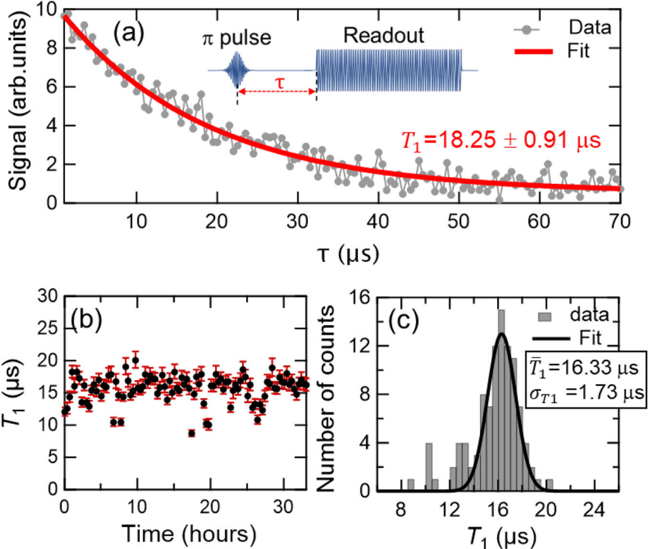
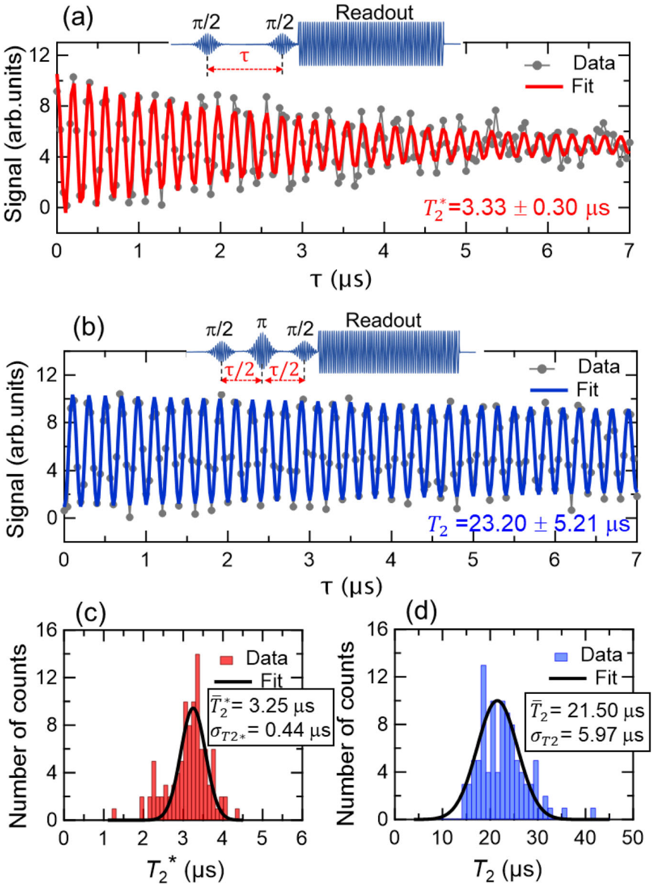
Improving the coherence of superconducting qubits is a fundamental step towards the realization of fault-tolerant quantum computation. However, coherence times of quantum circuits made from conventional aluminum-based Josephson junctions are limited by the presence of microscopic two-level systems in the amorphous aluminum oxide tunnel barriers. Here, we have developed superconducting qubits based on NbN/AlN/NbN epitaxial Josephson junctions on silicon substrates which promise to overcome the drawbacks of qubits based on Al/AlOx/Al junctions. The all-nitride qubits have great advantages such as chemical stability against oxidation, resulting in fewer two-level fluctuators, feasibility for epitaxial tunnel barriers that reduce energy relaxation and dephasing, and a larger superconducting gap of ~5.2 meV for NbN, compared to ~0.3 meV for aluminum, which suppresses the excitation of quasiparticles. By replacing conventional MgO by a silicon substrate with a TiN buffer layer for epitaxial growth of nitride junctions, we demonstrate a qubit energy relaxation time $${T}_{1}=16.3\;{{\upmu }}{{{{{\rm{s}}}}}}$$ T 1 = 16.3 μ s and a spin-echo dephasing time $${T}_{2}=21.5\;{{\upmu }}{{{{{\rm{s}}}}}}$$ T 2 = 21.5 μ s . These significant improvements in quantum coherence are explained by the reduced dielectric loss compared to the previously reported $${T}_{1}\approx {T}_{2}\approx 0.5\;{{\upmu }}{{{{{\rm{s}}}}}}$$ T 1 ≈ T 2 ≈ 0.5 μ s of NbN-based qubits on MgO substrates. These results are an important step towards constructing a new platform for superconducting quantum hardware.
Overview
The claims and statistics of this paper haven’t been checked yet.
Free: it reads the open-access text and checks the first 5 claims that cite a source we can check. Create a free account to check every claim.
Integrity signals
Registry
Cites
Statistics
Figures
Verification
Claims the paper makes
The claims and statistics of this paper haven’t been checked yet.
Free: it reads the open-access text and checks the first 5 claims that cite a source we can check. Create a free account to check every claim.
Claims other papers make about this one
Each is checked against this paper’s own text: does it say what the citing paper says it does?
The check wasn’t confident either way, so it gives no verdict — never disputed.
In the citing paper
“Although CMOS foundry-compatible processes26–28 and qubits fabricated partially in a foundry environment29 have been shown previously, the fabrication of 300 nm wafer-scale superconducting qubits has not been demonstrated.”
From Advanced CMOS manufacturing of superconducting qubits on 300 mm wafers (2024) · cites this paper as [27]
Experimental — accuracy not yet measured
Self-check
Percentages, sums and reported differences re-computed from the paper’s own numbers.
The self-check needs the paper’s full text.
Citations
Cites
Quantum supremacy using a programmable superconducting processor
Arute, F., Arya, K., Babbush, R., Bacon, D., Bardin, J. C., Barends, R., Biswas, R., Boixo, S., Brandao, F. G. S. L., Buell, D. A., et al. (2019) · Nature · doi:10.1038/s41586-019-1666-5 · Cited by 7,720
Hardware-efficient variational quantum eigensolver for small molecules and quantum magnets
Kandala, A., Mezzacapo, A., Temme, K., Takita, M., Brink, M., Chow, J. M., & Gambetta, J. M. (2017) · Nature · doi:10.1038/nature23879 · Cited by 2,982
Coherent control of macroscopic quantum states in a single-Cooper-pair box
Nakamura, Y., Pashkin, Y. A., & Tsai, J. S. (1999) · Nature · doi:10.1038/19718 · Cited by 2,380
Superconducting Circuits for Quantum Information: An Outlook
Devoret, M. H., & Schoelkopf, R. J. (2013) · Science · doi:10.1126/science.1231930 · Cited by 2,114
Superconducting Qubits: Current State of Play
Kjaergaard, M., Schwartz, M. E., Braumüller, J., Krantz, P., Wang, J. I.-J., Gustavsson, S., & Oliver, W. D. (2020) · Annual Review of Condensed Matter Physics · doi:10.1146/annurev-conmatphys-031119-050605 · Cited by 1,544
Coherent control of macroscopic quantum states in a single-Cooper-pair box
Nakamura, Y., Pashkin, Y. A., & Tsai, J. S. (1999) · RePEc: Research Papers in Economics · Cited by 1,509
Superconducting Qubits: Current State of PlayPreprint
Kjærgaard, M., Schwartz, M. E., Braumüller, J., Krantz, P., Wang, J. I.-J., Gustavsson, S., & Oliver, W. D. (2020) · DSpace@MIT (Massachusetts Institute of Technology) · Cited by 1,192
Scalable Quantum Simulation of Molecular Energies
O’Malley, P. J. J., Babbush, R., Kivlichan, I. D., Romero, J., McClean, J. R., Barends, R., Kelly, J., Roushan, P., Tranter, A., Ding, N., et al. (2016) · Physical Review X · doi:10.1103/physrevx.6.031007 · Cited by 1,059
Extending the lifetime of a quantum bit with error correction in superconducting circuits
Ofek, N., Petrenko, A., Heeres, R., Reinhold, P., Leghtas, Z., Vlastakis, B., Liu, Y., Frunzio, L., Girvin, S. M., Jiang, L., et al. (2016) · Nature · doi:10.1038/nature18949 · Cited by 941
Decoherence in Josephson Qubits from Dielectric Loss
Martinis, J. M., Cooper, K. B., McDermott, R., Steffen, M., Ansmann, M., Osborn, K. D., Cicak, K., Oh, S., Pappas, D. P., Simmonds, R. W., et al. (2005) · Physical Review Letters · doi:10.1103/physrevlett.95.210503 · Cited by 838
Cited by
Towards practical quantum computers: transmon qubit with a lifetime approaching 0.5 milliseconds
Wang, C., Li, X., Xu, H., Li, Z., Wang, J., Yang, Z., Mi, Z., Liang, X., Su, T., Yang, C., et al. (2022) · npj Quantum Information · doi:10.1038/s41534-021-00510-2 · Cited by 377
Hoo Teo, K., Zhang, Y., Chowdhury, N., Rakheja, S., Ma, R., Xie, Q., Yagyu, E., Yamanaka, K., Li, K., & Palacios, T. (2021) · Journal of Applied Physics · doi:10.1063/5.0061555 · Cited by 322
Material matters in superconducting qubits
Murray, C. E. (2021) · Materials Science and Engineering R Reports · doi:10.1016/j.mser.2021.100646 · Cited by 173
Hexagonal boron nitride as a low-loss dielectric for superconducting quantum circuits and qubits
Wang, J. I.-J., Yamoah, M., Li, Q., Karamlou, A. H., Dinh, T. H., Kannan, B., Braumüller, J., Kim, D. K., Melville, A. J., Muschinske, S. E., et al. (2022) · Nature Materials · doi:10.1038/s41563-021-01187-w · Cited by 126
Advanced CMOS manufacturing of superconducting qubits on 300 mm wafers
Van Damme, J., Massar, S., Acharya, R., Ivanov, T., Perez Lozano, D., Canvel, Y., Demarets, M., Vangoidsenhoven, D., Hermans, Y., Lai, J. G., et al. (2024) · Nature · doi:10.1038/s41586-024-07941-9 · Cited by 63
Metadata
- Authors
- Kim, S., Terai, H., Yamashita, T., Qiu, W., Fuse, T., Yoshihara, F., Ashhab, S., Inomata, K., & Semba, K.
- Affiliations
- National Institute of Information and Communications Technology (JP)
- Nagoya University (JP)
- National Institute of Advanced Industrial Science and Technology (JP)
- Corresponding author
- Kim, Sunmi
- Terai, Hirotaka
- Semba, Kouichi
- ORCID
- Venue
- Communications Materials
- Published
- 2021-09-20
- Volume
- 2
- Issue
- 1
- ISSN
- 2662-4443 (ISSN-L)
- OpenAlex
- W3200172332
- Cited by
- 92
- References
- 42
- Citations by year
- 2026: 16 · 2025: 22 · 2024: 23 · 2023: 12 · 2022: 14 · 2021: 5
- FWCI
- 4.75
- Type
- journal article
- Language
- en
- Open access
- gold
- doi.org
- Licence
- cc-by
- creativecommons.org/licenses/by/4.0 (tdm)
- creativecommons.org/licenses/by/4.0 (vor)
- Locations
- Communications Materials (publishedVersion, cc-by)
- Research Square (acceptedVersion, cc-by)
- arXiv (Cornell University) (submittedVersion)
- DOAJ (DOAJ: Directory of Open Access Journals) (submittedVersion, cc-by-sa)
- arXiv (Cornell University)
- Funders
- Ministry of Education, Culture, Sports, Science and Technology (JPMXS0118068682, JPMJER1601, JP-MXS0120319794)
- Japan Society for the Promotion of Science (JPMJER1601, JPMXS0120319794, 19H05615)
- Japan Science and Technology Agency (JPMJCR1775, JPMXS0120319794, JPMJER1601)
- Core Research for Evolutional Science and Technology (JPMJCR1775)
- Exploratory Research for Advanced Technology (JPMJER1601)
- Topics
- Physical Sciences › Physics and Astronomy › Atomic and Molecular Physics, and Optics › Quantum Information and Cryptography
- Physical Sciences › Engineering › Electrical and Electronic Engineering › Superconducting and THz Device Technology
- Physical Sciences › Physics and Astronomy › Condensed Matter Physics › Physics of Superconductivity and Magnetism
- Keywords
- superconducting qubits, silicon substrate, TiN buffer layer, two-level fluctuators, energy relaxation time, dephasing time, dielectric loss, superconducting gap, superconducting quantum hardware
About these checks
Registry, retraction, Cites and statistics results are computed, not judged, with one exception: a printed reference that no index lists is read once by a model before it counts as a citation error. Claims are extracted by a model and kept only when their quote appears verbatim in the text; each cited source is then checked, with a model’s help, for whether it says what the claim relies on. Those verdicts can be wrong — read the claim’s quote and the cited source before relying on one.
Statistics and arithmetic are recomputed, not judged.
Confidence bands are shown only for fields calibrated on our annotated test set. None is calibrated yet, so no band is shown.
What counts as a claim ›How we measure confidence ›How we check this ›
Are you an author, or do you see a problem with this page? Request a review
How to cite
Cite CoChat for the checks on this page, and the paper for its own findings.
- This page
- CoChat. (2026). Citation check: Enhanced coherence of all-nitride superconducting qubits epitaxially grown on silicon substrate. https://app.cochat.ai/papers/10.1038/s43246-021-00204-4
- The paper
- Kim, S., Terai, H., Yamashita, T., Qiu, W., Fuse, T., Yoshihara, F., Ashhab, S., Inomata, K., & Semba, K. (2021). Enhanced coherence of all-nitride superconducting qubits epitaxially grown on silicon substrate. Communications Materials. https://doi.org/10.1038/s43246-021-00204-4
Data sources
Bibliographic data: Semantic Scholar, OpenAlex, Crossref.
Contains information from the Semantic Scholar Academic Graph Datasets, made available under the ODC Attribution License (ODC-BY 1.0).
Semantic Scholar’s data is described in: Kinney, R., et al. (2023). The Semantic Scholar Open Data Platform. arXiv:2301.10140.
