

Afro-descendant lands in South America contribute to biodiversity conservation and climate change mitigation
Open accessThe DOI matches its Crossref record; 72 of the 73 references it cites were found in a registry or an index, and 1 are not checked yet; 2 of the 84 sources its claims cite were checked for support.
Abstract
Over 130 million people in Latin America identify as Afro-descendants, many of whom inhabit lands with potential to mitigate biodiversity loss and climate change. Yet, the role of Afro-descendants is not adequately considered in conservation and climate decision-making. Here, we mapped the biological value of Afro-descendant lands in Brazil, Colombia, Ecuador, and Suriname, and conducted a matching analysis to estimate the effect of these lands on deforestation. Afro-descendant lands coincide with areas that have high biodiversity and irrecoverable carbon and were associated with a 29%–55% reduction in forest loss compared to control sites. To contextualize these findings, we present a social-historical assessment of Afro-descendant conservation practices. This assessment highlights the adaptation of African knowledge to the American tropics and the development of sustainable environmental practices. Global environmental institutions, multilateral agencies, and governments should include Afro-descendants in environmental decision-making and support research and policies that enable Afro-descendant management practices. Despite covering less than 1 percent of the total land area, Afro-descendant lands in Brazil, Colombia, Ecuador, and Suriname have high biodiversity and carbon content, as well as low deforestation rates, according to spatial mapping and socio-historical assessment.
Verified 2026-11-25 · 1 reference not checked yet
Overview
CoChat Summary
TL;DR
This study maps recognized Afro-descendant Peoples’ (ADP) lands in Brazil, Colombia, Ecuador, and Suriname and finds they overlap high biodiversity and irrecoverable carbon and are associated with lower deforestation. It combines spatial and quasi-experimental analysis with a social-historical assessment of ADP management practices to argue for including ADP in conservation and climate decision-making.
Key findings
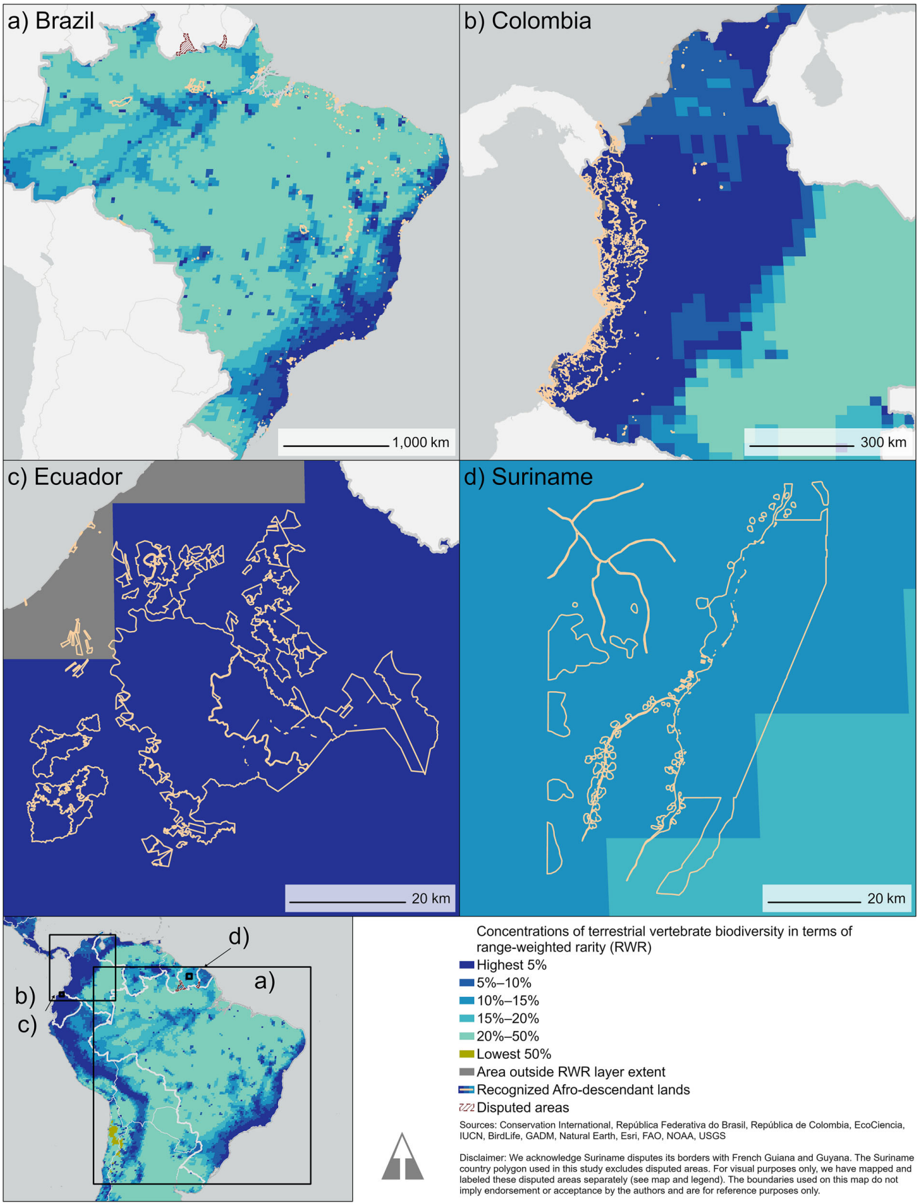
- Recognized ADP lands cover 9.9 million ha (0.98% of the four countries’ 1 billion ha) but overlap the ranges of 4004 terrestrial vertebrate species, 370 (9.2%) of which are IUCN Red List threatened, representing about 46% of threatened terrestrial vertebrate species in these countries; >58% of ADP lands are in the top 10% and about 72% in the top 20% of biodiverse areas globally.
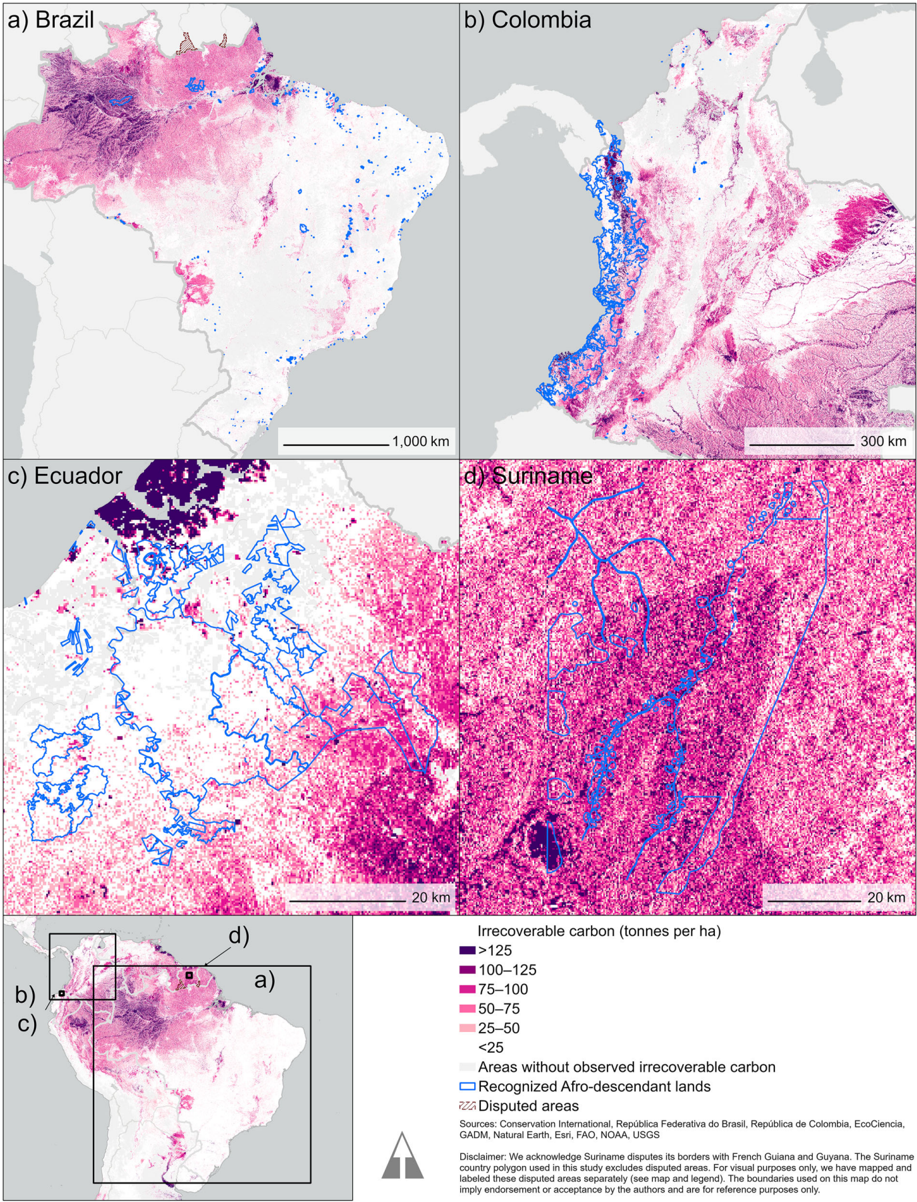
- ADP lands average 6.8 t/ha of irrecoverable carbon versus 5.2 t/ha for combined national totals; they store 486.2 Mt out of 25,852.9 Mt total irrecoverable carbon (1.88%), equivalent to 1784.3 Mt CO2e, or 38.79% of the annual 4600 Mt CO2e potential and almost 1.3% of total natural climate solution protection opportunities in the tropics from 2020 to 2050.
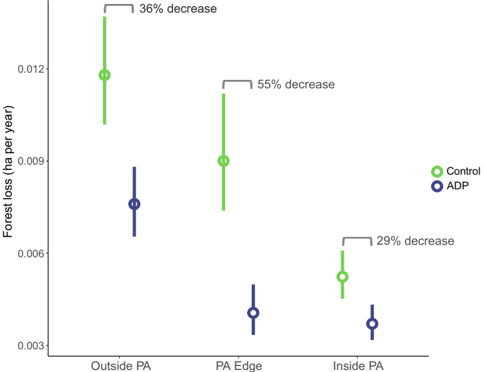
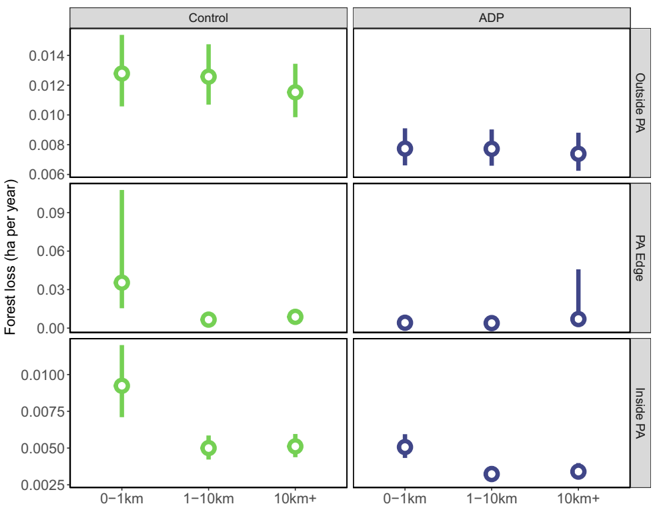
- Deforestation was 29%–55% lower on ADP lands than controls: outside protected areas (PAs) by 36% (BCI 34–38%), on PA edges by 55% (BCI 45–63%), and inside PAs by 29% (BCI 27–32%); ADP lands on PA edges or inside PAs had 46% and 51% less deforestation than ADP lands outside PAs, respectively.
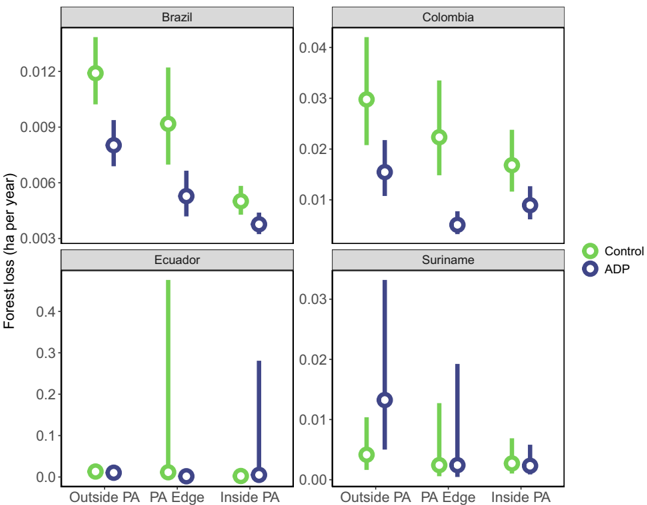
- Suriname was an exception: ADP lands there were not associated with a consistent reduction in forest loss and were associated with higher rates outside PAs; the social-historical assessment identifies four factors linking ADP practices to conservation—adaptive strategies, diverse production systems, multi-goal management, and African ethnobotanical/spiritual knowledge—while noting threats from monocultures, infrastructure, mining, violence, and climate events.
Methods
- The authors mapped legally recognized ADP lands in Brazil, Colombia, Ecuador, and Suriname; quantified biodiversity using IUCN rarity-weighted richness for terrestrial vertebrates and irrecoverable carbon using a global raster; and calculated overlaps with ecosystems and PAs.
- For deforestation impact, they used a quasi-experimental matching design with a 300 m sampling grid, matching ADP cells to control cells within country on PA coverage, forest cover in 2000, precipitation, elevation, Human Impact Index, log population density, and travel time to city; they fit Bayesian generalized linear mixed models for forest loss and CO2e, including a 200 km spatial random intercept. Sample cells included ADP outside PAs = 38,166; ADP on PA edge = 435; ADP inside PAs = 23,766; controls outside PAs = 37,748; controls at PA edge = 431; controls inside PAs = 24,188.
- The social-historical assessment used a mixed-methods concurrent convergence design, reviewing interdisciplinary sources including the Amazon Assessment Report chapter and Web of Science, with 35 additional references identified by snowballing; content analysis focused on settlement patterns, management practices, and species origins/domestication.
Limitations
- Stated in the paper: spatial analyses are limited by input dataset accuracy, coordinate-system standardization, and software/platform differences; the calculated ADP extent is conservative because unrecognized customary or ancestral territories are excluded; irrecoverable carbon estimates carry global uncertainty; the quasi-experimental analysis may be biased by unknown or unmeasured confounders and lacked robust before-after data prior to tenure recognition; the social-historical review was limited by language and geographic gaps, especially non-Spanish/non-English literature.
- Evident from the text: the study covers only four countries and only legally recognized ADP lands, so findings may not generalize to unrecognized lands or other regions; the Suriname exception and evidence of possible displacement/spillover near PA and ADP edges indicate context dependence; matching cannot fully establish causality.
Model-written summary. Check it against the paper before relying on it.
Integrity signals
Registry
Cites
Statistics
Figures
Verification
Claims the paper makes
1 Valid · 0 Not valid · 50 Not checked · 89 Own results and interpretations
The cited sources support only part of this claim — read each source’s verdict below.
In the paper
“Our findings add to emerging evidence that ADP lands coincide with areas of high vertebrate species richness, similar to many Indigenous lands [50][51][52] .”
§ Afro-descendant lands in South America contribute to biodiversity conservation and climate change mitigation Check for updates > Discussion
What the sources say
- Partly supportedcites [50] O'Bryan, C. J. et al. The importance of Indigenous Peoples' lands for the conservation of terrestrial mammals. Conserv. Biol. 35, 1002-1008 (2021). sourceExperimental — accuracy not yet measured
Our copy supports the Indigenous-lands half of the comparison only for mammals: the Results ('Occurrence of Species in Indigenous Peoples' Lands') and Discussion report that 60% of assessed mammals (and 47% of threatened ones) have ≥10% of their habitat on mapped Indigenous Peoples' lands, concentrated in Southeast Asia, northern Asia, Oceania, African grasslands/semiarid zones and northern South America. It does not measure vertebrate species richness, and the Discussion explicitly confines the analysis to mammals — 'the taxonomic group for which we had AOH data—mammals—is but a small fraction of the biodiversity found' — treating extension 'to other vertebrates' as likely but untested (citing Leal et al. 2010). The one vertebrate-level statement in our copy, that vertebrate biodiversity is equal in Indigenous Peoples' lands and protected areas in Australia, Brazil and Canada, is credited in the Introduction to Schuster et al. 2019 rather than shown here. So the 'high vertebrate species richness' framing overstates what this source reports. (LLM, conf=0.72)
- Supportedcites [51] Schuster, R., Germain, R. R., Bennett, J. R., Reo, N. J. & Arcese, P. Vertebrate biodiversity on indigenous-managed lands in Australia, Brazil, and Canada equals that in protected areas. Environ. Sci. Policy 101, 1-6 (2019). source
The Results (p. of our copy) state that 'In all three countries, Indigenous lands have the highest species richness in all focal taxonomic groups combined, with randomly selected areas having the lowest species richness', and that richness on Indigenous lands was slightly higher than in protected areas for most groups; the Introduction/Methods confirm these taxa are amphibians, birds, mammals and reptiles (i.e., vertebrates). The Discussion adds that more species, and more threatened species, overlapped Indigenous lands than protected areas. The citation is attached only to the Indigenous-lands half of the citing sentence, so the ADP-lands finding is the citing authors' own and not judged here. (LLM, conf=0.90)
- Not checked yetcites [52] Resende, F. M. et al. The importance of protected areas and Indigenous lands in securing ecosystem services and biodiversity in the Cerrado. Ecosyst. Serv. 49, 101282 (2021). source
Checked before — its earlier verdict is held back until a new check runs.
plainstates an association- Asserted: passes — The authors put it forward as true.
- Checkable: passes — It can be checked against evidence.
- Load-bearing: passes — The paper’s conclusions depend on it.
- Based: passes — The paper gives a reason why it holds.
- Partly supported
A result the paper reports from its own data — it cites no other source for it, so there is none to check. The quote shows it is in the paper.
In the paper
“ADP lands overlap the geographic ranges of 4004 terrestrial vertebrate species, 370 of which (9.2%) are listed under IUCN Red List Threatened categories (Supplementary Table 7).”
§ Afro-descendant lands in South America contribute to biodiversity conservation and climate change mitigation Check for updates > The extent and quantity of biodiversity and carbon in ADP lands
plainstates an association- Asserted: passes — The authors put it forward as true.
- Checkable: passes — It can be checked against evidence.
- Load-bearing: passes — The paper’s conclusions depend on it.
- Based: passes — The paper gives a reason why it holds.
A result the paper reports from its own data — it cites no other source for it, so there is none to check. The quote shows it is in the paper.
In the paper
“ADP lands on the edge of or inside PAs had the lowest rates of deforestation, with 46% (Bayesian credible intervals = 39-53%) and 51% (BCI = 49-53%) less deforestation than ADP lands outside PAs, respectively.”
§ Afro-descendant lands in South America contribute to biodiversity conservation and climate change mitigation Check for updates > Overall impact of recognized ADP lands on deforestation
plainstates an association- Asserted: passes — The authors put it forward as true.
- Checkable: passes — It can be checked against evidence.
- Load-bearing: passes — The paper’s conclusions depend on it.
- Based: passes — The paper gives a reason why it holds.
A result the paper reports from its own data — it cites no other source for it, so there is none to check. The quote shows it is in the paper.
In the paper
“Overall, rates of forest loss within ADP lands were consistently and significantly lower than rates of forest loss within control cells (Fig. 3; see methods for analytical details).”
§ Afro-descendant lands in South America contribute to biodiversity conservation and climate change mitigation Check for updates > Overall impact of recognized ADP lands on deforestation
plainstates an association- Asserted: passes — The authors put it forward as true.
- Checkable: passes — It can be checked against evidence.
- Load-bearing: passes — The paper’s conclusions depend on it.
- Based: passes — The paper gives a reason why it holds.
A result the paper reports from its own data — it cites no other source for it, so there is none to check. The quote shows it is in the paper.
In the paper
“Across the study countries, ADP lands average 6.8 tonnes of irrecoverable carbon per hectare (t/ha) compared to 5.2 t/ha of combined national totals (Supplementary Table 9).”
§ Afro-descendant lands in South America contribute to biodiversity conservation and climate change mitigation Check for updates > The extent and quantity of biodiversity and carbon in ADP lands
plain- Asserted: passes — The authors put it forward as true.
- Checkable: passes — It can be checked against evidence.
- Load-bearing: passes — The paper’s conclusions depend on it.
- Based: passes — The paper gives a reason why it holds.
67 more claims
Create a free account to see all 140 claims and to verify the 63 references still open.
- It may state two separate claims as one. 45
- Probably not a substantial claim. 36
- The quote only partly states this claim. 2
Citations
Cites
Constituição da República Federativa do Brasil de 1988
da República, B. P. (1988) · Cited by 54,644
High-Resolution Global Maps of 21st-Century Forest Cover Change
Hansen, M. C., Potapov, P. V., Moore, R., Hancher, M., Turubanova, S. A., Tyukavina, A., Thau, D., Stehman, S. V., Goetz, S. J., Loveland, T. R., et al. (2013) · Science · doi:10.1126/science.1244693 · Cited by 11,704 · cited 1×
“SamplinggridswerethenuploadedtoGEE,whichwasusedtoextractyearly (2001 – 2021) forest cover as the difference between forest cover in the baseline year (2000) and the amount of forest loss occurring each subsequent year using the Global Forest Change (GFC) dataset 105 .”
brms : An R Package for Bayesian Multilevel Models Using Stan
Bürkner, P.-C. (2017) · Journal of Statistical Software · doi:10.18637/jss.v080.i01 · Cited by 9,476
MatchIt : Nonparametric Preprocessing for Parametric Causal Inference
Ho, D. E., Imai, K., King, G., & Stuart, E. A. (2011) · Journal of Statistical Software · doi:10.18637/jss.v042.i08 · Cited by 4,385
The United Nations Framework Convention on Climate Change
Sands, P. (1992) · Review of European Community & International Environmental Law · doi:10.1111/j.1467-9388.1992.tb00046.x · Cited by 3,601
Property-Rights Regimes and Natural Resources: A Conceptual Analysis
Schlager, E., & Ostrom, E. (1992) · Land Economics · doi:10.2307/3146375 · Cited by 2,663
Constitución Política de Colombia, 1991
Colombia (1991) · Bogotá (Banco de la República) · Cited by 2,513
An ecoregion-based approach to protecting half the terrestrial realm
Dinerstein, E., Olson, D., Joshi, A., Vynne, C., Burgess, N. D., Wikramanayake, E., Hahn, N., Palminteri, S., Hedao, P., Noss, R., et al. (2017) · BioScience · doi:10.1093/biosci/bix014 · Cited by 2,460
Critical analysis of root : shoot ratios in terrestrial biomes
MOKANY, K., RAISON, R. J., & PROKUSHKIN, A. S. (2006) · Global Change Biology · doi:10.1111/j.1365-2486.2005.001043.x · Cited by 1,588
Global patterns of terrestrial vertebrate diversity and conservation
Jenkins, C. N., Pimm, S. L., & Joppa, L. N. (2013) · Proceedings of the National Academy of Sciences · doi:10.1073/pnas.1302251110 · Cited by 1,093
Williams, P., Gibbons, D., Margules, C., Rebelo, A., Humphries, C., & Pressey, R. (1996) · Conservation Biology · doi:10.1046/j.1523-1739.1996.10010155.x · Cited by 613
Convention on Biological Diversity (CBD)
Djoghlaf, A. (2008) · The Future of Drylands · doi:10.1007/978-1-4020-6970-3_5 · Cited by 551
Massive soybean expansion in South America since 2000 and implications for conservation
Song, X.-P., Hansen, M. C., Potapov, P., Adusei, B., Pickering, J., Adami, M., Lima, A., Zalles, V., Stehman, S. V., Di Bella, C. M., et al. (2021) · Nature Sustainability · doi:10.1038/s41893-021-00729-z · Cited by 474
Measuring Terrestrial Area of Habitat (AOH) and Its Utility for the IUCN Red List
Brooks, T. M., Pimm, S. L., Akçakaya, H. R., Buchanan, G. M., Butchart, S. H. M., Foden, W., Hilton-Taylor, C., Hoffmann, M., Jenkins, C. N., Joppa, L., et al. (2019) · Trends in Ecology & Evolution · doi:10.1016/j.tree.2019.06.009 · Cited by 362
In the Shadow of Slavery: Africa’s Botanical Legacy in the Atlantic World
Carney, J. (2009) · University of California Press eBooks · doi:10.1525/9780520944855 · Cited by 340
National mitigation potential from natural climate solutions in the tropics
Griscom, B. W., Busch, J., Cook-Patton, S. C., Ellis, P. W., Funk, J., Leavitt, S. M., Lomax, G., Turner, W. R., Chapman, M., Engelmann, J., et al. (2020) · Philosophical Transactions of the Royal Society B: Biological Sciences · doi:10.1098/rstb.2019.0126 · Cited by 310
Schuster, R., Germain, R. R., Bennett, J. R., Reo, N. J., & Arcese, P. (2019) · Environmental Science & Policy · doi:10.1016/j.envsci.2019.07.002 · Cited by 307
Statistical matching for conservation science
Schleicher, J., Eklund, J., D. Barnes, M., Geldmann, J., Oldekop, J. A., & Jones, J. P. G. (2020) · Conservation Biology · doi:10.1111/cobi.13448 · Cited by 229
Mapping co-benefits for carbon storage and biodiversity to inform conservation policy and action
Soto-Navarro, C., Ravilious, C., Arnell, A., de Lamo, X., Harfoot, M., Hill, S. L. L., Wearn, O. R., Santoro, M., Bouvet, A., Mermoz, S., et al. (2020) · Philosophical Transactions of the Royal Society B: Biological Sciences · doi:10.1098/rstb.2019.0128 · Cited by 228
Reyes-García, V., Fernández-Llamazares, Á., Aumeeruddy-Thomas, Y., Benyei, P., Bussmann, R. W., Diamond, S. K., García-del-Amo, D., Guadilla-Sáez, S., Hanazaki, N., Kosoy, N., et al. (2022) · Ambio · doi:10.1007/s13280-021-01561-7 · Cited by 219
Biodiversity needs every tool in the box: use OECMs
Gurney, G. G., Darling, E. S., Ahmadia, G. N., Agostini, V. N., Ban, N. C., Blythe, J., Claudet, J., Epstein, G., Estradivari, Himes-Cornell, A., et al. (2021) · Nature · doi:10.1038/d41586-021-02041-4 · Cited by 216
Mapping the irrecoverable carbon in Earth’s ecosystems
Noon, M. L., Goldstein, A., Ledezma, J. C., Roehrdanz, P. R., Cook-Patton, S. C., Spawn-Lee, S. A., Wright, T. M., Gonzalez-Roglich, M., Hole, D. G., Rockström, J., et al. (2021) · Nature Sustainability · doi:10.1038/s41893-021-00803-6 · Cited by 188
Self-citationMcElwee, P., Fernández‐Llamazares, Á., Aumeeruddy‐Thomas, Y., Babai, D., Bates, P., Galvin, K., Guèze, M., Liu, J., Molnár, Z., Ngo, H. T., et al. (2020) · Journal of Applied Ecology · doi:10.1111/1365-2664.13705 · Cited by 185
A metric for spatially explicit contributions to science-based species targets
Mair, L., Bennun, L. A., Brooks, T. M., Butchart, S. H. M., Bolam, F. C., Burgess, N. D., Ekstrom, J. M. M., Milner-Gulland, E. J., Hoffmann, M., Ma, K., et al. (2021) · Nature Ecology & Evolution · doi:10.1038/s41559-021-01432-0 · Cited by 173
Carney, J. A. (2021) · The Journal of Peasant Studies · doi:10.1080/03066150.2020.1725488 · Cited by 170
Reduced deforestation and degradation in Indigenous Lands pan-tropically
Sze, J. S., Carrasco, L. R., Childs, D., & Edwards, D. P. (2021) · Nature Sustainability · doi:10.1038/s41893-021-00815-2 · Cited by 167
Spatially Explicit Trends in the Global Conservation Status of Vertebrates
Rodrigues, A. S. L., Brooks, T. M., Butchart, S. H. M., Chanson, J. S., Cox, N. A., Hoffmann, M., & Stuart, S. N. (2014) · PLoS ONE · doi:10.1371/journal.pone.0113934 · Cited by 145
The importance of Indigenous Peoples’ lands for the conservation of terrestrial mammals
O'Bryan, C. J., Garnett, S. T., Fa, J. E., Leiper, I., Rehbein, J. A., Fernández‐Llamazares, Á., Jackson, M. V., Jonas, H. D., Brondizio, E. S., Burgess, N. D., et al. (2021) · Conservation Biology · doi:10.1111/cobi.13620 · Cited by 124
Black Geographies and Black Ecologies as Insurgent Ecocriticism
Moulton, A. A., & Salo, I. (2022) · Environment and Society · doi:10.3167/ares.2022.130110 · Cited by 96
The Origin and Diversification of the Hyperdiverse Flora in the Chocó Biogeographic Region
Pérez-Escobar, O. A., Lucas, E., Jaramillo, C., Monro, A., Morris, S. K., Bogarín, D., Greer, D., Dodsworth, S., Aguilar-Cano, J., Sanchez Meseguer, A., et al. (2019) · Frontiers in Plant Science · doi:10.3389/fpls.2019.01328 · Cited by 87
Cottrell, C. (2022) · Environmental Science & Policy · doi:10.1016/j.envsci.2022.05.003 · Cited by 77
Land tenure drives Brazil’s deforestation rates across socio-environmental contexts
Pacheco, A., & Meyer, C. (2022) · Nature Communications · doi:10.1038/s41467-022-33398-3 · Cited by 66
Vélez, M. A. (2011) · Human Ecology · doi:10.1007/s10745-011-9375-1 · Cited by 57
Vélez, M. A., Robalino, J., Cardenas, J. C., Paz, A., & Pacay, E. (2020) · World Development · doi:10.1016/j.worlddev.2019.104837 · Cited by 57
Resende, F. M., Cimon-Morin, J., Poulin, M., Meyer, L., Joner, D. C., & Loyola, R. (2021) · Ecosystem Services · doi:10.1016/j.ecoser.2021.101282 · Cited by 57
Stakeholder participation in IPBES: connecting local environmental work with global decision making
Krug, C. B., Sterling, E. J., Cadman, T., Geschke, J., de Castro, P. F. D., Schliep, R., Osemwegie, I., Muller-Karger, F. E., & Maraseni, T. (2020) · Ecosystems and People · doi:10.1080/26395916.2020.1788643 · Cited by 50
Turner, K. L., Idrobo, C. J., Desmarais, A. A., & Peredo, A. M. (2022) · The Journal of Peasant Studies · doi:10.1080/03066150.2020.1786812 · Cited by 45
Landscape legacies of the African diaspora in Brazil
Carney, J. A., & Voeks, R. A. (2003) · Progress in Human Geography · doi:10.1191/0309132503ph418oa · Cited by 40
The People of the River: Nature and Identity in Black Amazonia, 1835-1945
de la Torre, O. (2018) · doi:10.5149/northcarolina/9781469643243.001.0001 · Cited by 38
Mejía, J. F., Yepes, J., Henao, J. J., Poveda, G., Zuluaga, M. D., Raymond, D. J., & Fuchs‐Stone, Ž. (2021) · Journal of Geophysical Research: Atmospheres · doi:10.1029/2020jd033415 · Cited by 37
Cariño, J., & Ferrari, M. F. (2021) · Journal of Ethnobiology · doi:10.2993/0278-0771-41.2.192 · Cited by 37
Climate justice, forests, and Indigenous Peoples: toward an alternative to REDD + for the Amazon
Osborne, T., Cifuentes, S., Dev, L., Howard, S., Marchi, E., Withey, L., & Santos Rocha da Silva, M. (2024) · Climatic Change · doi:10.1007/s10584-024-03774-7 · Cited by 37
N. Alves-Pinto, H., L.O. Cordeiro, C., Geldmann, J., D. Jonas, H., Gaiarsa, M. P., Balmford, A., E.M. Watson, J., Latawiec, A. E., & Strassburg, B. (2022) · Biological Conservation · doi:10.1016/j.biocon.2022.109473 · Cited by 35
(2016) · Routledge eBooks · doi:10.4324/9781315435374 · Cited by 32
Common Ground: Integrating Social and Environmental History
Mosley, S. (2006) · Journal of Social History · doi:10.1353/jsh.2006.0007 · Cited by 31
Afro-descendants in Latin America
Freire, G., Diaz-Bonilla, C., Schwartz Orellana, S., Soler Lopez, J., & Carbonari, F. (2018) · doi:10.1596/30201 · Cited by 28
Esclavos de la tierra: los campesinos negros del Chota-Mira, siglos XVII-XX
Bouisson, E. (2015) · Procesos. Revista ecuatoriana de historia · doi:10.29078/rp.v1i11.363 · Cited by 27
Traditions in Transition: African Diaspora Ethnobotany in Lowland South America
Voeks, R. (2009) · Mobility and Migration in Indigenous Amazonia · doi:10.2307/j.ctt9qd5hf.17 · Cited by 21
Indigenous Peoples and Maroons in Suriname
Kambel, E.-R. (2006) · doi:10.18235/0008748 · Cited by 20
Quintero-Ángel, M., Coles, A. R., & Nivia, A. A. D. (2020) · Ecological Economics · doi:10.1016/j.ecolecon.2020.106901 · Cited by 20
Contested natures: Coca, the War on Drugs, and ecologies of difference in Colombia's Afro-Pacific
Huezo, A. (2019) · Journal of Political Ecology · doi:10.2458/v26i1.23060 · Cited by 14
Pasquini, M. W., Mendoza, J.-S., & Sánchez-Ospina, C. (2018) · Economic Botany · doi:10.1007/s12231-018-9422-6 · Cited by 12
Prado, H. M., Murrieta, R. S. S., Shepard, G. H., de Lima Souza, T., & Schlindwein, M. N. (2022) · Journal of Ethnobiology and Ethnomedicine · doi:10.1186/s13002-021-00499-0 · Cited by 11
Initiative, R. A. R. (2020) · doi:10.53892/uzez6605 · Cited by 10
Community Managed Protected Areas Conserve Aboveground Carbon Stocks: Implications for REDD+
Alejo, C., Walker, W. S., Gorelik, S. R., & Potvin, C. (2022) · Frontiers in Forests and Global Change · doi:10.3389/ffgc.2022.787978 · Cited by 9
Afro-Ecuadorian Women, Territory and Natural Resource Extraction in Esmeraldas, Ecuador
Boudewijn, I. A. M., Bone, J. C. F., Jenkins, K., & Zaragocin, S. (2024) · Progress in Development Studies · doi:10.1177/14649934241242863 · Cited by 7
Moulton, A. A. (2024) · Doing Political Ecology · doi:10.4324/9781003165477-21 · Cited by 7
Plantas de la Diáspora Africana en la botánica americana de la fase Colonial
Carney, J., & Marín, R. E. A. (2003) · Memoria y Sociedad · Cited by 5
Pensar el suroccidente. Antropología hecha en Colombia
Trimborn, H., Rappaport, J., Restrepo, C., Gros, C., Roux, G. D., Prado, E. M., Herrera, L. Á., Urrutia, A. M., Simeone Mancini, M., Taussig, M., et al. (2019) · Editorial Universidad Icesi eBooks · doi:10.18046/eui/ee.4.2019 · Cited by 5
Salinas-Castro, R. V., Cevallos, W., & Levy, K. (2019) · Íconos - Revista de Ciencias Sociales · doi:10.17141/iconos.66.2020.4012 · Cited by 3
Afro-descendancies in Latin America
Blanco, C. M. (2022) · Tapuya Latin American Science Technology and Society · doi:10.1080/25729861.2022.2117480 · Cited by 3
The Turning Points of Environmental History
(2010) · doi:10.2307/j.ctt5hjsg1 · Cited by 2
Africa and the Americas in the Columbian Exchange: an Interview with Judith Carney
Leal, C., Van Ausdal, S., Miraglia, M. M., & Dutra e Silva, S. (2020) · Historia Ambiental Latinoamericana y Caribeña (HALAC) revista de la Solcha · doi:10.32991/2237-2717.2020v10i3.p380-401 · Cited by 2
Chapter 13: African Presence in the Amazon: A Glance
Rosero-Peña, M. C. (2021) · Amazon Assessment Report 2021 · doi:10.55161/cdpm6805 · Cited by 2
Mapping the irrecoverable carbon in Earth's ecosystems
Noon, M. L., Goldstein, A., Ledezma, J. C., Roehrdanz, P. R., Cook‐Patton, S. C., Spawn, S., Wright, T. M., González‐Roglich, M., Hole, D. G., Rockström, J., et al. (2021) · Zenodo (CERN European Organization for Nuclear Research) · doi:10.5281/zenodo.4091028 · Cited by 2
Self-citation6. Biodiversity management: A current trace of the african diaspora
Moreno-Zapata, P. (2007) · African Brain Circulation · doi:10.1163/ej.9789004158856.i-189.47 · Cited by 1
D’Salete, M. (2018) · Callaloo · doi:10.1353/cal.2018.0014 · Cited by 1
Afro Colombian communities, conflict, and collective land titling
Hernández Ospina, M. P. (2020) · No Publisher Supplied · doi:10.7282/t3-0pnt-b903
STRATEGIES TO PERFORM A MIXED METHODS STUDY
Almeida, F. (2018) · Zenodo · doi:10.5281/zenodo.1406213
Botanical Relics of the Plantations of Suriname
Heilbron, T., & Andel, T. V. (2012) · Unpublished · doi:10.13140/rg.2.2.17800.93440
Sangat, S. S., Rosero, M., Olsson, E., Nowakowski, A. J., Drescher-Lehman, J., Roehrdanz, P. R., Noon, M. L., McManus, N., Perz, S. G., Angel, M., et al. (2025) · Zenodo · doi:10.5281/zenodo.15537255
Self-citation
Research works printed but not linked: 8
- Murillo, L. G. & Lalinde, M. A. Environmental equity and racial justice: Natural climate solutions in the Amazon and the Black/Afro- descendant Natural Belt of the Americas. Sur -Int. J. Hum. Rights 18, 143-148 (2021).
- Tapuya Lat. Am. Sci. Technol. Soc. 5, 2117480 (2022).
- Convention on Biological Diversity (CBD). Convention on Biological Diversity (CBD) Decision adopted by the Conference of the Parties to the Convention on Biological Diversity on 1 November 2024, CBD/ COP/DEC/16/6 (2024).
- Rosero-Peña, M. C. Chapter 13: African presence in the Amazon: A glance. in Amazon Assessment Report 2021 (eds.
- Patrick R. Roehrdanz contributed to analysis, writing-review and editing the manuscript.
- Monica L. Noon contributed to analysis, writing-review and editing the manuscript.
- Stephen G. Perz, writing-substantial review and editing of the manuscript. Marcela Angel contributed to conceptualization, writing-review and editing the manuscript.
- Leo R. Douglas contributed to writing-review and editing manuscript. Curtis Bernard contributed to writing-review and editing the manuscript. Loes Trustfull contributed to writing-review and editing the manuscript.
Cited by
Petróleo e Soberania Econômica no Brasil
Bercovici, G. (2023) · LA Referencia (Red Federada de Repositorios Institucionales de Publicaciones Científicas) · Cited by 4
Vanderhooft, C. J., Díaz, E. A., Sáenz, C., & Lizana, V. (2026) · Pathogens · doi:10.3390/pathogens15010077 · Cited by 2
Angel, M., Lara, M. C. P., Muzio, M. J., Mayolo-Obregón, A., Casas, D., Mejía, J. J., & Fernández, J. (2026) · AMBIO · doi:10.1007/s13280-025-02343-1 · Cited by 3
Self-citationVanilla pacifica (Orchidaceae), a new wild relative of the vanilla crop native to the Chocó region
Navia-Samboni, A., Álvarez-Aristizábal, A., Tobón, J. P., Delfines, C. C. G. L., Cedro, C. C. L. E., Valle, C. C. L. R., & Flanagan, N. S. (2026) · Discover Plants. · doi:10.1007/s44372-026-00733-7 · Cited by 1
Moola, F. M., Esteghamat, M., Aghraz, A., Sulaiman, N., Ulian, T., & Pieroni, A. (2026) · Current Opinion in Environmental Sustainability · doi:10.1016/j.cosust.2026.101693 · Cited by 1
Metadata
- Authors
- Sangat, S. S., Rosero, M., Olsson, E., Nowakowski, A. J., Drescher-Lehman, J., Roehrdanz, P. R., Noon, M. L., McManus, N., Perz, S. G., Angel, M., Krieger, J. M., Brock, C., Coutinho, B., Martinez, C., Douglas, L. R., Bernard, C., Trustfull, L., Raik, D., Troëng, S., & Alie, K.
- Affiliations
- Conservation International (US)
- Smithsonian Environmental Research Center (US)
- University of Florida (US)
- Massachusetts Institute of Technology (US)
- New York University (US)
- Corresponding author
- Sangat, Sushma Shrestha
- ORCID
- Venue
- Communications Earth & Environment
- Published
- 2025-07-22
- Volume
- 6
- Issue
- 1
- ISSN
- 2662-4435 (ISSN-L)
- OpenAlex
- W4412552486
- Semantic Scholar
- c2d029ad0141c6e73d5d9b8f54593325126a0b6f
- Cited by
- 14
- References
- 71
- Citations by year
- 2026: 12 · 2025: 1
- FWCI
- 3.41
- Type
- journal article
- Language
- en
- Open access
- gold
- doi.org
- Licence
- cc-by-nc-nd
- creativecommons.org/licenses/by-nc-nd/4.0 (tdm)
- creativecommons.org/licenses/by-nc-nd/4.0 (vor)
- Locations
- Communications Earth & Environment (publishedVersion, cc-by-nc-nd)
- DOAJ (DOAJ: Directory of Open Access Journals) (submittedVersion, cc-by-sa)
- Funders
- Conservation International
- Topics
- Physical Sciences › Environmental Science › Global and Planetary Change › Conservation, Biodiversity, and Resource Management
- Physical Sciences › Environmental Science › Ecology › Environmental and Cultural Studies in Latin America and Beyond
- Life Sciences › Agricultural and Biological Sciences › Soil Science › Land Rights and Reforms
- Keywords
- biodiversity conservation, climate change mitigation, deforestation, forest carbon, environmental decision-making, Latin America, Brazil, Colombia, Ecuador, Suriname
About these checks
Registry, retraction, Cites and statistics results are computed, not judged, with one exception: a printed reference that no index lists is read once by a model before it counts as a citation error. Claims are extracted by a model and kept only when their quote appears verbatim in the text; each cited source is then checked, with a model’s help, for whether it says what the claim relies on. Those verdicts can be wrong — read the claim’s quote and the cited source before relying on one.
The claim verdicts this report counts are experimental: their accuracy is not yet measured.
A language model drew the claims from the paper on 2026-11-17, under version 3 of the claim definition (model deepseek-v4.1-flash, prompt extract-v3).
A second model labelled each claim on 2026-11-17 (model jev-1.13-20260917, definition revision gold-guideline-v0.2).
Cited sources are checked with a language model’s help (qwen3.8-omni-flash).
Statistics and arithmetic are recomputed, not judged.
Confidence bands are shown only for fields calibrated on our annotated test set. None is calibrated yet, so no band is shown.
What counts as a claim ›How we measure confidence ›How we check this ›
Are you an author, or do you see a problem with this page? Request a review
Data sources
Bibliographic data: Semantic Scholar, OpenAlex, Crossref.
Contains information from the Semantic Scholar Academic Graph Datasets, made available under the ODC Attribution License (ODC-BY 1.0).
Semantic Scholar’s data is described in: Kinney, R., et al. (2023). The Semantic Scholar Open Data Platform. arXiv:2301.10140.
