

Cosmogenic radiocarbon production and glacial cycles control marine radiocarbon archive variations
Open accessThe DOI matches its Crossref record; 65 of the 65 references it cites were found in a registry or an index; 4 of the 47 sources its claims cite were checked for support.
Abstract
Marine radiocarbon archives are depleted relative to the atmosphere, which is commonly expressed as the marine radiocarbon reservoir age. Here we apply an Earth system model of intermediate complexity equipped with radiocarbon to simulate marine reservoir ages over the past 50,000 years. Globally, our simulated reservoir ages range from 400 to 1200 years at the sea surface and are systematically lower than previous uncoupled model estimates. This is mainly due to stronger vertical mixing and air sea exchange rates of carbon dioxide in our model. Short-term reservoir age variations are dominated by changes in cosmogenic radiocarbon production, while glacial-interglacial climate variations exert slower and damped effects. According to our model, the interhemispheric radiocarbon gradient in the atmosphere during the Laschamps geomagnetic excursion was up to twice as large as previously estimated. Moreover, our results indicate that an accurate evaluation of ocean circulation models by means of radiocarbon requires to consider transient climate-radiocarbon simulations over millennia rather than centuries.
Overview
CoChat Summary
TL;DR
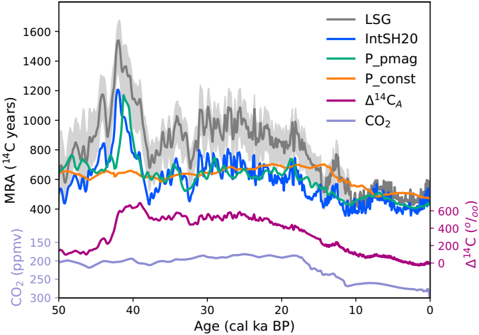
Using the intermediate-complexity Earth system model CLIMBER-X equipped with radiocarbon, the authors simulate marine reservoir ages (MRAs) over the past 50,000 years and find global sea-surface MRAs of 400–1200 years, lower than previous uncoupled LSG estimates. Short-term MRA variability is dominated by cosmogenic 14C production, while glacial–interglacial climate effects are slower and damped, and the Laschamps interhemispheric atmospheric Δ14C gradient may have been up to twice as large as previously estimated.
Key findings
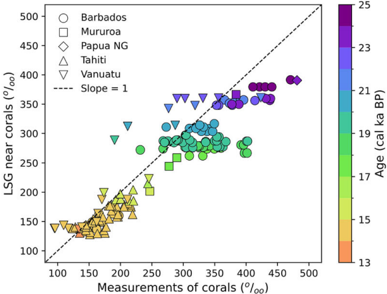
- Simulated global sea-surface MRAs (50°N–50°S) range from ~400 to 1200 14C years, with the highest values near 42 ka BP shortly before the Laschamps geomagnetic minimum (~41 ka BP). These values are systematically lower than previous LSG model estimates, attributed to model differences in vertical mixing and air–sea exchange/wind forcing. For 13–25 ka BP (sub)tropical corals, CLIMBER-X Δ14C_DIC has a bias of −7‰, compared with −25‰ for the LSG model.
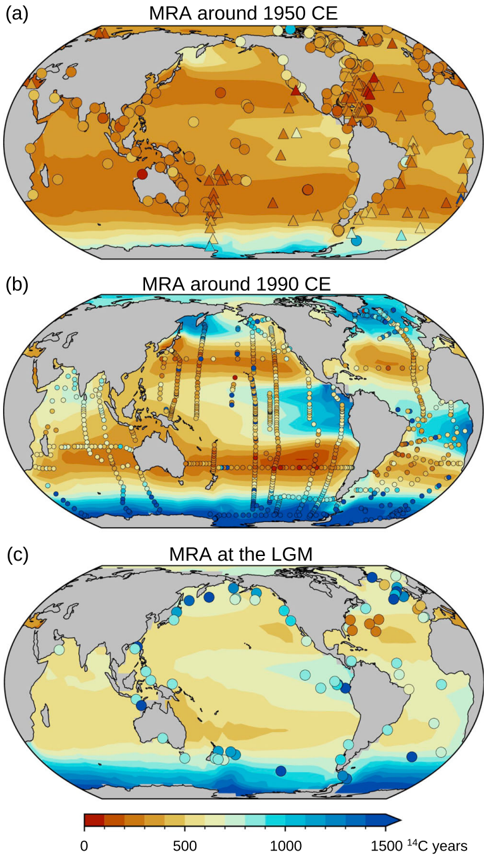
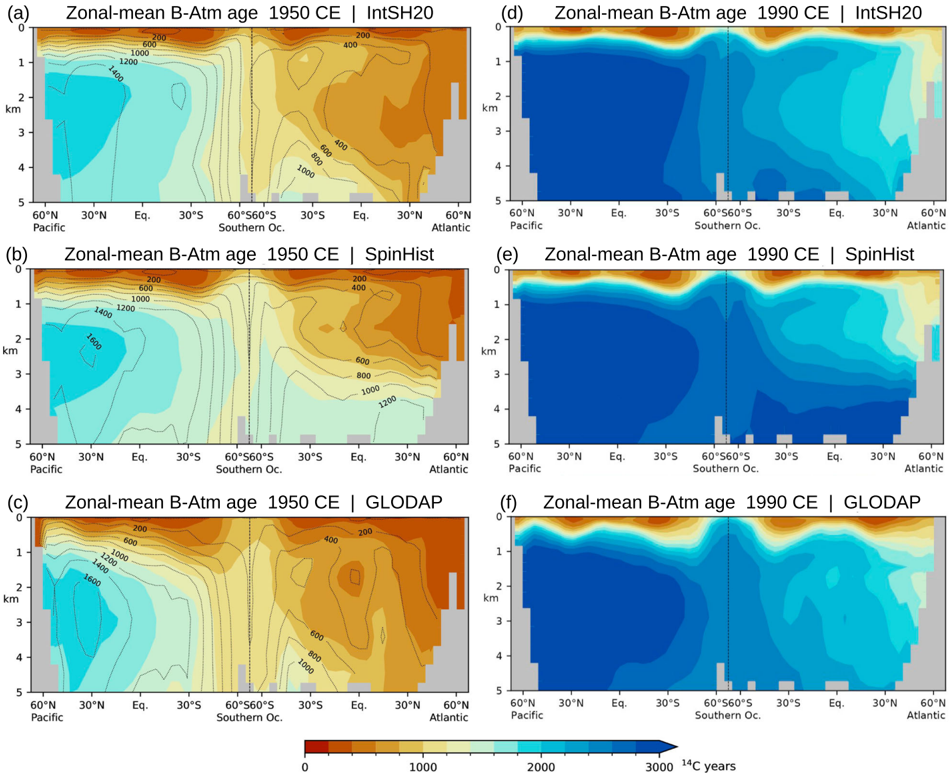
- At the Last Glacial Maximum (19.0–21.8 ka BP), simulated MRAs range from 300 14C years in subtropical oceans to about 1600 14C years in the Southern Ocean, with global means of about 600 14C years within 50°N–50°S and 670 14C years including polar oceans. The simulation has a young MRA bias of −379 14C years against all observations, and Pacific B-Atm 14C ages below about 1.5 km are too young (overall bias −483 14C years).
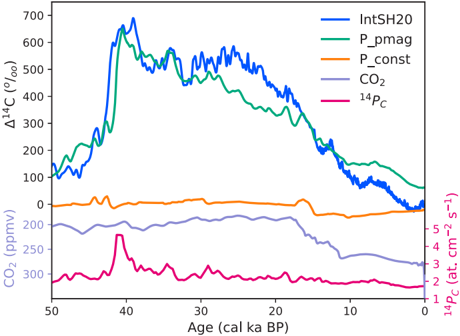
- In sensitivity experiments, constant cosmogenic production (P_const) gives global MRAs of 600–700 14C years before 14 ka BP, declining to 470 14C years in 1850 CE. Transient production (P_pmag) yields a pronounced MRA peak of almost 1200 14C years around 41 ka BP and an earlier deglacial decline, showing that short-term MRA variations are dominated by cosmogenic 14C production while climate variations exert slower, damped effects.
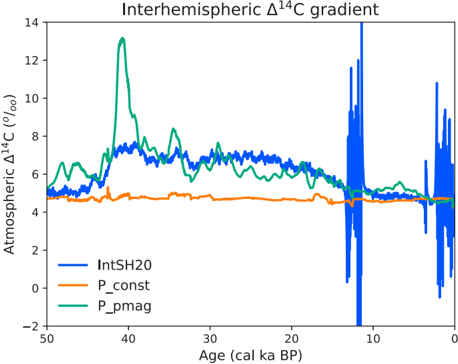
- In P_pmag, atmospheric Δ14C peaks at about 650‰ between 42 and 40.5 ka BP, close to but not matching the reconstructed Laschamps amplitude of ~700–800‰. The simulated interhemispheric atmospheric Δ14C gradient reaches up to 13‰ around the Laschamps excursion, almost twice the reconstructed long-term range of 4.5–7‰; the authors conclude that accurate evaluation of ocean circulation models with radiocarbon requires transient climate–radiocarbon simulations over millennia rather than centuries.
Methods
- The authors use the climate core of the EMIC CLIMBER-X version 3, with 5° × 5° horizontal resolution, 23 uneven ocean layers, dynamic–thermodynamic sea ice, and land surface–vegetation components. Radiocarbon is implemented as Δ14C in dissolved inorganic carbon, with a three-latitude-zone atmospheric 14C model and parameterized air–sea 14CO2 exchange; MRAs are reported as τ = −8033 ln(14R_DIC/14R_A).
- The model is spun up for 20,000 years under steady 1850 CE forcing with Δ14C_A = 0‰, then run transiently from 70 ka BP. Before 55 ka BP, Δ14C_A and 14P_C are held constant. The concentration-driven simulation (IntSH20) prescribes Δ14C_A from IntCal20/SHCal20 and historical reconstructions; production-driven experiments use either constant 14P_C* = 1.72 atoms cm−2 s−1 (P_const) or transient 14P_C reconstructed from paleomagnetic VADM records (P_pmag).
- Results are compared with previous LSG/Marine20 simulations, coral Δ14C observations for 13–25 ka BP, marine reservoir age observations around 1950 CE and 1990 CE, LGM MRA compilations, and benthic–atmospheric 14C age reconstructions; bias statistics are reported in supplementary tables.
Limitations
- Stated by the paper: CLIMBER-X is an intermediate-complexity model with 5° × 5° resolution and simplified physics; it neglects the terrestrial biosphere and organic 14C cycle, assumes constant homogeneous DIC and local solubility equilibrium, and has insufficient sea ice extent in subarctic/subantarctic regions, likely causing young MRA biases. The LGM ocean cooling is up to 10 K colder than reconstructions and sea ice is less than in GLOMAP. The model fails to reproduce the reconstructed Δ14C_A rebound between 33 and 25 ka BP and overestimates Holocene Δ14C_A (~50‰ instead of 0‰ in 1850 CE), with uncertain causes; Heinrich and Dansgaard–Oeschger events before the LGM are not captured. The interhemispheric gradient reconstruction prior to ~13 ka BP relies on statistical modelling, so the stronger simulated Laschamps gradient remains uncertain.
- Evident from the text: prescribed-Δ14C_A scenarios do not necessarily close the global 14C budget; production-rate reconstructions depend on paleomagnetic VADM and solar-modulation assumptions; the atmospheric model uses only three homogeneous latitude zones with fixed meridional exchange; and remaining model–observation discrepancies occur in tropical upwelling zones, the northern North Atlantic, and the Southern Ocean, with bomb-pulse evaluations sensitive to whether simulations include millennial-scale transient climate and 14C input history.
Model-written summary. Check it against the paper before relying on it.
Integrity signals
Registry
Cites
Statistics
Figures
Verification
Claims the paper makes
1 Valid · 2 Not valid · 32 Not checked · 56 Own results and interpretations
The cited sources that could be checked couldn’t confirm or dispute this claim.
In the paper
“We chose a meridional exchange rate of μ = 1.667 yr -1 , which leads to an interhemispheric Δ 14 C gradient (defined as Δ 14 C A,N -Δ 14 C A,S ) of 4.6‰ during the Holocene in line with observations 1,26 .”
§ Cosmogenic radiocarbon production and glacial cycles control marine radiocarbon archive variations Check for updates > Implementation of radiocarbon
What the sources say
- Could not verifycites [1] Reimer, P. J. et al. The IntCal20 northern hemisphere radiocarbon age calibration curve (0-55 cal kBP). Radiocarbon 62, 725-757 (2020). sourceExperimental — accuracy not yet measured
Our copy of IntCal20 contains no atmospheric-exchange or box-diffusion model parameter of this kind: searches for "meridional exchange rate", "μ = 1.667 yr−1", "interhemispheric Δ14C gradient" and "4.6‰ Holocene" returned nothing of the sort. The closest material is the Dendrochronology section, which only notes that "14C offsets between the Southern and Northern Hemispheres are well documented" and that a global tracer transport model (Braziunas et al. 1995) predicted intrahemispheric offsets of order 8 14C yr, and the Marine 14C Reservoir Ages section, which describes LSG OGCM MRA fields (Butzin et al. 2020) rather than any chosen hemispheric atmospheric exchange rate. So the specific model choice and the resulting 4.6‰ Holocene gradient are neither stated nor contradicted in our copy; the citing sentence's numbers appear to come from a carbon-cycle modelling study not represented here. (LLM, conf=0.72)
- Could not verifycites [26] Hogg, A. G. et al. SHCal20 Southern Hemisphere Calibration, 0-55,000 Years cal BP. Radiocarbon 62, 759-778 (2020). sourceExperimental — accuracy not yet measured
Our copy of SHCal20 contains no box/atmospheric-exchange model: searches for the meridional exchange rate (mu = 1.667 yr-1), for a 4.6-permil interhemispheric gradient, and for a two-box/transport parameterization returned nothing. The closest passages are Sec. 3.5 'Value of the N-S offset', which gives the Holocene N-S offset as 36 +/- 27 14C yrs (an age offset, not a Delta-14C gradient), and Sec. 2.1, which reports measured SH-NH Delta-14C offsets of 4.0 +/- 0.4 permil (774 CE) and 3.5 +/- 0.7 permil (993 CE) from tree rings — observational values, not a model choice. Nothing in our copy either states or contradicts the attributed mu-to-4.6-permil result, and no passage credits that modelling to another named work. (LLM, conf=0.70)
plainstates a cause- Asserted: passes — The authors put it forward as true.
- Checkable: passes — It can be checked against evidence.
- Load-bearing: unclear — It is unclear whether the paper’s conclusions depend on it.
- Based: passes — The paper gives a reason why it holds.
- Rests on an assumption not shown here.
- Could not verify
The cited sources support only part of this claim — read each source’s verdict below.
In the paper
“Despite of these global mismatches, the simulated IHG remains within the reconstructed long-term range of 4.5-7‰ (refs.1,26).”
§ Cosmogenic radiocarbon production and glacial cycles control marine radiocarbon archive variations Check for updates > Results and discussion
What the sources say
- Could not verifycites [1] Reimer, P. J. et al. The IntCal20 northern hemisphere radiocarbon age calibration curve (0-55 cal kBP). Radiocarbon 62, 725-757 (2020). sourceExperimental — accuracy not yet measured
Our copy of IntCal20 is a radiocarbon calibration-curve paper: its quantitative content is Δ14C / radiocarbon age and reservoir-age (MRA, in 14C yr) and dead-carbon-fraction values, e.g. the Marine 14C Reservoir Ages section on the LSG OGCM Hulu-Cave-driven MRA fields and the RESULTS/DISCUSSION comparison of IntCal20 vs IntCal13 Δ14C ranges. No passage reports a reconstructed long-term range of 4.5–7‰, nor any simulated-vs-reconstructed 'global mismatch' comparison of that kind; searches for '4.5 to 7 per mil long-term reconstructed range', 'δ18O per mil range speleothem Hulu Cave reconstruction' and 'simulation model mismatch compared with reconstruction' returned only MRA/DCF and curve-construction material. The only δ18O mention in our copy is a figure caption (Last Glacial, Figure 5a) referring to Hulu Cave and NGRIP δ18O records taken from Cheng et al. 2016 and North Greenland Ice Core Project members 2004, with no per-mil range given. So the claim's point is not addressed by our copy — neither supported nor contradicted. (LLM, conf=0.70)
- Partly supportedcites [26] Hogg, A. G. et al. SHCal20 Southern Hemisphere Calibration, 0-55,000 Years cal BP. Radiocarbon 62, 759-778 (2020). sourceExperimental — accuracy not yet measured
Our copy of SHCal20 does reconstruct the interhemispheric (N-S) 14C offset and gives its magnitude, but in 14C years: Section 3.5 (p. 772) reports a mean N-S offset of 36 ± 27 14C yrs from the 2500 paired NH/SH realizations, and Section 3.2/3.4 describe the AR(1) modelling of that time-varying offset. The only per-mil figures in our copy are event-specific SH-versus-NH offsets in Section 1 (History of Southern Hemisphere Calibration): 4.0 ± 0.4‰ for 774 CE and 3.5 ± 0.7‰ for 993 CE — not a long-term range of 4.5–7‰. So the source supports the existence of a reconstructed long-term interhemispheric gradient but not the specific 4.5–7‰ range the citing sentence attributes to it (searches: '4.5-7‰', 'interhemispheric gradient permil', 'long-term range per mil'). (LLM, conf=0.65)
plain- Asserted: passes — The authors put it forward as true.
- Checkable: passes — It can be checked against evidence.
- Load-bearing: unclear — It is unclear whether the paper’s conclusions depend on it.
- Based: passes — The paper gives a reason why it holds.
- Rests on an assumption not shown here.
- Could not verify
A result the paper reports from its own data — it cites no other source for it, so there is none to check. The quote shows it is in the paper.
In the paper
“Between 30 and 20 ka, CLIMBER-X simulates a slow decline of global MRAs from about 700 to 600 14 C years, which is superimposed by centennial-scale MRA fluctuations of about ± 100 14 C years.”
§ Cosmogenic radiocarbon production and glacial cycles control marine radiocarbon archive variations Check for updates > Results and discussion
plain- Asserted: passes — The authors put it forward as true.
- Checkable: passes — It can be checked against evidence.
- Load-bearing: unclear — It is unclear whether the paper’s conclusions depend on it.
- Based: passes — The paper gives a reason why it holds.
A result the paper reports from its own data — it cites no other source for it, so there is none to check. The quote shows it is in the paper.
In the paper
“A brief inspection of B-Atm 14 C ages in the interior of the glacial oceans yields that our results are qualitatively in line with observations (Supplementary Fig. S4).”
§ Cosmogenic radiocarbon production and glacial cycles control marine radiocarbon archive variations Check for updates > Results and discussion
plainstates an association- Asserted: passes — The authors put it forward as true.
- Checkable: passes — It can be checked against evidence.
- Load-bearing: unclear — It is unclear whether the paper’s conclusions depend on it.
- Based: passes — The paper gives a reason why it holds.
A result the paper reports from its own data — it cites no other source for it, so there is none to check. The quote shows it is in the paper.
In the paper
“In experiment P_const, global (50°N-50°S) MRAs vary only in a narrow range of 600-700 14 C years prior to 14 ka BP, before they almost monotonously decline to 470 14 C years in 1850 CE (0.1 ka BP) at the end of the experiment (Fig. 1).”
§ Cosmogenic radiocarbon production and glacial cycles control marine radiocarbon archive variations Check for updates > Results and discussion
plain- Asserted: passes — The authors put it forward as true.
- Checkable: passes — It can be checked against evidence.
- Load-bearing: passes — The paper’s conclusions depend on it.
- Based: passes — The paper gives a reason why it holds.
- Rests on an assumption not shown here.
33 more claims
Create a free account to see all 91 claims and to verify the 39 references still open.
- It may state two separate claims as one. 38
- Probably not a substantial claim. 18
Self-check
Percentages, sums and reported differences re-computed from the paper’s own numbers.
Each contradiction between two passages listed here was confirmed by an independent check.
Rated major: it would touch a result — a value a result rests on, reported and recomputed p-values on opposite sides of the significance level, two passages that conflict with no sign which is right, or a cited work retracted before this paper was published.
In the paper
§ Cosmogenic radiocarbon production and glacial cycles control marine radiocarbon archive variations Check for updates > Abstract
“This is mainly due to stronger vertical mixing and air sea exchange rates of carbon dioxide in our model.”
§ Cosmogenic radiocarbon production and glacial cycles control marine radiocarbon archive variations Check for updates > Results and discussion
“This is primarily due to weaker vertical mixing in the upper ocean and stronger near-surface winds in CLIMBER-X.”
Citations
Cites
The IntCal20 Northern Hemisphere Radiocarbon Age Calibration Curve (0–55 cal kBP)
Reimer, P. J., Austin, W. E. N., Bard, E., Bayliss, A., Blackwell, P. G., Bronk Ramsey, C., Butzin, M., Cheng, H., Edwards, R. L., Friedrich, M., et al. (2020) · Radiocarbon · doi:10.1017/rdc.2020.41 · Cited by 7,900 · cited 1×
“We chose a meridional exchange rate of μ = 1.667 yr − 1 , which leads to an interhemispheric Δ 14 C gradient (de fi ned as Δ 14 C A,N – Δ 14 C A,S ) of 4.6 ‰ during the Holocene in line with observations 1,26 .”
InfluentialSelf-citationA long-term numerical solution for the insolation quantities of the Earth
Laskar, J., Robutel, P., Joutel, F., Gastineau, M., Correia, A. C. M., & Levrard, B. (2004) · Astronomy & Astrophysics · doi:10.1051/0004-6361:20041335 · Cited by 3,837
Collapse and rapid resumption of Atlantic meridional circulation linked to deglacial climate changes
McManus, J. F., Francois, R., Gherardi, J.-M., Keigwin, L. D., & Brown-Leger, S. (2004) · Nature · doi:10.1038/nature02494 · Cited by 2,234
Marine20—The Marine Radiocarbon Age Calibration Curve (0–55,000 cal BP)
Heaton, T. J., Köhler, P., Butzin, M., Bard, E., Reimer, R. W., Austin, W. E. N., Bronk Ramsey, C., Grootes, P. M., Hughen, K. A., Kromer, B., et al. (2020) · Radiocarbon · doi:10.1017/rdc.2020.68 · Cited by 2,161
Self-citationRelationship between wind speed and gas exchange over the ocean revisited
Wanninkhof, R. (2014) · Limnology and Oceanography: Methods · doi:10.4319/lom.2014.12.351 · Cited by 1,825
Nitrous oxide solubility in water and seawater
Weiss, R. F., & Price, B. A. (1980) · Marine Chemistry · doi:10.1016/0304-4203(80)90024-9 · Cited by 1,721
A global ocean carbon climatology: Results from Global Data Analysis Project (GLODAP)
Key, R. M., Kozyr, A., Sabine, C. L., Lee, K., Wanninkhof, R., Bullister, J. L., Feely, R. A., Millero, F. J., Mordy, C., & Peng, T. ‐. (2004) · Global Biogeochemical Cycles · doi:10.1029/2004gb002247 · Cited by 1,652
SHCal20 Southern Hemisphere calibration, 0–55,000 years cal BP
Hogg, A. G., Heaton, T. J., Hua, Q., Palmer, J. G., Turney, C. S., Southon, J., Bayliss, A., Blackwell, P. G., Boswijk, G., Bronk Ramsey, C., et al. (2020) · Radiocarbon · doi:10.1017/rdc.2020.59 · Cited by 1,530
The Nubase evaluation of nuclear and decay properties
Audi, G., Bersillon, O., Blachot, J., & Wapstra, A. H. (2003) · Nuclear Physics A · doi:10.1016/j.nuclphysa.2003.11.001 · Cited by 1,338
Bard, E., Hamelin, B., Fairbanks, R. G., & Zindler, A. (1990) · Nature · doi:10.1038/345405a0 · Cited by 1,326
Lifton, N., Sato, T., & Dunai, T. J. (2014) · Earth and Planetary Science Letters · doi:10.1016/j.epsl.2013.10.052 · Cited by 948
Fairbanks, R. G., Mortlock, R. A., Chiu, T.-C., Cao, L., Kaplan, A., Guilderson, T. P., Fairbanks, T. W., Bloom, A. L., Grootes, P. M., & Nadeau, M.-J. (2005) · Quaternary Science Reviews · doi:10.1016/j.quascirev.2005.04.007 · Cited by 902
Glacial cooling and climate sensitivity revisited
Tierney, J. E., Zhu, J., King, J., Malevich, S. B., Hakim, G. J., & Poulsen, C. J. (2020) · Nature · doi:10.1038/s41586-020-2617-x · Cited by 573
A Marine Reservoir Correction Database and On-Line Interface
Reimer, P. J., & Reimer, R. W. (2001) · Radiocarbon · doi:10.1017/s0033822200038339 · Cited by 462
Bard, E., Arnold, M., Hamelin, B., Tisnerat-Laborde, N., & Cabioch, G. (1998) · Radiocarbon · doi:10.1017/s0033822200019135 · Cited by 360
Köhler, P., Nehrbass-Ahles, C., Schmitt, J., Stocker, T. F., & Fischer, H. (2017) · Earth System Science Data · doi:10.5194/essd-9-363-2017 · Cited by 319
Uncertainties due to transport-parameter sensitivity in an efficient 3-D ocean-climate model
Edwards, N. R., & Marsh, R. (2005) · Climate Dynamics · doi:10.1007/s00382-004-0508-8 · Cited by 282
Biogeochemical protocols and diagnostics for the CMIP6 Ocean Model Intercomparison Project (OMIP)
Orr, J. C., Najjar, R. G., Aumont, O., Bopp, L., Bullister, J. L., Danabasoglu, G., Doney, S. C., Dunne, J. P., Dutay, J.-C., Graven, H., et al. (2017) · Geoscientific Model Development · doi:10.5194/gmd-10-2169-2017 · Cited by 266
The Mass of the Atmosphere: A Constraint on Global Analyses
Trenberth, K. E., & Smith, L. (2005) · Journal of Climate · doi:10.1175/jcli-3299.1 · Cited by 260
Compiled records of carbon isotopes in atmospheric CO 2 for historical simulations in CMIP6
Graven, H., Allison, C. E., Etheridge, D. M., Hammer, S., Keeling, R. F., Levin, I., Meijer, H. A. J., Rubino, M., Tans, P. P., Trudinger, C. M., et al. (2017) · Geoscientific Model Development · doi:10.5194/gmd-10-4405-2017 · Cited by 242
A new global ice sheet reconstruction for the past 80 000 years
Gowan, E. J., Zhang, X., Khosravi, S., Rovere, A., Stocchi, P., Hughes, A. L. C., Gyllencreutz, R., Mangerud, J., Svendsen, J.-I., & Lohmann, G. (2021) · Nature Communications · doi:10.1038/s41467-021-21469-w · Cited by 237
Self-citationPresence of the Solar de Vries Cycle (∼205 years) during the Last Ice Age
Wagner, G., Beer, J., Masarik, J., Muscheler, R., Kubik, P. W., Mende, W., Laj, C., Raisbeck, G. M., & Yiou, F. (2001) · Geophysical Research Letters · doi:10.1029/2000gl006116 · Cited by 211
BUTZIN, M., PRANGE, M., & LOHMANN, G. (2005) · Earth and Planetary Science Letters · doi:10.1016/j.epsl.2005.03.003 · Cited by 201
Self-citationGeller, L. S., Elkins, J. W., Lobert, J. M., Clarke, A. D., Hurst, D. F., Butler, J. H., & Myers, R. C. (1997) · Geophysical Research Letters · doi:10.1029/97gl00523 · Cited by 177
Abrupt Climate and Weather Changes Across Time Scales
Lohmann, G., Butzin, M., Eissner, N., Shi, X., & Stepanek, C. (2020) · Paleoceanography and Paleoclimatology · doi:10.1029/2019pa003782 · Cited by 163
Self-citationSulfur hexafluoride—A powerful new atmospheric tracer
Maiss, M., Steele, L. P., Francey, R. J., Fraser, P. J., Langenfelds, R. L., Trivett, N. B. A., & Levin, I. (1996) · Atmospheric Environment · doi:10.1016/1352-2310(95)00425-4 · Cited by 149
Poluianov, S. V., Kovaltsov, G. A., Mishev, A. L., & Usoskin, I. G. (2016) · Journal of Geophysical Research: Atmospheres · doi:10.1002/2016jd025034 · Cited by 140
Atmospheric 14 C/ 12 C changes during the last glacial period from Hulu Cave
Cheng, H., Edwards, R. L., Southon, J., Matsumoto, K., Feinberg, J. M., Sinha, A., Zhou, W., Li, H., Li, X., Xu, Y., et al. (2018) · Science · doi:10.1126/science.aau0747 · Cited by 135
The annual update GLODAPv2.2023: the global interior ocean biogeochemical data product
Lauvset, S. K., Lange, N., Tanhua, T., Bittig, H. C., Olsen, A. S., Kozyr, A., Álvarez, M., Azetsu‐Scott, K., Brown, P. J., Carter, B. R., et al. (2024) · Earth system science data · doi:10.5194/essd-16-2047-2024 · Cited by 124
Marine radiocarbon reservoir age simulations for the past 50,000 years
Butzin, M., Köhler, P., & Lohmann, G. (2017) · Geophysical Research Letters · doi:10.1002/2017gl074688 · Cited by 119
Self-citationOne Hundred Thousand Years of Geomagnetic Field Evolution
Panovska, S., Korte, M., & Constable, C. G. (2019) · Reviews of Geophysics · doi:10.1029/2019rg000656 · Cited by 116
Applications of accelerator mass spectrometry
Kutschera, W. (2013) · International Journal of Mass Spectrometry · doi:10.1016/j.ijms.2013.05.023 · Cited by 104
A global environmental crisis 42,000 years ago
Cooper, A., Turney, C. S. M., Palmer, J., Hogg, A., McGlone, M., Wilmshurst, J., Lorrey, A. M., Heaton, T. J., Russell, J. M., McCracken, K., et al. (2021) · Science · doi:10.1126/science.abb8677 · Cited by 103
Self-citationOverview of Glacial Atlantic Ocean Mapping (GLAMAP 2000)
Sarnthein, M., Gersonde, R., Niebler, S., Pflaumann, U., Spielhagen, R., Thiede, J., Wefer, G., & Weinelt, M. (2003) · Paleoceanography · doi:10.1029/2002pa000769 · Cited by 97
Galbraith, E. D., Dunne, J. P. P., Gnanadesikan, A., Slater, R. D., Sarmiento, J. L., Dufour, C. O., de Souza, G. F., Bianchi, D., Claret, M., Rodgers, K. B., et al. (2015) · Journal of Advances in Modeling Earth Systems · doi:10.1002/2015ms000463 · Cited by 93
The impact of atmospheric p CO2 on carbon isotope ratios of the atmosphere and ocean
Galbraith, E. D., Kwon, E. Y., Bianchi, D., Hain, M. P., & Sarmiento, J. L. (2015) · Global Biogeochemical Cycles · doi:10.1002/2014gb004929 · Cited by 91
Cutler, K. B., Gray, S. C., Burr, G. S., Edwards, R. L., Taylor, F. W., Cabioch, G., Beck, J. W., Cheng, H., & Moore, J. (2004) · Radiocarbon · doi:10.1017/s0033822200033063 · Cited by 79
Separating natural and bomb‐produced radiocarbon in the ocean: The potential alkalinity method
Rubin, S. I., & Key, R. M. (2002) · Global Biogeochemical Cycles · doi:10.1029/2001gb001432 · Cited by 75
Herbst, K., Muscheler, R., & Heber, B. (2017) · Journal of Geophysical Research: Space Physics · doi:10.1002/2016ja023207 · Cited by 69
A short note on marine reservoir age simulations used in IntCal20
Butzin, M., Heaton, T. J., Köhler, P., & Lohmann, G. (2020) · Radiocarbon · doi:10.1017/rdc.2020.9 · Cited by 67 · cited 1×
“Similar to our previous simulations with the LSG model 2,12 , this major MRA excursion occurs prior to the reconstructed peak of Δ 14 C A intheatmosphere.”
Self-citationBard, E., Ménot-Combes, G., & Rostek, F. (2004) · Radiocarbon · doi:10.1017/s0033822200033087 · Cited by 64
Multi-proxy constraints on Atlantic circulation dynamics since the last ice age
Pöppelmeier, F., Jeltsch-Thömmes, A., Lippold, J., Joos, F., & Stocker, T. F. (2023) · Nature Geoscience · doi:10.1038/s41561-023-01140-3 · Cited by 57
The Role of Geomagnetic Field Intensity in Late Quaternary Evolution of Humans and Large Mammals
Channell, J. E. T., & Vigliotti, L. (2019) · Reviews of Geophysics · doi:10.1029/2018rg000629 · Cited by 52
On the hydrological cycle under paleoclimatic conditions as derived from AGCM simulations
Lohmann, G., & Lorenz, S. (2000) · Journal of Geophysical Research: Atmospheres · doi:10.1029/2000jd900189 · Cited by 49
Self-citationThe Earth system model CLIMBER-X v1.0 – Part 1: Climate model description and validation
Willeit, M., Ganopolski, A., Robinson, A., & Edwards, N. R. (2022) · Geoscientific Model Development · doi:10.5194/gmd-15-5905-2022 · Cited by 47
Panovska, S., Korte, M., Liu, J., & Nowaczyk, N. R. (2021) · Journal of Geophysical Research Solid Earth · doi:10.1029/2021jb022681 · Cited by 44
RADIOCARBON IN GLOBAL TROPOSPHERIC CARBON DIOXIDE
Levin, I., Hammer, S., Kromer, B., Preunkert, S., Weller, R., & Worthy, D. E. (2022) · Radiocarbon · doi:10.1017/rdc.2021.102 · Cited by 41
PALADYN v1.0, a comprehensive land surface–vegetation–carbon cycle model of intermediate complexity
Willeit, M., & Ganopolski, A. (2016) · Geoscientific model development · doi:10.5194/gmd-9-3817-2016 · Cited by 36
Aumont, O., Orr, J. C., Jamous, D., Monfray, P., Marti, O., & Madec, G. (1998) · Climate Dynamics · doi:10.1007/s003820050212 · Cited by 34
Comparison of 14C and U-Th Ages in Corals from IODP #310 Cores Offshore Tahiti
Durand, N., Deschamps, P., Bard, E., Hamelin, B., Camoin, G., Thomas, A. L., Henderson, G. M., Yokoyama, Y., & Matsuzaki, H. (2013) · Radiocarbon · doi:10.2458/azu_js_rc.v55i2.16134 · Cited by 33
Paul, A., Mulitza, S., Stein, R., & Werner, M. (2021) · Climate of the Past · doi:10.5194/cp-17-805-2021 · Cited by 33
Dinauer, A., Adolphi, F., & Joos, F. (2020) · Climate of the Past · doi:10.5194/cp-16-1159-2020 · Cited by 30
Self-citationThe Ocean Bomb Radiocarbon Inventory Revisited
Mouchet, A. (2013) · Radiocarbon · doi:10.1017/s0033822200048505 · Cited by 30
Skinner, L. C., Primeau, F., Jeltsch‐Thömmes, A., Joos, F., Köhler, P., & Bard, É. (2023) · Climate of the past · doi:10.5194/cp-19-2177-2023 · Cited by 29
Stott, L., Harazin, K. M., & Quintana-Krupinski, N. (2019) · Environmental Research Letters · doi:10.1088/1748-9326/aafe28 · Cited by 26
Holocene solar activity inferred from global and hemispherical cosmic-ray proxy records
Nilsson, A., Nguyen, L., Panovska, S., Herbst, K., Zheng, M., Suttie, N., & Muscheler, R. (2024) · Nature Geoscience · doi:10.1038/s41561-024-01467-5 · Cited by 24
Rafter, P. A., Carriquiry, J. D., Herguera, J. C., Hain, M. P., Solomon, E. A., & Southon, J. R. (2019) · Geophysical Research Letters · doi:10.1029/2019gl085102 · Cited by 23
The Earth system model CLIMBER-X v1.0 – Part 2: The global carbon cycle
Willeit, M., Ilyina, T., Liu, B., Heinze, C., Perrette, M., Heinemann, M., Dalmonech, D., Brovkin, V., Munhoven, G., Börker, J., et al. (2023) · Geoscientific Model Development · doi:10.5194/gmd-16-3501-2023 · Cited by 20
Active North Atlantic deepwater formation during Heinrich Stadial 1
Repschläger, J., Zhao, N., Rand, D., Lisiecki, L., Muglia, J., Mulitza, S., Schmittner, A., Cartapanis, O., Bauch, H. A., Schiebel, R., et al. (2021) · Quaternary Science Reviews · doi:10.1016/j.quascirev.2021.107145 · Cited by 20
Global Ocean Data Analysis Project version 2.2023 (GLODAPv2.2023) (NCEI Accession 0283442)
Lauvset, S. K., Lange, N., Tanhua, T., Bittig, H. C., Olsen, A. S., Kozyr, A., Álvarez, M., Azetsu‐Scott, K., Becker, S., Brown, P. J., et al. (2023) · DIGITAL.CSIC (Spanish National Research Council (CSIC)) · doi:10.25921/zyrq-ht66 · Cited by 15
Panovska, S., Poluianov, S., Gao, J., Korte, M., Mishev, A., Shprits, Y. Y., & Usoskin, I. (2023) · Journal of Geophysical Research: Space Physics · doi:10.1029/2022ja031158 · Cited by 13
Paleoclimate data assimilation with CLIMBER-X: An ensemble Kalman filter for the last deglaciation
Masoum, A., Nerger, L., Willeit, M., Ganopolski, A., & Lohmann, G. (2024) · PLoS ONE · doi:10.1371/journal.pone.0300138 · Cited by 13
Self-citationLessons From Transient Simulations of the Last Deglaciation With CLIMBER‐X: GLAC1D Versus PaleoMist
Masoum, A., Nerger, L., Willeit, M., Ganopolski, A., & Lohmann, G. (2024) · Geophysical Research Letters · doi:10.1029/2023gl107310 · Cited by 7
Self-citationJena, P. S., Chiessi, C. M., Beese, I., Butzin, M., Dias, B. B., Campos, M. D. C., Lohmann, G., & Mulitza, S. (2026) · Nature Communications · doi:10.1038/s41467-026-73364-x · Cited by 5
Self-citationCarbon isotopes in the marine biogeochemistry model FESOM2.1-REcoM3
Butzin, M., Ye, Y., Völker, C., Gürses, Ö., Hauck, J., & Köhler, P. (2024) · Geoscientific Model Development · doi:10.5194/gmd-17-1709-2024 · Cited by 4
Self-citation
Cited by
Still being checked.
Metadata
- Authors
- Butzin, M., Adolphi, F., & Lohmann, G.
- Affiliations
- Alfred-Wegener-Institut Helmholtz-Zentrum für Polar- und Meeresforschung (DE)
- Corresponding author
- Butzin, M.
- Venue
- Communications Earth & Environment
- Published
- 2026-09-22
- Volume
- 7
- Issue
- 1
- Pages
- 781
- ISSN
- 2662-4435 (ISSN-L)
- OpenAlex
- W7214013838
- Semantic Scholar
- 62fb8e0f220ea88a91cce655142d86a97c4a25d4
- Cited by
- 0
- References
- 65
- FWCI
- 0.00
- Type
- journal article
- Language
- en
- Open access
- gold
- doi.org
- Licence
- cc-by
- creativecommons.org/licenses/by/4.0 (tdm)
- creativecommons.org/licenses/by/4.0 (vor)
- Locations
- Communications Earth & Environment (publishedVersion, cc-by)
- Research Square (submittedVersion, cc-by)
- Helmholtz-Zentrum für Polar-und Meeresforschung (Alfred-Wegener-Institut) (submittedVersion, cc-by)
- DOAJ (DOAJ: Directory of Open Access Journals) (submittedVersion)
- Funders
- Deutsche Forschungsgemeinschaft (490763579)
- Topics
- Physical Sciences › Earth and Planetary Sciences › Atmospheric Science › Geology and Paleoclimatology Research
- Social Sciences › Archeology › Archaeology and ancient environmental studies
- Physical Sciences › Environmental Science › Global and Planetary Change › Climate variability and models
- Keywords
- glacial-interglacial cycles, ocean carbon cycle, air-sea CO2 flux, ocean circulation models, Earth system models
About these checks
Registry, retraction, Cites and statistics results are computed, not judged, with one exception: a printed reference that no index lists is read once by a model before it counts as a citation error. Claims are extracted by a model and kept only when their quote appears verbatim in the text; each cited source is then checked, with a model’s help, for whether it says what the claim relies on. Those verdicts can be wrong — read the claim’s quote and the cited source before relying on one.
The claim verdicts this report counts are experimental: their accuracy is not yet measured.
A language model drew the claims from the paper on 2026-11-24, under version 3 of the claim definition (model deepseek-v4.1-flash, prompt extract-v3).
A second model labelled each claim on 2026-11-24 (model jev-1.13-20260917, definition revision gold-guideline-v0.2).
Cited sources are checked with a language model’s help (qwen3.8-omni-flash).
Statistics and arithmetic are recomputed, not judged.
Confidence bands are shown only for fields calibrated on our annotated test set. None is calibrated yet, so no band is shown.
What counts as a claim ›How we measure confidence ›How we check this ›
Are you an author, or do you see a problem with this page? Request a review
Data sources
Bibliographic data: Semantic Scholar, OpenAlex, Crossref.
Contains information from the Semantic Scholar Academic Graph Datasets, made available under the ODC Attribution License (ODC-BY 1.0).
Semantic Scholar’s data is described in: Kinney, R., et al. (2023). The Semantic Scholar Open Data Platform. arXiv:2301.10140.
