

Mass spectrometric simultaneous quantification of tau species in plasma shows differential associations with amyloid and tau pathologies.
Open accessThe DOI matches its Crossref record; 42 of the 42 references it cites were found in a registry or an index.
Abstract
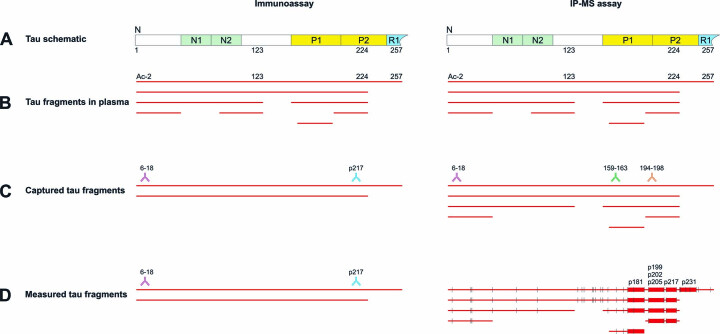
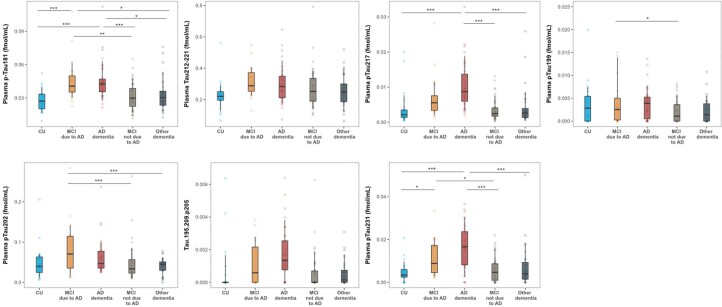
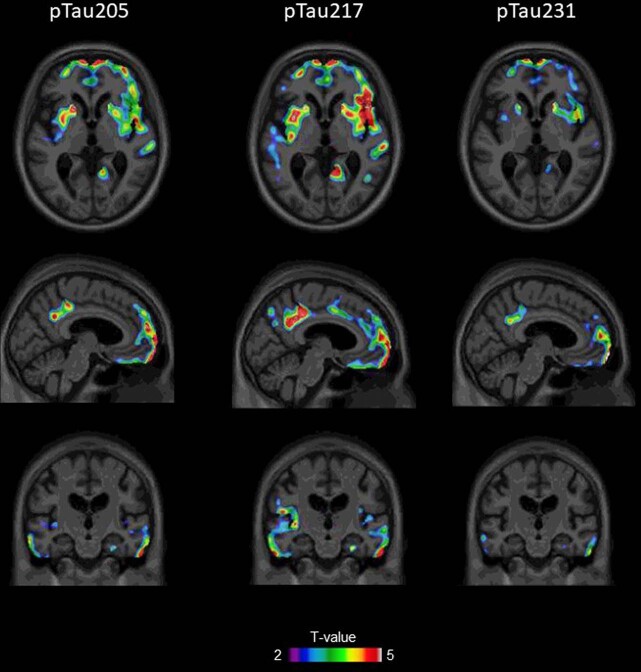
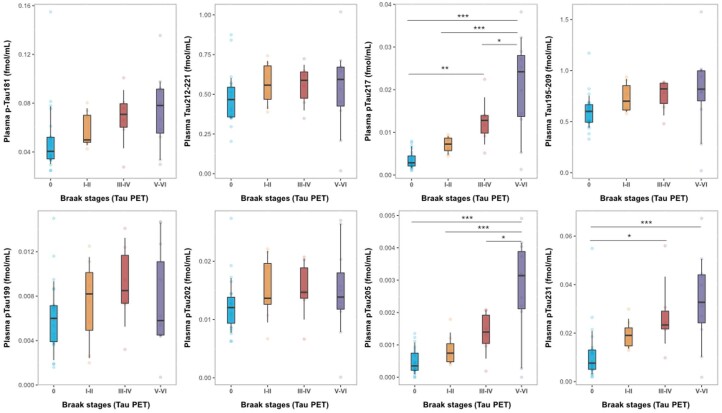
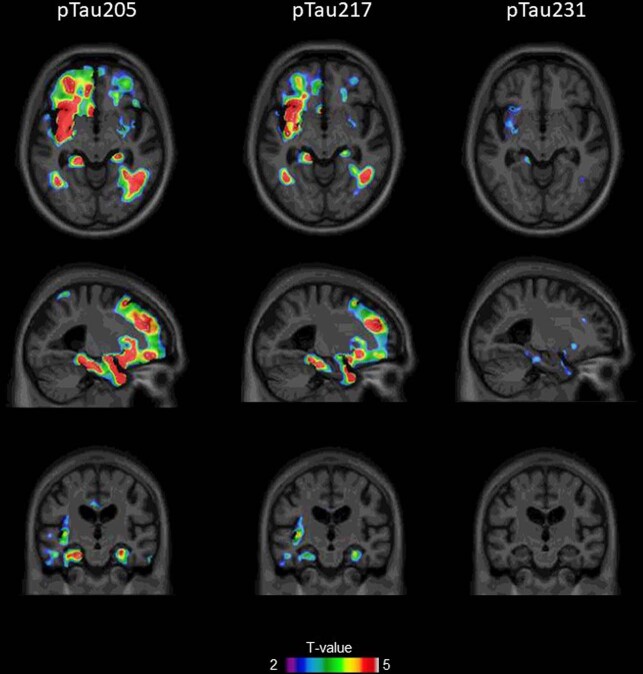
Blood phosphorylated tau (p-tau) biomarkers, at differing sites, demonstrate high accuracy to detect Alzheimerʼs disease (AD). However, knowledge on the optimal marker for disease identification across the AD continuum and the link to pathology is limited. This is partly due to heterogeneity in analytical methods. In this study, we employed an immunoprecipitation mass spectrometry method to simultaneously quantify six phosphorylated (p-tau181, p-tau199, p-tau202, p-tau205, p-tau217 and p-tau231) and two non-phosphorylated plasma tau peptides in a total of 214 participants from the Paris Lariboisière and Translational Biomarkers of Aging and Dementia cohorts. Our results indicate that p-tau217, p-tau231 and p-tau205 are the plasma tau forms that best reflect AD-related brain changes, although with distinct emergences along the disease course and correlations with AD features—amyloid and tau. These findings support the differential association of blood p-tau variants with AD pathology, and our method offers a potential tool for disease staging in clinical trials.
Overview
The claims and statistics of this paper haven’t been checked yet.
Free: it reads the open-access text and checks the first 5 claims that cite a source we can check. Create a free account to check every claim.
Integrity signals
Registry
Cites
Statistics
Figures
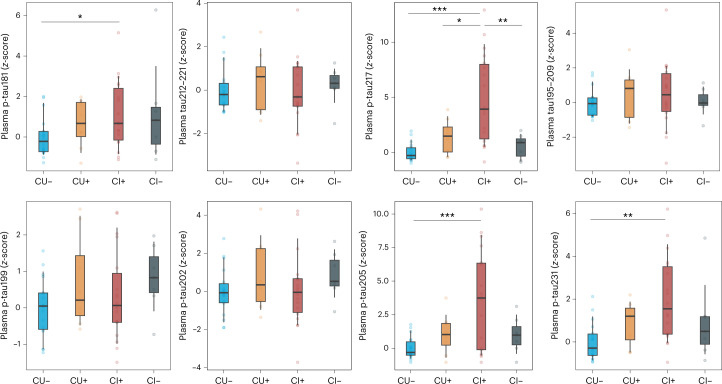
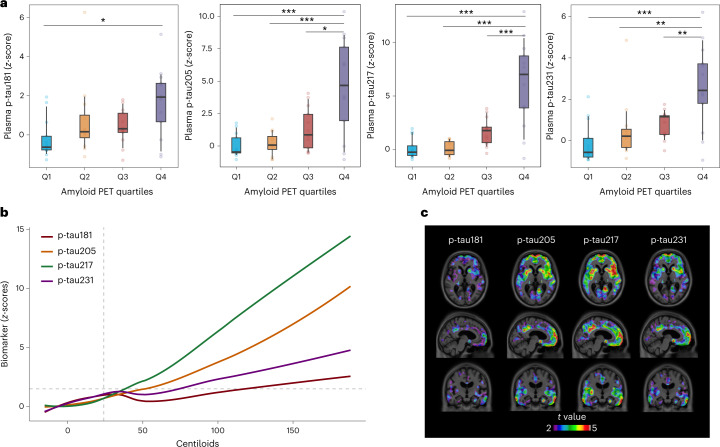
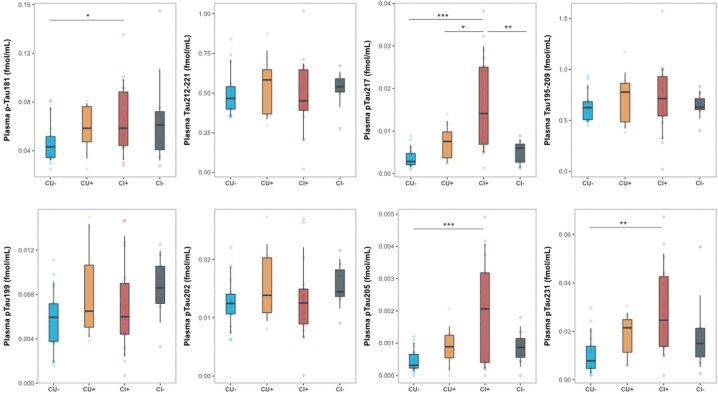
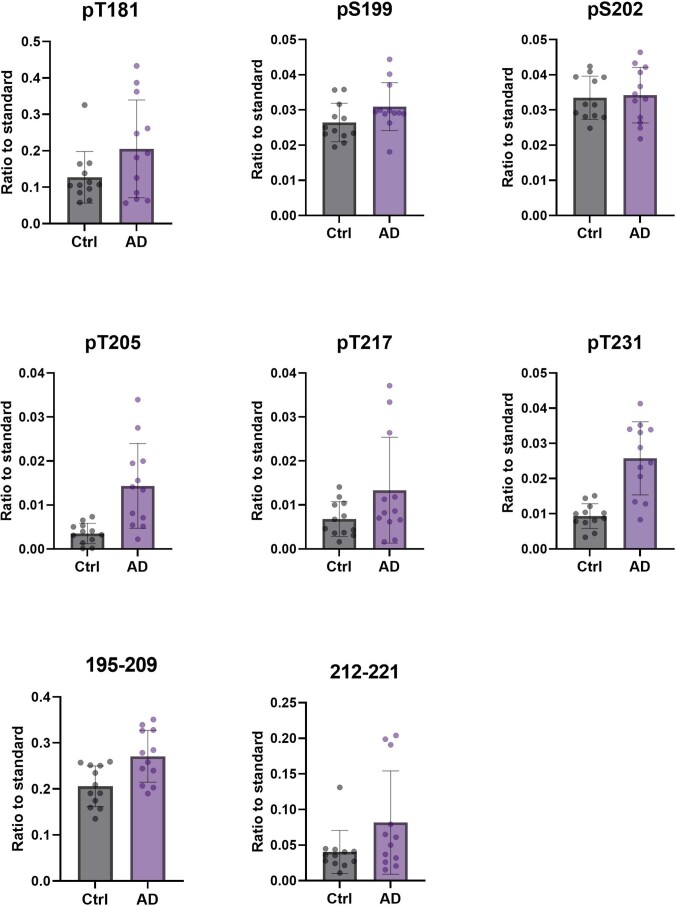
![Extended Data Fig. 4 Plasma tau species across Amyloid PET quartiles in Cohort 2. Box plots of plasma p-tau181, tau212-221, p-tau217, p-tau199, p-tau202, tau195-209 and p-tau231 levels in relation to amyloid PET (n=51). Participants were grouped in quartiles according to their levels of amyloid PET uptake (Q1=(-Inf,1.29]; Q2=(1.29,1.7]; Q3=(1.7,2.45]; Q4=(2.45, Inf]). The boxplots depict the median (horizontal bar), 25th to 75th percentiles (hinges) and whiskers indicate 10th and 90th percentiles. Statistical analysis across groups was performed using ANOVA (two-sided) and Tukey Contrasts were used to account for multiple comparisons (*P<0.05, **P<0.01, ***P<0.001). Exact significant p-values: P-tau181 PQ1 vs Q4 =0.0118; P-tau205 PQ1 vs Q4 <0.001, PQ2 vs Q4 <0.001, PQ3 vs Q4 = 0.0015; P-tau217 PQ1 vs Q4 <0.001, PQ2 vs Q4 <0.001, PQ3 vs Q4 <0.001; P-tau231 PQ1 vs Q4 <0.001, PQ2 vs Q4 = 0.0029, PQ3 vs Q4 = 0.0095.](https://figures.cochat.ai/paper-figures/55426e45a8b94b56a36b8643d2602c5b/mass-spectrometric-simultaneous-quantification-of-tau-species-in-plasma-shows-figure-8.jpg)
Verification
Claims the paper makes
The claims and statistics of this paper haven’t been checked yet.
Free: it reads the open-access text and checks the first 5 claims that cite a source we can check. Create a free account to check every claim.
Claims other papers make about this one
Each is checked against this paper’s own text: does it say what the citing paper says it does?
The cited source says what the claim attributes to it.
In the citing paper
“Among proposed blood tau biomarkers,18,19,20,21 phosphorylated tau at threonine 217 (p-tau217) has consistently shown high performance in differentiating AD from other neurodegenerative disorders10,22 and in detecting AD pathology in patients with mild cognitive impairment (MCI).22”
From Diagnostic Accuracy of a Plasma Phosphorylated Tau 217 Immunoassay for Alzheimer Disease Pathology (2024) · cites this paper as [21]
Self-check
Percentages, sums and reported differences re-computed from the paper’s own numbers.
The self-check needs the paper’s full text.
Citations
Cites
McKhann, G. M., Knopman, D. S., Chertkow, H., Hyman, B. T., Jack, C. R., Kawas, C. H., Klunk, W. E., Koroshetz, W. J., Manly, J. J., Mayeux, R., et al. (2011) · Alzheimer's & Dementia · doi:10.1016/j.jalz.2011.03.005 · Cited by 18,657
NIA‐AA Research Framework: Toward a biological definition of Alzheimer's disease
Jack, C. R., Bennett, D. A., Blennow, K., Carrillo, M. C., Dunn, B., Haeberlein, S. B., Holtzman, D. M., Jagust, W., Jessen, F., Karlawish, J., et al. (2018) · Alzheimer's & Dementia · doi:10.1016/j.jalz.2018.02.018 · Cited by 10,537
Self-citationClinical and biomarker changes in dominantly inherited Alzheimer's disease
Bateman, R. J., Xiong, C., Benzinger, T. L. S., Fagan, A. M., Goate, A., Fox, N. C., Marcus, D. S., Cairns, N. J., Xie, X., Blazey, T. M., et al. (2012) · New England Journal of Medicine · doi:10.1056/nejmoa1202753 · Cited by 3,814
Braak, H., Alafuzoff, I., Arzberger, T., Kretzschmar, H., & Del Tredici, K. (2006) · Acta Neuropathologica · doi:10.1007/s00401-006-0127-z · Cited by 3,172
Palmqvist, S., Janelidze, S., Quiroz, Y. T., Zetterberg, H., Lopera, F., Stomrud, E., Su, Y., Chen, Y., Serrano, G. E., Leuzy, A., et al. (2020) · JAMA · doi:10.1001/jama.2020.12134 · Cited by 1,603
Self-citationKarikari, T. K., Pascoal, T. A., Ashton, N. J., Janelidze, S., Benedet, A. L., Rodriguez, J. L., Chamoun, M., Savard, M., Kang, M. S., Therriault, J., et al. (2020) · The Lancet Neurology · doi:10.1016/s1474-4422(20)30071-5 · Cited by 1,316
Self-citationPlasma p-tau231: a new biomarker for incipient Alzheimer’s disease pathology.
Ashton, N. J., Pascoal, T. A., Karikari, T. K., Benedet, A. L., Lantero-Rodriguez, J., Brinkmalm, G., Snellman, A., Schöll, M., Troakes, C., Hye, A., et al. (2021) · Acta Neuropathologica · doi:10.1007/s00401-021-02275-6 · Cited by 719
Self-citationthe Dominantly Inherited Alzheimer Network, Barthélemy, N. R., Li, Y., Joseph-Mathurin, N., Gordon, B. A., Hassenstab, J., Benzinger, T. L. S., Buckles, V., Fagan, A. M., Perrin, R. J., et al. (2020) · Nature Medicine · doi:10.1038/s41591-020-0781-z · Cited by 651
Hansson, O., Edelmayer, R. M., Boxer, A. L., Carrillo, M. C., Mielke, M. M., Rabinovici, G. D., Salloway, S., Sperling, R., Zetterberg, H., & Teunissen, C. E. (2022) · Alzheimer's & Dementia · doi:10.1002/alz.12756 · Cited by 607
Self-citationHead-to-head comparison of 10 plasma phospho-tau assays in prodromal Alzheimer’s disease
Janelidze, S., Bali, D., Ashton, N. J., Barthélemy, N. R., Vanbrabant, J., Stoops, E., Vanmechelen, E., He, Y., Dolado, A. O., Triana-Baltzer, G., et al. (2023) · Brain · doi:10.1093/brain/awac333 · Cited by 522
Self-citation
Cited by
Revised criteria for diagnosis and staging of Alzheimer's disease: Alzheimer's Association Workgroup
Jack, C. R., Andrews, J. S., Beach, T. G., Buracchio, T., Dunn, B., Graf, A., Hansson, O., Ho, C., Jagust, W., McDade, E., et al. (2024) · Alzheimer's & Dementia · doi:10.1002/alz.13859 · Cited by 2,803
Diagnostic Accuracy of a Plasma Phosphorylated Tau 217 Immunoassay for Alzheimer Disease Pathology
Ashton, N. J., Brum, W. S., Di Molfetta, G., Benedet, A. L., Arslan, B., Jonaitis, E., Langhough, R. E., Cody, K., Wilson, R., Carlsson, C. M., et al. (2024) · JAMA Neurology · doi:10.1001/jamaneurol.2023.5319 · Cited by 884
Self-citationBrum, W. S., Cullen, N. C., Janelidze, S., Ashton, N. J., Zimmer, E. R., Therriault, J., Benedet, A. L., Rahmouni, N., Tissot, C., Stevenson, J., et al. (2023) · Nature Aging · doi:10.1038/s43587-023-00471-5 · Cited by 248
Self-citationBiomarker-based staging of Alzheimer disease: rationale and clinical applications
Therriault, J., Schindler, S. E., Salvadó, G., Pascoal, T. A., Benedet, A. L., Ashton, N. J., Karikari, T. K., Apostolova, L., Murray, M. E., Verberk, I., et al. (2024) · Nature Reviews Neurology · doi:10.1038/s41582-024-00942-2 · Cited by 197
“CSF 86,96,111,113 and plasma 86 p-tau205 levels are altered in the later stages of AD and are more strongly associated with tau PET measures than are p-tau231 or p-tau217.”
Self-citationChallenges in the practical implementation of blood biomarkers for Alzheimer’s disease
Schöll, M., Verberk, I. M. W., del Campo, M., Delaby, C., Therriault, J., Chong, J. R., Palmqvist, S., & Alcolea, D. A. (2024) · The Lancet Healthy Longevity · doi:10.1016/j.lanhl.2024.07.013 · Cited by 164
“27,28 Differences in concentrations of p-tau biomarkers might be greater depending on different assays or analysis platforms, or both, than differences between isoforms.”
Meyer, M. R., Kirmess, K. M., Eastwood, S., Wente‐Roth, T. L., Irvin, F., Holubasch, M. S., Venkatesh, V., Fogelman, I., Monane, M., Hanna, L., et al. (2024) · Alzheimer's & Dementia · doi:10.1002/alz.13764 · Cited by 121
Diagnosis of Alzheimer's disease using plasma biomarkers adjusted to clinical probability
Therriault, J., Janelidze, S., Benedet, A. L., Ashton, N. J., Arranz Martínez, J., Gonzalez-Escalante, A., Bellaver, B., Alcolea, D., Vrillon, A., Karim, H., et al. (2024) · Nature Aging · doi:10.1038/s43587-024-00731-y · Cited by 131
“50 ,51) or MTBR-tau243 (ref.”
Self-citationAshton, N. J., Keshavan, A., Brum, W. S., Andréasson, U., Arslan, B., Droescher, M., Barghorn, S., Vanbrabant, J., Lambrechts, C., Loo, M. V., et al. (2025) · Alzheimer s & Dementia · doi:10.1002/alz.14508 · Cited by 109
“Since the initial studies piloting p-tau detection in blood, 25,26 and immunoprecipitation mass spectrometry [IPMS] 14,32 ).”
Self-citationPlasma p‐tau immunoassays in clinical research for Alzheimer's disease
Teunissen, C. E., Kolster, R., Triana‐Baltzer, G., Janelidze, S., Zetterberg, H., & Kolb, H. C. (2024) · Alzheimer s & Dementia · doi:10.1002/alz.14397 · Cited by 103
Self-citationPlasma p-tau217 in Alzheimer’s disease: Lumipulse and ALZpath SIMOA head-to-head comparison
Pilotto, A., Quaresima, V., Trasciatti, C., Tolassi, C., Bertoli, D., Mordenti, C., Galli, A., Rizzardi, A., Caratozzolo, S., Zancanaro, A., et al. (2024) · Brain · doi:10.1093/brain/awae368 · Cited by 103
“5,10,11,15,19 The recent development of similar assays using chemiluminescent enzyme immunoassay (CLEIA) technology (including the fully automated Lumipulse platform) represents an attractive further step for their easier use and wider consistent applicability in clinical practice.”
Self-citationGonzález‐Ortiz, F., Ferreira, P. C. L., González‐Escalante, A., Montoliu‐Gaya, L., Ortiz‐Romero, P., Kac, P. R., Turton, M., Kvartsberg, H., Ashton, N. J., Zetterberg, H., et al. (2023) · Alzheimer s & Dementia · doi:10.1002/alz.13525 · Cited by 102
“32 Although the UGOT p-tau217 assay measures p-tau217 in regular plasma samples, the IP-MS method is based on immunoprecipitation using three phosphorylation-independenttauantibodiestoenrichfortauvariants, followed by trypsination so that the peptide tau212-221 phosphorylated at position 217 can be…”
MethodSelf-citationBlood-based biomarkers in Alzheimer’s disease – moving towards a new era of diagnostics
Arslan, B., Zetterberg, H., & Ashton, N. J. (2024) · Clinical Chemistry and Laboratory Medicine (CCLM) · doi:10.1515/cclm-2023-1434 · Cited by 99
Self-citationZeng, X., Chen, Y., Sehrawat, A., Lee, J., Lafferty, T. K., Kofler, J., Berman, S., Sweet, R. A., Tudorascu, D. L., Klunk, W. E., et al. (2024) · Molecular Neurodegeneration · doi:10.1186/s13024-024-00711-1 · Cited by 94
Self-citationComparison of two plasma p-tau217 assays to detect and monitor Alzheimer’s pathology
Therriault, J., Ashton, N. J., Pola, I., Triana-Baltzer, G., Brum, W. S., Di Molfetta, G., Arslan, B., Rahmouni, N., Tissot, C., Servaes, S., et al. (2024) · eBioMedicine · doi:10.1016/j.ebiom.2024.105046 · Cited by 84
“Future studies are required to evaluate whether additional p-tau biomarkers, which have different associations with key pathological features of AD, 11,14,30,31 provide additional diagnostic or prognostic information in clinical settings.”
BackgroundSelf-citationCSF p-tau205: a biomarker of tau pathology in Alzheimer’s disease
Lantero‐Rodriguez, J., Montoliu‐Gaya, L., Benedet, A. L., Vrillon, A., Dumurgier, J., Cognat, E., Brum, W. S., Rahmouni, N., Stevenson, J., Servaes, S., et al. (2024) · Acta Neuropathologica · doi:10.1007/s00401-023-02659-w · Cited by 82
Self-citationBiological variation estimates of Alzheimer's disease plasma biomarkers in healthy individuals
Brum, W. S., Ashton, N. J., Simrén, J., di Molfetta, G., Karikari, T. K., Benedet, A. L., Zimmer, E. R., Lantero‐Rodriguez, J., Montoliu‐Gaya, L., Jeromin, A., et al. (2024) · Alzheimer's & Dementia · doi:10.1002/alz.13518 · Cited by 76
Self-citationGuo, Y. X., Chen, S.-D., You, J., Huang, S.-Y., Chen, Y., Zhang, Y., Wang, L., He, X., Deng, Y., Zhang, Y.-R., et al. (2024) · Nature Human Behaviour · doi:10.1038/s41562-024-01924-6 · Cited by 78
“42,43) were not assessed in ADNI and the tau PET 44 was not contemporarily measured with CSF proteomics at baseline, we failed to further stage the participants with different pathological burdens.”
Yakoub, Y., González‐Ortiz, F., Ashton, N. J., Déry, C., Strikwerda‐Brown, C., St‐Onge, F., Ourry, V., Schöll, M., Geddes, M. R., Ducharme, S., et al. (2025) · Alzheimer s & Dementia · doi:10.1002/alz.14537 · Cited by 64
Self-citationMontoliu‐Gaya, L., Alosco, M. L., Yhang, E., Tripodis, Y., Sconzo, D., Ally, M., Grötschel, L., Ashton, N. J., Lantero‐Rodriguez, J., Sauer, M., et al. (2023) · Acta Neuropathologica · doi:10.1007/s00401-023-02660-3 · Cited by 60
Self-citationKac, P. R., González‐Ortiz, F., Emeršič, A., Dulewicz, M., Koutarapu, S., Turton, M., An, Y., Smirnov, D. S., Kulczyńska‐Przybik, A., Varma, V. R., et al. (2024) · Nature Communications · doi:10.1038/s41467-024-46876-7 · Cited by 58
Self-citationPlasma tau biomarkers for biological staging of Alzheimer’s disease
Montoliu‐Gaya, L., Salvadó, G., Therriault, J., Nilsson, J., Janelidze, S., Weiner, S., Ashton, N. J., Benedet, A. L., Rahmouni, N., Lantero‐Rodriguez, J., et al. (2025) · Nature Aging · doi:10.1038/s43587-025-00951-w · Cited by 58
“We observed a late increase in the levels of p-tau181 compared with previous reports, probably due to differences in the specific target measured between MS and immunoassay-based methods, as described 30 .”
InfluentialSelf-citationArias, J. F., Brum, W. S., Salvadó, G., Therriault, J., Servaes, S., Wang, Y., Aumont, É., Rahmouni, N., Macedo, A. C., Quispialaya, K. M., et al. (2025) · Brain · doi:10.1093/brain/awaf033 · Cited by 44
Self-citationJarek, D. J., Mizerka, H., Nuszkiewicz, J., & Szewczyk‐Golec, K. (2024) · Biomedicines · doi:10.3390/biomedicines12040786 · Cited by 44
“Moreover, according to Montoliu-Gaya et al. [108], plasma p-tau217 had the highest accuracy for differentiating A β status.”
BackgroundMethodInfluentialA blood-based biomarker workflow for optimal tau-PET referral in memory clinic settings
Brum, W. S., Cullen, N. C., Therriault, J., Janelidze, S., Rahmouni, N., Stevenson, J., Servaes, S., Benedet, A. L., Zimmer, E. R., Stomrud, E., et al. (2024) · Nature Communications · doi:10.1038/s41467-024-46603-2 · Cited by 45
Self-citationWojdała, A. L., Vanbrabant, J., Bayoumy, S., Antwi‐Berko, D., Bastard, N. L., van der Flier, W. M., Jeromin, A., Lambrechts, C., Loo, M. V., Vandijck, M. L. J., et al. (2024) · Alzheimer s Research & Therapy · doi:10.1186/s13195-024-01630-5 · Cited by 38
Lan, G., Wang, M., González‐Ortiz, F., Zhang, L., Li, A., Li, B., Jiang, M., Yang, J., Chen, X., Shi, D., et al. (2025) · Nature Aging · doi:10.1038/s43587-025-00904-3 · Cited by 38
“By contrast, plasma p-tau217 demonstrates more consistent performance across populations with different races and ethnicities 33 , as its dynamic increases correspond with initial Aβ plaques and late tau tangles 34,35 .”
Self-citationPan, F., Huang, L., Wang, Y., Huang, Q., Guan, Y., Li, Y., Xie, F., & Guo, Q. (2025) · Alzheimer s & Dementia · doi:10.1002/alz.70987 · Cited by 36
Wojdała, A. L., Bellomo, G., Gaetani, L., Teunissen, C. E., Parnetti, L., & Chiasserini, D. (2025) · Nature Communications · doi:10.1038/s41467-024-54878-8 · Cited by 34
“BothCSFandplasmap-tau181,p-tau217,andp-tau231 have shown a very good diagnostic potential as AD biomarkers, with p-tau217 and p-tau231 possibly outperforming p-tau181 as markers of early AD pathology 7,10,12 – 20, 31, 32 .”
SERS-Based Optical Nanobiosensors for the Detection of Alzheimer’s Disease
Gao, F., Li, F., Wang, J., Yu, H., Li, X., Chen, H., Wang, J., Qin, D., Li, Y., Liu, S., et al. (2023) · Biosensors · doi:10.3390/bios13090880 · Cited by 34
“Cerebrospinal fluid (CSF) and blood biomarkers for the diagnosis of AD [21,95], which”
A critical appraisal of blood-based biomarkers for Alzheimer’s disease
Lista, S., Mapstone, M. E., Caraci, F., Emanuele, E., López‐Ortiz, S., Martín-Hernández, J., Triaca, V., Imbimbo, C., Gabelle, A., Mielke, M. M., et al. (2024) · Ageing Research Reviews · doi:10.1016/j.arr.2024.102290 · Cited by 33
Differential roles of Alzheimer's disease plasma biomarkers in stepwise biomarker‐guided diagnostics
Jang, H., Shin, D., Yoo, H., Zetterberg, H., Blennow, K., González‐Ortiz, F., Ashton, N. J., Day, T. A., Lee, E. H., Yun, J., et al. (2025) · Alzheimer s & Dementia · doi:10.1002/alz.14526 · Cited by 29
“26 Moreover, these core plasma biomarkers may aid in distinguishing AD from non-AD patients.”
Self-citationFluid biomarkers for neurodegenerative diseases: a comprehensive update
Valletta, M., Briel, N., Yuksekel, I., Barboure, M. C., Coward, A. R., Houwer, J. F. H. D., Fawad, A., González-Mayoral, A., Iaccarino, G., Martínez‐Dubarbie, F., et al. (2025) · Alzheimer s Research & Therapy · doi:10.1186/s13195-025-01919-z · Cited by 26
“In AD research, mass spectrometry has been used to quantify plasma biomarkers such as p-tau, Aβ peptides, and NfL [37, 45, 48, 49, 146, 147].”
Self-citationKong, Q., Liu, C., Zhang, Y., He, Y., Zhang, R., Wang, Y., Zhou, Q., & Cui, F. (2024) · Microchimica Acta · doi:10.1007/s00604-024-06395-0 · Cited by 25
“The changes in peak electrode current at 5, 10, 15, 20, 25, and 30 s of electrochemical deposition were first compared using DPV. Fig.”
Eastwood, S., Meyer, M. R., Kirmess, K. M., Wente‐Roth, T. L., Irvin, F., Holubasch, M. S., Verghese, P. B., West, T., Braunstein, J. B., Yarasheski, K. E., et al. (2024) · Diagnostics · doi:10.3390/diagnostics14161739 · Cited by 24
Wang, S., Kang, D. W., Um, Y. H., Kim, S., Lee, C. U., Scheltens, P., & Lim, H. K. (2024) · Alzheimer s Research & Therapy · doi:10.1186/s13195-024-01400-3 · Cited by 24
“The p-tau 217, p-tau 181, and p-tau 231 became abnormal around the same time as A-PET [30–32], but MTBR-243 and non-phosphorylated tau fragments correlated more strongly with tau-PET [33, 34].”
ResultBlūma, M., Chiotis, K., Bucci, M., Savitcheva, I., Matton, A., Kivipelto, M., Jeromin, A., Santis, G. D., Molfetta, G. D., Ashton, N. J., et al. (2024) · EBioMedicine · doi:10.1016/j.ebiom.2024.105504 · Cited by 23
“These fi ndings are also consistent with in vivo studies using amyloid and tau PET imaging 24,70,71 which demonstrate that both pTau231 and pTau217 levels correlate with the presence of tau neuro fi brillary tangles in individuals with cognitive impairments.”
Self-citationMolina‐Henry, D. P., Langford, O., Donohue, M., Raman, R., Aisen, P. S. S., Johnson, K. A., Rissman, R. A., & Sperling, R. A. (2024) · The Journal of Prevention of Alzheimer s Disease · doi:10.14283/jpad.2024.124 · Cited by 22
“Phosphorylated tau at Threonine 217 (pTau217) has demonstrated superior performance to other pTau biomarkers including pTau181 and pTau231 with areas under the curve (AUC) exceeding 90% in discriminating individuals with evidence of amyloid pathology as measured by PET (14, 15).”
BackgroundMiner, A. E., Groh, J. R., Tripodis, Y., Adler, C. H., Balcer, L. J., Bernick, C. B., Zetterberg, H., Blennow, K., Peskind, E. R., Ashton, N. J., et al. (2024) · Alzheimer s & Dementia · doi:10.1002/alz.14231 · Cited by 22
“54 While p-tau181 and p-tau231 may be good biomarkers to help rule out or rule in the presence of other neurodegenerative diseases, like AD, investigation of alternative p-tau epitopes will be necessary to definitively measure RHI or CTE-specific plasma p-tau.”
Self-citationSerrano‐Pozo, A., Escott‐Price, V., Grinberg, L. T., Pascoal, T. A., Suárez‐Calvet, M., Dubois, B., & Sperling, R. A. (2026) · The Lancet · doi:10.1016/s0140-6736(26)00198-4 · Cited by 23
Self-citationWu, F., Li, W., Lu, H., & Li, L. (2025) · Molecular & Cellular Proteomics · doi:10.1016/j.mcpro.2025.101003 · Cited by 19
Potential utility of plasma pTau217 for assessing amyloid and tau biomarker profiles
Shin, D., Jang, H., Yoo, H., Kim, K., Zetterberg, H., Blennow, K., González‐Ortiz, F., Ashton, N. J., Lee, E. H., Yun, J., et al. (2025) · European Journal of Nuclear Medicine and Molecular Imaging · doi:10.1007/s00259-025-07457-y · Cited by 18
Self-citationLiou, J., Lou, J., Flores‐Aguilar, L., Nakagiri, J., Yong, W., Hom, C. L., Doran, E. W., Totoiu, M. O., Lott, I., Mapstone, M., et al. (2025) · Alzheimer's & Dementia · doi:10.1002/alz.14479 · Cited by 16
“23,49,50”
Comparison of plasma ALZpath p-Tau217 with Lilly p-Tau217 and p-Tau181 in a neuropathological cohort
Bali, D., Salvadó, G., Beach, T. G., Serrano, G. E., Atri, A., Reiman, E. M., Jeromin, A., Hansson, O., & Janelidze, S. (2025) · Acta Neuropathologica Communications · doi:10.1186/s40478-025-02064-2 · Cited by 17
“Notably, plasma p-Tau217 demonstrated a larger dynamic range and higher performance against core AD biomarkers such as cerebrospinal fluid (CSF), PET imaging, and clinical and neuropathology outcomes [8, 11]16– [19].”
Biofluid-based staging of Alzheimer’s disease
Lantero‐Rodriguez, J., Montoliu‐Gaya, L., Ashton, N. J., Pola, I., Therriault, J., Rahmouni, N., Brum, W. S., Servaes, S., Stevenson, J., Molfetta, G. D., et al. (2025) · Acta Neuropathologica · doi:10.1007/s00401-025-02863-w · Cited by 17
Self-citationSuárez‐Calvet, M., Ruiz, C. A., Alcolea, D. A., Mendióroz, M., Balasa, M., Morenas‐Rodríguez, E., Puig‐Pijoan, A., Sánchez‐Juan, P., Villarejo‐Galende, A., & Sánchez‐Valle, R. (2025) · Neurología (English Edition) · doi:10.1016/j.nrleng.2025.07.004 · Cited by 17
Weiner, S., Blennow, K., Zetterberg, H., & Gobom, J. (2023) · Expert Review of Proteomics · doi:10.1080/14789450.2023.2255752 · Cited by 16
Self-citationPost-Translationally Modified Proteoforms as Biomarkers: From Discovery to Clinical Use
Luo, Y. R., Yeung, P. S.-W., Mann, M. W., Zhang, L., Yang, Y. K., & Hoofnagle, A. N. (2025) · Clinical Chemistry · doi:10.1093/clinchem/hvaf094 · Cited by 15
Trudel, L., Therriault, J., Macedo, A. C., Servaes, S., Hosseini, S. A., Bezgin, G., Aumont, É., Rahmouni, N., Arias, J. F., Zheng, Y., et al. (2025) · Neurology · doi:10.1212/wnl.0000000000214111 · Cited by 14
Self-citationAdvances and applications of clinical proteomics in precision medicine
Alshehri, S., Vitorino, R. M. P., Saleh, O., Al-Harthi, S., Alahmadi, A., Alotibi, R., Rosa, S. C. D. S., Osama, A., Magedeldin, S., Alhattab, D. M., et al. (2025) · Expert Review of Proteomics · doi:10.1080/14789450.2025.2560919 · Cited by 13
“Montoliu-Gaya et al. also suggested that proteomics could optimize treatment regimens by providing valuable insights into disease stage and treatment effects [125].”
InfluentialSuárez‐Calvet, M., Ruiz, C. A., Alcolea, D. A., Mendióroz, M., Balasa, M., Morenas‐Rodríguez, E., Puig‐Pijoan, A., Sánchez‐Juan, P., Villarejo‐Galende, A., & Sánchez‐Valle, R. (2024) · Neurología · doi:10.1016/j.nrl.2024.08.002 · Cited by 12
Böken, D., Wu, Y., Zhang, Z., & Klenerman, D. (2025) · ChemBioChem · doi:10.1002/cbic.202400877 · Cited by 13
Frost, B. E., Rowe, J. B., Akinyemi, R., Abisambra, J. F., Ashton, N. J., Brendel, M., Buée, L., Butler, D., Carrillo, M. C., Chung, P. S., et al. (2025) · Alzheimer s & Dementia · doi:10.1002/alz.70078 · Cited by 12
“114 These observations were validated in a neuropathologically confirmed AD cohort, 116 where p-tau231, p-tau217, and p-tau205 showed the most significant alterations.”
Self-citationBlood‐based biomarkers of Alzheimer's disease: Standardization and comprehensiveness
Liu, Y., Guo, Y., & Yu, J. (2024) · Neuroprotection/Neuroprotection (Chichester, England. Print) · doi:10.1002/nep3.58 · Cited by 11
Blood-based biomarkers of Alzheimer’s disease—A guideline for clinical use
Shi, J., Ou, Q., & Chen, X. (2024) · Medicine Plus · doi:10.1016/j.medp.2024.100057 · Cited by 11
Montoliu‐Gaya, L., Valeriano-Lorenzo, E., Ashton, N. J., López‐González, F. J., Lantero‐Rodriguez, J., Ruiz-González, A., Pastor, A. B., Frades, B., Zea‐Sevilla, M. A., Valentí, M., et al. (2025) · Alzheimer s & Dementia · doi:10.1002/alz.70562 · Cited by 11
Self-citationReversible tau hyperphosphorylation in hibernation: a blood biomarker and brain tissue study
Brum, W. S., Montoliu‐Gaya, L., Brinkmalm, G., Piotrowska, D., Camporesi, E., Jäger, C., Isaksson, H. S., Martin, S., Kindberg, J., Lantero‐Rodriguez, J., et al. (2025) · Acta Neuropathologica · doi:10.1007/s00401-025-02930-2 · Cited by 11
“Hibernation-linked increases in plasma levels of p-tau181, p-tau205, p-tau217, and p-tau231, with unchanged p-tau199 and p-tau202 levels, resemble a pattern seen in AD patients [11].”
InfluentialSelf-citationRoh, H. W., Chang, Y. Y., Kim, K. Y., Jeon, S. Y., Wang, S., Kim, E., Bae, J. N., & Ryu, S. (2026) · Psychiatry Investigation · doi:10.30773/pi.2025.0400 · Cited by 12
“65,77 After increasing in the early stage, it remains at a plateau in the later stage of AD.”
Predicting continuous amyloid PET values with CSF tau phosphorylation occupancies
Wisch, J. K., Gordon, B. A., Barthélemy, N. R., Horie, K., Henson, R. L., He, Y., Flores, S. E., Benzinger, T. L. S., Morris, J. C., Bateman, R. J., et al. (2024) · Alzheimer s & Dementia · doi:10.1002/alz.14132 · Cited by 11
Alzheimer's Disease and Vascular Dementia, Connecting and Differentiating Features
Hurła, M., Banaszek, N., Kozubski, W. P., & Dorszewska, J. (2024) · Current Alzheimer Research · doi:10.2174/0115672050319219240711103459 · Cited by 10
Álvarez‐Sánchez, L., Peña‐Bautista, C., Ferré‐González, L., Balaguer, Á., Amengual, J. L., Baquero, M., & Cháfer‐Pericás, C. (2025) · Scientific Reports · doi:10.1038/s41598-025-01511-3 · Cited by 9
“In general, p-Tau217 emerges as a robust AD-specific biomarker with a large fold-change in Aβ positive patients, outperforming other p-Tau biomarkers in previous studies 13,16,36,37 .”
Emerging blood biomarkers in Alzheimer’s disease: a proteomic perspective
Patel, N. K., Agrawal, N., Mishra, R., Rekha, M. M., Nayak, P. P., Kaur, M., Khachi, A., Goyal, K., Rekha, A., Rana, M., et al. (2025) · Clinica Chimica Acta · doi:10.1016/j.cca.2025.120397 · Cited by 8
Collij, L. E., Mattsson, N., Janelidze, S., Ossenkoppele, R., & Hansson, O. (2025) · Alzheimer s & Dementia · doi:10.1002/alz.70763 · Cited by 10
Single-Oligomer Characterization of Tau Phosphorylation and Mechanical State
Pillai, V. V. S., Smeding, T., Meng, J. X., Klenerman, D., & Ruggeri, F. S. (2025) · ACS Measurement Science Au · doi:10.1021/acsmeasuresciau.5c00116 · Cited by 8
Lei, H., Chen, X., Ruan, L., Liu, X., Ye, F., 李珂静, Cheng, W., Yu, B., Li, Q., & Di, C. (2025) · Ageing Research Reviews · doi:10.1016/j.arr.2025.102927 · Cited by 8
Mulet, M., Milán, J. A. S., Lorca, C., Fernández‐Rhodes, M., Planell, A. A., Castillo, M. C. B., Saiz-Aúz, L., Mateos‐Moreno, M., Hase, Y., Mira, A., et al. (2025) · Molecular & Cellular Proteomics · doi:10.1016/j.mcpro.2025.101464 · Cited by 8
Zhang, L., Du, X., Zhang, T., Chen, Q., Zhang, Q., Su, Y., Zhang, M., & Luo, H. (2026) · Sensors and Actuators B Chemical · doi:10.1016/j.snb.2025.139417 · Cited by 8
The Current Role of Tau PET Imaging in Neurodegeneration
Vanderlinden, G., Vandenberghe, R. R., Vandenbulcke, M., & Laere, K. V. (2025) · Seminars in Nuclear Medicine · doi:10.1053/j.semnuclmed.2025.03.002 · Cited by 8
Emerging concepts towards a translational framework in Alzheimer’s disease
Cozachenco, D., Zimmer, E. R., & Lourenco, M. V. (2023) · Neuroscience & Biobehavioral Reviews · doi:10.1016/j.neubiorev.2023.105246 · Cited by 8
Coppinger, J., West, T., Kirmess, K. M., Fogelman, I., Ray, S., Aurora, S. K., Verghese, P. B., Braunstein, J. B., Yarasheski, K. E., & (ADNI), T. A. D. N. I. (2025) · npj Dementia · doi:10.1038/s44400-025-00026-y · Cited by 7
Performance of novel tau antibodies across multiple modalities for Alzheimer's disease assessment
Trivedi, P., Forrest, K., Fisher, D. W., Winstone, J. K., McMillan, P. J., Valentine, M., Postupna, N. O., Wilson, A., Bajwa, T. S., MacCoss, M. J., et al. (2025) · Alzheimer s & Dementia · doi:10.1002/alz.70481 · Cited by 6
Guo, W., Cheng, Y., Yin, H., Li, S., Wan, Y., Li, C., Jiang, C., Zhou, J., Yuan, X., & Wang, J. (2026) · Analytical Chemistry · doi:10.1021/acs.analchem.5c06080 · Cited by 7
Ishiguro, T., Kurihara, M., Nishida, Y., Kikkawa-Saito, E., Kasuga, K., Takenoshita, N., Kubota, S., Kuroha, Y., Ishii, K., Hamada, M., et al. (2026) · Alzheimer s Research & Therapy · doi:10.1186/s13195-026-01997-7 · Cited by 6
“In addition, plasma p-tau217 has been reported to become abnormal earlier than plasma p-tau181 in AD continuum [26].”
Use of biomarkers in the diagnosis of Alzheimer’s disease in adults with intellectual disability
McFeely, A., O’Connor, A., & Kennelly, S. (2024) · The Lancet Healthy Longevity · doi:10.1016/j.lanhl.2024.100639 · Cited by 6
Wei, M., Yu, X., Hu, S., Hu, W., Shi, R., Wang, M., Zhong, J., Zhang, Q., Zhang, Y., Li, C., et al. (2025) · Journal of Alzheimer s Disease · doi:10.1177/13872877241309105 · Cited by 5
Fu, S.-Y., Zheng, Q., Xu, B., & Chen, F. (2025) · View · doi:10.1002/viw.20240119 · Cited by 5
Chan, J. W., Corradetti, G., Wu, X., Astraea, N., Arakaki, X., Fonteh, A. N., Suchy‐Dicey, A. M., & Sadda, S. R. (2025) · Translational Vision Science & Technology · doi:10.1167/tvst.14.5.27 · Cited by 5
Advances in plasma biomarkers for the diagnosis of Alzheimer’s disease
Wu, H., Liu, L., & Zeng, L. (2026) · Brain Research · doi:10.1016/j.brainres.2025.150138 · Cited by 5
Blood proteomics: insights from public data
Larrea, A., Dai, C., Brenes, A. J., Korff, K., Neely, B. A., Geyer, P. E., Dagley, L. F., Unwin, R. D., Naba, A., MacCoss, M. J., et al. (2026) · Genome biology · doi:10.1186/s13059-026-04027-9 · Cited by 5
“MS has identified PTM-and isoform-specific protein variants in plasma and blood cancers, demonstrating access to molecular states largely invisible to affinity-based methods and underscoring its unique value for biomarker discovery and functional proteome analysis [46].”
Zeiss, C. J., Huttner, A. J., Nairn, A. C., Arnsten, A. F. T., Datta, D., Strittmatter, S. M., Wyk, B. V., & Duque, A. (2025) · Journal of Alzheimer s Disease · doi:10.1177/13872877251323787 · Cited by 5
Patel, R., Cheng, R., Cardona, C. L., Angeles, E., Singh, G., Miller, S., Ashok, A., Teich, A. F., Piriz, A. L., Maldonado, A., et al. (2026) · Glia · doi:10.1002/glia.70165 · Cited by 6
Alishahi, F., Beam, C. R., Gatz, M., Schneider, L. S. S., Nation, D. A., Yassine, H. N., Kaplan, H. S., Ganesan, S., Pappas, I., Davis, D. W., et al. (2025) · Journal of Alzheimer s Disease · doi:10.1177/13872877251340999 · Cited by 4
AD‐related plasma biomarkers in centenarians: links to cognition and neuropathology
Lorenz, L. M. C., Rohde, S. K., Luimes, M. C., Rozemüller, A. J. M., Bank, N. B., Hulsman, M., Graat, M. J. I., van der Hoorn, M. E., Daatselaar, D. A. H., Gouda, M., et al. (2025) · Alzheimer s & Dementia · doi:10.1002/alz.70969 · Cited by 4
“Future work should expand the plasma panel to include biomarkers like plasma pTau-231 and plasma pTau-217, 9,82 as well as plasma biomarkers for age-related comorbidities, 83 including limbic-predominant age-related TDP-43 encephalopathy (LATE) 84 and vascular neuropathology (e.g., infarcts,…”
Cánovas, R., Fowler, C. J., Feizpour, A., Doré, V., Bourgeat, P., Saad, Z. S., Triana‐Baltzer, G., Kolb, H. C., Vandijck, M. L. J., Kollmorgen, G., et al. (2026) · Alzheimer s & Dementia · doi:10.1002/alz.71145 · Cited by 4
Self-citationArslan, B., Gobom, J., Andréasson, U., Montoliu‐Gaya, L., Benedet, A. L., Dittrich, A., Kern, S., Skoog, I. G., Ashton, N. J., Chan, T., et al. (2026) · Alzheimer s & Dementia · doi:10.1002/alz.71374 · Cited by 4
“Data on agreement between plasma IP-MS and Lumipulse p-tau217 are also scarce, despitetheirimportanceforfutureCRMdevelopmentandassayrecal-ibration.”
InfluentialSelf-citationZheng, W., Jiang, Y., Wong, H. Y., Wong, W. W., Cheng, L. K., Cheng, E. Y. L., Wong, B. W. Y., Lo, R. M. N., Leung, S. K., Ip, F. C. F., et al. (2026) · Alzheimer s & Dementia · doi:10.1002/alz.71179 · Cited by 3
“9 Notably, blood p-tau217 is particularly correlated with the later stage of A β accumulation, while blood p-tau231 is more strongly correlated with the early stage, 10,11 indicating that different biomarkers may better reflect distinct A β pathology stages.”
Self-citationAdvances and emerging challenges in detecting Tau proteoforms for Alzheimer's disease diagnosis
Cai, Q., Miao, M., & Li, Z. (2026) · TrAC Trends in Analytical Chemistry · doi:10.1016/j.trac.2026.118897 · Cited by 3
Lai, W., Xia, Y., Fu, Y., Huang, Z., Yang, C., Wang, Y., Li, D., & Chen, L. (2024) · 四川大学学报:医学版 · doi:10.12182/20241160206 · Cited by 2
A novel pThr217 tau monoclonal antibody reveals neuropathological heterogeneity in tauopathies
Paterno, G., Bell, B. M., Gorion, K.-M. M., Quintin, S. S., Prokop, S., & Giasson, B. I. (2025) · Scientific Reports · doi:10.1038/s41598-025-04291-y · Cited by 2
Malotaux, V., Ashton, N. J., Öhrfelt, A., Chen, Y., Su, Y., Garcia‐Ospina, G., Guzman‐Martínez, C., Villegas‐Lanau, A., Gómez‐Ramirez, J., Giraldo, M., et al. (2025) · Alzheimer s & Dementia · doi:10.1002/alz.70421 · Cited by 2
Self-citationNeuropathology and Biomarker Correlates of Late Onset Alzheimer’s Disease in Aged Old World Monkeys
Zeiss, C. J., Duque, A., & Huttner, A. J. (2025) · Toxicologic Pathology · doi:10.1177/01926233251388069 · Cited by 3
“44,107 The recently approved AD blood test (pTau217/ β -Amyloid-42 Plasma Ratio) permits detection of early A β -plaque positivity 1 and likelihood of progression of cognitive decline.”
Gleerup, H. S., Sanna, F., Koutarapu, S., Lantero‐Rodriguez, J., Montoliu‐Gaya, L., Hanrieder, J., Brinkmalm, G., Karikari, T. K., Simrén, J., Høgh, P., et al. (2025) · Frontiers in Neuroscience · doi:10.3389/fnins.2025.1718237 · Cited by 2
Self-citationKang, H., Gu, Y., Lee, J., Yoon, S., Zetterberg, H., Blennow, K., González‐Ortiz, F., Ashton, N. J., Day, T. A., Weiner, M. W., et al. (2026) · Alzheimer s Research & Therapy · doi:10.1186/s13195-025-01952-y · Cited by 2
“Compared to several other phosphorylated tau species, pTau217 has shown the strongest correlation with brain tau accumulation [4, 13, 23, 28, 49, 50, 53], potentially due to its linkage with tau phosphorylation events occurring early in the disease cascade.”
Self-citationTau pathology in epilepsy: emerging mechanisms and translational opportunities
Sen, A., Tai, X. Y., Galanopoulou, A. S., Thom, M., Aronica, E., Vivash, L. E., Hardmeier, M., Amos, A., Rüegg, S. J., Koepp, M. J., et al. (2026) · Brain · doi:10.1093/brain/awag108 · Cited by 2
“205 In addition, detection of brain-derived tau, i.e. small molecular weight tau fragments, in blood has shown promise as a biomarker of A β -associated neurodegeneration and cognitive decline in AD, 206 correlates with CSF total tau, 207 and functional outcomes after stroke 208 or severe TBI.”
CSF and plasma tau biomarkers in the Down syndrome–Alzheimer’s disease continuum
Arranz, J., Lantero‐Rodriguez, J., Braun-Wohlfahrt, L. S., Vaqué‐Alcázar, L., Rodríguez‐Baz, Í., Kac, P. R., Arslan, B., Maure‐Blesa, L., Pertierra, L., Videla, L., et al. (2026) · EBioMedicine · doi:10.1016/j.ebiom.2026.106370 · Cited by 2
“13,18,29,30 These reports converge on several key biomarker milestones: (i) p-tau181 and p-tau217 emerge earliest, (ii) p-tau205 increases later, closer to the onset of tau PET positivity, and (iii) non-phosphorylated tau species—including t-tau, MTBR-tau243, and NTA-tau—are the last to reach…”
Self-citationAlzheimer's disease—Biomarkers, clinical evaluation or both?
Simrén, J., Ashton, N. J., Suárez‐Calvet, M., & Zetterberg, H. (2024) · Journal of Neuropsychology · doi:10.1111/jnp.12401 · Cited by 2
Self-citationLiu, Y., Liu, X., Che, P., Wang, Y., Piao, Z., Wang, Y., Cai, L., Xing, M., Xu, Y., Sun, W., et al. (2025) · Scientific Reports · doi:10.1038/s41598-024-83919-x · Cited by 2
“In addition, increased levels of other pathologic tau species, such as P-tau-T205 38 and microtubule-binding region (MTBR)-tau243 39 , are detected in CSF and plasma at a later time and might suggest advanced stages of AD.”
Abraham, M. K., Indongo, G., Rajeevan, G., Kala, A. B. K., Dhahir, D. M., & George, S. (2025) · ACS Applied Nano Materials · doi:10.1021/acsanm.5c01435 · Cited by 2
Tau pathological binding activity in plasma before the onset of symptomatic Alzheimer’s diseasePreprint
Hanseeuw, B. J., Quenon, L., Bayart, J., Boyer, E., Colmant, L., Salman, Y., Gérard, T., Huyghe, L., Malotaux, V., Kienlen‐Campard, P., et al. (2026) · medRxiv · doi:10.64898/2026.04.03.26350110 · Cited by 2
“The low discriminative ability of plasma pTau217 to identify early tau-PET stages aligns with previous findings 28,29,62 .”
Shekari, M., Escalante, A. G., Milà‐Alomà, M., Falcón, C., López‐Martos, D., Sánchez‐Benavides, G., Brugulat‐Serrat, A., Niñerola‐Baizán, A., Ashton, N. J., Karikari, T. K., et al. (2024) · Alzheimer s & Dementia · doi:10.1002/alz.091448 · Cited by 1
Self-citationAgostini, M., Traldi, P., & Hamdan, M. H. (2025) · NeuroSci · doi:10.3390/neurosci6020050 · Cited by 1
“…indicated that the plasma level of p-tau231 could indicate early changes in preclinical AD, earlier than the manifestation of amyloid PET abnormalities; furthermore, the level of the same isoform did not experience further increase in subjects with more serious symptoms of the disease [36,38].”
Metadata
- Authors
- Montoliu-Gaya, L., Benedet, A. L., Tissot, C., Vrillon, A., Ashton, N. J., Brum, W. S., Lantero-Rodriguez, J., Stevenson, J., Nilsson, J., Sauer, M., Rahmouni, N., Brinkmalm, G., Lussier, F. Z., Pascoal, T. A., Skoog, I., Kern, S., Zetterberg, H., Paquet, C., Gobom, J., Rosa-Neto, P., & Blennow, K.
- Affiliations
- University of Gothenburg (SE)
- Centre intégré universitaire de santé et de services sociaux de l'Ouest-de-l’Île-de-Montréal (CA)
- Inserm (FR)
- King's College London (GB)
- Universidade Federal do Rio Grande do Sul (BR)
- University of Pittsburgh (US)
- Sahlgrenska University Hospital (SE)
- University of Wisconsin–Madison (US)
- Corresponding author
- Blennow, Kaj
- ORCID
- Montoliu-Gaya, Laia
- Benedet, Andréa L.
- Tissot, Cécile
- Vrillon, Agathe
- Ashton, Nicholas J.
- Brum, Wagner S.
- Lantero-Rodriguez, Juan
- Stevenson, Jenna
- Nilsson, Johanna
- Rahmouni, Nesrine
- Brinkmalm, Gunnar
- Lussier, Firoza Z.
- Pascoal, Tharick A.
- Skoog, Ingmar
- Kern, Silke
- Zetterberg, Henrik
- Paquet, Claire
- Gobom, Johan
- Rosa-Neto, Pedro
- Blennow, Kaj
- Venue
- Nature Aging
- Published
- 2023-04-27
- Volume
- 3
- Issue
- 6
- Pages
- 661-669
- ISSN
- 2662-8465 (ISSN-L)
- PMC
- PMC10275761
- OpenAlex
- W4367321693
- Semantic Scholar
- 645931603748c81f5c0fe53232118164184041f3
- Cited by
- 122
- References
- 41
- Citations by year
- 2026: 26 · 2025: 51 · 2024: 37 · 2023: 8
- FWCI
- 21.56
- Type
- journal article
- Language
- en
- Open access
- hybrid
- doi.org
- Licence
- cc-by
- creativecommons.org/licenses/by/4.0 (tdm)
- creativecommons.org/licenses/by/4.0 (vor)
- Locations
- Nature Aging (publishedVersion, cc-by)
- PubMed Central (publishedVersion, cc-by)
- PubMed (publishedVersion)
- UCL Discovery (University College London) (submittedVersion, cc-by)
- Funders
- BrightFocus Foundation (A2022015F)
- Familjen Erling-Perssons Stiftelse (FO2022-0270, ALFGBG-71320, ADSF-21-831377-C, #ADSF-21-831381-C, 860197, 101053962, #201809-2016862, ADSF-21-831376-C)
- Gun och Bertil Stohnes Stiftelse
- Stiftelsen för Gamla Tjänarinnor (2020-00959, FO2022‐0270, 860197)
- Fondation Vaincre Alzheimer
- European Commission (-71320, ADSF-21-831377-C, FO2022-0270, ADSF-21-831381-C, 201809-2016862, 101,053,962, HORIZON2020, ALFGBG-71320, 860197, ADSF-21-831376-C)
- Hjärnfonden (#FO2022-0270, 860197)
- Vetenskapsrådet (FO2022-0270, ADSF-21-831377-C, #101053962, 860197, ADSF-21-831376-C, ALFGBG‐71320, 201809-2016862, 02532, 2018-, #ADSF-21-831381-C, 2018-02532)
- Göteborgs Universitet
- Alzheimerfonden (AF‐968621)
- Demensfonden
- Olav Thon Stiftelsen
- HORIZON EUROPE Framework Programme (101053962, 860197)
- National Institute on Aging (R01AG068398)
- Topics
- Life Sciences › Neuroscience › Cellular and Molecular Neuroscience › Alzheimer's disease research and treatments
- Health Sciences › Medicine › Psychiatry and Mental health › Dementia and Cognitive Impairment Research
- Physical Sciences › Chemistry › Spectroscopy › Advanced Proteomics Techniques and Applications
- Keywords
- phosphorylated tau, plasma tau, Alzheimer's disease, blood biomarkers, tau phosphorylation sites, p-tau217, p-tau231, amyloid, tau pathology, immunoprecipitation mass spectrometry, disease staging
- MeSH terms
- Alzheimer Disease, Brain, Humans, Biomarkers, Amyloid beta-Peptides, tau Proteins, Amyloidogenic Proteins
About these checks
Registry, retraction, Cites and statistics results are computed, not judged, with one exception: a printed reference that no index lists is read once by a model before it counts as a citation error. Claims are extracted by a model and kept only when their quote appears verbatim in the text; each cited source is then checked, with a model’s help, for whether it says what the claim relies on. Those verdicts can be wrong — read the claim’s quote and the cited source before relying on one.
Statistics and arithmetic are recomputed, not judged.
Confidence bands are shown only for fields calibrated on our annotated test set. None is calibrated yet, so no band is shown.
What counts as a claim ›How we measure confidence ›How we check this ›
Are you an author, or do you see a problem with this page? Request a review
Data sources
Bibliographic data: Semantic Scholar, OpenAlex, Crossref.
Contains information from the Semantic Scholar Academic Graph Datasets, made available under the ODC Attribution License (ODC-BY 1.0).
Semantic Scholar’s data is described in: Kinney, R., et al. (2023). The Semantic Scholar Open Data Platform. arXiv:2301.10140.
