

Longevity factor klotho enhances cognition in aged nonhuman primates
Open accessThe DOI matches its Crossref record; 45 of the 45 references it cites were found in a registry or an index.
Abstract
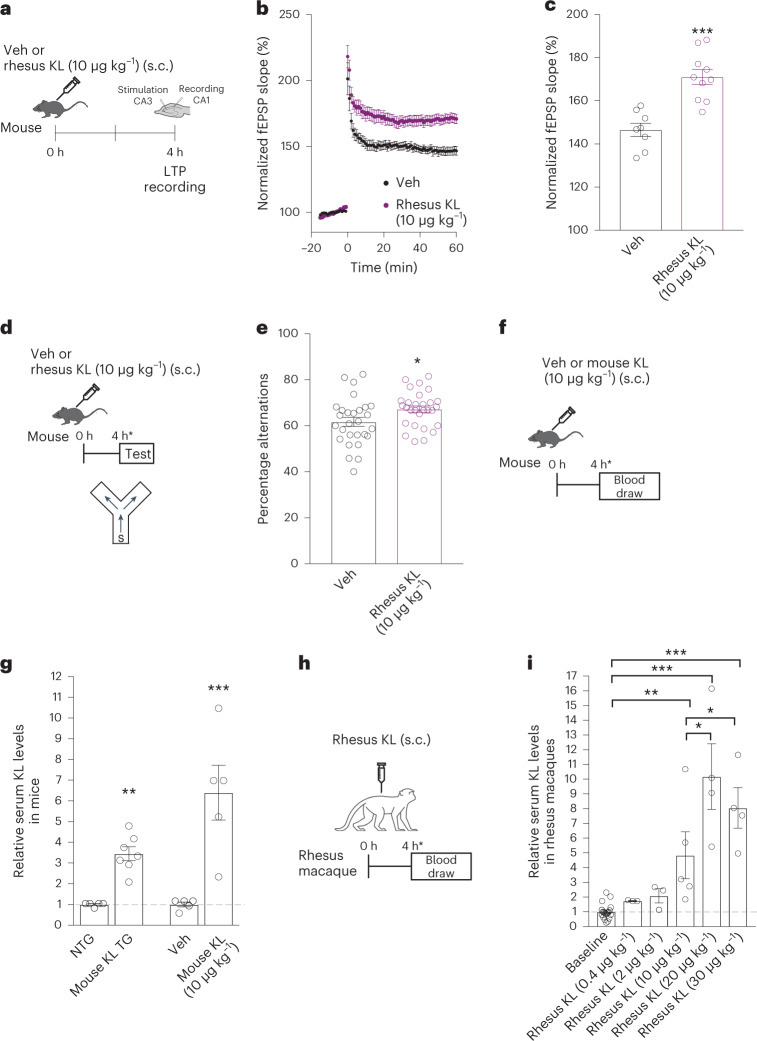
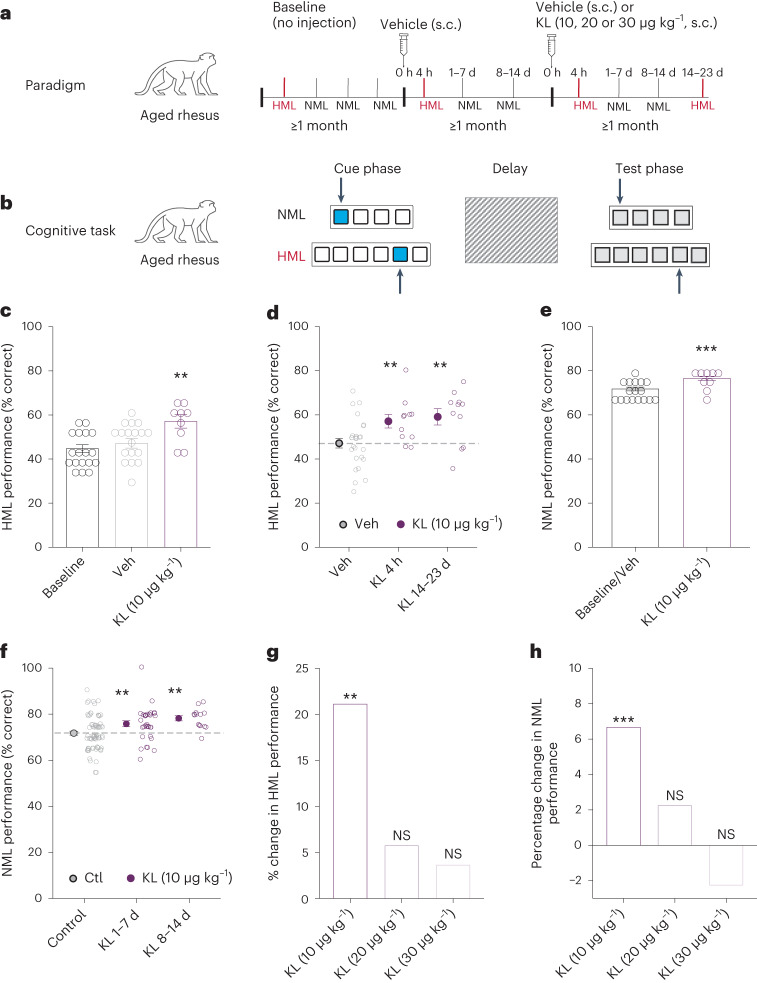
Cognitive dysfunction in aging is a major biomedical challenge. Whether treatment with klotho, a longevity factor, could enhance cognition in human-relevant models such as in nonhuman primates is unknown and represents a major knowledge gap in the path to therapeutics. We validated the rhesus form of the klotho protein in mice showing it increased synaptic plasticity and cognition. We then found that a single administration of low-dose, but not high-dose, klotho enhanced memory in aged nonhuman primates. Systemic low-dose klotho treatment may prove therapeutic in aging humans.
Overview
The claims and statistics of this paper haven’t been checked yet.
Free: it reads the open-access text and checks the first 5 claims that cite a source we can check. Create a free account to check every claim.
Integrity signals
Registry
Cites
Statistics
Figures


Verification
Claims the paper makes
The claims and statistics of this paper haven’t been checked yet.
Free: it reads the open-access text and checks the first 5 claims that cite a source we can check. Create a free account to check every claim.
Claims other papers make about this one
Each is checked against this paper’s own text: does it say what the citing paper says it does?
In the citing paper
“Moreover, the kidney is capable of secreting antiageing factors, such as klotho, which has been shown to enhance cognition and neural resilience. Furthermore, it has been observed that the level of kolotho decreases during the ageing process of the kidney.251,252”
From Antiageing strategy for neurodegenerative diseases: from mechanisms to clinical advances (2025) · cites this paper as [252]
In the citing paper
“Similarly, the cognitive benefits of klotho have recently been validated in aged nonhuman primates.252”
From Antiageing strategy for neurodegenerative diseases: from mechanisms to clinical advances (2025) · cites this paper as [252]
Self-check
Percentages, sums and reported differences re-computed from the paper’s own numbers.
The self-check needs the paper’s full text.
Citations
Cites
Fitting Linear Mixed-Effects Models Using lme4
Bates, D., Mächler, M., Bolker, B., & Walker, S. (2015) · Journal of Statistical Software · doi:10.18637/jss.v067.i01 · Cited by 86,835
Klotho converts canonical FGF receptor into a specific receptor for FGF23
Urakawa, I., Yamazaki, Y., Shimada, T., Iijima, K., Hasegawa, H., Okawa, K., Fujita, T., Fukumoto, S., & Yamashita, T. (2006) · Nature · doi:10.1038/nature05315 · Cited by 1,850
Evolutionary and biomedical insights from the rhesus macaque genome.
Gibbs, R. A., Rogers, J., Katze, M. G., Bumgarner, R., Weinstock, G. M., Mardis, E. R., Remington, K. A., Strausberg, R. L., Venter, J. C., Wilson, R. K., et al. (2007) · Science · doi:10.1126/science.1139247 · Cited by 1,403
The ageing cortical synapse: hallmarks and implications for cognitive decline
Morrison, J. H., & Baxter, M. G. (2012) · Nature Reviews Neuroscience · doi:10.1038/nrn3200 · Cited by 965
Self-citationAugmented Wnt signaling in a mammalian model of accelerated aging
Liu, H., Fergusson, M. M., Castilho, R. M., Liu, J., Cao, L., Chen, J., Malide, D., Rovira, I. I., Schimel, D., Kuo, C. J., et al. (2007) · Science · doi:10.1126/science.1143578 · Cited by 755
Yamazaki, Y., Imura, A., Urakawa, I., Shimada, T., Murakami, J., Aono, Y., Hasegawa, H., Yamashita, T., Nakatani, K., Saito, Y., et al. (2010) · Biochemical and Biophysical Research Communications · doi:10.1016/j.bbrc.2010.06.110 · Cited by 489
Neuronal basis of age-related working memory decline
Wang, M., Gamo, N. J., Yang, Y., Jin, L. E., Wang, X.-J., Laubach, M., Mazer, J. A., Lee, D., & Arnsten, A. F. T. (2011) · Nature · doi:10.1038/nature10243 · Cited by 485
Dumitriu, D., Hao, J., Hara, Y., Kaufmann, J., Janssen, W. G. M., Lou, W., Rapp, P. R., & Morrison, J. H. (2010) · The Journal of Neuroscience · doi:10.1523/jneurosci.6410-09.2010 · Cited by 439
Life Extension Factor Klotho Enhances Cognition
Dubal, D. B., Yokoyama, J. S., Zhu, L., Broestl, L., Worden, K., Wang, D., Sturm, V. E., Kim, D., Klein, E., Yu, G.-Q., et al. (2014) · Cell Reports · doi:10.1016/j.celrep.2014.03.076 · Cited by 321
Self-citationProtein kinase C overactivity impairs prefrontal cortical regulation of working memory
Birnbaum, S. G., Yuan, P. X., Wang, M., Vijayraghavan, S., Bloom, A. K., Davis, D. J., Gobeske, K. T., Sweatt, J. D., Manji, H. K., & Arnsten, A. F. T. (2004) · Science · doi:10.1126/science.1100021 · Cited by 318
Cited by
Molecular mechanisms of aging and anti-aging strategies
Li, Y., Tian, X., Luo, J., Bao, T., Wang, S., & Wu, X. (2024) · Cell Communication and Signaling · doi:10.1186/s12964-024-01663-1 · Cited by 293
Antiageing strategy for neurodegenerative diseases: from mechanisms to clinical advances
Jiang, Q., Liu, J., Huang, S., Wang, X.-Y., Chen, X., Liu, G.-H., Ye, K., Song, W., Masters, C. L., Wang, J., et al. (2025) · Signal Transduction and Targeted Therapy · doi:10.1038/s41392-025-02145-7 · Cited by 165
Park, C., Hahn, O., Gupta, S. K., Moreno, A. J., Marino, F., Kedir, B., Wang, D., Villeda, S., Wyss‐Coray, T., & Dubal, D. B. (2023) · Nature Aging · doi:10.1038/s43587-023-00468-0 · Cited by 136
Self-citationAnti-Inflammatory Role of the Klotho Protein and Relevance to Aging
Prud’homme, G. J., & Wang, Q. (2024) · Cells · doi:10.3390/cells13171413 · Cited by 87
Adeno-Associated Virus Vectors: Principles, Practices, and Prospects in Gene Therapy
Zwi‐Dantsis, L., Mohamed, S., Massaro, G., & Moeendarbary, E. (2025) · Viruses · doi:10.3390/v17020239 · Cited by 76
Metadata
- Authors
- Castner, S. A., Gupta, S., Wang, D., Moreno, A. J., Park, C., Chen, C., Poon, Y., Groen, A., Greenberg, K., David, N., Boone, T., Baxter, M. G., Williams, G. V., & Dubal, D. B.
- Affiliations
- Yale University (US)
- University of California, San Francisco (US)
- Unity Biotechnology (United States) (US)
- Newberry College (US)
- Wake Forest University Health Sciences (US)
- Corresponding author
- Dubal, Dena B.
- ORCID
- Venue
- Nature Aging
- Published
- 2023-07-03
- Volume
- 3
- Issue
- 8
- Pages
- 931-937
- ISSN
- 2662-8465 (ISSN-L)
- PMC
- PMC10432271
- OpenAlex
- W4382989585
- Cited by
- 114
- References
- 44
- Citations by year
- 2026: 27 · 2025: 37 · 2024: 40 · 2023: 10
- FWCI
- 23.21
- Type
- journal article
- Language
- en
- Open access
- hybrid
- doi.org
- Licence
- cc-by
- creativecommons.org/licenses/by/4.0 (tdm)
- creativecommons.org/licenses/by/4.0 (vor)
- Locations
- Nature Aging (publishedVersion, cc-by)
- PubMed Central (publishedVersion, cc-by)
- PubMed (publishedVersion)
- eScholarship (California Digital Library) (submittedVersion, cc-by)
- Funders
- University of Texas Southwestern Medical Center (P30DK079328)
- National Institutes of Health (AG034531)
- National Institute on Aging (K08AG034531)
- National Institute of Diabetes and Digestive and Kidney Diseases (P30DK079328)
- Topics
- Health Sciences › Medicine › Psychiatry and Mental health › Dementia and Cognitive Impairment Research
- Life Sciences › Neuroscience › Cellular and Molecular Neuroscience › Alzheimer's disease research and treatments
- Life Sciences › Biochemistry, Genetics and Molecular Biology › Aging › Genetics, Aging, and Longevity in Model Organisms
- Keywords
- Klotho, longevity factors, cognitive aging, memory enhancement, synaptic plasticity, rhesus monkeys
- MeSH terms
- Aged, Aging, Animals, Cognition, Glucuronidase, Humans, Longevity, Primates, Mice
About these checks
Registry, retraction, Cites and statistics results are computed, not judged, with one exception: a printed reference that no index lists is read once by a model before it counts as a citation error. Claims are extracted by a model and kept only when their quote appears verbatim in the text; each cited source is then checked, with a model’s help, for whether it says what the claim relies on. Those verdicts can be wrong — read the claim’s quote and the cited source before relying on one.
Statistics and arithmetic are recomputed, not judged.
Confidence bands are shown only for fields calibrated on our annotated test set. None is calibrated yet, so no band is shown.
What counts as a claim ›How we measure confidence ›How we check this ›
Are you an author, or do you see a problem with this page? Request a review
How to cite
Cite CoChat for the checks on this page, and the paper for its own findings.
- This page
- CoChat. (2026). Citation check: Longevity factor klotho enhances cognition in aged nonhuman primates. https://app.cochat.ai/papers/10.1038/s43587-023-00441-x
- The paper
- Castner, S. A., Gupta, S., Wang, D., Moreno, A. J., Park, C., Chen, C., Poon, Y., Groen, A., Greenberg, K., David, N., Boone, T., Baxter, M. G., Williams, G. V., & Dubal, D. B. (2023). Longevity factor klotho enhances cognition in aged nonhuman primates. Nature Aging. https://doi.org/10.1038/s43587-023-00441-x
Data sources
Bibliographic data: Semantic Scholar, OpenAlex, Crossref.
Contains information from the Semantic Scholar Academic Graph Datasets, made available under the ODC Attribution License (ODC-BY 1.0).
Semantic Scholar’s data is described in: Kinney, R., et al. (2023). The Semantic Scholar Open Data Platform. arXiv:2301.10140.
