

Longevity factor klotho enhances cognition in aged nonhuman primates
Open accessThe DOI matches its Crossref record; 45 of the 45 references it cites were found in a registry or an index.
Abstract
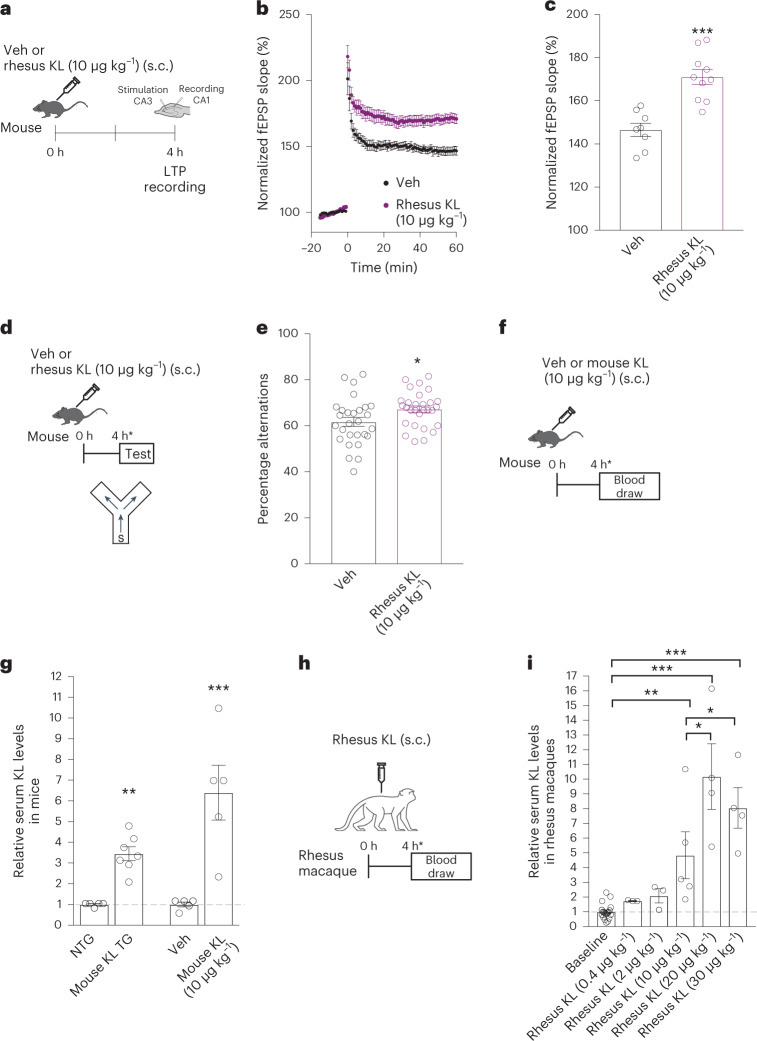
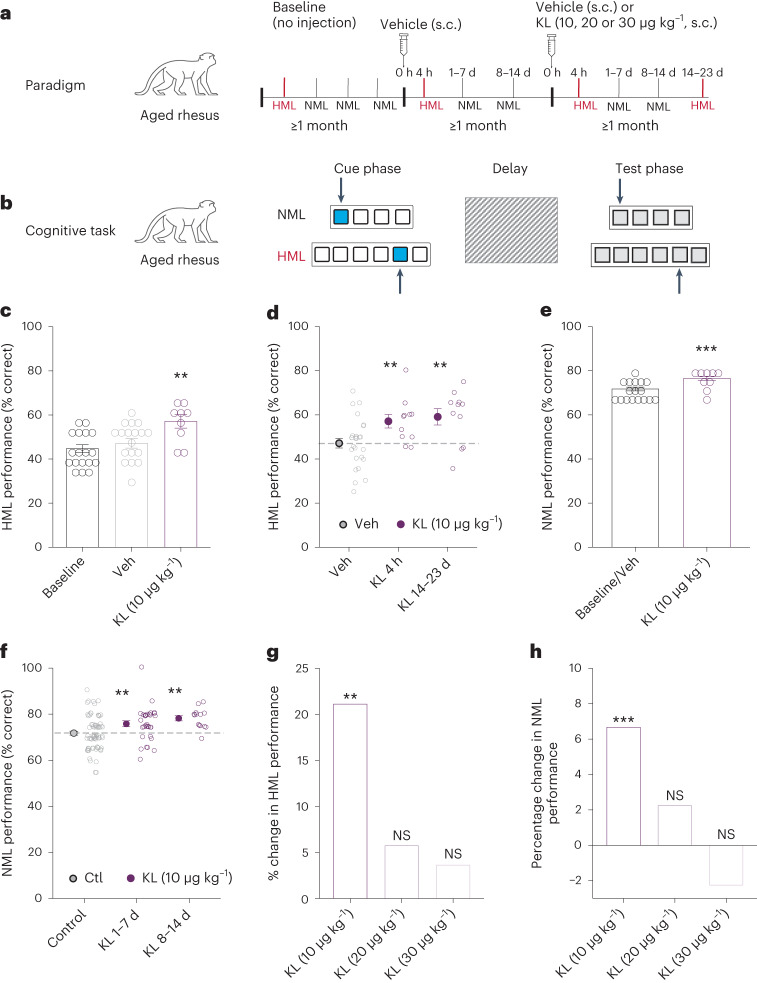
Cognitive dysfunction in aging is a major biomedical challenge. Whether treatment with klotho, a longevity factor, could enhance cognition in human-relevant models such as in nonhuman primates is unknown and represents a major knowledge gap in the path to therapeutics. We validated the rhesus form of the klotho protein in mice showing it increased synaptic plasticity and cognition. We then found that a single administration of low-dose, but not high-dose, klotho enhanced memory in aged nonhuman primates. Systemic low-dose klotho treatment may prove therapeutic in aging humans.
Overview
The claims and statistics of this paper haven’t been checked yet.
Free: it reads the open-access text and checks the first 5 claims that cite a source we can check. Create a free account to check every claim.
Integrity signals
Registry
Cites
Statistics
Figures
Verification
Claims the paper makes
The claims and statistics of this paper haven’t been checked yet.
Free: it reads the open-access text and checks the first 5 claims that cite a source we can check. Create a free account to check every claim.
Claims other papers make about this one
Each is checked against this paper’s own text: does it say what the citing paper says it does?
In the citing paper
“Moreover, the kidney is capable of secreting antiageing factors, such as klotho, which has been shown to enhance cognition and neural resilience. Furthermore, it has been observed that the level of kolotho decreases during the ageing process of the kidney.251,252”
From Antiageing strategy for neurodegenerative diseases: from mechanisms to clinical advances (2025) · cites this paper as [252]
In the citing paper
“Similarly, the cognitive benefits of klotho have recently been validated in aged nonhuman primates.252”
From Antiageing strategy for neurodegenerative diseases: from mechanisms to clinical advances (2025) · cites this paper as [252]
Self-check
Percentages, sums and reported differences re-computed from the paper’s own numbers.
The self-check needs the paper’s full text.
Citations
Cites
Fitting Linear Mixed-Effects Models Using lme4
Bates, D., Mächler, M., Bolker, B., & Walker, S. (2015) · Journal of Statistical Software · doi:10.18637/jss.v067.i01 · Cited by 86,835
Klotho converts canonical FGF receptor into a specific receptor for FGF23
Urakawa, I., Yamazaki, Y., Shimada, T., Iijima, K., Hasegawa, H., Okawa, K., Fujita, T., Fukumoto, S., & Yamashita, T. (2006) · Nature · doi:10.1038/nature05315 · Cited by 1,850
Evolutionary and biomedical insights from the rhesus macaque genome.
Gibbs, R. A., Rogers, J., Katze, M. G., Bumgarner, R., Weinstock, G. M., Mardis, E. R., Remington, K. A., Strausberg, R. L., Venter, J. C., Wilson, R. K., et al. (2007) · Science · doi:10.1126/science.1139247 · Cited by 1,403
The ageing cortical synapse: hallmarks and implications for cognitive decline
Morrison, J. H., & Baxter, M. G. (2012) · Nature Reviews Neuroscience · doi:10.1038/nrn3200 · Cited by 965
Self-citationAugmented Wnt signaling in a mammalian model of accelerated aging
Liu, H., Fergusson, M. M., Castilho, R. M., Liu, J., Cao, L., Chen, J., Malide, D., Rovira, I. I., Schimel, D., Kuo, C. J., et al. (2007) · Science · doi:10.1126/science.1143578 · Cited by 755
Yamazaki, Y., Imura, A., Urakawa, I., Shimada, T., Murakami, J., Aono, Y., Hasegawa, H., Yamashita, T., Nakatani, K., Saito, Y., et al. (2010) · Biochemical and Biophysical Research Communications · doi:10.1016/j.bbrc.2010.06.110 · Cited by 489
Neuronal basis of age-related working memory decline
Wang, M., Gamo, N. J., Yang, Y., Jin, L. E., Wang, X.-J., Laubach, M., Mazer, J. A., Lee, D., & Arnsten, A. F. T. (2011) · Nature · doi:10.1038/nature10243 · Cited by 485
Dumitriu, D., Hao, J., Hara, Y., Kaufmann, J., Janssen, W. G. M., Lou, W., Rapp, P. R., & Morrison, J. H. (2010) · The Journal of Neuroscience · doi:10.1523/jneurosci.6410-09.2010 · Cited by 439
Life Extension Factor Klotho Enhances Cognition
Dubal, D. B., Yokoyama, J. S., Zhu, L., Broestl, L., Worden, K., Wang, D., Sturm, V. E., Kim, D., Klein, E., Yu, G.-Q., et al. (2014) · Cell Reports · doi:10.1016/j.celrep.2014.03.076 · Cited by 321
Self-citationProtein kinase C overactivity impairs prefrontal cortical regulation of working memory
Birnbaum, S. G., Yuan, P. X., Wang, M., Vijayraghavan, S., Bloom, A. K., Davis, D. J., Gobeske, K. T., Sweatt, J. D., Manji, H. K., & Arnsten, A. F. T. (2004) · Science · doi:10.1126/science.1100021 · Cited by 318
Cited by
Items 101–114 of 114
Robertson, O. C., Parker, E. S., Henschel, B., Macagno, A. L. M., Kpormegbey, D. E., Thapa, D. K., & Allison, D. B. (2026) · Journal of Robustness Reports · doi:10.21468/jrobustrep.2-rr1
Ding, Z., Zhou, N., Luo, X., Luo, J., Hao, W., Zhang, C., Jin, X., & Zhao, D. (2026) · BMC Nephrology · doi:10.1186/s12882-026-04940-y · Cited by 1
Luthra, N., Bonham, L. W., Moreno, A. J., Park, C., Huguenard, C. J. C., Abdulai-Saiku, S., Gupta, S., Lin, J. Y., Broestl, L., Bétourné, A., et al. (2026) · Journal of Neuroscience · doi:10.1523/jneurosci.1904-25.2026 · Cited by 2
“Klothoimprovescognitioninyoungandoldmice(Dubalet al.,2014;Dubaletal.,2015;Leonetal.,2017;Guptaetal.,2022; Castneretal.,2023),oldnonhumanprimates(Castneretal., 2023),andmousemodelsofAlzheimer ’ s disease (AD; Dubal et al., 2015; Zeng et al., 2019; Zhao et al., 2020).”
Self-citationZhan, J., Li, Y., Jiang, F.-H., Wang, H., Huang, Y., Zhan, H.-Y., Xu, X., Liao, D., Zhang, J., Chen, L., et al. (2026) · Journal of Neurochemistry · doi:10.1111/jnc.70456 · Cited by 1
“A study from the University of California has demonstrated that a single systemic administration of low-dose klotho rapidly and long-lastingly enhanced cognitive behaviors in the spatial delayed response task in aged nonhuman primate rhesus (Castner et al. 2023).”
Cui, Y., Zhou, J., Lin, H., Li, J., Shi, Z., Li, X., Wu, Z., Dong, J., & Zhu, K. (2026) · Journal of medicine and health science. · doi:10.62517/jmhs.202605125
Yu, X., Zhang, M., Deng, S., Shi, J., Wei, M., Zhang, L., Zhu, S., Zhou, X., & Zhu, X. (2026) · Aging advances. · doi:10.4103/agingadv.agingadv-d-25-00045
Hu, W., Kong, Y., & Wang, J. (2026) · Frontiers in Aging Neuroscience · doi:10.3389/fnagi.2026.1838285
Oh, T. J., Kumagai, H., Yen, K., Crimmins, E. M., Arpawong, T. E., & Cohen, P. (2026) · Journal of the Endocrine Society · doi:10.1210/jendso/bvag143
“A recent attempt to test the therapeutic potential showed that Klotho protein administration improved memory in old rhesus monkeys [5].”
Rodrigues, B. A., Silva, J. D. N., Andreotti, D. Z., Lima, T. A. D. S., Scavone, C., & Kawamoto, E. M. (2026) · Discover Neuroscience · doi:10.1186/s13064-026-00304-2
“Although the literature describes a positive correlation between Klotho levels and improved cognitive function [84–87], our findings demonstrate that despite the increase in this protein in the frontal cortex, animals exposed to VPA exhibited significant behavioral deficits.”
Innovations in chronic kidney disease and aging
Fadem, S. Z. (2026) · Elsevier eBooks · doi:10.1016/b978-0-443-34069-7.00031-8
Du, X., Shen, Z., Xu, Y., Song, W., Guo, Y., Kou, J., Gong, S., & Ren, Q. (2026) · Biogerontology · doi:10.1007/s10522-026-10484-3
“…endothelial homeostasis, the longevity-associated protein Klotho exerts protective effects against vascular aging by enhancing antioxidant defenses via the Nrf2/ARE pathway and preserving NO bioavailability, thereby alleviating vascular dysfunction and cognitive decline (Castner et al. 2023).”
Liu, D., Ma, H., Yang, M., Yang, H., Yanling, S., Desta, S. W., Liu, Y., & Du, X. (2026) · Frontiers in Psychiatry · doi:10.3389/fpsyt.2026.1918894
Wang, G., Hiramoto, K., Ma, N., Ohnishi, S., Yoshikawa, N., Murata, M., & Kawanishi, S. (2026) · International Journal of Molecular Sciences · doi:10.3390/ijms27167399
“…AD progression. α -Klotho, a longevity factor, declines with aging, and its peripheral administration improved cognitive function in aged mice [2]. α -Klotho has several beneficial effects against brain aging, including reduction in oxidative stress, modulation of inflammatory responses, and…”
Metadata
- Authors
- Castner, S. A., Gupta, S., Wang, D., Moreno, A. J., Park, C., Chen, C., Poon, Y., Groen, A., Greenberg, K., David, N., Boone, T., Baxter, M. G., Williams, G. V., & Dubal, D. B.
- Affiliations
- Yale University (US)
- University of California, San Francisco (US)
- Unity Biotechnology (United States) (US)
- Newberry College (US)
- Wake Forest University Health Sciences (US)
- Corresponding author
- Dubal, Dena B.
- ORCID
- Venue
- Nature Aging
- Published
- 2023-07-03
- Volume
- 3
- Issue
- 8
- Pages
- 931-937
- ISSN
- 2662-8465 (ISSN-L)
- PMC
- PMC10432271
- OpenAlex
- W4382989585
- Semantic Scholar
- 51e55a313ff5ef48c10b474364fa2fd7b64f8010
- Cited by
- 114
- References
- 44
- Citations by year
- 2026: 27 · 2025: 37 · 2024: 40 · 2023: 10
- FWCI
- 23.21
- Type
- journal article
- Language
- en
- Open access
- hybrid
- doi.org
- Licence
- cc-by
- creativecommons.org/licenses/by/4.0 (tdm)
- creativecommons.org/licenses/by/4.0 (vor)
- Locations
- Nature Aging (publishedVersion, cc-by)
- PubMed Central (publishedVersion, cc-by)
- PubMed (publishedVersion)
- eScholarship (California Digital Library) (submittedVersion, cc-by)
- Funders
- University of Texas Southwestern Medical Center (P30DK079328)
- National Institutes of Health (AG034531)
- National Institute on Aging (K08AG034531)
- National Institute of Diabetes and Digestive and Kidney Diseases (P30DK079328)
- Topics
- Health Sciences › Medicine › Psychiatry and Mental health › Dementia and Cognitive Impairment Research
- Life Sciences › Neuroscience › Cellular and Molecular Neuroscience › Alzheimer's disease research and treatments
- Life Sciences › Biochemistry, Genetics and Molecular Biology › Aging › Genetics, Aging, and Longevity in Model Organisms
- Keywords
- Klotho, longevity factors, cognitive aging, memory enhancement, synaptic plasticity, rhesus monkeys
- MeSH terms
- Aged, Aging, Animals, Cognition, Glucuronidase, Humans, Longevity, Primates, Mice
About these checks
Registry, retraction, Cites and statistics results are computed, not judged, with one exception: a printed reference that no index lists is read once by a model before it counts as a citation error. Claims are extracted by a model and kept only when their quote appears verbatim in the text; each cited source is then checked, with a model’s help, for whether it says what the claim relies on. Those verdicts can be wrong — read the claim’s quote and the cited source before relying on one.
Statistics and arithmetic are recomputed, not judged.
Confidence bands are shown only for fields calibrated on our annotated test set. None is calibrated yet, so no band is shown.
What counts as a claim ›How we measure confidence ›How we check this ›
Are you an author, or do you see a problem with this page? Request a review
Data sources
Bibliographic data: Semantic Scholar, OpenAlex, Crossref.
Contains information from the Semantic Scholar Academic Graph Datasets, made available under the ODC Attribution License (ODC-BY 1.0).
Semantic Scholar’s data is described in: Kinney, R., et al. (2023). The Semantic Scholar Open Data Platform. arXiv:2301.10140.
