

The future landscape of large language models in medicine
Open accessThe DOI matches its Crossref record; 70 of the 70 references it cites were found in a registry or an index; 35 of the 78 sources its claims cite were checked for support.
Abstract
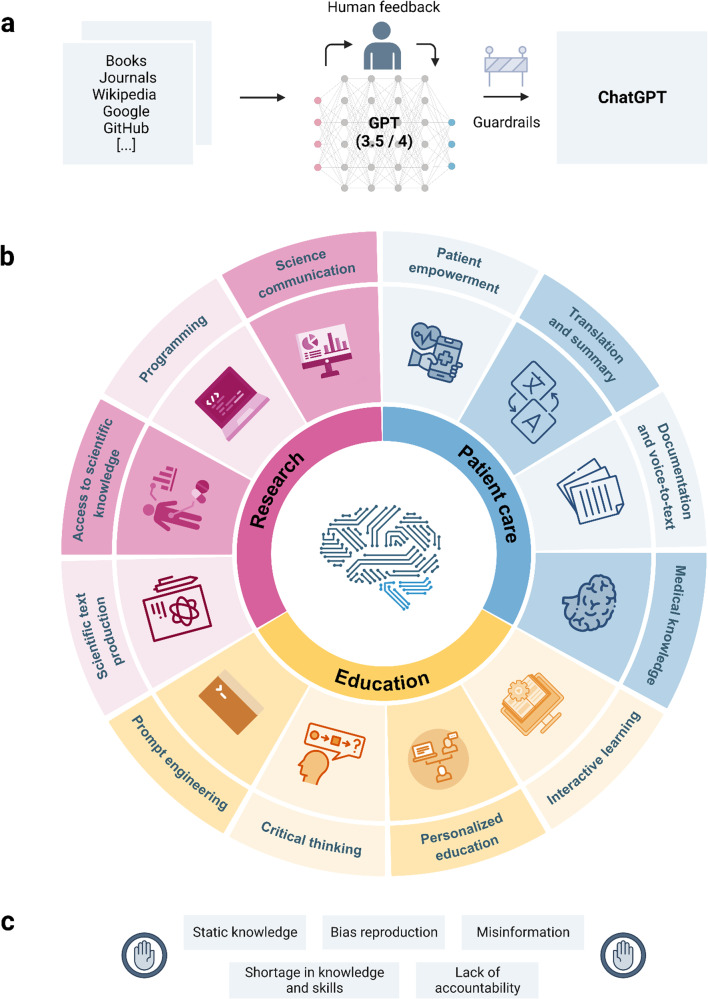
Large language models (LLMs) are artificial intelligence (AI) tools specifically trained to process and generate text. LLMs attracted substantial public attention after OpenAI’s ChatGPT was made publicly available in November 2022. LLMs can often answer questions, summarize, paraphrase and translate text on a level that is nearly indistinguishable from human capabilities. The possibility to actively interact with models like ChatGPT makes LLMs attractive tools in various fields, including medicine. While these models have the potential to democratize medical knowledge and facilitate access to healthcare, they could equally distribute misinformation and exacerbate scientific misconduct due to a lack of accountability and transparency. In this article, we provide a systematic and comprehensive overview of the potentials and limitations of LLMs in clinical practice, medical research and medical education.
Overview
CoChat Summary
TL;DR
This review surveys how large language models (LLMs) may affect patient care, medical research, and medical education, emphasizing both their capabilities and their risks. It argues that LLMs could democratize medical knowledge and assist communication, documentation, research, and teaching, but current limitations in factuality, bias, accountability, transparency, and reproducibility must be addressed before clinical use.
Key findings
- LLMs can augment patient care through medical knowledge and reasoning, translations, summaries, and documentation; GPT-4 “now exceeds the passing score on every step of the US-medical licensing exam (USMLE),” and documentation/administrative requirements consume around 25% of clinicians’ workdays.
- In medical research, LLMs can summarize evidence, generate scientific abstracts that humans struggle to differentiate from human-written ones, and assist with coding, but outputs currently require significant human revision and LLMs do not always provide appropriate detailed summaries or critical appraisals of up-to-date, high-quality, peer-reviewed evidence.
- In medical education, LLMs can serve as personalized teaching assistants, simplify complex concepts, and simulate patient conversations, but they risk decreasing critical thinking and creativity and may lead to “externalization of medical reasoning.”
- Ethical and safety concerns include misinformation, data privacy and leakage, prompt injection attacks, lack of public training datasets and source code, commercial monopolies, and reproducibility problems due to model version changes; the authors observed substantial differences between GPT-3.5 and GPT-4 prompted queries and minor changes across GPT-3.5 versions.
Methods
- Narrative review/overview; the abstract describes it as a “systematic and comprehensive overview of the potentials and limitations of LLMs in clinical practice, medical research and medical education.”
- No primary data, sample, or formal quantitative analysis are reported; illustrative model outputs were generated using ChatGPT (GPT-4—May 3, 2023; GPT-3.5—May 3, 2023) and additional examples are in Supplementary Data.
- The main analysis is a qualitative synthesis across patient care, medical research, and medical education, with example prompts and outputs used to illustrate capabilities and limitations.
Limitations
- Stated by the paper: LLMs reproduce existing biases, hallucinate false information, spread misinformation, lack accountability, and currently have no mechanisms to ensure output correctness; their knowledge is static, reproducibility is compromised by model updates or access restrictions, training datasets and source code are often not public, and development is driven primarily by commercial companies.
- Stated by the paper: safety guardrails can themselves pose limitations, for example if bias prevention leads to different symptoms in men and women being overlooked.
- Evident from the text: despite being described as “systematic,” no formal systematic review methodology, search strategy, inclusion criteria, or data extraction process is reported, and the illustrative examples are limited to selected ChatGPT versions rather than a comprehensive empirical evaluation.
Model-written summary. Check it against the paper before relying on it.
Integrity signals
Registry
Cites
Statistics
Figures
Verification
Claims the paper makes
16 Valid · 3 Not valid · 21 Not checked · 36 Own results and interpretations
The cited sources support only part of this claim — read each source’s verdict below.
In the paper
“Through their text simplification capabilities33, LLMs may improve communication between healthcare staff and patients34.”
§ The future landscape of large language models in medicine > Patient care > Medical knowledge and medical core competencies
What the sources say
- Partly supportedcites [33] Devaraj, A., Marshall, I., Wallace, B. & Li, J. J. Paragraph-level simplification of medical texts. In Proc. 2021 Conference of the North American Chapter of the Association for Computational Linguistics: Human Language Technologies, 4972–4984. 10.18653/v1/2021.naacl-main.395 (Association for Computational Linguistics, 2021). PMC9161242 35663507 sourceExperimental — accuracy not yet measured
The Introduction (page unavailable) says automatic simplification may make specialist medical information accessible to a wider audience, and the Conclusions report simpler model outputs. The paper does not examine communication between healthcare staff and patients, so it supports the proposed mechanism but not that specific application. (LLM, conf=0.83)
- Supportedcites [34] Ayers, J. W. et al. Comparing physician and artificial intelligence Chatbot responses to patient questions posted to a public social media forum. JAMA Intern. Med. 10.1001/jamainternmed.2023.1838 (2023). PMC10148230 37115527 source
The Discussion says chatbots could assist clinicians in messaging patients by drafting replies and could help staff improve their communication skills. The citing sentence attaches a separate citation to text simplification; this paper supports the hedged communication claim attributed to it. (LLM, conf=0.90)
hedgedstates a possible cause- Asserted: passes — The authors put it forward as true.
- Checkable: passes — It can be checked against evidence.
- Load-bearing: unclear — It is unclear whether the paper’s conclusions depend on it.
- Based: passes — The paper gives a reason why it holds.
- Partly supported
The cited sources support only part of this claim — read each source’s verdict below.
In the paper
“GPT-4 thus far demonstrates the highest medical domain knowledge of LLMs to date5.”
§ The future landscape of large language models in medicine > Patient care > Medical knowledge and medical core competencies
What the sources say
- Partly supportedcites [5] Nori, H., King, N., McKinney, S. M., Carignan, D. & Horvitz, E. Capabilities of GPT-4 on medical challenge problems. Preprint at arXiv10.48550/arXiv.2303.13375 (2023). sourceExperimental — accuracy not yet measured
The Abstract (p. 1) reports that GPT-4 outperformed GPT-3.5 and a medically tuned model on medical examinations and benchmarks. The Conclusion (p. 22) says it outperformed Flan-PaLM 540B on all but one MultiMedQA dataset. These comparisons support strong medical-benchmark performance, but not the unqualified claim that GPT-4 had the highest medical domain knowledge of all LLMs to date. (LLM, conf=0.86)
boosted- Asserted: passes — The authors put it forward as true.
- Checkable: passes — It can be checked against evidence.
- Load-bearing: unclear — It is unclear whether the paper’s conclusions depend on it.
- Based: passes — The paper gives a reason why it holds.
- Partly supported
The cited sources support only part of this claim — read each source’s verdict below.
In the paper
“Technical options to overcome limitations in factuality and mitigate (bias-related) harms can generally be implemented throughout the entire development process of LLMs.”
§ The future landscape of large language models in medicine > Ethical use and misinformation
What the sources say
- Partly supportedcites [33] Devaraj, A., Marshall, I., Wallace, B. & Li, J. J. Paragraph-level simplification of medical texts. In Proc. 2021 Conference of the North American Chapter of the Association for Computational Linguistics: Human Language Technologies, 4972–4984. 10.18653/v1/2021.naacl-main.395 (Association for Computational Linguistics, 2021). PMC9161242 35663507 sourceExperimental — accuracy not yet measured
The Ethical Considerations section says hallucinations in generated medical summaries can misinform readers and recommends examining outputs before use. That supports a limited way to address factuality harms, but the paper does not discuss bias-related harms or establish that technical options can be implemented throughout the entire LLM development process. (LLM, conf=0.79)
- Not checked yetcites [64] Kumar, S., Balachandran, V., Njoo, L., Anastasopoulos, A. & Tsvetkov, Y. Language generation models can cause harm: so what can we do about it? An actionable survey. In Proc. 17th Conference of the European Chapter of the Association for Computational Linguistics, 3299–3321 (Association for Computational Linguistics, 2023). source
- Not checked yetcites [65] Ma, Y., Seneviratne, S. & Daskalaki, E. Improving text simplification with factuality error detection. In Proc. Workshop on Text Simplification, Accessibility, and Readability (TSAR–2022), 173–178 (Association for Computational Linguistics, 2022). source
- Partly supportedcites [66] Devaraj, A., Sheffield, W., Wallace, B. & Li, J. J. Evaluating factuality in text simplification. In Proc. 60th Annual Meeting of the Association for Computational Linguistics (Volume 1: Long Papers), 7331–7345. 10.18653/v1/2022.acl-long.506 (Association for Computational Linguistics, 2022). PMC9671157 36404800 sourceExperimental — accuracy not yet measured
The Qualitative Analysis section suggests including document context or decontextualizing text before simplification, and the Conclusion describes work on automatic factuality assessment. These support technical approaches to factuality in text simplification, but the paper does not establish that options can be implemented throughout LLM development or address mitigation of bias-related harms. The cited passages provide no page numbers. (LLM, conf=0.78)
- Partly supportedcites [67] Fleisig, E. et al. FairPrism: evaluating fairness-related harms in text generation. In Proc. 61st Annual Meeting of the Association for Computational Linguistics (Volume 1: Long Papers), 6231–6251 (Association for Computational Linguistics, 2023). sourceExperimental — accuracy not yet measured
The Recommendations (p. 8) describe ways to improve datasets for measuring and mitigating harms in AI-generated text. They do not address factuality or say that technical options can be implemented throughout the entire LLM development process; the paper's supported point is narrower. (LLM, conf=0.85)
- Not checked yetcites [68] Sha, L., Li, Y., Gasevic, D. & Chen, G. Bigger data or fairer data? Augmenting BERT via active sampling for educational text classification. In Proc. 29th International Conference on Computational Linguistics, 1275–1285 (International Committee on Computational Linguistics, 2022).
plain- Asserted: passes — The authors put it forward as true.
- Checkable: passes — It can be checked against evidence.
- Load-bearing: unclear — It is unclear whether the paper’s conclusions depend on it.
- Based: passes — The paper gives a reason why it holds.
- Partly supported
Every source the paper cites for this claim was checked and supports it.
In the paper
“Lastly, to date, the development of LLMs has been driven primarily by commercial companies such as OpenAI/Microsoft21, Meta24, and Google2.”
§ The future landscape of large language models in medicine > Ethical use and misinformation
What the sources say
- Supportedcites [21] OpenAI. GPT-4 Technical Report. Preprint at arXiv10.48550/arXiv.2303.08774 (2023). source
The citation is attached to OpenAI/Microsoft as an example, rather than to the claims about Meta or Google. The report identifies GPT-4 as a model developed by OpenAI (Abstract, p. 1) and credits Microsoft Azure with supporting its training infrastructure (Authorship & credit attribution, p. 17). (LLM, conf=0.88)
- Supportedcites [24] Touvron, H. et al. LLaMA: open and efficient foundation language models. Preprint at arXiv10.48550/arXiv.2302.13971 (2023). source
The citation is attached to Meta in a list of companies developing LLMs. The title page (p. 1) identifies the LLaMA authors as Meta AI, and the Abstract (p. 1) says they developed the LLaMA foundation language models. This supports Meta as an example; this citation need not establish the sentence’s broader claim about who primarily drives LLM development. (LLM, conf=0.91)
- Supportedcites [2] Singhal, K. et al. Large language models encode clinical knowledge. Nature620, 172–180 (2023). PMC10396962 37438534 source
The citation is attached specifically to Google as an example of an LLM developer. The Methods > Modelling section describes the authors building Med-PaLM from PaLM and Flan-PaLM, supporting that example; it does not establish the separate, broader assertion that commercial companies primarily drive LLM development. (LLM, conf=0.86)
plainstates a cause- Asserted: passes — The authors put it forward as true.
- Checkable: passes — It can be checked against evidence.
- Load-bearing: passes — The paper’s conclusions depend on it.
- Based: passes — The paper gives a reason why it holds.
- Supported
The cited sources support only part of this claim — read each source’s verdict below.
In the paper
“as misconceived prompts may result in biases or misinformation with potentially serious consequences4.”
§ The future landscape of large language models in medicine > Medical education > Education about LLMs
What the sources say
- Partly supportedcites [4] Binz M Schulz E Using cognitive psychology to understand GPT-3 Proc. Natl Acad. Sci. USA 2023 120 e2218523120 10.1073/pnas.2218523120 36730192 PMC9963545 sourceExperimental — accuracy not yet measured
In Results, under “Problems with vignette-based investigations” (page unavailable), the paper reports that slightly modified prompts produced incorrect or contradictory GPT-3 answers. This supports the possibility that poorly framed prompts yield misleading responses, but the cited passages do not establish that such responses have potentially serious consequences. (LLM, conf=0.84)
hedgedstates a possible cause- Asserted: passes — The authors put it forward as true.
- Checkable: passes — It can be checked against evidence.
- Load-bearing: passes — The paper’s conclusions depend on it.
- Based: passes — The paper gives a reason why it holds.
- Partly supported
23 more claims
Create a free account to see all 76 claims and to verify the 43 references still open.
- It may state two separate claims as one. 31
- Probably not a substantial claim. 29
Claims other papers make about this one
Each is checked against this paper’s own text: does it say what the citing paper says it does?
The source backs part of the claim, not all of it — or backs it for a different population, condition or comparison.
In the citing paper
“Further to this, there is potential for these LLM-based applications to reduce medical errors and capturing missed information by providing a layer of scrutiny when embedded in EHRs [45].”
From Generative AI in healthcare: an implementation science informed translational path on application, integration and governance (2024) · cites this paper as [45]
Experimental — accuracy not yet measuredThe source backs part of the claim, not all of it — or backs it for a different population, condition or comparison.
In the citing paper
“Use cases like workflow and documentation automation, personalized predictive analytics, and patient education chatbots confirm vast potential [26, 41, 45], provided the technology supports rather than supplants human expertise.”
From Generative AI in healthcare: an implementation science informed translational path on application, integration and governance (2024) · cites this paper as [45]
Experimental — accuracy not yet measuredThe source backs part of the claim, not all of it — or backs it for a different population, condition or comparison.
In the citing paper
“Large language models (LLMs) have been shown to interpret complex clinical situations and offer recommendations, from differential diagnoses to care management, leading to growing interest in their application in the medical field [13-16].”
From Identifying Deprescribing Opportunities With Large Language Models in Older Adults: Retrospective Cohort Study (2025) · cites this paper as [13]
Experimental — accuracy not yet measuredThe source backs part of the claim, not all of it — or backs it for a different population, condition or comparison.
In the citing paper
“they lack the nuanced understanding, empathy, and ethical reasoning inherent to human practitioners [19].”
From Mitigating cognitive biases in clinical decision-making through multi-agent conversations using large language models: simulation study (2024) · cites this paper as [19]
Experimental — accuracy not yet measuredThe source backs part of the claim, not all of it — or backs it for a different population, condition or comparison.
In the citing paper
“While we recognize that these issues are affected by the use of LLMs in significant ways6,98,99 these, challenges are not specific to health-related applications.”
From The ethics of ChatGPT in medicine and healthcare: a systematic review on large language models (LLMs) (2024) · cites this paper as [6]
Experimental — accuracy not yet measured
5 more claims about this paper
Create a free account to see every claim other papers make about this one.
Citations
Cites
BERT: Pre-training of Deep Bidirectional Transformers for Language Understanding
Devlin, J., Chang, M.-W., Lee, K., & Toutanova, K. (2019) · Proceedings of the 2019 Conference of the North American Chapter of the Association for Computational Linguistics: Human Language Technologies, Volume 1 (Long and Short Papers) · doi:10.18653/v1/n19-1423 · Cited by 54,325
BioBERT: a pre-trained biomedical language representation model for biomedical text mining
Lee, J., Yoon, W., Kim, S., Kim, D., Kim, S., So, C. H., & Kang, J. (2020) · Bioinformatics · doi:10.1093/bioinformatics/btz682 · Cited by 7,218
LLaMA: Open and Efficient Foundation Language Models
Touvron, H., Lavril, T., Izacard, G., Martinet, X., Lachaux, M.-A., Lacroix, T., Rozière, B., Goyal, N., Hambro, E., Azhar, F., et al. (2023) · arXiv · doi:10.48550/arxiv.2302.13971 · Cited by 4,602 · cited 5×
“this was followed by the release of other LLMs from companies such as Google and Meta 2,15 – 17 .”
MethodInfluentialKung, T. H., Cheatham, M., Medenilla, A., Sillos, C., De Leon, L., Elepaño, C., Madriaga, M., Aggabao, R., Diaz-Candido, G., Maningo, J., et al. (2023) · PLOS Digital Health · doi:10.1371/journal.pdig.0000198 · Cited by 4,115 · cited 3×
“Nonetheless, using LLMs for scienti fi c writing currently requires signi fi cant revisions by human authors due to inaccurate, shallow and repetitive outputs (Supplementary Data, example 6).”
BackgroundMethodKung, T. H., Cheatham, M., ChatGPT, Medenilla, A., Sillos, C., De Leon, L., Elepaño, C., Madriaga, M., Aggabao, R., Diaz-Candido, G., et al. (2022) · doi:10.1101/2022.12.19.22283643 · Cited by 4,115
Large language models encode clinical knowledge
Singhal, K., Azizi, S., Tu, T., Mahdavi, S. S., Wei, J., Chung, H. W., Scales, N., Tanwani, A., Cole-Lewis, H., Pfohl, S., et al. (2023) · Nature · doi:10.1038/s41586-023-06291-2 · Cited by 4,083
Large Language Models Encode Clinical Knowledge
Singhal, K., Azizi, S., Tu, T., Mahdavi, S. S., Wei, J., Chung, H. W., Scales, N., Tanwani, A., Cole-Lewis, H., Pfohl, S., et al. (2022) · arXiv · doi:10.48550/arxiv.2212.13138 · Cited by 4,083
SciBERT: A Pretrained Language Model for Scientific Text
Beltagy, I., Lo, K., & Cohan, A. (2019) · Proceedings of the 2019 Conference on Empirical Methods in Natural Language Processing and the 9th International Joint Conference on Natural Language Processing (EMNLP-IJCNLP) · doi:10.18653/v1/d19-1371 · Cited by 3,218
Sallam, M. (2023) · Healthcare · doi:10.3390/healthcare11060887 · Cited by 3,126
Ayers, J. W., Poliak, A., Dredze, M., Leas, E. C., Zhu, Z., Kelley, J. B., Faix, D. J., Goodman, A. M., Longhurst, C. A., Hogarth, M., et al. (2023) · JAMA Internal Medicine · doi:10.1001/jamainternmed.2023.1838 · Cited by 2,613 · cited 1×
“Through their text simpli fi cation capabilities 33 , LLMs may improve communication between healthcare staff and patients 34 .”
BackgroundPaLM: Scaling Language Modeling with Pathways
Chowdhery, A., Narang, S., Devlin, J., Bosma, M., Mishra, G., Roberts, A., Barham, P., Chung, H. W., Sutton, C., Gehrmann, S., et al. (2022) · arXiv · doi:10.48550/arxiv.2204.02311 · Cited by 2,590
Kripalani, S., LeFevre, F., Phillips, C. O., Williams, M. V., Basaviah, P., & Baker, D. W. (2007) · JAMA · doi:10.1001/jama.297.8.831 · Cited by 2,103 · cited 1×
“A lack of clarity in patient reports correlates with inferior quality of patient care 28 .”
BackgroundGilson, A., Safranek, C. W., Huang, T., Socrates, V., Chi, L., Taylor, R. A., & Chartash, D. (2023) · JMIR Medical Education · doi:10.2196/45312 · Cited by 2,078 · cited 2×
“ChatGPT, for example, has substantial semantic medical knowledge and is capable of medical reasoning 2 (Box 2, Supplementary Data, example 1), as demonstrated in its performing well at medical licensing exams 5,6,30 .”
BackgroundRobust Speech Recognition via Large-Scale Weak Supervision
Radford, A., Kim, J. W., Xu, T., Brockman, G., McLeavey, C., & Sutskever, I. (2022) · arXiv · doi:10.48550/arxiv.2212.04356 · Cited by 1,953 · cited 1×
“Combining the potential of LLMs in the processing and production of both written and spoken language 43 could result in automated dictation or prompt-triggered chart review.”
BackgroundChatGPT: five priorities for research
van Dis, E. A. M., Bollen, J., Zuidema, W., van Rooij, R., & Bockting, C. L. (2023) · Nature · doi:10.1038/d41586-023-00288-7 · Cited by 1,842
Sparks of Artificial General Intelligence: Early experiments with GPT-4
Bubeck, S., Chandrasekaran, V., Eldan, R., Gehrke, J., Horvitz, E., Kamar, E., Lee, P., Lee, Y. T., Li, Y., Lundberg, S., et al. (2023) · arXiv · doi:10.48550/arxiv.2303.12712 · Cited by 1,526 · cited 1×
“GPT-4, developed with further reinforcement learning from ChatGPT by OpenAI 21 , now exceeds the passing score on every step of the US-medical licensing exam (USMLE) 5,22 .”
BackgroundBioGPT: generative pre-trained transformer for biomedical text generation and mining
Luo, R., Sun, L., Xia, Y., Qin, T., Zhang, S., Poon, H., & Liu, T.-Y. (2022) · Briefings in Bioinformatics · doi:10.1093/bib/bbac409 · Cited by 1,150 · cited 1×
“An LLM ’ s potential to produce and adapt the content, language, and style of text can be used to produce scienti fi c content 52,53 .”
MethodGao, C. A., Howard, F. M., Markov, N. S., Dyer, E. C., Ramesh, S., Luo, Y., & Pearson, A. T. (2023) · npj Digital Medicine · doi:10.1038/s41746-023-00819-6 · Cited by 1,099 · cited 1×
“For example, ChatGPT is capable of generating scienti fi c abstracts that humans struggle to differentiate from those written by human researchers 54 .”
BackgroundPrompt Programming for Large Language Models: Beyond the Few-Shot Paradigm
Reynolds, L., & McDonell, K. (2021) · Extended Abstracts of the 2021 CHI Conference on Human Factors in Computing Systems · doi:10.1145/3411763.3451760 · Cited by 952
Papers and patents are becoming less disruptive over time
Park, M., Leahey, E., & Funk, R. J. (2023) · Nature · doi:10.1038/s41586-022-05543-x · Cited by 899 · cited 2×
“It is conceivable that such next-generation LLMs could help counteract the trend toward less disruptive research 49 if employed as scienti fi c tools.”
BackgroundMethodChatGPT listed as author on research papers: many scientists disapprove
Stokel-Walker, C. (2023) · Nature · doi:10.1038/d41586-023-00107-z · Cited by 868
A large language model for electronic health records
Yang, X., Chen, A., PourNejatian, N., Shin, H. C., Smith, K. E., Parisien, C., Compas, C., Martin, C., Costa, A. B., Flores, M. G., et al. (2022) · npj Digital Medicine · doi:10.1038/s41746-022-00742-2 · Cited by 847
What ChatGPT and generative AI mean for science
Stokel-Walker, C., & Van Noorden, R. (2023) · Nature · doi:10.1038/d41586-023-00340-6 · Cited by 828 · cited 1×
“However, while they have the potential to democratize access to scienti fi c evidence, they could result in misinformation and facilitate scienti fi c misconduct 44 – 46 .”
BackgroundTools such as ChatGPT threaten transparent science; here are our ground rules for their use
(2023) · Nature · doi:10.1038/d41586-023-00191-1 · Cited by 605
ChatGPT and the future of medical writing
Biswas, S. (2023) · Radiology · doi:10.1148/radiol.223312 · Cited by 571 · cited 1×
“An LLM ’ s potential to produce and adapt the content, language, and style of text can be used to produce scienti fi c content 52,53 .”
MethodUsing cognitive psychology to understand GPT-3
Binz, M., & Schulz, E. (2023) · Proceedings of the National Academy of Sciences · doi:10.1073/pnas.2218523120 · Cited by 559 · cited 2×
“It is particularly important students learn appropriate prompt engineering, i.e., appropriate and precise phrasing of an appropriate input to achieve the desired output 62 , as misconceived prompts may result in biases or misinformation with potentially serious consequences 4 .”
BackgroundLearning to summarize from human feedback
Stiennon, N., Ouyang, L., Wu, J., Ziegler, D. M., Lowe, R., Voss, C., Radford, A., Amodei, D., & Christiano, P. (2020) · arXiv · doi:10.48550/arxiv.2009.01325 · Cited by 550
AI bot ChatGPT writes smart essays — should professors worry?
Stokel-Walker, C. (2022) · Nature · doi:10.1038/d41586-022-04397-7 · Cited by 543
Capabilities of GPT-4 on Medical Challenge Problems
Nori, H., King, N., McKinney, S. M., Carignan, D., & Horvitz, E. (2023) · arXiv · doi:10.48550/arxiv.2303.13375 · Cited by 509 · cited 7×
“As LLMs are currently not dynamically updated, their knowledge is static, which prevents access to the latest scienti fi c progress if used as a primary source of information (Box 2, Supplementary Data, example 5).”
BackgroundInfluentialUse and Effectiveness of Interpreters in an Emergency Department
Baker, D. W. (1996) · JAMA: The Journal of the American Medical Association · doi:10.1001/jama.1996.03530340047028 · Cited by 428 · cited 1×
“Language barriers often hinder patient participation in decisions regarding their own well-being 41,42 .”
BackgroundEvaluating large language models on medical evidence summarization
Tang, L., Sun, Z., Idnay, B., Nestor, J. G., Soroush, A., Elias, P. A., Xu, Z., Ding, Y., Durrett, G., Rousseau, J. F., et al. (2023) · npj Digital Medicine · doi:10.1038/s41746-023-00896-7 · Cited by 423
Evaluating Large Language Models on Medical Evidence Summarization
Tang, L., Sun, Z., Idnay, B., Nestor, J. G., Soroush, A., Elias, P. A., Xu, Z., Ding, Y., Durrett, G., Rousseau, J., et al. (2023) · doi:10.1101/2023.04.22.23288967 · Cited by 423 · cited 1×
“5 (Box 2, Supplementary Data, example 2, 5, 10), LLMs currently do not always provide appropriate detailed summaries or critical appraisals of up-to-date, high-quality, peer-reviewed evidence 50 .”
BackgroundAgniel, D., Kohane, I. S., & Weber, G. M. (2018) · BMJ · doi:10.1136/bmj.k1479 · Cited by 391 · cited 1×
“Still, LLMs have the inherent limitation of reproducing existing medical biases 31 (Supplementary Data, example 2) and perpetuating inequalities related to factors such as race, gender, sexual orientation, and socioeconomic status 30,32 .”
BackgroundChatGPT: The End of Online Exam Integrity?
Susnjak, T. (2022) · arXiv · doi:10.48550/arxiv.2212.09292 · Cited by 370 · cited 1×
“This can only be achieved via critical thinking, which is based on understanding, analytical thinking and critical evaluation 60,61 .”
BackgroundAI-Generated Medical Advice—GPT and Beyond
Haupt, C. E., & Marks, M. (2023) · JAMA · doi:10.1001/jama.2023.5321 · Cited by 346 · cited 1×
“These possibilities have been insuf fi ciently employed to date, and a legal framework to handle potential issues will need to be established before clinical usage of LLMs for decision-making or therapeutic recommendations 69,70 .”
BackgroundLarge pre-trained language models contain human-like biases of what is right and wrong to do
Schramowski, P., Turan, C., Andersen, N., Rothkopf, C. A., & Kersting, K. (2022) · Nature Machine Intelligence · doi:10.1038/s42256-022-00458-8 · Cited by 291 · cited 1×
“LLMs have been shown to reproduce existing biases and are susceptible to hallucinating false information and spreading misinformation 32,73 .”
BackgroundSmith, S., Patwary, M., Norick, B., LeGresley, P., Rajbhandari, S., Casper, J., Liu, Z., Prabhumoye, S., Zerveas, G., Korthikanti, V., et al. (2022) · arXiv · doi:10.48550/arxiv.2201.11990 · Cited by 286 · cited 1×
“this was followed by the release of other LLMs from companies such as Google and Meta 2,15 – 17 .”
MethodGPT-4 is here: what scientists think
Sanderson, K. (2023) · Nature · doi:10.1038/d41586-023-00816-5 · Cited by 262 · cited 3×
“However, despite recent improvements in factual accuracy 21 , the recurring issue of misinformation (Box 2, Supplementary Data, example 10 63 ) and potentially harmful consequences for patient care remains.”
Backgroundde Moissac, D., & Bowen, S. (2019) · Journal of Patient Experience · doi:10.1177/2374373518769008 · Cited by 260 · cited 1×
“Language barriers often hinder patient participation in decisions regarding their own well-being 41,42 .”
BackgroundKorngiebel, D. M., & Mooney, S. D. (2021) · npj Digital Medicine · doi:10.1038/s41746-021-00464-x · Cited by 259
Could AI help you to write your next paper?
Hutson, M. (2022) · Nature · doi:10.1038/d41586-022-03479-w · Cited by 236 · cited 1×
“It is anticipated that LLMs will impact the communication of scienti fi c fi ndings 9,55 .”
BackgroundLarge language model AI chatbots require approval as medical devices
Gilbert, S., Harvey, H., Melvin, T., Vollebregt, E., & Wicks, P. (2023) · Nature Medicine · doi:10.1038/s41591-023-02412-6 · Cited by 207 · cited 1×
“These possibilities have been insuf fi ciently employed to date, and a legal framework to handle potential issues will need to be established before clinical usage of LLMs for decision-making or therapeutic recommendations 69,70 .”
BackgroundThe pressure to publish pushes down quality
Sarewitz, D. (2016) · Nature · doi:10.1038/533147a · Cited by 204
Critical thinking in E-learning environments
Saadé, R. G., Morin, D., & Thomas, J. D. E. (2012) · Computers in Human Behavior · doi:10.1016/j.chb.2012.03.025 · Cited by 192 · cited 1×
“This can only be achieved via critical thinking, which is based on understanding, analytical thinking and critical evaluation 60,61 .”
BackgroundQuantifying the Economic Impact of Communication Inefficiencies in U.S. Hospitals
Agarwal, R., Sands, D. Z., & Schneider, J. D. (2010) · Journal of Healthcare Management · doi:10.1097/00115514-201007000-00007 · Cited by 183 · cited 1×
“Also, inef fi cient communication between healthcare providers results in a substantial economic burden for clinical institutions and healthcare systems 29 .”
BackgroundQuantity and/or Quality? The Importance of Publishing Many Papers
Sandström, U., & van den Besselaar, P. (2016) · PLOS ONE · doi:10.1371/journal.pone.0166149 · Cited by 146 · cited 1×
“Utilizing this knowledge appropriately is a considerable challenge for researchers 47 – 49 .”
BackgroundUnderstanding the Capabilities, Limitations, and Societal Impact of Large Language Models
Tamkin, A., Brundage, M., Clark, J., & Ganguli, D. (2021) · arXiv · doi:10.48550/arxiv.2102.02503 · Cited by 135
Smartphone Teledermoscopy Referrals: A Novel Process for Improved Triage of Skin Cancer Patients
Börve, A., Gyllencreutz, J., Terstappen, K., Backman, E., Aldenbratt, A., Danielsson, M., Gillstedt, M., Sandberg, C., & Paoli, J. (2015) · Acta Dermato Venereologica · doi:10.2340/00015555-1906 · Cited by 128
Caufield, J. H., Hegde, H., Emonet, V., Harris, N. L., Joachimiak, M. P., Matentzoglu, N., Kim, H., Moxon, S., Reese, J. T., Haendel, M. A., et al. (2024) · Bioinformatics · doi:10.1093/bioinformatics/btae104 · Cited by 120 · cited 1×
“For example, LLMs can be used to ef fi ciently extract data of interest from vast, unstructured text fi les or images, which is a tedious task that can lead to errors if it is done manually 51 .”
MethodWen, J., & Wang, W. (2023) · Clinical and Translational Medicine · doi:10.1002/ctm2.1207 · Cited by 105
Becker, G., Kempf, D. E., Xander, C. J., Momm, F., Olschewski, M., & Blum, H. E. (2010) · BMC Health Services Research · doi:10.1186/1472-6963-10-94 · Cited by 81 · cited 2×
“They can be accessed by patients at any time and do not have the same time constraints as healthcare experts, potentially making contact easier and more comfortable 35 .”
BackgroundOPT-IML: Scaling Language Model Instruction Meta Learning through the Lens of Generalization
Iyer, S., Lin, X. V., Pasunuru, R., Mihaylov, T., Simig, D., Yu, P., Shuster, K., Wang, T., Liu, Q., Koura, P. S., et al. (2022) · arXiv · doi:10.48550/arxiv.2212.12017 · Cited by 81 · cited 1×
“this was followed by the release of other LLMs from companies such as Google and Meta 2,15 – 17 .”
MethodParagraph-level Simplification of Medical Texts
Devaraj, A., Marshall, I., Wallace, B., & Li, J. J. (2021) · Proceedings of the 2021 Conference of the North American Chapter of the Association for Computational Linguistics: Human Language Technologies · doi:10.18653/v1/2021.naacl-main.395 · Cited by 79
On Second Thought, Let’s Not Think Step by Step! Bias and Toxicity in Zero-Shot Reasoning
Shaikh, O., Zhang, H., Held, W., Bernstein, M., & Yang, D. (2023) · Proceedings of the 61st Annual Meeting of the Association for Computational Linguistics (Volume 1: Long Papers) · doi:10.18653/v1/2023.acl-long.244 · Cited by 76
On Second Thought, Let’s Not Think Step by Step! Bias and Toxicity in Zero-Shot Reasoning
Shaikh, O., Zhang, H., Held, W., Bernstein, M., & Yang, D. (2022) · arXiv · doi:10.48550/arxiv.2212.08061 · Cited by 76 · cited 2×
“LLMs have been shown to reproduce existing biases and are susceptible to hallucinating false information and spreading misinformation 32,73 .”
BackgroundData Governance in the Age of Large-Scale Data-Driven Language Technology
Jernite, Y., Nguyen, H., Biderman, S., Rogers, A., Masoud, M., Danchev, V., Tan, S., Luccioni, A. S., Subramani, N., Johnson, I., et al. (2022) · 2022 ACM Conference on Fairness Accountability and Transparency · doi:10.1145/3531146.3534637 · Cited by 75 · cited 1×
“For example, they can break down complex concepts to an amateur level (Box 2, Supplementary Data, example 8, 9) and provide individualized feedback on academic topics with reasonable explanations (Supplementary Data, example 9) 6 .”
BackgroundPoulain, R., Bin Tarek, M. F., & Beheshti, R. (2023) · 2023 ACM Conference on Fairness Accountability and Transparency · doi:10.1145/3593013.3594102 · Cited by 63
Pile of Law: Learning Responsible Data Filtering from the Law and a 256GB Open-Source Legal Dataset
Henderson, P., Krass, M., Zheng, L., Guha, N., Manning, C. D., Jurafsky, D., & Ho, D. (2022) · Advances in Neural Information Processing Systems 35 · doi:10.52202/068431-2119 · Cited by 62
Pile of Law: Learning Responsible Data Filtering from the Law and a 256GB Open-Source Legal Dataset
Henderson, P., Krass, M. S., Zheng, L., Guha, N., Manning, C. D., Jurafsky, D., & Ho, D. E. (2022) · arXiv · doi:10.48550/arxiv.2207.00220 · Cited by 49 · cited 1×
“Popular applications of LLMs in the fi elds of data science and bioinformatics are code debugging and simpli fi cation, translation to different programming languages, and derivation of code from natural language input (Supplementary Data, example 7).”
BackgroundGiavina Bianchi, M., Santos, A., & Cordioli, E. (2021) · Journal of Telemedicine and Telecare · doi:10.1177/1357633x19864829 · Cited by 43 · cited 1×
“Currently, the success of such digital health applications is mostly limited by technical constraints 39 and limited acceptance by healthcare practitioners 40 .”
BackgroundEvaluating Factuality in Text Simplification
Devaraj, A., Sheffield, W., Wallace, B., & Li, J. J. (2022) · Proceedings of the 60th Annual Meeting of the Association for Computational Linguistics (Volume 1: Long Papers) · doi:10.18653/v1/2022.acl-long.506 · Cited by 40
Language Generation Models Can Cause Harm: So What Can We Do About It? An Actionable Survey
Kumar, S., Balachandran, V., Njoo, L., Anastasopoulos, A., & Tsvetkov, Y. (2023) · Proceedings of the 17th Conference of the European Chapter of the Association for Computational Linguistics · doi:10.18653/v1/2023.eacl-main.241 · Cited by 38
FairPrism: Evaluating Fairness-Related Harms in Text Generation
Fleisig, E., Amstutz, A., Atalla, C., Blodgett, S. L., Daumé III, H., Olteanu, A., Sheng, E., Vann, D., & Wallach, H. (2023) · Proceedings of the 61st Annual Meeting of the Association for Computational Linguistics (Volume 1: Long Papers) · doi:10.18653/v1/2023.acl-long.343 · Cited by 14
Monteiro, M. G., Pantani, D., Pinsky, I., & Hernandes Rocha, T. A. (2023) · JMIR Formative Research · doi:10.2196/43165 · Cited by 11 · cited 1×
“Currently, the success of such digital health applications is mostly limited by technical constraints 39 and limited acceptance by healthcare practitioners 40 .”
BackgroundA pilot study of a medical information service using mobile phones in Sweden
Börve, A., & Molina-Martinez, R. (2009) · Journal of Telemedicine and Telecare · doi:10.1258/jtt.2009.009002 · Cited by 8 · cited 1×
“Examples of such tools are First Derm 36,37 , a teledermoscopy application for the diagnosis of skin conditions, enabling dermatologists to remotely assess and provide guidance, and Pahola 38 , a digital chatbot to provide guidance on alcohol consumption.”
BackgroundNew tools for online teaching and their impact on student learning
Huguet, C., Pearse, J., & Esteve, J. (2021) · 7th International Conference on Higher Education Advances (HEAd'21) · doi:10.4995/head21.2021.12811 · Cited by 6 · cited 1×
“Because a vast amount of knowledge is now readily available via the internet and smart devices, memorization has become less of a requisite in medical education 57,58 .”
BackgroundThe development of the Pan American Health Organization digital health specialist on alcohol use
Monteiro, M. G., Pantani, D. S., Pinsky, I., & Rocha, T. A. H. (2022) · Frontiers in Digital Health · doi:10.3389/fdgth.2022.948187 · Cited by 5 · cited 1×
“Examples of such tools are First Derm 36,37 , a teledermoscopy application for the diagnosis of skin conditions, enabling dermatologists to remotely assess and provide guidance, and Pahola 38 , a digital chatbot to provide guidance on alcohol consumption.”
BackgroundImproving Text Simplification with Factuality Error Detection
Ma, Y., Seneviratne, S., & Daskalaki, E. (2022) · Proceedings of the Workshop on Text Simplification, Accessibility, and Readability (TSAR-2022) · doi:10.18653/v1/2022.tsar-1.16 · Cited by 3
OpenAI, Achiam, J., Adler, S., Agarwal, S., Ahmad, L., Akkaya, I., Aleman, F. L., Almeida, D., Altenschmidt, J., Altman, S., et al. (2023) · arXiv · doi:10.48550/arxiv.2303.08774 · cited 8×
“Although dynamically updating models can lead to improved performance compared to their predecessors 5,21 , such updates, or restrictions to their access, can also compromise reliable and consistent reproduction of research fi ndings.”
BackgroundMethodInfluentialCaufield, J. H., Hegde, H., Emonet, V., Harris, N. L., Joachimiak, M. P., Matentzoglu, N., Kim, H., Moxon, S. A. T., Reese, J. T., Haendel, M. A., et al. (2023) · arXiv · doi:10.48550/arxiv.2304.02711 · cited 1×
“For example, LLMs can be used to ef fi ciently extract data of interest from vast, unstructured text fi les or images, which is a tedious task that can lead to errors if it is done manually 51 .”
Method
Research works printed but not linked: 2
- Xiu Y Thompson P Flipped university class: a study of motivation and learning Int. J. Inf. Commun. Technol. Educ. 2020 19 41 63
- Sha, L., Li, Y., Gasevic, D. & Chen, G. Bigger data or fairer data? Augmenting BERT via active sampling for educational text classification. In Proc. 29th International Conference on Computational Linguistics, 1275–1285 (International Committee on Computational Linguistics, 2022).
Cited by
A survey on large language model (LLM) security and privacy: The Good, The Bad, and The Ugly
Yao, Y., Duan, J., Xu, K., Cai, Y., Sun, Z., & Zhang, Y. (2024) · High-Confidence Computing · doi:10.1016/j.hcc.2024.100211 · Cited by 1,083
Reddy, S. (2024) · Implementation Science · doi:10.1186/s13012-024-01357-9 · Cited by 554
“Also, LLMs have the potential to serve as a decision support tool by analysing patient charts and flagging discrepancies or gaps in care [45].”
BackgroundA framework to assess clinical safety and hallucination rates of LLMs for medical text summarisation
Asgari, E., Montaña-Brown, N., Dubois, M., Khalil, S., Balloch, J., Yeung, J. A., & Pimenta, D. (2025) · npj Digital Medicine · doi:10.1038/s41746-025-01670-7 · Cited by 423
Haltaufderheide, J., & Ranisch, R. (2024) · npj Digital Medicine · doi:10.1038/s41746-024-01157-x · Cited by 396
“While we recognize that these issues are affected by the use of LLMs in significant ways 6,35,36 these, challenges are not specific to health-related applications.”
BackgroundCurrent applications and challenges in large language models for patient care: a systematic review
Busch, F., Hoffmann, L., Rueger, C., van Dijk, E. H., Kader, R., Ortiz-Prado, E., Makowski, M. R., Saba, L., Hadamitzky, M., Kather, J. N., et al. (2025) · Communications Medicine · doi:10.1038/s43856-024-00717-2 · Cited by 358
Self-citation
Metadata
- Authors
- Clusmann, J., Kolbinger, F. R., Muti, H. S., Carrero, Z. I., Eckardt, J.-N., Laleh, N. G., Löffler, C. M. L., Schwarzkopf, S.-C., Unger, M., Veldhuizen, G. P., Wagner, S. J., & Kather, J. N.
- Affiliations
- Universitätsklinikum Aachen (DE)
- University Hospital Carl Gustav Carus (DE)
- Else Kröner Fresenius Center for Digital Health (DE)
- Helmholtz Munich (DE)
- Heidelberg University (DE)
- Corresponding author
- Kather, Jakob Nikolas
- ORCID
- Venue
- Communications Medicine
- Published
- 2023-10-10
- Volume
- 3
- Issue
- 1
- Pages
- 141-141
- ISSN
- 2730-664X (ISSN-L)
- PMC
- PMC10564921
- OpenAlex
- W4387500346
- Semantic Scholar
- 282c568302701bc163d454702eae10e43ca784a3
- Cited by
- 1,045
- References
- 63
- Citations by year
- 2026: 304 · 2025: 435 · 2024: 293 · 2023: 13
- FWCI
- 12.29
- Type
- journal article
- Language
- en
- Open access
- gold
- doi.org
- Licence
- cc-by
- creativecommons.org/licenses/by/4.0 (tdm)
- creativecommons.org/licenses/by/4.0 (vor)
- Locations
- Communications Medicine (publishedVersion, cc-by)
- PubMed Central (publishedVersion, cc-by)
- PubMed (publishedVersion)
- Qucosa (Saxon State and University Library Dresden) (submittedVersion, cc-by)
- DOAJ (DOAJ: Directory of Open Access Journals) (submittedVersion, cc-by-sa)
- mediaTUM – the media and publications repository of the Technical University Munich (Technical University Munich) (submittedVersion, other-oa)
- Funders
- European Union’s Horizon Europe and innovation programme
- Topics
- Health Sciences › Medicine › Health Informatics › Artificial Intelligence in Healthcare and Education
- Physical Sciences › Computer Science › Artificial Intelligence › Machine Learning in Healthcare
- Physical Sciences › Computer Science › Artificial Intelligence › Artificial Intelligence Applications
- Keywords
- large language models, ChatGPT, artificial intelligence in healthcare, clinical practice, medical research, medical education, misinformation, research misconduct, transparency and accountability, health care access
About these checks
Registry, retraction, Cites and statistics results are computed, not judged, with one exception: a printed reference that no index lists is read once by a model before it counts as a citation error. Claims are extracted by a model and kept only when their quote appears verbatim in the text; each cited source is then checked, with a model’s help, for whether it says what the claim relies on. Those verdicts can be wrong — read the claim’s quote and the cited source before relying on one.
The claim verdicts this report counts are experimental: their accuracy is not yet measured.
A language model drew the claims from the paper on 2026-10-04, under version 3 of the claim definition (model deepseek-v4.1-flash, prompt extract-v3).
A second model labelled each claim on 2026-10-04 (model jev-1.13-20260917, definition revision gold-guideline-v0.2).
Cited sources are checked with a language model’s help (gpt-6-sol).
Statistics and arithmetic are recomputed, not judged.
Confidence bands are shown only for fields calibrated on our annotated test set. None is calibrated yet, so no band is shown.
What counts as a claim ›How we measure confidence ›How we check this ›
Are you an author, or do you see a problem with this page? Request a review
Data sources
Bibliographic data: Semantic Scholar, OpenAlex, Crossref.
Contains information from the Semantic Scholar Academic Graph Datasets, made available under the ODC Attribution License (ODC-BY 1.0).
Semantic Scholar’s data is described in: Kinney, R., et al. (2023). The Semantic Scholar Open Data Platform. arXiv:2301.10140.
