

A self-supervised framework for laboratory data imputation in electronic health records
Open accessThe DOI matches its Crossref record; 31 of the 31 references it cites were found in a registry or an index.
Abstract
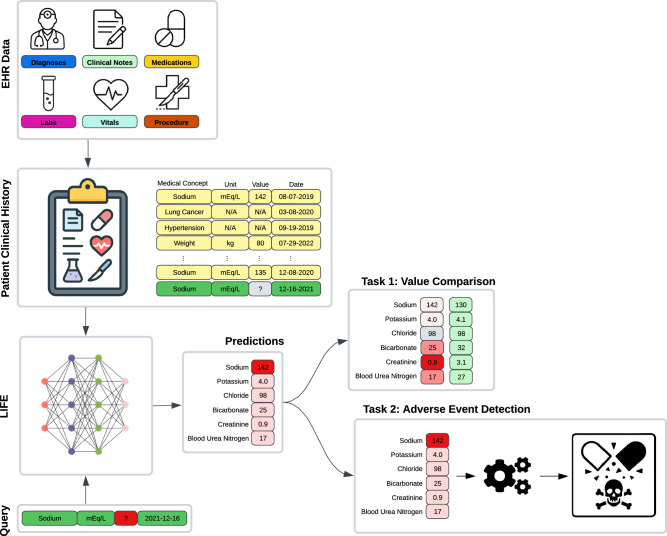
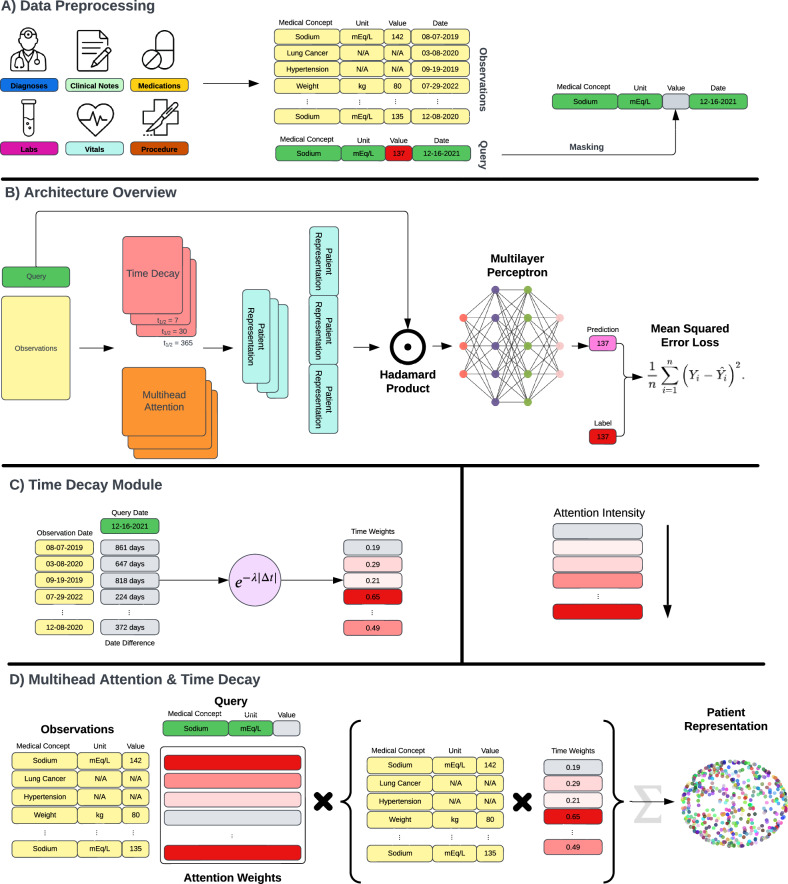
Laboratory data in electronic health records (EHRs) is an effective source of information to characterize patient populations, inform accurate diagnostics and treatment decisions, and fuel research studies. However, despite their value, laboratory values are underutilized due to high levels of missingness. Existing imputation methods fall short, as they do not fully leverage patient clinical histories and are commonly not scalable to the large number of tests available in real-world data (RWD). To address these shortcomings, we present Laboratory Imputation Framework for EHRs (LIFE), a self-supervised learning framework based on multi-head attention that is trained to impute any laboratory test value at any point in time in the patient’s journey using their complete EHRs. This architecture (1) eliminates the need to train a different model for each laboratory test by jointly modeling all laboratory data of interest; and (2) better clinically contextualizes the predictions by leveraging additional EHR variables, such as diagnosis, medications, and discrete laboratory results. We validate our framework using a large-scale, real-world dataset encompassing over 1 million oncology patients. Our results demonstrate that LIFE obtains superior or equivalent results compared to state-of-the-art baseline methods in 23 out of 25 evaluated laboratory tests and better enhances a downstream adverse event detection task in 7 out of 9 cases. LIFE shows promise in accurately estimating missing laboratory values and enhancing the utilization of large-scale RWD in healthcare. This advancement could lead to better clinical models, more informed decision-making and improved patient outcomes. Electronic health records (EHRs) contain laboratory test results that are crucial for modeling and analyzing patient health and outcomes. However, many laboratory test results are often missing, which limits their usefulness. Current automated methods to fill these gaps are not very effective because they generally do not utilize all available patient clinical information and cannot handle a wide variety of tests. To address this issue, we present Laboratory Imputation Framework for EHRs (LIFE), a model that predicts missing laboratory results at any point in time by analyzing a patient’s entire health record, including diagnoses and medications. Tested on data from over a million cancer patients, LIFE outperformed other methods in predicting laboratory results and improved the detection of several clinical adverse events. This tool could lead to better clinical models, potentially enhancing healthcare decisions and improving patient outcomes. Heilbroner et al. present LIFE, a self-supervised learning framework for imputing laboratory test values at any point in a patient’s journey using electronic health records. LIFE generally outperforms state-of-the-art baselines and enhances adverse event detection when tested on over 1 million oncology records.
Overview
The claims and statistics of this paper haven’t been checked yet.
Free: it reads the open-access text and checks the first 5 claims that cite a source we can check. Create a free account to check every claim.
Integrity signals
Registry
Cites
Statistics
Figures
Verification
Claims the paper makes
The claims and statistics of this paper haven’t been checked yet.
Free: it reads the open-access text and checks the first 5 claims that cite a source we can check. Create a free account to check every claim.
Claims other papers make about this one
Each is checked against this paper’s own text: does it say what the citing paper says it does?
The check wasn’t confident either way, so it gives no verdict — never disputed.
In the citing paper
“Both processes require collaboration among IT teams, data stewards, and business users [93].”
From Data Quality in the Age of AI: A Review of Governance, Ethics, and the FAIR Principles (2025) · cites this paper as [93]
Experimental — accuracy not yet measured
Self-check
Percentages, sums and reported differences re-computed from the paper’s own numbers.
The self-check needs the paper’s full text.
Citations
Cites
Vaswani, A., Shazeer, N., Parmar, N., Uszkoreit, J., Jones, L., Gomez, A. N., Kaiser, L., & Polosukhin, I. (2017) · arXiv · doi:10.48550/arxiv.1706.03762 · Cited by 120,404 · cited 2×
“Traditionally, token position is encoded using embeddings – for example, in the original trans-former method described by Vaswani et al, positional information is encoded using sine and cosine functions of each token ’ s discrete positon 19 .”
LeCun, Y., Bengio, Y., & Hinton, G. (2015) · Nature · doi:10.1038/nature14539 · Cited by 84,126
BERT: Pre-training of Deep Bidirectional Transformers for Language Understanding
Devlin, J., Chang, M.-W., Lee, K., & Toutanova, K. (2018) · arXiv · doi:10.48550/arxiv.1810.04805 · Cited by 73,173
mice: Multivariate Imputation by Chained Equations in R
Buuren, S. V., & Groothuis-Oudshoorn, K. (2011) · Journal of Statistical Software · doi:10.18637/jss.v045.i03 · Cited by 13,870 · cited 7×
“Detailed pseudocode is provided in the appendix (Supplementary Algorithms 1 – 6).”
InfluentialMIMIC-III, a freely accessible critical care database
Johnson, A. E. W., Pollard, T. J., Shen, L., Lehman, L.-W. H., Feng, M., Ghassemi, M., Moody, B., Szolovits, P., Anthony Celi, L., & Mark, R. G. (2016) · Scientific Data · doi:10.1038/sdata.2016.35 · Cited by 8,141 · cited 2×
“…on clean, homogenous, regularly sampled ICU data from a single institution, such as the Medical Information Mart for Intensive Care (MIMIC) datasets 13 , and have not been tested on the heterogeneous, irregularly sampled, outpatient and inpatient RWD from multiple institutions, which is more…”
Multiple imputation by chained equations: what is it and how does it work?
Azur, M. J., Stuart, E. A., Frangakis, C., & Leaf, P. J. (2011) · International Journal of Methods in Psychiatric Research · doi:10.1002/mpr.329 · Cited by 3,542
Deep learning for healthcare: review, opportunities and challenges
Miotto, R., Wang, F., Wang, S., Jiang, X., & Dudley, J. T. (2018) · Briefings in Bioinformatics · doi:10.1093/bib/bbx044 · Cited by 3,076 · cited 1×
“Recent advances in deep learning 14 and self-supervised learning 15 are enabling new ways to leverage EHRs for personalized healthcare 16 – 18 , and provide an opportunity to address the challenges discussed above.”
Self-citationRecurrent Neural Networks for Multivariate Time Series with Missing Values
Che, Z., Purushotham, S., Cho, K., Sontag, D., & Liu, Y. (2018) · Scientific Reports · doi:10.1038/s41598-018-24271-9 · Cited by 2,370 · cited 2×
“…Estimation in Multivariate Time Series Data (MD-MTS) 7 , Gaussian processes such as 3D-MICE 8 , and deep learning architectures, such as Bidirectional Recurrent Imputation for Time Series (BRITS) 9 , Multi-directional Recurrent Neural Networks (M-RNN) 10 , and Gated Recurrent Unit with Decay 11 .”
Shickel, B., Tighe, P. J., Bihorac, A., & Rashidi, P. (2018) · IEEE Journal of Biomedical and Health Informatics · doi:10.1109/jbhi.2017.2767063 · Cited by 1,688 · cited 1×
“Detailed pseudocode is provided in the appendix (Supplementary Algorithms 1 – 6).”
Mining electronic health records: towards better research applications and clinical care
Jensen, P. B., Jensen, L. J., & Brunak, S. (2012) · Nature Reviews Genetics · doi:10.1038/nrg3208 · Cited by 1,680
Rasmy, L., Xiang, Y., Xie, Z., Tao, C., & Zhi, D. (2021) · npj Digital Medicine · doi:10.1038/s41746-021-00455-y · Cited by 886 · cited 2×
“The transformer architecture and its building block, the multi-head self-attention module, speci fi cally, can contextualize each data point more ef fi ciently than other machine learning architectures 19 , showing improved performances when modeling EHRs 20 .”
Xiao, C., Choi, E., & Sun, J. (2018) · Journal of the American Medical Informatics Association · doi:10.1093/jamia/ocy068 · Cited by 792
Self-supervised learning in medicine and healthcare
Krishnan, R., Rajpurkar, P., & Topol, E. J. (2022) · Nature Biomedical Engineering · doi:10.1038/s41551-022-00914-1 · Cited by 605 · cited 1×
“Recent advances in deep learning 14 and self-supervised learning 15 are enabling new ways to leverage EHRs for personalized healthcare 16 – 18 , and provide an opportunity to address the challenges discussed above.”
Rebutting Existing Misconceptions About Multiple Imputation as a Method for Handling Missing Data
van Ginkel, J. R., Linting, M., Rippe, R. C. A., & van der Voort, A. (2020) · Journal of Personality Assessment · doi:10.1080/00223891.2018.1530680 · Cited by 550
BRITS: Bidirectional Recurrent Imputation for Time Series
Cao, W., Wang, D., Li, J., Zhou, H., Li, L., & Li, Y. (2018) · arXiv (Cornell University) · doi:10.48550/arxiv.1805.10572 · Cited by 357
A gentle introduction to conformal prediction and distribution-free uncertainty quantification
Angelopoulos, A. N., & Bates, S. (2021) · arXiv · doi:10.48550/arxiv.2107.07511 · Cited by 240 · cited 1×
“Another direction is to provide error estimates along with the predicted laboratory values, for example using ideasfrom conformal prediction 32 .”
Deep representation learning of electronic health records to unlock patient stratification at scale
Landi, I., Glicksberg, B. S., Lee, H.-C., Cherng, S., Landi, G., Danieletto, M., Dudley, J. T., Furlanello, C., & Miotto, R. (2020) · npj Digital Medicine · doi:10.1038/s41746-020-0301-z · Cited by 213
Self-citationAyilara, O. F., Zhang, L., Sajobi, T. T., Sawatzky, R., Bohm, E., & Lix, L. M. (2019) · Health and Quality of Life Outcomes · doi:10.1186/s12955-019-1181-2 · Cited by 174 · cited 1×
“EHR for various reasons, including patients not needing speci fi c tests, irregularcheck-upsorfollow-ups,datarecordingandintegrationissues,and more,oftenresultinginbiasedstatisticsandsuboptimalclinicalmodel performances,speci fi cally in groups with traditionally poor access to healthcare 3 – 5 .”
Johnson, A., Pollard, T., & Mark, R. (2015) · PhysioNet · doi:10.13026/c2xw26 · Cited by 165
Imputation of missing values for electronic health record laboratory data
Li, J., Yan, X. S., Chaudhary, D., Avula, V., Mudiganti, S., Husby, H., Shahjouei, S., Afshar, A., Stewart, W. F., Yeasin, M., et al. (2021) · npj Digital Medicine · doi:10.1038/s41746-021-00518-0 · Cited by 133 · cited 2×
“Forexample,by imputingmissingvaluesatmultiplepointsintimethroughoutapatients ’ history, LIFE could facilitate and improve tools for cohort selection, clinical trial matching, outcome measurement, risk strati fi cation, clinical decision support, and causal inference 5 .”
Evaluating the state of the art in missing data imputation for clinical data
Luo, Y. (2022) · Briefings in Bioinformatics · doi:10.1093/bib/bbab489 · Cited by 127 · cited 1×
“A recent benchmark suggested that MD-MTS may have the best performance on healthcare data 12 .”
Luo, Y., Szolovits, P., Dighe, A. S., & Baron, J. M. (2018) · Journal of the American Medical Informatics Association · doi:10.1093/jamia/ocx133 · Cited by 108 · cited 1×
“…such as Multi-directional Approach for Missing Value Estimation in Multivariate Time Series Data (MD-MTS) 7 , Gaussian processes such as 3D-MICE 8 , and deep learning architectures, such as Bidirectional Recurrent Imputation for Time Series (BRITS) 9 , Multi-directional Recurrent Neural…”
Using electronic health records for clinical trials: Where do we stand and where can we go?
Mc Cord, K. A., & Hemkens, L. G. (2019) · Canadian Medical Association Journal · doi:10.1503/cmaj.180841 · Cited by 88 · cited 1×
“Thiswillconsequentlyenhance systemsusingEHRsfor,amongothers,clinicaldecisionsupport,caregaps detection,phenotyping,andclinicaltrialmatching 21 – 24 .”
Freitas, J. K. D., Johnson, K. W., Golden, E., Nadkarni, G. N., Dudley, J. T., Böttinger, E. P., Glicksberg, B. S., & Miotto, R. (2021) · Patterns · doi:10.1016/j.patter.2021.100337 · Cited by 52
Self-citationCEHR-BERT: Incorporating temporal information from structured EHR data to improve prediction tasks
Pang, C., Jiang, X., Kalluri, K. S., Spotnitz, M., Chen, R., Perotte, A., & Natarajan, K. (2021) · arXiv (Cornell University) · doi:10.48550/arxiv.2111.08585 · Cited by 30 · cited 1×
“Transformers andattentionmechanismshavealreadybeenusedwithEHRs,commonlyto trainfoundationmodelsfromstructuredEHRsandclinicalnotesto improvepredictivemodelingtasks 20,29,30 .”
Guo, L. L., Morse, K., Aftandilian, C. C., Steinberg, E., Fries, J., Posada, J., Fleming, S. L., Lemmon, J., Jessa, K., Shah, N. H., et al. (2024) · BMC Medical Informatics and Decision Making · doi:10.1186/s12911-024-02449-8 · Cited by 28 · cited 1×
“1, 2).”
Heilbroner, S. P., & Miotto, R. (2023) · Clinical Journal of the American Society of Nephrology · doi:10.2215/cjn.0000000000000080 · Cited by 25
Self-citationShao, Y., Cheng, Y., Nelson, S. J., Kokkinos, P. F., ZAMRINI, E. Y., Ahmed, A., & Zeng‐Treitler, Q. (2023) · Journal of Personalized Medicine · doi:10.3390/jpm13071070 · Cited by 20 · cited 1×
“Transformers andattentionmechanismshavealreadybeenusedwithEHRs,commonlyto trainfoundationmodelsfromstructuredEHRsandclinicalnotesto improvepredictivemodelingtasks 20,29,30 .”
A Multi-directional Approach for Missing Value Estimation in Multivariate Time Series Clinical Data
Xiao, X., Liu, X., Kang, Y., Xu, X., Wang, J., Sun, Y., Chen, Q., Jia, X., Ma, X., Meng, X., et al. (2020) · Journal of Healthcare Informatics Research · doi:10.1007/s41666-020-00076-2 · Cited by 17 · cited 9×
“…techniques include tree-based models, such as Multi-directional Approach for Missing Value Estimation in Multivariate Time Series Data (MD-MTS) 7 , Gaussian processes such as 3D-MICE 8 , and deep learning architectures, such as Bidirectional Recurrent Imputation for Time Series (BRITS) 9 ,…”
InfluentialGeneric medical concept embedding and time decay for diverse patient outcome prediction tasks
Li, Y., Dong, W., Ru, B., Black, A., Zhang, X., & Guan, Y. (2022) · iScience · doi:10.1016/j.isci.2022.104880 · Cited by 9 · cited 1×
“Furthermore, this architecture has been shown to outperform RNNs or CNNs when used to capture temporal information in structured EHRs 25 .”
(2012) · neural information processing systems
Research works printed but not linked: 2
- Yoon, J. & Zame, W. R. Multi-directional recurrent neural networks: a novel method for estimating missing data. InTime series workshop in international conference on machine learning 2017 Nov.
- Ma, C. & Zhang, C. Identifiable generative models for missing not at random data imputation. Adv. Neural Inf. Process Syst34, 27645–2758 (2021).
Cited by
Data Quality in the Age of AI: A Review of Governance, Ethics, and the FAIR Principles
Guillen-Aguinaga, M., Aguinaga-Ontoso, E., Guillen-Aguinaga, L., Guillen-Grima, F., & Aguinaga-Ontoso, I. (2025) · Data · doi:10.3390/data10120201 · Cited by 37
“In healthcare, incomplete patient records can obscure critical patterns, delaying medical discoveries and compromising research progress [91–93].”
Metadata
- Authors
- Heilbroner, S. P., Carter, C., Vidmar, D. M., Mueller, E. T., Stumpe, M. C., & Miotto, R.
- Affiliations
- Tempus Labs (United States) (US)
- Corresponding author
- Miotto, Riccardo
- Venue
- Communications Medicine
- Published
- 2025-07-01
- Volume
- 5
- Issue
- 1
- Pages
- 251-251
- ISSN
- 2730-664X (ISSN-L)
- PMC
- PMC12216283
- OpenAlex
- W4411857863
- Cited by
- 1
- References
- 28
- Citations by year
- 2025: 1
- FWCI
- 0.40
- Type
- journal article
- Language
- en
- Open access
- gold
- doi.org
- Licence
- cc-by-nc-nd
- creativecommons.org/licenses/by-nc-nd/4.0 (tdm)
- creativecommons.org/licenses/by-nc-nd/4.0 (vor)
- Locations
- Communications Medicine (publishedVersion, cc-by-nc-nd)
- PubMed Central (publishedVersion, cc-by-nc-nd)
- PubMed (publishedVersion)
- DOAJ (DOAJ: Directory of Open Access Journals) (submittedVersion, cc-by-sa)
- Topics
- Physical Sciences › Computer Science › Artificial Intelligence › Machine Learning in Healthcare
- Health Sciences › Health Professions › Health Information Management › Electronic Health Records Systems
- Health Sciences › Health Professions › Health Information Management › Medical Coding and Health Information
- Keywords
- electronic health records, self-supervised learning, multi-head attention, real-world data, cancer patients, adverse event detection, clinical decision support, missing data imputation, clinical natural language processing, clinical decision support systems
About these checks
Registry, retraction, Cites and statistics results are computed, not judged, with one exception: a printed reference that no index lists is read once by a model before it counts as a citation error. Claims are extracted by a model and kept only when their quote appears verbatim in the text; each cited source is then checked, with a model’s help, for whether it says what the claim relies on. Those verdicts can be wrong — read the claim’s quote and the cited source before relying on one.
Statistics and arithmetic are recomputed, not judged.
Confidence bands are shown only for fields calibrated on our annotated test set. None is calibrated yet, so no band is shown.
What counts as a claim ›How we measure confidence ›How we check this ›
Are you an author, or do you see a problem with this page? Request a review
Data sources
Bibliographic data: Semantic Scholar, OpenAlex, Crossref.
Contains information from the Semantic Scholar Academic Graph Datasets, made available under the ODC Attribution License (ODC-BY 1.0).
Semantic Scholar’s data is described in: Kinney, R., et al. (2023). The Semantic Scholar Open Data Platform. arXiv:2301.10140.
