

The DOI matches its Crossref record; 15 of the 16 references it cites were found in a registry or an index.
Survival Analysis Part II: Multivariate data analysis – an introduction to concepts and methods
Open accessAbstract
Survival analysis involves the consideration of the time between a fixed starting point (e.g. diagnosis of cancer) and a terminating event (e.g. death). The key feature that distinguishes such data from other types is that the event will not necessarily have occurred in all individuals by the time the study ends, and for these patients, their full survival times are unknown. For instance, in studies that measure the length of survival after diagnosis of cancer, it is common for a proportion of individuals to remain alive and disease-free at the end of the follow-up period, and for these patients, we know only a lower limit on their actual time to event. Thus, special methods are required for these type of data. The explanation and demonstration of some of the methods proposed to analyse such data are the basis of this series.
Overview
The claims and statistics of this paper haven’t been checked yet.
Run the check — free, no account needed. It reads the open-access text and checks the sources it cites.
Integrity signals
Registry
Cites
Statistics
Figures
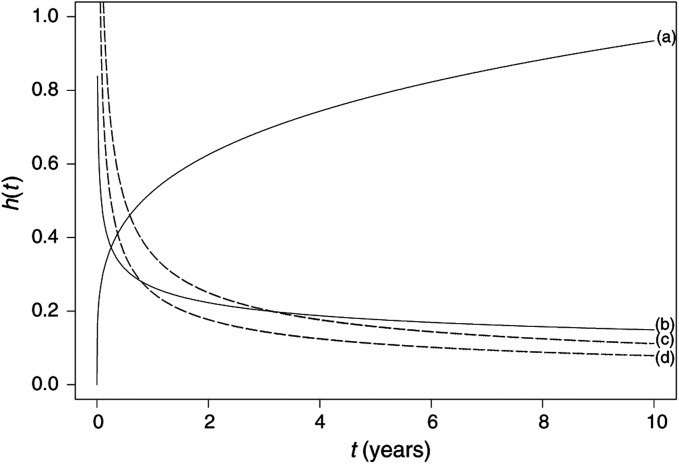
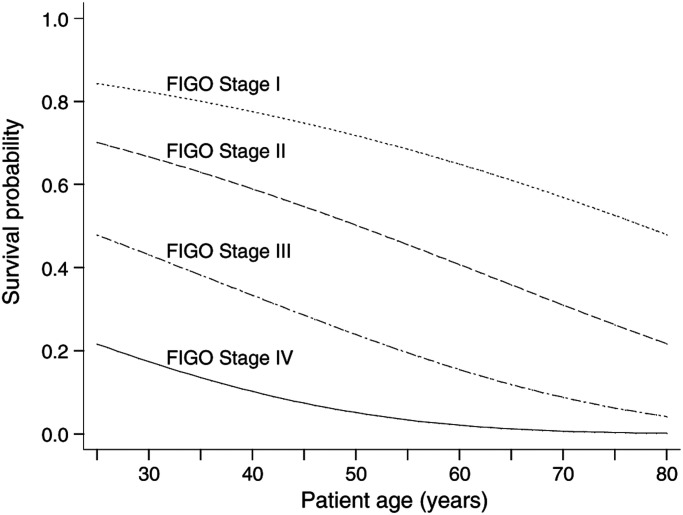
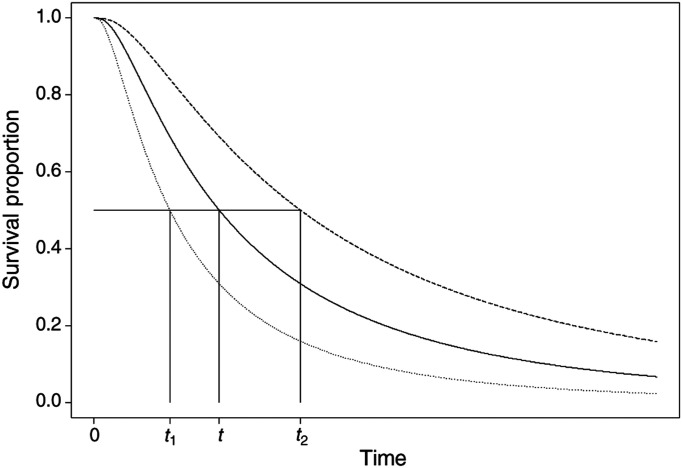
Verification
Claims the paper makes
The claims and statistics of this paper haven’t been checked yet.
Run the check — free, no account needed. It reads the open-access text and checks the sources it cites.
Claims other papers make about this one
Each is checked against this paper’s own text: does it say what the citing paper says it does?
In the citing paper
“The proportional hazards assumption was assessed using the log(−log(survival)) plot, and those that failed the assumption or that were deemed to be time dependent were entered as continuous time-dependent covariates (Bradburn et al, 2003).”
From Cohort study of adherence to adjuvant endocrine therapy, breast cancer recurrence and mortality (2013) · cites this paper as Bradburn et al, 2003
Self-check
Percentages, sums and reported differences re-computed from the paper’s own numbers.
The self-check needs the paper’s full text.
Citations
Cites
Regression Models and Life-Tables
Cox, D. R. (1972) · Journal of the Royal Statistical Society Series B: Statistical Methodology · doi:10.1111/j.2517-6161.1972.tb00899.x · Cited by 39,793
Miller, R. G. (1981) · Cited by 3,336
Modelling for Survival Data in Medical Research
(1995) · Technometrics · doi:10.1080/00401706.1995.10485920 · Cited by 2,159
Modelling Survival Data in Medical Research
Collett, D. (1994) · Springer eBooks · doi:10.1007/978-1-4899-3115-3 · Cited by 1,064
Survival Analysis Part I: Basic concepts and first analyses
Clark, T. G., Bradburn, M. J., Love, S., & Altman, D. G. (2003) · British Journal of Cancer · doi:10.1038/sj.bjc.6601118 · Cited by 1,045 · cited 11×
“Examples of survival and hazard functions derived from some of these parametric models were presented in the previous paper (Clark et al , 2003).”
InfluentialSelf-citationLinear regression with censored data
Buckley, J. D., & JAMES, I. R. (1979) · Biometrika · doi:10.1093/biomet/66.3.429 · Cited by 1,032 · cited 1×
“Alternative methods include the method of Buckley and James (1979), which is discussed by Stare et al (2000), and semiparametric AFT models, in which the baseline survivor function is estimated nonparame-trically (see Wei, 1992, for an overview), but have not yet been widely implemented in…”
Modelling Survival Data in Medical Research.
McLachlan, G. J., & Collett, D. (1994) · Biometrics · doi:10.2307/2533471 · Cited by 1,023
Wei, L. J. (1992) · Statistics in Medicine · doi:10.1002/sim.4780111409 · Cited by 827 · cited 1×
“…include the method of Buckley and James (1979), which is discussed by Stare et al (2000), and semiparametric AFT models, in which the baseline survivor function is estimated nonparame-trically (see Wei, 1992, for an overview), but have not yet been widely implemented in statistical software.”
A linear regression model for the analysis of life times
Aalen, O. O. (1989) · Statistics in Medicine · doi:10.1002/sim.4780080803 · Cited by 725 · cited 1×
“These important issues will be addressed in the subsequent paper in this series.”
Multivariate survival analysis using Cox's regression model
Christensen, E. I. (1987) · Hepatology · doi:10.1002/hep.1840070628 · Cited by 372 · cited 1×
“This information could then be displayed via tabular or Christensen (1987) based on the Cox model, but can also be used when fitting fully parametric models.”
Cited by
Sorted by citations
Moons, K. G. M., Altman, D. G., Reitsma, J. B., Ioannidis, J. P. A., Macaskill, P., Steyerberg, E. W., Vickers, A. J., Ransohoff, D. F., & Collins, G. S. (2015) · Annals of Internal Medicine · doi:10.7326/m14-0698 · Cited by 5,147
Self-citationUALCAN: A Portal for Facilitating Tumor Subgroup Gene Expression and Survival Analyses
Chandrashekar, D. S., Bashel, B., Balasubramanya, S. A. H., Creighton, C. J., Ponce-Rodriguez, I., Chakravarthi, B. V. S. K., & Varambally, S. (2017) · Neoplasia · doi:10.1016/j.neo.2017.05.002 · Cited by 6,086
“In order to assess the combined survival effect of gene expression and clinical parameters such as patient race, gender, BMI, cancer subtypes, tumor grade, etc., we applied multivariate Kaplan – Meier survival analysis [46].”
MethodReporting Recommendations for Tumor Marker Prognostic Studies (REMARK): Explanation and Elaboration
Altman, D. G., McShane, L. M., Sauerbrei, W., & Taube, S. E. (2012) · PLoS Medicine · doi:10.1371/journal.pmed.1001216 · Cited by 1,034
“More extensive discussions of statistical analysis methods for binary outcome and for survival data can be found elsewhere [74,102,114-125].”
MethodSelf-citationA note on competing risks in survival data analysis
Satagopan, J. M., Ben‐Porat, L., Berwick, M., Robson, M. E., Kutler, D. I., & Auerbach, A. D. (2004) · British Journal of Cancer · doi:10.1038/sj.bjc.6602102 · Cited by 752
Shattuck, P. T., Durkin, M., Maenner, M., Newschaffer, C., Mandell, D. S., Wiggins, L., Lee, L.-C., Rice, C., Giarelli, E., Kirby, R., et al. (2009) · Journal of the American Academy of Child & Adolescent Psychiatry · doi:10.1097/chi.0b013e31819b3848 · Cited by 623
“Time ratios greater than 1 indicate an effect that delays the timing of identification; whereas, time ratios less than 1 indicate an accelerating effect on the timing of identification.(18) For instance, a time ratio of 2 would mean a 1-unit change in the covariate and was associated with a doubling of the median age…”
Background
Metadata
- Authors
- Bradburn, M. J., Clark, T. G., Love, S. B., & Altman, D. G.
- Affiliations
- Cancer Research UK (GB)
- Corresponding author
- Bradburn, M J
- Venue
- British Journal of Cancer
- Published
- 2003-07-29
- Volume
- 89
- Issue
- 3
- Pages
- 431-436
- ISSN
- 0007-0920 (ISSN-L)
- 1532-1827
- PMC
- PMC2394368
- OpenAlex
- W2107482271
- Cited by
- 741
- References
- 16
- Citations by year
- 2026: 31 · 2025: 55 · 2024: 86 · 2023: 67 · 2022: 54 · 2021: 91 · 2020: 55 · 2019: 41 · 2018: 43 · 2017: 35 · 2016: 26 · 2015: 21 · 2014: 27 · 2013: 15 · 2012: 24
- FWCI
- 7.17
- Type
- journal article
- Language
- en
- Open access
- hybrid
- doi.org
- Licence
- cc-by-nc-sa
- www.springer.com/tdm (unspecified)
- Locations
- British Journal of Cancer (publishedVersion, cc-by-nc-sa)
- PubMed Central (publishedVersion, cc-by)
- PubMed (publishedVersion)
- White Rose Research Online (University of Leeds, The University of Sheffield, University of York) (acceptedVersion)
- LSHTM Research Online (London School of Hygiene and Tropical Medicine) (acceptedVersion)
- Funders
- Cancer Research UK
- Topics
- Physical Sciences › Mathematics › Statistics and Probability › Statistical Methods and Inference
- Physical Sciences › Mathematics › Statistics and Probability › Probability and Statistical Research
- Physical Sciences › Mathematics › Statistics and Probability › Statistical Distribution Estimation and Applications
- Keywords
- survival analysis, multivariate survival data, censored data, time to event, cancer survival, censoring
- MeSH terms
- Clinical Trials as Topic, Humans, Neoplasms, Models, Statistical, Multivariate Analysis, Survival Analysis
About these checks
Registry, retraction, Cites and statistics results are computed, not judged, with one exception: a printed reference that no index lists is read once by a model before it counts as a citation error. Claims are extracted by a model and kept only when their quote appears verbatim in the text; each cited source is then checked, with a model’s help, for whether it says what the claim relies on. Those verdicts can be wrong — read the claim’s quote and the cited source before relying on one.
Statistics and arithmetic are recomputed, not judged.
Confidence bands are shown only for fields calibrated on our annotated test set. None is calibrated yet, so no band is shown.
What counts as a claim ›How we measure confidence ›How we check this ›
Are you an author, or do you see a problem with this page? Request a review
