

Targeting telomerase for cancer therapeutics
Open accessThe DOI matches its Crossref record; 33 of the 33 references it cites were found in a registry or an index.
Abstract
One of the hallmarks of advanced malignancies is continuous cell growth and this almost universally correlates with the reactivation of telomerase. Although there is still much we do not understand about the regulation of telomerase, it remains a very attractive and novel target for cancer therapeutics. Several clinical trials have been initiated, and in this review we highlight some of the most promising approaches and conclude by speculating on the role of telomerase in cancer stem cells.
Overview
The claims and statistics of this paper haven’t been checked yet.
Free: it reads the open-access text and checks the first 5 claims that cite a source we can check. Create a free account to check every claim.
Integrity signals
Registry
Cites
Statistics
Figures
Verification
Claims the paper makes
The claims and statistics of this paper haven’t been checked yet.
Free: it reads the open-access text and checks the first 5 claims that cite a source we can check. Create a free account to check every claim.
Claims other papers make about this one
Each is checked against this paper’s own text: does it say what the citing paper says it does?
In the citing paper
“The upregulation of telomerase in most human cancers and its requirement for proliferation makes anti-telomerase compounds a potential means to induce telomere shortening and initiation of a senescence program in tumor cells64.”
From Telomere dysfunction and tumour suppression: the senescence connection (2008) · cites this paper as [64]
Self-check
Percentages, sums and reported differences re-computed from the paper’s own numbers.
The self-check needs the paper’s full text.
Citations
Cites
Specific Association of Human Telomerase Activity with Immortal Cells and Cancer
Kim, N. W., Piatyszek, M. A., Prowse, K. R., Harley, C. B., West, M. D., Ho, P. L. C., Coviello, G. M., Wright, W. E., Weinrich, S. L., & Shay, J. W. (1994) · Science · doi:10.1126/science.7605428 · Cited by 7,091 · cited 2×
“Telomerase is detected in approximately 90% of all malignant tumours (Kim et al, 1994; Shay and Bacchetti, 1997), making it a highly attractive target for the development of mechanism-based therapeutics (Keith et al, 2007).”
BackgroundSelf-citationShelterin: the protein complex that shapes and safeguards human telomeres
de Lange, T. (2005) · Genes & Development · doi:10.1101/gad.1346005 · Cited by 3,056 · cited 1×
“Telomeres consist of long TTAGGG nucleotide repeats and an associated protein complex, termed shelterin (de Lange, 2005).”
A survey of telomerase activity in human cancer
Shay, J. W., & Bacchetti, S. (1997) · European Journal of Cancer · doi:10.1016/s0959-8049(97)00062-2 · Cited by 2,794 · cited 1×
“Telomerase is detected in approximately 90% of all malignant tumours (Kim et al, 1994; Shay and Bacchetti, 1997), making it a highly attractive target for the development of mechanism-based therapeutics (Keith et al, 2007).”
BackgroundSelf-citationPonti, D., Costa, A., Zaffaroni, N., Pratesi, G., Petrangolini, G., Coradini, D., Pilotti, S., Pierotti, M. A., & Daidone, M. G. (2005) · Cancer Research · doi:10.1158/0008-5472.can-05-0626 · Cited by 1,723 · cited 2×
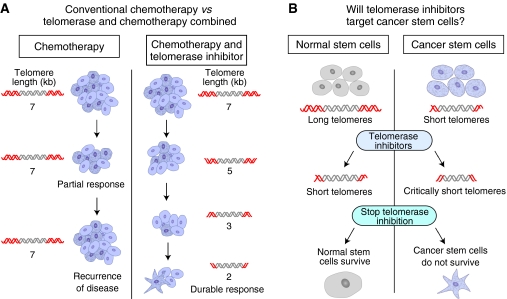
“…al, unpublished data), and thus there may be a window of opportunity to target cancer stem cells by inhibiting telomerase and driving telomeres short and cells into apoptotic cell death, hopefully without irreversible damage to normal stem cells (Figure 2B; Ponti et al, 2005; Drummond et al, 2007).”
BackgroundTelomere loss: mitotic clock or genetic time bomb?
Harley, C. B. (1991) · Mutation Research/DNAging · doi:10.1016/0921-8734(91)90018-7 · Cited by 1,139 · cited 1×
“The TTAGGG repeats shorten with each cell division due to the end replication problem, oxidative damage and other end processing events (Harley, 1991; Wright and Shay, 2000).”
BackgroundTelomerase in the human organism
Collins, K., & Mitchell, J. R. (2002) · Oncogene · doi:10.1038/sj.onc.1205083 · Cited by 603 · cited 2×
“Telomerase is a cellular reverse transcriptase (molecular motor) that adds new DNA onto the telomeres that are located at the ends of chromosomes (Collins and Mitchell, 2002).”
BackgroundWright, W. E., Pereira-Smith, O. M., & Shay, J. W. (1989) · Molecular and Cellular Biology · doi:10.1128/mcb.9.7.3088 · Cited by 491 · cited 1×
“In cell line models, senescence bypass can be accomplished by abrogating important cell-cycle checkpoint genes (such as p53, p21, p16INK4a and pRb), leading to extended growth of the premalignant cells eventually leading to crisis (Wright et al, 1989).”
BackgroundSelf-citationTelomerase therapeutics for cancer: challenges and new directions
Shay, J. W., & Wright, W. E. (2006) · Nature Reviews Drug Discovery · doi:10.1038/nrd2081 · Cited by 432 · cited 2×
“The general schemes for targeting telomerase are well described (Keith et al, 2004, 2007; Shay and Wright, 2006).”
BackgroundSelf-citationWright, W. E., & Shay, J. W. (2000) · Nature Medicine · doi:10.1038/78592 · Cited by 398 · cited 1×
“The TTAGGG repeats shorten with each cell division due to the end replication problem, oxidative damage and other end processing events (Harley, 1991; Wright and Shay, 2000).”
BackgroundSelf-citationSu, Z., Dannull, J., Yang, B. K., Dahm, P., Coleman, D., Yancey, D., Sichi, S., Niedzwiecki, D., Boczkowski, D., Gilboa, E., et al. (2005) · The Journal of Immunology · doi:10.4049/jimmunol.174.6.3798 · Cited by 359 · cited 1×
“Twenty patients (12 of the low-dose group and eight of the high-dose group) were enrolled and treated (Su et al, 2005).”
Background
Cited by
Hoeijmakers, J. H. J. (2009) · New England Journal of Medicine · doi:10.1056/nejmra0804615 · Cited by 2,239
A systematic review of the anticancer properties of berberine, a natural product from Chinese herbs
Sun, Y., Xun, K., Wang, Y., & Chen, X. (2009) · Anti-Cancer Drugs · doi:10.1097/cad.0b013e328330d95b · Cited by 417
Telomere dysfunction and tumour suppression: the senescence connection
Deng, Y., Chan, S. S., & Chang, S. (2008) · Nature Reviews Cancer · doi:10.1038/nrc2393 · Cited by 411
“The upregulation of telomerase in most human cancers and its requirement for proliferation make anti-telomerase compounds a potential means to induce telomere shortening and initiation of a senescence programme in tumour cell”
BackgroundTERT—Regulation and Roles in Cancer Formation
Dratwa, M., Wysoczańska, B., Łacina, P., Kubik, T., & Bogunia-Kubik, K. (2020) · Frontiers in Immunology · doi:10.3389/fimmu.2020.589929 · Cited by 311
Novel anticancer therapeutics targeting telomerase
Ruden, M., & Puri, N. (2013) · Cancer Treatment Reviews · doi:10.1016/j.ctrv.2012.06.007 · Cited by 310
“Another strategy is targeting the telomera se subunit indirectly with G-quadru plex stabilizers, Tankyrase or HSP90 inhibitors, thus blocking telomerase access to telomere s or inhibiting binding of telomerase-ass ociated proteins leading to telomere uncapping and cell apoptosis.(3,11) One of the most recent approach…”
BackgroundMethod
Metadata
- Authors
- Shay, J. W., & Keith, W. N.
- Affiliations
- The University of Texas Southwestern Medical Center (US)
- Cancer Research UK (GB)
- Corresponding author
- Shay, J W
- ORCID
- Venue
- British Journal of Cancer
- Published
- 2008-01-29
- Volume
- 98
- Issue
- 4
- Pages
- 677-683
- ISSN
- 0007-0920 (ISSN-L)
- 1532-1827
- PMC
- PMC2259186
- OpenAlex
- W2163579602
- Cited by
- 171
- References
- 33
- Citations by year
- 2026: 2 · 2025: 4 · 2024: 4 · 2023: 5 · 2022: 4 · 2021: 2 · 2020: 6 · 2019: 2 · 2018: 7 · 2017: 11 · 2016: 8 · 2015: 7 · 2014: 18 · 2013: 12 · 2012: 14
- FWCI
- 2.35
- Type
- journal article
- Language
- en
- Open access
- hybrid
- doi.org
- Licence
- cc-by-nc-sa
- www.springer.com/tdm (unspecified)
- Locations
- British Journal of Cancer (publishedVersion, cc-by-nc-sa)
- PubMed Central (publishedVersion, cc-by)
- PubMed (publishedVersion)
- ENLIGHTEN (Jurnal Bimbingan dan Konseling Islam) (submittedVersion)
- Funders
- Cancer Research UK
- University of Glasgow
- National Cancer Institute (P50CA75907, P50CA070907)
- Topics
- Life Sciences › Biochemistry, Genetics and Molecular Biology › Cell Biology › Telomeres, Telomerase, and Senescence
- Health Sciences › Medicine › Oncology › Cancer-related Molecular Pathways
- Life Sciences › Biochemistry, Genetics and Molecular Biology › Aging › Genetics, Aging, and Longevity in Model Organisms
- Keywords
- telomerase, cancer therapeutics, telomerase reactivation, cancer stem cells, telomerase regulation, clinical trials, uncontrolled cell proliferation
- MeSH terms
- Animals, Antineoplastic Agents, Humans, Neoplasms, Telomerase
About these checks
Registry, retraction, Cites and statistics results are computed, not judged, with one exception: a printed reference that no index lists is read once by a model before it counts as a citation error. Claims are extracted by a model and kept only when their quote appears verbatim in the text; each cited source is then checked, with a model’s help, for whether it says what the claim relies on. Those verdicts can be wrong — read the claim’s quote and the cited source before relying on one.
Statistics and arithmetic are recomputed, not judged.
Confidence bands are shown only for fields calibrated on our annotated test set. None is calibrated yet, so no band is shown.
What counts as a claim ›How we measure confidence ›How we check this ›
Are you an author, or do you see a problem with this page? Request a review
Data sources
Bibliographic data: Semantic Scholar, OpenAlex, Crossref.
Contains information from the Semantic Scholar Academic Graph Datasets, made available under the ODC Attribution License (ODC-BY 1.0).
Semantic Scholar’s data is described in: Kinney, R., et al. (2023). The Semantic Scholar Open Data Platform. arXiv:2301.10140.
