

The DOI matches its Crossref record; 36 of the 39 references it cites were found in a registry or an index; 20 of the 34 sources its claims cite were checked for support.
Observing fermionic statistics with photons in arbitrary processes
Open accessAbstract
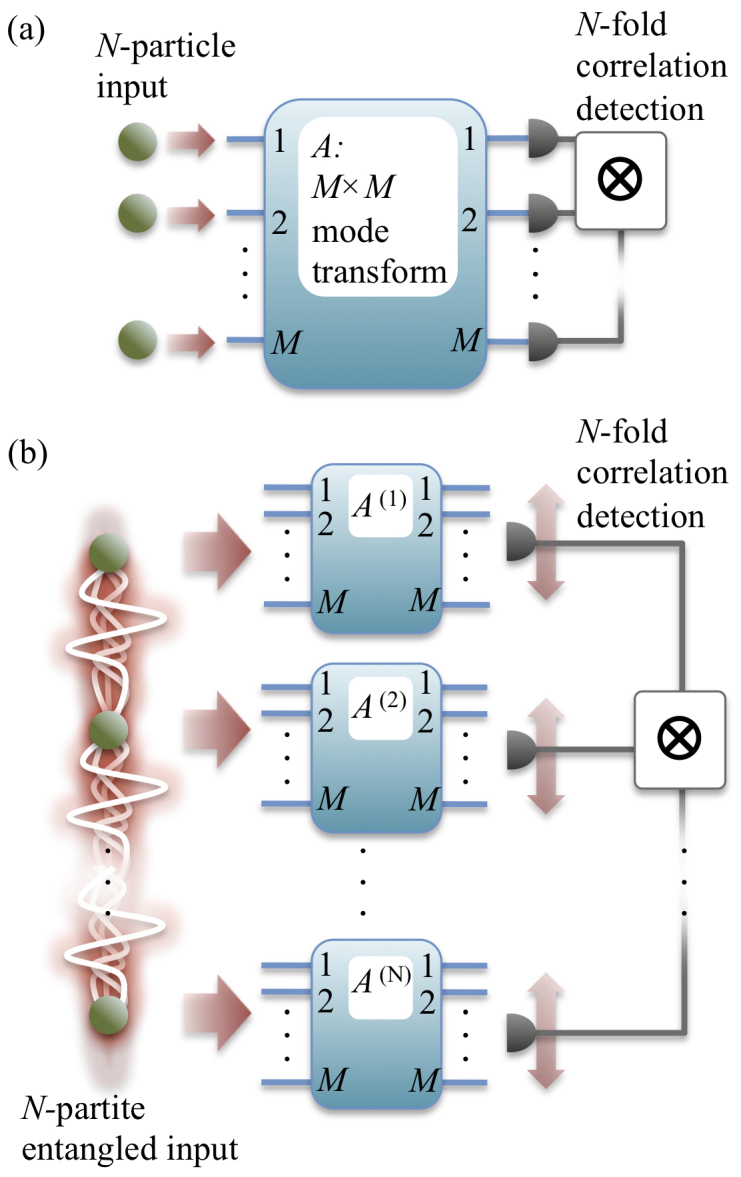
Quantum mechanics defines two classes of particles-bosons and fermions-whose exchange statistics fundamentally dictate quantum dynamics. Here we develop a scheme that uses entanglement to directly observe the correlated detection statistics of any number of fermions in any physical process. This approach relies on sending each of the entangled particles through identical copies of the process and by controlling a single phase parameter in the entangled state, the correlated detection statistics can be continuously tuned between bosonic and fermionic statistics. We implement this scheme via two entangled photons shared across the polarisation modes of a single photonic chip to directly mimic the fermion, boson and intermediate behaviour of two-particles undergoing a continuous time quantum walk. The ability to simulate fermions with photons is likely to have applications for verifying boson scattering and for observing particle correlations in analogue simulation using any physical platform that can prepare the entangled state prescribed here.
Overview
CoChat Summary
TL;DR
The paper shows that entanglement and two identical copies of a physical process can be used to make photons reproduce the correlated detection statistics of bosons, fermions, and intermediate fractional statistics. The authors demonstrate this experimentally with two entangled photons in a photonic chip implementing a continuous-time quantum walk.
Key findings
- By tuning a single phase parameter in the entangled input state, the correlated detection statistics can be continuously moved between bosonic statistics (ϕ = 0) and fermionic statistics (ϕ = π), with intermediate behavior for 0 < ϕ < π.
- The experiment used two entangled photons shared across TE and TM modes of a silicon oxynitride waveguide array to simulate two-particle quantum walk dynamics.
- For two different inputs, the measured correlations matched the ideal model closely; when the photons were deliberately made distinguishable, agreement with the classical model was reported as S = 97.4 ± 0.7% and S = 97.5 ± 0.6%.
- The paper generalizes the scheme to N particles, stating that the multi-particle correlation function reduces to the permanent for bosons and the determinant for fermions.
Methods
- Entangled photon pairs were generated in a 2 mm BiBO crystal pumped by a 60 mW, 404 nm CW diode laser, filtered to 808 nm, and injected into a photonic chip.
- The chip was a silicon oxynitride waveguide array; polarization entanglement was mapped onto two copies of the same process, realized as the TE and TM modes of the array.
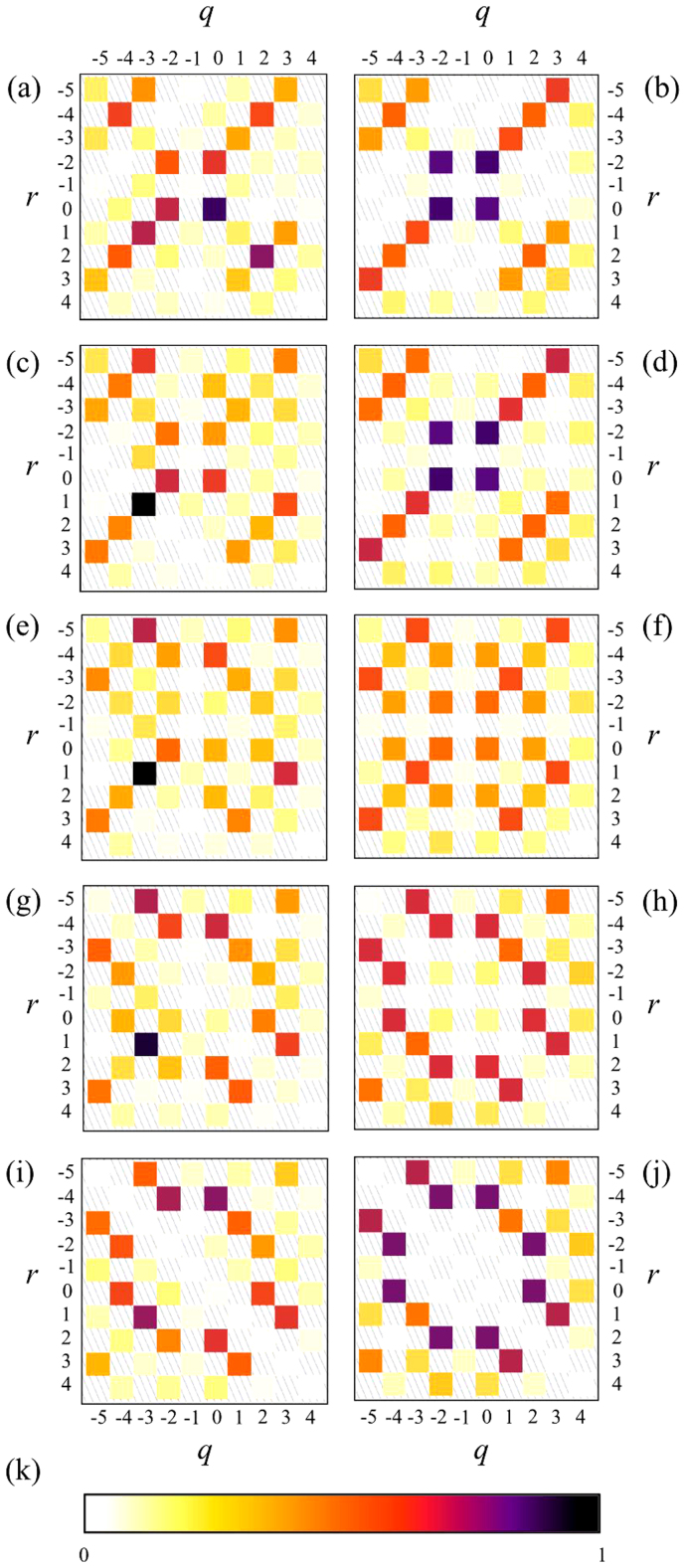
- The main analysis compared measured two-photon coincidence matrices for different phase settings (including ϕ = 0, π/4, π/2, 3π/4, π) against ideal correlation matrices, using a similarity metric S.
Limitations
- The text notes that non-unit similarity (S < 100%) is attributed to non-perfect entanglement generation.
- The method, as described, is demonstrated for a two-particle photonic implementation; the N-particle generalization is mathematical and discussed as scalable, but not experimentally demonstrated in the provided text.
- The paper states that some broader applications are possible, but whether the approach can be used for topological fault tolerant quantum computation is described as an open question.
Model-written summary. Check it against the paper before relying on it.
Integrity signals
Registry
Cites
Statistics
Figures


Verification
Claims the paper makes
12 Valid · 0 Not valid · 9 Not checked · 40 Own results and interpretations
The cited sources support only part of this claim — read each source’s verdict below.
In the paper
“we experimentally demonstrate the simulation of arbitrary particle statistics with a complex photonic network—a continuous time quantum walk1011.”
§ Observing fermionic statistics with photons in arbitrary processes > Abstract
What the sources say
- Not checked — no full text of the sourcecites [10] Perets, H. B. et al. Realization of quantum walks with negligible decoherence in waveguide lattices. Phys. Rev. Lett. 100, 170506 (2008). source
- Partly supportedcites [11] Peruzzo, A. et al. Quantum walks of correlated photons. Science 329, 1500–1503 (2010). sourceExperimental — accuracy not yet measured
The paper reports an experimental quantum walk of two identical photons in a continuously coupled waveguide array (Quantum walks of correlated particles, p. 1). It does not report experimentally simulating arbitrary particle statistics: on p. 5, it describes simulating symmetric and anti-symmetric particles as a future possibility using reconfigurable circuits. (LLM, conf=0.88)
boostedstates a cause- Asserted: passes — The authors put it forward as true.
- Checkable: passes — It can be checked against evidence.
- Load-bearing: passes — The paper’s conclusions depend on it.
- Based: passes — The paper gives a reason why it holds.
The cited sources support only part of this claim — read each source’s verdict below.
In the paper
“Correlations resulting from quantum interference of multiple indistinguishable non-interacting bosons in large linear optical circuits cannot be efficiently simulated with classical computers192021.”
§ Observing fermionic statistics with photons in arbitrary processes > Discussion
What the sources say
- Partly supportedcites [19] Scheel, S. Permanents in linear optical networks. arXiv:quant-ph/0406127v1 (2004). sourceExperimental — accuracy not yet measured
The Introduction (p. 1) says that calculating matrix elements for transformed multi-mode photonic states, and calculations based on them, is computationally expensive and cannot be done in polynomial time. Section III (p. 3) links that difficulty to computing permanents. These passages support the difficulty of calculating optical-network outcomes, but do not establish the broader claim that the resulting correlations cannot be efficiently simulated classically. (LLM, conf=0.83)
- Partly supportedcites [20] Aaronson, S. & Arkhipov, A. The computational complexity of linear optics. Proceedings of the 43rd annual ACM symposium on Theory of computing, 333–342 (2011). sourceExperimental — accuracy not yet measured
The Abstract and §1.1 describe a model of identical, noninteracting photons passing through a linear-optical network and give evidence that sampling its output is hard to simulate classically. The claim overstates the result as unconditional: the paper says classical intractability rests on plausible complexity assumptions, and its approximate-simulation result requires two unproven conjectures. Page numbers are unavailable in our copy. (LLM, conf=0.88)
- Partly supportedcites [21] Aaronson, S. & Arkhipov, A. The computational complexity of linear optics. arXiv:1011.3245 [quant-ph] (2010). sourceExperimental — accuracy not yet measured
Section 1.1 describes identical, noninteracting photons passing through a linear-optical network, and Section 1.2.1 gives a hardness result for exact classical sampling. But the claim’s unqualified “cannot be efficiently simulated” overstates the paper: the exact result depends on avoiding a collapse of the polynomial hierarchy, while Section 1.2.2 says the argument for approximate simulation still has a gap. (LLM, conf=0.87)
plain- Asserted: passes — The authors put it forward as true.
- Checkable: passes — It can be checked against evidence.
- Load-bearing: passes — The paper’s conclusions depend on it.
- Based: passes — The paper gives a reason why it holds.
- Partly supported
The cited sources support only part of this claim — read each source’s verdict below.
In the paper
“We note the fermion simulation directly maps to the dynamics of two excitations in a chain consisting of ten sites: Using the Jordan-Wigner transformation, excitations correspond to fermion creation operators and the vacuum to the ground state of each spin12.”
§ Observing fermionic statistics with photons in arbitrary processes > Abstract
What the sources say
- Partly supportedcites [12] Hines, A. P. & Stamp, P. C. E. Quantum walks, quantum gates and quantum computers. Phys. Rev. A 75, 062321 (2007). sourceExperimental — accuracy not yet measured
Split into 2 atoms — 0 confirmed, 2 partially supported, 0 disputed, 0 misattributed, 0 unverifiable. Expand the claim to see per-atom verdicts.
plainstates an association- Asserted: passes — The authors put it forward as true.
- Checkable: passes — It can be checked against evidence.
- Load-bearing: passes — The paper’s conclusions depend on it.
- Based: passes — The paper gives a reason why it holds.
- Partly supported
Every source the paper cites for this claim was checked and supports it.
In the paper
“In the bosonic case, we observe a less pronounced bunching behaviour for the (j, k) = (−1, 1) input (Fig. 4 (a)) than for the (j, k) = (−1, 0) input (Fig. 3 (a)), as expected14.”
§ Observing fermionic statistics with photons in arbitrary processes > Results
What the sources say
- Supportedcites [14] Bromberg, A., Lahini, Y., Morandotti, R. & Silberberg, Y. Quantum and classical correlations in waveguide lattices. Phys. Rev. Lett. 102, 253904 (2009). source
On p. 3, the paper says photons entering adjacent waveguides tend to bunch into the same lobe, with the off-diagonal lobes vanishing. For inputs separated by one waveguide, it says the four lobes reappear, although the pair still exhibits bunching with a different symmetry. This supports the qualitative comparison. (LLM, conf=0.88)
plainstates an association- Asserted: passes — The authors put it forward as true.
- Checkable: passes — It can be checked against evidence.
- Load-bearing: unclear — It is unclear whether the paper’s conclusions depend on it.
- Based: passes — The paper gives a reason why it holds.
- Supported
The cited sources support only part of this claim — read each source’s verdict below.
In the paper
“Our simulation of arbitrary fractional exchange statistics also provides a novel method to study fractional quantum interference phenomena28;”
§ Observing fermionic statistics with photons in arbitrary processes > Discussion
What the sources say
- Partly supportedcites [28] Keilmann, T., Lanzmich, S., McCulloch, I. & Roncaglia, M. Statistically induced phase transitions and anyons in 1d optical lattices. Nature Communications 2, 361 (2011). sourceExperimental — accuracy not yet measured
The Discussion (page unavailable) describes a proposed 1D optical-lattice setup with full control and tunability of particles’ exchange statistics. Our copy does not say that the setup provides a method to study fractional quantum interference phenomena; a search for interference-related passages found none. (LLM, conf=0.82)
plainstates a cause- Asserted: passes — The authors put it forward as true.
- Checkable: passes — It can be checked against evidence.
- Load-bearing: unclear — It is unclear whether the paper’s conclusions depend on it.
- Based: passes — The paper gives a reason why it holds.
- Partly supported
24 more claims · 1 with their cited sources checked
Create a free account to see all 61 claims and every source verdict.
- Probably not a substantial claim. 17
- It may state two separate claims as one. 19
- Borderline: one of the tests for a substantial claim is unclear. 1
- The quote only partly states this claim. 1
Claims other papers make about this one
Each is checked against this paper’s own text: does it say what the citing paper says it does?
The cited source says what the claim attributes to it.
In the citing paper
“Polarization encoding has always played an important role in a significant number of investigations in quantum information, ranging from quantum simulation [16,17] to quantum computation [18][19][20][21][22] and communication [23,24].”
From Photonic quantum information processing: a review (2019) · cites this paper as [23]
The check wasn’t confident either way, so it gives no verdict — never disputed.
In the citing paper
“The zero transmission law (ZTL) [53] predicts that correlated photon detection for most of the exponentially growing number of configurations is strictly suppressed if the circuit is set to implement the Fourier transform (FT) on optical modes.”
From Universal linear optics (2015) · cites this paper as [53]
Experimental — accuracy not yet measured
Citations
Cites
A scheme for efficient quantum computation with linear optics
Knill, E., Laflamme, R., & Milburn, G. J. (2001) · Nature · doi:10.1038/35051009 · Cited by 5,880 · cited 2×
“ward to implement quantum gates following the KLM scheme[18].”
BackgroundMethodAnomalous Quantum Hall Effect: An Incompressible Quantum Fluid with Fractionally Charged Excitations
Laughlin, R. B. (1983) · Physical Review Letters · doi:10.1103/physrevlett.50.1395 · Cited by 5,749
Measurement of subpicosecond time intervals between two photons by interference
Hong, C. K., Ou, Z. Y., & Mandel, L. (1987) · Physical Review Letters · doi:10.1103/physrevlett.59.2044 · Cited by 4,369 · cited 3×
“…a † j ). obeying For example an arbitrary number of bosons ( Bose-Einstein statistics: ‘+’) can occupy a single quantum state, leading to bunching [1] and Bose-Einstein condensation; whereas fermions (obeying Fermi-Dirac statistics: ‘ ’) are strictly forbidden to occupy the same state via the…”
BackgroundMethodInfluentialExperimental realization of any discrete unitary operator
Reck, M., Zeilinger, A., Bernstein, H. J., & Bertani, P. (1994) · Physical Review Letters · doi:10.1103/physrevlett.73.58 · Cited by 2,155
Magnetic Flux, Angular Momentum, and Statistics
Wilczek, F. (1982) · Physical Review Letters · doi:10.1103/physrevlett.48.1144 · Cited by 1,252 · cited 3×
“Quantum interference between two indistinguishable particles—modelled by creation operators aj and annihilation operators aj acting on labeled modes j in a finite set of modes associated to system a—is quantified by the correlation function Γr,q and has been derived for photons (bosons) [2] and fermions [3] in multi-p…”
BackgroundMethodInfluentialSilica-on-silicon waveguide quantum circuits
Politi, A., Cryan, M. J., Rarity, J. G., Yu, S., & O'Brien, J. L. (2008) · Science · doi:10.1126/science.1155441 · Cited by 1,084 · cited 1×
“Large scale repeated quantum interference is achievable with photons in waveguides [7, 22–24], which is likely to provide the platform for the realisation of such a boson scattering device, to realise an engineered system that can outperform the limits of classical computation.”
BackgroundSelf-citationFractional Statistics and Anyon Superconductivity
Wilczek, F. (1990) · Series on Directions in Condensed Matter Physics · doi:10.1142/0961 · Cited by 1,070 · cited 3×
“…anyons ω times (represented by the braid group) results in the combined wave-function acquiring phase φ = ωθ where 0 θ π and the positive (or negative) winding number ω keeps track of the number of times two anyons braid in trajectory space with clockwise (or anti-clockwise) orientation [4].”
BackgroundMethodInfluentialQuantum Walks of Correlated Photons
Peruzzo, A., Lobino, M., Matthews, J. C. F., Matsuda, N., Politi, A., Poulios, K., Zhou, X.-Q., Lahini, Y., Ismail, N., Wörhoff, K., et al. (2010) · Science · doi:10.1126/science.1193515 · Cited by 929 · cited 2×
“Large scale repeated quantum interference is achievable with photons in waveguides [7, 22–24], which is likely to provide the platform for the realisation of such a boson scattering device, to realise an engineered system that can outperform the limits of classical computation.”
BackgroundMethodSelf-citationThe computational complexity of linear optics
Aaronson, S., & Arkhipov, A. (2011) · Proceedings of the forty-third annual ACM symposium on Theory of computing · doi:10.1145/1993636.1993682 · Cited by 874 · cited 1×
“Correlations resulting from quantum interference of multiple indistinguishable non-interacting bosons in large linear optical circuits cannot be efficiently simulated with classical computers [19–21].”
BackgroundSimulation of Many-Body Fermi Systems on a Universal Quantum Computer
Abrams, D. S., & Lloyd, S. (1997) · Physical Review Letters · doi:10.1103/physrevlett.79.2586 · Cited by 745 · cited 1×
“Note that the approach of initialising the simulation with a pre-symmetrized (or pre-antisymmetrized) state is in the spirit of first quantised quantum simulation [15], for which quantum algorithms have been designed to effi-ciently generate the required states [16, 17] (see Supplementary Information).”
Background
Research works printed but not linked: 1
- Aaronson, S. & Arkhipov, A. The computational complexity of linear optics. arXiv:1011.3245 [quant-ph] (2010). · DOI · Paper page
Cited by
Carolan, J., Harrold, C., Sparrow, C., Martín-López, E., Russell, N. J., Silverstone, J. W., Shadbolt, P. J., Matsuda, N., Oguma, M., Itoh, M., et al. (2015) · Science · doi:10.1126/science.aab3642 · Cited by 1,093
Self-citationPhotonic quantum information processing: a review
Flamini, F., Spagnolo, N., & Sciarrino, F. (2019) · Reports on Progress in Physics · doi:10.1088/1361-6633/aad5b2 · Cited by 770
On the experimental verification of quantum complexity in linear optics
Carolan, J., Meinecke, J. D. A., Shadbolt, P. J., Russell, N. J., Ismail, N., Wörhoff, K., Rudolph, T., Thompson, M. G., O'Brien, J. L., Matthews, J. C. F., et al. (2014) · Nature Photonics · doi:10.1038/nphoton.2014.152 · Cited by 221
Self-citationQuantum Walks of Correlated Photon Pairs in Two-Dimensional Waveguide Arrays
Poulios, K., Keil, R., Fry, D., Meinecke, J. D. A., Matthews, J. C. F., Politi, A., Lobino, M., Gräfe, M., Heinrich, M., Nolte, S., et al. (2014) · Physical Review Letters · doi:10.1103/physrevlett.112.143604 · Cited by 148
Self-citationExperimental perfect state transfer of an entangled photonic qubit
Chapman, R. J., Santandrea, M., Huang, Z., Corrielli, G., Crespi, A., Yung, M. H., Osellame, R., & Peruzzo, A. (2016) · Nature Communications · doi:10.1038/ncomms11339 · Cited by 149
Self-citation
Metadata
- Authors
- Matthews, J. C. F., Poulios, K., Meinecke, J. D. A., Politi, A., Peruzzo, A., Ismail, N., Wörhoff, K., Thompson, M. G., & O'Brien, J. L.
- Affiliations
- University of Bristol (GB)
- University of California, Santa Barbara (US)
- University of Twente (NL)
- ORCID
- Venue
- Scientific Reports
- Published
- 2013-03-27
- Volume
- 3
- Issue
- 1
- Pages
- 1539-1539
- ISSN
- 2045-2322 (ISSN-L)
- PMC
- PMC3609020
- OpenAlex
- W2131402846
- Semantic Scholar
- 3e3ecf65d0ad026dc478b824c58d8aa76d10d10a
- Cited by
- 98
- References
- 39
- Citations by year
- 2026: 4 · 2025: 1 · 2024: 8 · 2023: 4 · 2022: 9 · 2021: 9 · 2020: 5 · 2019: 7 · 2018: 6 · 2017: 6 · 2016: 7 · 2015: 12 · 2014: 14 · 2013: 6
- FWCI
- 6.68
- Type
- journal article
- Language
- en
- Update notices
- correction (2013-04-18)
- Open access
- gold
- doi.org
- Licence
- cc-by-nc-nd
- creativecommons.org/licenses/by-nc-nd/3.0/ (tdm)
- creativecommons.org/licenses/by-nc-nd/3.0/ (vor)
- Locations
- Scientific Reports (publishedVersion, cc-by-nc-nd)
- Europe PMC (PubMed Central) (publishedVersion, cc-by-nc-nd)
- PubMed Central (publishedVersion, cc-by-nc-nd)
- PubMed (publishedVersion)
- Explore Bristol Research (publishedVersion, other-oa)
- ePrints Soton (University of Southampton) (acceptedVersion)
- arXiv (Cornell University) (submittedVersion)
- Bristol Research (University of Bristol) (submittedVersion, cc-by-nc-nd)
- RMIT Research Repository (RMIT University Library) (submittedVersion, cc-by-nc-nd)
- Figshare (submittedVersion, cc-by-nc-nd)
- Repository@Nottingham (University of Nottingham) (submittedVersion, cc-by)
- Repository@Nottingham (University of Nottingham) (submittedVersion)
- Funders
- Leverhulme Trust
- Royal Academy of Engineering
- Engineering and Physical Sciences Research Council (EP/J017175/1, EP/K023063/1, EP/K033085/1)
- Air Force Office of Scientific Research
- Topics
- Physical Sciences › Physics and Astronomy › Atomic and Molecular Physics, and Optics › Quantum Mechanics and Applications
- Physical Sciences › Physics and Astronomy › Atomic and Molecular Physics, and Optics › Quantum Information and Cryptography
- Physical Sciences › Computer Science › Artificial Intelligence › Quantum Computing Algorithms and Architecture
- Keywords
- fermionic statistics, entangled photons, continuous-time quantum walks, photonic chip, analog quantum simulation, particle correlations
About these checks
Registry, retraction, Cites and statistics results are computed, not judged, with one exception: a printed reference that no index lists is read once by a model before it counts as a citation error. Claims are extracted by a model and kept only when their quote appears verbatim in the text; each cited source is then checked, with a model’s help, for whether it says what the claim relies on. Those verdicts can be wrong — read the claim’s quote and the cited source before relying on one.
The claim verdicts this report counts are experimental: their accuracy is not yet measured.
A language model drew the claims from the paper on 2026-09-30, under version 3 of the claim definition (model deepseek-v4.1-flash, prompt extract-v3).
A second model labelled each claim on 2026-09-30 (model jev-1.13-20260917, definition revision gold-guideline-v0.2).
Cited sources are checked with a language model’s help (gpt-6-sol).
Statistics and arithmetic are recomputed, not judged.
Confidence bands are shown only for fields calibrated on our annotated test set. None is calibrated yet, so no band is shown.
What counts as a claim ›How we measure confidence ›How we check this ›
Are you an author, or do you see a problem with this page? Request a review
How to cite
Cite CoChat for the checks on this page, and the paper for its own findings.
- This page
- CoChat. (2026). Citation check: Observing fermionic statistics with photons in arbitrary processes. https://app.cochat.ai/papers/10.1038/srep01539
- The paper
- Matthews, J. C. F., Poulios, K., Meinecke, J. D. A., Politi, A., Peruzzo, A., Ismail, N., Wörhoff, K., Thompson, M. G., & O'Brien, J. L. (2013). Observing fermionic statistics with photons in arbitrary processes. Scientific Reports. https://doi.org/10.1038/srep01539
Data sources
Bibliographic data: Semantic Scholar, OpenAlex, Crossref.
Contains information from the Semantic Scholar Academic Graph Datasets, made available under the ODC Attribution License (ODC-BY 1.0).
Semantic Scholar’s data is described in: Kinney, R., et al. (2023). The Semantic Scholar Open Data Platform. arXiv:2301.10140.
