

Towards an in vitro model mimicking the foreign body response: tailoring the surface properties of biomaterials to modulate extracellular matrix
Open accessThe DOI matches its Crossref record; 60 of the 60 references it cites were found in a registry or an index.
Abstract
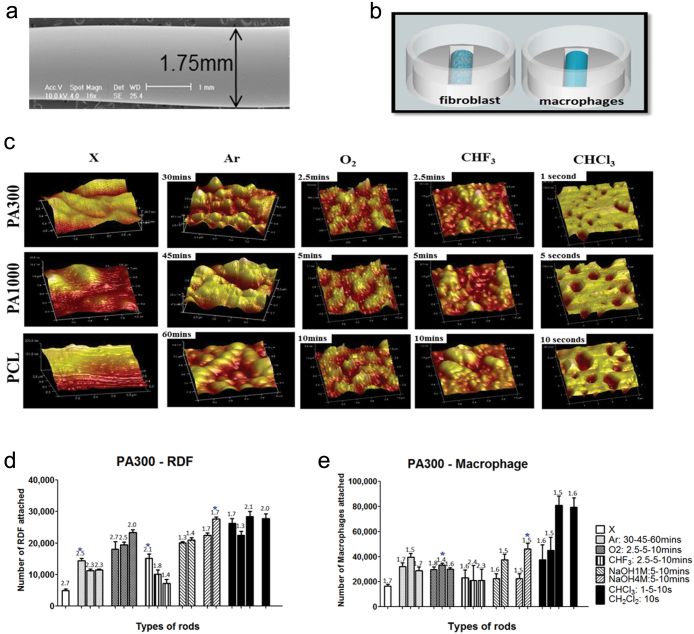
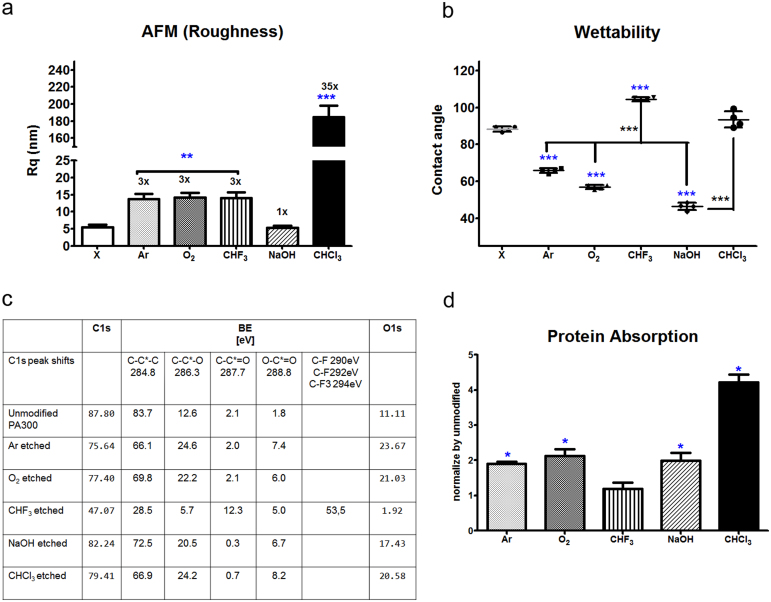
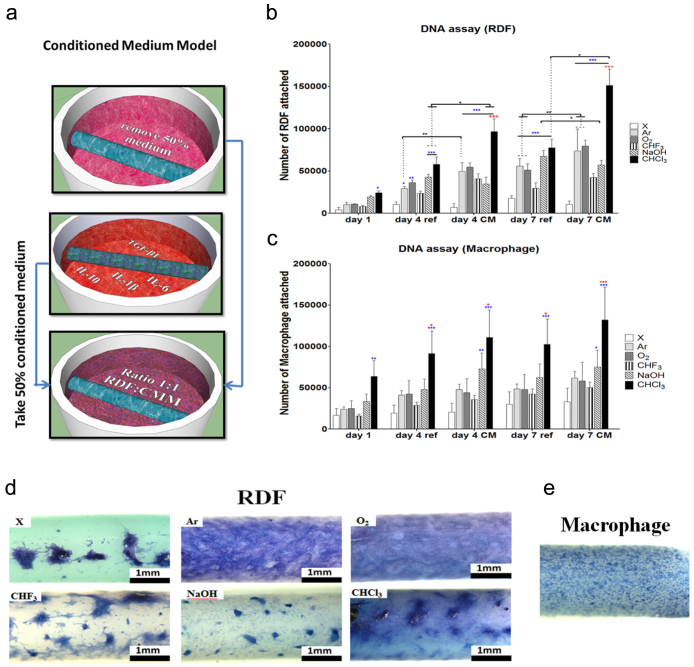
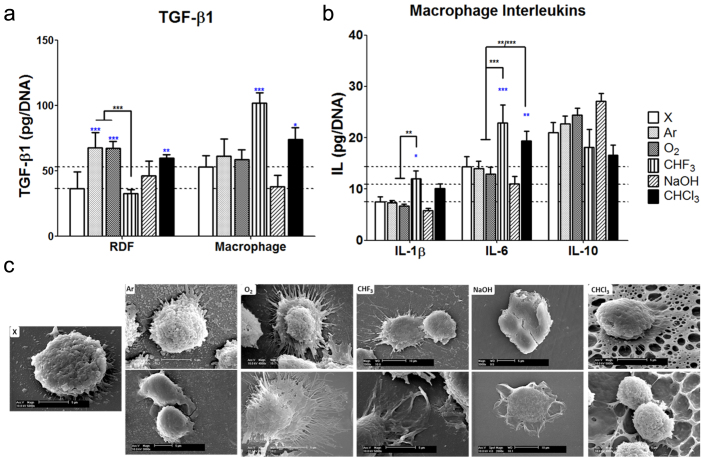
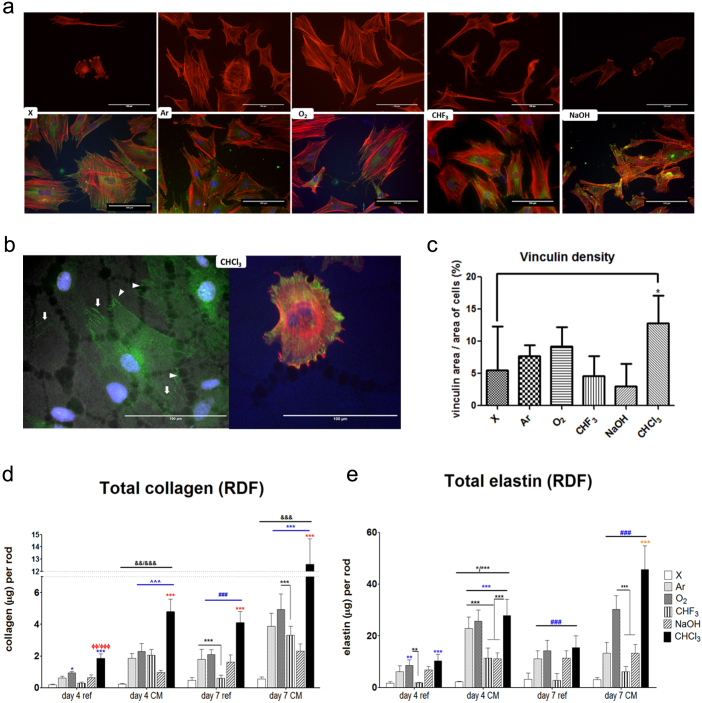
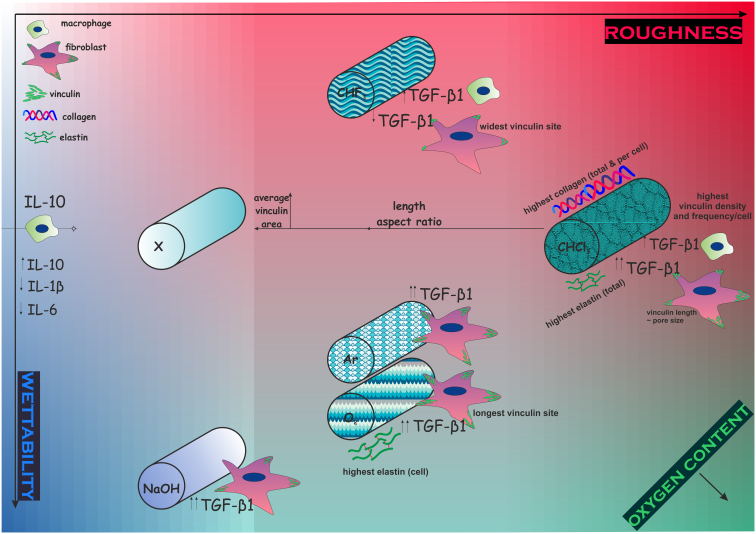
Despite various studies to minimize host reaction following a biomaterial implantation, an appealing strategy in regenerative medicine is to actively use such an immune response to trigger and control tissue regeneration. We have developed an in vitro model to modulate the host response by tuning biomaterials' surface properties through surface modifications techniques as a new strategy for tissue regeneration applications. Results showed tunable surface topography, roughness, wettability, and chemistry by varying treatment type and exposure, allowing for the first time to correlate the effect of these surface properties on cell attachment, morphology, strength and proliferation, as well as proinflammatory (IL-1β, IL-6) and antiinflammatory cytokines (TGF-β1, IL-10) secreted in medium, and protein expression of collagen and elastin. Surface microstructuring, derived from chloroform partial etching, increased surface roughness and oxygen content. This resulted in enhanced cell adhesion, strength and proliferation as well as a balance of soluble factors for optimum collagen and elastin synthesis for tissue regeneration. By linking surface parameters to cell activity, we could determine the fate of the regenerated tissue to create successful soft tissue-engineered replacement.
Overview
The claims and statistics of this paper haven’t been checked yet.
Free: it reads the open-access text and checks the first 5 claims that cite a source we can check. Create a free account to check every claim.
Integrity signals
Registry
Cites
Statistics
Figures
Verification
Claims the paper makes
The claims and statistics of this paper haven’t been checked yet.
Free: it reads the open-access text and checks the first 5 claims that cite a source we can check. Create a free account to check every claim.
Claims other papers make about this one
Each is checked against this paper’s own text: does it say what the citing paper says it does?
The source backs part of the claim, not all of it — or backs it for a different population, condition or comparison.
In the citing paper
“Furthermore, material pore size also affected fibroblast elongation, where condensed focal adhesion areas were found in larger pores while smaller pores resulted in increased elongation.[ 107 ]”
From Unraveling and Harnessing the Immune Response at the Cell–Biomaterial Interface for Tissue Engineering Purposes (2024) · cites this paper as [107]
Experimental — accuracy not yet measuredThe source backs part of the claim, not all of it — or backs it for a different population, condition or comparison.
In the citing paper
“Furthermore, a secretory increase of TGF‐β1 and IL‐6 was also observed, indicating a macrophage polarization shift toward the M2c state, an increase of collagen production and increased tissue remodeling.”
From Unraveling and Harnessing the Immune Response at the Cell–Biomaterial Interface for Tissue Engineering Purposes (2024) · cites this paper as [107]
Experimental — accuracy not yet measuredThe cited source says what the claim attributes to it.
In the citing paper
“Factors such as the surface roughness, wettability, and oxygen content have been found to directly influence the morphology and behavior of fibroblasts.”
From Unraveling and Harnessing the Immune Response at the Cell–Biomaterial Interface for Tissue Engineering Purposes (2024) · cites this paper as [107]
The cited source says what the claim attributes to it.
In the citing paper
“Higher levels of hydrophilicity, roughness, and oxygen content induced enhanced homogenous spread and formation of focal adhesion points.”
From Unraveling and Harnessing the Immune Response at the Cell–Biomaterial Interface for Tissue Engineering Purposes (2024) · cites this paper as [107]
The cited source says what the claim attributes to it.
In the citing paper
“the level of wettability has been shown to be adjustable through gas plasma treatment, which additionally affects the roughness of the material.[ 107 ]”
From Unraveling and Harnessing the Immune Response at the Cell–Biomaterial Interface for Tissue Engineering Purposes (2024) · cites this paper as [107]
2 more claims about this paper
Create a free account to see every claim other papers make about this one.
Self-check
Percentages, sums and reported differences re-computed from the paper’s own numbers.
The self-check needs the paper’s full text.
Citations
Cites
Macrophage plasticity and polarization: in vivo veritas
Sica, A., & Mantovani, A. (2012) · Journal of Clinical Investigation · doi:10.1172/jci59643 · Cited by 6,335
Foreign body reaction to biomaterials
Anderson, J. M., Rodriguez, A., & Chang, D. T. (2008) · Seminars in Immunology · doi:10.1016/j.smim.2007.11.004 · Cited by 5,138
Biological Responses to Materials
Anderson, J. M. (2001) · Annual Review of Materials Research · doi:10.1146/annurev.matsci.31.1.81 · Cited by 1,465
Seong, S.-Y., & Matzinger, P. (2004) · Nature Reviews Immunology · doi:10.1038/nri1372 · Cited by 1,220
Macrophages in Tumor Microenvironments and the Progression of Tumors
Hao, N.-B., Lü, M.-H., Fan, Y.-H., Cao, Y.-L., Zhang, Z.-R., & Yang, S.-M. (2012) · Clinical and Developmental Immunology · doi:10.1155/2012/948098 · Cited by 1,003
Macrophage phenotypes during tissue repair
Novak, M. L., & Koh, T. J. (2013) · Journal of Leukocyte Biology · doi:10.1189/jlb.1012512 · Cited by 658
Host Responses in Tissue Repair and Fibrosis
Duffield, J. S., Lupher, M., Thannickal, V. J., & Wynn, T. A. (2013) · Annual Review of Pathology: Mechanisms of Disease · doi:10.1146/annurev-pathol-020712-163930 · Cited by 624
Biomaterials/Tissue Interactions: Possible Solutions to Overcome Foreign Body Response
Morais, J. M., Papadimitrakopoulos, F., & Burgess, D. J. (2010) · The AAPS Journal · doi:10.1208/s12248-010-9175-3 · Cited by 560
Nanoparticle Hydrophobicity Dictates Immune Response
Moyano, D. F., Goldsmith, M., Solfiell, D. J., Landesman-Milo, D., Miranda, O. R., Peer, D., & Rotello, V. M. (2012) · Journal of the American Chemical Society · doi:10.1021/ja2108905 · Cited by 478
A critical role for elastin signaling in vascular morphogenesis and disease
Karnik, S. K., Brooke, B. S., Bayes-Genis, A., Sorensen, L., Wythe, J. D., Schwartz, R. S., Keating, M. T., & Li, D. Y. (2003) · Development · doi:10.1242/dev.00223 · Cited by 463
Cited by
Engineering Immunomodulatory Biomaterials To Tune the Inflammatory Response
Vishwakarma, A., Bhise, N. S., Evangelista, M. B., Rouwkema, J., Dokmeci, M. R., Ghaemmaghami, A. M., Vrana, N. E., & Khademhosseini, A. (2016) · Trends in Biotechnology · doi:10.1016/j.tibtech.2016.03.009 · Cited by 517
“which will be key to better mimic the FBR in vitro will allow the elucidation of biomaterial-specific responses in real-time [86,87], and will therefore substantially improve our ability to identify, predict, and control the immune response to implanted biomaterials.”
BackgroundMacrophage and Fibroblast Interactions in Biomaterial‐Mediated Fibrosis
Witherel, C. E., Abebayehu, D., Barker, T. H., & Spiller, K. L. (2019) · Advanced Healthcare Materials · doi:10.1002/adhm.201801451 · Cited by 374
Biomaterial-driven in situ cardiovascular tissue engineering—a multi-disciplinary perspective
Wissing, T. B., Bonito, V., Bouten, C. V. C., & Smits, A. I. P. M. (2017) · npj Regenerative Medicine · doi:10.1038/s41536-017-0023-2 · Cited by 232
Examination of the foreign body response to biomaterials by nonlinear intravital microscopy
Dondossola, E., Holzapfel, B. M., Alexander, S., Filippini, S., Hutmacher, D. W., & Friedl, P. (2016) · Nature Biomedical Engineering · doi:10.1038/s41551-016-0007 · Cited by 215
Macrophage responses to implants: prospects for personalized medicine
Kzhyshkowska, J., Gudima, A., Riabov, V., Dollinger, C., Lavalle, P., & Vrana, N. E. (2015) · Journal of Leukocyte Biology · doi:10.1189/jlb.5vmr0415-166r · Cited by 204
“[83].”
Metadata
- Authors
- Damanik, F. F. R., Rothuizen, T. C., van Blitterswijk, C., Rotmans, J. I., & Moroni, L.
- Affiliations
- University of Twente (NL)
- Leiden University Medical Center (NL)
- Maastricht University (NL)
- Corresponding author
- Damanik, Febriyani F. R.
- Moroni, Lorenzo
- Venue
- Scientific Reports
- Published
- 2014-09-19
- Volume
- 4
- Issue
- 1
- Pages
- 6325-6325
- ISSN
- 2045-2322 (ISSN-L)
- PMC
- PMC4168285
- OpenAlex
- W2010681507
- Semantic Scholar
- 998eb3e6ba885fdb0898b6fbc343962aec6c913e
- Cited by
- 97
- References
- 60
- Citations by year
- 2026: 3 · 2025: 4 · 2024: 7 · 2023: 6 · 2022: 7 · 2021: 10 · 2020: 7 · 2019: 12 · 2018: 15 · 2017: 12 · 2016: 8 · 2015: 6
- FWCI
- 4.50
- Type
- journal article
- Language
- en
- Open access
- gold
- doi.org
- Licence
- cc-by-nc-nd
- creativecommons.org/licenses/by-nc-nd/4.0 (tdm)
- creativecommons.org/licenses/by-nc-nd/4.0 (vor)
- Locations
- Scientific Reports (publishedVersion, cc-by-nc-nd)
- PubMed Central (publishedVersion, cc-by-nc-nd)
- PubMed (publishedVersion)
- Research Publications (Maastricht University) (publishedVersion, cc-by-nc-nd)
- University of Twente Research Information (publishedVersion, cc-by)
- Data Archiving and Networked Services (DANS) (submittedVersion)
- Leiden Repository (Leiden University) (submittedVersion)
- Research Publications (Maastricht University) (submittedVersion, cc-by-nc-nd)
- University of Twente Research Information (submittedVersion, cc-by)
- Funders
- Nierstichting
- Ministerie van Economische Zaken, Landbouw en Innovatie
- Topics
- Physical Sciences › Engineering › Biomedical Engineering › Bone Tissue Engineering Materials
- Health Sciences › Medicine › Surgery › Tissue Engineering and Regenerative Medicine
- Physical Sciences › Materials Science › Surfaces, Coatings and Films › Polymer Surface Interaction Studies
- Keywords
- foreign body reaction, biomaterial surface modification, surface topography, surface roughness, wettability, surface microstructuring, cell adhesion, cell proliferation, cytokine production, tissue regeneration, soft tissue engineering, in vitro model
- MeSH terms
- Animals, Biocompatible Materials, Cell Adhesion, Collagen, Elastin, Extracellular Matrix, Foreign Bodies, Gene Expression Regulation, Immunity, Active, Surface Properties, Interleukin-6, Interleukin-10, Tissue Engineering, Regenerative Medicine, Rats, Interleukin-1beta, Transforming Growth Factor beta1, In Vitro Techniques
About these checks
Registry, retraction, Cites and statistics results are computed, not judged, with one exception: a printed reference that no index lists is read once by a model before it counts as a citation error. Claims are extracted by a model and kept only when their quote appears verbatim in the text; each cited source is then checked, with a model’s help, for whether it says what the claim relies on. Those verdicts can be wrong — read the claim’s quote and the cited source before relying on one.
Statistics and arithmetic are recomputed, not judged.
Confidence bands are shown only for fields calibrated on our annotated test set. None is calibrated yet, so no band is shown.
What counts as a claim ›How we measure confidence ›How we check this ›
Are you an author, or do you see a problem with this page? Request a review
How to cite
Cite CoChat for the checks on this page, and the paper for its own findings.
- This page
- CoChat. (2026). Citation check: Towards an in vitro model mimicking the foreign body response: tailoring the surface properties of biomaterials to modulate extracellular matrix. https://app.cochat.ai/papers/10.1038/srep06325
- The paper
- Damanik, F. F. R., Rothuizen, T. C., van Blitterswijk, C., Rotmans, J. I., & Moroni, L. (2014). Towards an in vitro model mimicking the foreign body response: tailoring the surface properties of biomaterials to modulate extracellular matrix. Scientific Reports. https://doi.org/10.1038/srep06325
Data sources
Bibliographic data: Semantic Scholar, OpenAlex, Crossref.
Contains information from the Semantic Scholar Academic Graph Datasets, made available under the ODC Attribution License (ODC-BY 1.0).
Semantic Scholar’s data is described in: Kinney, R., et al. (2023). The Semantic Scholar Open Data Platform. arXiv:2301.10140.
