

Updating algal evolutionary relationships through plastid genome sequencing: did alveolate plastids emerge through endosymbiosis of an ochrophyte?
Open accessThe DOI matches its Crossref record; 54 of the 54 references it cites were found in a registry or an index.
Abstract
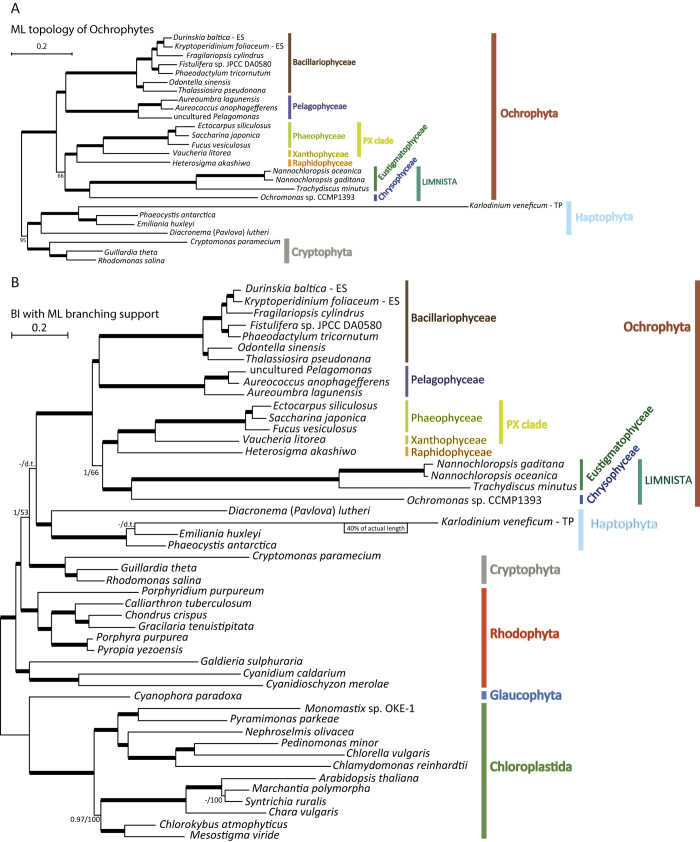
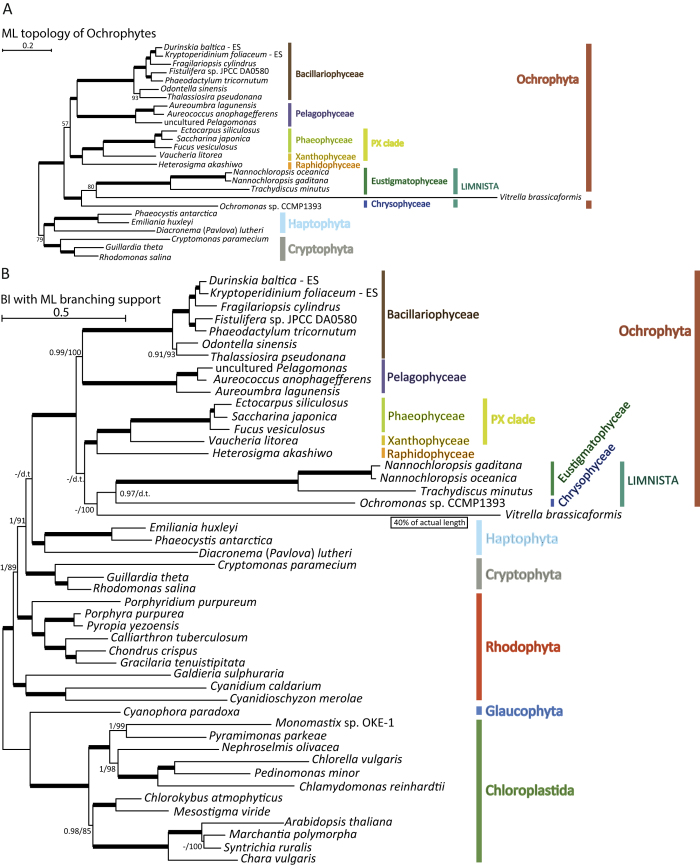
Algae with secondary plastids of a red algal origin, such as ochrophytes (photosynthetic stramenopiles), are diverse and ecologically important, yet their evolutionary history remains controversial. We sequenced plastid genomes of two ochrophytes, Ochromonas sp. CCMP1393 (Chrysophyceae) and Trachydiscus minutus (Eustigmatophyceae). A shared split of the clpC gene as well as phylogenomic analyses of concatenated protein sequences demonstrated that chrysophytes and eustigmatophytes form a clade, the Limnista, exhibiting an unexpectedly elevated rate of plastid gene evolution. Our analyses also indicate that the root of the ochrophyte phylogeny falls between the recently redefined Khakista and Phaeista assemblages. Taking advantage of the expanded sampling of plastid genome sequences, we revisited the phylogenetic position of the plastid of Vitrella brassicaformis , a member of Alveolata with the least derived plastid genome known for the whole group. The results varied depending on the dataset and phylogenetic method employed, but suggested that the Vitrella plastids emerged from a deep ochrophyte lineage rather than being derived vertically from a hypothetical plastid-bearing common ancestor of alveolates and stramenopiles. Thus, we hypothesize that the plastid in Vitrella and potentially in other alveolates, may have been acquired by an endosymbiosis of an early ochrophyte.
Overview
The claims and statistics of this paper haven’t been checked yet.
Free: it reads the open-access text and checks the first 5 claims that cite a source we can check. Create a free account to check every claim.
Integrity signals
Registry
Cites
Statistics
Figures
Verification
Claims the paper makes
The claims and statistics of this paper haven’t been checked yet.
Free: it reads the open-access text and checks the first 5 claims that cite a source we can check. Create a free account to check every claim.
Claims other papers make about this one
Each is checked against this paper’s own text: does it say what the citing paper says it does?
The source backs part of the claim, not all of it — or backs it for a different population, condition or comparison.
In the citing paper
“At present, the data suggest that red alga-type complex plastids share more recent common ancestry with those of mesophilic red algae such as Porphyra and Chondrus than they do with the plastids of extremophiles such as Cyanidioschyzon and Galdieria (e.g., Ševčíková et al. 2015; Kim et al. 2017; Muñoz-Gómez et al. 2017).”
From Genomic Insights into Plastid Evolution (2020) · cites this paper as Ševčíková et al. 2015
Experimental — accuracy not yet measuredThe check wasn’t confident either way, so it gives no verdict — never disputed.
In the citing paper
“a trend that has nevertheless emerged is plastid trees that unite haptophytes and cryptophytes to the exclusion of all other complex algae; see, e.g., Janouškovec et al. 2010; Ševčíková et al. 2015; Kim et al. 2017 and references therein for discussion”
From Genomic Insights into Plastid Evolution (2020) · cites this paper as Ševčíková et al. 2015
Experimental — accuracy not yet measured
Self-check
Percentages, sums and reported differences re-computed from the paper’s own numbers.
The self-check needs the paper’s full text.
Citations
Cites
RAxML-VI-HPC: maximum likelihood-based phylogenetic analyses with thousands of taxa and mixed models
Stamatakis, A. (2006) · Bioinformatics · doi:10.1093/bioinformatics/btl446 · Cited by 15,582
PhyloBayes 3: a Bayesian software package for phylogenetic reconstruction and molecular dating
Lartillot, N., Lepage, T., & Blanquart, S. (2009) · Bioinformatics · doi:10.1093/bioinformatics/btp368 · Cited by 1,297
Estimating the timing of early eukaryotic diversification with multigene molecular clocks
Parfrey, L. W., Lahr, D. J. G., Knoll, A. H., & Katz, L. A. (2011) · Proceedings of the National Academy of Sciences · doi:10.1073/pnas.1110633108 · Cited by 899
Lartillot, N., Brinkmann, H., & Philippe, H. (2007) · BMC Evolutionary Biology · doi:10.1186/1471-2148-7-s1-s4 · Cited by 705
CAVALIER‐SMITH, T. (1999) · Journal of Eukaryotic Microbiology · doi:10.1111/j.1550-7408.1999.tb04614.x · Cited by 621
Ruhfel, B. R., Gitzendanner, M. A., Soltis, P. S., Soltis, D. E., & Burleigh, J. (2014) · BMC Evolutionary Biology · doi:10.1186/1471-2148-14-23 · Cited by 552
The Number, Speed, and Impact of Plastid Endosymbioses in Eukaryotic Evolution
Keeling, P. J. (2013) · Annual Review of Plant Biology · doi:10.1146/annurev-arplant-050312-120144 · Cited by 493
A common red algal origin of the apicomplexan, dinoflagellate, and heterokont plastids
Janouškovec, J., Horák, A., Oborník, M., Lukeš, J., & Keeling, P. J. (2010) · Proceedings of the National Academy of Sciences · doi:10.1073/pnas.1003335107 · Cited by 489
Self-citationHampl, V., Hug, L., Leigh, J. W., Dacks, J. B., Lang, B. F., Simpson, A. G. B., & Roger, A. J. (2009) · Proceedings of the National Academy of Sciences · doi:10.1073/pnas.0807880106 · Cited by 483
Self-citationA photosynthetic alveolate closely related to apicomplexan parasites
Moore, R. B., Oborník, M., Janouškovec, J., Chrudimský, T., Vancová, M., Green, D. H., Wright, S. W., Davies, N. W., Bolch, C. J. S., Heimann, K., et al. (2008) · Nature · doi:10.1038/nature06635 · Cited by 476
Self-citation
Research works printed but not linked: 1
- Yoon H. S., Andersen R. A., Boo S. M. & Bhattacharya D. Stramenopiles. In Eukaryotic Microbes (ed. Schaechter M.) 373– 384 Academic Press 2012).
Cited by
Items 101–127 of 127
An, Y., Hao, J., Nan, F., Lv, J., Liu, Q., Liu, X., Xie, S., & Feng, J. (2025) · Biodiversity Data Journal · doi:10.3897/bdj.13.e150900 · Cited by 2
микробиологии, Ф. В. Н. С., & ПРОВОРОВ, Н. А. (2022) · Sel skokhozyaistvennaya Biologiya · doi:10.15389/agrobiology.2022.5.821rus · Cited by 2
Complex Endosymbioses I: From Primary to Complex Plastids, Serial Endosymbiotic Events
Füssy, Z., & Oborník, M. (2024) · Methods in molecular biology · doi:10.1007/978-1-0716-3726-5_2 · Cited by 4
Self-citationTranslocation of Proteins into Four Membrane-Bound Complex Plastids of Red Algal Origin
Gruber, A., & Kroth, P. G. (2024) · Springer eBooks · doi:10.1007/978-3-031-57446-7_15 · Cited by 2
Putative MutS2 Homologs in Algae: More Goods in Shopping Bag?
Berdieva, M. A., Kalinina, V. O., Palii, O., & Skarlato, S. O. (2024) · Journal of Molecular Evolution · doi:10.1007/s00239-024-10210-y · Cited by 2
“…a number of structural and molecular differences and phylogenetic analyzes have suggested that common ancestral alveolate plastid could have been replaced with a new one, presumably from eustigmatophytes, in the apicomplexan/chrom-podellid lineage (Ševcíková et al. 2015; Füssy and Oborník 2017).”
Evolution: Structure and surprises in the diversification of golden algae
Graf, L., & Dorrell, R. G. (2025) · Current Biology · doi:10.1016/j.cub.2024.12.014 · Cited by 1
Hoskinson, J. S., & Wideman, J. G. (2025) · The American Biology Teacher · doi:10.1525/abt.2025.87.2.93 · Cited by 1
“…secondary and tertiary endosymbioses have resulted in the many different kinds of unicellular algae spread across the tree of eukaryotes (Burki, 2017; Cavalier-Smith, 1999; Dorrell et al., 2017; Miller & Delwiche, 2015; Petersen et al., 2014; Ševcíková et al., 2015; Stiller et al., 2014).”
Bodył, A., Cieśla, J., Mackiewicz, P., & Gagat, P. (2016) · WORLD SCIENTIFIC (EUROPE) eBooks · doi:10.1142/9781786340580_0009 · Cited by 1
A PHYLOGENOMIC APPROACH TO EXPLORE PHOTOSYNTHETHIC STRAMENOPILE EVOLUTION
Terpis, K. X. (2021) · Digital Commons - URI (University of Rhode Island) · doi:10.23860/thesis-terpis-kristina-2021
Novák, L., Muñoz-Gómez, S. A., van Beveren, F., Ciobanu, M., Eme, L., López‐García, P., & Moreira, D. (2026) · New Phytologist · doi:10.1111/nph.71116 · Cited by 1
Chachoui, S., Amkraz, N., Mimouni, A., & Boubaker, H. (2024) · Environmental Monitoring and Assessment · doi:10.1007/s10661-024-12656-5
“Their plastid is of red algal origin (Ševčíková et al., 2015).”
Dinotoms possess two evolutionary distinct autophagy-related ubiquitin-like conjugation systems
Yazaki, E., Uehara, T., Sakamoto, H., & Inagaki, Y. (2024) · Protist · doi:10.1016/j.protis.2024.126067
Metabolic Adaptations Determine the Evolutionary Trajectory of TOR Signaling in Diverse Eukaryotes
Johnson, K., Pourkeramati, D., Korf, I. F., & Powers, T. (2025) · Biomolecules · doi:10.3390/biom15091295 · Cited by 1
Sun, X., Li, K., He, F.-Y., Wang, H.-J., Chen, H., Wen, Q., Liu, H.-Y., Zhao, F., Chen, X., Weng, Y., et al. (2025) · Science Advances · doi:10.1126/sciadv.aea4965 · Cited by 2
“Previous studies have suggested that the dinoflagellate peridinin plastid originated from ochrophytes ( 61 – 63 ).”
Bakku, R. K. (2026) · Elsevier eBooks · doi:10.1016/b978-0-443-15652-6.00002-3
Richtář, M., Klapuchová, E., Yurchenko, T., Fawley, K. P., Fawley, M. W., Barcytė, D., Jaške, K., Wolf, B. M., Li, F., Ševčíková, T., et al. (2026) · bioRxiv (Cold Spring Harbor Laboratory) · doi:10.64898/2026.03.28.715030
Self-citationOrigins and early evolution of photosynthetic eukaryotes
Ponce-Toledo, R. I. (2018) · theses.fr (ABES) · doi:10.70675/e80da54ez4400z4af2z90ccza6b6fb5b6bc7 · Cited by 1
“publications have suggested possible scenarios of serial plastid acquisitions (Bodył, 2017; Bodył et al., 2009; Kim et al., 2017; Ševčíková et al., 2015) (Fig.”
BackgroundFranco, A. D. (2019) · theses.fr (ABES) · doi:10.70675/9c8d2b6cz53cfz4351za1cbz83d9c20217f1 · Cited by 1
“Comparison with more recently published plastid (Ševčíková et al. 2015), mitochondrial (Ševčíková et al. 2016) and nuclear trees (Derelle et al. 2016) was more difficult, as those datasets lacked some major clades: Bolidophyceae, Dictyochophyceae and Pinguiophyceae (Ševčíková et al. 2015); Bolidophyceae, Dictyochophyc…”
BackgroundResultInfluentialLight sensing in the Ocean : studying diatom phytochrome photoreceptors
Duchêne, C. (2022) · theses.fr (ABES) · doi:10.70675/1a0d43adz02ecz44e7z8d03zeb6fa0027308
The evolution of red algal organellar genomes and the origin of red complex plastids
van Beveren, F. (2022) · theses.fr (ABES) · doi:10.70675/1d5ed7dezb138z4504za194z566b690fb2db · Cited by 1
The life cycle of fatty acids in oleaginous stramenopiles: from synthesis to maturation and beyond
Sérès, Y., Serbutoviez-Verville, C., Maréchal, É., & Amato, A. (2026) · BMC Plant Biology · doi:10.1186/s12870-026-08803-4
“These findings suggest that the plastids in stramenopiles, alveo-lates, and haptophytes may have been acquired via tertiary endosymbiosis from cryptophytes, or possibly even more complex quaternary endosymbiosis [22].”
Rao, X., Liu, L., Yuan, X., Liang, W., & Gao, X. (2026) · Mitochondrial DNA Part A · doi:10.1080/24701394.2026.2677588
Gastineau, R., Freyria, N. J., Lemieux, C., Turmel, M., Otis, C., & Lovejoy, C. (2026) · Scientific Reports · doi:10.1038/s41598-026-58736-z
Single cell genomics and fluorescence microscopy suggest a permanent plastid in a marine centrohelidPreprint
Walraven, A., Zlatogursky, V. V., Keeling, P. J., Foster, R. A., & Burki, F. (2026) · bioRxiv (Cold Spring Harbor Laboratory) · doi:10.64898/2026.06.22.732937
Jia, L., Hou, Y., Zhang, M. M., Li, L., Zhang, Y., Wang, J., Yuan, Z., Fan, G., Shi, C., & Zhao, H. (2026) · Biology · doi:10.3390/biology15131058
“Recent research has established that Rhodophyta, despite losing flagella ancestrally, contributed chloroplasts to Alveolata through endosymbiosis, yet the evolutionary trajectory of their flagellar-related genes remains poorly resolved [7].”
Richtář, M., Klapuchová, E., Yurchenko, T., Fawley, K. P., Fawley, M. W., Barcytė, D., Jaške, K., Wolf, B. M., Li, F., Ševčíková, T., et al. (2026) · Genome Biology and Evolution · doi:10.1093/gbe/evag169 · Cited by 1
Self-citationJia, L., Li, L., Zhang, Y., Wang, J., Yuan, Z., Fan, G., Shi, C., & Zhang, M. M. (2026) · Biology · doi:10.3390/biology15141127
“Parmales, a group of heterotrophic flagellates that occupy a key phylogenetic position near the root of the Opisthokonta, have also been reported to possess silicon-transporting vesicles, although they do not form structured siliceous cell walls [4].”
Metadata
- Authors
- Ševčíková, T., Horák, A., Klimeš, V., Zbránková, V., Demir-Hilton, E., Sudek, S., Jenkins, J., Schmutz, J., Přibyl, P., Fousek, J., Vlček, Č., Lang, B. F., Oborník, M., Worden, A. Z., & Eliáš, M.
- Affiliations
- University of Ostrava (CZ)
- Czech Academy of Sciences (CZ)
- Monterey Bay Aquarium Research Institute (US)
- Joint Genome Institute (US)
- HudsonAlpha Institute for Biotechnology (US)
- Université de Montréal (CA)
- Canadian Institute for Advanced Research (CA)
- Corresponding author
- Worden, Alexandra Z.
- Eliáš, Marek
- ORCID
- Venue
- Scientific Reports
- Published
- 2015-05-28
- Volume
- 5
- Issue
- 1
- Pages
- 10134-10134
- ISSN
- 2045-2322 (ISSN-L)
- PMC
- PMC4603697
- OpenAlex
- W2261599836
- Semantic Scholar
- 71dea813ef989305b303250355f4bd816eb8a322
- Cited by
- 125
- References
- 54
- Citations by year
- 2026: 11 · 2025: 7 · 2024: 15 · 2023: 4 · 2022: 13 · 2021: 10 · 2020: 8 · 2019: 14 · 2018: 11 · 2017: 18 · 2016: 13 · 2015: 1
- FWCI
- 6.23
- Type
- journal article
- Language
- en
- Open access
- gold
- doi.org
- Licence
- cc-by
- creativecommons.org/licenses/by/4.0 (tdm)
- creativecommons.org/licenses/by/4.0 (vor)
- Locations
- Scientific Reports (publishedVersion, cc-by)
- Europe PMC (PubMed Central) (publishedVersion, cc-by)
- PubMed Central (publishedVersion, cc-by)
- PubMed (publishedVersion)
- Helmholtz Centre for Ocean Research Kiel (GEOMAR) (acceptedVersion, other-oa)
- OSTI OAI (U.S. Department of Energy Office of Scientific and Technical Information) (submittedVersion)
- ASEP (submittedVersion, public-domain)
- eScholarship (California Digital Library) (submittedVersion)
- Funders
- U.S. Department of Energy (-AC02-05CH11231, Contract No. DE-AC02-05-CH11231, 05CH11231, No. DE-AC02-05-CH11231, DE AC02 05CH11231, GBMF3788, DESC0004765, DE-AC02-)
- Gordon and Betty Moore Foundation (GBMF3788)
- Joint Genome Institute (AC02-05CH11231, DE–AC02–05CH11231)
- Grantová Agentura České Republiky (GPP506/12/P931, LO1208, GA13-33039S)
- Office of Science (No. DE-AC02- 05-CH11231, DEAC02–05CH11231, AC02-05CH11231, DE-AC02, 05CH11231, Contract No. DE-AC02-05CH11231)
- Topics
- Life Sciences › Agricultural and Biological Sciences › Ecology, Evolution, Behavior and Systematics › Protist diversity and phylogeny
- Life Sciences › Biochemistry, Genetics and Molecular Biology › Molecular Biology › Photosynthetic Processes and Mechanisms
- Life Sciences › Biochemistry, Genetics and Molecular Biology › Genetics › Chromosomal and Genetic Variations
- Keywords
- chloroplast genome, algal evolution, endosymbiosis, Ochromonas, Chrysophyceae, Eustigmatophyceae, plastid phylogeny, alveolates
- MeSH terms
- Rhodophyta, DNA, Phylogeny, Symbiosis, Sequence Analysis, DNA, Plastids, Evolution, Molecular, Genome, Plastid, Stramenopiles
About these checks
Registry, retraction, Cites and statistics results are computed, not judged, with one exception: a printed reference that no index lists is read once by a model before it counts as a citation error. Claims are extracted by a model and kept only when their quote appears verbatim in the text; each cited source is then checked, with a model’s help, for whether it says what the claim relies on. Those verdicts can be wrong — read the claim’s quote and the cited source before relying on one.
Statistics and arithmetic are recomputed, not judged.
Confidence bands are shown only for fields calibrated on our annotated test set. None is calibrated yet, so no band is shown.
What counts as a claim ›How we measure confidence ›How we check this ›
Are you an author, or do you see a problem with this page? Request a review
Data sources
Bibliographic data: Semantic Scholar, OpenAlex, Crossref.
Contains information from the Semantic Scholar Academic Graph Datasets, made available under the ODC Attribution License (ODC-BY 1.0).
Semantic Scholar’s data is described in: Kinney, R., et al. (2023). The Semantic Scholar Open Data Platform. arXiv:2301.10140.
