

Updating algal evolutionary relationships through plastid genome sequencing: did alveolate plastids emerge through endosymbiosis of an ochrophyte?
Open accessThe DOI matches its Crossref record; 54 of the 54 references it cites were found in a registry or an index.
Abstract
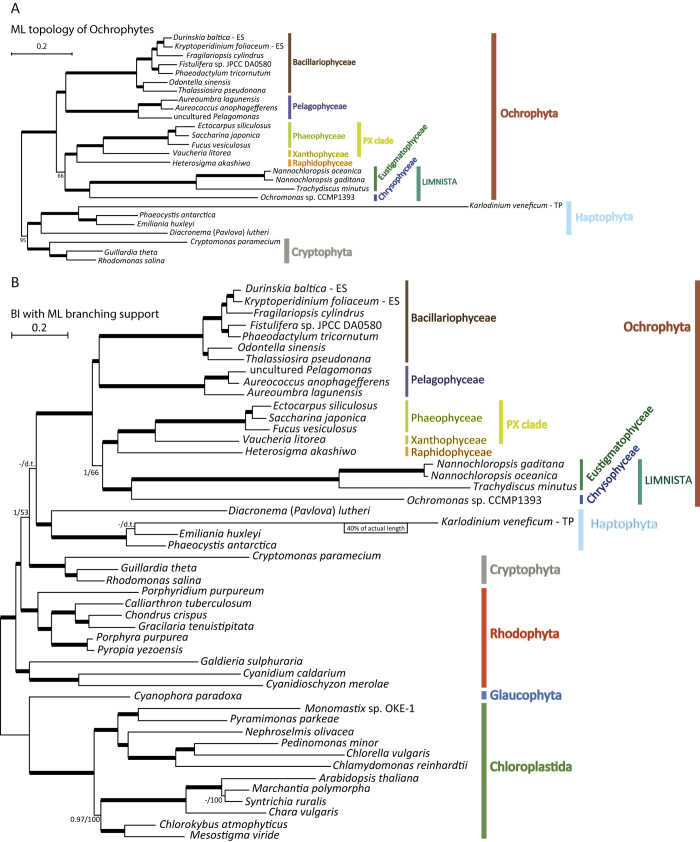
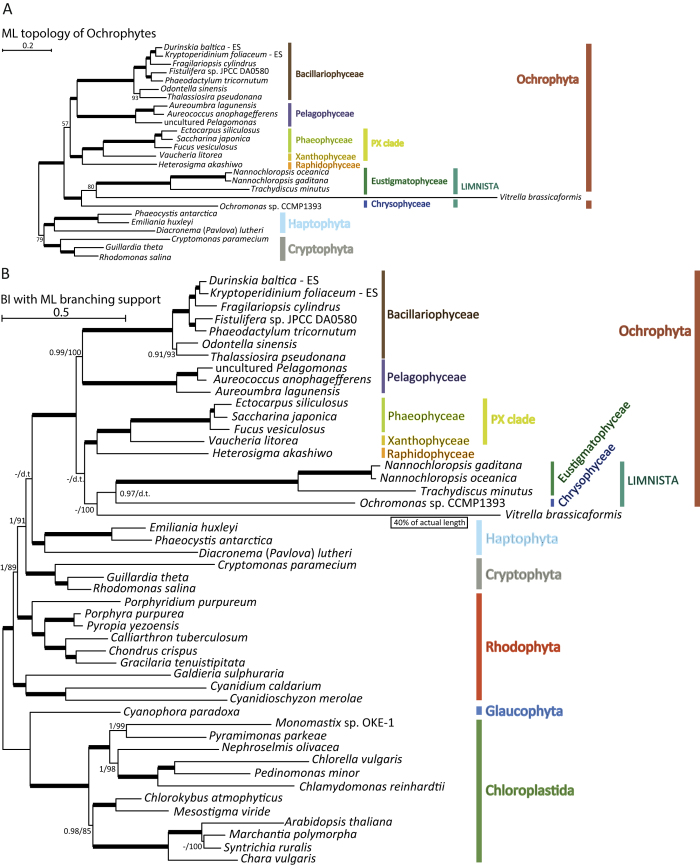
Algae with secondary plastids of a red algal origin, such as ochrophytes (photosynthetic stramenopiles), are diverse and ecologically important, yet their evolutionary history remains controversial. We sequenced plastid genomes of two ochrophytes, Ochromonas sp. CCMP1393 (Chrysophyceae) and Trachydiscus minutus (Eustigmatophyceae). A shared split of the clpC gene as well as phylogenomic analyses of concatenated protein sequences demonstrated that chrysophytes and eustigmatophytes form a clade, the Limnista, exhibiting an unexpectedly elevated rate of plastid gene evolution. Our analyses also indicate that the root of the ochrophyte phylogeny falls between the recently redefined Khakista and Phaeista assemblages. Taking advantage of the expanded sampling of plastid genome sequences, we revisited the phylogenetic position of the plastid of Vitrella brassicaformis , a member of Alveolata with the least derived plastid genome known for the whole group. The results varied depending on the dataset and phylogenetic method employed, but suggested that the Vitrella plastids emerged from a deep ochrophyte lineage rather than being derived vertically from a hypothetical plastid-bearing common ancestor of alveolates and stramenopiles. Thus, we hypothesize that the plastid in Vitrella and potentially in other alveolates, may have been acquired by an endosymbiosis of an early ochrophyte.
Overview
The claims and statistics of this paper haven’t been checked yet.
Free: it reads the open-access text and checks the first 5 claims that cite a source we can check. Create a free account to check every claim.
Integrity signals
Registry
Cites
Statistics
Figures
Verification
Claims the paper makes
The claims and statistics of this paper haven’t been checked yet.
Free: it reads the open-access text and checks the first 5 claims that cite a source we can check. Create a free account to check every claim.
Claims other papers make about this one
Each is checked against this paper’s own text: does it say what the citing paper says it does?
The source backs part of the claim, not all of it — or backs it for a different population, condition or comparison.
In the citing paper
“At present, the data suggest that red alga-type complex plastids share more recent common ancestry with those of mesophilic red algae such as Porphyra and Chondrus than they do with the plastids of extremophiles such as Cyanidioschyzon and Galdieria (e.g., Ševčíková et al. 2015; Kim et al. 2017; Muñoz-Gómez et al. 2017).”
From Genomic Insights into Plastid Evolution (2020) · cites this paper as Ševčíková et al. 2015
Experimental — accuracy not yet measuredThe check wasn’t confident either way, so it gives no verdict — never disputed.
In the citing paper
“a trend that has nevertheless emerged is plastid trees that unite haptophytes and cryptophytes to the exclusion of all other complex algae; see, e.g., Janouškovec et al. 2010; Ševčíková et al. 2015; Kim et al. 2017 and references therein for discussion”
From Genomic Insights into Plastid Evolution (2020) · cites this paper as Ševčíková et al. 2015
Experimental — accuracy not yet measured
Self-check
Percentages, sums and reported differences re-computed from the paper’s own numbers.
The self-check needs the paper’s full text.
Citations
Cites
RAxML-VI-HPC: maximum likelihood-based phylogenetic analyses with thousands of taxa and mixed models
Stamatakis, A. (2006) · Bioinformatics · doi:10.1093/bioinformatics/btl446 · Cited by 15,582
PhyloBayes 3: a Bayesian software package for phylogenetic reconstruction and molecular dating
Lartillot, N., Lepage, T., & Blanquart, S. (2009) · Bioinformatics · doi:10.1093/bioinformatics/btp368 · Cited by 1,297
Estimating the timing of early eukaryotic diversification with multigene molecular clocks
Parfrey, L. W., Lahr, D. J. G., Knoll, A. H., & Katz, L. A. (2011) · Proceedings of the National Academy of Sciences · doi:10.1073/pnas.1110633108 · Cited by 899
Lartillot, N., Brinkmann, H., & Philippe, H. (2007) · BMC Evolutionary Biology · doi:10.1186/1471-2148-7-s1-s4 · Cited by 705
CAVALIER‐SMITH, T. (1999) · Journal of Eukaryotic Microbiology · doi:10.1111/j.1550-7408.1999.tb04614.x · Cited by 621
Ruhfel, B. R., Gitzendanner, M. A., Soltis, P. S., Soltis, D. E., & Burleigh, J. (2014) · BMC Evolutionary Biology · doi:10.1186/1471-2148-14-23 · Cited by 552
The Number, Speed, and Impact of Plastid Endosymbioses in Eukaryotic Evolution
Keeling, P. J. (2013) · Annual Review of Plant Biology · doi:10.1146/annurev-arplant-050312-120144 · Cited by 493
A common red algal origin of the apicomplexan, dinoflagellate, and heterokont plastids
Janouškovec, J., Horák, A., Oborník, M., Lukeš, J., & Keeling, P. J. (2010) · Proceedings of the National Academy of Sciences · doi:10.1073/pnas.1003335107 · Cited by 489
Self-citationHampl, V., Hug, L., Leigh, J. W., Dacks, J. B., Lang, B. F., Simpson, A. G. B., & Roger, A. J. (2009) · Proceedings of the National Academy of Sciences · doi:10.1073/pnas.0807880106 · Cited by 483
Self-citationA photosynthetic alveolate closely related to apicomplexan parasites
Moore, R. B., Oborník, M., Janouškovec, J., Chrudimský, T., Vancová, M., Green, D. H., Wright, S. W., Davies, N. W., Bolch, C. J. S., Heimann, K., et al. (2008) · Nature · doi:10.1038/nature06635 · Cited by 476
Self-citation
Research works printed but not linked: 1
- Yoon H. S., Andersen R. A., Boo S. M. & Bhattacharya D. Stramenopiles. In Eukaryotic Microbes (ed. Schaechter M.) 373– 384 Academic Press 2012).
Cited by
Burki, F., Kaplan, M., Tikhonenkov, D. V., Zlatogursky, V., Minh, B. Q., Radaykina, L. V., Smirnov, A., Mylnikov, A. P., & Keeling, P. J. (2016) · Proceedings of the Royal Society B: Biological Sciences · doi:10.1098/rspb.2015.2802 · Cited by 301
Strassert, J. F. H., Irisarri, I., Williams, T. A., & Burki, F. (2021) · Nature Communications · doi:10.1038/s41467-021-22044-z · Cited by 298
A molecular timescale for the origin of red algal-derived plastids
(2020) · doi:10.1101/2020.08.20.259127 · Cited by 298
A Phylogenomic Framework to Study the Diversity and Evolution of Stramenopiles (=Heterokonts)
Derelle, R., López-García, P., Timpano, H., & Moreira, D. (2016) · Molecular Biology and Evolution · doi:10.1093/molbev/msw168 · Cited by 172
Genomic Insights into Plastid Evolution
Sibbald, S. J., & Archibald, J. M. (2020) · Genome Biology and Evolution · doi:10.1093/gbe/evaa096 · Cited by 161
Chimeric origins of ochrophytes and haptophytes revealed through an ancient plastid proteome
Dorrell, R. G., Gile, G., McCallum, G., Méheust, R., Bapteste, E. P., Klinger, C. M., Brillet-Guéguen, L., Freeman, K. D., Richter, D. J., & Bowler, C. (2017) · eLife · doi:10.7554/elife.23717 · Cited by 152
Comparative and Functional Algal Genomics
Blaby-Haas, C. E., & Merchant, S. S. (2019) · Annual Review of Plant Biology · doi:10.1146/annurev-arplant-050718-095841 · Cited by 131
Multiple independent origins of apicomplexan-like parasites
Mathur, V., Kolísko, M., Hehenberger, E., Irwin, N. A. T., Leander, B. S., Kristmundsson, Á., Freeman, M. A., & Keeling, P. J. (2019) · Current Biology · doi:10.1016/j.cub.2019.07.019 · Cited by 126
Basu, S., Patil, S., Mapleson, D., Russo, M. T., Vitale, L. A., Fevola, C., Maumus, F., Casotti, R., Möck, T., Cáccamo, M., et al. (2017) · New Phytologist · doi:10.1111/nph.14557 · Cited by 146
Muñoz-Gómez, S. A., Mejía-Franco, F. G., Durnin, K., Colp, M., Grisdale, C. J., Archibald, J. M., & Slamovits, C. H. (2017) · Current Biology · doi:10.1016/j.cub.2017.04.054 · Cited by 114
Leyland, B., Leu, S., & Boussiba, S. (2017) · Fungal Biology · doi:10.1016/j.funbio.2017.07.006 · Cited by 107
“…endosymbiotic events have been d monstrated in the Alveolata, Rhizaria, and Euglenids, which suggests it’s not as unlikely a phenomenon as the proponents of the Chromalveolate hypothesis assumed a priori (Inagaki et al. 2000; Rogers et al. 2007; Petersen et al. 2014; Ševčíková et al. 2015).”
BackgroundJackson, C., Knoll, A. H., Chan, C. X., & Verbruggen, H. (2018) · Scientific Reports · doi:10.1038/s41598-017-18805-w · Cited by 99
Diversity of Plastid Types and Their Interconversions
Choi, H., Yi, T., & Ha, S. (2021) · Frontiers in Plant Science · doi:10.3389/fpls.2021.692024 · Cited by 87
Principles of plastid reductive evolution illuminated by nonphotosynthetic chrysophytes
Dorrell, R. G., Azuma, T., Nomura, M., de Kerdrel, G. A., Paoli, L., Yang, S. S., Bowler, C., Ishii, K., Miyashita, H., Gile, G. H., et al. (2019) · Proceedings of the National Academy of Sciences · doi:10.1073/pnas.1819976116 · Cited by 86
“CCMP1393 (22) in both size (126,750 bp) and the number of encoded proteins (124; Fig.”
BackgroundMethodInfluentialEvolutionary dynamics of cryptophyte plastid genomes
Kim, J. I., Moore, C. E., Archibald, J. M., Bhattacharya, D., Yi, G., Yoon, H. S., & Shin, W. (2017) · Genome Biology and Evolution · doi:10.1093/gbe/evx123 · Cited by 70
Phylogenomic fingerprinting of tempo and functions of horizontal gene transfer within ochrophytes
Dorrell, R. G., Villain, A., Perez‐Lamarque, B., de Kerdrel, G. A., McCallum, G., Watson, A., Aït-Mohamed, O., Alberti, A., Corre, E., Frischkorn, K. R., et al. (2021) · Proceedings of the National Academy of Sciences · doi:10.1073/pnas.2009974118 · Cited by 70
“…in the small numbers (26) of gene trees that implied a horizontal transfer from the ochro-phytes into other plastid-bearing alveolates [e.g., apicomplexans, and chromerids (25)], which showed a weak enrichment in signal toward synchromophytes, synurophytes, and chrysophytes ( SI Appendix , Fig.”
InfluentialFunctional relationship between a dinoflagellate host and its diatom endosymbiont
Hehenberger, E., Burki, F., Kolisko, M., & Keeling, P. J. (2016) · Molecular Biology and Evolution · doi:10.1093/molbev/msw109 · Cited by 61
Plastid Complexity in Dinoflagellates: A Picture of Gains, Losses, Replacements and Revisions
Waller, R. F., & Kořený, L. (2017) · Advances in botanical research · doi:10.1016/bs.abr.2017.06.004 · Cited by 70
Architecture of the light-harvesting apparatus of the eustigmatophyte alga Nannochloropsis oceanica
Litvín, R., Bína, D., Herbstová, M., & Gardian, Z. (2016) · Photosynthesis Research · doi:10.1007/s11120-016-0234-1 · Cited by 62
Biddau, M., Bouchut, A., Major, J., Saveria, T., Tottey, J., Oka, O., van Lith, M., Jennings, K. E., Ovciarikova, J., DeRocher, A. E., et al. (2018) · PLoS Pathogens · doi:10.1371/journal.ppat.1006836 · Cited by 55
Endosymbiotic Evolution of Algae, Secondary Heterotrophy and Parasitism
Oborník, M. (2019) · Biomolecules · doi:10.3390/biom9070266 · Cited by 58
Self-citationYurchenko, T., Ševčíková, T., Přibyl, P., Karkouri, K. E., Klimeš, V., Amaral, R., Zbránková, V., Kim, E., Raoult, D., Santos, L. M. A., et al. (2018) · The ISME Journal · doi:10.1038/s41396-018-0177-y · Cited by 55
Self-citationTriassic chrysophyte cyst fossils discovered in the Ordos Basin, China
Zhang, W., Yang, H. Q., Xia, X., Liqin, X., & Xie, G. (2016) · Geology · doi:10.1130/g38527.1 · Cited by 49
Did some red alga‐derived plastids evolve via kleptoplastidy? A hypothesis
Bodył, A. (2018) · Biological Reviews · doi:10.1111/brv.12340 · Cited by 47
“In support of this view, the phylogenetic analyses of Ševčíková et al. (2015) show that the chromerid plastid evolved from an ochrophyte alga, which suggests that this plastid (along with those of apicomplexans and perkinsids) and the peridinin plastid have distinct ochrophyte versus haptophyte…”
BackgroundMethodInfluentialBartolo, A. G., Zammit, G., Peters, A. F., & Küpper, F. C. (2020) · Botanica Marina · doi:10.1515/bot-2019-0041 · Cited by 62
Choi, C. J., Jiménez, V., Needham, D. M., Poirier, C. L., Bachy, C., Alexander, H., Wilken, S., Chavez, F. P., Sudek, S., Giovannoni, S. J., et al. (2020) · Frontiers in Microbiology · doi:10.3389/fmicb.2020.542372 · Cited by 50
“, diatoms and eustigmatophytes (Sevcikova et al., 2015), and the four dictyochophytes, which range from 108,152 to 140,025 bp.”
BackgroundInfluentialSelf-citationYurchenko, T., Ševčíková, T., Strnad, H., Butenko, A., & Eliáš, M. (2016) · Open Biology · doi:10.1098/rsob.160249 · Cited by 44
“All previous reports on eustigmatophyte plastomes, including our own study [3,8,9,12], missed the presence of the ssrA gene specifying transfer-messenger RNA (tmRNA).”
InfluentialSelf-citationSalomaki, E. D., & Kolísko, M. (2019) · Biomolecules · doi:10.3390/biom9080378 · Cited by 45
Bolidophyceae, a Sister Picoplanktonic Group of Diatoms – A Review
Kuwata, A., Yamada, K., Ichinomiya, M., Yoshikawa, S., Tragin, M., Vaulot, D., & dos Santos, A. L. (2018) · Frontiers in Marine Science · doi:10.3389/fmars.2018.00370 · Cited by 45
A Comparative Analysis of Mitochondrial Genomes in Eustigmatophyte Algae
Ševčíková, T., Klimeš, V., Zbránková, V., Strnad, H., Hradilová, M., Vlček, Č., & Eliáš, M. (2016) · Genome Biology and Evolution · doi:10.1093/gbe/evw027 · Cited by 41
Self-citationŠevčíková, T., Yurchenko, T., Fawley, K. P., Amaral, R., Strnad, H., Santos, L. M. A., Fawley, M. W., & Eliáš, M. (2019) · Genome Biology and Evolution · doi:10.1093/gbe/evz004 · Cited by 38
Self-citationCihlář, J., Füssy, Z., Horák, A., & Oborník, M. (2016) · PLoS ONE · doi:10.1371/journal.pone.0166338 · Cited by 35
Self-citationThe Convoluted Evolution of Eukaryotes With Complex Plastids
Burki, F. (2017) · Advances in botanical research · doi:10.1016/bs.abr.2017.06.001 · Cited by 43
Secondary Plastids of Stramenopiles
Dorrell, R. G., & Bowler, C. (2017) · Advances in botanical research · doi:10.1016/bs.abr.2017.06.003 · Cited by 43
Comparative plastid genomics of Synurophyceae: inverted repeat dynamics and gene content variation
Kim, J. I., Shin, H.-M., Škaloud, P., Jung, J., Yoon, H. S., Archibald, J. M., & Shin, W. (2019) · BMC Evolutionary Biology · doi:10.1186/s12862-018-1316-9 · Cited by 32
“, Phaeophyceae, Phaeothamniophyceae, Xanthophyceae, and Eustigmatophyceae ([5, 38, 39], this study).”
BackgroundResultInfluentialDictyochophyceae Plastid Genomes Reveal Unusual Variability in Their Organization
Han, K. Y., Maciszewski, K., Graf, L., Yang, J. H., Andersen, R. A., Karnkowska, A., & Yoon, H. S. (2019) · Journal of Phycology · doi:10.1111/jpy.12904 · Cited by 36
Klinger, C. M., Paoli, L., Newby, R. J., Wang, M. Y.-W., Carroll, H. D., Leblond, J. D., Howe, C. J., Dacks, J. B., Bowler, C., Cahoon, A. B., et al. (2018) · Genome Biology and Evolution · doi:10.1093/gbe/evy057 · Cited by 33
“Of these, PPR proteins are known to bind sequence motifs upstream of editing events, and direct editing site specificity (Shikanai 2015).”
BackgroundIntegrated overview of stramenopile ecology, taxonomy, and heterotrophic origin
Jírsová, D., & Wideman, J. G. (2024) · The ISME Journal · doi:10.1093/ismejo/wrae150 · Cited by 34
“These findings indicate that ochrophyte, alveolate, and hapto-phyte algae could have been derived from tertiary endosymbioses of cryptophytes or even more complex quaternary endosym-bioses [117].”
BackgroundAmaral, R., Fawley, K. P., Němcová, Y., Ševčíková, T., Lukešová, A., Fawley, M. W., Santos, L. M. A., & Eliáš, M. (2020) · Journal of Phycology · doi:10.1111/jpy.12980 · Cited by 29
Self-citationWaller, R. F., Gornik, S. G., Kořený, L., & Pain, A. (2015) · Communicative & Integrative Biology · doi:10.1080/19420889.2015.1116653 · Cited by 29
“endosymbiotic gains and/or exchanges of red algal symbionts.(17-23) These include secondary, tertiary and even quaternary endosymbiotic events, the permutations of”
BackgroundDiversity and evolution of cytochromes P450 in stramenopiles
Teng, L., Fan, X., Nelson, D. R., Han, W., Zhang, X., Xu, D., Renault, H., Markov, G. V., & Ye, N. (2018) · Planta · doi:10.1007/s00425-018-3028-1 · Cited by 30
Liu, F., Jin, Z., Wang, Y., Yu-ping, B., & Melton, J. T. (2017) · Marine Biotechnology · doi:10.1007/s10126-017-9781-5 · Cited by 29
Eliáš, M., Amaral, R., Fawley, K. P., Fawley, M. W., Němcová, Y., Neustupa, J., Přibyl, P., Santos, L. M. A., & Ševčíková, T. (2017) · Springer eBooks · doi:10.1007/978-3-319-28149-0_39 · Cited by 35
Self-citationSobotka, R., Esson, H. J., Koník, P., Trsková, E. K., Moravcová, L., Horák, A., Dufková, P., & Oborník, M. (2017) · Scientific Reports · doi:10.1038/s41598-017-13575-x · Cited by 29
Self-citationFerredoxin-dependent bilin reductases in eukaryotic algae: Ubiquity and diversity
Rockwell, N. C., & Lagarias, J. C. (2017) · Journal of Plant Physiology · doi:10.1016/j.jplph.2017.05.022 · Cited by 26
Füssy, Z., & Oborník, M. (2017) · Advances in botanical research · doi:10.1016/bs.abr.2017.07.001 · Cited by 28
Self-citationAn Enigmatic Stramenopile Sheds Light on Early Evolution in Ochrophyta Plastid Organellogenesis
Azuma, T., Pánek, T., Tice, A. K., Kayama, M., Kobayashi, M., Miyashita, H., Suzaki, T., Yabuki, A., Brown, M. W., & Kamikawa, R. (2022) · Molecular Biology and Evolution · doi:10.1093/molbev/msac065 · Cited by 26
“Ochrophyta has been taxonomically divided into two large groups — Diatomista and Chrysista: Bolidophyceae, Bacillariophyceae, Dictyochophyceae, Pinguiophyceae, and Pelagophyceae are subassemblages of the former, and Chrysophyceae, Synchromophyceae, Phaeophyceae, Xanthophyceae, Raphidophyceae, and Eustigmatophyceae of…”
InfluentialMultiple parallel origins of parasitic Marine Alveolates
Holt, C. C., Hehenberger, E., Tikhonenkov, D. V., Jacko-Reynolds, V. K. L., Okamoto, N., Cooney, E. C., Irwin, N. A. T., & Keeling, P. J. (2023) · Nature Communications · doi:10.1038/s41467-023-42807-0 · Cited by 28
Füssy, Z., Masařová, P., Kručinská, J., Esson, H. J., & Oborník, M. (2016) · Protist · doi:10.1016/j.protis.2016.12.001 · Cited by 26
Self-citationComplex Endosymbioses I: From Primary to Complex Plastids, Multiple Independent Events
Füssy, Z., & Oborník, M. (2018) · Methods in molecular biology · doi:10.1007/978-1-4939-8654-5_2 · Cited by 26
Self-citationGoodenough, U. W., Roth, R. A., Kariyawasam, T., Amelia, H., & Lee, J. (2018) · mBio · doi:10.1128/mbio.02020-18 · Cited by 28
Bína, D., Gardian, Z., Herbstová, M., & Litvín, R. (2016) · Photosynthesis Research · doi:10.1007/s11120-016-0315-1 · Cited by 24
Dorrell, R. G., Klinger, C. M., Newby, R. J., Butterfield, E. R., Richardson, E., Dacks, J. B., Howe, C. J., Nisbet, R. E. R., & Bowler, C. (2016) · Molecular Biology and Evolution · doi:10.1093/molbev/msw235 · Cited by 25
Litvín, R., Bína, D., Herbstová, M., Pazderník, M., Kotabová, E., Gardian, Z., Trtílek, M., Prášil, O., & Vácha, F. (2019) · Photosynthesis Research · doi:10.1007/s11120-019-00662-5 · Cited by 21
Biosynthesis of chlorophyll c in a dinoflagellate and heterologous production in planta
Jinkerson, R. E., Poveda-Huertes, D., Cooney, E. C., Cho, A., Ochoa‐Fernandez, R., Keeling, P. J., Xiang, T., & Andersen‐Ranberg, J. (2023) · Current Biology · doi:10.1016/j.cub.2023.12.068 · Cited by 28
Lower Statistical Support with Larger Data Sets: Insights from the Ochrophyta Radiation
Franco, A. D., Baurain, D., Glöckner, G., Melkonian, M., & Philippe, H. (2021) · Molecular Biology and Evolution · doi:10.1093/molbev/msab300 · Cited by 21
Olisthodiscus represents a new class of Ochrophyta
Barcytė, D., Eikrem, W., Engesmo, A., Seoane, S., Wohlmann, J., Horák, A., Yurchenko, T., & Eliáš, M. (2021) · Journal of Phycology · doi:10.1111/jpy.13155 · Cited by 22
“Our results are congruent with outcomes of similar analyses reported before ( Sev c ıkov a et al. 2015, Han et al. 2019, Kim et al. 2019) and support the existence of three primary clades of ochrophytes initially proposed on the bases of a five-gene analysis carried out by Yang et al. (2012) and…”
BackgroundResultInfluentialSelf-citationMoog, D., Nozawa, A., Tozawa, Y., & Kamikawa, R. (2020) · Scientific Reports · doi:10.1038/s41598-020-58082-8 · Cited by 21
Molecular evolution and diversification of phytoene synthase (PSY) gene family
Lisbôa, M. P., Canal, D., Filgueiras, J. P. C., & Turchetto‐Zolet, A. C. (2022) · Genetics and Molecular Biology · doi:10.1590/1678-4685-gmb-2021-0411 · Cited by 18
“Our results corroborate with other studies, such those that have demonstrated that the ochrophytahas a red alga-derived plastid through eukaryote– eukaryote endosymbiosis (Ševčíková et al ., 2015; Sibbald and Archibald, 2020; Azuma et al ., 2022).”
He, F.-Y., Zhao, L., Qu, X.-X., Li, K., Guo, J., Zhao, F., Wang, N., Qin, B.-Y., Chen, X., Gao, J., et al. (2024) · Proceedings of the National Academy of Sciences · doi:10.1073/pnas.2413678121 · Cited by 22
“Most photosynthetic dinoflagellates possess a peridinin plastid, and it has been suggested that the ancestor of the peridinin plastid could have been an ochrophyte ( 35 , 62 , 63 ).”
Leblond, J. D., McDaniel, S. L., Lowrie, S. D., Khadka, M., & Dahmen, J. L. (2018) · European Journal of Phycology · doi:10.1080/09670262.2018.1519602 · Cited by 18
“ing lipid biosynthesis genes) from pelagophytes (cf. Stiller et al. 2014; Ševčíková et al. 2015; Dorrell et al. 2017).”
BackgroundIkumi, U., Kunugi, M., Yokono, M., Takabayashi, A., & Tanaka, A. (2017) · Photosynthesis Research · doi:10.1007/s11120-017-0438-z · Cited by 18
New plastids, old proteins: repeated endosymbiotic acquisitions in kareniacean dinoflagellates
Vanclová, A. M. G. N., Nef, C., Füssy, Z., Vancl, A., Liu, F., Bowler, C., & Dorrell, R. G. (2024) · EMBO Reports · doi:10.1038/s44319-024-00103-y · Cited by 22
“Within the eukaryotic tree of life, they fall among the supergroup Alveolata, speci fi cally Myzozoa, along with chrompodellids and apicomplexans ( Š ev č íková et al, 2015).”
BackgroundGraf, L., Yang, E. C., Han, K. Y., Küpper, F. C., Benes, K. M., Oyadomari, J. K., Herbert, R. J. H., Verbruggen, H., Wetherbee, R., Andersen, R. A., et al. (2020) · Protist · doi:10.1016/j.protis.2020.125781 · Cited by 17
Phylogenomic analyses of ochrophytes (stramenopiles) with an emphasis on neglected lineages
Cho, A., Lax, G., & Keeling, P. J. (2024) · Molecular Phylogenetics and Evolution · doi:10.1016/j.ympev.2024.108120 · Cited by 15
Comparative Plastid Genomics of Non-Photosynthetic Chrysophytes: Genome Reduction and Compaction
Kim, J. I., Jeong, M., Archibald, J. M., & Shin, W. (2020) · Frontiers in Plant Science · doi:10.3389/fpls.2020.572703 · Cited by 19
Gastineau, R., Давидович, Н. А., Davidovich, O. I., Lemieux, C., Turmel, M., Wróbel, R. J., & Witkowski, A. (2021) · International Journal of Molecular Sciences · doi:10.3390/ijms22137155 · Cited by 14
Marine Protists: A Hitchhiker’s Guide to their Role in the Marine Microbiome
Bachy, C., Hehenberger, E., Ling, Y.-C., Needham, D. M., Strauss, J., Wilken, S., & Worden, A. Z. (2022) · The microbiomes of humans, animals, plants, and the environment · doi:10.1007/978-3-030-90383-1_4 · Cited by 20
Self-citationCho, A., Tikhonenkov, D. V., Lax, G., Prokina, K. I., & Keeling, P. J. (2023) · Molecular Phylogenetics and Evolution · doi:10.1016/j.ympev.2023.107964 · Cited by 13
“…branches (e.g., Marine OCHrophytes (MOCH) (Massana et al., 2014) and Olisthodiscophyceae (Barcyt ˙ e et al., 2021)) and developing new phylogenomic models that can resolve short internal branches within early ochrophyte divergence (di Franco et al., 2021; Philippe et al., 2011; ˇ ´ et al., 2015).”
BackgroundRe-analyses of “Algal” Genes Suggest a Complex Evolutionary History of Oomycetes
Qia, W., Sun, H., & Huang, J. (2017) · Frontiers in Plant Science · doi:10.3389/fpls.2017.01540 · Cited by 14
“Although there are different views about the phylogenetic relationships within stramenopiles (Brown and Sorhannus, 2009; Riisberg et al., 2009; Yang et al., 2012; Cavalier-Smith and Scoble, 2013; Ševčíková et al., 2015), the most recent phylogenomic analyses suggest that oomycetes form a clade closely related to ochro…”
BackgroundHollin, T., Jaroszewski, L., Stajich, J., Godzik, A., & Roch, K. G. L. (2021) · Microbial Genomics · doi:10.1099/mgen.0.000541 · Cited by 16
“Successive tertiary and quaternary endosymbiosis are also still considered to explain their evolution [68, 69].”
BackgroundA New Model and Dating for the Evolution of Complex Plastids of Red Alga Origin
Pietluch, F., Mackiewicz, P., Ludwig, K. R., & Gagat, P. (2024) · Genome Biology and Evolution · doi:10.1093/gbe/evae192 · Cited by 14
Identification of a deep-branching lineage of algae using environmental plastid genomes
Jamy, M., Huber, T., Antoine, T., Ruscheweyh, H., Paoli, L., Pelletier, É., Delmont, T. O., & Burki, F. (2025) · Nature Communications · doi:10.1038/s41467-025-67401-4 · Cited by 18
Pyrenoid Structure, Function, Evolution, and Characterization Across Diverse Lineages
Barrett, J., Nam, O., Naduthodi, M. I. S., & Mackinder, L. C. M. (2026) · Annual Review of Plant Biology · doi:10.1146/annurev-arplant-070225-034846 · Cited by 12
Pigment configuration in the light-harvesting protein of the xanthophyte alga Xanthonema debile
Streckaitė, S., Gardian, Z., Li, F., Pascal, A. A., Litvín, R., Robert, B., & Llansola‐Portoles, M. J. (2018) · Photosynthesis Research · doi:10.1007/s11120-018-0557-1 · Cited by 12
Biogeographical Patterns and Genomes of Aquatic Photoautotrophs
Karlusich, J. J. P., Nef, C., Bowler, C., & Dorrell, R. G. (2022) · Wiley eBooks · doi:10.1002/9781119986782.ch3 · Cited by 7
Barcytė, D., Jaške, K., Pánek, T., Yurchenko, T., Ševčíková, T., Eliášová, A., & Eliáš, M. (2024) · Open Biology · doi:10.1098/rsob.240022 · Cited by 10
“Variation to the organization of the plastidial clpC gene has, however, been noted before in two ochrophyte lineages, chrysophytes and eustigmatophytes [41].”
BackgroundSelf-citationEliáš, M., Amaral, R., Fawley, K. P., Fawley, M. W., Němcová, Y., Neustupa, J., Přibyl, P., Santos, L. M. A., & Ševčíková, T. (2016) · Springer eBooks · doi:10.1007/978-3-319-32669-6_39-1 · Cited by 11
Self-citationLiu, F., Liu, S., Huang, T., & Chen, N. (2019) · Journal of Applied Phycology · doi:10.1007/s10811-019-01952-0 · Cited by 11
Jírsová, D., Füssy, Z., Richtová, J., Gruber, A., & Oborník, M. (2019) · Microorganisms · doi:10.3390/microorganisms7080240 · Cited by 9
“Their plastids are complex in origin, and are derived from a rhodophyte ancestor [20,21].”
BackgroundSelf-citationLewis, W. H., Paris, G., Beedessee, G., Kořený, L., Flores, V. M. Q., Dendooven, T., Gallet, B., Yee, D. P., Lam, S., Decelle, J., et al. (2024) · Current Biology · doi:10.1016/j.cub.2024.10.034 · Cited by 10
“48,49”
Position of Algae on the Tree of Life
Gololobova, M. A., & Belyakova, G. A. (2022) · Doklady Biological Sciences · doi:10.1134/s0012496622060035 · Cited by 12
“Reconstructions based on chloroplast phylogeny agree with the idea that all plastids originating from an ancestral red alga are a product of a single secondary endosymbiotic event (Janouškovec et al., 2010; Qiu et al., 2012; Ševčíková et al., 2015).”
BackgroundPlastid Genomes in the Myzozoa
Muñoz-Gómez, S. A., & Slamovits, C. H. (2017) · Advances in botanical research · doi:10.1016/bs.abr.2017.11.015 · Cited by 12
Проворов, Н. А. (2022) · Sel skokhozyaistvennaya Biologiya · doi:10.15389/agrobiology.2022.5.821eng · Cited by 7
Characterization of Aminoacyl-tRNA Synthetases in Chromerids
Sharaf, A., Gruber, A., Jiroutová, K., & Oborník, M. (2019) · Genes · doi:10.3390/genes10080582 · Cited by 7
Self-citationReconstructing Dynamic Evolutionary Events in Diatom Nuclear and Organelle Genomes
Dorrell, R. G., Liu, F., & Bowler, C. (2022) · Springer eBooks · doi:10.1007/978-3-030-92499-7_6 · Cited by 7
Transition dynamics in plastid interconversion in land plants
Altamura, M. M., Piacentini, D., Rovere, F. D., Fattorini, L., Valletta, A., & Falasca, G. (2024) · Plant Biosystems - An International Journal Dealing with all Aspects of Plant Biology · doi:10.1080/11263504.2024.2375333 · Cited by 8
“The two organisms became inextricably linked due to several processes occurring during their co-evolution (Ševčíková et al. 2015; Sibbald and Archibald 2020).”
Fatty Acid Biosynthesis in Chromerids
Tomčala, A., Michálek, J., Schneedorferová, I., Füssy, Z., Gruber, A., Vancová, M., & Oborník, M. (2020) · Biomolecules · doi:10.3390/biom10081102 · Cited by 8
Self-citationGastineau, R., Yılmaz, E., Solak, C. N., Lemieux, C., Turmel, M., & Witkowski, A. (2021) · Mitochondrial DNA Part B · doi:10.1080/23802359.2021.1923416 · Cited by 6
Ponce-Toledo, R. I., Moreira, D., López-García, P., & Deschamps, P. (2025) · Molecular Biology and Evolution · doi:10.1093/molbev/msaf167 · Cited by 5
The Complete Plastid Genomes of Seven Sargassaceae Species and Their Phylogenetic Analysis
Li, R., Jia, X., Zhang, J., Jia, S., Liu, T., Qu, J., & Wang, X. (2021) · Frontiers in Plant Science · doi:10.3389/fpls.2021.747036 · Cited by 7
Ponce-Toledo, R. I., Moreira, D., López-García, P., & Deschamps, P. (2025) · doi:10.1101/2025.03.31.646294 · Cited by 5
Reductive Evolution of Apicomplexan Parasites from Phototrophic Ancestors
Füssy, Z., & Oborník, M. (2017) · Springer eBooks · doi:10.1007/978-3-319-61569-1_12 · Cited by 7
Self-citationWang, L., Yang, M., Guo, C., Jiang, Y., Zhu, Z., Hu, C., & Zhang, X. (2023) · Chemosphere · doi:10.1016/j.chemosphere.2023.140885 · Cited by 5
Divergent and diversified proteome content across a serially acquired plastid lineagePreprint
Vanclová, A. M. G. N., Nef, C., Vancl, A., Liu, F., Füssy, Z., Bowler, C., & Dorrell, R. (2022) · bioRxiv · doi:10.1101/2022.11.30.518497 · Cited by 2
“Within the eukaryotic tree of life, they fall among the supergroup Alveolata, specifically Myzozoa along with chrompodellids and apicomplexans (Ševčíková et al., 2015).”
Přibyl, P., & Procházková, L. (2022) · European Journal of Phycology · doi:10.1080/09670262.2022.2089913 · Cited by 2
Self-citationComplex Plastids Across the Eukaryotes: An Overview of Inherited and Convergently Evolved Characters
Vanclová, A. M. G. N., & Dorrell, R. G. (2024) · Springer eBooks · doi:10.1007/978-3-031-57446-7_2 · Cited by 10
Small Genomes and Big Data: Adaptation of Plastid Genomics to the High-Throughput Era
Klinger, C. M., & Richardson, E. (2019) · Biomolecules · doi:10.3390/biom9080299 · Cited by 3
Evolutionary Dynamics and Lateral Gene Transfer in Raphidophyceae Plastid Genomes
Kim, J. I., Jo, B. Y., Park, M. G., Yoo, Y. D., Shin, W., & Archibald, J. M. (2022) · Frontiers in Plant Science · doi:10.3389/fpls.2022.896138 · Cited by 3
“This is consistent with earlier studies documenting the patchy distribution of group II introns in cyanobacteria and diverse eukaryotes (e.g., Odom et al., 2004; Sheveleva and Hallick, 2004; Khan and Archibald, 2008; Kim et al., 2022; Suzuki et al., 2022).”
ResultAlgae from Secondary Endosymbiosis
Friedl, T. (2024) · Springer eBooks · doi:10.1007/978-3-662-65712-6_5 · Cited by 3
Metadata
- Authors
- Ševčíková, T., Horák, A., Klimeš, V., Zbránková, V., Demir-Hilton, E., Sudek, S., Jenkins, J., Schmutz, J., Přibyl, P., Fousek, J., Vlček, Č., Lang, B. F., Oborník, M., Worden, A. Z., & Eliáš, M.
- Affiliations
- University of Ostrava (CZ)
- Czech Academy of Sciences (CZ)
- Monterey Bay Aquarium Research Institute (US)
- Joint Genome Institute (US)
- HudsonAlpha Institute for Biotechnology (US)
- Université de Montréal (CA)
- Canadian Institute for Advanced Research (CA)
- Corresponding author
- Worden, Alexandra Z.
- Eliáš, Marek
- ORCID
- Venue
- Scientific Reports
- Published
- 2015-05-28
- Volume
- 5
- Issue
- 1
- Pages
- 10134-10134
- ISSN
- 2045-2322 (ISSN-L)
- PMC
- PMC4603697
- OpenAlex
- W2261599836
- Semantic Scholar
- 71dea813ef989305b303250355f4bd816eb8a322
- Cited by
- 125
- References
- 54
- Citations by year
- 2026: 11 · 2025: 7 · 2024: 15 · 2023: 4 · 2022: 13 · 2021: 10 · 2020: 8 · 2019: 14 · 2018: 11 · 2017: 18 · 2016: 13 · 2015: 1
- FWCI
- 6.23
- Type
- journal article
- Language
- en
- Open access
- gold
- doi.org
- Licence
- cc-by
- creativecommons.org/licenses/by/4.0 (tdm)
- creativecommons.org/licenses/by/4.0 (vor)
- Locations
- Scientific Reports (publishedVersion, cc-by)
- Europe PMC (PubMed Central) (publishedVersion, cc-by)
- PubMed Central (publishedVersion, cc-by)
- PubMed (publishedVersion)
- Helmholtz Centre for Ocean Research Kiel (GEOMAR) (acceptedVersion, other-oa)
- OSTI OAI (U.S. Department of Energy Office of Scientific and Technical Information) (submittedVersion)
- ASEP (submittedVersion, public-domain)
- eScholarship (California Digital Library) (submittedVersion)
- Funders
- U.S. Department of Energy (-AC02-05CH11231, Contract No. DE-AC02-05-CH11231, 05CH11231, No. DE-AC02-05-CH11231, DE AC02 05CH11231, GBMF3788, DESC0004765, DE-AC02-)
- Gordon and Betty Moore Foundation (GBMF3788)
- Joint Genome Institute (AC02-05CH11231, DE–AC02–05CH11231)
- Grantová Agentura České Republiky (GPP506/12/P931, LO1208, GA13-33039S)
- Office of Science (No. DE-AC02- 05-CH11231, DEAC02–05CH11231, AC02-05CH11231, DE-AC02, 05CH11231, Contract No. DE-AC02-05CH11231)
- Topics
- Life Sciences › Agricultural and Biological Sciences › Ecology, Evolution, Behavior and Systematics › Protist diversity and phylogeny
- Life Sciences › Biochemistry, Genetics and Molecular Biology › Molecular Biology › Photosynthetic Processes and Mechanisms
- Life Sciences › Biochemistry, Genetics and Molecular Biology › Genetics › Chromosomal and Genetic Variations
- Keywords
- chloroplast genome, algal evolution, endosymbiosis, Ochromonas, Chrysophyceae, Eustigmatophyceae, plastid phylogeny, alveolates
- MeSH terms
- Rhodophyta, DNA, Phylogeny, Symbiosis, Sequence Analysis, DNA, Plastids, Evolution, Molecular, Genome, Plastid, Stramenopiles
About these checks
Registry, retraction, Cites and statistics results are computed, not judged, with one exception: a printed reference that no index lists is read once by a model before it counts as a citation error. Claims are extracted by a model and kept only when their quote appears verbatim in the text; each cited source is then checked, with a model’s help, for whether it says what the claim relies on. Those verdicts can be wrong — read the claim’s quote and the cited source before relying on one.
Statistics and arithmetic are recomputed, not judged.
Confidence bands are shown only for fields calibrated on our annotated test set. None is calibrated yet, so no band is shown.
What counts as a claim ›How we measure confidence ›How we check this ›
Are you an author, or do you see a problem with this page? Request a review
Data sources
Bibliographic data: Semantic Scholar, OpenAlex, Crossref.
Contains information from the Semantic Scholar Academic Graph Datasets, made available under the ODC Attribution License (ODC-BY 1.0).
Semantic Scholar’s data is described in: Kinney, R., et al. (2023). The Semantic Scholar Open Data Platform. arXiv:2301.10140.
