

Residual Tumor Volume as Best Outcome Predictor in Low Grade Glioma – A Nine-Years Near-Randomized Survey of Surgery vs. Biopsy
Open accessThe DOI matches its Crossref record; 42 of the 44 references it cites were found in a registry or an index.
Abstract
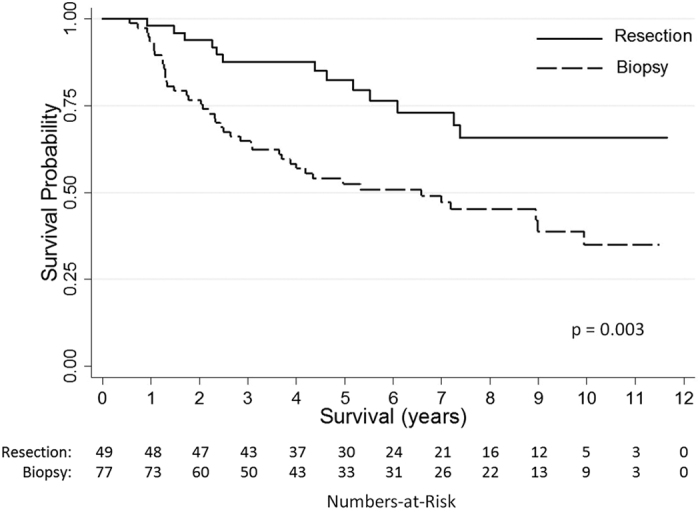
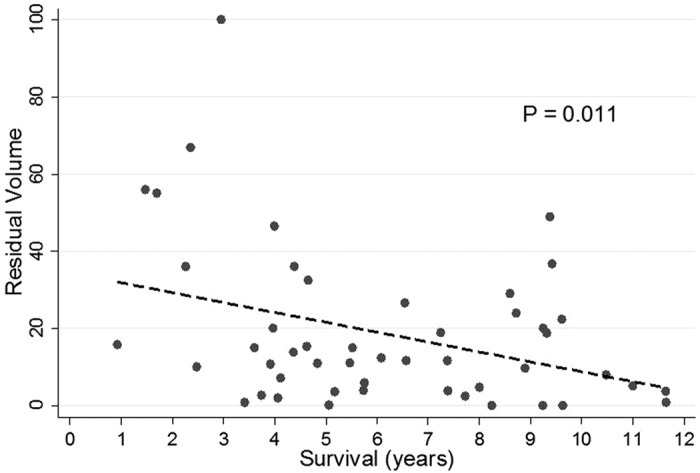
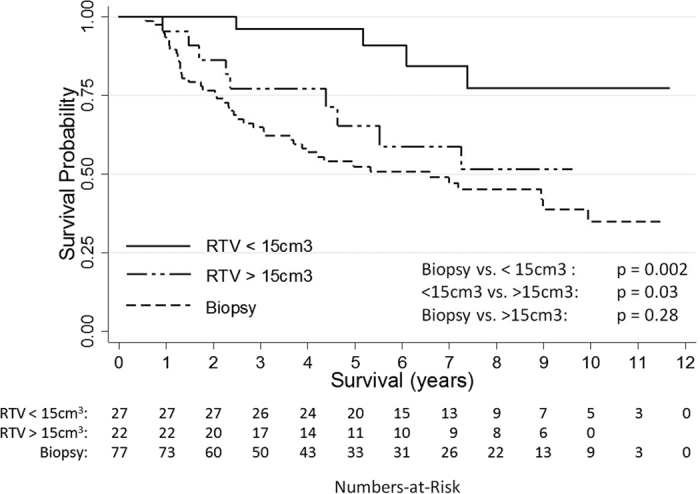
Diffuse low grade gliomas (DLGG) are continuously progressive primary brain neoplasms that lead to neurological deficits and death. Treatment strategies are controversial. Randomized trials establishing the prognostic value of surgery do not exist. Here, we report the results of a nine-year near-randomized patient distribution between resection and biopsy. Until 2012, the Department of Neurosurgery and the Department of Stereotactic Neurosurgery at the University Medical Center Freiburg were organized as separate administrative units both coordinating DLGG patient treatment independently. All consecutive adult patients with a new diagnosis of DLGG by either stereotactic biopsy or resection were included. Pre- and post-operative tumor volumetry was performed. 126 patients, 87 men (69%), 39 women (31%), median age 41 years, were included. 77 (61%) were initially managed by biopsy, 49 (39%) by resection. A significant survival benefit was found for patients with an initial management by resection (5-year OS 82% vs. 54%). The survival benefit of patients with initial resection was reserved to patients with a residual tumor volume of less than 15 cm 3. Maximum safe resection is the first therapy of choice in DLGG patients if a near-complete tumor removal can be achieved. Accurate prediction of the extent-of-resection is required for selection of surgical candidates.
Overview
The claims and statistics of this paper haven’t been checked yet.
Free: it reads the open-access text and checks the first 5 claims that cite a source we can check. Create a free account to check every claim.
Integrity signals
Registry
Cites
Statistics
Figures
Verification
Claims the paper makes
The claims and statistics of this paper haven’t been checked yet.
Free: it reads the open-access text and checks the first 5 claims that cite a source we can check. Create a free account to check every claim.
Claims other papers make about this one
Each is checked against this paper’s own text: does it say what the citing paper says it does?
The source backs part of the claim, not all of it — or backs it for a different population, condition or comparison.
In the citing paper
“RTV > 10–15 cm3 is associated with earlier progression and decreased survival [29,30].”
From BPC 157 Therapy of Myotendinous Junction Injury in Rats (2025) · cites this paper as [29]
Experimental — accuracy not yet measured
Self-check
Percentages, sums and reported differences re-computed from the paper’s own numbers.
The self-check needs the paper’s full text.
Citations
Cites
Charlson, M. E., Pompei, P., Ales, K. L., & MacKenzie, C. R. (1987) · Journal of Chronic Diseases · doi:10.1016/0021-9681(87)90171-8 · Cited by 49,742
The 2007 WHO Classification of Tumours of the Central Nervous System
Louis, D. N., Ohgaki, H., Wiestler, O. D., Cavenee, W. K., Burger, P. C., Jouvet, A., Scheithauer, B. W., & Kleihues, P. (2007) · Acta Neuropathologica · doi:10.1007/s00401-007-0243-4 · Cited by 15,397
Comprehensive, Integrative Genomic Analysis of Diffuse Lower-Grade Gliomas
The Cancer Genome Atlas Research Network (2015) · New England Journal of Medicine · doi:10.1056/nejmoa1402121 · Cited by 3,148
Glioma Groups Based on 1p/19q,IDH, and TERT Promoter Mutations in Tumors
Eckel-Passow, J. E., Lachance, D. H., Molinaro, A. M., Walsh, K. M., Decker, P. A., Sicotte, H., Pekmezci, M., Rice, T., Kosel, M. L., Smirnov, I. V., et al. (2015) · New England Journal of Medicine · doi:10.1056/nejmoa1407279 · Cited by 1,982 · cited 1×
“014 Astrocytoma WHO°II 44 (57%) 18 (37%) Oligoastrocytoma WHO°II 27 (35%) 19 (39%) Oligodendroglioma WHO°II 6 (8%) 12 (24%) Tumor size Maximum diameter, mean, (SD), mm 50 (19) 58 (23) p = 0.”
GLIOMA EXTENT OF RESECTION AND ITS IMPACT ON PATIENT OUTCOME
Sanai, N., & Berger, M. S. (2008) · Neurosurgery · doi:10.1227/01.neu.0000318159.21731.cf · Cited by 1,328
Role of extent of resection in the long-term outcome of low-grade hemispheric gliomas
Smith, J. S., Chang, E. F., Lamborn, K. R., Chang, S. M., Prados, M. D., Cha, S., Tihan, T., VandenBerg, S., McDermott, M. W., & Berger, M. S. (2008) · Journal of Clinical Oncology · doi:10.1200/jco.2007.13.9337 · Cited by 1,283
Prognostic Factors for Survival in Adult Patients With Cerebral Low-Grade Glioma
Pignatti, F., van den Bent, M., Curran, D., Debruyne, C., Sylvester, R., Therasse, P., Áfra, D., Cornu, P., Bolla, M., Vecht, C., et al. (2002) · Journal of Clinical Oncology · doi:10.1200/jco.2002.08.121 · Cited by 955
Neurosurgical Outcomes in a Modern Series of 400 Craniotomies for Treatment of Parenchymal Tumors
Sawaya, R., Hammoud, M., Schoppa, D., Hess, K. R., Wu, S. Z., Shi, W.-M., & WiIdrick, D. M. (1998) · Neurosurgery · doi:10.1097/00006123-199805000-00054 · Cited by 644 · cited 1×
“014 Astrocytoma WHO°II 44 (57%) 18 (37%) Oligoastrocytoma WHO°II 27 (35%) 19 (39%) Oligodendroglioma WHO°II 6 (8%) 12 (24%) Tumor size Maximum diameter, mean, (SD), mm 50 (19) 58 (23) p = 0.”
Jakola, A. S., Myrmel, K. S., Kloster, R., Torp, S. H., Lindal, S., Unsgård, G., & Solheim, O. (2012) · JAMA · doi:10.1001/jama.2012.12807 · Cited by 641
Guidelines on management of low‐grade gliomas: report of an EFNS–EANO* Task Force
Soffietti, R., Baumert, B. G., Bello, L., Von Deimling, A., Duffau, H., Frénay, M., Grisold, W., Grant, R., Graus, F., Hoang‐Xuan, K., et al. (2010) · European Journal of Neurology · doi:10.1111/j.1468-1331.2010.03151.x · Cited by 505
Cited by
Items 101–143 of 143
Nassihi, A., & Duffau, H. (2024) · Acta Neurochirurgica · doi:10.1007/s00701-024-06321-6 · Cited by 2
“The rationale is to control the tumor volume over years thanks to repeat resections since LGG volume is correlated to the risk of malignant transformation (MT) [5, 7, 27, 39, 40], knowing that MT occurs locally and within the T2w hyperintensities in most patients [28].”
Assessment of Residual Tumor After Resection of Glioma: A Magnetic Resonance Spectroscopic Study
Raminfard, S., Haghighatkhah, H., Alimohamadi, M., Yoonessi, A., Arbabi, F., Batouli, S. A. H., & Oghabian, M. A. (2019) · Archives of Neuroscience · doi:10.5812/ans.88159 · Cited by 2
Functional approach to brain tumor surgery: awake setting
Bello, L., Rossi, M., Nibali, M. C., Sciortino, T., Riva, M., & Pessina, F. (2020) · Elsevier eBooks · doi:10.1016/b978-0-12-815000-9.00019-8 · Cited by 2
Lahiff, M., & Ghali, M. G. Z. (2020) · Asian Journal of Neurosurgery · doi:10.4103/ajns.ajns_296_19 · Cited by 2
Challenges facing level I evidence in treatment of low-grade gliomas and subsequent uncertainties
Fawzy, P., & Karpin, T. (2024) · The Egyptian Journal of Neurosurgery : the official publication of the Egyptian Society of Neurological Surgeons/Egyptian journal of neurosurgery · doi:10.1186/s41984-024-00271-y · Cited by 1
“1 Risk factors associated with more aggressive LGGs and rapid de-differentiation controversial [12], the benefits of surgery on OS and seizure control are clear [13, 14] and have been shown to stand even when adjusted for molecular markers [11, 15].”
BackgroundBienestar en salud mental: Orientaciones para la construcción de intervenciones
T., A. (2025) · Revista chilena de neuro-psiquiatría · doi:10.4067/s0717-92272025000100081 · Cited by 1
Patient selection and outcome in low-grade glioma surgery
Jensdottir, M., Solheim, O. S., Corell, A., de Dios, E., Dunås, T., Fletcher‐Sandersjöö, A., Gulati, S., Holmgren, K., Latini, F., Mahesparan, R., et al. (2025) · Frontiers in Oncology · doi:10.3389/fonc.2025.1703756 · Cited by 1
The Concept of Onco-Functional Balance in the Management of DLGG
Mandonnet, E., & Duffau, H. (2017) · Springer eBooks · doi:10.1007/978-3-319-55466-2_33 · Cited by 1
New Individualized and Dynamic Therapeutic Strategies in DLGG
Duffau, H., & Taillandier, L. (2017) · Springer eBooks · doi:10.1007/978-3-319-55466-2_28 · Cited by 1
Surgery for Diffuse Low-Grade Gliomas (DLGG) Oncological Outcomes
Duffau, H. (2017) · Springer eBooks · doi:10.1007/978-3-319-55466-2_23 · Cited by 1
Battista, F., MUSCAS, G., SCOCCIANTI, S., Buccoliero, A. M., GADDA, D., & PUPPA, A. D. (2021) · Journal of Neurosurgical Sciences · doi:10.23736/s0390-5616.21.05446-1 · Cited by 1
Sudibio, S., Anton, J., Handoko, H., Permata, T. B. M., Kodrat, H., Nuryadi, E., Sofyan, H. R., Mulyadi, R., Aman, R. A., & Gondhowiardjo, S. A. (2021) · Open Access Macedonian Journal of Medical Sciences · doi:10.3889/oamjms.2021.7502 · Cited by 1
Coșman, M., Cucu, A. I., Iordache, A., Iliescu, B. F., Dumitrescu, G. F., & Turliuc, D. M. (2021) · Romanian Neurosurgery · doi:10.33962/roneuro-2021-007 · Cited by 1
Awake Craniotomy for Tumor Surgery <Awake Craniotomy, Tumor, Mapping>
Tavallaii, A., & Mansouri, A. (2023) · Springer eBooks · doi:10.1007/978-981-99-2985-6_2 · Cited by 1
Awake Craniotomies for Neoplasms Involving Language Networks
Duffau, H. (2019) · Elsevier eBooks · doi:10.1016/b978-0-12-811783-5.00019-7 · Cited by 1
Editorial. Considering the role of surgery for low-grade glioma in the molecular genetic era
Vogelbaum, M. A. (2019) · Journal of neurosurgery · doi:10.3171/2019.7.jns191747 · Cited by 1
Henderson, F. C., & Brem, S. S. (2019) · Neurosurgery · doi:10.1093/neuros/nyz528 · Cited by 1
Extraoperative Cortical Stimulation and Mapping
Fountas, K. N., & Smith, J. R. (2018) · Springer eBooks · doi:10.1007/978-3-319-95918-4_11
Einfluss der Resektion bei molekular definierten niedriggradigen Gliomen
Ille, S., & Krieg, S. M. (2018) · Info Onkologie · doi:10.1007/s15004-018-6216-z
Neoformazioni intracraniche: gliomi di grado II
Darlix, A., Rigau, V., & Duffau, H. (2020) · EMC - Neurologia · doi:10.1016/s1634-7072(20)44227-8
Molecular Imaging in Diagnosis and Treatment of Brain Tumours
Farrer, N. J., Evans, R. J., Morse, S. V., & Long, N. J. (2022) · Royal Society of Chemistry eBooks · doi:10.1039/9781782624028-00207
Motomura, K., Chalise, L., Ohka, F., Aoki, K., Tanahashi, K., Hirano, M., Nishikawa, T., Yamaguchi, J., Shimizu, H., Wakabayashi, T., et al. (2021) · Research Square · doi:10.21203/rs.3.rs-315855/v1
“Large observational studies based on the objective evaluation of the EOR for gliomas have shown that maximal resection is signi cantly associated with favorable clinical outcomes for WHO grade II gliomas[6-11, 34].”
BackgroundLam, F. C., Tsedev, U., Kasper, E. M., & Belcher, A. M. (2022) · Frontiers in Bioengineering and Biotechnology · doi:10.3389/fbioe.2022.857093
“Similarly, a GTR or maximal safe EoR were associated with significantly longer progression free survival (PFS) and overall survival (OS) in patients with low grade gliomas compared to performing a biopsy alone (Roelz et al., 2016; Scherer et al., 2020).”
BackgroundSolís, S. T., Sánchez, J. J. G., Lozano, I. I., Ahicart, G. P., Núñez, A. P., Carballo, L. M., Salú, J. L. G., Coello, A. F., Romero, J. C. G., de Lope, Á. R., et al. (2022) · Neurocirugía · doi:10.1016/j.neucir.2022.08.001
Zambrano, E. P. V., Monsalves, S., Araya, P., & Henríquez, F. (2022) · Revista Chilena de Neurocirugía · doi:10.36593/revchilneurocir.v48i1.342
Low grade gliomas guide-lines elaborated by the tumor section of Spanish Society of Neurosurgery
Solís, S. T., Sánchez, J. J. G., Lozano, I. I., Ahicart, G. P., Núñez, A. P., Carballo, L. M., Salú, J. L. G., Coello, A. F., Romero, J. C. G., de Lope, Á. R., et al. (2022) · Neurocirugía (English Edition) · doi:10.1016/j.neucie.2022.11.006
Peritumoral cortex : electrophysiological signals
Díaz-Fernández, B. (2023) · theses.fr (ABES) · doi:10.70675/500324e4zf697z4dd5z9c1fz693d3a606a57 · Cited by 2
Heiland, D. H., Ohle, R., Cipriani, D., Franco, P., Delev, D., Behriger, S. P., Kellner, E., Petrova, G., Neidert, N. N., Mader, I., et al. (2020) · Figshare · doi:10.6084/m9.figshare.12885652
Gliomas insulares gigantes, una propuesta de manejo quirúrgico
Montiel, S. S. (2024) · Revista Chilena de Neurocirugía · doi:10.36593/revchilneurocir.v49i3.431 · Cited by 1
The Role of Surgery Along the Diffuse Low-Grade Glioma Timeline: Insights into Surgical Paradigms
Ius, T., Bertolotti, C., Agosti, E., Bagatto, D., & Panciani, P. P. (2025) · Springer eBooks · doi:10.1007/978-3-031-81850-9_7
Gliomas insulares gigantes: una propuesta de manejo quirúrgico
Montiel, S. S., Colomer, C. B., Dennett, M. G., Moyano, F. T., & Sherrington, P. Z. (2025) · Revista chilena de neuro-psiquiatría · doi:10.4067/s0717-92272025000200118
Klug, M. F. (2020) · mediaTUM (Technical University of Munich)
Ketterer, C., Gempt, J., & München, T. U. (2024)
de Albuquerque, L. A., & Almeida, J. P. (2025) · Springer eBooks · doi:10.1007/978-3-031-95119-0_11
Safety and efficacy of circumferential sulcus guided resection of low-grade gliomas
Hassan, M. A. M. A., Amer, M. A. A. R., ElKheshin, S. E., Ganna, A. A., Abdelhameed, E. A., & Balaha, A. M. (2025) · The Egyptian Journal of Neurosurgery : the official publication of the Egyptian Society of Neurological Surgeons/Egyptian journal of neurosurgery · doi:10.1186/s41984-025-00497-4
“These data were also compatible with the data reviewed by Roelz et al., 2016 [3] who reported that 7 (14”
Lopes, T. L. M., Balsells, M. D., Cavalcante, M. A. O. D. M., de Queiroz, A. G. D., Filho, H. F. L., de Almeida, M. V., de Sousa, Y. G., Matos, L. E. O., Polverini, A. D., de Albuquerque, L. A. F., et al. (2026) · Journal of Neuro-Oncology · doi:10.1007/s11060-026-05430-9
Blonski, M. (2021) · theses.fr (ABES) · doi:10.70675/449078ddz0ec7z44c5z80f4zfcf91836c6d4
Verdier, M. (2022) · theses.fr (ABES) · doi:10.70675/e8c44323z531bz40cfz99c6zb211cb065631 · Cited by 1
Andrushkevich, O. M., Kalinovskiy, A. V., Gavrjushin, A., Minnigulova, A., & Рзаев, Д. А. (2026) · Russian journal of neurosurgery · doi:10.63769/1683-3295-2026-28-1-33-42
Correlation Between Histomorphometric Parameters and Lymph Node Metastasis in Colorectal Cancer
Saravanan, P. (2026) · International Journal for Clinical Anatomy and Research · doi:10.66715/ijcar/2026v2.i1.3745
Lanman, T. A. (2026) · Current Opinion in Neurology · doi:10.1097/wco.0000000000001518
Metadata
- Authors
- Roelz, R., Strohmaier, D., Jabbarli, R., Kraeutle, R., Egger, K., Coenen, V. A., Weyerbrock, A., & Reinacher, P. C.
- Affiliations
- University of Freiburg (DE)
- Corresponding author
- Roelz, Roland
- ORCID
- Venue
- Scientific Reports
- Published
- 2016-08-30
- Volume
- 6
- Issue
- 1
- Pages
- 32286-32286
- ISSN
- 2045-2322 (ISSN-L)
- PMC
- PMC5004168
- OpenAlex
- W2511465040
- Cited by
- 137
- References
- 44
- Citations by year
- 2026: 4 · 2025: 8 · 2024: 8 · 2023: 13 · 2022: 17 · 2021: 16 · 2020: 18 · 2019: 16 · 2018: 20 · 2017: 17
- FWCI
- 12.82
- Type
- journal article
- Language
- en
- Open access
- gold
- doi.org
- Licence
- cc-by
- creativecommons.org/licenses/by/4.0 (tdm)
- creativecommons.org/licenses/by/4.0 (vor)
- Locations
- Scientific Reports (publishedVersion, cc-by)
- PubMed Central (publishedVersion, cc-by)
- PubMed (publishedVersion)
- FreiDok plus (Universitätsbibliothek Freiburg) (submittedVersion)
- Topics
- Health Sciences › Medicine › Oncology › Glioma Diagnosis and Treatment
- Health Sciences › Medicine › Oncology › Ovarian cancer diagnosis and treatment
- Health Sciences › Medicine › Radiology, Nuclear Medicine and Imaging › Advanced Neuroimaging Techniques and Applications
- Keywords
- diffuse low-grade glioma, residual tumor volume, extent of resection, tumor resection, stereotactic biopsy, tumor volume measurement, survival, prognostic factors, adult brain tumors
- MeSH terms
- Adult, Biopsy, Brain Neoplasms, Female, Glioma, Humans, Male, Middle Aged, Prognosis, Surveys and Questionnaires, Survival Analysis, Outcome Assessment, Health Care, Neoplasm, Residual, Neurosurgical Procedures, Tumor Burden, Neoplasm Grading
About these checks
Registry, retraction, Cites and statistics results are computed, not judged, with one exception: a printed reference that no index lists is read once by a model before it counts as a citation error. Claims are extracted by a model and kept only when their quote appears verbatim in the text; each cited source is then checked, with a model’s help, for whether it says what the claim relies on. Those verdicts can be wrong — read the claim’s quote and the cited source before relying on one.
Statistics and arithmetic are recomputed, not judged.
Confidence bands are shown only for fields calibrated on our annotated test set. None is calibrated yet, so no band is shown.
What counts as a claim ›How we measure confidence ›How we check this ›
Are you an author, or do you see a problem with this page? Request a review
Data sources
Bibliographic data: Semantic Scholar, OpenAlex, Crossref.
Contains information from the Semantic Scholar Academic Graph Datasets, made available under the ODC Attribution License (ODC-BY 1.0).
Semantic Scholar’s data is described in: Kinney, R., et al. (2023). The Semantic Scholar Open Data Platform. arXiv:2301.10140.
