

Adenylyl cyclase 3 haploinsufficiency confers susceptibility to diet-induced obesity and insulin resistance in mice
Open accessThe DOI matches its Crossref record; 34 of the 34 references it cites were found in a registry or an index.
Abstract
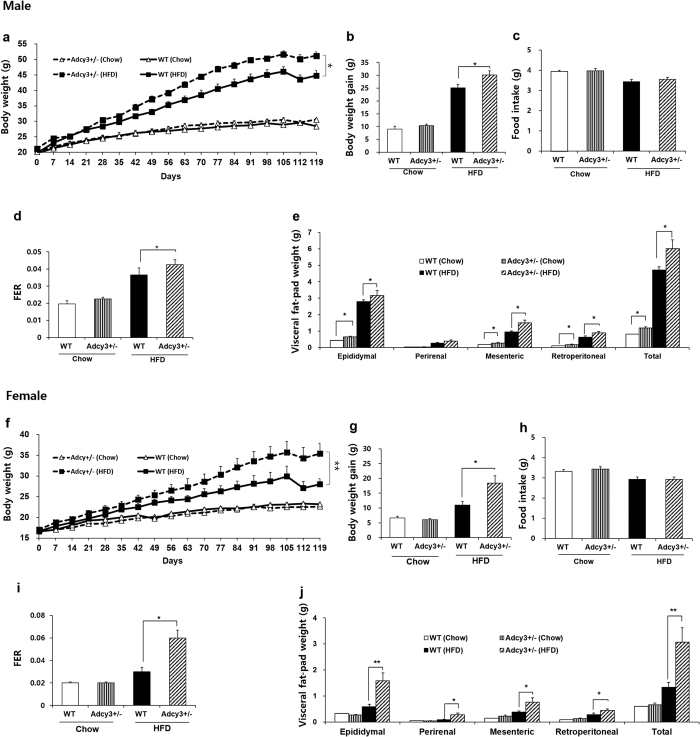
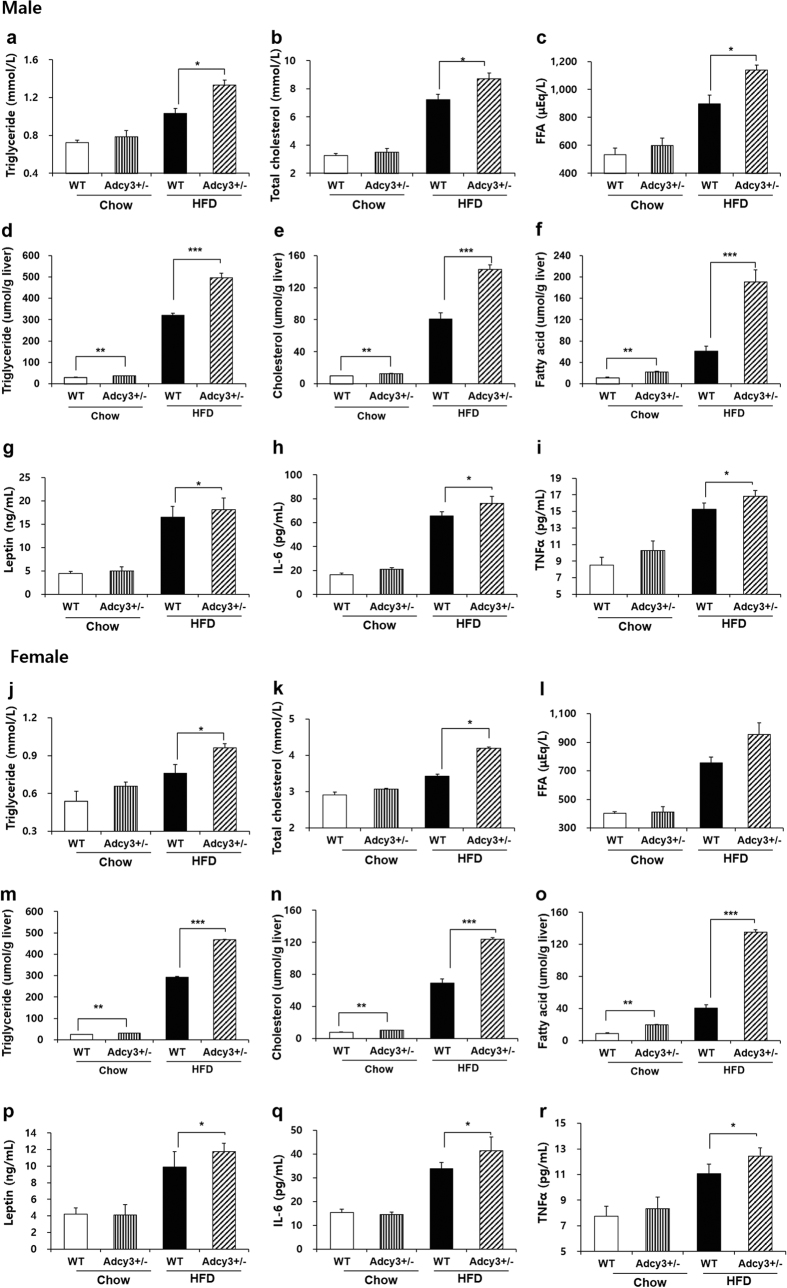
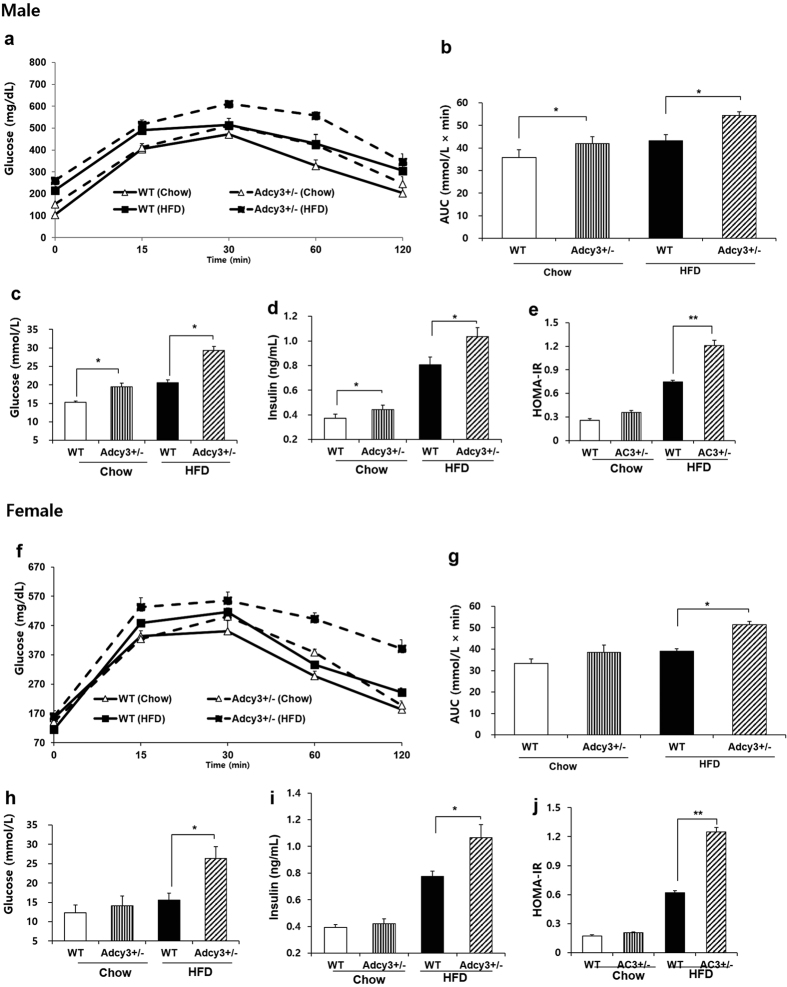
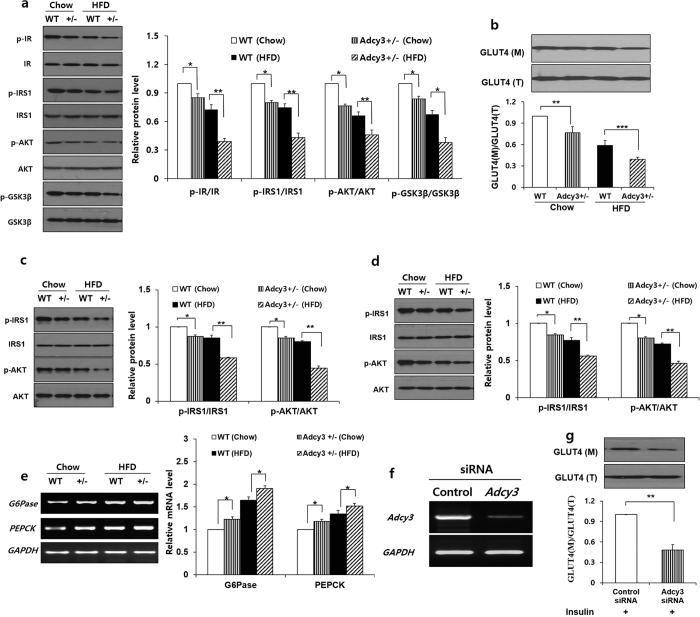
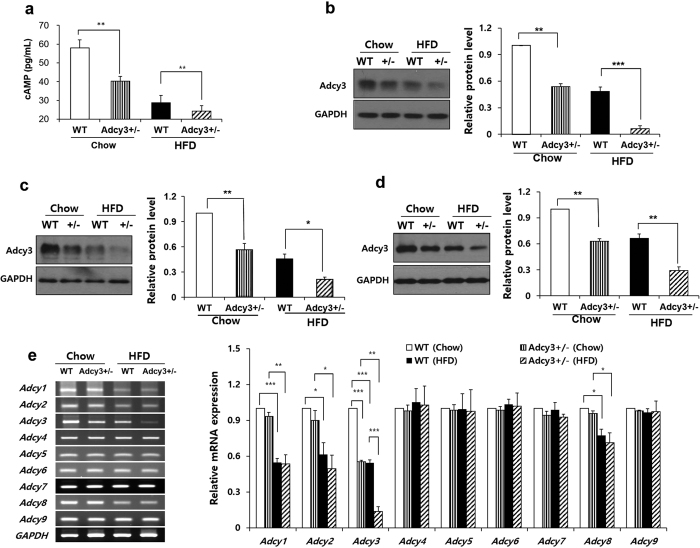
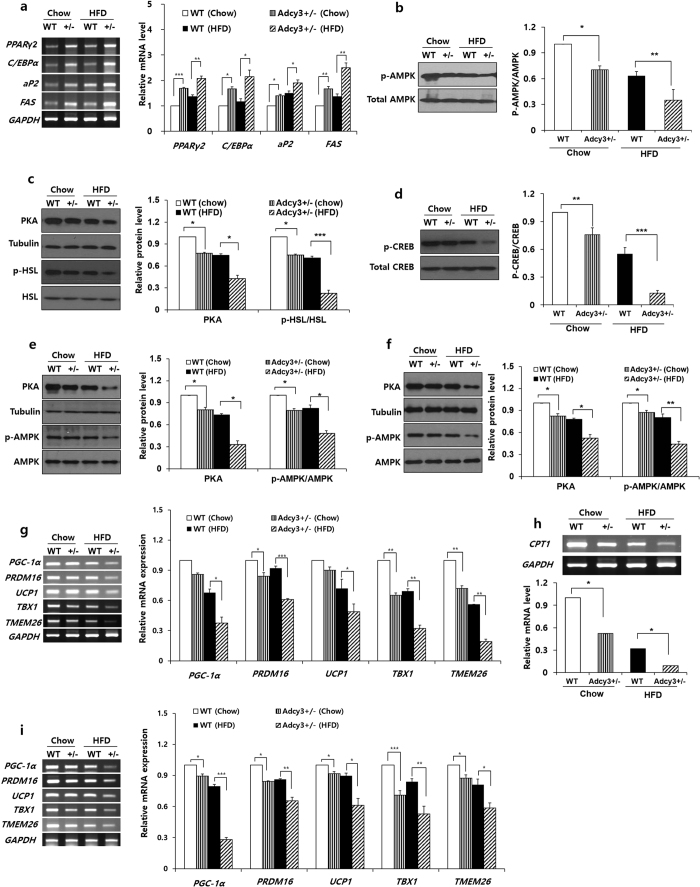
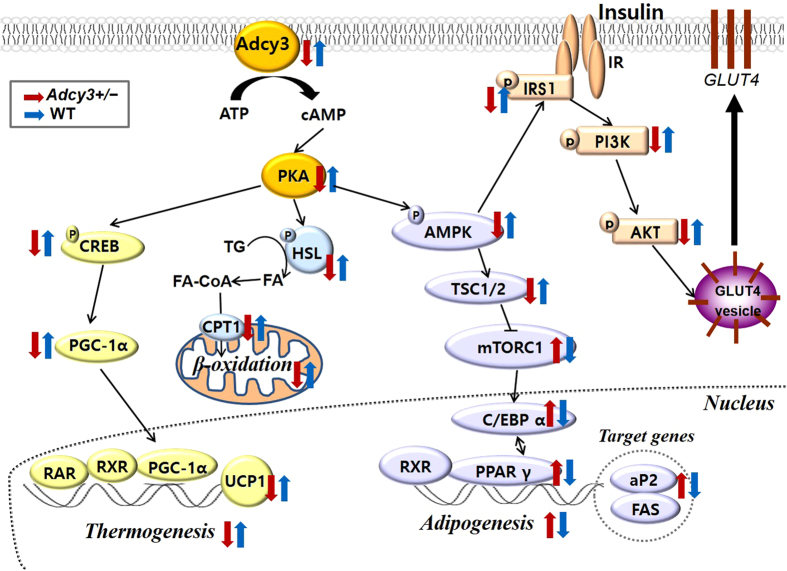
Adenylyl cyclase 3 (Adcy3 ), a member of the mammalian adenylyl cyclase family responsible for generating the second messenger cAMP, has long been known to play an essential role in olfactory signal transduction. Here, we demonstrated that Adcy3 heterozygous null mice displayed increased visceral adiposity in the absence of hyperphagia and developed abnormal metabolic features characterized by impaired insulin sensitivity, dyslipidemia and increased plasma levels of proinflammatory cytokines on both chow and high-fat diet (HFD). Of note, HFD decreased the Adcy3 expression in white adipose tissue, liver and muscle. We also report for the first time that Adcy3 haploinsufficiency resulted in reduced expression of genes involved in thermogenesis, fatty acid oxidation and insulin signaling, with enhanced expression of genes related to adipogenesis in peripheral tissues of mice. In conclusion, these findings suggest that cAMP signals generated by Adcy3 in peripheral tissues may play a pivotal role in modulating obesity and insulin sensitivity.
Overview
The claims and statistics of this paper haven’t been checked yet.
Free: it reads the open-access text and checks the first 5 claims that cite a source we can check. Create a free account to check every claim.
Integrity signals
Registry
Cites
Statistics
Figures
Verification
Claims the paper makes
The claims and statistics of this paper haven’t been checked yet.
Free: it reads the open-access text and checks the first 5 claims that cite a source we can check. Create a free account to check every claim.
Claims other papers make about this one
Each is checked against this paper’s own text: does it say what the citing paper says it does?
In the citing paper
“Haploinsufficiency of the ADCY3 gene in AC3−/+ mice produced a phenotype similar to AC3−/− but was dependent on the type of diet mice were fed (303).”
From Physiological roles of mammalian transmembrane adenylyl cyclase isoforms (2022) · cites this paper as [303]
In the citing paper
“Furthermore, when fed a high-fat diet, AC3−/+ mice have increased triglycerides, leptin, and other hepatic biochemical parameters.”
From Physiological roles of mammalian transmembrane adenylyl cyclase isoforms (2022) · cites this paper as [303]
In the citing paper
“Additionally, they display impaired glucose tolerance and insulin resistance.”
From Physiological roles of mammalian transmembrane adenylyl cyclase isoforms (2022) · cites this paper as [303]
In the citing paper
“When fed a high-fat diet, these mice gained significant weight, while they consumed the same amount of food as wild-type mice.”
From Physiological roles of mammalian transmembrane adenylyl cyclase isoforms (2022) · cites this paper as [303]
In the citing paper
“When fed normal mouse chow, heterozygous AC3 mice do not gain weight.”
From Physiological roles of mammalian transmembrane adenylyl cyclase isoforms (2022) · cites this paper as [303]
1 more claim about this paper
Create a free account to see every claim other papers make about this one.
Self-check
Percentages, sums and reported differences re-computed from the paper’s own numbers.
The self-check needs the paper’s full text.
Citations
Cites
A SIMPLE METHOD FOR THE ISOLATION AND PURIFICATION OF TOTAL LIPIDES FROM ANIMAL TISSUES
Folch, J., Lees, M., & Stanley, G. H. S. (1957) · Journal of Biological Chemistry · doi:10.1016/s0021-9258(18)64849-5 · Cited by 65,189
Macrophages, inflammation, and insulin resistance
Olefsky, J. M., & Glass, C. K. (2010) · Annual Review of Physiology · doi:10.1146/annurev-physiol-021909-135846 · Cited by 2,733
Rotter, V., Nagaev, I., & Smith, U. (2003) · Journal of Biological Chemistry · doi:10.1074/jbc.m301977200 · Cited by 1,062
Regulation and Role of Adenylyl Cyclase Isoforms
Hanoune, J., & Defer, N. (2001) · Annual Review of Pharmacology and Toxicology · doi:10.1146/annurev.pharmtox.41.1.145 · Cited by 691
Cao, W., Daniel, K. W., Robidoux, J., Puigserver, P., Medvedev, A. V., Bai, X., Floering, L. M., Spiegelman, B. M., & Collins, S. (2004) · Molecular and Cellular Biology · doi:10.1128/mcb.24.7.3057-3067.2004 · Cited by 605
Wong, S. T., Trinh, K., Hacker, B., Chan, G. C. K., Lowe, G., Gaggar, A., Xia, Z., Gold, G. H., & Storm, D. R. (2000) · Neuron · doi:10.1016/s0896-6273(00)00060-x · Cited by 470
Signalling Mechanisms Regulating Lipolysis
Carmen, G.-Y., & Víctor, S.-M. (2006) · Cellular Signalling · doi:10.1016/j.cellsig.2005.08.009 · Cited by 429
Regulation and organization of adenylyl cyclases and cAMP
COOPER, D. M. F. (2003) · Biochemical Journal · doi:10.1042/bj20031061 · Cited by 356
Role of AMP-activated Protein Kinase in Cyclic AMP-dependent Lipolysis In 3T3-L1 Adipocytes
Yin, W., Mu, J., & Birnbaum, M. J. (2003) · Journal of Biological Chemistry · doi:10.1074/jbc.m308484200 · Cited by 287
PKA phosphorylates and inactivates AMPKα to promote efficient lipolysis
Djouder, N., Tuerk, R. D., Suter, M., Salvioni, P., Thali, R. F., Scholz, R., Vaahtomeri, K., Auchli, Y., Rechsteiner, H., Brunisholz, R. A., et al. (2010) · The EMBO Journal · doi:10.1038/emboj.2009.339 · Cited by 275
Cited by
Loss-of-function variants in ADCY3 increase risk of obesity and type 2 diabetes
Grarup, N., Moltke, I., Andersen, M. K., Dalby, M., Vitting-Seerup, K., Kern, T., Mahendran, Y., Jørsboe, E., Larsen, C. V. L., Dahl-Petersen, I. K., et al. (2018) · Nature Genetics · doi:10.1038/s41588-017-0022-7 · Cited by 216
Loss-of-function mutations in ADCY3 cause monogenic severe obesity
Saeed, S., Bonnefond, A., Tamanini, F., Mirza, M. U., Manzoor, J., Janjua, Q. M., Din, S. M., Gaitan, J., Milochau, A., Durand, E., et al. (2018) · Nature Genetics · doi:10.1038/s41588-017-0023-6 · Cited by 187
Physiological roles of mammalian transmembrane adenylyl cyclase isoforms
Ostrom, K. F., LaVigne, J. E., Brust, T. F., Seifert, R., Dessauer, C. W., Watts, V. J., & Ostrom, R. S. (2022) · Physiological Reviews · doi:10.1152/physrev.00013.2021 · Cited by 131
Keele, G. R., Prokop, J. W., He, H., Holl, K., Littrell, J. C., Deal, A. W., Francic, S., Cui, L., Gatti, D. M., Broman, K. W., et al. (2017) · Obesity · doi:10.1002/oby.22075 · Cited by 72
“Adcy3 knock-out and haplo-insufficient mice develop obesity with age, exhibiting increased food intake and decreased locomotion (32,33).”
Li, W., Tang, R., Ma, F., Ouyang, S., Liu, Z., & Wu, J. (2018) · The Journal of Nutritional Biochemistry · doi:10.1016/j.jnutbio.2018.05.010 · Cited by 74
Metadata
- Authors
- Tong, T., Shen, Y., Lee, H.-W., Yu, R., & Park, T.
- Affiliations
- Yonsei University (KR)
- University of Ulsan (KR)
- Corresponding author
- Park, Taesun
- Venue
- Scientific Reports
- Published
- 2016-09-28
- Volume
- 6
- Issue
- 1
- Pages
- 34179-34179
- ISSN
- 2045-2322 (ISSN-L)
- PMC
- PMC5039768
- OpenAlex
- W2526480137
- Cited by
- 82
- References
- 34
- Citations by year
- 2026: 6 · 2025: 11 · 2024: 8 · 2023: 9 · 2022: 5 · 2021: 13 · 2020: 9 · 2019: 5 · 2018: 13 · 2017: 3
- FWCI
- 6.57
- Type
- journal article
- Language
- en
- Open access
- gold
- doi.org
- Licence
- cc-by
- creativecommons.org/licenses/by/4.0 (tdm)
- creativecommons.org/licenses/by/4.0 (vor)
- Locations
- Scientific Reports (publishedVersion, cc-by)
- PubMed Central (publishedVersion, cc-by)
- PubMed (publishedVersion)
- Funders
- National Research Foundation
- Ministry of Agriculture, Food and Rural Affairs (2015R1A5A6001906)
- National Research Foundation of Korea (2015R1A5A6001906)
- Topics
- Health Sciences › Medicine › Endocrinology, Diabetes and Metabolism › Adipokines, Inflammation, and Metabolic Diseases
- Health Sciences › Medicine › Physiology (medical) › Adipose Tissue and Metabolism
- Life Sciences › Neuroscience › Endocrine and Autonomic Systems › Regulation of Appetite and Obesity
- Keywords
- diet-induced obesity, insulin resistance, cAMP signaling, high-fat diet, visceral fat, dyslipidemia, inflammatory cytokines, thermogenesis, fatty acid oxidation, adipogenesis, insulin signaling, white adipose tissue, liver, skeletal muscle
About these checks
Registry, retraction, Cites and statistics results are computed, not judged, with one exception: a printed reference that no index lists is read once by a model before it counts as a citation error. Claims are extracted by a model and kept only when their quote appears verbatim in the text; each cited source is then checked, with a model’s help, for whether it says what the claim relies on. Those verdicts can be wrong — read the claim’s quote and the cited source before relying on one.
Statistics and arithmetic are recomputed, not judged.
Confidence bands are shown only for fields calibrated on our annotated test set. None is calibrated yet, so no band is shown.
What counts as a claim ›How we measure confidence ›How we check this ›
Are you an author, or do you see a problem with this page? Request a review
Data sources
Bibliographic data: Semantic Scholar, OpenAlex, Crossref.
Contains information from the Semantic Scholar Academic Graph Datasets, made available under the ODC Attribution License (ODC-BY 1.0).
Semantic Scholar’s data is described in: Kinney, R., et al. (2023). The Semantic Scholar Open Data Platform. arXiv:2301.10140.
