

Adult Type 3 Adenylyl Cyclase–Deficient Mice Are Obese
Open accessThe DOI matches its Crossref record; 60 of the 60 references it cites were found in a registry or an index.
Abstract
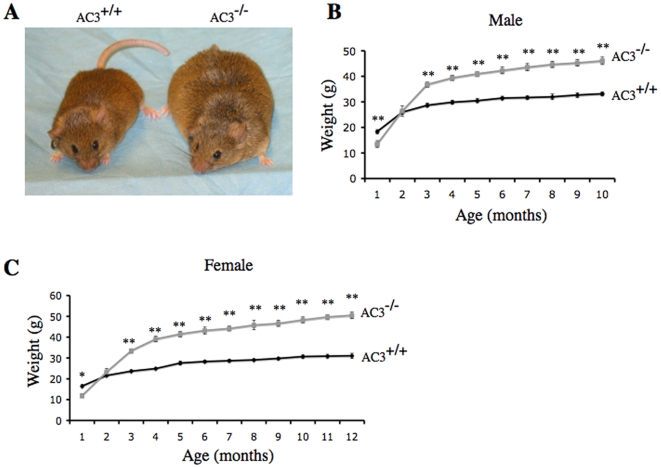
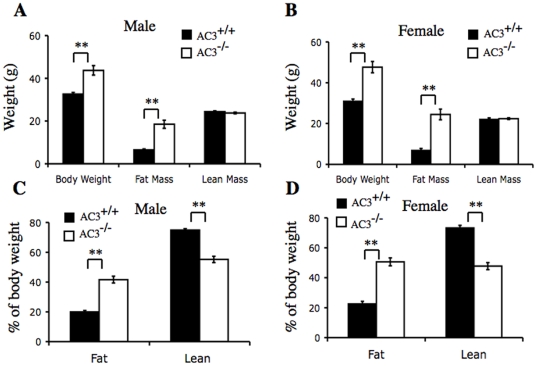
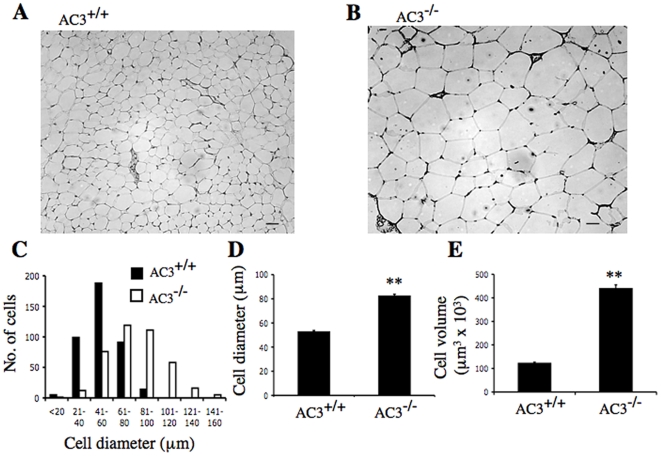
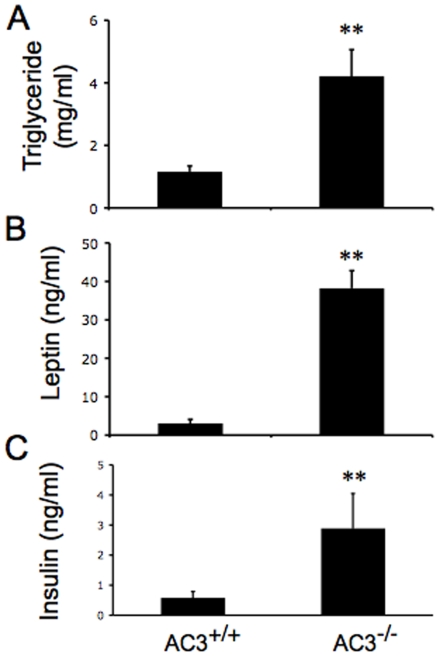
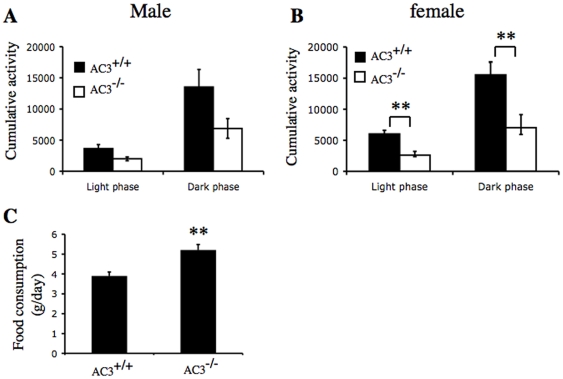
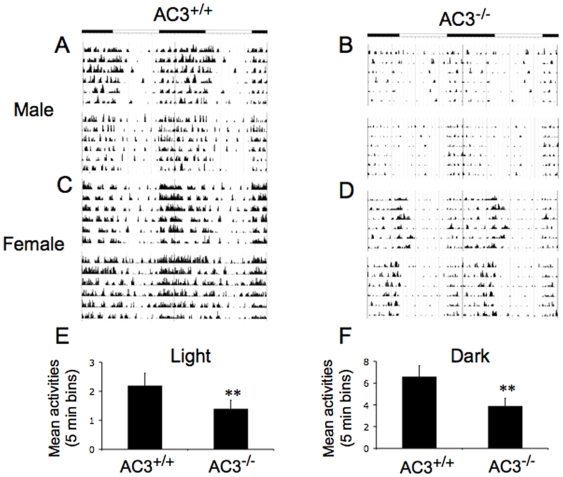
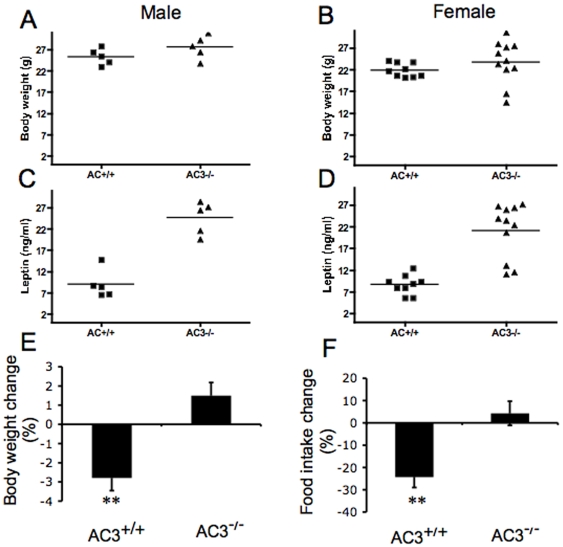
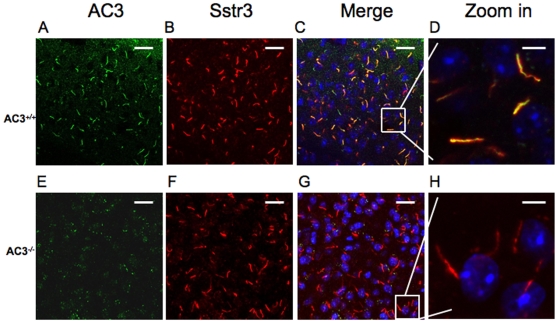
BACKGROUND: A recent study of obesity in Swedish men found that polymorphisms in the type 3 adenylyl cyclase (AC3) are associated with obesity, suggesting the interesting possibility that AC3 may play a role in weight control. Therefore, we examined the weight of AC3 mice over an extended period of time. METHODOLOGY/PRINCIPAL FINDINGS: We discovered that AC3(-/-) mice become obese as they age. Adult male AC3(-/-) mice are about 40% heavier than wild type male mice while female AC3(-/-) are 70% heavier. The additional weight of AC3(-/-) mice is due to increased fat mass and larger adipocytes. Before the onset of obesity, young AC3(-/-) mice exhibit reduced physical activity, increased food consumption, and leptin insensitivity. Surprisingly, the obesity of AC3(-/-) mice is not due to a loss of AC3 from white adipose and a decrease in lipolysis. CONCLUSIONS/SIGNIFICANCE: We conclude that mice lacking AC3 exhibit obesity that is apparently caused by low locomotor activity, hyperphagia, and leptin insensitivity. The presence of AC3 in primary cilia of neurons of the hypothalamus suggests that cAMP signals generated by AC3 in the hypothalamus may play a critical role in regulation of body weight.
Overview
The claims and statistics of this paper haven’t been checked yet.
Free: it reads the open-access text and checks the first 5 claims that cite a source we can check. Create a free account to check every claim.
Integrity signals
Registry
Cites
Statistics
Figures
Verification
Claims the paper makes
The claims and statistics of this paper haven’t been checked yet.
Free: it reads the open-access text and checks the first 5 claims that cite a source we can check. Create a free account to check every claim.
Claims other papers make about this one
Each is checked against this paper’s own text: does it say what the citing paper says it does?
The cited source says what the claim attributes to it.
In the citing paper
“At young ages, AC3−/− mice were less active and consumed more food, and at old ages they continued to be less active.”
From Physiological roles of mammalian transmembrane adenylyl cyclase isoforms (2022) · cites this paper as [299]
In the citing paper
“These AC3−/− mice had significantly more fat versus lean mass, larger adipocytes, and increases in triglycerides, leptin, and insulin.”
From Physiological roles of mammalian transmembrane adenylyl cyclase isoforms (2022) · cites this paper as [299]
In the citing paper
“These AC3−/− mice had significantly more fat versus lean mass, larger adipocytes, and increases in triglycerides, leptin, and insulin.”
From Physiological roles of mammalian transmembrane adenylyl cyclase isoforms (2022) · cites this paper as [299]
In the citing paper
“At young ages, AC3−/− mice were less active and consumed more food, and at old ages they continued to be less active.”
From Physiological roles of mammalian transmembrane adenylyl cyclase isoforms (2022) · cites this paper as [299]
In the citing paper
“These AC3−/− mice had significantly more fat versus lean mass, larger adipocytes, and increases in triglycerides, leptin, and insulin.”
From Physiological roles of mammalian transmembrane adenylyl cyclase isoforms (2022) · cites this paper as [299]
2 more claims about this paper
Create a free account to see every claim other papers make about this one.
Self-check
Percentages, sums and reported differences re-computed from the paper’s own numbers.
The self-check needs the paper’s full text.
Citations
Cites
Kopelman, P. G. (2000) · Nature · doi:10.1038/35007508 · Cited by 4,795 · cited 1×
“risk for a number of diseases including type 2 diabetes, cardiovascular disease, metabolic syndrome, hypertension, certain forms of cancer, and sleep-breathing disorders [1].”
BackgroundWeight-Reducing Effects of the Plasma Protein Encoded by the obese Gene
Halaas, J. L., Gajiwala, K. S., Maffei, M., Cohen, S. L., Chait, B. T., Rabinowitz, D., Lallone, R. L., Burley, S. K., & Friedman, J. M. (1995) · Science · doi:10.1126/science.7624777 · Cited by 4,451
Effects of the obese Gene Product on Body Weight Regulation in ob / ob Mice
Pelleymounter, M. A., Cullen, M. J., Baker, M. B., Hecht, R., Winters, D., Boone, T., & Collins, F. (1995) · Science · doi:10.1126/science.7624776 · Cited by 4,017 · cited 1×
“In normal mice, leptin signals the central nervous system to reduce food intake [29], and administration of leptin causes a weight loss [30,31,32].”
BackgroundMaffei, M., Halaas, J., Ravussin, E., Pratley, R. E., Lee, G. H., Zhang, Y., Fei, H., Kim, S., Lallone, R., Ranganathan, S., et al. (1995) · Nature Medicine · doi:10.1038/nm1195-1155 · Cited by 3,725 · cited 1×
“Obesity is often associated with increased leptin production and leptin insensitivity [40].”
BackgroundCampfield, L. A., Smith, F. J., Guisez, Y., Devos, R., & Burn, P. (1995) · Science · doi:10.1126/science.7624778 · Cited by 3,243 · cited 1×
“In normal mice, leptin signals the central nervous system to reduce food intake [29], and administration of leptin causes a weight loss [30,31,32].”
BackgroundTargeted disruption of the melanocortin-4 receptor results in obesity in mice
Huszar, D., Lynch, C. A., Fairchild-Huntress, V., Dunmore, J. H., Fang, Q., Berkemeier, L. R., Gu, W., Kesterson, R. A., Boston, B. A., Cone, R. D., et al. (1997) · Cell · doi:10.1016/s0092-8674(00)81865-6 · Cited by 3,030 · cited 1×
“Furthermore, transgenic mice lacking specific proteins expressed in the VMH including leptin receptor, steroidogenic factor 1 (SF-1), melanocortin-4 receptor (MC4R), and brain-derived neurotrophic factor (BDNF), exhibits obesity, hyperphagia, and low locomotor activity similar to AC3 mice [46,47,48,49,50,51].”
BackgroundYears of Life Lost Due to Obesity
Fontaine, K. R., Redden, D. T., Wang, C., Westfall, A. O., & Allison, D. B. (2003) · JAMA · doi:10.1001/jama.289.2.187 · Cited by 2,495 · cited 1×
“Furthermore, obesity decreases longevity [2,3,4] and lowers the general quality of life [5].”
BackgroundObesity and the regulation of energy balance
Spiegelman, B. M., & Flier, J. S. (2001) · Cell · doi:10.1016/s0092-8674(01)00240-9 · Cited by 2,398
Adipogenesis and Obesity: Rounding Out the Big Picture
Spiegelman, B. M., & Flier, J. S. (1996) · Cell · doi:10.1016/s0092-8674(00)81359-8 · Cited by 1,269 · cited 1×
“One of the physiological roles of leptin is to signal the nutritional status of the animal to the brain [39].”
BackgroundBDNF regulates eating behavior and locomotor activity in mice
Kernie, S. G., Liebl, D. J., & Parada, L. F. (2000) · The EMBO Journal · doi:10.1093/emboj/19.6.1290 · Cited by 806 · cited 1×
“Furthermore, transgenic mice lacking specific proteins expressed in the VMH including leptin receptor, steroidogenic factor 1 (SF-1), melanocortin-4 receptor (MC4R), and brain-derived neurotrophic factor (BDNF), exhibits obesity, hyperphagia, and low locomotor activity similar to AC3 mice [46,47,48,49,50,51].”
Background
Cited by
The primary cilium at a glance
Satir, P., Pedersen, L. B., & Christensen, S. T. (2010) · Journal of Cell Science · doi:10.1242/jcs.050377 · Cited by 504
“Furthermore, type 3 adenylyl cyclase, which is also associated with obesity in mice and humans, is also specifically localized to hypothalamic neurons (Wang et al., 2009).”
BackgroundMukhopadhyay, S., Wen, X., Chih, B., Nelson, C. D., Lane, W. S., Scales, S. J., & Jackson, P. K. (2010) · Genes & Development · doi:10.1101/gad.1966210 · Cited by 435
Leptin signalling pathways in hypothalamic neurons
Kwon, O., Kim, K. W., & Kim, M.-S. (2016) · Cellular and Molecular Life Sciences · doi:10.1007/s00018-016-2133-1 · Cited by 280
The melanocortin pathway and control of appetite-progress and therapeutic implications
Baldini, G., & Phelan, K. D. (2019) · Journal of Endocrinology · doi:10.1530/joe-18-0596 · Cited by 272
Cilia in the CNS: The Quiet Organelle Claims Center Stage
Louvi, A., & Grove, E. A. (2011) · Neuron · doi:10.1016/j.neuron.2011.03.002 · Cited by 253
“In the presence of Shh, Ptch1 binds Shh and moves away from the ciliary membrane, allowing Smo to accumulate in the cilium (Chen et al., 2009; Corbit et al., 2005; Endoh-Yamagami et al., 2009; Kim et al., 2009; Rohatgi et al., 2007; Wang et al., 2009a).”
Metadata
- Authors
- Wang, Z., Li, V., Chan, G. C. K., Phan, T., Nudelman, A. S., Xia, Z., & Storm, D. R.
- Affiliations
- University of Washington (US)
- Corresponding author
- Storm, Daniel R.
- Venue
- PLoS ONE
- Publisher
- Public Library of Science (PLoS)
- Published
- 2009-09-11
- Volume
- 4
- Issue
- 9
- Pages
- e6979
- ISSN
- 1932-6203 (ISSN-L)
- PMC
- PMC2735775
- OpenAlex
- W2053154705
- Cited by
- 159
- References
- 60
- Citations by year
- 2026: 4 · 2025: 7 · 2024: 10 · 2023: 6 · 2022: 8 · 2021: 15 · 2020: 13 · 2019: 6 · 2018: 11 · 2017: 11 · 2016: 13 · 2015: 11 · 2014: 8 · 2013: 4 · 2012: 11
- FWCI
- 4.79
- Type
- journal article
- Language
- en
- Open access
- gold
- doi.org
- Locations
- PLoS ONE (publishedVersion, cc-by)
- PubMed Central (publishedVersion, cc-by)
- PubMed (publishedVersion)
- DOAJ (DOAJ: Directory of Open Access Journals) (submittedVersion, cc-by-sa)
- Figshare (submittedVersion, cc-by)
- Funders
- University of Washington
- National Institutes of Health
- National Institute on Deafness and Other Communication Disorders (DC 04158, R01DC004158)
- Topics
- Life Sciences › Neuroscience › Endocrine and Autonomic Systems › Regulation of Appetite and Obesity
- Health Sciences › Medicine › Endocrinology, Diabetes and Metabolism › Adipokines, Inflammation, and Metabolic Diseases
- Life Sciences › Biochemistry, Genetics and Molecular Biology › Genetics › Genetic and Kidney Cyst Diseases
- Keywords
- obesity, fat mass, adipocyte size, hyperphagia, physical inactivity, cAMP signaling, body weight regulation, sex differences
- MeSH terms
- Cyclic AMP, Adenylyl Cyclases, Adipose Tissue, Animals, Body Weight, Female, Hypothalamus, Male, Neurons, Obesity, Polymorphism, Genetic, Sex Factors, Adipocytes, Leptin, Mice
About these checks
Registry, retraction, Cites and statistics results are computed, not judged, with one exception: a printed reference that no index lists is read once by a model before it counts as a citation error. Claims are extracted by a model and kept only when their quote appears verbatim in the text; each cited source is then checked, with a model’s help, for whether it says what the claim relies on. Those verdicts can be wrong — read the claim’s quote and the cited source before relying on one.
Statistics and arithmetic are recomputed, not judged.
Confidence bands are shown only for fields calibrated on our annotated test set. None is calibrated yet, so no band is shown.
What counts as a claim ›How we measure confidence ›How we check this ›
Are you an author, or do you see a problem with this page? Request a review
How to cite
Cite CoChat for the checks on this page, and the paper for its own findings.
- This page
- CoChat. (2026). Citation check: Adult Type 3 Adenylyl Cyclase–Deficient Mice Are Obese. https://app.cochat.ai/papers/10.1371/journal.pone.0006979
- The paper
- Wang, Z., Li, V., Chan, G. C. K., Phan, T., Nudelman, A. S., Xia, Z., & Storm, D. R. (2009). Adult Type 3 Adenylyl Cyclase–Deficient Mice Are Obese. PLoS ONE. https://doi.org/10.1371/journal.pone.0006979
Data sources
Bibliographic data: Semantic Scholar, OpenAlex, Crossref.
Contains information from the Semantic Scholar Academic Graph Datasets, made available under the ODC Attribution License (ODC-BY 1.0).
Semantic Scholar’s data is described in: Kinney, R., et al. (2023). The Semantic Scholar Open Data Platform. arXiv:2301.10140.
