

Orientation toward humans predicts cognitive performance in orang-utans
Open accessThe DOI matches its Crossref record; 63 of the 64 references it cites were found in a registry or an index, and 1 are not checked yet.
Abstract
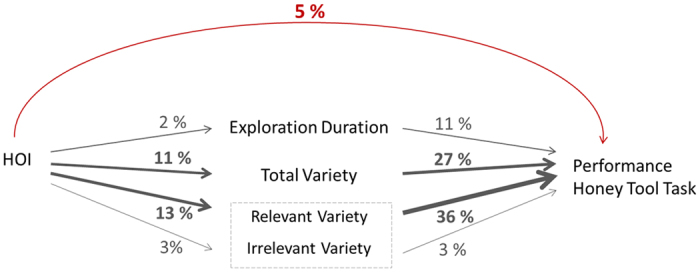
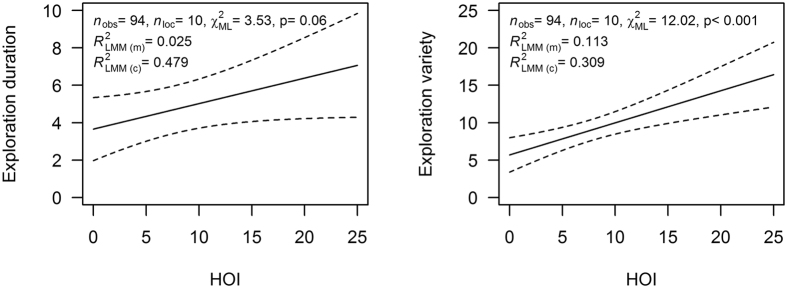
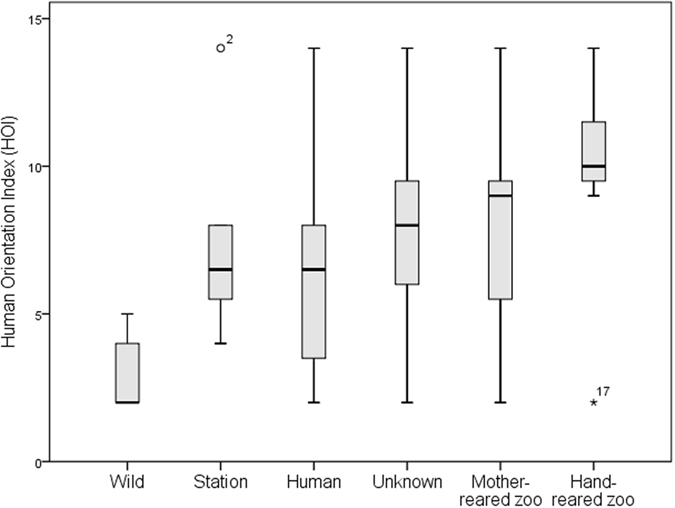
Non-human animals sometimes show marked intraspecific variation in their cognitive abilities that may reflect variation in external inputs and experience during the developmental period. We examined variation in exploration and cognitive performance on a problem-solving task in a large sample of captive orang-utans (Pongo abelii &P. pygmaeus, N = 103) that had experienced different rearing and housing conditions during ontogeny, including human exposure. In addition to measuring exploration and cognitive performance, we also conducted a set of assays of the subjects' psychological orientation, including reactions towards an unfamiliar human, summarized in the human orientation index (HOI), and towards novel food and objects. Using generalized linear mixed models we found that the HOI, rather than rearing background, best predicted both exploration and problem-solving success. Our results suggest a cascade of processes: human orientation was accompanied by a change in motivation towards problem-solving, expressed in reduced neophobia and increased exploration variety, which led to greater experience, and thus eventually to higher performance in the task. We propose that different experiences with humans caused individuals to vary in curiosity and understanding of the physical problem-solving task. We discuss the implications of these findings for comparative studies of cognitive ability.
Overview
The claims and statistics of this paper haven’t been checked yet.
Free: it reads the open-access text and checks the first 5 claims that cite a source we can check. Create a free account to check every claim.
Integrity signals
Registry
Cites
Statistics
Figures
Verification
Claims the paper makes
The claims and statistics of this paper haven’t been checked yet.
Free: it reads the open-access text and checks the first 5 claims that cite a source we can check. Create a free account to check every claim.
Claims other papers make about this one
Each is checked against this paper’s own text: does it say what the citing paper says it does?
The cited source says what the claim attributes to it.
In the citing paper
“We do not expect this to be important because we know of no studies of primate cognition that needed to control for sex [e.g., Amici et al., 2012;Hopkins et al., 2014;Damerius et al., 2017; see also Arden and Adams, 2016, for dogs].”
From A Farewell to the Encephalization Quotient: A New Brain Size Measure for Comparative Primate Cognition (2021) · cites this paper as Damerius et al., 2017
Self-check
Percentages, sums and reported differences re-computed from the paper’s own numbers.
The self-check needs the paper’s full text.
Citations
Cites
Fitting Linear Mixed-Effects Models Using lme4
Bates, D., Mächler, M., Bolker, B., & Walker, S. (2015) · Journal of Statistical Software · doi:10.18637/jss.v067.i01 · Cited by 86,835
A general and simple method for obtaining R 2 from generalized linear mixed‐effects models
Nakagawa, S., & Schielzeth, H. (2013) · Methods in Ecology and Evolution · doi:10.1111/j.2041-210x.2012.00261.x · Cited by 10,356 · cited 1×
“Further statistical analyses were performed in R version 3.2.3 59,60 using the ‘lme4’ 61 and ‘MUMIn’ 62 packages.”
MethodInfluentialIntelligence: Knowns and unknowns.
Neisser, U., Boodoo, G., Bouchard, T. J., Boykin, A. W., Brody, N., Ceci, S. J., Halpern, D. F., Loehlin, J. C., Perloff, R., Sternberg, R. J., et al. (1996) · American Psychologist · doi:10.1037/0003-066x.51.2.77 · Cited by 2,913
The formation of learning sets.
Harlow, H. F. (1949) · Psychological Review · doi:10.1037/h0062474 · Cited by 1,959
Sources of human psychological differences: the Minnesota Study of Twins Reared Apart
Bouchard, T. J., Lykken, D. T., McGue, M., Segal, N. L., & Tellegen, A. (1990) · Science · doi:10.1126/science.2218526 · Cited by 1,373
Intelligence: New findings and theoretical developments
Nisbett, R. E., Aronson, J., Blair, C., Dickens, W., Flynn, J., Halpern, D. F., & Turkheimer, E. (2012) · American Psychologist · doi:10.1037/a0026699 · Cited by 1,031
Harlow, H. F., & Zimmermann, R. R. (1959) · Science · doi:10.1126/science.130.3373.421 · Cited by 951
Learning by imitation: A hierarchical approach
Byrne, R. W., & Russon, A. E. (1998) · Behavioral and Brain Sciences · doi:10.1017/s0140525x98001745 · Cited by 884
Animal tool behavior: the use and manufacture of tools by animals
(2011) · Choice Reviews Online · doi:10.5860/choice.49-1468 · Cited by 785 · cited 2×
“Second, because the effect of captivity on cognitive performance is particularly pronounced in the context of tool use 34–39 , we assessed cognitive performance using a novel tool-use task including multi-step problem-solving with high ecological validity: the honey-tool task.”
MethodResultPotent Social Learning and Conformity Shape a Wild Primate’s Foraging Decisions
van de Waal, E., Borgeaud, C., & Whiten, A. (2013) · Science · doi:10.1126/science.1232769 · Cited by 568
Cited by
van Schaik, C. P., Triki, Z., Bshary, R., & Heldstab, S. A. (2021) · Brain, Behavior and Evolution · doi:10.1159/000517013 · Cited by 64
Bandini, E., & Harrison, R. A. (2020) · Biological reviews/Biological reviews of the Cambridge Philosophical Society · doi:10.1111/brv.12604 · Cited by 76
“…afforded by these conditions), and human contact and/or training, on the innovative abilities of chimpanzees and other animals (e.g. Haslam, 2013; Damerius et al., 2017). a Failures to innovate in captivity Despite this potential captivity effect, not all behaviours in captivity seem to be as…”
BackgroundValidity of Cognitive Tests for Non-human Animals: Pitfalls and Prospects
Schubiger, M. N., Fichtel, C., & Burkart, J. M. (2020) · Frontiers in Psychology · doi:10.3389/fpsyg.2020.01835 · Cited by 85
Self-citationExplaining the Paradox of Neophobic Explorers: The Social Information Hypothesis
Forss, S., Koski, S. E., & van Schaik, C. P. (2017) · International Journal of Primatology · doi:10.1007/s10764-017-9984-7 · Cited by 76
“2013) and orangutans (Damerius et al. 2017), which was attributed to both reduced neophobia and increased exploration tendency.”
BackgroundSelf-citationTeaching and curiosity: sequential drivers of cumulative cultural evolution in the hominin lineage
van Schaik, C. P., Pradhan, G. R., & Tennie, C. (2019) · Behavioral Ecology and Sociobiology · doi:10.1007/s00265-018-2610-7 · Cited by 60
A meta-analysis of interindividual differences in innovation
Amici, F., Widdig, A., Lehmann, J., & Majolo, B. (2019) · Animal Behaviour · doi:10.1016/j.anbehav.2019.07.008 · Cited by 63
Curiosity boosts orang-utan problem-solving ability
Damerius, L. A., Graber, S. M., Willems, E. P., & van Schaik, C. P. (2017) · Animal Behaviour · doi:10.1016/j.anbehav.2017.10.005 · Cited by 64
Self-citationField experiments find no evidence that chimpanzee nut cracking can be independently innovated
Koops, K., Soumah, A. G., van Leeuwen, K. L., Camara, H. D., & Matsuzawa, T. (2022) · Nature Human Behaviour · doi:10.1038/s41562-021-01272-9 · Cited by 53
Janmaat, K. R. L. (2019) · Evolutionary Anthropology: Issues, News, and Reviews · doi:10.1002/evan.21794 · Cited by 44
Individual acquisition of “stick pounding” behavior by naïve chimpanzees
Bandini, E., & Tennie, C. (2019) · American Journal of Primatology · doi:10.1002/ajp.22987 · Cited by 44
Captivity and habituation to humans raise curiosity in vervet monkeys
Forss, S., Motes‐Rodrigo, A., Dongre, P., Mohr, T., & van de Waal, E. (2021) · Animal Cognition · doi:10.1007/s10071-021-01589-y · Cited by 41
Self-citationIdentifying animal complex cognition requires natural complexity
Boesch, C. (2021) · iScience · doi:10.1016/j.isci.2021.102195 · Cited by 41
How task format affects cognitive performance: a memory test with two species of New World monkeys
Schubiger, M. N., Kissling, A., & Burkart, J. M. (2016) · Animal Behaviour · doi:10.1016/j.anbehav.2016.08.005 · Cited by 27
Self-citationBohn, M., Eckert, J., Hanus, D., Lugauer, B., Holtmann, J., & Haun, D. B. M. (2023) · Nature Ecology & Evolution · doi:10.1038/s41559-023-02050-8 · Cited by 31
“On the other hand, they inform us about the contexts in which cognitive abilities emerge and are the cornerstone for theorizing about the ontogeny and phylogeny of cognitive abilities 26,27 .”
Self-citationAcquisition of joint attention by olive baboons gesturing toward humans
Lamaury, A., Cochet, H., & Bourjade, M. (2017) · Animal Cognition · doi:10.1007/s10071-017-1111-9 · Cited by 23
Innovation in wild Barbary macaques (Macaca sylvanus)
Amici, F., Caicoya, Á. L., Majolo, B., & Widdig, A. (2020) · Scientific Reports · doi:10.1038/s41598-020-61558-2 · Cited by 31
Early sociability fosters later exploratory tendency in wild immature orangutans
Schuppli, C., van Noordwijk, M. A., Utami-Atmoko, S. S., & van Schaik, C. P. (2020) · Science Advances · doi:10.1126/sciadv.aaw2685 · Cited by 23
“Given that exploratory tendency has previously been shown to be a measure of problem-solving ability and thus cognitive ability (10, 12), our results suggest that in orangutans, opportunities for social learning during development are important for cognitive development.”
ResultDifferences in novel food response betweenPongoandPan
Forss, S., Motes‐Rodrigo, A., Hrubesch, C., & Tennie, C. (2019) · American Journal of Primatology · doi:10.1002/ajp.22945 · Cited by 23
“This would allow individuals to effectively explore and individually assess the edibility of unfamiliar food, which would select for high exploration tendency and curiosity (Damerius et al., 2017; van Schaik et al., 2016), as suggested by the abovementioned sniffing behavior in chimpanzees.”
BackgroundInfluentialSelf-citationForss, S., Ciria, A., Clark, F. E., Galusca, C., Harrison, D., & Lee, S. (2024) · Biological reviews/Biological reviews of the Cambridge Philosophical Society · doi:10.1111/brv.13054 · Cited by 23
Self-citationSocial dynamics of vervet monkeys are dependent upon group identity
Kerjean, E., van de Waal, E., & Canteloup, C. (2023) · iScience · doi:10.1016/j.isci.2023.108591 · Cited by 18
“100 Another potential explanation would be the existence of two stable states of the overall sociality: one before 2015 and one after 2015.”
BackgroundJacobson, S. L., Freeman, H. D., Santymire, R. M., & Ross, S. R. (2017) · Royal Society Open Science · doi:10.1098/rsos.170932 · Cited by 18
“Frequent and intensive interactions with humans have also resulted in enculturation effects in which apes displayed different social skills and cognitive performance from those with reduced human influence [15,16].”
BackgroundForss, S., Motes‐Rodrigo, A., Hrubesch, C., & Tennie, C. (2020) · PeerJ · doi:10.7717/peerj.10263 · Cited by 17
Self-citationThe ontogeny of exploratory object manipulation behaviour in wild orangutans
Schuppli, C., van Cauwenberghe, A., Setia, T. M., & Haun, D. B. M. (2021) · Evolutionary Human Sciences · doi:10.1017/ehs.2021.34 · Cited by 18
Self-citationLab cognition going wild: Implementing a new portable touchscreen system in vervet monkeys
Harrison, R. A., Mohr, T., & van de Waal, E. (2023) · Journal of Animal Ecology · doi:10.1111/1365-2656.13857 · Cited by 16
Individual differences in task participation in wild chacma baboons
Martina, C., Cowlishaw, G., & Carter, A. J. (2020) · Animal Behaviour · doi:10.1016/j.anbehav.2020.11.020 · Cited by 14
Learning to Be an Orangutan—Implications of Life History for Orangutan Rehabilitation
Preuschoft, S., Yassir, I., Putri, A. I., Aoliya, N., Yuliani, E., Badriyah, S. N., Corbi, P., Sugianto, Y., Sitepu, B. S., Mukhlisi, M., et al. (2021) · Animals · doi:10.3390/ani11030767 · Cited by 14
“Several studies have found that wild orangutans are characterised by marked neophobia and risk aversion, while orangutans exposed to human culture are neophilic and apparently unaware of risks [36,37].”
BackgroundBirchmeier, K., Johnson-Ulrich, L., Stein, J., & Forss, S. (2023) · Animal Behavior and Cognition · doi:10.26451/abc.10.04.03.2023 · Cited by 9
“For example, orangutans that were more human-oriented were also more creative in their exploration, and in turn, better at solving problems (Damerius et al., 2017).”
BackgroundSelf-citationDoes opportunistic testing bias cognitive performance in primates? Learning from drop-outs
Schubiger, M. N., Kissling, A., & Burkart, J. M. (2019) · PLoS ONE · doi:10.1371/journal.pone.0213727 · Cited by 10
Self-citationSchuppli, C., Nellissen, L., Carvajal, L., Ashbury, A. M., Oliver-Caldwell, N., Rahmaeti, T., Laumer, I. B., & Haun, D. B. M. (2023) · Scientific Reports · doi:10.1038/s41598-023-39214-2 · Cited by 10
“Furthermore, in our study, focal orangutans saw the experiment being installed by human experimenters, which likely played a role in attracting their interest 49 .”
BackgroundSelf-citationCastellano‐Navarro, A., Macanás‐Martínez, E., Xu, Z., Guillén‐Salazar, F., MacIntosh, A. J. J., Amici, F., & Albiach‐Serrano, A. (2021) · Scientific Reports · doi:10.1038/s41598-021-84250-5 · Cited by 8
Amici, F., Meacci, S., Caray, E., Oña, L. S., Liebal, K., & Ciucci, P. (2024) · Animal Cognition · doi:10.1007/s10071-024-01849-7 · Cited by 8
“We adapted the procedure used in previous studies on other species (e.g., see Amici et al. 2020; Damerius et al. 2017).”
Self-citationBandini, E., Girish, S., Barnes, P., Boot, M., Tennie, C., & Forss, S. (2025) · Ethology · doi:10.1111/eth.70007 · Cited by 4
Self-citationDanel, S., Rebout, N., Bureau, L., Zidat, T., Biro, D., & Bonadonna, F. (2024) · Animal Cognition · doi:10.1007/s10071-024-01838-w · Cited by 4
“Moreover, interaction with humans and/ or exposure to anthropogenic stimuli may promote exploration in some species (e.g. Donaldson et al. 2010; Damerius et al. 2017).”
BackgroundAmalia, N., Farajallah, D. P., & Utami-Atmoko, S. S. (2022) · Biodiversitas Journal of Biological Diversity · doi:10.13057/biodiv/d230141 · Cited by 5
“It also triggers AMALIA et al. – Orangutan with human-oriented behavior 401 animals to be more interested in exploring new things, such as unfamiliar objects/foods, including those related to humans (van Schaik et al. 2016; Damerius et al. 2017).”
BackgroundVale, G. L., & Rawlings, B. S. (2024) · Comparative Cognition & Behavior Reviews · doi:10.3819/ccbr.2024.190021 · Cited by 3
Variation in neophilia in seven primate species.
Souganidis, C., Llorente, M., Aureli, F., Call, J., & Amici, F. (2024) · Journal of comparative psychology · doi:10.1037/com0000377 · Cited by 5
Self-citationWild and zoo-housed orangutans differ in how they explore objects
Laumer, I. B., Kansal, S., van Cauwenberghe, A., Rahmaeti, T., Setia, T. M., Mundry, R., Haun, D. B. M., & Schuppli, C. (2025) · Scientific Reports · doi:10.1038/s41598-025-97926-z · Cited by 5
“…with different rearing backgrounds found that the degree of human orientation predicted the motivation to explore an apparatus which affected their problem-solving skills 68 , suggesting that the effects of the social and physical environment on cognitive performance interact with each other.”
Self-citationViaro, R., Bernardi, D., Mazzoni, L., & Fadiga, L. (2023) · International Journal of Primatology · doi:10.1007/s10764-023-00371-w · Cited by 4
“Different experiences with humans also caused captive orangutans ( Pongo abelii and Pongo pygmaeus ) to vary in curiosity and their understanding of physical problem-solving tasks (Damerius et al ., 2017).”
BackgroundKukofka, P., Young, R., Kunz, J. A., Nellissen, L., Alavi, S. E., Rahmaeti, T., Basalamah, F., Haun, D. B. M., & Schuppli, C. (2024) · iScience · doi:10.1016/j.isci.2024.111542 · Cited by 6
Self-citationActive sharing of a novel, arbitrary innovation in captive cotton-top tamarins?
Gokcekus, S., Brügger, R. K., & Burkart, J. M. (2020) · Behaviour · doi:10.1163/1568539x-bja10049 · Cited by 2
“…called ‘captivity effect’ where the decrease of energy needed for foraging, vigilance, and overall survival coupled with an increase in free time leads to increased curiosity and motivation to approach or manipulate novel objects (Forss et al., 2015; Damerius et al., 2017; van Schaik et al., 2017).”
BackgroundSelf-citationAnimal Behavior: Ape Curiosity on Camera
Forss, S., Motes‐Rodrigo, A., & Tennie, C. (2019) · Current Biology · doi:10.1016/j.cub.2019.02.055 · Cited by 2
Self-citationAmalia, N., Perwitasari‐Farajallah, D., Utami-Atmoko, S. S., & Purbatrapsila, A. (2023) · Journal of Tropical Biodiversity and Biotechnology · doi:10.22146/jtbb.70001 · Cited by 1
A comparison of tool-use flexibility between captive chimpanzees and bonobos
Bandini, E., Harrison, R. A., Hrubesch, C., & Forss, S. (2026) · Royal Society Open Science · doi:10.1098/rsos.251950 · Cited by 1
Self-citationBehavioral flexibility and its drivers in semi-urban vervet monkeys
Barnes, P., Robira, B., Mercier, S., & Forss, S. (2026) · Behavioral Ecology · doi:10.1093/beheco/arag070 · Cited by 1
“…such as predation pressures, food availability, contact with humans, and enrichment, can impact cognitive phenotypes (Call and Tomasello 1996; Damerius et al. 2017; Boogert et al. 2018), less is known about how anthropogenic experiences, such as exploiting urban food sources, affect…”
Self-citationThe Development of Feeding Competence in Rehabilitant Orphaned Orangutans and How to Measure It
Preuschoft, S., Marshall, A. J., Scott, L., Badriyah, S. N., Purba, M. D. T., Yuliani, E., Corbi, P., Yassir, I., Wibawanto, M. A., & Kalcher-Sommersguter, E. (2023) · Animals · doi:10.3390/ani13132111 · Cited by 1
“Beyond that time window of immaturity, mature orangutans are very conservative (neophobic) in their food choices [28], although they are capable of adapting to radical ecological changes, e.”
BackgroundDanel, S., Rebout, N., Belle, S., Caro, S. P., Bonadonna, F., & Biro, D. (2024) · Biology Letters · doi:10.1098/rsbl.2024.0135 · Cited by 1
Effects of Socialization on Problem Solving in Domestic Cats
Foerder, P., & Howard, M. C. (2024) · Animals · doi:10.3390/ani14172604 · Cited by 1
“Social-ization has also been studied in regard to the effects of habituation to humans on captive animal behavior [10,11].”
BackgroundEpistemic Curiosity in Kea Parrots and Human Children
Smith, G. E., Lambert, M. L., Swindell, E., Engelmann, J. M., & Völter, C. J. (2025) · Open Mind · doi:10.1162/opmi.a.34 · Cited by 1
“…bias in animal experiments suggests that factors such as human rearing and living with conspecifics — two relevant variables in the tested kea population — has a strong effect on expressed curiosity in animals (Damerius, Forss, et al., 2017; Damerius, Graber, et al., 2017; Schubiger et al., 2020).”
Factors Influencing Species Performance in a Cross-Taxon Comparative Research Program
Prétôt, L. (2017) · Digital Archive @ GSU · doi:10.57709/10463896
Innovation and Problem-Solving in Orangutans
Russon, A. E. (2021) · Cambridge University Press eBooks · doi:10.1017/9781108564113.041
Innovation and Problem-Solving
(2021) · Cambridge University Press eBooks · doi:10.1017/9781108564113.034
Rivas-Blanco, D., Gonnet-dit-Revel, L., Range, F., Tebbich, S., & Marshall‐Pescini, S. (2025) · Animal Cognition · doi:10.1007/s10071-025-02019-z · Cited by 1
“…that life in captivity has been reported as a factor that would reduce animals’ neophobia and increase their neophilia (Benson-Aram et al. 2013; Damerius et al. 2017 ; Lazzaroni et al. 2019; Souganidis et al. 2024), and hand-rearing in particular has been known to reduce neophobia in some…”
Metadata
- Authors
- Damerius, L. A., Forss, S. I. F., Kosonen, Z. K., Willems, E. P., Burkart, J. M., Call, J., Galdikas, B. M. F., Liebal, K., Haun, D. B. M., & van Schaik, C. P.
- Affiliations
- University of Zurich (CH)
- University of St Andrews (GB)
- Freie Universität Berlin (DE)
- Leipzig University (DE)
- Corresponding author
- Damerius, Laura A.
- Forss, Sofia I. F.
- ORCID
- Venue
- Scientific Reports
- Published
- 2017-01-09
- Volume
- 7
- Issue
- 1
- Pages
- 40052-40052
- ISSN
- 2045-2322 (ISSN-L)
- PMC
- PMC5220318
- OpenAlex
- W2570048708
- Cited by
- 53
- References
- 62
- Citations by year
- 2026: 3 · 2025: 4 · 2024: 8 · 2023: 8 · 2022: 3 · 2021: 8 · 2020: 7 · 2019: 7 · 2017: 4
- FWCI
- 7.05
- Type
- journal article
- Language
- en
- Open access
- gold
- doi.org
- Licence
- cc-by
- creativecommons.org/licenses/by/4.0 (tdm)
- creativecommons.org/licenses/by/4.0 (vor)
- Locations
- Scientific Reports (publishedVersion, cc-by)
- PubMed Central (publishedVersion, cc-by)
- PubMed (publishedVersion)
- MPG.PuRe (Max Planck Society) (submittedVersion, other-oa)
- Refubium (Universitätsbibliothek der Freien Universität Berlin) (submittedVersion, cc-by)
- St Andrews Research Repository (St Andrews Research Repository) (submittedVersion, cc-by)
- Zurich Open Repository and Archive (University of Zurich) (submittedVersion, cc-by)
- Universitätsbibliothek der FU Berlin Hochschulschriftenstelle u. Dokumentenserver (cc-by)
- Topics
- Life Sciences › Agricultural and Biological Sciences › Ecology, Evolution, Behavior and Systematics › Primate Behavior and Ecology
- Life Sciences › Agricultural and Biological Sciences › Animal Science and Zoology › Animal Behavior and Welfare Studies
- Social Sciences › Psychology › Developmental and Educational Psychology › Child and Animal Learning Development
- Keywords
- orangutans, Pongo abelii, Bornean orangutan, human orientation, cognitive performance, problem solving, exploratory behavior, neophobia, curiosity, rearing conditions, housing conditions, ontogeny, individual differences in cognition, comparative cognition
- MeSH terms
- Animals, Behavior, Animal, Exploratory Behavior, Humans, Pongo pygmaeus, Problem Solving, Pongo abelii
About these checks
Registry, retraction, Cites and statistics results are computed, not judged, with one exception: a printed reference that no index lists is read once by a model before it counts as a citation error. Claims are extracted by a model and kept only when their quote appears verbatim in the text; each cited source is then checked, with a model’s help, for whether it says what the claim relies on. Those verdicts can be wrong — read the claim’s quote and the cited source before relying on one.
Statistics and arithmetic are recomputed, not judged.
Confidence bands are shown only for fields calibrated on our annotated test set. None is calibrated yet, so no band is shown.
What counts as a claim ›How we measure confidence ›How we check this ›
Are you an author, or do you see a problem with this page? Request a review
Data sources
Bibliographic data: Semantic Scholar, OpenAlex, Crossref.
Contains information from the Semantic Scholar Academic Graph Datasets, made available under the ODC Attribution License (ODC-BY 1.0).
Semantic Scholar’s data is described in: Kinney, R., et al. (2023). The Semantic Scholar Open Data Platform. arXiv:2301.10140.
