

Orientation toward humans predicts cognitive performance in orang-utans
Open accessThe DOI matches its Crossref record; 63 of the 64 references it cites were found in a registry or an index, and 1 are not checked yet.
Abstract
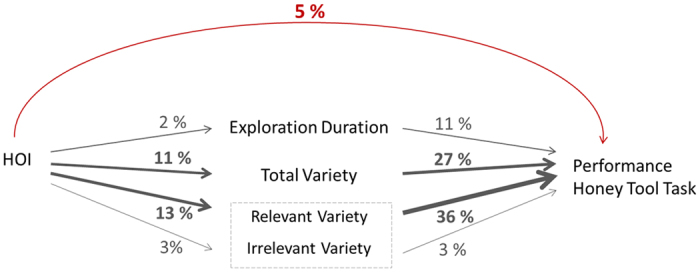
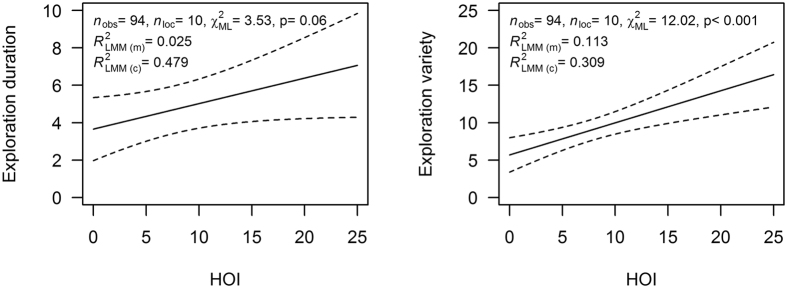
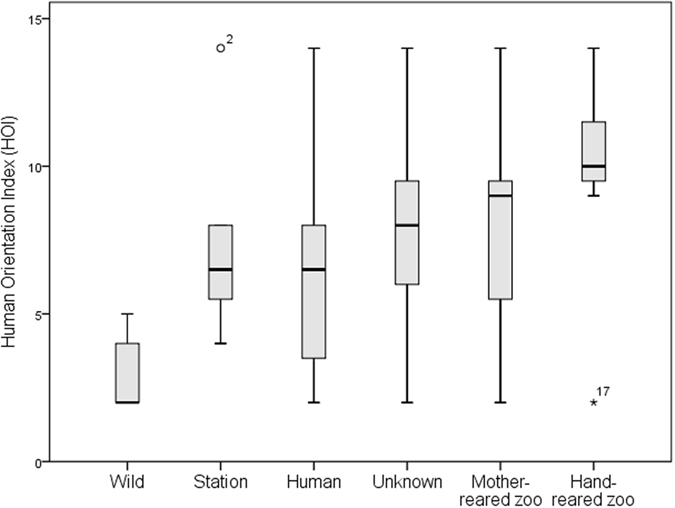
Non-human animals sometimes show marked intraspecific variation in their cognitive abilities that may reflect variation in external inputs and experience during the developmental period. We examined variation in exploration and cognitive performance on a problem-solving task in a large sample of captive orang-utans (Pongo abelii &P. pygmaeus, N = 103) that had experienced different rearing and housing conditions during ontogeny, including human exposure. In addition to measuring exploration and cognitive performance, we also conducted a set of assays of the subjects' psychological orientation, including reactions towards an unfamiliar human, summarized in the human orientation index (HOI), and towards novel food and objects. Using generalized linear mixed models we found that the HOI, rather than rearing background, best predicted both exploration and problem-solving success. Our results suggest a cascade of processes: human orientation was accompanied by a change in motivation towards problem-solving, expressed in reduced neophobia and increased exploration variety, which led to greater experience, and thus eventually to higher performance in the task. We propose that different experiences with humans caused individuals to vary in curiosity and understanding of the physical problem-solving task. We discuss the implications of these findings for comparative studies of cognitive ability.
Overview
The claims and statistics of this paper haven’t been checked yet.
Free: it reads the open-access text and checks the first 5 claims that cite a source we can check. Create a free account to check every claim.
Integrity signals
Registry
Cites
Statistics
Figures
Verification
Claims the paper makes
The claims and statistics of this paper haven’t been checked yet.
Free: it reads the open-access text and checks the first 5 claims that cite a source we can check. Create a free account to check every claim.
Claims other papers make about this one
Each is checked against this paper’s own text: does it say what the citing paper says it does?
The cited source says what the claim attributes to it.
In the citing paper
“We do not expect this to be important because we know of no studies of primate cognition that needed to control for sex [e.g., Amici et al., 2012;Hopkins et al., 2014;Damerius et al., 2017; see also Arden and Adams, 2016, for dogs].”
From A Farewell to the Encephalization Quotient: A New Brain Size Measure for Comparative Primate Cognition (2021) · cites this paper as Damerius et al., 2017
Self-check
Percentages, sums and reported differences re-computed from the paper’s own numbers.
The self-check needs the paper’s full text.
Citations
Cites
Fitting Linear Mixed-Effects Models Using lme4
Bates, D., Mächler, M., Bolker, B., & Walker, S. (2015) · Journal of Statistical Software · doi:10.18637/jss.v067.i01 · Cited by 86,835
A general and simple method for obtaining R 2 from generalized linear mixed‐effects models
Nakagawa, S., & Schielzeth, H. (2013) · Methods in Ecology and Evolution · doi:10.1111/j.2041-210x.2012.00261.x · Cited by 10,356 · cited 1×
“Further statistical analyses were performed in R version 3.2.3 59,60 using the ‘lme4’ 61 and ‘MUMIn’ 62 packages.”
MethodInfluentialIntelligence: Knowns and unknowns.
Neisser, U., Boodoo, G., Bouchard, T. J., Boykin, A. W., Brody, N., Ceci, S. J., Halpern, D. F., Loehlin, J. C., Perloff, R., Sternberg, R. J., et al. (1996) · American Psychologist · doi:10.1037/0003-066x.51.2.77 · Cited by 2,913
The formation of learning sets.
Harlow, H. F. (1949) · Psychological Review · doi:10.1037/h0062474 · Cited by 1,959
Sources of human psychological differences: the Minnesota Study of Twins Reared Apart
Bouchard, T. J., Lykken, D. T., McGue, M., Segal, N. L., & Tellegen, A. (1990) · Science · doi:10.1126/science.2218526 · Cited by 1,373
Intelligence: New findings and theoretical developments
Nisbett, R. E., Aronson, J., Blair, C., Dickens, W., Flynn, J., Halpern, D. F., & Turkheimer, E. (2012) · American Psychologist · doi:10.1037/a0026699 · Cited by 1,031
Harlow, H. F., & Zimmermann, R. R. (1959) · Science · doi:10.1126/science.130.3373.421 · Cited by 951
Learning by imitation: A hierarchical approach
Byrne, R. W., & Russon, A. E. (1998) · Behavioral and Brain Sciences · doi:10.1017/s0140525x98001745 · Cited by 884
Animal tool behavior: the use and manufacture of tools by animals
(2011) · Choice Reviews Online · doi:10.5860/choice.49-1468 · Cited by 785 · cited 2×
“Second, because the effect of captivity on cognitive performance is particularly pronounced in the context of tool use 34–39 , we assessed cognitive performance using a novel tool-use task including multi-step problem-solving with high ecological validity: the honey-tool task.”
MethodResultPotent Social Learning and Conformity Shape a Wild Primate’s Foraging Decisions
van de Waal, E., Borgeaud, C., & Whiten, A. (2013) · Science · doi:10.1126/science.1232769 · Cited by 568
Shumaker, R. (2011) · Johns Hopkins University Press eBooks · doi:10.1353/book.98237 · Cited by 422
Imitative Learning of Actions on Objects by Children, Chimpanzees, and Enculturated Chimpanzees
Tomasello, M., Savage‐Rumbaugh, S., & Kruger, A. C. (1993) · Child Development · doi:10.1111/j.1467-8624.1993.tb04207.x · Cited by 420
Innovation and problem solving: A review of common mechanisms
Griffin, A. S., & Guez, D. (2014) · Behavioural Processes · doi:10.1016/j.beproc.2014.08.027 · Cited by 347 · cited 1×
“Previous studies on hyenas 29 and birds 56 have also reported that the diversity of exploration actions influences innovative-ness and problem-solving skills.”
BackgroundImitative Learning of Actions on Objects by Children, Chimpanzees, and Enculturated Chimpanzees
Tomasello, M., Savage-Rumbaugh, S., & Kruger, A. C. (1993) · Child Development · doi:10.2307/1131463 · Cited by 338
Defensive Behaviors in Infant Rhesus Monkeys: Environmental Cues and Neurochemical Regulation
Kalin, N. H., & Shelton, S. E. (1989) · Science · doi:10.1126/science.2564702 · Cited by 311 · cited 1×
“Reactions to an unfamiliar human have previously been used to measure temperament in great apes 23 and physiological distress responses in monkeys 24,25 .”
MethodInnovative problem solving by wild spotted hyenas
Benson-Amram, S., & Holekamp, K. E. (2012) · Proceedings of the Royal Society B: Biological Sciences · doi:10.1098/rspb.2012.1450 · Cited by 287 · cited 1×
“Previous studies on hyenas 29 and birds 56 have also reported that the diversity of exploration actions influences innovative-ness and problem-solving skills.”
BackgroundKalin, N. H., Larson, C., Shelton, S. E., & Davidson, R. J. (1998) · Behavioral Neuroscience · doi:10.1037/0735-7044.112.2.286 · Cited by 265 · cited 1×
“Reactions to an unfamiliar human have previously been used to measure temperament in great apes 23 and physiological distress responses in monkeys 24,25 .”
MethodAnimal tool use: current definitions and an updated comprehensive catalog
Bentley-Condit, V., & Smith (2010) · Behaviour · doi:10.1163/000579509x12512865686555 · Cited by 260 · cited 1×
“Second, because the effect of captivity on cognitive performance is particularly pronounced in the context of tool use 34–39 , we assessed cognitive performance using a novel tool-use task including multi-step problem-solving with high ecological validity: the honey-tool task.”
MethodAuersperg, A. M. I., von Bayern, A. M. P., Gajdon, G. K., Huber, L., & Kacelnik, A. (2011) · PLoS ONE · doi:10.1371/journal.pone.0020231 · Cited by 255
Selective attention to philopatric models causes directed social learning in wild vervet monkeys
van de Waal, E., Renevey, N., Favre, C. M., & Bshary, R. (2010) · Proceedings of the Royal Society B: Biological Sciences · doi:10.1098/rspb.2009.2260 · Cited by 239
Kalin, N. H., Larson, C., Shelton, S. E., & Davidson, R. J. (2002) · Foundations in Social Neuroscience · doi:10.7551/mitpress/3077.003.0072 · Cited by 235
Differences in the Cognitive Skills of Bonobos and Chimpanzees
Herrmann, E., Hare, B., Call, J., & Tomasello, M. (2010) · PLoS ONE · doi:10.1371/journal.pone.0012438 · Cited by 232
Self-citationLonsdorf, E. V. (2006) · Animal Cognition · doi:10.1007/s10071-005-0002-7 · Cited by 220
Imitation in free-ranging rehabilitant orangutans (Pongo pygmaeus).
Russon, A. E., & Galdikas, B. M. F. (1993) · Journal of comparative psychology · doi:10.1037//0735-7036.107.2.147 · Cited by 215 · cited 1×
“Our results thus support previous suggestions 39,53,54 that early exposure to humans and human artefacts presents a broader range of opportunities for exploration resulting in increased innovativeness in captive apes.”
ResultSelf-citationProblem-solving performance is correlated with reproductive success in a wild bird population
Cauchard, L., Boogert, N. J., Lefebvre, L., Dubois, F., & Doligez, B. (2013) · Animal Behaviour · doi:10.1016/j.anbehav.2012.10.005 · Cited by 213
Jaeggi, A. V., Dunkel, L. P., Van Noordwijk, M. A., Wich, S. A., Sura, A. A. L., & Van Schaik, C. P. (2010) · American Journal of Primatology · doi:10.1002/ajp.20752 · Cited by 185
Early experience and depressive disorders: human and non-human primate studies
Gilmer, W. S., & McKinney, W. T. (2003) · Journal of Affective Disorders · doi:10.1016/s0165-0327(03)00046-6 · Cited by 169
Intelligence of Apes and Other Rational Beings
Rumbaugh, D., & Washburn, D. (2003) · Yale University Press eBooks · doi:10.12987/yale/9780300099836.001.0001 · Cited by 166
Cognitive Processes of Nonhuman Primates
(1971) · Elsevier eBooks · doi:10.1016/b978-0-12-380850-9.x5001-4 · Cited by 163
Benson-Amram, S., Weldele, M. L., & Holekamp, K. E. (2013) · Animal Behaviour · doi:10.1016/j.anbehav.2012.11.003 · Cited by 161 · cited 2×
“This measure was developed because the effect of captivity on cognitive abilities 26,27 seems to reflect a major psychological change.”
BackgroundThe effect of humans on the cognitive development of apes
Call, J., & Tomasello, M. (1996) · Cited by 154
Self-citationSchuppli, C., Meulman, E. J. M., Forss, S., Aprilinayati, F., van Noordwijk, M. A., & van Schaik, C. P. (2016) · Animal Behaviour · doi:10.1016/j.anbehav.2016.06.014 · Cited by 152
Self-citationThe role of humans in the cognitive development of apes revisited
Tomasello, M., & Call, J. (2004) · Animal Cognition · doi:10.1007/s10071-004-0227-x · Cited by 134
Self-citationAre there geniuses among the apes?
Herrmann, E., & Call, J. (2012) · Philosophical Transactions of the Royal Society B Biological Sciences · doi:10.1098/rstb.2012.0191 · Cited by 132
Self-citationIntelligence of apes and other rational beings
(2004) · Choice Reviews Online · doi:10.5860/choice.41-3449 · Cited by 129 · cited 1×
“This perspective also explains why enculturated apes outperform others not just in socio-cognitive skills, but also in physical cognitive skills 19,46 .”
BackgroundHumle, T., Snowdon, C. T., & Matsuzawa, T. (2009) · Animal Cognition · doi:10.1007/s10071-009-0272-6 · Cited by 122
Mother knows best: Epigenetic inheritance, maternal effects, and the evolution of human intelligence
Bjorklund, D. F. (2006) · Developmental Review · doi:10.1016/j.dr.2006.02.007 · Cited by 110
Santos, L. R., Pearson, H. M., Spaepen, G. M., Tsao, F., & HAUSER, M. D. (2005) · Animal Cognition · doi:10.1007/s10071-005-0001-8 · Cited by 110
Contrasting responses to novelty by wild and captive orangutans
Forss, S., Schuppli, C., Haiden, D., Zweifel, N., & van Schaik, C. P. (2015) · American Journal of Primatology · doi:10.1002/ajp.22445 · Cited by 107 · cited 3×
“Exploration plays a crucial role in skill acquisition in the wild, but virtually all exploration is socially facilitated, allowing orang-utans to overcome intrinsic neophobia 32 .”
BackgroundSelf-citationHerrmann, E., Hare, B., Cissewski, J., & Tomasello, M. (2011) · Developmental Science · doi:10.1111/j.1467-7687.2011.01082.x · Cited by 99
Gluck, J. P., Harlow, H. F., & Schiltz, K. A. (1973) · Journal of Comparative and Physiological Psychology · doi:10.1037/h0034880 · Cited by 94
Influences on development in infant chimpanzees: enculturation temperament, and cognition
Bard, K. A., & Gardner, K. H. (1996) · Cited by 93
Raking it in: the impact of enculturation on chimpanzee tool use
Furlong, E. E., Boose, K. J., & Boysen, S. T. (2007) · Animal Cognition · doi:10.1007/s10071-007-0091-6 · Cited by 85
Consumer and motor innovation in the common myna: the role of motivation and emotional responses
Sol, D., Griffin, A. S., & Bartomeus, Í. (2011) · Animal Behaviour · doi:10.1016/j.anbehav.2011.10.024 · Cited by 82 · cited 2×
“As expected, the latency to touch novel food or objects, and thus reduced neophobia, was an important independent predictor of task performance (Table 1), as has been found in other studies 28–31 .”
BackgroundResultRapid learning of sequential tool use by macaque monkeys
Hihara, S., Obayashi, S., Tanaka, M., & Iriki, A. (2003) · Physiology & Behavior · doi:10.1016/s0031-9384(02)01006-5 · Cited by 80
Response Toward Novel Foods and Novel Objects in Wild Cebus apella
Visalberghi, E. M., Janson, C. H., & Agostini, I. (2003) · International Journal of Primatology · doi:10.1023/a:1023700800113 · Cited by 76 · cited 1×
“…has been shown to influence problem-solving skills 28–31 , and because captive orang-utans show strongly increased interest in novel items relative to their wild counterparts 32 (as do other species 27,33 ), we assessed the response to novelty across individuals with different captive experiences.”
BackgroundThe Cultural Ecology of Young Children’s Interactions With Objects and Artifacts
(1999) · Ecological Approaches to Cognition · doi:10.4324/9781410604507-13 · Cited by 75 · cited 1×
“The social triggering of the engagement with artefacts is highly influential in human child development 47,48 .”
BackgroundThe Effect of Early Deprivation on the Social Behavior of Adolescent Chimpanzees
TURNER, C. H., DAVENPORT, R. K., & ROGERS, C. M. (1969) · American Journal of Psychiatry · doi:10.1176/ajp.125.11.1531 · Cited by 74
Bering, J. M. (2004) · Animal Cognition · doi:10.1007/s10071-004-0210-6 · Cited by 73
Emotional engagements predict and enhance social cognition in young chimpanzees
Bard, K. A., Bakeman, R. A., Boysen, S. T., & Leavens, D. A. (2014) · Developmental Science · doi:10.1111/desc.12145 · Cited by 70 · cited 1×
“This perspective also explains why enculturated apes outperform others not just in socio-cognitive skills, but also in physical cognitive skills 19,46 .”
BackgroundCan captive orangutans (Pongo pygmaeus abelii) be coaxed into cumulative build-up of techniques?
Lehner, S. R., Burkart, J. M., & van Schaik, C. P. (2011) · Journal of comparative psychology · doi:10.1037/a0024413 · Cited by 69
Self-citationLong-term cognitive deficits in chimpanzees associated with early impoverished rearing.
Davenport, R. K., Rogers, C. M., & Rumbaugh, D. M. (1973) · Developmental Psychology · doi:10.1037/h0034877 · Cited by 65
The impact of atypical early histories on pet or performer chimpanzees
Freeman, H. D., & Ross, S. R. (2014) · PeerJ · doi:10.7717/peerj.579 · Cited by 65
How to crack nuts: acquisition process in captive chimpanzees (Pan troglodytes) observing a model
Hirata, S., Morimura, N., & Houki, C. (2009) · Animal Cognition · doi:10.1007/s10071-009-0275-3 · Cited by 63 · cited 1×
“Studies within the field of comparative psychology have documented non-human primates’ tendency to attend to humans 17,49 and acknowledged the improvement in learning cognitive tasks due to human contact in captive settings 50,51 .”
BackgroundCognitive differences between orang-utan species: a test of the cultural intelligence hypothesis
Forss, S., Willems, E. P., Call, J., & van Schaik, C. P. (2016) · Scientific Reports · doi:10.1038/srep30516 · Cited by 53 · cited 1×
“Thus, we found no differences between the two orang-utan species ( P. abelii and P. pygmaeus ), even though these were found when orang-utans with very similar backgrounds (all mother-reared zoo individuals) were compared on a range of cognitive tasks 57 .”
BackgroundSelf-citation(2008) · Psychology Press eBooks · doi:10.4324/9780203889909 · Cited by 49
Fredman, T., & Whiten, A. (2007) · Animal Cognition · doi:10.1007/s10071-007-0117-0 · Cited by 48
Early maternal loss affects social integration of chimpanzees throughout their lifetime
Kalcher-Sommersguter, E., Preuschoft, S., Franz-Schaider, C., Hemelrijk, C. K., Crailsheim, K., & Massen, J. J. M. (2015) · Scientific Reports · doi:10.1038/srep16439 · Cited by 47
Spontaneous performance of wild baboons on three novel food-access puzzles
Laidre, M. E. (2007) · Animal Cognition · doi:10.1007/s10071-007-0104-5 · Cited by 35 · cited 1×
“This measure was developed because the effect of captivity on cognitive abilities 26,27 seems to reflect a major psychological change.”
BackgroundSchubiger, M. N., Wüstholz, F. L., Wunder, A., & Burkart, J. M. (2015) · Animal Cognition · doi:10.1007/s10071-015-0837-5 · Cited by 32
Self-citationBoysen, S. T., Kuhlmeier, V. A., Halliday, P., & Halliday, Y. M. (1999) · Cambridge University Press eBooks · doi:10.1017/cbo9780511542305.009 · Cited by 32
Ideational Behavior of Monkeys and Apes
Yerkes, R. M. (1916) · Proceedings of the National Academy of Sciences · doi:10.1073/pnas.2.11.639 · Cited by 17
Tobach, E. (2014) · doi:10.4324/9781315802558-23 · Cited by 8
Teaching Sign Language to Cross-Fostered Chimpanzees
Gardner, B., & Gardner, R. (1990) · Seminars in Speech and Language · doi:10.1055/s-2008-1064245
Cited by
van Schaik, C. P., Triki, Z., Bshary, R., & Heldstab, S. A. (2021) · Brain, Behavior and Evolution · doi:10.1159/000517013 · Cited by 64
Bandini, E., & Harrison, R. A. (2020) · Biological reviews/Biological reviews of the Cambridge Philosophical Society · doi:10.1111/brv.12604 · Cited by 76
“…afforded by these conditions), and human contact and/or training, on the innovative abilities of chimpanzees and other animals (e.g. Haslam, 2013; Damerius et al., 2017). a Failures to innovate in captivity Despite this potential captivity effect, not all behaviours in captivity seem to be as…”
BackgroundValidity of Cognitive Tests for Non-human Animals: Pitfalls and Prospects
Schubiger, M. N., Fichtel, C., & Burkart, J. M. (2020) · Frontiers in Psychology · doi:10.3389/fpsyg.2020.01835 · Cited by 85
Self-citationExplaining the Paradox of Neophobic Explorers: The Social Information Hypothesis
Forss, S., Koski, S. E., & van Schaik, C. P. (2017) · International Journal of Primatology · doi:10.1007/s10764-017-9984-7 · Cited by 76
“2013) and orangutans (Damerius et al. 2017), which was attributed to both reduced neophobia and increased exploration tendency.”
BackgroundSelf-citationTeaching and curiosity: sequential drivers of cumulative cultural evolution in the hominin lineage
van Schaik, C. P., Pradhan, G. R., & Tennie, C. (2019) · Behavioral Ecology and Sociobiology · doi:10.1007/s00265-018-2610-7 · Cited by 60
Metadata
- Authors
- Damerius, L. A., Forss, S. I. F., Kosonen, Z. K., Willems, E. P., Burkart, J. M., Call, J., Galdikas, B. M. F., Liebal, K., Haun, D. B. M., & van Schaik, C. P.
- Affiliations
- University of Zurich (CH)
- University of St Andrews (GB)
- Freie Universität Berlin (DE)
- Leipzig University (DE)
- Corresponding author
- Damerius, Laura A.
- Forss, Sofia I. F.
- ORCID
- Venue
- Scientific Reports
- Published
- 2017-01-09
- Volume
- 7
- Issue
- 1
- Pages
- 40052-40052
- ISSN
- 2045-2322 (ISSN-L)
- PMC
- PMC5220318
- OpenAlex
- W2570048708
- Semantic Scholar
- a32509f7b4d6546135bdcb2f098edc3d43d12fd9
- Cited by
- 53
- References
- 62
- Citations by year
- 2026: 3 · 2025: 4 · 2024: 8 · 2023: 8 · 2022: 3 · 2021: 8 · 2020: 7 · 2019: 7 · 2017: 4
- FWCI
- 7.05
- Type
- journal article
- Language
- en
- Open access
- gold
- doi.org
- Licence
- cc-by
- creativecommons.org/licenses/by/4.0 (tdm)
- creativecommons.org/licenses/by/4.0 (vor)
- Locations
- Scientific Reports (publishedVersion, cc-by)
- PubMed Central (publishedVersion, cc-by)
- PubMed (publishedVersion)
- MPG.PuRe (Max Planck Society) (submittedVersion, other-oa)
- Refubium (Universitätsbibliothek der Freien Universität Berlin) (submittedVersion, cc-by)
- St Andrews Research Repository (St Andrews Research Repository) (submittedVersion, cc-by)
- Zurich Open Repository and Archive (University of Zurich) (submittedVersion, cc-by)
- Universitätsbibliothek der FU Berlin Hochschulschriftenstelle u. Dokumentenserver (cc-by)
- Topics
- Life Sciences › Agricultural and Biological Sciences › Ecology, Evolution, Behavior and Systematics › Primate Behavior and Ecology
- Life Sciences › Agricultural and Biological Sciences › Animal Science and Zoology › Animal Behavior and Welfare Studies
- Social Sciences › Psychology › Developmental and Educational Psychology › Child and Animal Learning Development
- Keywords
- orangutans, Pongo abelii, Bornean orangutan, human orientation, cognitive performance, problem solving, exploratory behavior, neophobia, curiosity, rearing conditions, housing conditions, ontogeny, individual differences in cognition, comparative cognition
- MeSH terms
- Animals, Behavior, Animal, Exploratory Behavior, Humans, Pongo pygmaeus, Problem Solving, Pongo abelii
About these checks
Registry, retraction, Cites and statistics results are computed, not judged, with one exception: a printed reference that no index lists is read once by a model before it counts as a citation error. Claims are extracted by a model and kept only when their quote appears verbatim in the text; each cited source is then checked, with a model’s help, for whether it says what the claim relies on. Those verdicts can be wrong — read the claim’s quote and the cited source before relying on one.
Statistics and arithmetic are recomputed, not judged.
Confidence bands are shown only for fields calibrated on our annotated test set. None is calibrated yet, so no band is shown.
What counts as a claim ›How we measure confidence ›How we check this ›
Are you an author, or do you see a problem with this page? Request a review
Data sources
Bibliographic data: Semantic Scholar, OpenAlex, Crossref.
Contains information from the Semantic Scholar Academic Graph Datasets, made available under the ODC Attribution License (ODC-BY 1.0).
Semantic Scholar’s data is described in: Kinney, R., et al. (2023). The Semantic Scholar Open Data Platform. arXiv:2301.10140.
