

Direct observation of the dynamics of single metal ions at the interface with solids in aqueous solutions
Open accessThe DOI matches its Crossref record; 102 of the 103 references it cites were found in a registry or an index.
Abstract
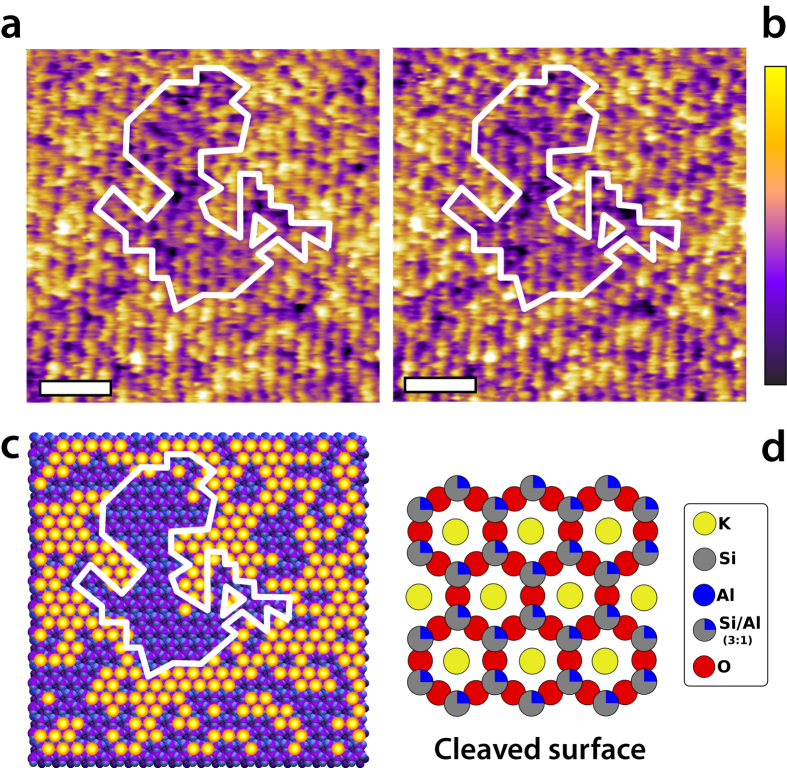
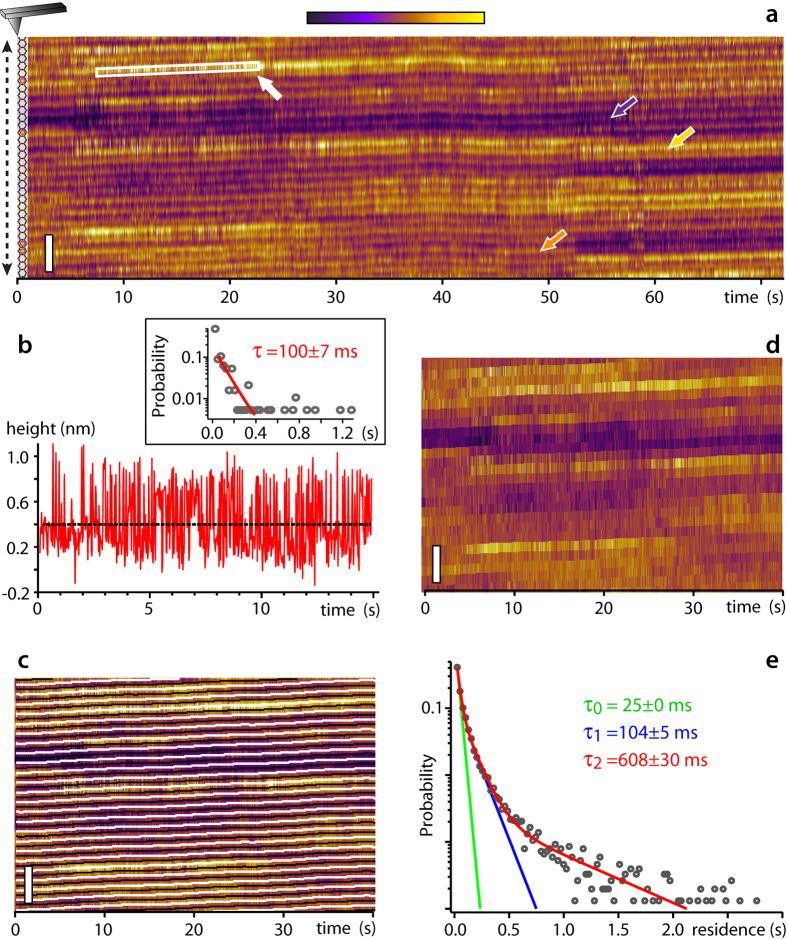
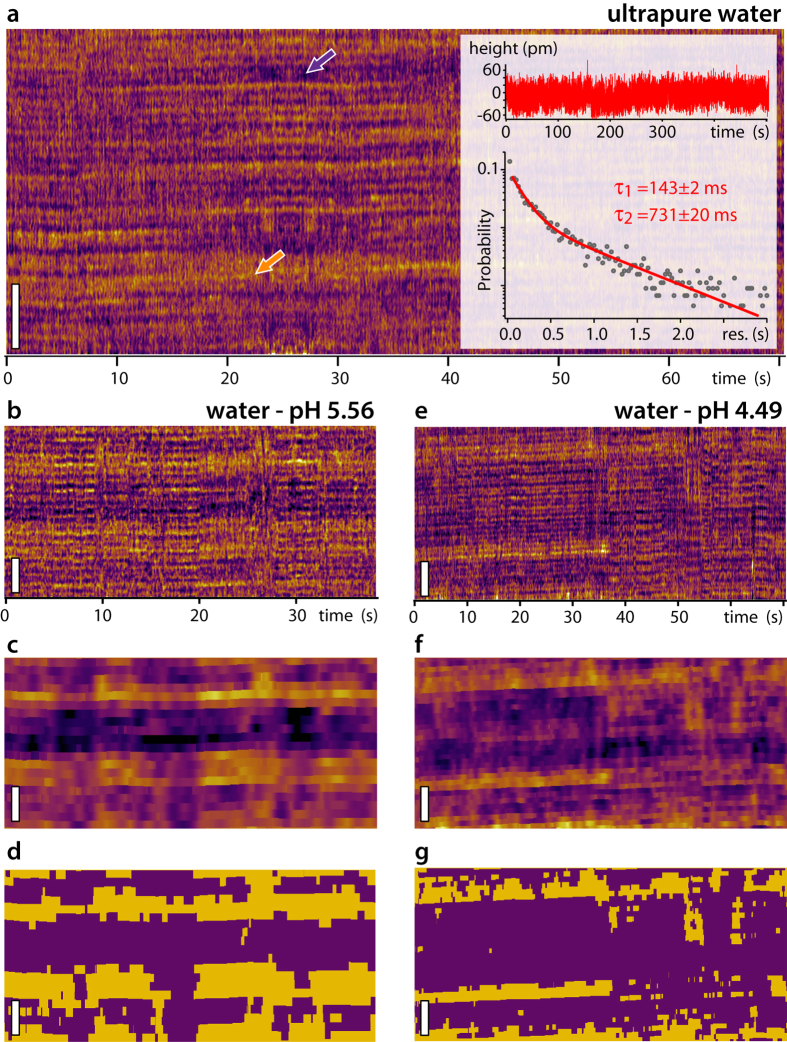
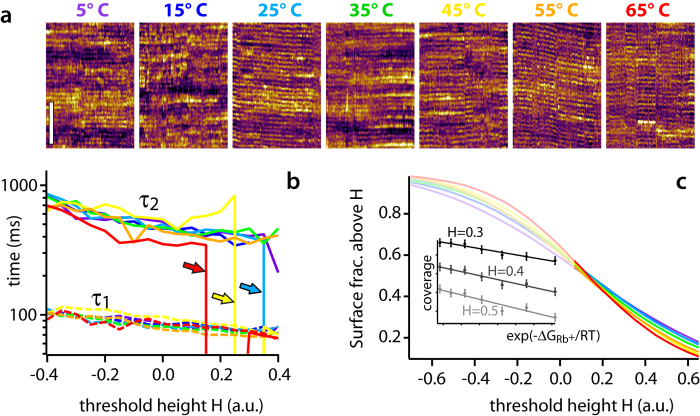
The dynamics of ions adsorbed at the surface of immersed charged solids plays a central role in countless natural and industrial processes such as crystal growth, heterogeneous catalysis, electrochemistry, or biological function. Electrokinetic measurements typically distinguish between a so-called Stern layer of ions and water molecules directly adsorbed on to the solid’s surface, and a diffuse layer of ions further away from the surface. Dynamics within the Stern layer remain poorly understood, largely owing to a lack of in-situ atomic-level insights. Here we follow the dynamics of single Rb+ and H 3 O+ ions at the surface of mica in water using high-resolution atomic force microscopy with 25 ms resolution. Our results suggest that single hydrated Rb+ions reside τ 1 = 104 ± 5 ms at a given location, but this is dependent on the hydration state of the surface which evolves on a slower timescale of τ 2 = 610 ± 30 ms depending on H 3 O+ adsorption. Increasing the liquid’s temperature from 5 °C to 65 °C predictably decreases the apparent glassiness of the interfacial water, but no clear effect on the ions’ dynamics was observed, indicating a diffusion-dominated process. These timescales are remarkably slow for individual monovalent ions and could have important implications for interfacial processes in electrolytes.
Overview
The claims and statistics of this paper haven’t been checked yet.
Free: it reads the open-access text and checks the first 5 claims that cite a source we can check. Create a free account to check every claim.
Integrity signals
Registry
Cites
Statistics
Figures
Verification
Claims the paper makes
The claims and statistics of this paper haven’t been checked yet.
Free: it reads the open-access text and checks the first 5 claims that cite a source we can check. Create a free account to check every claim.
Claims other papers make about this one
Each is checked against this paper’s own text: does it say what the citing paper says it does?
The source backs part of the claim, not all of it — or backs it for a different population, condition or comparison.
In the citing paper
“Adsorbed K + and Rb + ions tend to form small domains due to watermediated attractive lateral interactions when at the interface, 23,24 inducing near-uniform looking layer in 5 mM RbCl 24 and ordered longitudinal domains in KCl at the same concentration.”
From Lubricating properties of single metal ions at interfaces (2018) · cites this paper as [23]
Experimental — accuracy not yet measuredThe source backs part of the claim, not all of it — or backs it for a different population, condition or comparison.
In the citing paper
“When under nano-confinement, the diffusion of the water molecules decreases dramatically.23,65”
From Lubricating properties of single metal ions at interfaces (2018) · cites this paper as [23]
Experimental — accuracy not yet measuredThe source backs part of the claim, not all of it — or backs it for a different population, condition or comparison.
In the citing paper
“In this framework, the relaxation timescale is related to reorientation dynamics of the confined water molecules when forming hydrogen bonds, preferentially parallel and perpendicular to the shearing direction.23”
From Lubricating properties of single metal ions at interfaces (2018) · cites this paper as [23]
Experimental — accuracy not yet measuredThe cited source says what the claim attributes to it.
In the citing paper
“Ions do not necessarily arrange randomly at the surface of solids, but instead can form organised nanoscale clusters through water-mediated correlations, 24 and with millisecond dynamics at the single ion level.23,53”
From Lubricating properties of single metal ions at interfaces (2018) · cites this paper as [23]
The cited source says what the claim attributes to it.
In the citing paper
“The ions move through a thermally activated process, 23 here enhanced by the shearing tip that effectively 'pulls' ions to adjacent sites (Fig. 2e).”
From Lubricating properties of single metal ions at interfaces (2018) · cites this paper as [23]
2 more claims about this paper
Create a free account to see every claim other papers make about this one.
Self-check
Percentages, sums and reported differences re-computed from the paper’s own numbers.
The self-check needs the paper’s full text.
Citations
Cites
Ab initio study of lithium intercalation in metal oxides and metal dichalcogenides
Aydinol, M. K., Kohan, A. F., Ceder, G., Cho, K., & Joannopoulos, J. (1997) · Physical Review B · doi:10.1103/physrevb.56.1354 · Cited by 1,388
Hydration and mobility of ions in solution
Impey, R. W., Madden, P. A., & McDonald, I. R. (1983) · The Journal of Physical Chemistry · doi:10.1021/j150643a008 · Cited by 983
Solvent Structure, Dynamics, and Ion Mobility in Aqueous Solutions at 25 °C
Koneshan, S., Rasaiah, J. C., Lynden-Bell, R. M., & Lee, S. H. (1998) · The Journal of Physical Chemistry B · doi:10.1021/jp980642x · Cited by 965
Pashley, R. M. (1981) · Journal of Colloid and Interface Science · doi:10.1016/0021-9797(81)90348-9 · Cited by 958
Pressure and temperature dependence of self-diffusion in water
Krynicki, K., Green, C. D., & Sawyer, D. W. (1978) · Faraday Discussions of the Chemical Society · doi:10.1039/dc9786600199 · Cited by 740
Cooperativity in Ion Hydration
Tielrooij, K. J., Garcia-Araez, N., Bonn, M., & Bakker, H. J. (2010) · Science · doi:10.1126/science.1183512 · Cited by 685
Power Generation by Pressure-Driven Transport of Ions in Nanofluidic Channels
van der Heyden, F. H. J., Bonthuis, D. J., Stein, D., Meyer, C., & Dekker, C. (2007) · Nano Letters · doi:10.1021/nl070194h · Cited by 586
Proton Transfer Pathways in Bacteriorhodopsin at 2.3 Angstrom Resolution
Luecke, H., Richter, H.-T., & Lanyi, J. K. (1998) · Science · doi:10.1126/science.280.5371.1934 · Cited by 576
Combination of Lightweight Elements and Nanostructured Materials for Batteries
Chen, J., & Cheng, F. (2009) · Accounts of Chemical Research · doi:10.1021/ar800229g · Cited by 502
Probing the surfaces of heterogeneous catalysts by in situ IR spectroscopy
Lamberti, C., Zecchina, A., Groppo, E., & Bordiga, S. (2010) · Chemical Society Reviews · doi:10.1039/c0cs00117a · Cited by 491
Research works printed but not linked: 2
- Bard A. J. & Faulkner L. R. Electrochem. Methods. (Wiley, 2002).
- Aroti A., Leontidis E., Dubois M. & Zemb T. Effects of Monovalent Anions of the Hofmeister Series on DPPC Lipid Bilayers Part I: Swelling and In-Plane Equations of State. Biophys. J. 93, 1580– 1590 (2007). 17496051 PMC1948043 · DOI
Cited by
Atomic- and Molecular-Resolution Mapping of Solid–Liquid Interfaces by 3D Atomic Force Microscopy
Fukuma, T., & Garcia, R. (2018) · ACS Nano · doi:10.1021/acsnano.8b07216 · Cited by 198
Emerging CO2 utilization technologies for construction materials: A review
Li, N., Mo, L., & Unluer, C. (2022) · Journal of CO2 Utilization · doi:10.1016/j.jcou.2022.102237 · Cited by 175
Atomically thin micas as proton-conducting membranes
Mogg, L., Hao, G., Zhang, S., Bacaksız, C., Zou, Y., Haigh, S. J., Peeters, F. M., Geim, A. K., & Lozada-Hidalgo, M. (2019) · Nature Nanotechnology · doi:10.1038/s41565-019-0536-5 · Cited by 95
Measuring surface charge: Why experimental characterization and molecular modeling should be coupled
Hartkamp, R., Biance, A., Fu, L., Dufrêche, J., Bonhomme, O., & Joly, L. (2018) · Current Opinion in Colloid & Interface Science · doi:10.1016/j.cocis.2018.08.001 · Cited by 84
“rfacial fluid structure. Following huge improvement of AFM resolution, it became possible to probe the structure of the interface [57–59], and even the residence time of single ions in the Stern layer [60, 61]. Radically dierent approaches also focused on the determination of ion repartition at interfaces using transpo…”
BackgroundIon-Specific and pH-Dependent Hydration of Mica–Electrolyte Interfaces
van Lin, S. R., Grotz, K. K., Siretanu, I., Schwierz, N., & Mugele, F. (2019) · Langmuir · doi:10.1021/acs.langmuir.9b00520 · Cited by 79
Metadata
- Authors
- Ricci, M., Trewby, W., Cafolla, C., & Voïtchovsky, K.
- Affiliations
- University of Cambridge (GB)
- Durham University (GB)
- Venue
- Scientific Reports
- Published
- 2017-02-23
- Volume
- 7
- Issue
- 1
- Pages
- 43234-43234
- ISSN
- 2045-2322 (ISSN-L)
- PMC
- PMC5322364
- OpenAlex
- W2589971676
- Cited by
- 61
- References
- 103
- Citations by year
- 2026: 4 · 2025: 2 · 2024: 9 · 2023: 8 · 2022: 4 · 2021: 7 · 2020: 6 · 2019: 7 · 2018: 9 · 2017: 5
- FWCI
- 5.43
- Type
- journal article
- Language
- en
- Open access
- gold
- doi.org
- Licence
- cc-by
- creativecommons.org/licenses/by/4.0 (tdm)
- creativecommons.org/licenses/by/4.0 (vor)
- Locations
- Scientific Reports (publishedVersion, cc-by)
- PubMed Central (publishedVersion, cc-by)
- PubMed (publishedVersion)
- Durham Research Online (Durham University) (acceptedVersion, cc-by)
- Durham Research Online (Durham University) (submittedVersion, cc-by)
- Funders
- National Science Foundation
- Durham University
- Schweizerischer Nationalfonds zur Förderung der Wissenschaftlichen Forschung
- Engineering and Physical Sciences Research Council (1788302, 1452230)
- Topics
- Physical Sciences › Chemistry › Physical and Theoretical Chemistry › Electrostatics and Colloid Interactions
- Life Sciences › Biochemistry, Genetics and Molecular Biology › Biophysics › Chemical and Physical Studies
- Physical Sciences › Physics and Astronomy › Atomic and Molecular Physics, and Optics › Spectroscopy and Quantum Chemical Studies
- Keywords
- Stern layer, hydrated ions, rubidium ions, hydronium ion, mica surface, interfacial water, ion adsorption, hydration status, temperature dependence, in situ atomic force microscopy
About these checks
Registry, retraction, Cites and statistics results are computed, not judged, with one exception: a printed reference that no index lists is read once by a model before it counts as a citation error. Claims are extracted by a model and kept only when their quote appears verbatim in the text; each cited source is then checked, with a model’s help, for whether it says what the claim relies on. Those verdicts can be wrong — read the claim’s quote and the cited source before relying on one.
Statistics and arithmetic are recomputed, not judged.
Confidence bands are shown only for fields calibrated on our annotated test set. None is calibrated yet, so no band is shown.
What counts as a claim ›How we measure confidence ›How we check this ›
Are you an author, or do you see a problem with this page? Request a review
How to cite
Cite CoChat for the checks on this page, and the paper for its own findings.
- This page
- CoChat. (2026). Citation check: Direct observation of the dynamics of single metal ions at the interface with solids in aqueous solutions. https://app.cochat.ai/papers/10.1038/srep43234
- The paper
- Ricci, M., Trewby, W., Cafolla, C., & Voïtchovsky, K. (2017). Direct observation of the dynamics of single metal ions at the interface with solids in aqueous solutions. Scientific Reports. https://doi.org/10.1038/srep43234
Data sources
Bibliographic data: Semantic Scholar, OpenAlex, Crossref.
Contains information from the Semantic Scholar Academic Graph Datasets, made available under the ODC Attribution License (ODC-BY 1.0).
Semantic Scholar’s data is described in: Kinney, R., et al. (2023). The Semantic Scholar Open Data Platform. arXiv:2301.10140.
