

Phenotypic and genotypic correlation between myopia and intelligence
Open accessThe DOI matches its Crossref record; 69 of the 72 references it cites were found in a registry or an index.
Abstract
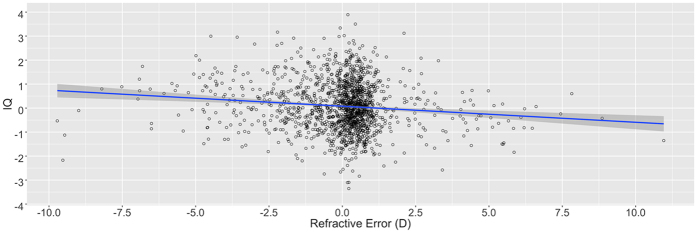
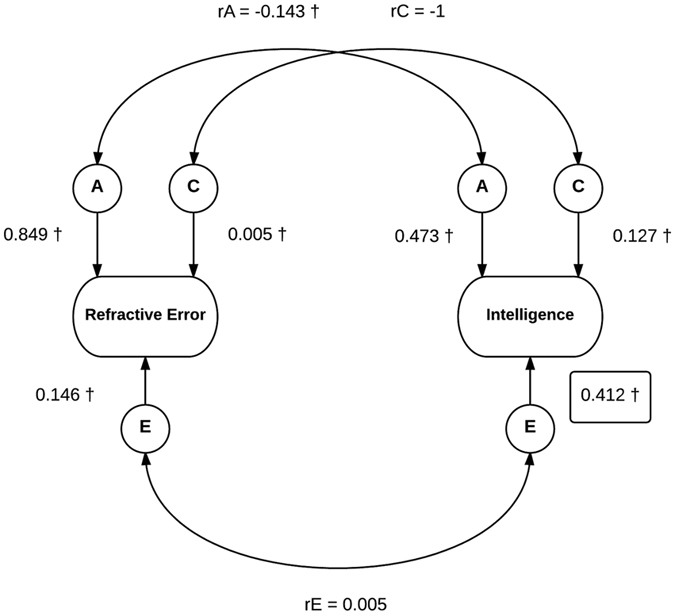
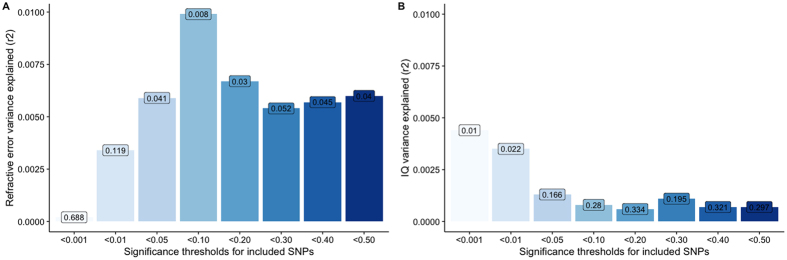
Myopia, or near-sightedness, is our most common eye condition and the prevalence is increasing globally. Visual impairment will occur if uncorrected, whilst high myopia causes sight-threatening complications. Myopia is associated with higher intelligence. As both are heritable, we set out to examine whether there is a genetic correlation between myopia and intelligence in over 1,500 subjects (aged 14–18 years) from a twin birth cohort. The phenotypic correlation between refractive error and intelligence was −0.116 (p < 0.01) - the inverse correlation due to the fact that myopia is a negative refractive error. Bivariate twin modeling confirmed both traits were heritable (refractive error 85%, intelligence 47%) and the genetic correlation was −0.143 (95% CI −0.013 to −0.273). Of the small phenotypic correlation the majority (78%) was explained by genetic factors. Polygenic risk scores were constructed based on common genetic variants identified in previous genome-wide association studies of refractive error and intelligence. Genetic variants for intelligence and refractive error explain some of the reciprocal variance, suggesting genetic pleiotropy; in the best-fit model the polygenic score for intelligence explained 0.99% (p = 0.008) of refractive error variance. These novel findings indicate shared genetic factors contribute significantly to the covariance between myopia and intelligence.
Overview
The claims and statistics of this paper haven’t been checked yet.
Free: it reads the open-access text and checks the first 5 claims that cite a source we can check. Create a free account to check every claim.
Integrity signals
Registry
Cites
Statistics
Figures
Verification
Claims the paper makes
The claims and statistics of this paper haven’t been checked yet.
Free: it reads the open-access text and checks the first 5 claims that cite a source we can check. Create a free account to check every claim.
Self-check
Percentages, sums and reported differences re-computed from the paper’s own numbers.
The self-check needs the paper’s full text.
Citations
Cites
PLINK: a tool set for whole-genome association and population-based linkage analyses.
Purcell, S., Neale, B., Todd-Brown, K., Thomas, L., Ferreira, M. A. R., Bender, D., Maller, J., Sklar, P., de Bakker, P. I. W., Daly, M. J., et al. (2007) · The American Journal of Human Genetics · doi:10.1086/519795 · Cited by 34,089
Genetics of Food Intake Self-Regulation in Childhood: Literature Review and Research Opportunities
Faith, M. S., Carnell, S., & Kral, T. V. E. (2013) · Human Heredity · doi:10.1159/000353879 · Cited by 7,601
"General Intelligence," Objectively Determined and Measured
Spearman, C. (1904) · The American Journal of Psychology · doi:10.2307/1412107 · Cited by 6,207
(1998) · Cited by 4,172
Morgan, I. G., Ohno-Matsui, K., & Saw, S.-M. (2012) · The Lancet · doi:10.1016/s0140-6736(12)60272-4 · Cited by 1,871
Power and predictive accuracy of polygenic risk scores
Dudbridge, F. (2013) · PLoS Genetics · doi:10.1371/journal.pgen.1003348 · Cited by 1,509
Dolgin, E. (2015) · Nature · doi:10.1038/519276a · Cited by 967
Increased Prevalence of Myopia in the United States Between 1971-1972 and 1999-2004
Vitale, S. (2009) · Archives of Ophthalmology · doi:10.1001/archophthalmol.2009.303 · Cited by 906
Worldwide prevalence and risk factors for myopia
Pan, C., Ramamurthy, D., & Saw, S. (2012) · Ophthalmic and Physiological Optics · doi:10.1111/j.1475-1313.2011.00884.x · Cited by 899
(2002) · PubMed · Cited by 735
Research works printed but not linked: 2
- Plomin, R., DeFries, J. C., Knopik, V. S. & Neiderhiser, J. M. Behavioral Genetics.6h Edition edn, (Worth Publishers, 2013).
- McFadden, S. A. Partial occlusion produces local form deprivation myopia in the guinea pig eye. Investigative ophthalmology & visual science 43, U34–U34 (2002).
Cited by
The new genetics of intelligence
Plomin, R., & von Stumm, S. (2018) · Nature Reviews Genetics · doi:10.1038/nrg.2017.104 · Cited by 483
Morgan, I. G., Wu, P.-C., Ostrin, L. A., Tideman, J. W. L., Yam, J. C., Lan, W., Baraas, R. C., He, X., Sankaridurg, P., Saw, S.-M., et al. (2021) · Investigative Opthalmology & Visual Science · doi:10.1167/iovs.62.5.3 · Cited by 460
Education and myopia: assessing the direction of causality by mendelian randomisation
Mountjoy, E., Davies, N. M., Plotnikov, D., Smith, G. D., Rodriguez, S., Williams, C. E., Guggenheim, J. A., & Atan, D. (2018) · BMJ · doi:10.1136/bmj.k2022 · Cited by 299
Origins of Refractive Errors: Environmental and Genetic Factors
Harb, E. N., & Wildsoet, C. F. (2019) · Annual Review of Vision Science · doi:10.1146/annurev-vision-091718-015027 · Cited by 194
Interaction between lifestyle and genetic susceptibility in myopia: the Generation R study
Enthoven, C. A., Tideman, J. W. L., Polling, J. R., Tedja, M. S., Raat, H., Iglesias, A. I., Verhoeven, V. J. M., & Klaver, C. C. W. (2019) · European Journal of Epidemiology · doi:10.1007/s10654-019-00512-7 · Cited by 109
Metadata
- Authors
- Williams, K. M., Hysi, P. G., Yonova-Doing, E., Mahroo, O. A., Snieder, H., & Hammond, C. J.
- Affiliations
- St Thomas' Hospital (GB)
- University Medical Center Groningen (NL)
- Corresponding author
- Hammond, Christopher J.
- Venue
- Scientific Reports
- Published
- 2017-04-06
- Volume
- 7
- Issue
- 1
- Pages
- 45977-45977
- ISSN
- 2045-2322 (ISSN-L)
- PMC
- PMC5382686
- OpenAlex
- W2604373801
- Cited by
- 28
- References
- 72
- Citations by year
- 2025: 1 · 2024: 2 · 2023: 2 · 2022: 5 · 2021: 2 · 2020: 3 · 2019: 9 · 2018: 3 · 2017: 1
- FWCI
- 3.43
- Type
- journal article
- Language
- en
- Open access
- gold
- doi.org
- Licence
- cc-by
- creativecommons.org/licenses/by/4.0 (tdm)
- creativecommons.org/licenses/by/4.0 (vor)
- Locations
- Scientific Reports (publishedVersion, cc-by)
- PubMed Central (publishedVersion, cc-by)
- PubMed (publishedVersion)
- UCL Discovery (University College London) (submittedVersion)
- Research Portal (King's College London) (submittedVersion, cc-by)
- University of Groningen research database (University of Groningen / Centre for Information Technology) (submittedVersion, cc-by)
- Funders
- National Institute for Health and Care Research (CL-2011-17-501)
- European Commission (295366, 602768)
- Moorfields Eye Hospital NHS Foundation Trust
- National Institutes of Health (G0901245, AG046903, 602768, MR/M021475/1)
- Medical Research Council (MR/K023721/1, G0901245, G19/2, MR/M021475, MR/M021475/1, 602768, 295366)
- Eunice Kennedy Shriver National Institute of Child Health and Human Development (R01HD044454)
- Topics
- Health Sciences › Medicine › Ophthalmology › Ophthalmology and Visual Impairment Studies
- Life Sciences › Biochemistry, Genetics and Molecular Biology › Genetics › Genetic Associations and Epidemiology
- Social Sciences › Psychology › Experimental and Cognitive Psychology › Cognitive Abilities and Testing
- Keywords
- myopia, intelligence, refractive error, genetic correlation, heritability, polygenic risk score, pleiotropy, shared genes
- MeSH terms
- Adolescent, Female, Humans, Intelligence, Male, Myopia, Refractive Errors, Risk Factors, Twins, Genome, Human, Linear Models, Multifactorial Inheritance, Genetic Association Studies
About these checks
Registry, retraction, Cites and statistics results are computed, not judged, with one exception: a printed reference that no index lists is read once by a model before it counts as a citation error. Claims are extracted by a model and kept only when their quote appears verbatim in the text; each cited source is then checked, with a model’s help, for whether it says what the claim relies on. Those verdicts can be wrong — read the claim’s quote and the cited source before relying on one.
Statistics and arithmetic are recomputed, not judged.
Confidence bands are shown only for fields calibrated on our annotated test set. None is calibrated yet, so no band is shown.
What counts as a claim ›How we measure confidence ›How we check this ›
Are you an author, or do you see a problem with this page? Request a review
How to cite
Cite CoChat for the checks on this page, and the paper for its own findings.
- This page
- CoChat. (2026). Citation check: Phenotypic and genotypic correlation between myopia and intelligence. https://app.cochat.ai/papers/10.1038/srep45977
- The paper
- Williams, K. M., Hysi, P. G., Yonova-Doing, E., Mahroo, O. A., Snieder, H., & Hammond, C. J. (2017). Phenotypic and genotypic correlation between myopia and intelligence. Scientific Reports. https://doi.org/10.1038/srep45977
Data sources
Bibliographic data: Semantic Scholar, OpenAlex, Crossref.
Contains information from the Semantic Scholar Academic Graph Datasets, made available under the ODC Attribution License (ODC-BY 1.0).
Semantic Scholar’s data is described in: Kinney, R., et al. (2023). The Semantic Scholar Open Data Platform. arXiv:2301.10140.
