

Phenotypic and genotypic correlation between myopia and intelligence
Open accessThe DOI matches its Crossref record; 69 of the 72 references it cites were found in a registry or an index.
Abstract
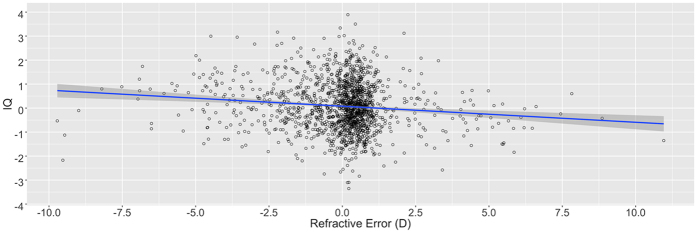
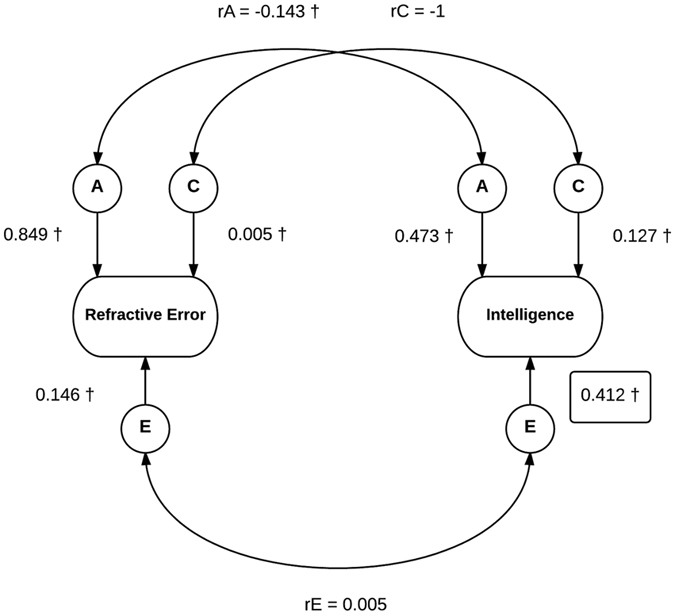
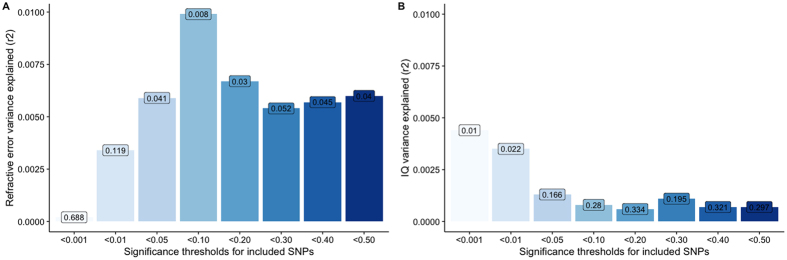
Myopia, or near-sightedness, is our most common eye condition and the prevalence is increasing globally. Visual impairment will occur if uncorrected, whilst high myopia causes sight-threatening complications. Myopia is associated with higher intelligence. As both are heritable, we set out to examine whether there is a genetic correlation between myopia and intelligence in over 1,500 subjects (aged 14–18 years) from a twin birth cohort. The phenotypic correlation between refractive error and intelligence was −0.116 (p < 0.01) - the inverse correlation due to the fact that myopia is a negative refractive error. Bivariate twin modeling confirmed both traits were heritable (refractive error 85%, intelligence 47%) and the genetic correlation was −0.143 (95% CI −0.013 to −0.273). Of the small phenotypic correlation the majority (78%) was explained by genetic factors. Polygenic risk scores were constructed based on common genetic variants identified in previous genome-wide association studies of refractive error and intelligence. Genetic variants for intelligence and refractive error explain some of the reciprocal variance, suggesting genetic pleiotropy; in the best-fit model the polygenic score for intelligence explained 0.99% (p = 0.008) of refractive error variance. These novel findings indicate shared genetic factors contribute significantly to the covariance between myopia and intelligence.
Overview
The claims and statistics of this paper haven’t been checked yet.
Free: it reads the open-access text and checks the first 5 claims that cite a source we can check. Create a free account to check every claim.
Integrity signals
Registry
Cites
Statistics
Figures
Verification
Claims the paper makes
The claims and statistics of this paper haven’t been checked yet.
Free: it reads the open-access text and checks the first 5 claims that cite a source we can check. Create a free account to check every claim.
Self-check
Percentages, sums and reported differences re-computed from the paper’s own numbers.
The self-check needs the paper’s full text.
Citations
Cites
PLINK: a tool set for whole-genome association and population-based linkage analyses.
Purcell, S., Neale, B., Todd-Brown, K., Thomas, L., Ferreira, M. A. R., Bender, D., Maller, J., Sklar, P., de Bakker, P. I. W., Daly, M. J., et al. (2007) · The American Journal of Human Genetics · doi:10.1086/519795 · Cited by 34,089
Genetics of Food Intake Self-Regulation in Childhood: Literature Review and Research Opportunities
Faith, M. S., Carnell, S., & Kral, T. V. E. (2013) · Human Heredity · doi:10.1159/000353879 · Cited by 7,601
"General Intelligence," Objectively Determined and Measured
Spearman, C. (1904) · The American Journal of Psychology · doi:10.2307/1412107 · Cited by 6,207
(1998) · Cited by 4,172
Morgan, I. G., Ohno-Matsui, K., & Saw, S.-M. (2012) · The Lancet · doi:10.1016/s0140-6736(12)60272-4 · Cited by 1,871
Power and predictive accuracy of polygenic risk scores
Dudbridge, F. (2013) · PLoS Genetics · doi:10.1371/journal.pgen.1003348 · Cited by 1,509
Dolgin, E. (2015) · Nature · doi:10.1038/519276a · Cited by 967
Increased Prevalence of Myopia in the United States Between 1971-1972 and 1999-2004
Vitale, S. (2009) · Archives of Ophthalmology · doi:10.1001/archophthalmol.2009.303 · Cited by 906
Worldwide prevalence and risk factors for myopia
Pan, C., Ramamurthy, D., & Saw, S. (2012) · Ophthalmic and Physiological Optics · doi:10.1111/j.1475-1313.2011.00884.x · Cited by 899
(2002) · PubMed · Cited by 735
Genetics and intelligence differences: five special findings
Plomin, R., & Deary, I. J. (2015) · Molecular Psychiatry · doi:10.1038/mp.2014.105 · Cited by 702
Outdoor Activity during Class Recess Reduces Myopia Onset and Progression in School Children
Wu, P.-C., Tsai, C.-L., Wu, H.-L., Yang, Y.-H., & Kuo, H.-K. (2013) · Ophthalmology · doi:10.1016/j.ophtha.2012.11.009 · Cited by 688
Morgan, I., & Rose, K. (2005) · Progress in Retinal and Eye Research · doi:10.1016/j.preteyeres.2004.06.004 · Cited by 661
The heritability of general cognitive ability increases linearly from childhood to young adulthood
Haworth, C. M. A., Wright, M. J., Luciano, M., Martin, N. G., de Geus, E. J. C., van Beijsterveldt, C. E. M., Bartels, M., Posthuma, D., Boomsma, D. I., Davis, O. S. P., et al. (2010) · Molecular Psychiatry · doi:10.1038/mp.2009.55 · Cited by 617
Role of Near Work in Myopia: Findings in a Sample of Australian School Children
Ip, J. M., Saw, S.-M., Rose, K. A., Morgan, I. G., Kifley, A., Wang, J. J., & Mitchell, P. (2008) · Investigative Opthalmology & Visual Science · doi:10.1167/iovs.07-0804 · Cited by 595
Increasing Prevalence of Myopia in Europe and the Impact of Education
Williams, K. M., Bertelsen, G., Cumberland, P., Wolfram, C., Verhoeven, V. J. M., Anastasopoulos, E., Buitendijk, G. H. S., Cougnard-Grégoire, A., Creuzot-Garcher, C., Erke, M. G., et al. (2015) · Ophthalmology · doi:10.1016/j.ophtha.2015.03.018 · Cited by 496
Self-citationConsortium for Refractive Error and Myopia (CREAM), Verhoeven, V. J. M., The Diabetes Control and Complications Trial/Epidemiology of Diabetes Interventions and Complications (DCCT/EDIC) Research Group, Wellcome Trust Case Control Consortium 2 (WTCCC2), The Fuchs' Genetics Multi-Center Study Group, Hysi, P. G., Wojciechowski, R., Fan, Q., Guggenheim, J. A., Höhn, R., et al. (2013) · Nature Genetics · doi:10.1038/ng.2554 · Cited by 487
Self-citation(2002) · PubMed · Cited by 474
The Association between Time Spent Outdoors and Myopia in Children and Adolescents
Sherwin, J. C., Reacher, M. H., Keogh, R. H., Khawaja, A. P., Mackey, D. A., & Foster, P. J. (2012) · Ophthalmology · doi:10.1016/j.ophtha.2012.04.020 · Cited by 469
Genes and environment in refractive error: the twin eye study.
Hammond, C. J., Snieder, H., Gilbert, C. E., & Spector, T. D. (2001) · PubMed · Cited by 456
Self-citationInfant zygosity can be assigned by parental report questionnaire data
Price, T. S., Freeman, B., Craig, I., Petrill, S. A., Ebersole, L., & Plomin, R. (2000) · Twin Research (2000) · doi:10.1375/136905200320565391 · Cited by 397
Time outdoors and the prevention of myopia
French, A. N., Ashby, R. S., Morgan, I. G., & Rose, K. A. (2013) · Experimental Eye Research · doi:10.1016/j.exer.2013.04.018 · Cited by 395
Davies, G., Armstrong, N., Bis, J. C., Bressler, J., Chouraki, V, Giddaluru, S., Hofer, E., Ibrahim-Verbaas, C. A., Kirin, M., Lahti, J., et al. (2015) · Molecular Psychiatry · doi:10.1038/mp.2014.188 · Cited by 384
(2012) · Cited by 374
Davies, G., Marioni, R. E., Liewald, D. C., Hill, W. D., Hagenaars, S. P., Harris, S. E., Ritchie, S. J., Luciano, M., Fawns-Ritchie, C., Lyall, D., et al. (2016) · Molecular Psychiatry · doi:10.1038/mp.2016.45 · Cited by 373
Prediction of Juvenile-Onset Myopia
Zadnik, K., Sinnott, L. T., Cotter, S. A., Jones-Jordan, L. A., Kleinstein, R. N., Manny, R. E., Twelker, J. D., & Mutti, D. O. (2015) · JAMA Ophthalmology · doi:10.1001/jamaophthalmol.2015.0471 · Cited by 366
Genetic foundations of human intelligence
Deary, I. J., Johnson, W., & Houlihan, L. M. (2009) · Human Genetics · doi:10.1007/s00439-009-0655-4 · Cited by 365
Physiological correlates of extreme intellectual precocity
Benbow, C. P. (1986) · Neuropsychologia · doi:10.1016/0028-3932(86)90011-4 · Cited by 268
Haworth, C. M. A., Davis, O. S. P., & Plomin, R. (2013) · Twin Research and Human Genetics · doi:10.1017/thg.2012.91 · Cited by 259
Childhood intelligence is heritable, highly polygenic and associated with FNBP1L
Benyamin, B., Pourcain, B., Davis, O. S., Davies, G., Hansell, N. K., Brion, M.-J., Kirkpatrick, R. M., Cents, R. A. M., Franić, S., Miller, M. B., et al. (2014) · Molecular Psychiatry · doi:10.1038/mp.2012.184 · Cited by 255
Smith, E. L., Hung, L.-F., Huang, J., Blasdel, T. L., Humbird, T. L., & Bockhorst, K. H. (2010) · Investigative Opthalmology & Visual Science · doi:10.1167/iovs.09-4969 · Cited by 238
THE TRANSMISSION OF REFRACTIVE ERRORS WITHIN ESKIMO FAMILIES
Young, F. A., Leary, G. A., Baldwin, W. R., West, D. C., Box, R. A., Harris, E., & Johnson, C. (1969) · Optometry and Vision Science · doi:10.1097/00006324-196909000-00005 · Cited by 187
Mirshahi, A., Ponto, K. A., Hoehn, R., Zwiener, I., Zeller, T., Lackner, K., Beutel, M. E., & Pfeiffer, N. (2014) · Ophthalmology · doi:10.1016/j.ophtha.2014.04.017 · Cited by 183
Family history, near work, outdoor activity, and myopia in Singapore Chinese preschool children
Low, W., Dirani, M., Gazzard, G., Chan, Y.-H., Zhou, H.-J., Selvaraj, P., Au Eong, K.-G., Young, T. L., Mitchell, P., Wong, T.-Y., et al. (2010) · British Journal of Ophthalmology · doi:10.1136/bjo.2009.173187 · Cited by 173
Myopia Over the Lifecourse: Prevalence and Early Life Influences in the 1958 British Birth Cohort
Rahi, J. S., Cumberland, P. M., & Peckham, C. S. (2011) · Ophthalmology · doi:10.1016/j.ophtha.2010.09.025 · Cited by 170
Visual Activity before and after the Onset of Juvenile Myopia
Jones-Jordan, L. A., Mitchell, G. L., Cotter, S. A., Kleinstein, R. N., Manny, R. E., Mutti, D. O., Twelker, J. D., Sims, J. R., & Zadnik, K. (2011) · Investigative Opthalmology & Visual Science · doi:10.1167/iovs.09-4997 · Cited by 166
Intelligence, Education, and Myopia in Males
Rosner, M., & Belkin, M. (1987) · Archives of Ophthalmology · doi:10.1001/archopht.1987.01060110054030 · Cited by 158
IQ and the Association with Myopia in Children
Saw, S.-M., Tan, S.-B., Fung, D., Chia, K.-S., Koh, D., Tan, D. T. H., & Stone, R. A. (2004) · Investigative Opthalmology & Visual Science · doi:10.1167/iovs.03-1296 · Cited by 154
Lopes, M. C., Andrew, T., Carbonaro, F., Spector, T. D., & Hammond, C. J. (2009) · Investigative Opthalmology & Visual Science · doi:10.1167/iovs.08-2385 · Cited by 153
Self-citationPACELLA, R., McLellan, J. S., Grice, K., Bono, E. A. D., Wiggs, J. L., & Gwiazda, J. (1999) · Optometry and Vision Science · doi:10.1002/j.1538-9235.1999.tb05417.x · Cited by 147
Academic achievement, close up work parameters, and myopia in Singapore military conscripts
Saw, S.-M. (2001) · British Journal of Ophthalmology · doi:10.1136/bjo.85.7.855 · Cited by 142
Multivariate Genetic Analysis of Brain Structure in an Extended Twin Design
Posthuma, D., de Geus, E. J. C., Neale, M. C., Pol, H. E. H., Baaré, W. E. C., Kahn, R. S., & Boomsma, D. I. (2000) · Behavior Genetics · doi:10.1023/a:1026501501434 · Cited by 134
The Raising of Intelligence: A Selected History of Attempts to Raise Retarded Intelligence
Sternberg, R. J., & Spitz, H. H. (1988) · The American Journal of Psychology · doi:10.2307/1422800 · Cited by 108
Beyond a bigger brain: Multivariable structural brain imaging and intelligence
Ritchie, S. J., Booth, T., Valdés Hernández, M. D. C., Corley, J., Maniega, S. M., Gow, A. J., Royle, N. A., Pattie, A., Karama, S., Starr, J. M., et al. (2015) · Intelligence · doi:10.1016/j.intell.2015.05.001 · Cited by 106
Fan, Q., Guo, X., Tideman, J. W. L., Williams, K. M., Yazar, S., Hosseini, S. M., Howe, L. D., Pourcain, B. S., Evans, D. M., Timpson, N. J., et al. (2016) · Scientific Reports · doi:10.1038/srep25853 · Cited by 105
Self-citationCycloplegic autorefraction versus subjective refraction: the Tehran Eye Study
Hashemi, H., Khabazkhoob, M., Asharlous, A., Soroush, S., Yekta, A., Dadbin, N., & Fotouhi, A. (2015) · British Journal of Ophthalmology · doi:10.1136/bjophthalmol-2015-307871 · Cited by 99
DEGREE OF MYOPIA IN RELATION TO INTELLIGENCE AND EDUCATION LEVEL
Fuchs, I., Goldschmidt, E., & Teasdale, T. W. (1988) · The Lancet · doi:10.1016/s0140-6736(88)90880-x · Cited by 93
Brain size does not predict general cognitive ability within families
Schoenemann, P. T., Budinger, T. F., Sarich, V. M., & Wang, W. S.-Y. (2000) · Proceedings of the National Academy of Sciences · doi:10.1073/pnas.97.9.4932 · Cited by 91
Williams, C., Miller, L. L., Gazzard, G., & Saw, S. (2008) · British Journal of Ophthalmology · doi:10.1136/bjo.2007.128256 · Cited by 90
Snell, R. S., & Lemp, M. A. (1997) · Wiley eBooks · doi:10.1002/9781118690987 · Cited by 89
Influence of the myopia gene on brain development
KARLSSON, J. L. (1975) · Clinical Genetics · doi:10.1111/j.1399-0004.1975.tb01508.x · Cited by 85
Assessing the Genetic Predisposition of Education on Myopia: A Mendelian Randomization Study
Cuellar‐Partida, G., Lu, Y., Kho, P. F., Hewitt, A. W., Wichmann, H. ‐., Yazar, S., Stambolian, D., Bailey‐Wilson, J. E., Wojciechowski, R., Wang, J. J., et al. (2016) · Genetic Epidemiology · doi:10.1002/gepi.21936 · Cited by 79
The Role of Educational Attainment in Refraction: The Genes in Myopia (GEM) Twin Study
Dirani, M., Shekar, S. N., & Baird, P. N. (2008) · Investigative Ophthalmology & Visual Science · doi:10.1167/iovs.07-1123 · Cited by 72
Genetic relationship between giftedness and myopia
KARLSSON, J. L. (2009) · Hereditas · doi:10.1111/j.1601-5223.1973.tb01070.x · Cited by 63
Measuring Refraction in Adults in Epidemiological Studies
Krantz, E. M. (2010) · Archives of Ophthalmology · doi:10.1001/archophthalmol.2009.349 · Cited by 55
Evidence of Shared Genes in Refraction and Axial Length: The Genes in Myopia (GEM) Twin Study
Dirani, M., Shekar, S. N., & Baird, P. N. (2008) · Investigative Ophthalmology & Visual Science · doi:10.1167/iovs.07-1516 · Cited by 49
Storfer, M. (1999) · International Journal of Neuroscience · doi:10.3109/00207459908997465 · Cited by 48
REFRACTIVE STATE, INTELLIGENCE TEST SCORES, AND ACADEMIC ABILITY*
Grosvenor, T. (1970) · Optometry and Vision Science · doi:10.1097/00006324-197005000-00003 · Cited by 42
Myopia and intelligence:a pleiotropic relationship?
Cohn, S. J., Cohn, C. M. G., & Jensen, A. R. (1988) · Human Genetics · doi:10.1007/bf00451456 · Cited by 42
Gene Expression and Pathways Underlying Form Deprivation Myopia in the Guinea Pig Sclera
Srinivasalu, N., McFadden, S. A., Medcalf, C., Fuchs, L., Chung, J., Philip, G. K., Richardson, A. J., Riaz, M., & Baird, P. N. (2018) · Investigative Ophthalmology & Visual Science · doi:10.1167/iovs.16-21278 · Cited by 42
THE RELATIONSHIP BETWEEN REFRACTIVE STATE OF THE EYE AND INTELLIGENCE TEST SCORES
Hirsch, M. J. (1959) · Optometry and Vision Science · doi:10.1097/00006324-195901000-00003 · Cited by 39
REFRACTIVE ERROR, IQ AND READING ABILITY: A LOIUGITUDINAL STUDY FROM AGE SEVEN TO 11
Williams, S. M., Sanderson, G. F., Share, D. L., & Silva, P. A. (1988) · Developmental Medicine & Child Neurology · doi:10.1111/j.1469-8749.1988.tb14635.x · Cited by 36
READING, MEASURES OF INTELLIGENCE AND REFRACTIVE ERRORS
Young, F. A. (1963) · Optometry and Vision Science · doi:10.1097/00006324-196305000-00002 · Cited by 36
On the correlation of myopia and intelligence.
Miller, E. M. (1992) · PubMed · Cited by 35
Myopia and Cognitive Performance: Results From the Gutenberg Health Study
Mirshahi, A., Ponto, K. A., Laubert‐Reh, D., Rahm, B., Lackner, K. J., Binder, H., Pfeiffer, N., & Unterrainer, J. M. (2016) · Investigative Ophthalmology & Visual Science · doi:10.1167/iovs.16-19507 · Cited by 32
The association between schoolchildren intelligence and refractive error.
Akrami, A., Bakmohammadi, N., Seyedabadi, M., Nabipour, I., Mirzaei, Z., Farrokhi, S., & Assadi, M. (2012) · PubMed · Cited by 25
Mak, W., Kwan, M. W.-M., Cheng, T. S., Chan, K. H., Cheung, R. T. F., & Ho, S. (2006) · Medical Hypotheses · doi:10.1016/j.mehy.2005.11.037 · Cited by 24
MYOPIAS VERSUS NONMYOPES ??? A COMPARISON
Young, F. A. (1955) · American journal of optometry and archives of American Academy of Optometry · doi:10.1097/00006324-195504000-00003 · Cited by 13
THE RELATIONSHIP BETWEEN INTELLIGENCE AND THE REFRACTIVE STATE IN A SELECTED HIGH SCHOOL SAMPLE
Nadell, M. C., & Hirsch, M. J. (1958) · Optometry and Vision Science · doi:10.1097/00006324-195806000-00005 · Cited by 12
Research works printed but not linked: 2
- Plomin, R., DeFries, J. C., Knopik, V. S. & Neiderhiser, J. M. Behavioral Genetics.6h Edition edn, (Worth Publishers, 2013).
- McFadden, S. A. Partial occlusion produces local form deprivation myopia in the guinea pig eye. Investigative ophthalmology & visual science 43, U34–U34 (2002).
Cited by
The new genetics of intelligence
Plomin, R., & von Stumm, S. (2018) · Nature Reviews Genetics · doi:10.1038/nrg.2017.104 · Cited by 483
Morgan, I. G., Wu, P.-C., Ostrin, L. A., Tideman, J. W. L., Yam, J. C., Lan, W., Baraas, R. C., He, X., Sankaridurg, P., Saw, S.-M., et al. (2021) · Investigative Opthalmology & Visual Science · doi:10.1167/iovs.62.5.3 · Cited by 460
Education and myopia: assessing the direction of causality by mendelian randomisation
Mountjoy, E., Davies, N. M., Plotnikov, D., Smith, G. D., Rodriguez, S., Williams, C. E., Guggenheim, J. A., & Atan, D. (2018) · BMJ · doi:10.1136/bmj.k2022 · Cited by 299
Origins of Refractive Errors: Environmental and Genetic Factors
Harb, E. N., & Wildsoet, C. F. (2019) · Annual Review of Vision Science · doi:10.1146/annurev-vision-091718-015027 · Cited by 194
Interaction between lifestyle and genetic susceptibility in myopia: the Generation R study
Enthoven, C. A., Tideman, J. W. L., Polling, J. R., Tedja, M. S., Raat, H., Iglesias, A. I., Verhoeven, V. J. M., & Klaver, C. C. W. (2019) · European Journal of Epidemiology · doi:10.1007/s10654-019-00512-7 · Cited by 109
Metadata
- Authors
- Williams, K. M., Hysi, P. G., Yonova-Doing, E., Mahroo, O. A., Snieder, H., & Hammond, C. J.
- Affiliations
- St Thomas' Hospital (GB)
- University Medical Center Groningen (NL)
- Corresponding author
- Hammond, Christopher J.
- Venue
- Scientific Reports
- Published
- 2017-04-06
- Volume
- 7
- Issue
- 1
- Pages
- 45977-45977
- ISSN
- 2045-2322 (ISSN-L)
- PMC
- PMC5382686
- OpenAlex
- W2604373801
- Cited by
- 28
- References
- 72
- Citations by year
- 2025: 1 · 2024: 2 · 2023: 2 · 2022: 5 · 2021: 2 · 2020: 3 · 2019: 9 · 2018: 3 · 2017: 1
- FWCI
- 3.43
- Type
- journal article
- Language
- en
- Open access
- gold
- doi.org
- Licence
- cc-by
- creativecommons.org/licenses/by/4.0 (tdm)
- creativecommons.org/licenses/by/4.0 (vor)
- Locations
- Scientific Reports (publishedVersion, cc-by)
- PubMed Central (publishedVersion, cc-by)
- PubMed (publishedVersion)
- UCL Discovery (University College London) (submittedVersion)
- Research Portal (King's College London) (submittedVersion, cc-by)
- University of Groningen research database (University of Groningen / Centre for Information Technology) (submittedVersion, cc-by)
- Funders
- National Institute for Health and Care Research (CL-2011-17-501)
- European Commission (295366, 602768)
- Moorfields Eye Hospital NHS Foundation Trust
- National Institutes of Health (G0901245, AG046903, 602768, MR/M021475/1)
- Medical Research Council (MR/K023721/1, G0901245, G19/2, MR/M021475, MR/M021475/1, 602768, 295366)
- Eunice Kennedy Shriver National Institute of Child Health and Human Development (R01HD044454)
- Topics
- Health Sciences › Medicine › Ophthalmology › Ophthalmology and Visual Impairment Studies
- Life Sciences › Biochemistry, Genetics and Molecular Biology › Genetics › Genetic Associations and Epidemiology
- Social Sciences › Psychology › Experimental and Cognitive Psychology › Cognitive Abilities and Testing
- Keywords
- myopia, intelligence, refractive error, genetic correlation, heritability, polygenic risk score, pleiotropy, shared genes
- MeSH terms
- Adolescent, Female, Humans, Intelligence, Male, Myopia, Refractive Errors, Risk Factors, Twins, Genome, Human, Linear Models, Multifactorial Inheritance, Genetic Association Studies
About these checks
Registry, retraction, Cites and statistics results are computed, not judged, with one exception: a printed reference that no index lists is read once by a model before it counts as a citation error. Claims are extracted by a model and kept only when their quote appears verbatim in the text; each cited source is then checked, with a model’s help, for whether it says what the claim relies on. Those verdicts can be wrong — read the claim’s quote and the cited source before relying on one.
Statistics and arithmetic are recomputed, not judged.
Confidence bands are shown only for fields calibrated on our annotated test set. None is calibrated yet, so no band is shown.
What counts as a claim ›How we measure confidence ›How we check this ›
Are you an author, or do you see a problem with this page? Request a review
Data sources
Bibliographic data: Semantic Scholar, OpenAlex, Crossref.
Contains information from the Semantic Scholar Academic Graph Datasets, made available under the ODC Attribution License (ODC-BY 1.0).
Semantic Scholar’s data is described in: Kinney, R., et al. (2023). The Semantic Scholar Open Data Platform. arXiv:2301.10140.
