

The DOI matches its Crossref record; 37 of the 37 references it cites were found in a registry or an index.
Artificial light-harvesting n-type porphyrin for panchromatic organic photovoltaic devices
Open accessAbstract
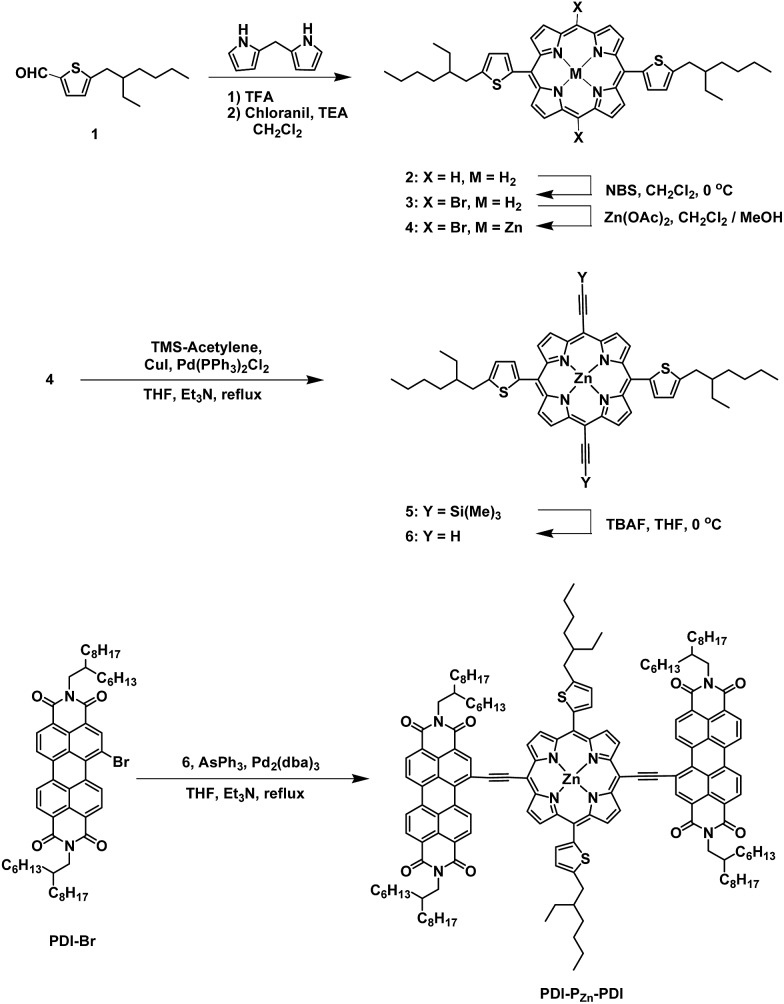
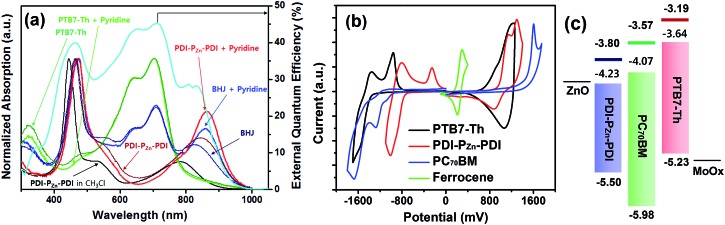
We developed a novel NIR-harvesting n-type porphyrin derivative, PDI–P Zn –PDI, that shows a low bandgap of 1.27 eV. Panchromatic absorption was extended to the NIR area with a significantly low energy loss of 0.54 eV which led to promising photovoltaic performance.
Overview
The claims and statistics of this paper haven’t been checked yet.
Run the check — free, no account needed. It reads the open-access text and checks the sources it cites.
Integrity signals
Registry
Cites
Statistics
Figures
Verification
Claims the paper makes
The claims and statistics of this paper haven’t been checked yet.
Run the check — free, no account needed. It reads the open-access text and checks the sources it cites.
Claims other papers make about this one
Each is checked against this paper’s own text: does it say what the citing paper says it does?
The source backs part of the claim, not all of it — or backs it for a different population, condition or comparison.
In the citing paper
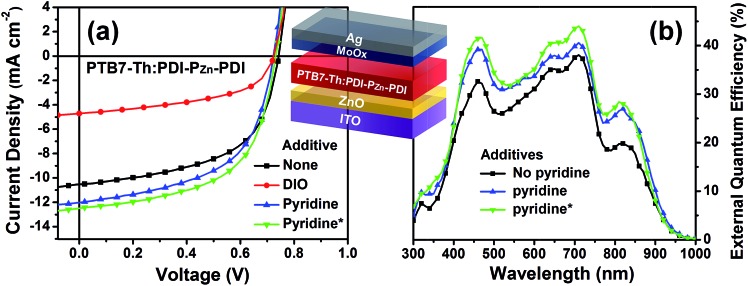
“The PTB7-Th: H5 device exhibited a PCE of 5.25% with a remarkably low E loss of 0.54 eV.”
From Recent progress in porphyrin-based materials for organic solar cells (2018) · cites this paper as [135]
Experimental — accuracy not yet measuredThe cited source says what the claim attributes to it.
In the citing paper
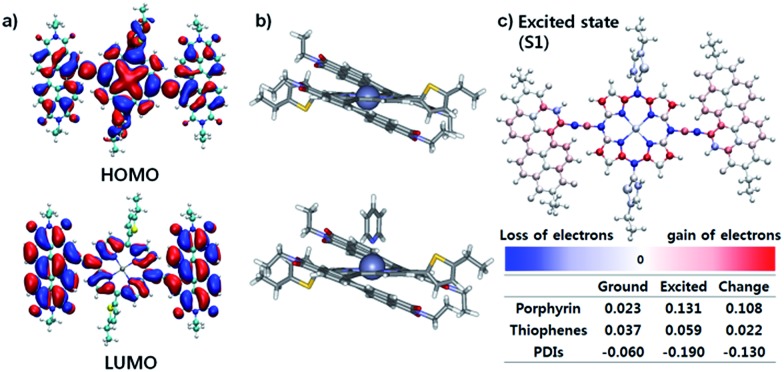
“A narrow band-gap of 1.27 eV and NIR-harvesting resulted from extended p -conjugation and intramolecular charge transfer between the strong electron-donating PZn core and the electron-accepting PDI wings.”
From Recent progress in porphyrin-based materials for organic solar cells (2018) · cites this paper as [135]
The check wasn’t confident either way, so it gives no verdict — never disputed.
In the citing paper
“The PCE of H5 is lower than that of H4 which contains four PDI groups.”
From Recent progress in porphyrin-based materials for organic solar cells (2018) · cites this paper as [135]
Experimental — accuracy not yet measured
Self-check
Percentages, sums and reported differences re-computed from the paper’s own numbers.
The self-check needs the paper’s full text.
Citations
Cites
A new hybrid exchange–correlation functional using the Coulomb-attenuating method (CAM-B3LYP)
Yanai, T., Tew, D. P., & Handy, N. C. (2004) · Chemical Physics Letters · doi:10.1016/j.cplett.2004.06.011 · Cited by 15,047
Mathew, S., Yella, A., Gao, P., Humphry-Baker, R., Curchod, B. F. E., Ashari-Astani, N., Tavernelli, I., Rothlisberger, U., Nazeeruddin, M. K., & Grätzel, M. (2014) · Nature Chemistry · doi:10.1038/nchem.1861 · Cited by 4,473
Advances in molecular quantum chemistry contained in the Q-Chem 4 program package
Shao, Y., Gan, Z., Epifanovsky, E., Gilbert, A. T. B., Wormit, M., Kußmann, J., Lange, A. W., Behn, A., Deng, J., Feng, X., et al. (2014) · Molecular Physics · doi:10.1080/00268976.2014.952696 · Cited by 3,007
Lessons from nature about solar light harvesting
Scholes, G. D., Fleming, G. R., Olaya-Castro, A., & van Grondelle, R. (2011) · Nature Chemistry · doi:10.1038/nchem.1145 · Cited by 1,915
Nonplanar porphyrins and their significance in proteins
Shelnutt, J. A., Song, X.-Z., Ma, J.-G., Jia, S., Jentzen, W., Medforth, C. J., & Medforth, C. J. (1998) · Chemical Society Reviews · doi:10.1039/a827031z · Cited by 831
Highly Conjugated, Acetylenyl Bridged Porphyrins: New Models for Light-Harvesting Antenna Systems
Lin, V. S. ‐., DiMagno, S. G., & Therien, M. J. (1994) · Science · doi:10.1126/science.8178169 · Cited by 694
Porphyrins as excellent dyes for dye-sensitized solar cells: recent developments and insights
Higashino, T., & Imahori, H. (2015) · Dalton Transactions · doi:10.1039/c4dt02756f · Cited by 582
Lou, S. J., Szarko, J. M., Xu, T., Yu, L., Marks, T. J., & Chen, L. X. (2011) · Journal of the American Chemical Society · doi:10.1021/ja2085564 · Cited by 548
Additives for morphology control in high-efficiency organic solar cells
Liao, H., Ho, C., Chang, C., Jao, M., Darling, S. B., & Su, W. (2013) · Materials Today · doi:10.1016/j.mattod.2013.08.013 · Cited by 545
Yella, A., Mai, C., Zakeeruddin, S. M., Chang, S., Hsieh, C., Yeh, C., & Grätzel, M. (2014) · Angewandte Chemie International Edition · doi:10.1002/anie.201309343 · Cited by 489
Cited by
Sorted by citations
Recent progress in porphyrin-based materials for organic solar cells
Mahmood, A., Hu, J.-Y., Xiao, B., Tang, A., Wang, X., & Zhou, E. (2018) · Journal of Materials Chemistry A · doi:10.1039/c8ta06392c · Cited by 311
Applications of porphyrins in emerging energy conversion technologies
Park, J. M., Lee, J. H., & Jang, W. (2019) · Coordination Chemistry Reviews · doi:10.1016/j.ccr.2019.213157 · Cited by 255
Self-citationXie, B., Chen, Z., Ying, L., Huang, F., & Cao, Y. (2019) · InfoMat · doi:10.1002/inf2.12063 · Cited by 151
Porphyrin-based supramolecular polymers
Lee, H., Park, H., Ryu, D. Y., & Jang, W. (2023) · Chemical Society Reviews · doi:10.1039/d2cs01066f · Cited by 118
Self-citationRecent progress in porphyrin- and phthalocyanine-containing perovskite solar cells
Matsuo, Y., Ogumi, K., Jeon, I., Wang, H., & Nakagawa, T. (2020) · RSC Advances · doi:10.1039/d0ra03234d · Cited by 80
Metadata
- Authors
- Hadmojo, W. T., Yim, D., Aqoma, H., Ryu, D. Y., Shin, T. J., Kim, H. W., Hwang, E., Jang, W.-D., Jung, I. H., & Jang, S.-Y.
- Affiliations
- Kookmin University (KR)
- Yonsei University (KR)
- Ulsan National Institute of Science and Technology (KR)
- Korea Research Institute of Chemical Technology (KR)
- Corresponding author
- Jang, Woo-Dong
- Jung, In Hwan
- Jang, Sung-Yeon
- ORCID
- Venue
- Chemical Science
- Publisher
- Royal Society of Chemistry (RSC)
- Published
- 2017
- Volume
- 8
- Issue
- 7
- Pages
- 5095-5100
- ISSN
- 2041-6520 (ISSN-L)
- 2041-6539
- PMC
- PMC5613227
- OpenAlex
- W2615045677
- Cited by
- 60
- References
- 37
- Citations by year
- 2026: 3 · 2025: 3 · 2024: 4 · 2023: 5 · 2022: 4 · 2021: 6 · 2020: 7 · 2019: 10 · 2018: 13 · 2017: 5
- FWCI
- 3.98
- Type
- journal article
- Language
- en
- Open access
- diamond
- doi.org
- Licence
- cc-by
- Locations
- Chemical Science (publishedVersion, cc-by)
- PubMed Central (publishedVersion, cc-by)
- PubMed (publishedVersion)
- Scholarworks@UNIST (Ulsan National Institute of Science and Technology) (submittedVersion)
- Funders
- National Research Foundation of Korea (2016M1A2A2940912, 2016R1A5A1012966, 2017R1C1B2010694, 2014R1A2A1A10051083)
- Korea Institute of Energy Technology Evaluation and Planning (20163030013960)
- Topics
- Physical Sciences › Engineering › Electrical and Electronic Engineering › Organic Electronics and Photovoltaics
- Physical Sciences › Materials Science › Materials Chemistry › Porphyrin and Phthalocyanine Chemistry
- Life Sciences › Biochemistry, Genetics and Molecular Biology › Cancer Research › Photodynamic Therapy Research Studies
- Keywords
- zinc porphyrin, artificial light harvesting, panchromatic absorption, near-infrared absorption, organic solar cells, low band gap, energy loss
About these checks
Registry, retraction, Cites and statistics results are computed, not judged, with one exception: a printed reference that no index lists is read once by a model before it counts as a citation error. Claims are extracted by a model and kept only when their quote appears verbatim in the text; each cited source is then checked, with a model’s help, for whether it says what the claim relies on. Those verdicts can be wrong — read the claim’s quote and the cited source before relying on one.
Statistics and arithmetic are recomputed, not judged.
Confidence bands are shown only for fields calibrated on our annotated test set. None is calibrated yet, so no band is shown.
What counts as a claim ›How we measure confidence ›How we check this ›
Are you an author, or do you see a problem with this page? Request a review
How to cite
Cite CoChat for the checks on this page, and the paper for its own findings.
- This page
- CoChat. (2026). Citation check: Artificial light-harvesting n-type porphyrin for panchromatic organic photovoltaic devices. https://app.cochat.ai/papers/10.1039/c7sc01275f
- The paper
- Hadmojo, W. T., Yim, D., Aqoma, H., Ryu, D. Y., Shin, T. J., Kim, H. W., Hwang, E., Jang, W.-D., Jung, I. H., & Jang, S.-Y. (2017). Artificial light-harvesting n-type porphyrin for panchromatic organic photovoltaic devices. Chemical Science. https://doi.org/10.1039/c7sc01275f
