

A new function for thermal phase transition-based polymer actuators: autonomous motion on a surface of constant temperature
Open accessThe DOI matches its Crossref record; 30 of the 30 references it cites were found in a registry or an index.
Abstract
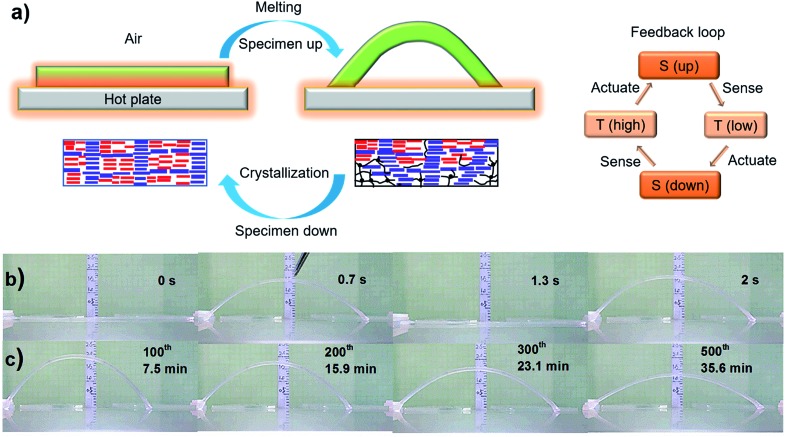
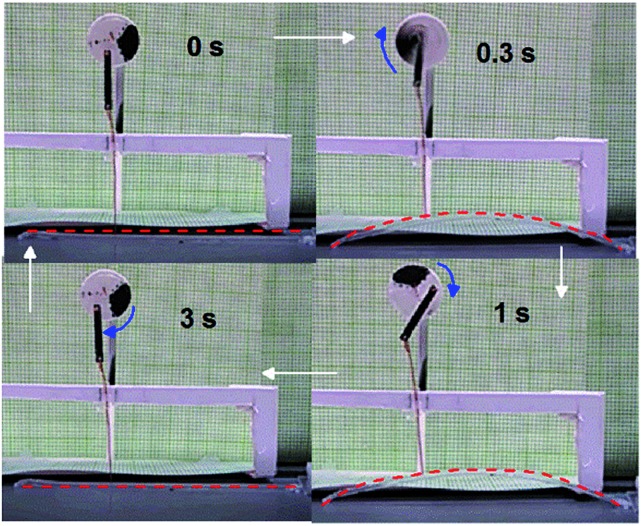
A thermo-mechano-thermal feedback loop allows solid polymer actuators to undergo hour-long, autonomous motion on a substrate surface of constant temperature.
Overview
The claims and statistics of this paper haven’t been checked yet.
Free: it reads the open-access text and checks the first 5 claims that cite a source we can check. Create a free account to check every claim.
Integrity signals
Registry
Cites
Statistics
Figures
Verification
Claims the paper makes
The claims and statistics of this paper haven’t been checked yet.
Free: it reads the open-access text and checks the first 5 claims that cite a source we can check. Create a free account to check every claim.
Self-check
Percentages, sums and reported differences re-computed from the paper’s own numbers.
The self-check needs the paper’s full text.
Citations
Cites
Design, fabrication and control of soft robots
Rus, D., & Tolley, M. T. (2015) · Nature · doi:10.1038/nature14543 · Cited by 5,825
Soft Actuators for Small-Scale Robotics
Hines, L., Petersen, K., Lum, G. Z., & Sitti, M. (2017) · Advanced Materials · doi:10.1002/adma.201603483 · Cited by 1,337
Photomobile Polymer Materials: Towards Light‐Driven Plastic Motors
Yamada, M., Kondo, M., Mamiya, J., Yu, Y., Kinoshita, M., Barrett, C. J., & Ikeda, T. (2008) · Angewandte Chemie International Edition · doi:10.1002/anie.200800760 · Cited by 1,047
Palagi, S., Mark, A. G., Reigh, S. Y., Melde, K., Qiu, T., Zeng, H., Parmeggiani, C., Martella, D., Sanchez-Castillo, A., Kapernaum, N., et al. (2016) · Nature Materials · doi:10.1038/nmat4569 · Cited by 977
Bio-Inspired Polymer Composite Actuator and Generator Driven by Water Gradients
Ma, M., Guo, L., Anderson, D. G., & Langer, R. (2013) · Science · doi:10.1126/science.1230262 · Cited by 849
Maeda, S., Hara, Y., Sakai, T., Yoshida, R., & Hashimoto, S. (2007) · Advanced Materials · doi:10.1002/adma.200700625 · Cited by 640
Photocontrollable Liquid‐Crystalline Actuators
Yu, H., & Ikeda, T. (2011) · Advanced Materials · doi:10.1002/adma.201100131 · Cited by 633
Autonomous Movement and Self-Assembly
Ismagilov, R. F., Schwartz, A., Bowden, N., & Whitesides, G. M. (2002) · Angewandte Chemie International Edition · doi:10.1002/1521-3773(20020215)41:4<652::aid-anie652>3.0.co;2-u · Cited by 601
Synthetic homeostatic materials with chemo-mechano-chemical self-regulation
He, X., Aizenberg, M., Kuksenok, O., Zarzar, L. D., Shastri, A., Balazs, A. C., & Aizenberg, J. (2012) · Nature · doi:10.1038/nature11223 · Cited by 524
Reversible bidirectional shape-memory polymers
Behl, M., Kratz, K., Zotzmann, J., Nöchel, U., & Lendlein, A. (2013) · Advanced Materials · doi:10.1002/adma.201300880 · Cited by 496
A high frequency photodriven polymer oscillator
White, T. J., Tabiryan, N. V., Serak, S. V., Hrozhyk, U. A., Tondiglia, V. P., Koerner, H., Vaia, R. A., & Bunning, T. J. (2008) · Soft Matter · doi:10.1039/b805434g · Cited by 470
A chaotic self-oscillating sunlight-driven polymer actuator
Kumar, K., Knie, C., Bléger, D., Peletier, M. A., Friedrich, H., Hecht, S., Broer, D. J., Debije, M. G., & Schenning, A. P. H. J. (2016) · Nature Communications · doi:10.1038/ncomms11975 · Cited by 440
An autonomous actuator driven by fluctuations in ambient humidity
Arazoe, H., Miyajima, D., Akaike, K., Araoka, F., Sato, E., Hikima, T., Kawamoto, M., & Aida, T. (2016) · Nature Materials · doi:10.1038/nmat4693 · Cited by 435
Self‐Oscillating Gels Driven by the Belousov–Zhabotinsky Reaction as Novel Smart Materials
Yoshida, R. (2010) · Advanced Materials · doi:10.1002/adma.200904075 · Cited by 427
Liquid crystalline polymer cantilever oscillators fueled by light
Serak, S., Tabiryan, N., Vergara, R., White, T. J., Vaia, R. A., & Bunning, T. J. (2010) · Soft Matter · doi:10.1039/b916831a · Cited by 385
Photoactuators and motors based on carbon nanotubes with selective chirality distributions
Zhang, X., Yu, Z., Wang, C., Zarrouk, D., Seo, J.-W. T., Cheng, J. C., Buchan, A. D., Takei, K., Zhao, Y., Ager, J. W., et al. (2014) · Nature Communications · doi:10.1038/ncomms3983 · Cited by 341
Self-citationTemperature-memory polymer actuators
Behl, M., Kratz, K., Noechel, U., Sauter, T., & Lendlein, A. (2013) · Proceedings of the National Academy of Sciences · doi:10.1073/pnas.1301895110 · Cited by 313
Photodriven, Flexural–Torsional Oscillation of Glassy Azobenzene Liquid Crystal Polymer Networks
Lee, K. M., Smith, M. L., Koerner, H., Tabiryan, N., Vaia, R. A., Bunning, T. J., & White, T. J. (2011) · Advanced Functional Materials · doi:10.1002/adfm.201100333 · Cited by 277
Light-induced crawling of crystals on a glass surface
Uchida, E., Azumi, R., & Norikane, Y. (2015) · Nature Communications · doi:10.1038/ncomms8310 · Cited by 267
Gelebart, A. H., Vantomme, G., Meijer, E. W., & Broer, D. J. (2017) · Advanced Materials · doi:10.1002/adma.201606712 · Cited by 265
Nanolocomotion—Catalytic Nanomotors and Nanorotors
Mirkovic, T., Zacharia, N. S., Scholes, G. D., & Ozin, G. A. (2010) · Small · doi:10.1002/smll.200901340 · Cited by 186
Light-Powered Tumbler Movement of Graphene Oxide/Polymer Nanocomposites
Yu, L., & Yu, H. (2015) · ACS Applied Materials & Interfaces · doi:10.1021/am508970k · Cited by 137
Reversible switching transitions of stimuli-responsive shape changing polymers
Meng, H., & Li, G. (2013) · Journal of Materials Chemistry A · doi:10.1039/c3ta10716g · Cited by 115
Self‐Powered Microscale Pumps Based on Analyte‐Initiated Depolymerization Reactions
Zhang, H., Yeung, K., Robbins, J. S., Pavlick, R. A., Wu, M., Liu, R., Sen, A., & Phillips, S. T. (2012) · Angewandte Chemie International Edition · doi:10.1002/anie.201107787 · Cited by 97
Ge, F., Lu, X., Xiang, J., Tong, X., & Zhao, Y. (2017) · Angewandte Chemie International Edition · doi:10.1002/anie.201612164 · Cited by 94
Self-citationDepolymerization-Powered Autonomous Motors Using Biocompatible Fuel
Zhang, H., Duan, W., Liu, L., & Sen, A. (2013) · Journal of the American Chemical Society · doi:10.1021/ja4089549 · Cited by 91
Self‐Oscillating Polymer Brushes
Masuda, T., Hidaka, M., Murase, Y., Akimoto, A. M., Nagase, K., Okano, T., & Yoshida, R. (2013) · Angewandte Chemie International Edition · doi:10.1002/anie.201301988 · Cited by 80
Li, B., Du, T., Yu, B., van der Gucht, J., & Zhou, F. (2015) · Small · doi:10.1002/smll.201500577 · Cited by 65
Ge, F., Lu, X., Xiang, J., Tong, X., & Zhao, Y. (2017) · Angewandte Chemie · doi:10.1002/ange.201612164 · Cited by 65
Self-citationRecent Advances in Self‐Oscillating Polymer Material Systems
Tamate, R., Akimoto, A. M., & Yoshida, R. (2016) · The Chemical Record · doi:10.1002/tcr.201600009 · Cited by 61
Research works printed but not linked: 2
- L. Hines , K.Petersen, G. Z.Lum and M.Sitti, Adv. Mater., 2017, 29, 1603483
- A. H. Gelebart , G.Vantomme, B. E.Meijer and D. J.Broer, Adv. Mater., 2017, 29, 1616712
Cited by
Carbon‐Based Photothermal Actuators
Han, B., Zhang, Y., Chen, Q., & Sun, H. (2018) · Advanced Functional Materials · doi:10.1002/adfm.201802235 · Cited by 522
Light-fuelled freestyle self-oscillators
Zeng, H., Lahikainen, M., Liu, L., Ahmed, Z., Wani, O. M., Wang, M., Yang, H., & Priimagi, A. (2019) · Nature Communications · doi:10.1038/s41467-019-13077-6 · Cited by 236
Two-Way and Multiple-Way Shape Memory Polymers for Soft Robotics: An Overview
Scalet, G. (2020) · Actuators · doi:10.3390/act9010010 · Cited by 209
Multiple and two-way reversible shape memory polymers: Design strategies and applications
Wang, K., Jia, Y.-G., Zhao, C., & Zhu, X. X. (2019) · Progress in Materials Science · doi:10.1016/j.pmatsci.2019.100572 · Cited by 208
Bio-inspired sensing and actuating materials
Zhao, Q., Wang, Y., Cui, H., & Du, X. (2019) · Journal of Materials Chemistry C · doi:10.1039/c9tc01483g · Cited by 152
Metadata
- Authors
- Ge, F., & Zhao, Y.
- Affiliations
- Université de Sherbrooke (CA)
- Corresponding author
- Zhao, Yue
- ORCID
- Venue
- Chemical Science
- Publisher
- Royal Society of Chemistry (RSC)
- Published
- 2017
- Volume
- 8
- Issue
- 9
- Pages
- 6307-6312
- ISSN
- 2041-6520 (ISSN-L)
- 2041-6539
- PMC
- PMC5628403
- OpenAlex
- W2734165412
- Cited by
- 52
- References
- 30
- Citations by year
- 2026: 3 · 2025: 5 · 2024: 1 · 2023: 3 · 2022: 7 · 2021: 5 · 2020: 11 · 2019: 10 · 2018: 7
- FWCI
- 5.95
- Type
- journal article
- Language
- en
- Open access
- diamond
- doi.org
- Licence
- cc-by
- Locations
- Chemical Science (publishedVersion, cc-by)
- PubMed Central (publishedVersion, cc-by)
- PubMed (publishedVersion)
- Funders
- Natural Sciences and Engineering Research Council of Canada
- Fonds de Recherche du Québec Nature et Technologies
- Topics
- Physical Sciences › Engineering › Mechanical Engineering › Advanced Materials and Mechanics
- Physical Sciences › Materials Science › Electronic, Optical and Magnetic Materials › Dielectric materials and actuators
- Physical Sciences › Materials Science › Polymers and Plastics › Polymer composites and self-healing
- Keywords
- temperature-induced phase transition, polymer actuators, autonomous motion
About these checks
Registry, retraction, Cites and statistics results are computed, not judged, with one exception: a printed reference that no index lists is read once by a model before it counts as a citation error. Claims are extracted by a model and kept only when their quote appears verbatim in the text; each cited source is then checked, with a model’s help, for whether it says what the claim relies on. Those verdicts can be wrong — read the claim’s quote and the cited source before relying on one.
Statistics and arithmetic are recomputed, not judged.
Confidence bands are shown only for fields calibrated on our annotated test set. None is calibrated yet, so no band is shown.
What counts as a claim ›How we measure confidence ›How we check this ›
Are you an author, or do you see a problem with this page? Request a review
Data sources
Bibliographic data: Semantic Scholar, OpenAlex, Crossref.
Contains information from the Semantic Scholar Academic Graph Datasets, made available under the ODC Attribution License (ODC-BY 1.0).
Semantic Scholar’s data is described in: Kinney, R., et al. (2023). The Semantic Scholar Open Data Platform. arXiv:2301.10140.
